Market Overview
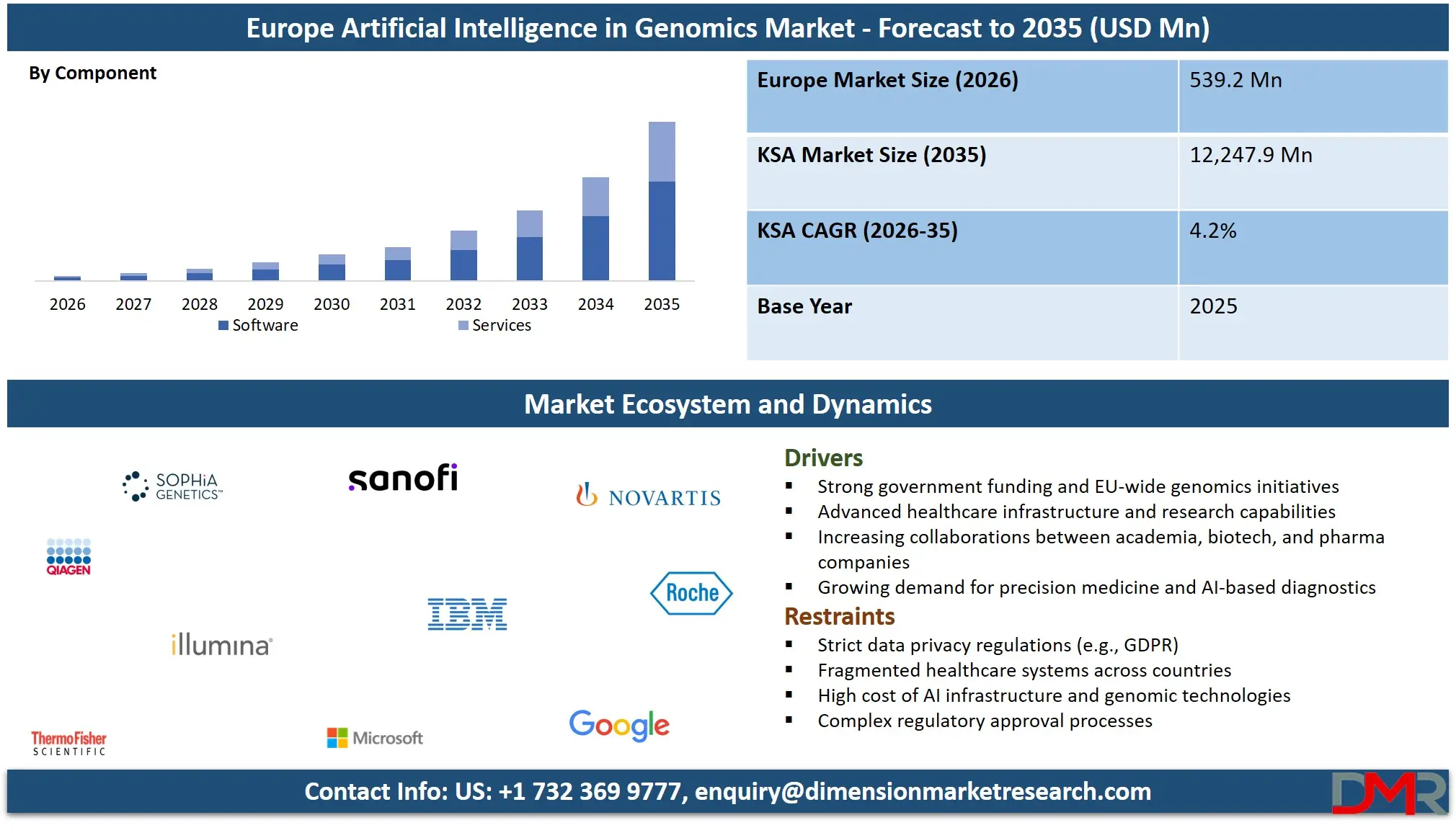
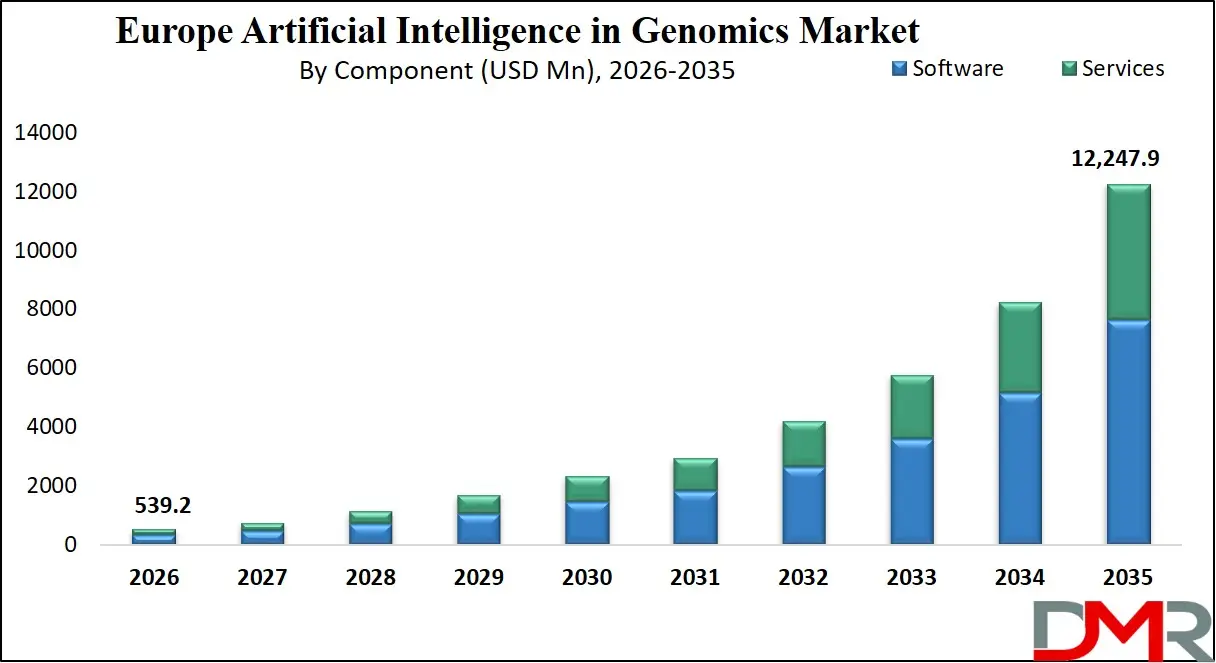
Europe Artificial Intelligence in Genomics Market size is projected to reach USD 539.2 million in 2026 and grow at a compound annual growth rate of 41.5% to reach a value of USD 12,247.9 million in 2035.
ℹ
To learn more about this report –
Download Your Free Sample Report Here
Artificial intelligence in genomics refers to the integration of advanced computational algorithms, including machine learning and data analytics, into genomic research and applications. It encompasses technologies that process vast genomic datasets to identify patterns, predict disease risks, and enable precision medicine. This domain includes software platforms, cloud-based analytics tools, and AI-driven sequencing systems that support research institutions, healthcare providers, and pharmaceutical companies. Its importance lies in accelerating genetic discovery, improving diagnostic accuracy, and reducing drug-development timelines across the broader life sciences ecosystem.
The European landscape is witnessing rapid transformation due to the increasing availability of genomic data and advancements in computational biology. The convergence of high-throughput sequencing technologies with AI capabilities is enabling more efficient interpretation of complex genetic information. Emerging shifts include the adoption of federated data systems for secure data sharing, integration of AI in clinical workflows, and growing use of predictive analytics in disease prevention. These changes are strengthening the region’s position in global genomics innovation.
ℹ
To learn more about this report –
Download Your Free Sample Report Here
Growth is being shaped by strong public funding, supportive regulatory frameworks, and rising demand for personalized healthcare solutions. Milestones such as national genome projects, cross-border collaborations, and AI-enabled diagnostics are contributing to market maturity. Increasing partnerships between research institutes and technology providers are also accelerating commercialization and real-world adoption.
Europe Artificial Intelligence in Genomics Market: Key Takeaways
- Market Growth: Europe Artificial Intelligence in Genomics Market size is expected to grow by USD 11,507.4 million, at a CAGR of 41.5%, during the forecasted period of 2027 to 2035.
- By Component: The software segment is anticipated to get the majority share of the Europe Artificial Intelligence in Genomics market in 2026.
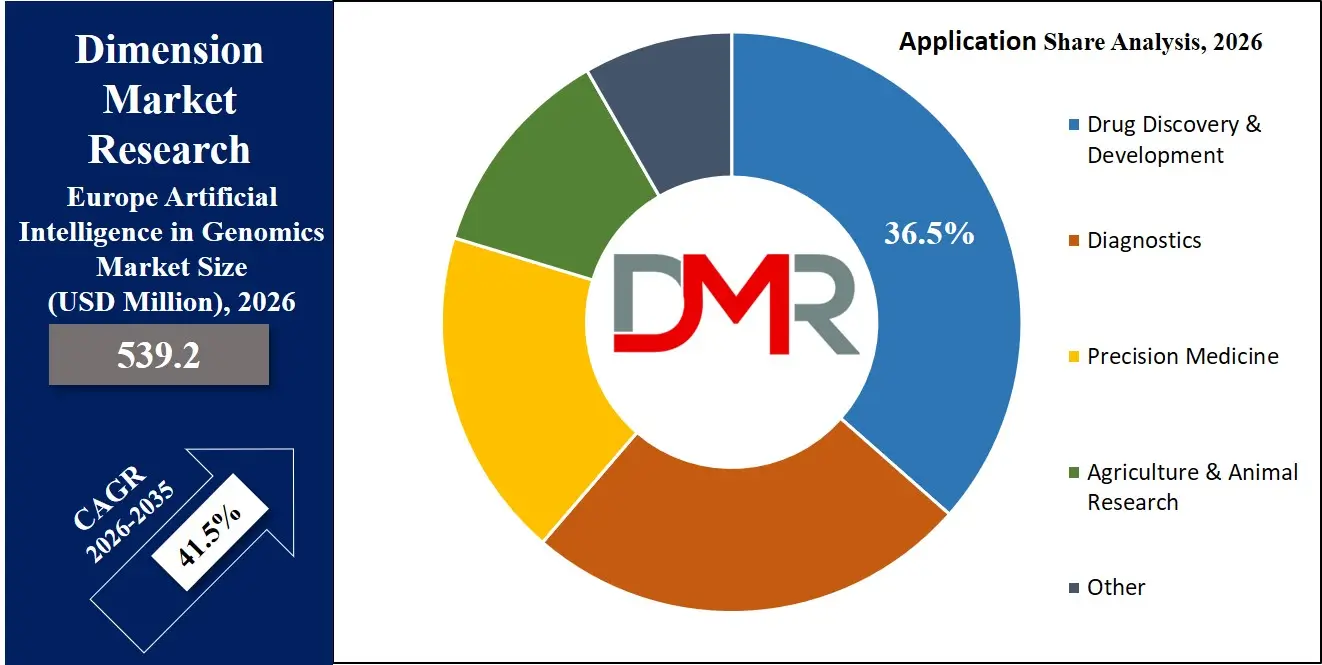
- By Application: The drug discovery & development segment is expected to get the largest revenue share in 2026 in the Europe Artificial Intelligence in Genomics market.
- Use Cases: Some of the use cases of artificial intelligence in genomics include precision medicine, clinical diagnostics, and more.
Europe Artificial Intelligence in Genomics Market: Use Cases
- Precision Medicine: AI enables tailored treatment plans by analyzing patient-specific genomic data, improving outcomes in chronic and rare diseases. It supports clinicians in identifying targeted therapies with higher accuracy and efficiency.
- Drug Discovery: AI models analyze genetic variations to identify potential drug targets, significantly reducing research timelines. Pharmaceutical firms use these insights to accelerate early-stage drug development.
- Disease Risk Prediction: Predictive algorithms assess genetic predisposition to diseases such as cancer or cardiovascular conditions. This allows early intervention and preventive healthcare strategies.
- Clinical Diagnostics: AI enhances the interpretation of genomic tests, enabling faster and more accurate diagnoses. It reduces manual analysis time and improves diagnostic reliability.
- Agricultural Genomics: AI supports crop and livestock genetic improvements by analyzing genomic traits, helping enhance yield, disease resistance, and sustainability.
- Gene Editing Optimization: AI assists in improving CRISPR-based gene editing by predicting off-target effects and optimizing editing precision.
- Population Genomics Research: Large-scale genomic studies leverage AI to uncover patterns across populations, aiding in public health planning and epidemiological insights.
Stats & Facts
- European Commission reported in 2025 that over €1 billion has been allocated to genomics and AI research under Horizon Europe initiatives.
- UK Government stated in 2024 that the national genomics program sequenced over 500,000 genomes for research and clinical use.
- Eurostat indicated in 2025 that healthcare R&D expenditure in the EU exceeded 2.3% of GDP.
- OECD reported in 2024 that AI adoption in European healthcare systems grew by 28% year-over-year.
- European Medicines Agency noted in 2025 that AI-supported drug evaluations increased by 35% compared to 2023.
- German Federal Ministry of Education and Research reported in 2024 that genomics research funding surpassed €600 million annually.
- French Ministry of Health stated in 2025 that precision medicine initiatives expanded to cover 80% of rare disease programs.
- European Bioinformatics Institute recorded in 2024 that genomic data volume doubled every 7 months.
- NHS England reported in 2025 that AI-assisted diagnostics improved genomic test turnaround time by 40%.
- Italian National Institute of Health stated in 2024 that AI-based genomics projects increased by 25% across research centers.
- Spanish Ministry of Science reported in 2025 that over 300 genomics startups were actively integrating AI technologies.
- European Investment Bank noted in 2024 that biotech and AI startups secured over €5 billion in funding.
- World Health Organization Europe reported in 2025 that genomic surveillance systems expanded across 90% of member states.
Market Dynamic
Driving Factors in the Europe Artificial Intelligence in Genomics Market
Expansion of Precision Medicine Initiatives
The growing emphasis on personalized healthcare across Europe is a major growth driver. Governments and healthcare providers are increasingly investing in genomic-based treatment approaches to improve patient outcomes and reduce long-term healthcare costs. AI plays a critical role by analyzing complex genomic datasets quickly and accurately, enabling clinicians to tailor therapies to individual genetic profiles. Large-scale genome sequencing programs and national health strategies are further supporting this transition. As chronic diseases and rare genetic disorders continue to rise, the demand for AI-powered genomics solutions is expected to grow significantly, reinforcing its importance in modern healthcare systems.
Technological Advancements in AI and Sequencing
Rapid innovations in artificial intelligence and next-generation sequencing technologies are accelerating market expansion. AI algorithms are becoming more sophisticated, capable of handling large-scale genomic data with improved accuracy and speed. Integration with cloud computing and high-performance computing infrastructure enhances data processing capabilities. These advancements reduce the cost and time associated with genomic analysis, making it more accessible to healthcare providers and research institutions. Continuous improvements in deep learning models and bioinformatics tools are also enabling more precise predictions and insights, strengthening the adoption of AI in genomics across Europe.
Restraints in the Europe Artificial Intelligence in Genomics Market
Data Privacy and Regulatory Challenges
Strict data protection regulations in Europe, such as GDPR, pose significant challenges for the use of genomic data in AI applications. Genomic data is highly sensitive, and ensuring compliance with privacy laws requires robust data governance frameworks. This often increases operational complexity and costs for organizations. Cross-border data sharing, essential for large-scale genomic studies, is also restricted, limiting collaboration opportunities. These regulatory hurdles can slow down innovation and delay the deployment of AI-driven genomic solutions, particularly for smaller companies with limited resources.
High Implementation Costs and Skill Gaps
The integration of AI into genomics requires substantial investment in infrastructure, advanced software, and skilled professionals. Many healthcare institutions and research centers face budget constraints, limiting their ability to adopt these technologies. Additionally, there is a shortage of experts with combined expertise in genomics, data science, and AI. This talent gap hinders efficient implementation and scalability. Smaller organizations, in particular, struggle to compete with larger players that have greater access to funding and expertise, thereby restricting overall market growth.
Opportunities in the Europe Artificial Intelligence in Genomics Market
Expansion of Cross-Border Research Collaborations
Europe’s collaborative research environment presents strong growth opportunities. Initiatives promoting data sharing and joint research projects across countries are enabling the development of comprehensive genomic databases. AI technologies can leverage these datasets to generate more accurate insights and drive innovation. Increased funding from regional programs and international partnerships is further supporting collaborative efforts. These initiatives not only enhance research capabilities but also accelerate the commercialization of AI-driven genomics solutions, creating new opportunities for market participants.
Growing Adoption in Emerging Healthcare Systems
Emerging markets within Europe are increasingly adopting AI-based genomics solutions as healthcare infrastructure improves. Governments are investing in digital health transformation, including genomic research and AI integration. This creates opportunities for technology providers to expand their presence in underserved regions. The rising awareness of precision medicine and the need for efficient healthcare delivery are also driving adoption. As these regions continue to modernize their healthcare systems, they offer significant untapped potential for market growth.
Trends in the Europe Artificial Intelligence in Genomics Market
Integration of AI with Cloud-Based Genomic Platforms
The shift toward cloud-based platforms is transforming how genomic data is stored and analyzed. AI integration with cloud infrastructure enables scalable and cost-effective data processing, allowing organizations to handle large genomic datasets efficiently. This trend is particularly beneficial for collaborative research, as it facilitates secure data sharing across institutions. Cloud-based solutions also support real-time analytics and remote access, enhancing operational flexibility. As data volumes continue to grow, this integration is expected to become a standard approach in the genomics ecosystem.
Rise of Federated Learning and Secure Data Sharing
Federated learning is emerging as a key trend in addressing data privacy concerns. This approach allows AI models to be trained across multiple datasets without transferring sensitive data, ensuring compliance with strict regulations. It enables collaboration between institutions while maintaining data security. The adoption of this technology is increasing across Europe, particularly in large-scale genomic research projects. This trend is reshaping how organizations approach data sharing and AI model development, fostering innovation while adhering to privacy requirements.
Research Scope and Analysis
By Component Analysis
Software solutions dominate the Europe artificial intelligence in genomics market and are projected to account for 62.4% of the total share in 2026, due to their essential role in processing, analyzing, and interpreting vast genomic datasets. These platforms include AI-powered bioinformatics tools, advanced data visualization interfaces, and scalable cloud-based analytics systems that enable efficient and accurate genomic insights. The growing demand for automation, real-time analytics, and precision-driven healthcare outcomes is significantly boosting adoption across research institutions and clinical environments. Continuous advancements in machine learning algorithms, coupled with improvements in user interface design, are making these tools more accessible and efficient. Moreover, software solutions offer scalability and cost advantages, allowing both large pharmaceutical companies and smaller research organizations to leverage AI capabilities. Integration with electronic health records and laboratory systems further strengthens their utility, reinforcing their dominant position.
The services segment is experiencing rapid expansion, driven by the increasing need for specialized support to implement and manage AI-driven genomics solutions. These services include consulting, system integration, training, maintenance, and ongoing technical support, all of which are crucial for successful deployment. Many healthcare providers and research institutions lack in-house expertise in both genomics and artificial intelligence, creating strong demand for external service providers. Additionally, the complexity of regulatory compliance and data governance in Europe necessitates professional guidance. Service providers enable customization of AI tools to fit specific workflows, ensuring optimal performance. As genomic data continues to grow in complexity, the demand for continuous optimization and expert support is expected to further accelerate this segment’s growth trajectory.
By Technology Analysis
Machine learning leads the technology segment and is estimated to hold 38.7% of the market share in 2026, owing to its adaptability and broad applicability in genomics research and clinical practice. It is widely used for pattern recognition, predictive modeling, and classification of genetic data, enabling researchers to extract meaningful insights from complex datasets. Machine learning algorithms efficiently process large volumes of genomic information, making them indispensable for disease prediction, biomarker discovery, and treatment optimization. Continuous improvements in algorithm design, integration with cloud platforms, and compatibility with bioinformatics tools further enhance its effectiveness. Additionally, its relatively lower computational requirements compared to deep learning make it more accessible to a wide range of institutions. Strong adoption across pharmaceutical companies, healthcare providers, and research organizations reinforces its leadership position in the market.
Deep learning is emerging as the fastest-growing technology segment due to its capability to process highly complex and unstructured genomic data. Using multi-layered neural networks, it uncovers intricate patterns within DNA sequences and genetic variations, making it highly effective for advanced applications such as mutation detection and gene expression analysis. The increasing availability of high-quality genomic datasets and improvements in computational infrastructure are driving its adoption. Enhanced processing capabilities through GPUs and cloud-based systems further support its expansion. As genomics research becomes more data-intensive, deep learning is expected to play a transformative role in unlocking deeper biological insights and advancing precision medicine initiatives.
By Functionality Analysis
Genome sequencing dominates the functionality segment and is projected to capture 41.2% of the market share in 2026, due to its foundational role in genomics research and clinical diagnostics. AI technologies significantly enhance sequencing by improving data accuracy, reducing turnaround time, and enabling real-time genomic analysis. The widespread adoption of next-generation sequencing technologies across Europe has strengthened this segment’s position. Large-scale genome initiatives and government-funded research programs generate massive datasets that require AI-driven tools for efficient interpretation. Additionally, the rising focus on personalized medicine and early disease detection continues to drive demand for sequencing solutions. Integration with AI allows automation of workflows and improved scalability, making it easier for institutions to manage increasing data volumes, thereby sustaining its leadership in the market.
Gene editing is the fastest-growing functionality segment, driven by advancements in CRISPR and related technologies. AI plays a crucial role in enhancing editing precision, predicting off-target effects, and optimizing overall efficiency. This is particularly significant in therapeutic applications where safety and accuracy are paramount. The increasing focus on genetic therapies for treating complex diseases, including cancer and inherited disorders, is accelerating adoption. Additionally, expanding applications in agriculture and animal research are broadening the segment’s scope. Investments by research institutions and biotech companies in AI-enabled gene editing tools are further propelling growth, positioning this segment as a major innovation driver.
By Application Analysis
Drug discovery and development lead the application segment and are estimated to account for 36.5% of the market share in 2026, driven by the extensive use of AI in identifying drug targets and accelerating research timelines. AI enables pharmaceutical companies to analyze genomic data efficiently, significantly reducing the time and cost associated with traditional drug development processes. By identifying genetic markers and understanding disease mechanisms, AI supports the development of targeted therapies with higher success rates. The increasing demand for innovative treatments, particularly for rare and complex diseases, is further boosting this segment. Collaborations between biotech firms and research institutions, along with AI-driven predictive modeling, enhance clinical trial efficiency, ensuring sustained leadership in the market.
ℹ
To learn more about this report –
Download Your Free Sample Report Here
Diagnostics is the fastest-growing application segment as AI significantly improves the speed and accuracy of genomic testing. AI-powered diagnostic tools enable rapid identification of genetic mutations and disease risks, facilitating early intervention and better patient outcomes. The increasing prevalence of genetic disorders and rising awareness of personalized medicine are key growth drivers. Healthcare providers are integrating AI-based genomic diagnostics into clinical workflows to enhance efficiency and reduce errors. Additionally, advancements in sequencing and data analytics technologies are making these solutions more accessible, further accelerating adoption across Europe.
By End User Analysis
Pharmaceutical and biotech companies dominate the end-user segment and are projected to hold 44.8% of the market share in 2026, due to their extensive use of AI-driven genomics in drug discovery and research. These organizations invest heavily in advanced technologies to improve their ability to identify new drug targets, understand disease mechanisms, and optimize clinical trials. AI enables faster processing of large genomic datasets, leading to accelerated innovation and reduced development costs. Strong financial resources and access to advanced infrastructure further support their leadership. Strategic collaborations with research institutions and technology providers also enhance their capabilities, ensuring continued dominance in the market.
Healthcare providers are the fastest-growing end-user segment, driven by the increasing integration of AI-driven genomics into clinical practice. Hospitals and diagnostic centers are adopting these technologies to improve patient outcomes through accurate diagnoses and personalized treatment plans. The shift toward value-based care and preventive healthcare is accelerating demand for genomic insights in routine workflows. AI tools assist clinicians in interpreting complex genetic data efficiently, reducing manual effort and enhancing decision-making. Government initiatives supporting digital health transformation further boost adoption, positioning healthcare providers as a key growth driver in the market.
The Europe Artificial Intelligence in Genomics Market Report is segmented on the basis of the following:
By Component
By Technology
- Machine Learning
- Deep Learning
- Natural Language Processing (NLP)
- Computer Vision
- Others
By Functionality
- Genome Sequencing
- Gene Editing
- Clinical Workflow
- Predictive Gene Testing
By Application
- Drug Discovery & Development
- Diagnostics
- Precision Medicine
- Agriculture & Animal Research
- Other
By End User
- Pharmaceutical and Biotech Companies
- Healthcare Providers
- Research Centers
- Others
Country Analysis
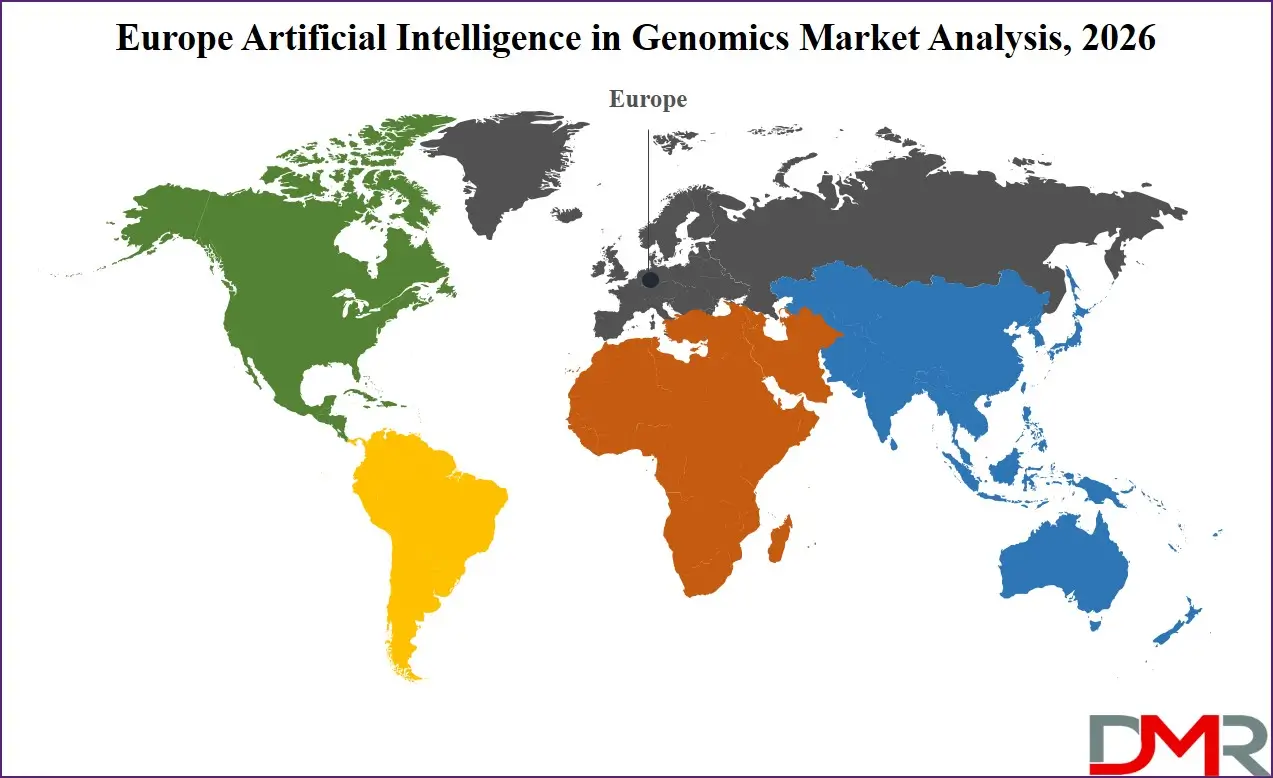
The Europe Artificial Intelligence in Genomics market is characterized by strong growth driven by advanced healthcare systems and government-backed genomic initiatives. Key countries include United Kingdom, Germany, and France, which lead due to robust research infrastructure and national genome programs.
ℹ
To learn more about this report –
Download Your Free Sample Report Here
The UK shows the fastest growth, supported by large-scale sequencing initiatives, while Germany benefits from strong pharmaceutical and biotech industries. France is advancing through significant public investments in genomic medicine. Southern European countries like Italy and Spain are emerging with increasing adoption. Overall, Europe accounts for around 25–28% of the global market, driven by precision medicine and AI integration.
By Country
- Germany
- The U.K.
- France
- Italy
- Russia
- Spain
- Benelux
- Nordic
- Rest of Europe
Competitive Landscape
The Europe Artificial Intelligence in Genomics market is highly competitive, driven by continuous innovation and advancements in AI and genomic technologies. Companies are focusing on enhancing data analytics capabilities, improving user experience, and developing advanced algorithms to strengthen their market position. Strategic collaborations with research institutions and healthcare providers are common to access large genomic datasets and accelerate innovation. However, high entry barriers such as strict regulations, data privacy requirements, and significant infrastructure costs limit new entrants. To stay competitive, organizations are investing heavily in research and development, enabling differentiation and supporting the growing demand for precision medicine and genomics-based solutions.
Some of the prominent players in the Europe Artificial Intelligence in Genomics are:
- Illumina
- Thermo Fisher Scientific
- Roche
- QIAGEN
- SOPHiA GENETICS
- IBM
- Microsoft
- Google
- NVIDIA Corporation
- AstraZeneca
- Novartis
- Sanofi
- GlaxoSmithKline
- Bayer AG
- BenevolentAI
- Exscientia
- Oxford Nanopore Technologies
- Genomics England
- Lifebit
- Genestack
- Other Key Players
Recent Developments
- In June 2025, DeepMind Technologies entered into a strategic collaboration with a leading European biotech firm to develop AI-driven tools for gene editing optimization. The partnership focuses on leveraging deep learning models to predict genetic mutations and improve CRISPR accuracy. This initiative is expected to accelerate research in genetic therapies and agricultural genomics. The collaboration includes joint investments in R&D and the establishment of dedicated research centers across Europe to support innovation.
- In February 2025, Illumina announced the launch of an advanced AI-powered genomic analysis platform designed to enhance sequencing accuracy and reduce turnaround time. The platform integrates machine learning algorithms with cloud-based infrastructure, enabling researchers to process large datasets more efficiently. This development aims to support precision medicine initiatives across Europe by providing scalable and cost-effective solutions.
Report Details
| Report Characteristics |
| Market Size (2026) |
USD 539.2 Mn |
| Forecast Value (2035) |
USD 12,247.9 Mn |
| CAGR (2026–2035) |
41.5% |
| Historical Data |
2021 – 2025 |
| Forecast Data |
2027 – 2035 |
| Base Year |
2025 |
| Estimate Year |
2026 |
| Report Coverage |
Market Revenue Estimation, Market Dynamics, Competitive Landscape, Growth Factors and etc. |
| Segments Covered |
By Component (Software, Services), By Technology (Machine Learning, Deep Learning, Natural Language Processing (NLP), Computer Vision, Others), By Functionality (Genome Sequencing, Gene Editing, Clinical Workflow, Predictive Gene Testing), By Application (Drug Discovery & Development, Diagnostics, Precision Medicine, Agriculture & Animal Research, Other), By End User (Pharmaceutical and Biotech Companies, Healthcare Providers, Research Centers, Others) |
| Regional Coverage |
Europe – Germany, The UK, France, Russia, Spain, Italy, Benelux, Nordic, & Rest of Europe |
| Prominent Players |
Illumina, Thermo Fisher Scientific, Roche, QIAGEN, SOPHiA GENETICS, IBM, Microsoft, Google, NVIDIA Corporation, AstraZeneca, Novartis, Sanofi, GlaxoSmithKline, Bayer AG, BenevolentAI, Exscientia, Oxford Nanopore Technologies, Genomics England, Lifebit, Genestack, and Other Key Players |
| Purchase Options |
We have three licenses to opt for: Single User License (Limited to 1 user), Multi-User License (Up to 5 Users) and Corporate Use License (Unlimited User) along with free report customization equivalent to 0 analyst working days, 3 analysts working days and 5 analysts working days respectively. |
Frequently Asked Questions
How big is the Europe Artificial Intelligence in Genomics Market?
▾ Europe Artificial Intelligence in Genomics Market size is expected to reach USD 539.2 million by 2026 and is projected to reach USD 12,247.9 million by the end of 2035.
Who are the key players in the Europe Artificial Intelligence in Genomics Market?
▾ Some of the major key players in the Europe Artificial Intelligence in Genomics Market include Roche, IBM, Google and others.
What is the growth rate in the Europe Artificial Intelligence in Genomics Market?
▾ The market is growing at a CAGR of 41.5 percent over the forecasted period.