Europe Business Process Outsourcing (BPO) Services Market Snapshot
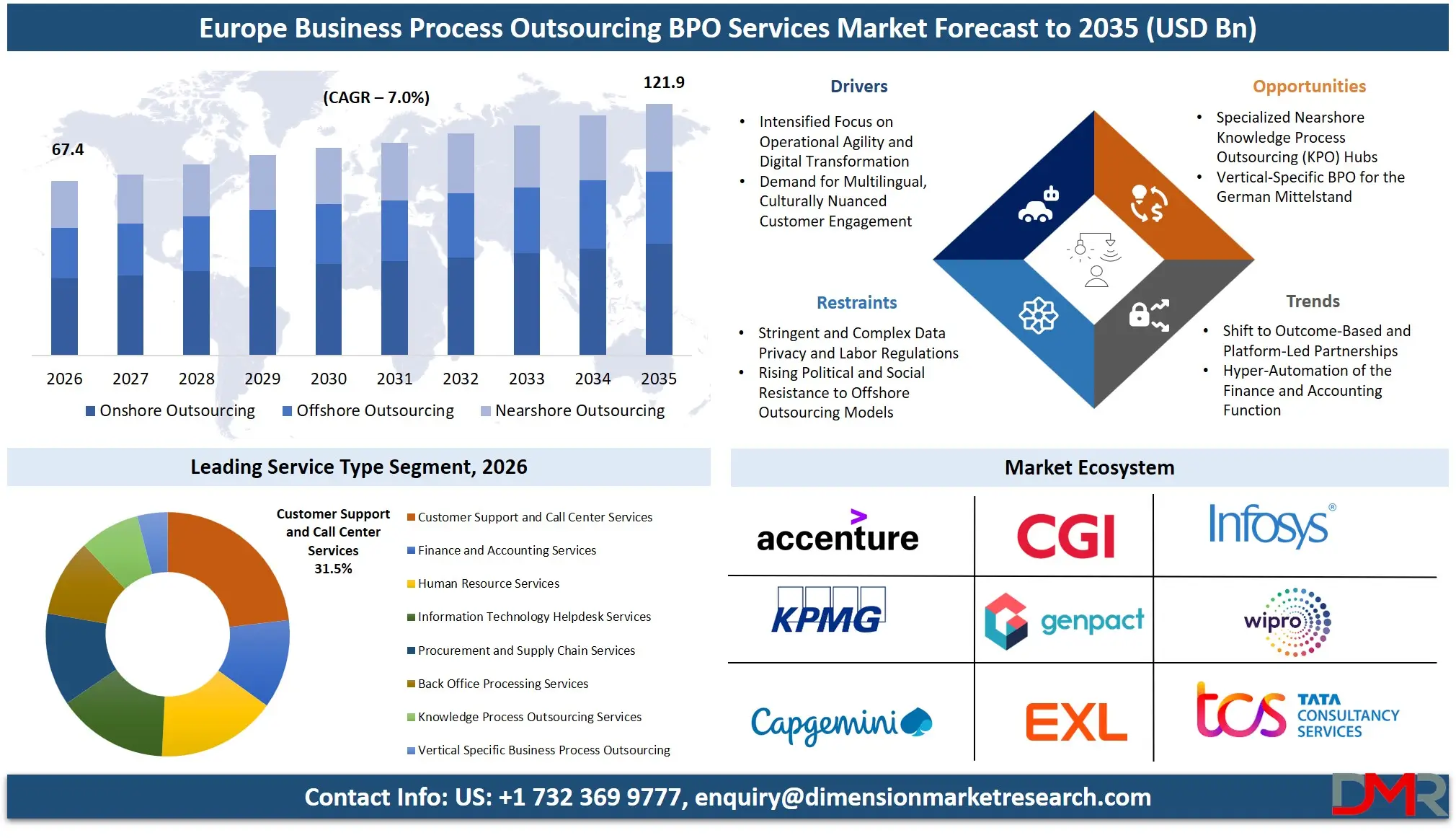
- Europe BPO Services Market Size in 2026: USD 67.4 Billion
- Europe BPO Services Market Size in 2035: USD 121.9 Billion
- Europe CAGR from 2026 to 2035: 7.0%
- Customer Support and Call Center Services is the leading service type segment in 2026: 31.5%
- Onshore Outsourcing is the leading outsourcing type segment in 2026: 42.8%
- Cloud is the leading deployment mode segment in 2026: 64.2%
- Large Enterprises is the leading organization size segment in 2026: 71.3%
- Third-Party is the leading ownership model segment in 2026: 78.5%
- Information Technology and Telecommunications is the leading end-user vertical in 2026: 28.4%
What is the Europe Business Process Outsourcing (BPO) Services Market and its Market Size?
Business Process Outsourcing (BPO) in Europe is a sophisticated strategic discipline that involves the delegation of non-core, yet operationally critical, business functions to specialized external service providers. This ecosystem integrates a comprehensive array of process expertise, technology platforms, and human capital management to optimize functions such as customer lifecycle management, finance and accounting operations, human capital administration, and knowledge-intensive research. European enterprises, public sector bodies, and fast-growing mid-market firms depend on BPO services to achieve operational resilience, ensure stringent regulatory compliance with frameworks like the General Data Protection Regulation (GDPR), and deliver a localized, multilingual customer experience across diverse linguistic and cultural markets. The market has evolved from a pure labor arbitrage model to a partnership centered on digital transformation, process intelligence, and advanced analytics.
ℹ
To learn more about this report –
Download Your Free Sample Report Here
The Europe BPO Services Market was valued at USD 63.0 billion in 2025 and is projected to reach USD 67.4 billion in 2026, further expanding to USD 121.9 billion by 2035, growing at a compound annual growth rate CAGR of 7.0% during the forecast period. Growth is being propelled by a pan-European shift toward cloud-based operational agility, the embedding of artificial intelligence and automation in process workflows, a critical demand for superior omnichannel customer engagement in local languages, and the escalating complexity of cross-border finance, tax, and data sovereignty compliance. Investment is accelerating as organizations move beyond simple task execution toward value-driven partnerships that integrate robotic process automation, predictive analytics, and intelligent case management to build hyper-efficient, scalable European service delivery ecosystems.
Use Cases
- Multilingual Pan-European Customer Experience Orchestration: A global consumer electronics firm partners with a third-party BPO provider to manage a unified, omnichannel customer support hub from a nearshore center in Poland. The provider integrates voice, email, social media, and chat support in ten European languages, using AI-driven sentiment analysis to prioritize high-value customer interactions and ensure compliance with German and French consumer protection laws.
- Automated Finance and Accounting Operations for GDPR Compliance: A large European retailer engages a cloud-enabled BPO provider to manage its entire source-to-pay and record-to-report processes. The provider implements an on-premise-connected cloud solution to process accounts payable across multiple European tax jurisdictions, ensuring VAT compliance and using automated data masking for financial reporting to adhere to GDPR's data minimization principles.
- Recruitment Process Outsourcing for a Continental Scale-Up: A European electric vehicle manufacturer utilizes a dedicated service provider for its high-volume recruitment across new gigafactories in Germany and Hungary. The BPO firm manages multilingual candidate sourcing, skills assessment, and interview scheduling, leveraging an applicant tracking system integrated with local job boards, drastically reducing time-to-hire for specialized engineers.
- Healthcare Claims Processing for a National Health System: A regional public health authority in the UK outsources back-office claims adjudication for its dental services program. The provider uses a specialized vertical BPO platform with embedded optical character recognition to extract data from paper and digital forms, validate treatments against local NHS rules, and process reimbursements for thousands of dental practitioners with near-perfect accuracy.
Key Takeaways
- Market Size: The Europe BPO Services Market is forecast to be valued at USD 67.4 billion in 2026 and is anticipated to reach USD 121.9 billion by 2035, marking a robust expansion trajectory.
- Growth Outlook: Market expansion is supported by the necessity for multilingual, localized customer experiences, the digitization of finance and accounting workflows, the adoption of AI-augmented service desks, and growing demand from mid-sized enterprises for scalable, cloud-first back-office solutions.
- Primary Growth Drivers: The imperative for GDPR-compliant data handling, severe cost pressures driving operational efficiency, the region's complex multilingual landscape requiring specialized language skills, and the need for business agility in volatile economic cycles are accelerating investment in sophisticated BPO partnerships across Europe.
- By Service Type Analysis: Customer Support and Call Center Services is projected to be the leading segment in 2026, driven by the non-negotiable demand for seamless, empathetic, and multilingual omnichannel customer engagement to combat churn in competitive European markets.
- By Outsourcing Type Analysis: Onshore Outsourcing is expected to dominate in 2026, as data security imperatives, cultural alignment for nuanced customer conversations, and the desire for tight operational control drive European firms to prioritize domestic service delivery models.
- By End-User Vertical Analysis: Information Technology and Telecommunications is anticipated to lead in 2026, driven by the continuous need for technical helpdesk support, digital service migration, and managing complex subscriber lifecycles across highly saturated European telecom markets.
How AI/Gen AI is Transforming the Europe BPO Services Market?
Artificial intelligence is fundamentally transforming the European BPO landscape by enabling hyper-personalized, context-aware service delivery that respects local language nuance and cultural context. Generative AI assistants are empowering multilingual contact center agents with real-time translation, sentiment-guided scripting, and instant knowledge retrieval, dramatically improving first-contact resolution rates for queries ranging from Italian luxury fashion aftersales to Swedish fintech technical support. Machine learning algorithms are moving from simple task automation to intelligent process optimization, dynamically routing finance exceptions in an accounts payable workflow or predicting employee attrition risks within a managed human resource shared services model, allowing preemptive intervention.
The frontier of adoption involves agentic AI workflows orchestrating end-to-end, autonomous business processes. In this paradigm, an AI orchestrator autonomously manages an entire claim, from initial email extraction and multilingual document classification to fraud probability scoring and final adjudication in a healthcare insurance process, only escalating a complex legal liability case to a human specialist in a nearshore center in Portugal. This capability compresses processing times from days to minutes. However, for these AI models to be trusted in automated decision-making within the European regulatory framework, they require strict governance, complete audit trails, and bias detection mechanisms, ensuring full alignment with the EU's proposed AI Act and foundational GDPR principles. The focus is on "explainable AI" that can justify a loan processing decision or a customer credit note issuance to a regulator, making the BPO provider a custodian of both efficiency and ethical, compliant automation.
Key Drivers in the Europe Business Process Outsourcing (BPO) Services Market
Intensified Focus on Operational Agility and Digital Transformation
A major driver is the pan-European mandate for businesses to become more agile and digitally mature. Companies are leveraging BPO partnerships not just for cost savings, but to inject digital capabilities—cloud platforms, robotic process automation, and AI analytics—directly into their finance, HR, and customer service functions. A utility company can rapidly deploy a new billing inquiry chatbot for a fluctuating energy market, supported by a BPO provider's technical expertise, without a lengthy internal IT development cycle. This model allows traditional European manufacturing, retail, and financial services firms to keep pace with digital-native competitors, transforming fixed operational costs into variable, scalable ones while simultaneously modernizing legacy back-office processing.
Demand for Multilingual, Culturally Nuanced Customer Engagement
Europe's rich tapestry of languages, dialects, and consumer expectations makes specialized BPO services indispensable. Unlike other regions, customer loyalty hinges on the ability to provide support in the customer's mother tongue, with an understanding of local consumer rights and cultural etiquette. This drives demand for nearshore delivery centers in locations like Spain, Romania, and Bulgaria, where a diverse, highly educated workforce can provide this complex omnichannel engagement. A travel and hospitality company, for instance, relies on its BPO partner to handle social media complaints from a French guest and an email query from a Czech guest with equal cultural dexterity and operational finesse, protecting brand reputation across its entire European footprint.
Restraints in the Europe Business Process Outsourcing (BPO) Services Market
Stringent and Complex Data Privacy and Labor Regulations
The complex web of regulations, anchored by GDPR, can act as a significant restraint on outsourcing decisions, particularly for offshore models. Strict restrictions on cross-border personal data flows, mandatory data breach notifications, and the strict contractual liability on the data controller create intense risk management scrutiny. Furthermore, diverse European labor laws regarding working time, fixed-term contracts, and works council consultations add complexity to any large-scale outsourcing deal involving staff transfer (TUPE regulations). This regulatory density can slow contract negotiations, increase legal overhead, and deter some organizations from outsourcing sensitive human resource services or knowledge process functions, particularly when the service provider's operational footprint lies outside a recognized EU adequacy decision.
Growth Opportunities in the Europe Business Process Outsourcing (BPO) Services Market
Specialized Nearshore Knowledge Process Outsourcing (KPO) Hubs
A significant growth opportunity lies in developing deep-domain, nearshore KPO capabilities for Europe's core industries. This moves beyond generic business analytics into specialized legal process outsourcing for German contract law, financial research for ESG-compliant investment portfolios in Scandinavia, and pharmacovigilance case processing for pharmaceutical firms headquartered in Switzerland. By establishing centers of excellence within the EU that combine advanced research skills with critical language capabilities and domain-specific professional certifications, service providers can command premium pricing and forge long-term, deeply integrated partnerships that are highly resistant to offshoring cost pressures due to the trust and expertise involved.
Vertical-Specific BPO for the German Mittelstand
Germany's vast "Mittelstand" (small and medium-sized enterprises) represents a largely untapped opportunity for tailored, vertical-specific BPO. These manufacturing and engineering powerhouses require specialized services like logistics coordination for export-heavy supply chains, technical documentation management in multiple European languages, and procurement support for high-precision components. A BPO provider focusing exclusively on the German industrial sector, offering cloud-based procurement operations and accounts payable services with a native understanding of industry-specific quality and engineering standards, can unlock a loyal and substantial client base that demands more than generic back-office processing.
Trends in the Europe Business Process Outsourcing (BPO) Services Market
Shift to Outcome-Based and Platform-Led Partnerships
A defining trend is the shift from traditional full-time equivalent pricing models to outcome-based commercial agreements. A customer care contract may now be priced on customer retention uplift or net promoter score improvement, while a claims processing deal might be tied to processing accuracy and reimbursement cycle times. These contracts are enabled by integrated, cloud-based platform ecosystems provided by the BPO firm, which offer real-time analytics dashboards and transparent performance monitoring. This convergence of service delivery and technology platform fosters a true partnership model where both client and provider are aligned on achieving tangible business results, such as reducing daily sales outstanding in accounts receivable or improving employee onboarding experience in human resource shared services.
Hyper-Automation of the Finance and Accounting Function
The finance and accounting BPO segment is undergoing a rapid transformation through hyper-automation, the orchestrated use of robotic process automation, intelligent document processing, and machine learning. In a procurement operations context, an automated workflow handles everything from invoice capture and three-way matching to automated payment runs and dynamic discounting, flagging only anomalous supplier master data changes for human review. This trend is particularly strong in Europe, where complex indirect tax rules like VAT demand absolute precision. BPO providers are building "digital finance factories" that combine this process automation with on-demand financial reporting and actionable insights, moving from transaction processing to becoming a predictive financial management engine for European enterprises.
Research Scope and Analysis
The Europe BPO Services Market is segmented by service type, outsourcing type, deployment mode, organization size, ownership model, application, and end-user vertical. Service types include customer support, finance & accounting, human resources, IT helpdesk, procurement & supply chain, back-office processing, knowledge process outsourcing, and vertical-specific BPO. The study evaluates the shift toward cloud-based, third-party models, assesses adoption across key functions like customer care and talent management, and analyzes pan-European demand in sectors including IT/telecom, BFSI, healthcare, and manufacturing.
ℹ
To learn more about this report –
Download Your Free Sample Report Here
By Service Type Analysis
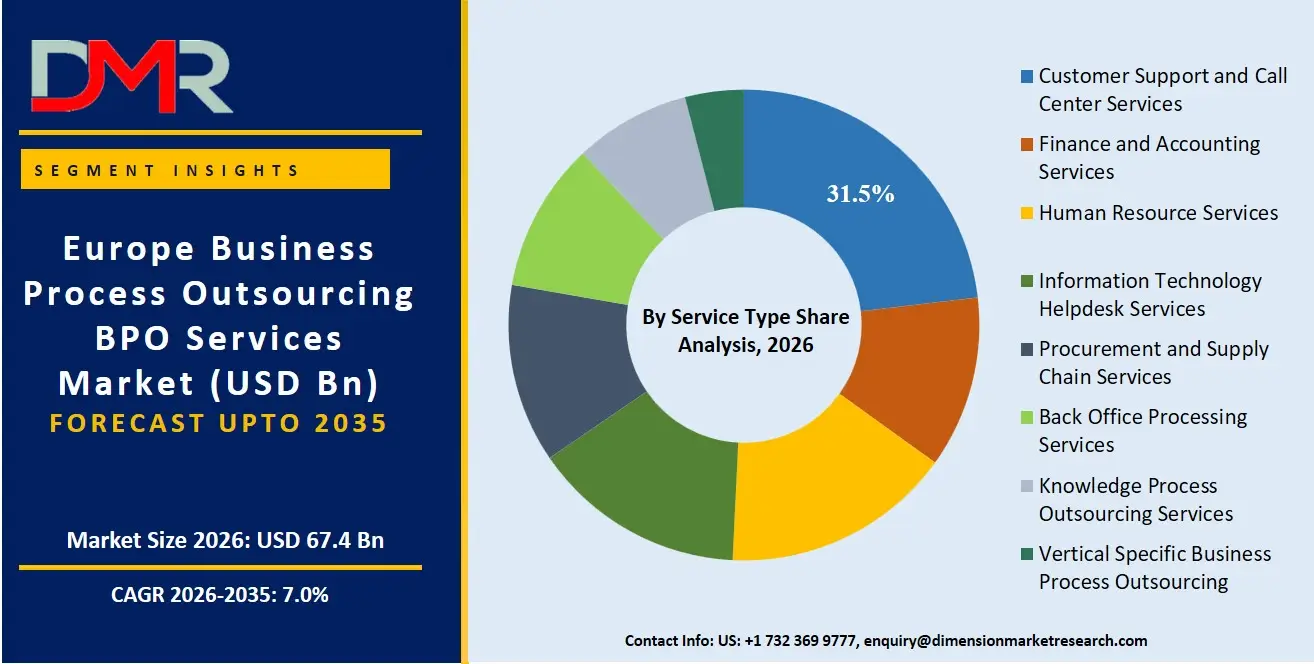
Customer Support and Call Center Services is poised to dominate the Europe BPO Services Market with a 31.5% share in 2026. This dominance is fueled by the critical requirement for multilingual, omnichannel customer engagement to manage complex queries, reduce churn in competitive telecom and retail sectors, and protect brand equity across diverse European markets. Finance and Accounting Services holds the second-highest share, underpinned by the relentless need for efficient, compliant transaction processing, invoice management, and financial reporting across jurisdictions. Knowledge Process Outsourcing Services is projected to record the highest CAGR of 9.2% from 2026 to 2035, driven by surging demand for specialized business analytics, regulatory research, and legal process support that requires deep European market knowledge and advanced analytical skills.
By Outsourcing Type Analysis
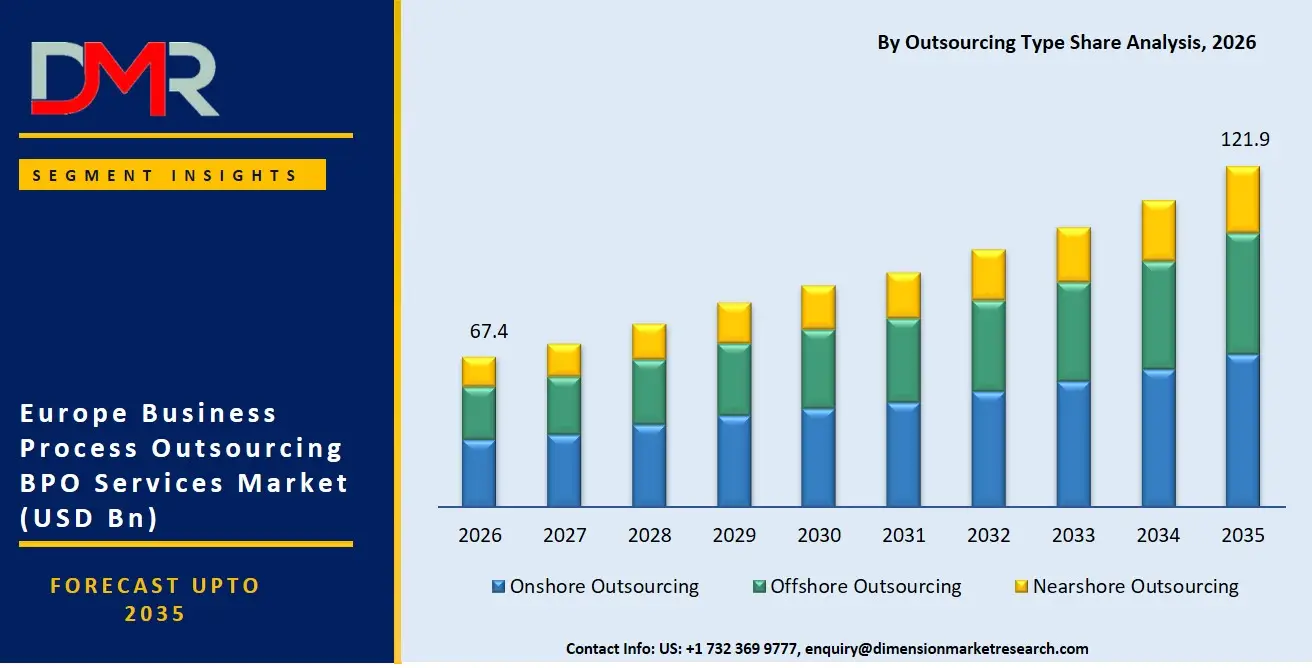
Onshore Outsourcing is anticipated to lead the market with a 42.8% share in 2026. This model is strongly preferred across Europe, particularly in Germany and France, where data sovereignty, cultural alignment, and the need for seamless, accent-free communication are paramount for customer-centric and sensitive HR functions.
ℹ
To learn more about this report –
Download Your Free Sample Report Here
Nearshore Outsourcing is expected to register the highest CAGR of 8.5% during the forecast period, as European companies seek a balance between cost arbitrage and regulatory/operational proximity. Delivery centers in Central and Eastern Europe and Iberia offer attractive operational costs while maintaining EU data boundaries, making them ideal for IT helpdesk, procurement, and regional shared services.
By Deployment Mode Analysis
Cloud-based deployment is the dominant and fastest-growing segment, expected to account for 64.2% of the market in 2026. The shift is accelerated by the need for business continuity, distributed workforce enablement, and the rapid integration of AI tools. European enterprises and government bodies increasingly mandate cloud-first BPO solutions for their scalability, security (with EU-based data centers), and ability to facilitate outcome-based contracting. On-Premise solutions, while declining in share, remain relevant for highly sensitive defense contracts, certain banking operations, and legacy systems where a dedicated local shared service center model is strictly required for perceived control.
By Organization Size Analysis
Large Enterprises is the leading segment, projected to hold a 71.3% share in 2026, driven by extensive, multi-process outsourcing engagements spanning global captive centers and third-party partnerships for finance, HR, and customer management. However, the Small and Medium-Sized Enterprises segment is projected to grow at the highest CAGR of 9.1%, representing a significant white space. For the first time, cloud platforms are enabling mid-market firms to access sophisticated, pay-as-you-go finance and accounting services, procurement support, and professional customer engagement, functions previously only affordable for large corporations.
By Ownership Model Analysis
The Third-Party model, particularly through dedicated and multi-client service providers, is expected to command a dominant 78.5% share in 2026. This is driven by the value proposition of variable cost models, immediate access to technology platforms and skilled talent, and the ability to rapidly scale operations across Europe. However, Global Capability Centers (Captive) are witnessing a strategic renaissance, especially for core R&D, product engineering support, and high-end analytics for leading German automotive and Swiss financial institutions. These entities provide unparalleled control over intellectual property and strategic processes, with cities like Krakow, Barcelona, and Dublin serving as prime locations.
By Application or Business Function Analysis
Customer Care and Contact Center is the leading application segment, mirroring the broader service type trend, as voice and non-voice support remain the public face of many brands. Finance and Accounting is the second-largest function, as automated transaction processing and financial management form the operational backbone of business. Talent and Human Resource Services is forecast to experience rapid growth, with a CAGR of 8.8%, fueled by complex, post-pandemic workforce administration, pan-European recruitment process outsourcing, and the need for integrated digital employee lifecycle management from onboarding to offboarding.
By End-User Vertical Analysis
Information Technology and Telecommunications is projected to dominate with a 28.4% share in 2026. This sector's reliance on BPO is immense, spanning level 1/2 technical helpdesk support for millions of subscribers, complex service desk management, and revenue assurance processes. Banking, Financial Services, and Insurance (BFSI) holds the second-largest share, driven by mortgage processing, claims handling, and stringent regulatory reporting. The Healthcare vertical is anticipated to record the highest CAGR of 9.6%, propelled by aging populations, the digitization of national health systems, and a surge in demand for specialized medical claims processing, clinical data management, and patient engagement services compliant with national health data privacy laws.
The Europe Business Process Outsourcing (BPO) Services Market Report is segmented on the basis of the following:
By Service Type
- Customer Support and Call Center Services
- Inbound Customer Support
- Outbound Customer Support
- Technical Helpdesk
- Omnichannel Customer Engagement
- Customer Relationship Management
- Finance and Accounting Services
- General Ledger Accounting
- Financial Reporting
- Payroll Accounting
- Human Resource Services
- Recruitment Process Outsourcing
- Payroll Processing
- Benefits Administration
- Employee Lifecycle Management
- Information Technology Helpdesk Services
- Remote Infrastructure Support
- Service Desk Management
- Procurement and Supply Chain Services
- Strategic Sourcing
- Procurement Operations
- Supplier Management
- Logistics Coordination
- Back Office Processing Services
- Data Entry
- Document Management
- Claims Processing
- Order Processing
- Knowledge Process Outsourcing Services
- Business Analytics
- Market Research
- Legal Process Outsourcing
- Financial Research
- Vertical Specific Business Process Outsourcing
- Healthcare Claims Processing
- Banking Operations
- Insurance Processing
- Telecommunications Operations
By Outsourcing Type
- Onshore Outsourcing
- Domestic Service Delivery
- Local Shared Service Centers
- Offshore Outsourcing
- Global Delivery Centers
- Low Cost Offshore Services
- Nearshore Outsourcing
- Regional Delivery Centers
- Cross Border Shared Services
By Deployment Mode
By Organization Size
- Large Enterprises
- Small and Medium Sized Enterprises
By Ownership Model
- Third Party
- Dedicated Service Providers
- Multi Client Service Providers
- Captive
- Shared Service Centers
- Global Capability Centers
By Application or Business Function
- Customer Care and Contact Center
- Voice Support
- Non Voice Support
- Social Media Support
- Finance and Accounting
- Transaction Processing
- Financial Management
- Talent and Human Resource Services
- Recruitment
- Workforce Administration
- Sales and Marketing
- Lead Generation
- Customer Acquisition
- Campaign Management
- Sourcing Procurement and Supply Chain
- Vendor Management
- Procurement Support
- Facilities and Administration
- Office Administration
- Facility Management
- Product Engineering and Product Development
- Product Design Support
- Engineering Services
- Training and Learning Services
- Employee Training
- Learning Management
- Other Back Office and Support Functions
By End User Vertical
- Information Technology and Telecommunications
- Manufacturing
- Banking Financial Services and Insurance
- Government and Defense
- Transportation and Logistics
- Retail and Ecommerce
- Travel and Hospitality
- Healthcare
- Energy and Utilities
- Education
- Other Industries
Regional Analysis
The Europe Business Process Outsourcing Services Market is led by Western Europe, with the United Kingdom, Germany, France, and the Netherlands accounting for the largest share due to high enterprise digitalization, mature outsourcing ecosystems, and strong demand for customer support, finance, HR, and IT outsourcing services. Central and Eastern Europe, particularly Poland, Romania, the Czech Republic, Hungary, and Bulgaria, represents the fastest-growing region, benefiting from skilled multilingual talent, competitive operating costs, and increasing investments in shared service centers and nearshore outsourcing. Northern Europe is witnessing rising adoption of knowledge process outsourcing, cloud-based BPO, and automation-driven services, while Southern Europe, led by Spain, Italy, and Portugal, continues to expand through growing digital transformation initiatives, multilingual contact centers, and increasing demand for outsourced business processes across healthcare, retail, manufacturing, and financial services.
By Region
Europe
- Germany
- The U.K.
- France
- Italy
- Russia
- Spain
- Benelux
- Nordic
- Rest of Europe
Regulatory Landscape
The regulatory landscape for the Europe Business Process Outsourcing Services Market is shaped by stringent data privacy, cybersecurity, labor, and industry-specific compliance requirements. The General Data Protection Regulation (GDPR) remains the primary framework governing the processing and cross-border transfer of personal data. Financial service providers must comply with regulations related to operational resilience and anti-money laundering, while healthcare outsourcing must adhere to strict patient data protection requirements. The NIS2 Directive, the Digital Operational Resilience Act (DORA), and the AI Act are increasing expectations around cybersecurity, third-party risk management, AI governance, and incident reporting. BPO providers are investing in secure cloud infrastructure, compliance automation, identity management, audit trails, and continuous monitoring to meet evolving regulatory obligations and maintain client trust.
Investment and White Space Analysis
Investment opportunities in the Europe Business Process Outsourcing Services Market are centered on artificial intelligence, intelligent process automation, cloud-based BPO platforms, multilingual customer experience solutions, and analytics-driven business services. Demand is growing for industry-specific outsourcing across BFSI, healthcare, manufacturing, and the public sector. Significant white space exists in integrating AI-powered automation with legacy enterprise systems, expanding outcome-based service models, supporting small and medium-sized enterprises, and delivering specialized compliance-focused outsourcing solutions. Vendors can strengthen their competitive position through low-code workflow automation, cybersecurity-enhanced service delivery, nearshore multilingual operations, sustainability reporting support, and scalable digital transformation services tailored to European regulatory and industry requirements.
Competitive Landscape
The Europe BPO Services Market features a diverse competitive landscape, ranging from global integrators and pure-play European champions to a dense network of regional and local specialists. Global players like Capgemini, Accenture, and Teleperformance vie for large-scale transformation deals, combining deep process expertise with proprietary digital platforms. Central European champions, such as Comdata Group and Webhelp (now Concentrix + Webhelp), fiercely compete through specialized nearshore delivery networks, offering impeccable multilingual capabilities that are highly valued in customer care and technical support contracts. The competitive dynamic is increasingly defined by a provider's ability to offer integrated, cloud-native solutions that embed AI for hyper-automation, while demonstrating deep regional regulatory and cultural knowledge. Differentiation is achieved through outcome-based commercial models, deep vertical specialization in areas like healthcare RCM or automotive procurement, and a proven ability to manage complex labor relations and GDPR compliance seamlessly across borders.
Some of the prominent players in the Europe Business Process Outsourcing (BPO) Services Market are:
- Accenture plc
- Capgemini SE
- Cognizant Technology Solutions Corporation
- Tata Consultancy Services Limited
- Infosys Limited
- Wipro Limited
- HCL Technologies Limited
- Genpact Limited
- Teleperformance SE
- Concentrix Corporation
- Foundever Group
- Majorel Group Luxembourg S.A.
- Webhelp SAS
- Arvato SE
- IBM Corporation
- CGI Inc.
- Atos SE
- Sopra Steria Group
- DXC Technology Company
- EXL Service Holdings Inc.
- WNS Holdings Limited
- Sutherland Global Services Inc.
- Tech Mahindra Limited
- Tietoevry Corporation
- Fujitsu Limited
- NTT DATA Group Corporation
- Xerox Holdings Corporation
- Serco Group plc
- HGS Healthcare LLC
- Firstsource Solutions Limited
- Other Key Players
Recent Developments
- In July 2026, Infosys announced the successful migration of NTN Corporation's e-commerce platform to SAP Commerce Cloud, highlighting its continued investment in digital business transformation and managed enterprise services for global clients.
- In November 2025, Capgemini completed its acquisition of Cloud4C, enhancing its cloud-managed services portfolio and strengthening digital transformation offerings for enterprise outsourcing clients.
- In July 2025, Capgemini announced the acquisition of WNS for approximately USD 3.3 billion, significantly expanding its intelligent operations, finance and accounting outsourcing, and AI-powered business process management capabilities.
- In March 2025, TP announced a strategic partnership with Carnegie Mellon University to accelerate applied artificial intelligence research for customer experience, automation, and digital business services.
- In February 2025, TP partnered with Sanas and made a strategic investment in the company to deploy real-time AI speech enhancement technology across customer service operations, improving multilingual communication and customer experience.
Report Details
| Report Characteristics |
| Market Size (2026) |
USD 67.4 Bn |
| Forecast Value (2035) |
USD 121.9 Bn |
| CAGR (2026–2035) |
7.0% |
| Historical Data |
2021 – 2025 |
| Forecast Data |
2027 – 2035 |
| Base Year |
2025 |
| Estimate Year |
2026 |
| Segments Covered |
By Service Type, By Outsourcing Type, By Deployment Mode, By Organization Size, By Ownership Model, By Application or Business Function, and By End User Vertical |
| Regional Coverage |
Europe – Germany, The UK, France, Russia, Spain, Italy, Benelux, Nordic, & Rest of Europe |
Frequently Asked Questions
How big is the Europe BPO Services Market?
▾ The Europe BPO Services Market is projected to reach USD 67.4 billion in 2026, and is forecast to be worth USD 121.9 billion by 2035, reflecting deep and sustained enterprise demand for specialized operational support.
What is the CAGR of the Europe BPO Services Market from 2026 to 2035?
▾ The market is projected to expand at a compound annual growth rate of 7.0% from 2026 to 2035, supported by the regional imperative for digital process automation, multilingual service delivery, and regulatory compliance.
What factors are driving the growth of the Europe BPO Services Market?
▾ Growth is driven by the pan-European focus on operational agility, the complexity of managing a multilingual customer base, escalating pressure for GDPR-compliant finance and HR operations, and the shift towards cloud-based, outcome-oriented partnerships.
What are the major trends in the Europe BPO Services Market?
▾ Major trends include the convergence of BPO services and AI-powered platform ecosystems, a strategic shift to hyper-automation in finance and accounting, the rise of outcome-based commercial models, and the growth of specialized nearshore knowledge process outsourcing hubs within the EU.
Who are the key players in the Europe BPO Services Market?
▾ Key market participants include Teleperformance, Concentrix + Webhelp, Capgemini, Majorel, Foundever, Comdata, Arvato, and other global and regional specialists that provide multilingual, digitally enabled services across customer care, finance, HR, and vertical-specific processes.