Market Overview
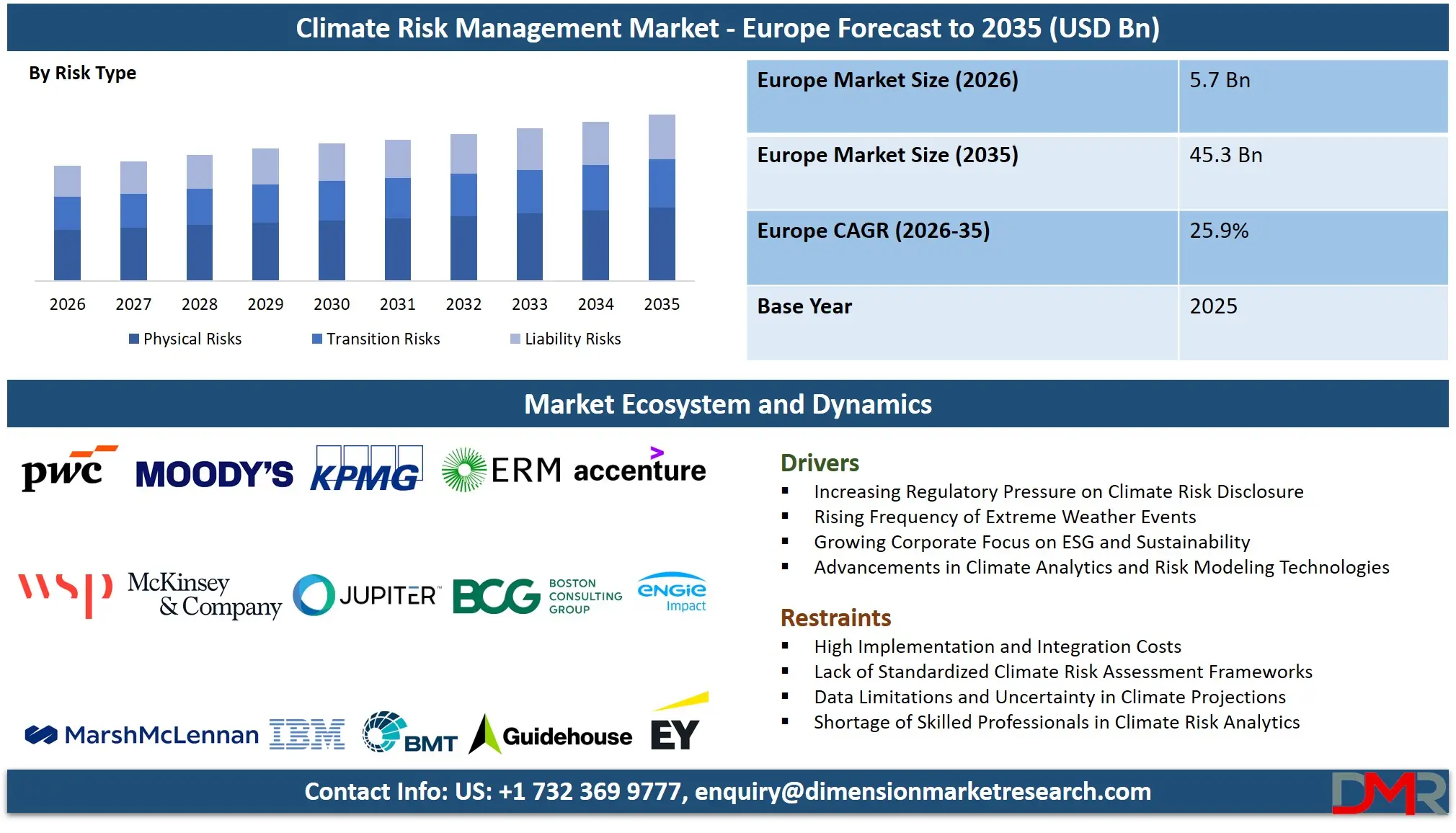
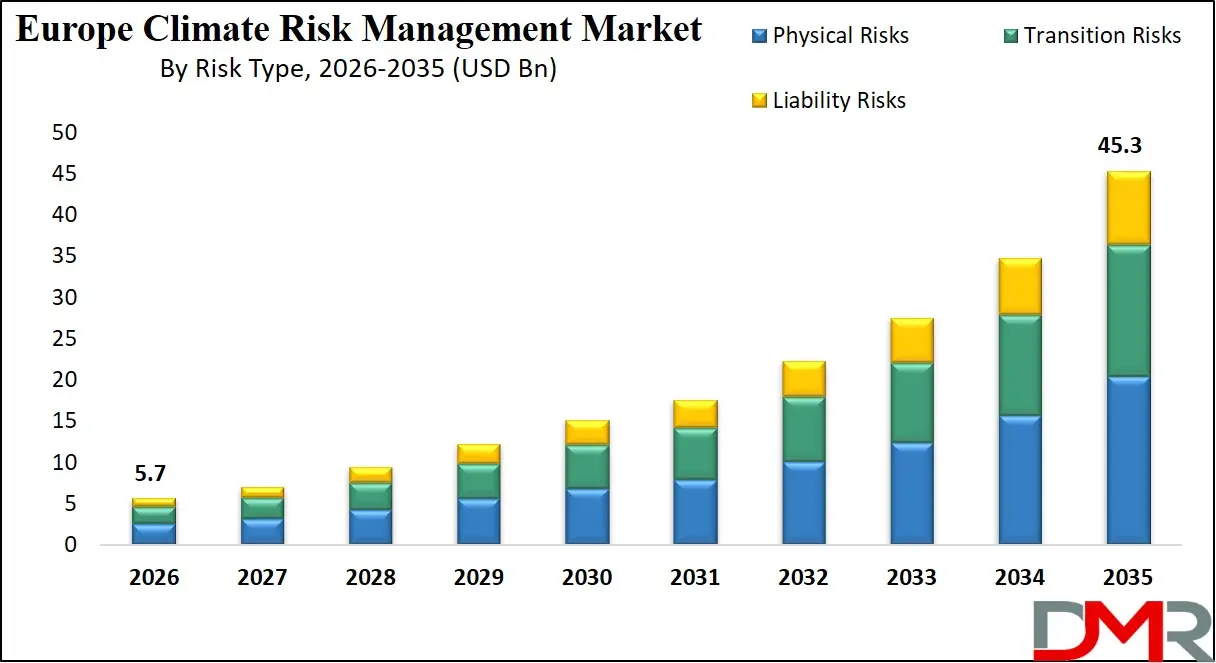
The Europe climate risk management market size is projected to have a market value of 5.7 billion USD in 2026, this is projected to have risen to a market value of 45.3 billion USD by the end of 2035 with a CAGR of 25.9%.
ℹ
To learn more about this report –
Download Your Free Sample Report Here
This trend of growth, then, substantiates the fact that Europe is among the key areas of the world in climate risk analysis, sustainability, and environmental risk management. This is because the region has a well-developed regulatory framework, high decarbonization goals according to the European Green Deal, and a high sense of understanding of financial risks associated with climate change. Europe has the most developed climate risk management market in the world, where the presence of the ESG factors, climate-related disclosure policies, and principles of sustainable finance is early adopted. London, Frankfurt and Paris are among the highly regarded financial centers of the area and they spear head the implementation of climate-related financial regulations, where financial institutions are developing climate-related financial risks into their financial decision-making, financial portfolio management, and strategic financial decisions.
This market is changing its perception towards a compliance need to strategic and value-based management of climate risks. Climate-related financial intelligence is helping organizations to enhance their own resilience, to enhance their operations, and to consider new growth possibilities in a net-zero economy. In addition, businesses are under pressure to implement a robust climate-related financial framework, and sustainability is incorporated in the enterprise-wide risk management systems. The market is being shaped by technological advancements. In the example, the accurate analysis of climate risks is made with the help of artificial intelligence, machine learning, geospatial analysis, and satellite monitoring systems.
ℹ
To learn more about this report –
Download Your Free Sample Report Here
In addition, predictive models are utilized to manage both physical climate-related risks e.g., extreme weather, as well as transition-related risks e.g., policy, market and technological changes. This is combined with financial analysis to come up with next-generation platforms which are offering new insights to make decisions. The market has a number of structural problems even with the large expansion of the market. As an example, the problem of data fragmentation, absence of common methodologies, and variations of approaches to climate modeling render the implementation of the market challenging. Complex global supply chains are also hard to evaluate on the effects of climate risk.
Europe Climate Risk Management Market: Key Takeaways
- Market Growth Insights: The market is expected to grow to approximately USD 5.7 billion in 2026, which is further poised to grow to USD 45.3 billion by 2035, at a CAGR of 25.9%.
- By Risk Type Insights: Physical risks, including floods and extreme heat, are projected to dominate the market, but transition risks, including those due to changes in policies and technologies, are growing the fastest due to increasing regulations in the EU.
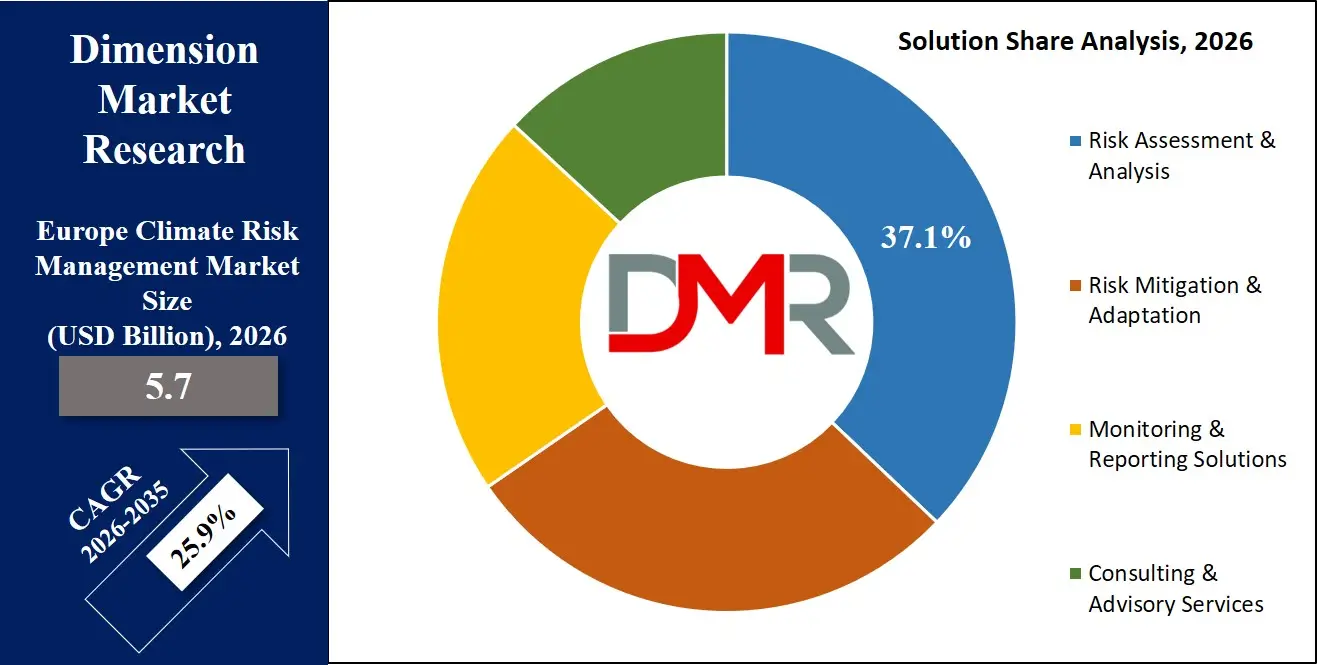
- By Solution Insights: Risk Assessment & Analysis solutions are poised to dominate the market due to mandatory disclosure requirements, but Risk Mitigation & Adaptation services are expected to grow the fastest.
- By Deployment Mode Insights: Cloud deployment mode is expected to dominate the market due to the scalability of solutions to integrate complex, real-time climate data.
- By Enterprise Size Insights: Large enterprises are projected to dominate the market, with high investment in comprehensive risk management solutions, but the SME segment is expected to grow the fastest.
- By Industry Vertical Insights: Financial Services & Insurance is poised to dominate the market due to the use of climate risk management analytics for portfolio risk management.
- Key Players Insights: Some of the key players in the market include MSCI Inc., Moody’s ESG Solutions, Bloomberg, S&P Global, Accenture, IBM, Cervest, Risilience, etc.
Impact of Iran Conflict on the Europe Climate Risk Management Market
- Energy Price Shock and Industrial Pressure: The energy price inflation is extremely high in Europe. The oil and gas supply is affected due to the conflict, which in turn affects the cost of production. This is further causing an even worse industrial stance, especially in the already vulnerable economies that are based on manufacturing.
- Financial Market Volatility and Pressure of Investors: The financial markets in Europe have been extremely volatile. The investors have been forced to sell their shares, which in turn is causing financial constraints, bond market failure, and high uncertainty.
- Trade slowdown and Supply Chain Disruptions: The war on trade routes in the Middle East is also causing an impact on European countries. The imports of oil, fertilizers, and raw materials have been reduced, which in turn is causing low efficiency in major sectors.
- Pressure of Inflation on consumers and businesses: Rising inflation and fuel prices cause a rise in inflation levels in the European nations, which causes consumer buying power to decrease and necessitates intervention of the monetary policy.
- Accelerated Energy Diversification Strategies: The war leads to the fact that European nations are forced to focus on faster investments and plans towards renewable energy, which leads to the realization that the country has less dependence on the import of products of war, as well as that the long-term sustainability plans are positively influenced.
Europe Climate Risk Management Market: Use Cases
- Climate risk management and regulatory compliance and financial disclosure: The area of the most significant use case of climate risk management is regulatory compliance with highly regulated and complex regulations (CSRD, EU Taxonomy, and SFDR). The highly developed software applied by financial institutions and large corporations has been used to measure, report, and disclose climate-related financial risks, such as physical and transition risks.
- Financial Institutions Climate Stress Testing: The central banks and the financial regulators of European nations demand that financial institutions, including banks and insurance companies, make climate stress tests. The financial institutions are also using the models of scenario analysis to determine how they can withstand the various climate and weather risks on their loan books and investments.
- Supplier Chain Decarbonization and Resilience: Big manufacturers and retailers are using climate risk platforms to enable them to map and analyze climate risks in their global supply chains. It helps them to see risky suppliers in high-risk areas (e.g., water shortage, risk of wildfires) and create supply chain diversification and decarbonization plans.
- Infrastructure Asset Management and Adaptation: Governments and the owners of infrastructure (e.g., energy, transportation, real estate) take advantage of climate analytics tools that enable them to estimate the long-term physical climate risks on their infrastructure. This allows them to come up with adaptation strategies such as fortifying the coastline and constructing climate-resistant structures.
Europe Climate Risk Management Market: Stats & Facts
European Commission / European Environment Agency (EEA)
- Economic damage from climate-related extreme events in the EU has exceeded USD 650 billion over the last 40 years.
- Over 50,000 companies in the EU are impacted by the Corporate Sustainability Reporting Directive (CSRD), resulting in a large and growing market for climate risk report writing tools.
- Over 90% of European banks are currently incorporating climate risk into their governance and risk management strategies, as recommended by the European Central Bank (ECB).
European Central Bank (ECB)
- As a result of the ECB's climate stress tests conducted in 2022, 60% of banks have yet to implement a climate risk stress testing framework, representing a significant opportunity for service providers.
- ECB has set deadlines for all significant institutions to fully comply with climate risk management recommendations by the end of 2024.
Network for Greening the Financial System (NGFS)
- Over 120 central banks and supervisors comprise the NGFS, which has developed common climate scenarios that are currently used by the financial industry for risk assessment, promoting standardization in the market.
Europe Climate Risk Management Market: Market Dynamics
Driving Factors in the Europe Climate Risk Management Market
Stringent and Proactive Regulatory Landscape
The Europe climate risk management market is primarily driven by the region's robust and proactive regulatory landscape. Sustainability reporting regulations, green taxonomy classifications, and sustainable finance disclosure regulations have now made climate-related reporting mandatory. This has created a need among businesses to quantify, disclose, and manage climate risks and opportunities with increasing transparency and accuracy. Businesses in the region are now using climate risk management solutions to manage their risks and opportunities. As the regulatory landscape is becoming more and more proactive, businesses are now investing more in the implementation of the required regulations. This is expected to boost the adoption of climate risk management solutions in the region.
High Exposure to Physical Climate Risks
The high exposure to physical risks in the Europe region is another key factor expected to boost the adoption of climate risk management solutions in the region. As the region is becoming more and more exposed to physical risks, businesses are now becoming more proactive in managing the risks. Extreme weather conditions are becoming more common in the region, which is affecting businesses and the overall ecosystem. As the impact of climate risks is becoming more and more visible, businesses are now using climate risk management solutions to manage their risks and opportunities. This is expected to boost the adoption of climate risk management solutions in the region.
Restraints in the Europe Climate Risk Management Market
Data Gaps and Lack of Standardization
Despite these advancements in regulations, data inconsistencies are proving to be an obstacle to efficient risk management in Europe. Organizations are facing challenges in dealing with data gaps and the lack of standardization in methodologies used in climate scenario analysis. This is proving to be an issue in generating efficient insights in an effective manner. Integrating such data into financial reporting systems is also proving to be an obstacle in efficient implementation, especially in aligning with changing regulations. Lack of standardization is creating uncertainty and adding complexity to business operations. This is proving to be an obstacle to the efficient growth of the market despite the presence of strong underlying demand.
High Cost of Implementation and Expertise
The cost of implementing efficient solutions in climate risk management is proving to be an obstacle to the efficient growth of the market. Implementing efficient solutions in climate risk management is proving to be highly expensive for organizations. Creating efficient frameworks is proving to be highly expensive due to the need for advanced software solutions, efficient data subscription, and hiring experts with appropriate knowledge in dealing with climate science. Organizations are also hiring experts to validate these models, which is proving to be an expense. Despite these challenges, large organizations are finding it easy to implement efficient solutions in climate risk management. These challenges are proving to be an obstacle to the efficient growth of the market due to the presence of underlying demand.
Opportunities in the Europe Climate Risk Management Market
Technological Innovation in Climate Analytics
Another significant opportunity in the Europe climate risk management market is the advancements in technology. The latest technologies, such as artificial intelligence, machine learning, and big data analytics, are helping organizations perform more accurate and precise climate risk management assessments. These technologies are also helping organizations look into the future and assess the risks more precisely and accurately, which is creating a huge opportunity in the market. The Europe climate risk management market is expected to witness significant growth in the coming years due to the advancements in technology and other factors discussed in the previous points.
Integrated Transition and Physical Risk Solutions
There is a huge opportunity in the Europe climate risk management market in the form of integrated transition and physical risk solutions. The latest trend in the market is that businesses are demanding integrated transition and physical risk management solutions that can help them perform both types of risk assessments simultaneously and provide insights into the risks associated with climate change. The Europe climate risk management market is expected to witness significant growth in the coming years due to the opportunities in the form of integrated transition and physical risk management solutions, and other factors discussed in the previous points.
Trends in the Europe Climate Risk Management Market
Mainstreaming Climate Risk in Finance
Climate risk is quickly becoming an integral part of mainstream financial risk management in Europe. Financial institutions, including banks, insurance companies, and asset management firms, have started mainstreaming climate risk in their credit risk management, investment strategies, and portfolio management. This is because climate risks have now been recognized as key drivers that impact financial performance. Therefore, there is an increasing demand for high-quality finance-grade climate analytics that meet traditional risk management standards. This trend is changing climate risk management from a mainstream sustainability issue to a mainstream financial issue. As a result, there is an increased focus on using sophisticated climate risk management tools in the European financial sector.
Convergence of Sustainability and Technology (SustainTech)
The Convergence of Sustainability and Technology (SustainTech) is an emerging trend that is revolutionizing the climate risk management market in Europe. Businesses have been using SustainTech solutions for effective ESG reporting and climate risk management. SustainTech is converging with climate risk management in Europe, which is highly promising. With more businesses embracing digital transformation, SustainTech is likely to revolutionize climate risk management in Europe.
Europe Climate Risk Management Market: Research Scope and Analysis
By Risk Type Analysis
Physical risks are currently projected to dominate the Europe climate risk management market, primarily due to the increasing frequency and intensity of extreme weather events such as floods, droughts, wildfires, and prolonged heatwaves. These types of risks have a direct bearing on infrastructure, real estate, agriculture, and supply chains, making them extremely tangible in nature for businesses. Businesses are currently investing in tools that can assess such risks, making physical risks a key area of focus.
Liability risks are an emerging type of climate-related risk that is gaining importance in the market. These types of risks are primarily due to potential legal actions that can be filed by shareholders, governments, or civil society for inadequate disclosure of climate-related information, failure to mitigate climate-related risks, or failure to develop adaptation strategies. These types of risks are having a direct bearing on businesses, particularly at the board and executive levels. As climate litigation continues to increase in Europe, businesses are shifting focus to liability risk management.
By Solution Analysis
Risk Assessment & Analysis solutions are expected to dominate the Europe climate risk management market in terms of market share, as it is the foundation upon which all other decisions and regulations are made. Risk Assessment & Analysis solutions include climate scenario analysis, geospatial risk mapping, stress testing, and portfolio-level analytics. These solutions are used by organizations to assess physical and transition risks and thus help them in meeting stringent reporting demands and incorporating climate risks in their financial planning processes.
ℹ
To learn more about this report –
Download Your Free Sample Report Here
Monitoring & Reporting solutions are also gaining traction in the Europe climate risk management market, as organizations are now required to disclose their climate risks and performance in their reports and thus need monitoring and reporting solutions. Monitoring & Reporting solutions include data collection and monitoring in accordance with the regulations.
Consulting & Advisory services are an essential solution in the Europe climate risk management market, as organizations, especially small and medium enterprises, do not have in-house expertise in dealing with climate risks and hence rely on consulting and advisory services to guide them in dealing with climate risks.
By Deployment Mode Analysis
Cloud-based deployment is expected to be the most prominent in the Europe climate risk management market in the near future, owing to factors such as scalability, flexibility, and computational capabilities. Risk modeling in the climate sector involves processing large amounts of data, which include satellite images, geospatial data, and long-term climate data. This is where the importance of cloud-based deployment is felt, as organizations can access computational capabilities without having to make heavy investments in infrastructure. Moreover, data can be easily integrated from different sources, and real-time data analytics can be performed, making it suitable for risk management.
Another advantage of cloud-based deployment is the support of software-as-a-service capabilities, which include regular updates and reduced maintenance activities. As cybersecurity is enhanced and more organizations and authorities are embracing the use of cloud-based solutions, traditional systems are being replaced by their cloud-based counterparts. This is more visible in mid-sized organizations, which are looking for more affordable and flexible solutions.
Another type of traditional system is on-premise, which is losing market shares in the Europe climate risk management market over time. This type of system is only used by large organizations, which have stringent data security requirements and are not in a position to adopt cloud-based systems due to regulatory issues. These systems provide more control over data but lack the required flexibility and scalability to support more complex data and climate risk management activities. As more and more organizations are embracing the use of cloud-based systems and cybersecurity is being improved, the preference is shifting more and more towards cloud-based systems.
By Enterprise Size Analysis
Large enterprises are expected to be the leader in the Europe climate risk management market, owing to their high financial capabilities, technological strengths, and sustainability teams. These are the ones who are expected to be more adherent to the regulations and investor pressure, which would force them to adopt the entire suite of climate risk management solutions. They are the key adopters of integrated solutions that provide risk assessment, mitigation, monitoring, and reporting features. Moreover, they are the ones who are expected to adopt the solutions more, as they are the ones who are willing to spend more on customized solutions.
These are the ones who are expected to create the demand for the market, which would eventually lead to the development of more sophisticated solutions. This segment is expected to be more focused on building their resilience, which is beyond the scope of mere compliance. This segment is expected to be the early adopters of the latest technology solutions.
Small and medium enterprises are another segment that is expected to provide the market with immense opportunities. This segment has been restricted so far due to their low budget and lack of expertise. However, the entry of this segment is inevitable, owing to the regulations that are forcing them to provide the required data to the larger enterprises with which they are associated.
For this segment, the solution providers are developing solutions that are standardized, cost-effective, and user-friendly. This segment is expected to provide the market with immense opportunities in the future.
By Industry Vertical Analysis
Financial Services & Insurance is expected to be the largest and most active vertical in the Europe climate risk management market. Financial organizations such as banks and insurance companies are under immense pressure from regulators to factor in climate risks in their core business processes. Climate risks are being increasingly recognized as financial risks, which need to be incorporated in credit risks, stress tests, and investment portfolios. This has ensured that the financial sector is the largest consumer of advanced climate analytics and reporting solutions.
The Energy & Utilities vertical is another key vertical in the Europe climate risk management market. This vertical is driven by the dual challenges of physical risks to critical infrastructure and the need to move towards low-carbon energy. Organizations in this vertical are investing heavily in renewable energy sources.
The Real Estate & Infrastructure vertical is another key vertical in the Europe climate risk management market. This vertical is driven by the fact that long-term assets are highly susceptible to extreme weather events such as flooding and heat stress.
The Europe Climate Risk Management Market Report is segmented on the basis of the following:
By Risk Type
- Physical Risks
- Transition Risks
- Liability Risks
By Solution
- Risk Assessment & Analysis
- Risk Mitigation & Adaptation
- Monitoring & Reporting Solutions
- Consulting & Advisory Services
By Deployment Mode
By Enterprise Size
- Large Enterprises
- Small & Medium Enterprises (SMEs)
By Industry Vertical
- Financial Services & Insurance
- Energy & Utilities
- Agriculture & Forestry
- Manufacturing & Industrial
- Real Estate & Infrastructure
- Government & Public Sector
Impact of Artificial Intelligence on the Europe Climate Risk Management Market
- Advanced Scenario Modeling and Forecasting: AI is revolutionizing climate risk by enabling the creation of highly granular, dynamic climate scenarios. Machine learning models can process vast datasets from climate models, satellite imagery, and economic indicators to provide forward-looking risk assessments at an asset-specific level.
- Automated Regulatory Reporting: AI-driven platforms are automating the complex process of data collection, analysis, and report generation for regulations like CSRD, significantly reducing the manual effort and cost of compliance for large enterprises.
- Enhanced Physical Risk Assessment: Computer vision and AI are used to analyze satellite and drone imagery to map flood plains, monitor wildfire risks, and assess the physical vulnerability of infrastructure and agricultural assets in real-time.
- Supply Chain Risk Discovery: Natural Language Processing (NLP) and AI are being used to scan millions of news sources, reports, and supplier disclosures to identify emerging climate risks within complex global supply chains, providing early warnings to companies.
- Optimizing Adaptation Investments: AI is used to optimize capital allocation for climate adaptation projects. By analyzing the potential impact and cost-effectiveness of different adaptation measures, AI helps governments and corporations prioritize investments in resilience.
Europe Climate Risk Management Market: Regional Analysis
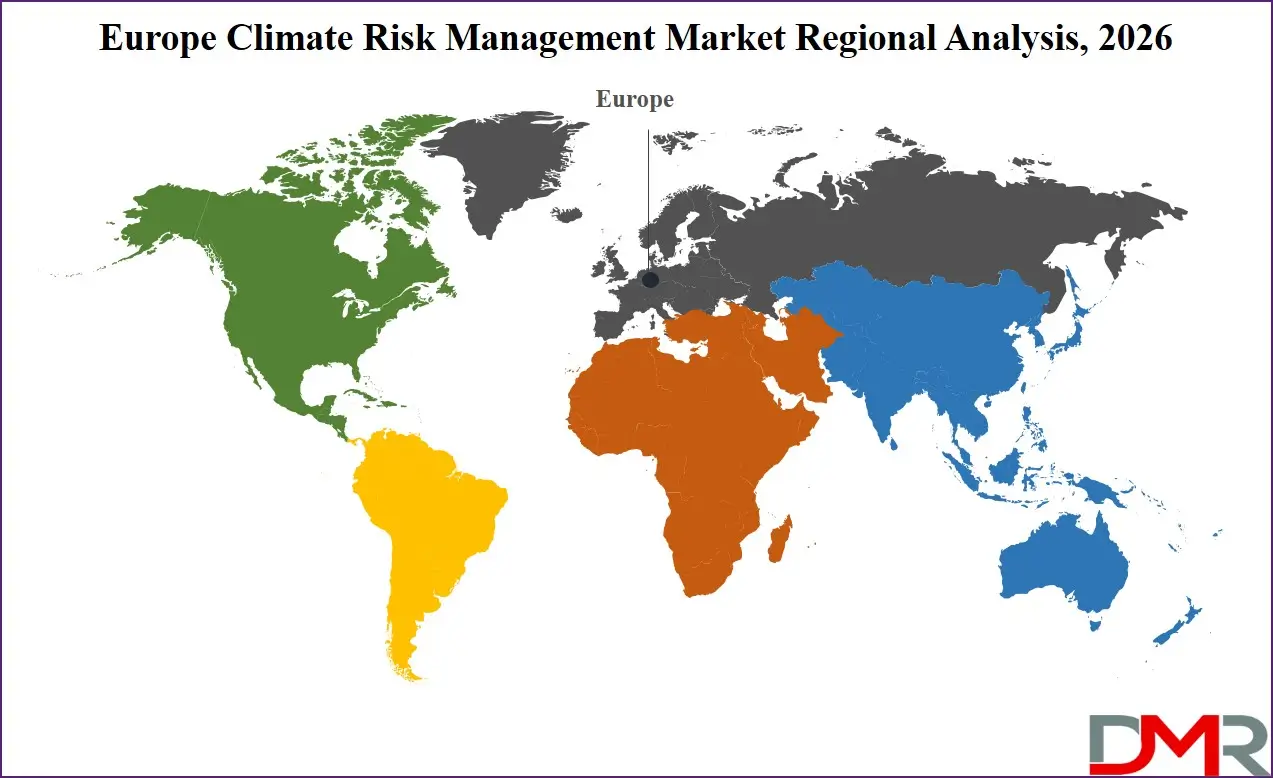
The market for climate risk management in Europe is highly variant, depending on various factors such as the maturity of regulations, climate vulnerability, and economic factors. Western Europe is the leading market for climate risk management, with countries such as Germany, France, and the Netherlands leading the way in climate risk management. The regulatory environment, institutional support, and high level of awareness among corporations and financial institutions are the key factors for the adoption of climate risk management in Western Europe.
ℹ
To learn more about this report –
Download Your Free Sample Report Here
The countries in Southern Europe are highly exposed to climate-related risks such as heatwaves, droughts, and wildfires. Despite this, there is a high level of investment in adaptation and resilience-building measures, particularly in sectors such as agriculture, tourism, and infrastructure. The climate risk management market in this region is expected to grow due to the increase in adaptation and resilience-building measures.
The climate risk management market in Central and Eastern Europe is a growing market, with a high level of alignment with the rest of the European Union. Although the adoption of climate risk management in Central and Eastern Europe is lower, due to factors such as economic and technological limitations, access to funding from the EU is expected to increase adoption in the near future.
By Region
Europe
- Germany
- The U.K.
- France
- Italy
- Russia
- Spain
- Benelux
- Nordic
- Rest of Europe
Europe Climate Risk Management Market: Competitive Landscape
The European climate risk management market is a dynamic and rapidly consolidating landscape, blending global financial data giants with specialized European climate-tech start-ups. The market is characterized by intense competition to provide the most accurate, granular, and compliant solutions.
Global players like MSCI Inc., Moody's ESG Solutions, S&P Global, and Bloomberg dominate the financial data and analytics segment, integrating climate risk into their core offerings for institutional investors. Technology and consulting giants such as Accenture, IBM, and McKinsey & Company are major players, providing end-to-end advisory and technology implementation services.
A vibrant ecosystem of European-native climate-tech firms is a key differentiator. Companies like Cervest (UK), Risilience (UK), and Entrix (Germany) are challenging incumbents with AI-driven, SaaS-based platforms that offer deep scientific rigor and user-centric design. This innovative landscape is supported by strong venture capital investment.
Some of the prominent players in the Europe Climate Risk Management Market are:
- Accenture
- Anthesis Group
- BMT
- Boston Consulting Group
- Climate Risk Services
- ClimSystems
- Deloitte
- ENGIE Impact
- Environmental Resources Management
- EY
- Guidehouse
- IBM
- Jupiter Intelligence
- KPMG
- Marsh McLennan
- McKinsey & Company
- Moody’s
- PwC
- S&P Global
- WSP
- Other Key Players
Recent Developments in the Europe Climate Risk Management Market
- March 2026: Moody’s ESG Solutions announced the enhancement of its climate risk data platform with new asset-level physical risk scores for all major European infrastructure assets.
- February 2026: MSCI Inc. developed and announced the launch of new Climate Value-at-Risk (Climate VaR) metrics that are tailored to meet the needs of the European Central Bank’s climate stress testing requirements.
- February 2026: Cervest secured Series C funding to further develop and expand its AI-powered climate intelligence platform for enterprise and government clients in Europe.
- January 2026: Accenture acquired a leading climate data analytics company in Europe to strengthen its climate capabilities in supporting clients in the EU with the CSRD.
- December 2025: The European Commission announced the final technical screening criteria for the EU Taxonomy, creating huge demand for services that can classify and report on ‘sustainable’ economic activities.
Report Details
| Report Characteristics |
| Market Size (2026) |
USD 5.7 Bn |
| Forecast Value (2035) |
USD 45.3 Bn |
| CAGR (2026–2035) |
25.9% |
| Historical Data |
2021 – 2025 |
| Forecast Data |
2027 – 2035 |
| Base Year |
2025 |
| Estimate Year |
2026 |
| Report Coverage |
Market Revenue Estimation, Market Dynamics, Competitive Landscape, Growth Factors and etc. |
| Segments Covered |
By Risk Type (Physical Risks, Transition Risks, and Liability Risks), By Solution (Risk Assessment & Analysis, Risk Mitigation & Adaptation, Monitoring & Reporting Solutions, and Consulting & Advisory Services), By Deployment Mode (Cloud-based and On-premises), By Enterprise Size (Large Enterprises, and Small & Medium Enterprises (SMEs)), and By Industry Vertical (Financial Services & Insurance, Energy & Utilities, Agriculture & Forestry, Manufacturing & Industrial, Real Estate & Infrastructure, and Government & Public Sector) |
| Regional Coverage |
Europe – Germany, The UK, France, Russia, Spain, Italy, Benelux, Nordic, & Rest of Europe |
| Prominent Players |
Accenture, Anthesis Group, BMT, Boston Consulting Group, Climate Risk Services, ClimSystems, Deloitte, ENGIE Impact, Environmental Resources Management, EY, Guidehouse, IBM, Jupiter Intelligence, KPMG, Marsh McLennan, McKinsey & Company, Moody’s, PwC, S&P Global, WSP, and Other Key Players |
| Purchase Options |
We have three licenses to opt for: Single User License (Limited to 1 user), Multi-User License (Up to 5 Users) and Corporate Use License (Unlimited User) along with free report customization equivalent to 0 analyst working days, 3 analysts working days and 5 analysts working days respectively. |
Frequently Asked Questions
How big is the Europe Climate Risk Management Market?
▾ The Europe Climate Risk Management Market size is estimated to have a value of USD 5.7 billion in 2026 and is expected to reach USD 45.3 billion by the end of 2035.
Who are the key players in the Europe Climate Risk Management Market?
▾ Some of the major key players in the Europe Climate Risk Management Market are MSCI Inc., Moody's ESG Solutions, S&P Global, Bloomberg, Accenture, IBM, and many others.
What is the growth rate in the Europe Climate Risk Management Market?
▾ The market is growing at a CAGR of 25.9 percent over the forecasted period.