Market Overview
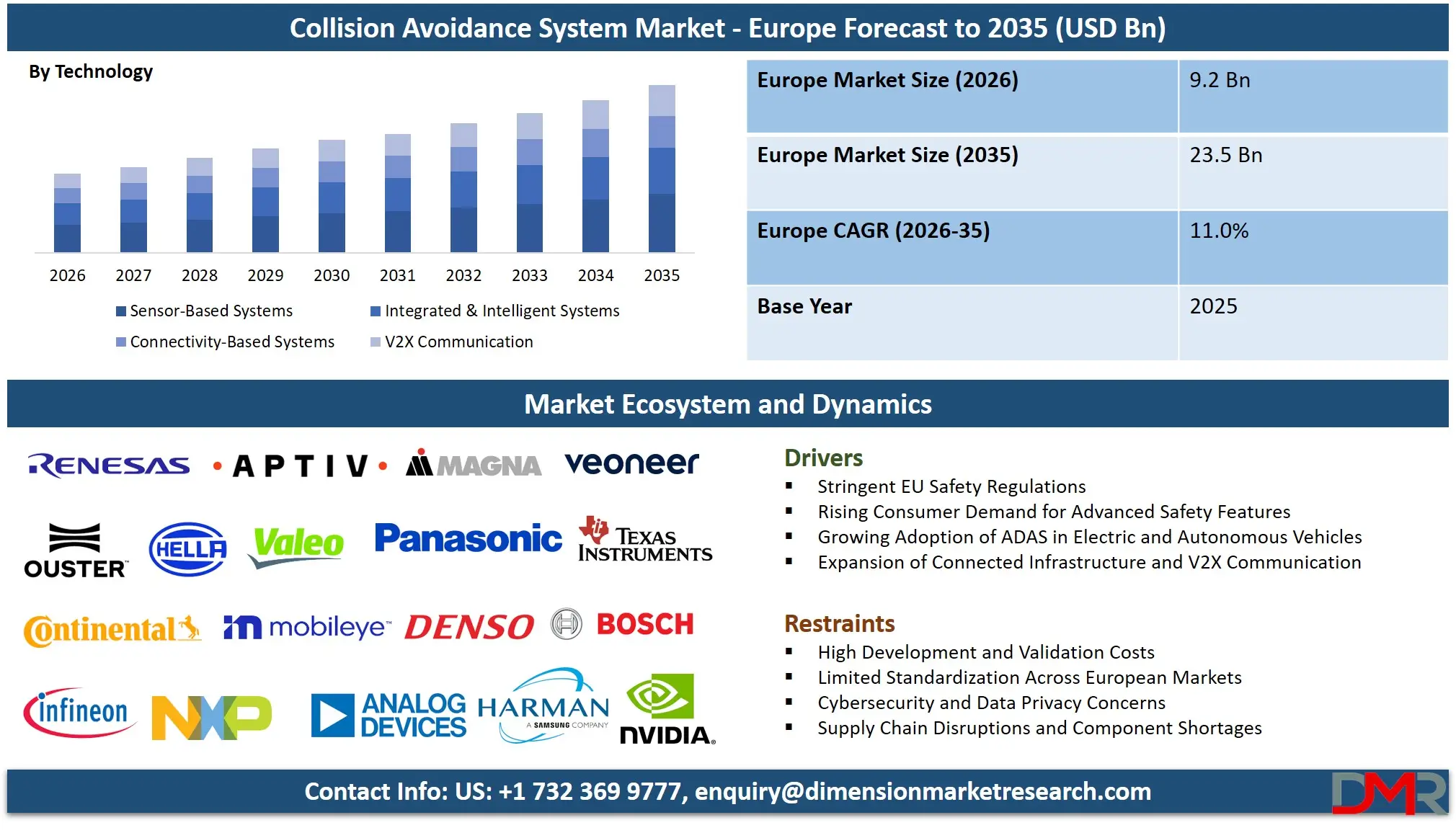
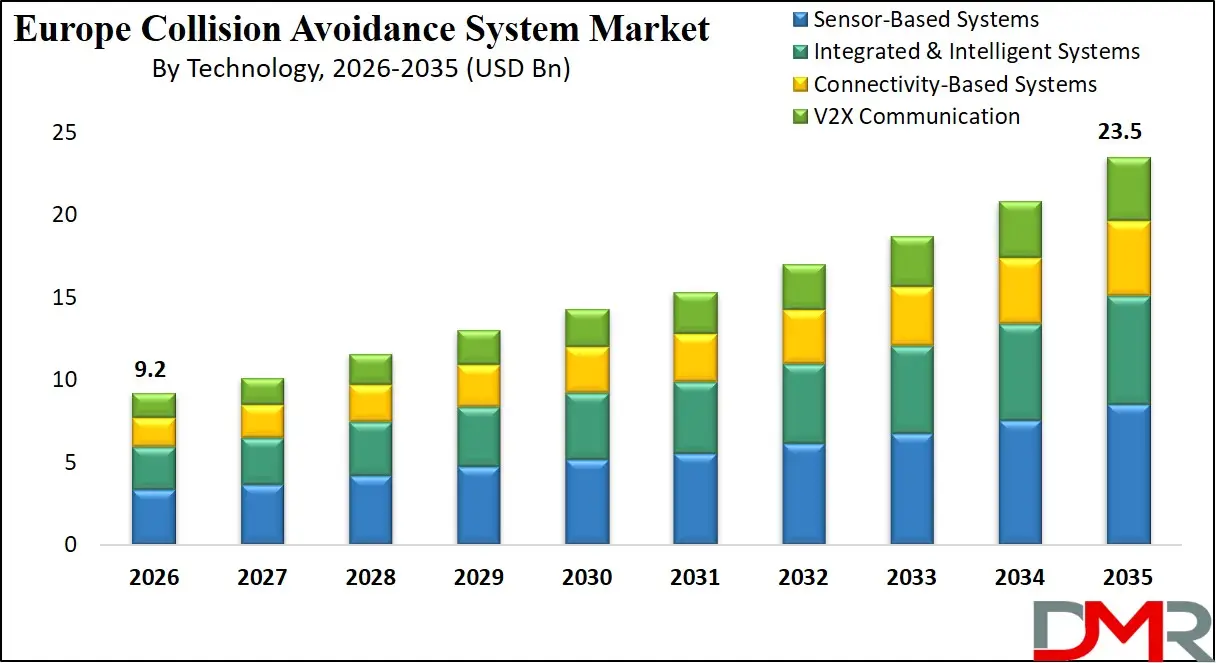
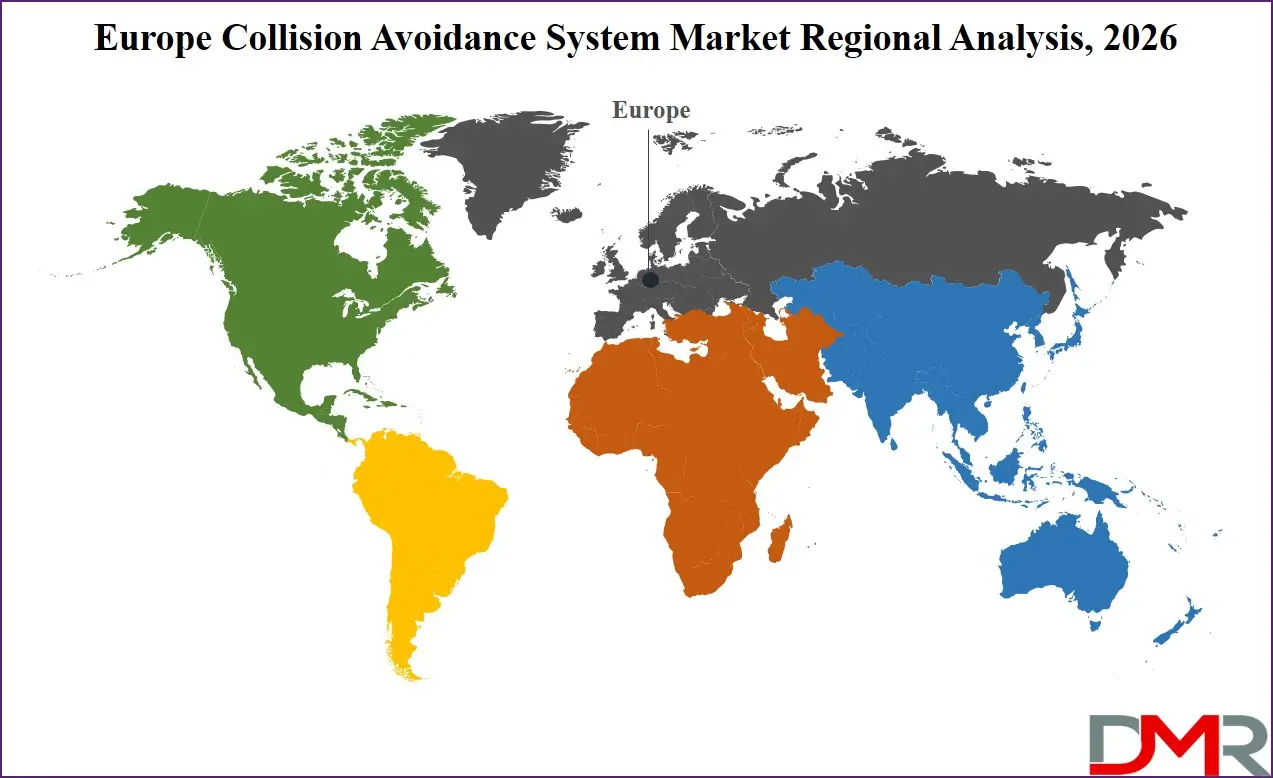
The Europe Collision Avoidance System market size is expected to reach a value of USD 9.2 billion in 2026, and it is further anticipated to reach a market value of USD 23.5 billion by 2035 at a CAGR of 11.0%.
ℹ
To learn more about this report –
Download Your Free Sample Report Here
The collision avoidance system market is an important part of the automotive and transportation safety ecosystem in Europe, driven by stringent safety regulations and the region's commitment to Vision Zero—eliminating traffic fatalities. As a global leader in automotive innovation and safety standards, Europe occupies a privileged position in the development and adoption of advanced driver-assistance systems (ADAS). The sector covers a wide range of technologies, from longitudinal and lateral control systems to surround monitoring and driver monitoring solutions, which are crucial in reducing road accidents and supporting the growth of connected and autonomous mobility. The European Union's commitment to enhancing road safety has resulted in substantial investment in research, infrastructure, and technology, significantly transforming the vehicle safety landscape.
Over the last few years, the collision avoidance system market in Europe has witnessed a strategic transition in adopting advanced technologies like AI, sensor fusion, and V2X communication. These technologies are making safety systems more effective, developing real-time situational awareness, facilitating easier decision-making, and further helping in the mitigation of collision risks. Also, with the rapid growth of electric and autonomous vehicles, the need for sophisticated perception and intervention systems has accelerated the demand for companies to scale up their safety portfolios. All these evolutions of technology and the market are likely to drive the sector's growth, signifying a good future outlook for the market.
Key trends currently evident within the collision avoidance system arena in Europe are digital transitions taking hold of vehicle safety operations by moving from traditional reactive measures to proactive, tech-based ecosystems. Aside from this, further integration of AI and sensor fusion brings predictive analytics and real-time decisions with enhanced environmental perception for better outputs of efficiency. Furthermore, with the augmenting emphasis on sustainability and safety in line with the European Green Deal, the adaptation of lightweight and energy-efficient sensor technologies, such as advanced radar and LiDAR systems, is on the rise. Similarly, the rise in shared mobility and autonomous driving has changed strategies for system integration as companies try to meet consumer expectations of safe and reliable transportation.
ℹ
To learn more about this report –
Download Your Free Sample Report Here
The market is consequently witnessing huge opportunities on the back of high investments by the European government in smart infrastructure development. Initiatives such as the construction of intelligent transport systems (ITS) and connected road networks are creating a robust safety backbone to support regional mobility. Megaprojects like the development of 5G corridors for connected vehicles illustrate the strategic importance of collision avoidance in enabling Europe's ambitious safety and sustainability goals. The technological prowess of the region enhances its potential to become a global hub for ADAS innovation, offering unparalleled access to key markets across the continent. Further, the focus on smart technologies like AI, edge computing, and high-definition mapping provides companies with opportunities to gain a competitive edge by improving system accuracy and reducing costs.
Impact of Iran Conflict On Europe Collision Avoidance System Market
The Iran conflict can influence the Europe Collision Avoidance System (CAS) Market through its effects on energy prices, supply chains, and economic stability. Rising geopolitical tensions in the Middle East often lead to higher oil and fuel prices, which increase manufacturing and transportation costs for European automotive companies. Higher production costs can raise vehicle prices and may slow the adoption of advanced safety technologies such as collision avoidance systems in the short term.
The conflict can also disrupt global logistics and trade routes, causing delays in the supply of critical automotive components such as sensors, semiconductors, and radar modules used in collision avoidance technologies. These supply chain disruptions may affect production schedules for vehicles equipped with advanced driver assistance systems (ADAS).
Additionally, economic uncertainty caused by geopolitical tensions can influence consumer spending and vehicle demand across Europe. However, rising fuel costs may encourage greater adoption of electric vehicles and advanced safety technologies, which could support long-term growth of the collision avoidance system market in the region.
Europe Collision Avoidance System Market: Key Takeaways
- Market Value: The Europe Collision Avoidance System Market size is estimated to have a value of USD 9.2 billion in 2026 and is expected to reach USD 23.5 billion by the end of 2035.
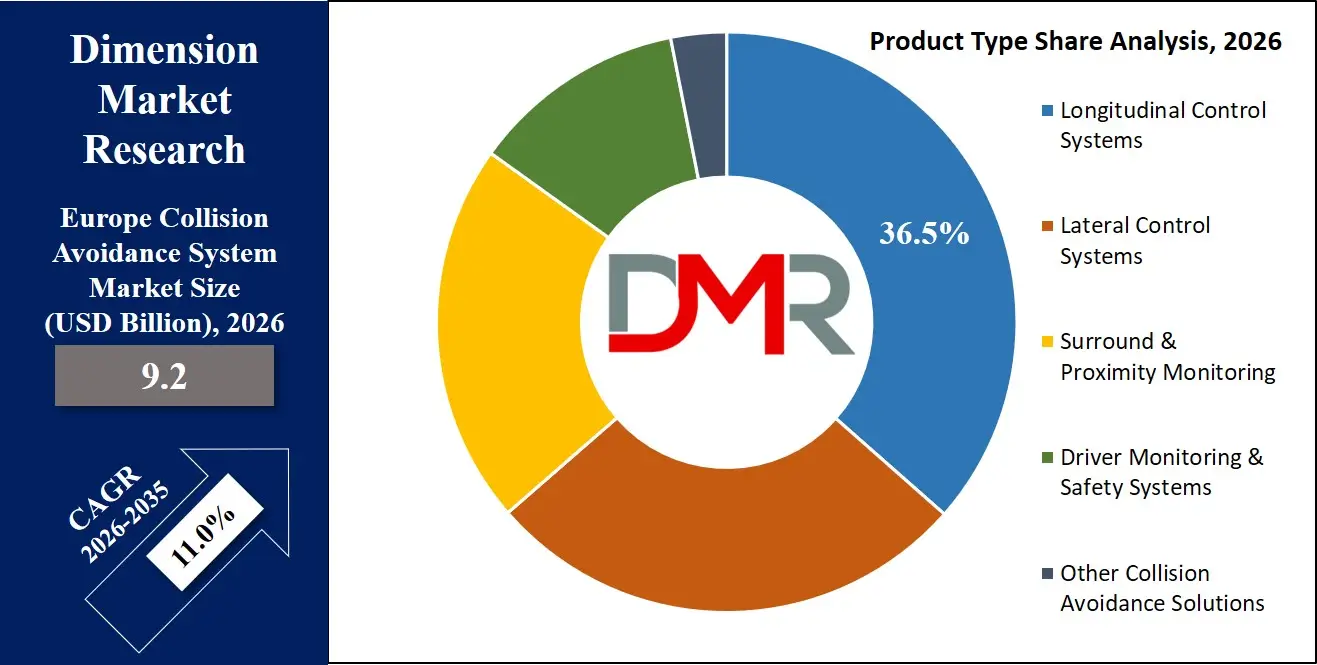
- By Product Type Segment Analysis: Longitudinal Control Systems are anticipated to dominate this segment in this market as they will hold 36.5% of market share in 2026.
- By Technology Segment Analysis: Sensor-Based Systems, particularly Radar and Camera, are projected to dominate the technology segment in the Europe Collision Avoidance System Market with the highest market share in 2026.
- By Vehicle Type Segment Analysis: The passenger vehicles segment is anticipated to dominate the Europe collision avoidance system market with a major market share in 2026.
- By Autonomy Level Segment Analysis: Level 1 (Driver Assistance) and Level 2 (Partial Automation) are projected to hold the leading positions in the autonomy level segment of this market in 2026.
- By Sales Channel Segment Analysis: OEM is projected to dominate the sales channel segment in the Europe collision avoidance system market in 2026.
- By End User Industry Segment Analysis: The automotive sector is projected to dominate the end-user industry segment in the Europe collision avoidance system market in 2026.
- Key Players: Some of the major key players in the Europe Collision Avoidance System Market are Bosch, Continental AG, ZF Friedrichshafen AG, Aptiv, Denso Corporation, Valeo, Magna International, and many others.
- Market Growth Rate: The market is growing at a CAGR of 11.0 percent over the forecasted period.
Europe Collision Avoidance System Market: Use Cases
- Autonomous Emergency Braking (AEB) in Passenger Vehicles: This application automatically applies the brakes to prevent or mitigate rear-end collisions, leveraging radar and camera fusion to detect vehicles, pedestrians, and cyclists, significantly reducing urban accidents.
- Lane Keeping Assist (LKA) for Long-Haul Trucking: LKA systems in heavy commercial vehicles prevent unintended lane departures on highways, reducing driver fatigue-related incidents and enhancing safety for fleet operators across European transport corridors.
- Blind Spot Detection (BSD) in Delivery Vans: BSD systems in light commercial vehicles alert drivers to vehicles or cyclists in adjacent lanes during city deliveries, addressing a critical safety gap in congested urban environments.
- Driver Monitoring Systems (DMS) for Autonomous Driving: In Level 3 automated vehicles, DMS ensures the driver remains attentive and can take over control when required, providing a critical safety layer for conditional automation on European motorways.
Europe Collision Avoidance System Market: Stats & Facts
European Commission (EU Road Safety & Transport)
- Around 19,940 people died in road crashes in the EU in 2024.
- The EU recorded an average of 45 road deaths per million inhabitants in 2024.
- The European Union aims to reduce road deaths by 50% by 2030 under the Vision Zero strategy.
- EU vehicle safety regulations are expected to save about 860 lives annually.
- These regulations could also prevent about 10,000 serious road injuries every year.
- The EU General Safety Regulation affects over 15 million new vehicle registrations annually across EU member states.
European Automobile Manufacturers' Association (ACEA)
- European vehicle production reached 12.8 million vehicles in 2023.
- More than 85% of vehicles produced in Europe include some form of active safety system.
- Around 30% of European drivers consider ADAS safety features essential when purchasing a new vehicle.
- Europe recorded 1.59 million new van sales in 2024, representing an 8.3% annual increase.
- Van sales in Europe grew 14.6% in 2023 before the 2024 increase.
Euro NCAP (European New Car Assessment Programme)
- Nearly 95% of new vehicles sold in Europe comply with Euro NCAP safety ratings.
- Europe has more than 30 million vans operating on its roads.
- Euro NCAP introduced ADAS safety testing for commercial vans in 2021.
- In 2021, testing of 18 vans, only 4 vehicles scored above 40% in ADAS performance ratings.
- By 2024 testing, 17 out of 18 vans scored above 60% in ADAS safety performance.
Eurostat (European Union Statistics Office)
- The European Union has over 4 million registered heavy goods vehicles.
- Heavy trucks account for 83.1% of freight transport measured in tonne-kilometers in the EU.
European Transport Safety Council
- EU vehicle safety regulations could prevent approximately 25,000 road deaths by 2038.
- These measures could also prevent around 140,000 serious road injuries by 2038.
European Automotive Safety Studies
- Automatic Emergency Braking (AEB) systems could reduce road crashes by 18% to 26% when widely implemented.
- Lane departure warning and lane-keeping systems could reduce crashes by 3% to 18%.
- Parking assistance and maneuvering systems can reduce low-speed property-damage crashes by 38% to 44%.
- Around 20% of road accidents in Europe occur at intersections, where collision avoidance technologies are crucial.
Europe Collision Avoidance System Market: Market Dynamic
Driving Factors in the Europe Collision Avoidance System Market
Digital Transformation of Vehicle Safety Systems
The collision avoidance system sector in Europe is also becoming a hub of digital transformation due to the initiatives laid down by the EU's Digital Decade for integrating technology across all mobility sectors. Companies are leveraging technologies such as AI, sensor fusion, and cloud-based mapping for real-time risk assessment, predictive analytics, and extended environmental perception. For example, AI-enabled perception software provides timely insights into potential hazards, hence reducing any inefficiencies in decision-making. Sensor fusion enhances data accuracy in complex driving scenarios, building trust among stakeholders.
Autonomous Driving Expansion Boosting ADAS Demand
This rapid growth in autonomous driving has produced high demand in Europe for the sector to implement efficient and reliable collision avoidance solutions. Automakers such as Volkswagen, Stellantis, and Mercedes-Benz have partnered with leading technology providers to try to meet today's demanding expectations around safety and automation. As autonomous vehicles are increasingly integral to future mobility, this trend is producing real investment in the hard infrastructure of testing and validation, but also increasingly in digital platforms that then tie the operation together in one seamless interface for automakers and consumers alike.
Restraints in the Europe Collision Avoidance System Market
High Development and Validation Costs
Advanced collision avoidance technologies and validation processes require huge capital investment, although regulations are very supportive. Smaller automotive suppliers can hardly afford high-definition LiDAR, AI processing units, or comprehensive real-world testing. This may impede market entry and further widen the gap between large corporations and SMEs in access to next-generation safety solutions.
Limited Standardization Across Markets
The ADAS industry will have challenges with varying national interpretations of EU directives and differing infrastructure readiness across member states. While safety harmonization is included in EU transport policy, the pace of its implementation often outpaces the standardization of technical requirements. Normally, companies incur additional costs for region-specific calibration and validation. Getting over this restraint will involve considerable investments in cross-border collaboration and unified technical standards.
Opportunities in the Europe Collision Avoidance System Market
Integration of Emerging Technologies
The adoption of technologies such as AI, edge computing, and high-definition mapping presents an excellent opportunity for collision avoidance optimization. Automated perception and decision-making cut down reaction times, while AI-powered systems enhance prediction capabilities. Startups and established firms alike are testing such integrations, which offer an excellent opportunity for technology providers and investors to reach the European ADAS market.
Expansion of Two-Wheeler and Micromobility Solutions
With growing demand for safety systems in powered two-wheelers, e-scooters, and e-bikes, this collision avoidance segment is developing at a very fast pace. There is also more inflow of investments into radar and camera-based detection systems tailored for vulnerable road users. Additionally, urban mobility development in Europe and changing commuting habits will further contribute to this segment and open doors for value-added service providers through innovative solution design.
Trends in the Europe Collision Avoidance System Market
EU Safety Regulations and Mandates
Europe's General Safety Regulation (GSR) underlines mandatory fitment of advanced collision avoidance systems like AEB, intelligent speed assistance, and lane keeping systems in all new vehicles, making the ADAS industry one of the mainstays of automotive safety. Huge investments in research and testing facilities across Germany, France, and Sweden have been driving growth. In addition, it also comprises safety-friendly policies like Euro NCAP ratings, which also attract investment in higher levels of automation. This helps strengthen the region's standing as a leading automotive safety hub globally.
Increasing Consumer Demand for Safety Features
European consumers are also actively seeking vehicles equipped with advanced safety features, with participation in consumer awareness campaigns increasing the demand for vehicles with high safety ratings, which in turn are raising demand for more sophisticated collision avoidance solutions. The integration of these systems in mass-market vehicles, the expansion of features to two-wheelers and commercial vehicles, and the development of more affordable sensor technology are easing the way to broader adoption. All these growth drivers increase the region's penetration of safety technologies and ensure the prosperity of the ADAS sector in the globalized automotive economy.
Europe Collision Avoidance System Market: Research Scope and Analysis
By Product Type Analysis
Longitudinal Control Systems are projected to dominate the product type segment in this market as they will hold 36.5% of market share in 2026. The dominance of longitudinal control systems in the product type segment of the Europe Collision Avoidance System Market is owing to stringent safety mandates and high consumer demand for active safety features in the region. Automakers in Europe are heavily investing in integrating AEB, ACC, and FCW systems across their vehicle lineups; hence, advanced solutions are being used to smooth safety operations, ranging from forward-looking radar sensors and camera modules to complex control algorithms. Europe's General Safety Regulation underlines the emphasis on mandating technology for the enhancement of road safety. It therefore raises demand for radar and camera-based systems that help in detecting potential frontal collisions with real-time intervention and building system reliability, critical to maintaining safety performance in this highly competitive market. Such huge production volumes of passenger vehicles spur demand for high-class longitudinal control systems.
ℹ
To learn more about this report –
Download Your Free Sample Report Here
It will help in the complete interconnectivity of active safety and autonomous driving functions within a vehicle, thus making its future in the market indispensable. ADAS, autonomous driving, and connected mobility completely depend on this basic longitudinal control for gathering and synchronizing data within their systems. Growth in the electric vehicle industry also adds to the contribution of advanced regenerative braking integrated with AEB that optimizes the processes of energy recovery. Government-backed safety programs and initiatives advocate the use of the latest available technology to reduce road fatalities, thus supporting the market of longitudinal control systems. Hence, longitudinal control systems remain an integral factor as they provide the foundational safety skeleton for modern vehicle autonomy in Europe.
By Technology Analysis
Sensor-based systems, particularly Radar and Camera, are anticipated to dominate the share in the technology segment of the collision avoidance system market in Europe, owing to the strategic reliance on mature, cost-effective sensing technologies for mass-market ADAS applications. Europe has vast automotive production capabilities with a supply chain connecting important manufacturing regions for easier distribution of sensor components to OEMs across Germany, France, and Central Europe. Radar and camera offer a proven balance of performance and affordability that no other sensing modality can match for functions like AEB and ACC. First-generation ADAS functions, being very essential, do happen with passenger vehicles and also in commercial vehicle applications. There is an unparalleled growth in the number of safety regulations, as with a growing demand for higher levels of automation, manufacturers would want to expect reliable sensor data under all conditions.
The sensor technology investments involve the expansion of production capacity for 4D imaging radar and high-resolution cameras, adding testing facilities along major development hubs, and furthering sensor fusion algorithms. This development also aligns with the EU's Digital Decade in positioning Europe as a leader in automotive electronics. The proximity of automotive R&D centers to sensor production facilities further cements their position as the main technology enabler for collision avoidance. Among many factors, cost-effectiveness comes forward. Compared with LiDAR or thermal imaging, it has radar and camera at a lower cost for mass-market applications, thus making it perfectly fit for meeting regulatory requirements across vehicle segments. The increased use of technologies for sensor fusion, like AI-based perception, improves the operational efficiency-cum-situation more in enhancing sensor system dominance.
By Deployment Analysis
The deployment segment in the Europe Collision Avoidance System Market is projected to be dominated by integrated, embedded systems, having become essential for real-time performance, functional safety compliance, and seamless vehicle integration. Due to the increased adoption of stringent safety standards by automakers in Europe, embedded solutions offer deterministic response times and robust architecture support for complex ADAS operations. This is also aligned with the aim of ISO 26262 functional safety standards toward ensuring system reliability and embracing technological rigor. Embedded solutions make the sensor data available in real-time to make better decisions and activate safety mechanisms without latency. This becomes even more important in a region like Europe, where high-speed driving and varied road conditions require instant intervention. Moreover, embedded deployments reduce cybersecurity risks associated with external connectivity, such as hacking and data breaches. The functional safety appeal appeals to businesses of all sizes, especially Tier 1 suppliers, who are a growth segment in Europe's automotive ecosystem.
Not to say that the capability for advanced fail-operational architectures of the embedded platforms stands in their favor, too. Redundancy, high-integrity software, and real-time operating systems integrated with these embedded systems further enable businesses in safety operations relevant to achieving high levels of autonomy. This dream is partly driven by initiatives from the European Commission aimed at improving semiconductor sovereignty and partnering with major global chip manufacturers. This will enable them to support dynamic safety demands and ensure operational integrity, hence remaining the dominant deployment method within the collision avoidance system market.
By Vehicle Type Analysis
The passenger vehicles segment is poised to dominate the Europe collision avoidance system market due to several reasons, such as high production volumes, stringent regulatory requirements, and advanced technology adoption. Passenger vehicles are at the forefront of collision avoidance system adoption, driven by their high unit sales and consumer demand for safety features. Europe's General Safety Regulation places a strong emphasis on the mandatory fitment of ADAS in all new passenger cars, a factor that automakers across Germany, France, and Italy are eyeing with great interest. These manufacturers could be operating very extensive vehicle lineups for which they need advanced sensor suites to enable functions like AEB, Lane Keep Assist, and Blind Spot Detection. Passenger vehicle OEMs also boast scale for the adoption of innovative technologies like sensor fusion and AI, paving the way to enhance safety and complete transparency in operations. The reason passenger vehicle manufacturers can negotiate better with sensor suppliers and deploy integrated ADAS solutions is because of their overall scale.
Passenger vehicle manufacturers have benefited from such initiatives funded by the European Commission, examples of which are the research programs under Horizon Europe to provide different types of funding and infrastructure to extend the safety functionalities of their vehicles. In summary, this dominant position has also been enabled by driving the wheel of Europe's automotive export economy. At the forefront in the implementation of state-of-the-art safety best practices, leading passenger vehicle manufacturers continue to help set new thresholds in terms of safety and innovative applications across the industry, therefore continuing their top market performance.
By Autonomy Level Analysis
Level 1 (Driver Assistance) and Level 2 (Partial Automation) are projected to lead in the Europe Collision Avoidance System Market due to their highly transformative effect in achieving immediate safety improvements and widespread availability across vehicle segments. These autonomy levels power basic and advanced driver assistance functions, respectively, and, most importantly, provide stepping stones toward higher automation in solving the complexity brought along by modern traffic scenarios. Europe's General Safety Regulation focuses on mandating Level 1 and Level 2 functions across all new vehicles. All these objectives also align with Level 1 and Level 2 applications focused on improved accident avoidance and driver convenience. Firms utilize Level 1 and Level 2 technologies to meet regulatory requirements, reduce accident rates, and create better customer value.
Passenger vehicle and commercial vehicle adoption have gained momentum in Europe, thus increasing the need for Level 1 and Level 2 solutions. For example, adaptive cruise control improves highway driving comfort, and lane-keeping assist prevents unintended departures. Level 1 and Level 2 functions enhance the end-user experience, which is an important factor in the competitive market. Government-backed safety mandates and partnerships with global tech leaders further fuel Level 1 and Level 2 adoption. These are increasingly being integrated into electric and autonomous vehicles, packaging what is to be expected in the future. Having already proven their potential through improvement in safety, convenience, and scalability, Level 1 and Level 2 remain among the major autonomy levels that will still dominate in the European collision avoidance system sector.
By Sales Channel Analysis
OEM is projected to hold the leading position with 83.1% of market share in the sales channel segment of the Europe Collision Avoidance System Market in 2026, as such a channel is very crucial to ensure system integration and regulatory compliance. With the fast growth of vehicle production and stringent safety mandates in Europe, the demand for OEM-integrated collision avoidance solutions that could meet such regulatory demands effectively is increasingly felt. OEM-integrated systems enable automakers under EU regulations to attain the goal of Europe being a global safety leader by ensuring the best system calibration with minimum integration issues and improved reliability. Advanced OEM solutions integrate AI, sensor fusion, and embedded software to offer real-time hazard detection and smooth safety interventions that minimize accidents, optimize system performance, and improve vehicle safety ratings. The increasing adoption of integrated ADAS platforms underlines the importance of this segment all the more. Besides, integrated technologies are increasingly being adopted by OEMs that work in tandem with vehicle architecture to help lower development costs and meet customer expectations.
Further, this segment ensures dominance through the development of growing vehicle production and electrification. Most advanced OEM systems have their dependence on such kinds of factory integration by serving vehicle segments that range from small hatchbacks to luxury sedans. Supporting the market's demand are also some government initiatives towards developing local semiconductor and sensor production. Due to its immediate effects relating to system reliability, safety compliance, and customer satisfaction, it keeps its superiority in the market.
By End User Industry Analysis
The automotive sector is projected to dominate the end-user industry segment in the Europe collision avoidance system market because this sector has the highest volume of vehicles produced and the most stringent reliance on efficient safety systems and regulatory compliance. Vehicle production is showing stable demand in Europe, driven by a safety-conscious consumer base, with seamless safety system integration, driving this segment to dominate. Europe's General Safety Regulation emphasizes safety improvements across all road vehicles, with a key focus on the automotive sector. Further, this segment would need the implementation of high-tech collision avoidance solutions to guarantee safety and performance-impacting sensor selection, software algorithms, and system validation, since safety expectations evolve day by day. Heavy investments have been made in R&D and production capacity not only by leading automakers like Volkswagen Group and Stellantis but also by local Tier 1 suppliers, making the market competitive in reality. Safety feature packages for online and offline sales are increasingly being offered by automakers, further raising the requirement for sophisticated collision avoidance systems.
The EU's support in enhancing testing infrastructure, thereby establishing innovation hubs, improves the supply chain for automotive companies. Because this industry is considered a major contributor to the EU GDP and employment, it is considered one of the most dominant end-user industries. The automotive sector continues to lead with the latest technologies and comprehensive safety systems in shaping the region's collision avoidance ecosystem.
The Europe Collision Avoidance System Market Report is segmented on the basis of the following:
By Product Type
- Longitudinal Control Systems
- Adaptive Cruise Control (ACC)
- Autonomous Emergency Braking (AEB)
- Forward Collision Warning (FCW)
- Pedestrian & Cyclist Detection Systems
- Lateral Control Systems
- Lane Departure Warning System (LDWS)
- Lane Keeping Assist (LKA)
- Lane Centering Assist
- Surround & Proximity Monitoring
- Blind Spot Detection (BSD)
- Rear Cross Traffic Alert (RCTA)
- Front & Rear Parking Sensors
- 360° Surround View Camera Systems
- Automated Parking Assistance
- Driver Monitoring & Safety Systems
- Driver Monitoring Systems (DMS)
- Driver Drowsiness Detection
- Attention & Distraction Monitoring
- Other Collision Avoidance Solutions
By Technology
- Sensor-Based Systems
- Radar
- LiDAR
- Camera
- Ultrasonic
- Fusion (Multi-Sensor)
- Infrared/Thermal Imaging
- Integrated & Intelligent Systems
- Sensor Fusion (Multi-Sensor Integration)
- Artificial Intelligence & Machine Learning-Based Processing
- Connectivity-Based Systems
- V2X Communication
By Vehicle Type
- Passenger Vehicles
- Light Commercial Vehicles (LCVs)
- Heavy Commercial Vehicles (HCVs)
- Electric Vehicles
- Two-Wheelers
- Autonomous Vehicles
By Autonomy Level
- Level 0 (No Automation)
- Level 1 (Driver Assistance)
- Level 2 (Partial Automation)
- Level 3 (Conditional Automation)
- Level 4 (High Automation)
- Level 5 (Full Automation)
By Sales Channel
By End User Industry
- Automotive
- Aviation
- Marine & Shipping
- Railways
- Industrial / Warehousing & Logistics
- Other End-Use Areas
Impact of Artificial Intelligence on the Europe Collision Avoidance System Market
- Strong Safety Regulations: Strict vehicle safety regulations by the European Union, including the General Safety Regulation, are driving the mandatory adoption of advanced driver assistance systems (ADAS) such as automatic emergency braking and lane-keeping assist.
- Growing Adoption of ADAS Technologies: Increasing integration of radar, LiDAR, camera, and sensor-fusion technologies in passenger and commercial vehicles is accelerating the deployment of collision avoidance systems across Europe.
- Rising Focus on Road Safety: Europe continues to prioritize road safety initiatives aimed at reducing road accidents and fatalities, which is encouraging automakers to implement advanced collision prevention technologies.
- Expansion of Electric and Autonomous Vehicles: The growth of electric vehicles and the development of autonomous and semi-autonomous driving technologies are increasing demand for advanced safety systems, including collision detection and avoidance solutions.
- Technological Advancements and Innovation: Continuous innovation in artificial intelligence, machine learning, and vehicle-to-everything (V2X) communication is enhancing the performance and reliability of collision avoidance systems in modern vehicles.
By Region
Europe
- Germany
- The U.K.
- France
- Italy
- Russia
- Spain
- Benelux
- Nordic
- Rest of Europe
Europe Collision Avoidance System Market: Competitive Landscape
The competitive landscape is fueled by participation, both domestic and international, in the Europe Collision Avoidance System Market, with dissimilar capabilities across sensor technologies, software, and system integration. Major companies, therefore, strategize to develop advanced technologies such as AI, sensor fusion, and V2X communication to enhance collision avoidance capabilities to better competitiveness. The leading players are Bosch, Continental AG, and ZF Friedrichshafen AG in integrated ADAS solutions, while in software and AI-based processing, the leading players include Aptiv, Nvidia, and Mobileye. These companies leverage Europe's General Safety Regulation initiatives by aligning their offerings with regulatory priorities meant to attract investments and improve safety. It addresses both the rising passenger vehicle and commercial vehicle sectors, where these focus more on niche capabilities: urban autonomy and heavy-duty safety systems, while Tier 1 suppliers have emerged, providing end-to-end solutions in sensor integration and software development.
ℹ
To learn more about this report –
Download Your Free Sample Report Here
Mergers and partnerships are common strategies that allow companies to expand service portfolios and reach. For instance, technology companies partnering with automakers enhance data-driven decision-making and operational agility. While the leading companies are competitive, innovation in the fields of AI, sensor miniaturization, and predictive analytics separates the leaders. These opportunities are likely to come along with an intense competitive landscape for both established players and new entrants, with strong governmental support for developing safety innovation clusters.
Some of the prominent players in the Europe Collision Avoidance System Market are:
- Bosch
- Continental AG
- ZF Friedrichshafen AG
- Aptiv
- Denso Corporation
- Valeo
- Magna International
- Mobileye (Intel)
- Nvidia Corporation
- Texas Instruments
- Infineon Technologies
- NXP Semiconductors
- Hella GmbH & Co. KGaA
- Veoneer
- Autoliv
- Ouster, Inc.
- Analog Devices, Inc.
- Renesas Electronics Corporation
- Samsung Electronics (Harman International)
- Panasonic Corporation
- Other Key Players
Recent Developments in the Europe Collision Avoidance System Market
- October 2025: Bosch introduced a new AI-powered sensor fusion platform designed to enhance object detection and classification for Level 2+ and Level 3 systems. The platform uses deep learning algorithms to reduce false positives, improve environmental perception, and minimize computational load, addressing challenges in urban and highway automation.
- September 2025: Continental AG entered a strategic partnership with a prominent European automaker to integrate 4D imaging radar technology into its next-generation vehicle platforms. The collaboration focuses on enhancing long-range detection, reducing system complexity, and enabling high-resolution mapping across diverse driving conditions.
- August 2025: The European Commission inaugurated the "Connected Europe" testing corridor, a state-of-the-art facility spanning Germany, France, and Luxembourg designed to improve V2X communication validation across critical mobility applications such as automated driving and safety systems.
- November 2024: Mobileye launched a new EyeQ-based high-definition mapping solution to enhance localization and path planning for automated vehicles in Europe. The solution facilitates seamless collaboration across stakeholders, ensuring accurate positioning, reducing localization errors, and enhancing safety in complex environments.
- July 2024: ZF Friedrichshafen AG unveiled cloud-based predictive maintenance innovations aimed at improving commercial vehicle safety operations. These solutions leverage big data to forecast component failures, optimize maintenance schedules, and streamline fleet management processes, empowering businesses to adapt to dynamic operational demands.
- April 2024: Aptiv expanded its portfolio of sensor fusion software platforms, increasing capability for Level 3 highway pilot systems. This move supports the growing demand for automated driving and strengthens Europe's position in global ADAS software development.
Report Details
| Report Characteristics |
| Market Size (2026) |
USD 9.2 Bn |
| Forecast Value (2035) |
USD 23.5 Bn |
| CAGR (2026–2035) |
11.0% |
| Historical Data |
2021 – 2025 |
| Forecast Data |
2027 – 2035 |
| Base Year |
2025 |
| Estimate Year |
2026 |
| Report Coverage |
Market Revenue Estimation, Market Dynamics, Competitive Landscape, Growth Factors and etc. |
| Segments Covered |
By Product Type (Longitudinal Control Systems, Lateral Control Systems, Surround & Proximity Monitoring, Driver Monitoring & Safety Systems, and Other Collision Avoidance Solutions), By Technology (Sensor-Based Systems, Integrated & Intelligent Systems, Connectivity-Based Systems, and V2X Communication), By Vehicle Type (Passenger Vehicles, Light Commercial Vehicles (LCVs), Heavy Commercial Vehicles (HCVs), Electric Vehicles, Two-Wheelers, and Autonomous Vehicles), By Autonomy Level (Level 0 (No Automation), Level 1 (Driver Assistance), Level 2 (Partial Automation), Level 3 (Conditional Automation), Level 4 (High Automation), and Level 5 (Full Automation)), By Sales Channel (OEM, and Aftermarket), By End User Industry (Automotive, Aviation, Marine & Shipping, Railways, Industrial / Warehousing & Logistics, Other end-use areas) |
| Regional Coverage |
Europe – Germany, The UK, France, Russia, Spain, Italy, Benelux, Nordic, & Rest of Europe |
| Prominent Players |
Bosch, Continental AG, ZF Friedrichshafen AG, Aptiv, Denso Corporation, Valeo, Magna International, Mobileye (Intel), Nvidia Corporation, Texas Instruments, Infineon Technologies, NXP Semiconductors, Hella GmbH & Co. KGaA, Veoneer, Autoliv, Ouster, Inc., Analog Devices, Inc., Renesas Electronics Corporation, Samsung Electronics (Harman International), and Panasonic Corporation, and Other Key Players |
| Purchase Options |
We have three licenses to opt for: Single User License (Limited to 1 user), Multi-User License (Up to 5 Users) and Corporate Use License (Unlimited User) along with free report customization equivalent to 0 analyst working days, 3 analysts working days and 5 analysts working days respectively. |
Frequently Asked Questions
How big is the Europe Collision Avoidance System Market?
▾ The Europe Collision Avoidance System Market size is estimated to have a value of USD 9.2 billion in 2026 and is expected to reach USD 23.5 billion by the end of 2035.
Who are the key players in the Europe Collision Avoidance System Market?
▾ Some of the major key players in the Europe Collision Avoidance System Market are Bosch, Continental AG, ZF Friedrichshafen AG, Aptiv, Denso Corporation, Valeo, Magna International, and many others.
What is the growth rate in the Europe Collision Avoidance System Market?
▾ The market is growing at a CAGR of 11.0 percent over the forecasted period.