Market Overview
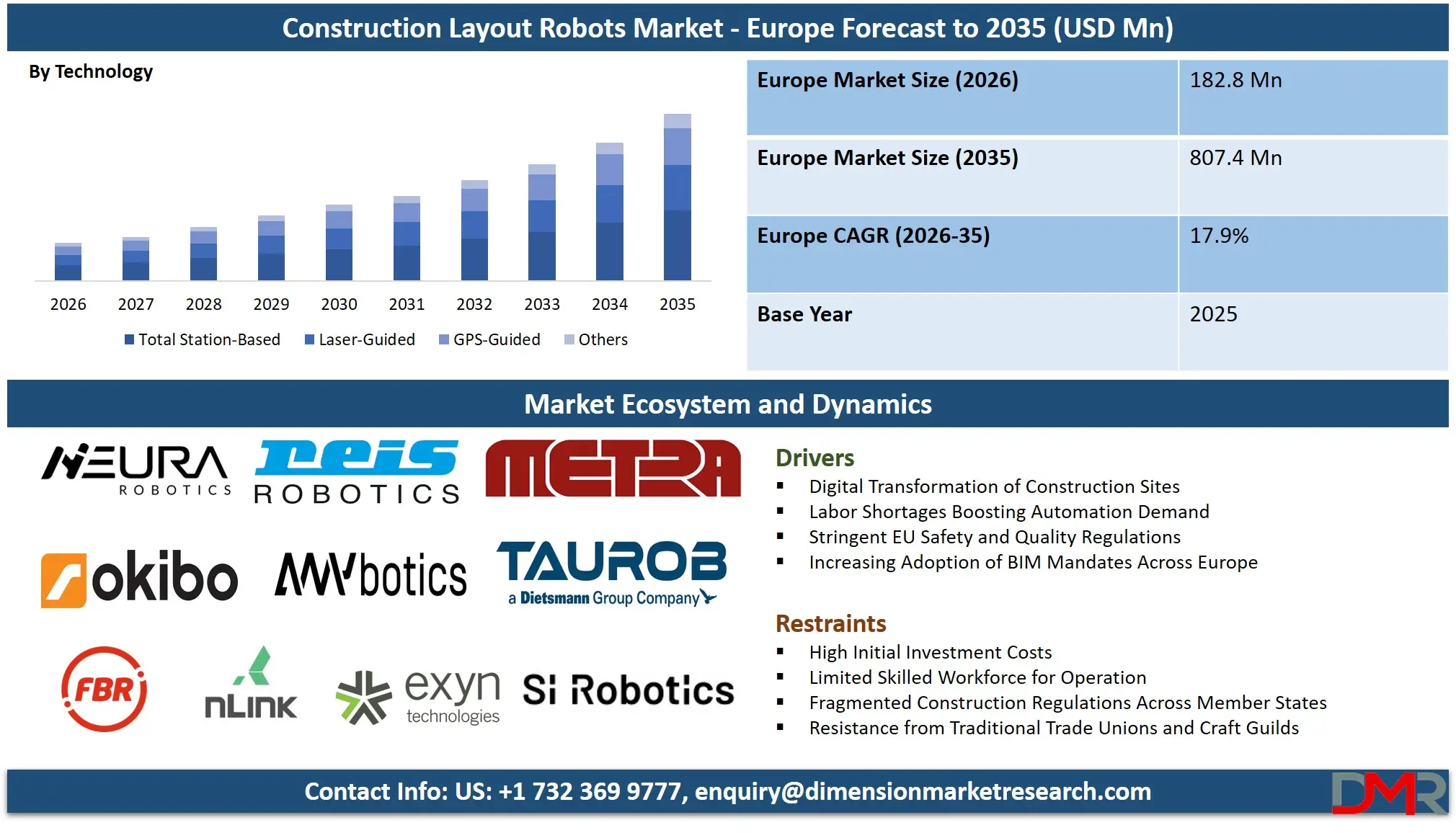
The Europe Construction Layout Robots Market size is expected to reach a value of USD 182.8 million in 2026, and it is further anticipated to reach a market value of USD 807.4 million by 2035 at a CAGR of 17.9%. The construction layout robots market is an important part of the construction and infrastructure development ecosystem in Europe, driven by labor shortages, increasing project complexity, and the region's commitment to digitalization in construction, transforming traditional building practices. As a global leader in construction technology and sustainable development, Europe occupies a privileged position in the adoption of automated layout solutions. The sector covers a range of robotic systems, from semi-autonomous to fully autonomous platforms utilizing total station, laser-guided, and GPS technologies, which are crucial in reducing on-site errors, minimizing material waste, and accelerating project timelines. The European Union's commitment to enhancing construction productivity has resulted in substantial investment in research, digital infrastructure, and technology adoption, significantly transforming the building and infrastructure landscape.
ℹ
To learn more about this report –
Download Your Free Sample Report Here
Over the last few years, the construction layout robots market in Europe has witnessed a strategic transition toward adopting advanced technologies like BIM integration, real-time positioning systems, and cloud-based data synchronization. These technologies are making layout processes more efficient, developing precise on-site marking, facilitating easier quality control, and further helping in the reduction of rework costs. Also, with the rapid growth of modular and prefabricated construction, the need for high-accuracy layout systems has accelerated the demand for companies to scale up their automation portfolios. All these evolutions of technology and the market are likely to drive the sector's growth, signifying a good future outlook for the market.
Key trends currently evident within the construction layout robots arena in Europe are digital transitions taking hold of construction site operations by moving from traditional manual methods to automated, data-driven ecosystems. Aside from this, further integration of Building Information Modeling (BIM) with robotic systems brings real-time design synchronization and enhanced accuracy for better project outcomes. Furthermore, with the augmenting emphasis on sustainable construction in line with the European Green Deal, the adaptation of electric and energy-efficient robotic platforms is on the rise. Similarly, the rise in renovation and retrofitting projects has changed strategies for system deployment as companies try to meet client expectations of faster and more precise construction delivery.
ℹ
To learn more about this report –
Download Your Free Sample Report Here
The market is consequently witnessing huge opportunities on the back of high investments by the European government in digital construction initiatives. Initiatives such as the development of smart construction sites and connected job sites are creating a robust productivity backbone to support regional building activity. Megaprojects like the construction of high-speed rail networks and urban development programs illustrate the strategic importance of layout automation in enabling Europe's ambitious infrastructure and sustainability goals. The technological prowess of the region enhances its potential to become a global hub for construction robotics innovation, offering unparalleled access to key markets across the continent. Further, the focus on smart technologies like AI, cloud computing, and real-time kinematic positioning provides companies with opportunities to gain a competitive edge by improving system accuracy and reducing operational costs.
Europe Construction Layout Robots Market: Key Takeaways
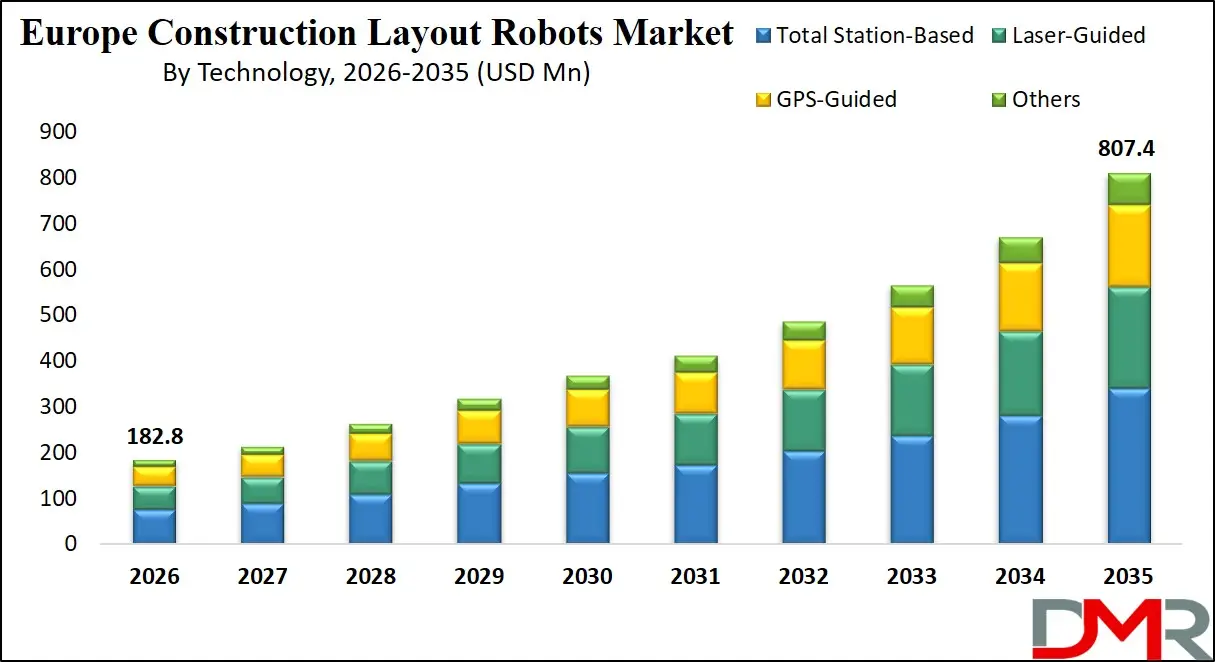
- Market Value: The Europe Construction Layout Robots Market size is estimated to have a value of USD 182.8 million in 2026 and is expected to reach USD 807.4 million by the end of 2035.
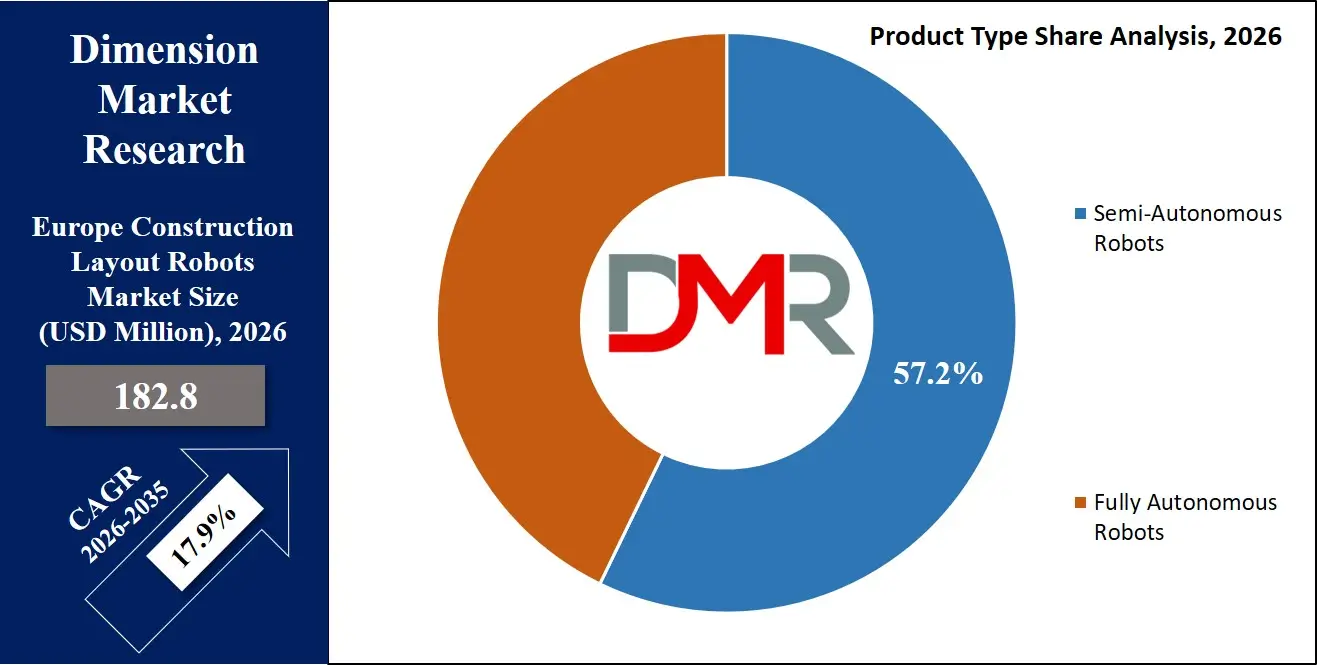
- By Product Type Segment Analysis: Semi-Autonomous Robots are anticipated to dominate this segment in this market as they will hold 57.2% of market share in 2026.
- By Technology Segment Analysis: Total Station-Based systems, particularly robotic total stations, are projected to dominate the technology segment in the Europe Construction Layout Robots Market with the highest market share in 2026.
- By Application Segment Analysis: The commercial construction segment is anticipated to dominate the Europe construction layout robots market with a major market share in 2026.
- By End-User Segment Analysis: Construction companies are projected to hold the leading position in the end-user segment of this market in 2026.
- Key Players: Some of the major key players in the Europe Construction Layout Robots Market are KUKA AG, Neura Robotics, MetraLabs GmbH, Reis Robotics, ABB Robotics, Okibo, and many others.
- Market Growth Rate: The market is growing at a CAGR of 17.9% over the forecasted period.
Europe Construction Layout Robots Market: Use Cases
- Automated Floor Layout in Commercial Buildings: This application uses robotic total stations to automatically mark column locations, wall positions, and MEP embedments on concrete slabs, reducing manual measuring errors and accelerating construction timelines for office towers and retail spaces.
- Foundation Marking for Residential Projects: Semi-autonomous robots equipped with laser guidance precisely mark footing and foundation perimeters on residential construction sites, ensuring accurate excavation and concrete placement while reducing labor requirements.
- Bridge Pier Positioning in Infrastructure Construction: GPS-guided layout robots establish precise pier locations for bridge construction projects, enabling accurate positioning across large, obstacle-prone sites and improving quality control for transportation infrastructure.
- Steel Column Alignment in Industrial Facilities: Fully autonomous robots with total station integration verify and mark anchor bolt locations for steel column installation in industrial plants, ensuring structural accuracy and reducing costly rework during facility construction.
Europe Construction Layout Robots Market: Stats & Facts
European Construction Industry Federation (FIEC)
- The European construction industry employs over 14 million people across EU member states.
- Construction output in Europe reached approximately USD 2.11 trillion in 2024.
- The sector accounts for about 9% of EU GDP, making it one of the largest industrial segments in Europe.
- Labor productivity in European construction has grown by only 1% annually over the past decade, driving automation adoption.
- Skilled labor shortages affect over 60% of construction firms across major European markets.
Eurostat (European Union Statistics Office)
- Building permits across the EU increased by 4.2% in 2024, indicating sustained construction activity.
- Renovation and retrofit projects now account for over 35% of construction activity in Western Europe.
- Infrastructure investment in the EU is projected to reach approximately USD 760.5 billion annually by 2027.
- Germany, France, and Italy together represent over 55% of European construction output.
European Construction Sector Observatory
- Digital technology adoption in construction could increase sector productivity by up to 15% by 2030.
- Building Information Modeling (BIM) adoption among European construction firms reached 62% in 2024, up from 40% in 2020.
- Construction site accidents cost the European economy an estimated approximately USD 5.9 billion annually.
- Projects utilizing automated layout systems report rework reductions of 20% to 30% compared to traditional methods.
European Investment Bank (EIB)
- The EIB provided over USD 29.3 billion in construction and infrastructure financing in 2024.
- Digital construction technologies received approximately USD 1.40 billion in dedicated EU funding under the Horizon Europe program.
- Green construction initiatives are expected to drive approximately USD 234.0 billion in additional investment by 2030.
Construction Robotics Studies
- Automated layout systems can reduce marking time by up to 80% compared to manual methods.
- Layout robots achieve positioning accuracy within 1-2 millimeters, significantly improving quality control.
- Projects using robotic layout report material waste reductions of 15% to 25%.
- Labor cost savings from automated layout typically range from 30% to 50% per project phase.
- Return on investment for construction layout robots is typically achieved within 12 to 18 months for medium-sized contractors.
Europe Construction Layout Robots Market: Market Dynamic
Driving Factors in the Europe Construction Layout Robots Market
Digital Transformation of Construction Sites
The construction layout robots sector in Europe is also becoming a hub of digital transformation due to the initiatives laid down by the EU's Digital Decade for integrating technology across all construction sectors. Companies are leveraging technologies such as BIM integration, cloud-based data synchronization, and real-time positioning for enhanced accuracy, predictive analytics, and extended site connectivity. For example, BIM-enabled layout robots provide precise design-to-site transfer, hence reducing any inefficiencies in construction processes. Real-time positioning enhances data accuracy in complex site conditions, building trust among stakeholders.
Labor Shortages Boosting Automation Demand
This persistent labor shortage in European construction has produced high demand in Europe for the sector to implement efficient and reliable layout automation solutions. Contractors such as Vinci, Strabag, and Skanska have partnered with leading technology providers to try to meet today's demanding expectations around productivity and quality. As labor scarcity becomes increasingly integral to construction challenges, this trend is producing real investment in the hardware infrastructure of robotic systems, but also increasingly in digital platforms that then tie the operation together in one seamless interface for contractors and project owners alike.
Restraints in the Europe Construction Layout Robots Market
High Initial Investment Costs
Advanced construction layout robots and training programs require huge capital investment, although productivity benefits are very supportive. Smaller construction firms can hardly afford high-precision total stations, robotic platforms, or comprehensive operator training. This may impede market entry and further widen the gap between large contractors and SMEs in access to next-generation construction technologies.
Limited Skilled Workforce for Operation
The construction robotics industry will have challenges with limited availability of operators skilled in robotic systems and varying digital literacy across workforces. While productivity improvement is included in EU construction policy, the pace of technology adoption often outpaces the training of technical personnel. Normally, companies incur additional costs for operator training and technical support. Getting over this restraint will involve considerable investments in vocational training and workforce development programs.
Opportunities in the Europe Construction Layout Robots Market
Integration of Emerging Technologies
The adoption of technologies such as AI, cloud computing, and real-time kinematic positioning presents an excellent opportunity for construction layout optimization. Automated design transfer and robotic marking cut down layout time, while AI-powered systems enhance error detection capabilities. Startups and established firms alike are testing such integrations, which offer an excellent opportunity for technology providers and investors to reach the European construction robotics market.
Expansion of Renovation and Retrofitting Projects
With growing demand for precision layout systems in renovation projects, historic building restorations, and energy-efficient retrofits, this construction layout segment is developing at a very fast pace. There is also more inflow of investments into compact and portable robotic systems tailored for confined site conditions. Additionally, urban development initiatives in Europe and changing building stock modernization requirements will further contribute to this segment and open doors for value-added service providers through innovative solution design.
Trends in the Europe Construction Layout Robots Market
EU Digital Construction Initiatives
Europe's Digital Construction Strategy underlines promotion of BIM adoption and automated systems in public procurement, making the construction robotics industry one of the mainstays of construction modernization. Huge investments in research and testing facilities across Germany, France, and Scandinavia have been driving growth. In addition, it also comprises productivity-friendly policies like digital construction incentives, which also attract investment in higher levels of automation. This helps strengthen the region's standing as a leading construction technology hub globally.
Increasing Demand for Productivity Improvement
European contractors are also actively seeking construction methods equipped with automated systems, with participation in productivity improvement programs increasing the demand for projects with high efficiency targets, which in turn are raising demand for more sophisticated layout robotics solutions. The integration of these systems in commercial construction, the expansion of features to residential and infrastructure projects, and the development of more affordable robotic technology are easing the way to broader adoption. All these growth drivers increase the region's penetration of construction technologies and ensure the prosperity of the robotics sector in the globalized construction economy.
Europe Construction Layout Robots Market: Research Scope and Analysis
By Product Type Analysis
Semi-Autonomous Robots are projected to dominate the product type segment in this market as they will hold 57.2% of market share in 2026. The dominance of semi-autonomous robots in the product type segment of the Europe Construction Layout Robots Market is owing to their proven reliability, operator familiarity, and optimal balance between automation and human oversight in the region. Construction firms in Europe are heavily investing in integrating robotic total stations and semi-automated layout systems across their project sites; hence, advanced solutions are being used to smooth construction operations, ranging from precision positioning sensors and control interfaces to field-proven software algorithms. Europe's focus on construction productivity underlines the emphasis on adopting technology for the enhancement of project delivery. It therefore raises demand for systems that help in accurate site marking with operator supervision and building system trust, critical to maintaining quality performance in this competitive market. Such huge volumes of commercial construction projects spur demand for reliable semi-autonomous layout systems.
ℹ
To learn more about this report –
Download Your Free Sample Report Here
It will help in the complete interconnectivity of layout accuracy and project management functions within a construction site, thus making its future in the market indispensable. BIM, digital construction, and connected job sites completely depend on this semi-autonomous control for gathering and synchronizing data within their systems. Growth in the infrastructure sector also adds to the contribution of advanced positioning systems integrated with layout robots that optimize the processes of quality control. Government-backed digitalization programs and initiatives advocate the use of the latest available technology to improve construction productivity, thus supporting the market of semi-autonomous layout robots. Hence, semi-autonomous robots remain an integral factor as they provide the foundational accuracy skeleton for modern construction projects in Europe.
By Technology Analysis
Total Station-Based systems, particularly robotic total stations, are anticipated to dominate the share in the technology segment of the construction layout robots market in Europe, owing to the strategic reliance on mature, high-precision positioning technologies for professional construction applications. Europe has vast construction activity with a supply chain connecting important project regions for easier distribution of robotic equipment to contractors across Germany, France, and Scandinavia. Total station-based systems offer a proven balance of accuracy and reliability that no other positioning technology can match for functions like floor layout and foundation marking. First-generation robotic layout applications, being very essential, do happen with commercial construction and also in infrastructure project applications. There is an unparalleled growth in the number of digitalization requirements, as with a growing demand for higher project quality, contractors would want to expect reliable positioning data under all site conditions.
The technology investments involve the expansion of production capacity for robotic total stations and high-precision prisms, adding training facilities along major development hubs, and furthering positioning algorithms. This development also aligns with the EU's Digital Decade in positioning Europe as a leader in construction technology. The proximity of construction R&D centers to equipment production facilities further cements their position as the main technology enabler for layout automation. Among many factors, accuracy comes forward. Compared with standard GPS or manual methods, total station-based systems deliver superior accuracy for complex applications, thus making it perfectly fit for meeting quality requirements across construction segments. The increased use of technologies for BIM integration, like cloud-based data transfer, improves the operational efficiency-cum-situation more in enhancing total station system dominance.
By Application Analysis
The commercial construction segment is poised to dominate the Europe construction layout robots market due to several reasons, such as high project volumes, stringent quality requirements, and advanced technology adoption. Commercial construction is at the forefront of layout robot adoption, driven by its project complexity and demand for precision in office buildings, retail spaces, and hospitality developments. Europe's focus on construction quality places a strong emphasis on the adoption of automated layout in all new commercial projects, a factor that contractors across Germany, France, and the UK are eyeing with great interest. These contractors could be operating very extensive project portfolios for which they need advanced positioning systems to enable functions like column layout, wall marking, and MEP embedment positioning. Commercial contractors also boast scale for the adoption of innovative technologies like BIM integration and cloud synchronization, paving the way to enhance accuracy and complete transparency in operations. The reason commercial contractors can negotiate better with equipment suppliers and deploy integrated robotic solutions is because of their overall scale.
Commercial contractors have benefited from such initiatives funded by the European Commission, examples of which are the research programs under Horizon Europe to provide different types of funding and infrastructure to extend the automation capabilities of their projects. In summary, this dominant position has also been enabled by driving the wheel of Europe's commercial building economy. At the forefront in the implementation of state-of-the-art construction best practices, leading commercial contractors continue to help set new thresholds in terms of quality and innovative applications across the industry, therefore continuing their top market performance.
By Application Analysis
The end-user segment in the Europe Construction Layout Robots Market is projected to be dominated by construction companies, having become essential for project efficiency, quality compliance, and seamless site integration. Due to the increased adoption of productivity standards by contractors in Europe, robotic solutions offer deterministic accuracy and robust support for complex layout operations. This is also aligned with the aim of quality management standards toward ensuring project reliability and embracing technological rigor. Robotic solutions make the positioning data available in real-time to make better decisions and execute marking without delays. This becomes even more important in a region like Europe, where tight project schedules and complex site conditions require precise execution. Moreover, robotic deployments reduce human errors associated with manual methods, such as miscalculations and misreadings. The quality improvement appeal appeals to businesses of all sizes, especially medium-to-large contractors, who are a growth segment in Europe's construction ecosystem.
Not to say that the capability for advanced data integration of the robotic platforms stands in their favor, too. BIM connectivity, cloud-based synchronization, and real-time reporting integrated with these robotic systems further enable businesses in quality operations relevant to achieving high project standards. This dream is partly driven by initiatives from the European Commission aimed at improving construction digitalization and partnering with major global technology providers. This will enable them to support dynamic project demands and ensure operational integrity, hence remaining the dominant end-user group within the construction layout robots market.
The Europe Construction Layout Robots Market Report is segmented on the basis of the following:
By Product Type
- Semi-Autonomous Robots
- Fully Autonomous Robots
By Technology
- Total Station-Based
- Laser-Guided
- GPS-Guided
- Others
By Application
- Commercial Construction
- Residential Construction
- Industrial Construction
- Infrastructure Construction
By End-User
- Construction Companies
- Contractors
- Surveyors
- Architects
- Others
Impact of Artificial Intelligence on the Europe Construction Layout Robots Market
- Strong Digital Construction Mandates: Strict digitalization requirements by the European Union, including the BIM Mandate for public works, are driving the mandatory adoption of automated layout systems such as robotic total stations and GPS-guided positioning.
- Growing Adoption of Construction Automation: Increasing integration of robotic total stations, laser-guided systems, and GPS technology in commercial and infrastructure projects is accelerating the deployment of layout robots across Europe.
- Rising Focus on Productivity and Quality: Europe continues to prioritize construction productivity initiatives aimed at reducing project delays and rework, which is encouraging contractors to implement automated layout technologies.
- Expansion of Digital Construction: The growth of BIM adoption and the development of connected job site technologies are increasing demand for advanced layout systems, including robotic positioning and real-time data synchronization solutions.
- Technological Advancements and Innovation: Continuous innovation in artificial intelligence, cloud computing, and real-time kinematic positioning is enhancing the performance and reliability of construction layout robots in modern building projects.
By Region
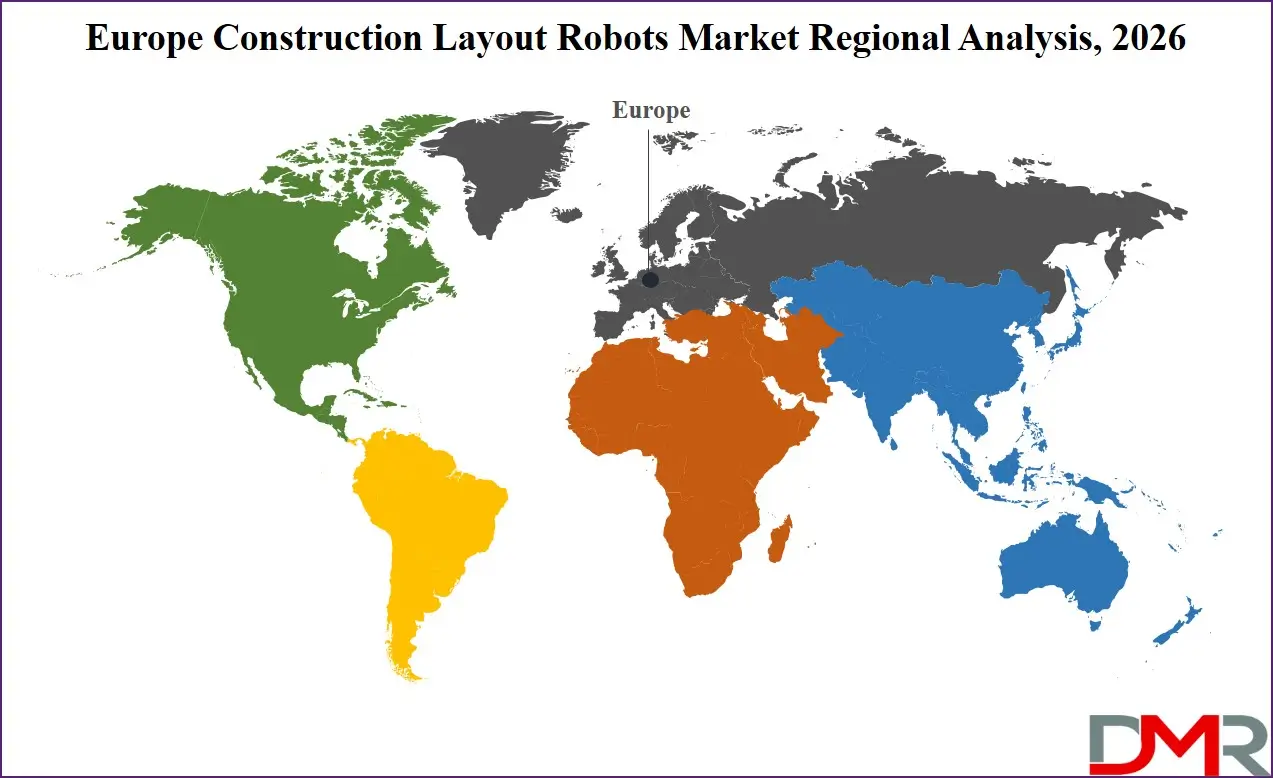
Europe
- Germany
- The U.K.
- France
- Italy
- Russia
- Spain
- Benelux
- Nordic
- Rest of Europe
Europe Construction Layout Robots Market: Competitive Landscape
The competitive landscape is fueled by participation, both domestic and international, in the Europe Construction Layout Robots Market, with dissimilar capabilities across positioning technologies, software, and system integration. Major companies, therefore, strategize to develop advanced technologies such as BIM integration, real-time kinematic positioning, and cloud-based data management to enhance layout capabilities to better competitiveness. The leading players are Topcon Corporation, Trimble Inc., and Hexagon AB in integrated positioning solutions, while in software and data processing, the leading players include Hilti Corporation and Komatsu Ltd. These companies leverage Europe's digital construction initiatives by aligning their offerings with regulatory priorities meant to attract investments and improve productivity. It addresses both the growing commercial construction and infrastructure sectors, where these focus more on niche capabilities: urban building projects and heavy civil works, while technology providers have emerged, providing end-to-end solutions in hardware integration and software development.
ℹ
To learn more about this report –
Download Your Free Sample Report Here
Mergers and partnerships are common strategies that allow companies to expand service portfolios and reach. For instance, technology companies partnering with contractors enhance data-driven decision-making and operational agility. While the leading companies are competitive, innovation in the fields of AI, sensor miniaturization, and predictive analytics separates the leaders. These opportunities are likely to come along with an intense competitive landscape for both established players and new entrants, with strong governmental support for developing construction innovation clusters.
Some of the prominent players in the Europe Construction Layout Robots Market are:
- KUKA AG
- Neura Robotics
- MetraLabs GmbH
- Reis Robotics
- ABB Robotics
- Okibo
- FBR Limited
- nLink AS
- GAMMA AR
- Exyn Technologies
- Additive Industries
- SI Robotics
- Scalers
- Taurob GmbH
- ANYbotics
- Rovenso SA
- Cyberdyne Europe
- PAL Robotics
- Blue Ocean Robotics
- Robotnik Automation
- Other Key Players
Recent Developments in the Europe Construction Layout Robots Market
- January 2026: ABB Robotics partnered with construction technology company AUAR to develop robotic micro-factories capable of automating timber building component production for modular housing projects in Europe, supporting sustainable and digitally automated construction processes.
- November 2025: KUKA AG collaborated with modular construction specialist Kleusberg to implement robotic welding systems for automated manufacturing of structural building modules, helping improve productivity and precision in prefabricated construction environments.
- September 2025: ANYbotics raised more than USD 137.2 million in funding to expand the global deployment of its autonomous inspection robot ANYmal, which is widely used for infrastructure inspection and digital asset monitoring across industrial and construction facilities.
- June 2025: PAL Robotics showcased its advanced mobile manipulation robots at international robotics conferences, demonstrating autonomous navigation, site monitoring, and AI-based robotic capabilities applicable to construction and infrastructure environments.
- March 2025: GAMMA AR expanded its augmented-reality construction platform designed to allow contractors to visualize BIM models directly on construction sites, enabling real-time layout verification and reducing positioning errors during building installation processes.
- October 2024: Taurob GmbH deployed its autonomous inspection robots across industrial facilities in Europe to perform remote monitoring and digital data collection in hazardous environments, supporting the growing adoption of robotics for infrastructure inspection and maintenance.
Report Details
| Report Characteristics |
| Market Size (2026) |
USD 182.8 Mn |
| Forecast Value (2035) |
USD 807.4 Mn |
| CAGR (2026–2035) |
17.9% |
| Historical Data |
2021 – 2025 |
| Forecast Data |
2027 – 2035 |
| Base Year |
2025 |
| Estimate Year |
2026 |
| Report Coverage |
Market Revenue Estimation, Market Dynamics, Competitive Landscape, Growth Factors and etc. |
| Segments Covered |
By Product Type (Semi-Autonomous Robots and Fully Autonomous Robots), By Technology (Total Station-Based, Laser-Guided, GPS-Guided and Others), By Application (Commercial Construction, Residential Construction, Industrial Construction and Infrastructure Construction), By End-User (Construction Companies, Contractors, Surveyors, Architects and Others) |
| Regional Coverage |
Europe – Germany, The UK, France, Russia, Spain, Italy, Benelux, Nordic, & Rest of Europe |
| Prominent Players |
KUKA AG, Neura Robotics, MetraLabs GmbH, Reis Robotics, ABB Robotics, Okibo, FBR Limited, nLink AS, GAMMA AR, Exyn Technologies, Additive Industries, SI Robotics, Scalers, Taurob GmbH, ANYbotics, Rovenso SA, Cyberdyne Europe, PAL Robotics, Blue Ocean Robotics, Robotnik Automation, and Other Key Players |
| Purchase Options |
We have three licenses to opt for: Single User License (Limited to 1 user), Multi-User License (Up to 5 Users) and Corporate Use License (Unlimited User) along with free report customization equivalent to 0 analyst working days, 3 analysts working days and 5 analysts working days respectively. |
Frequently Asked Questions
How big is the Europe Construction Layout Robots Market?
▾ The Europe Construction Layout Robots Market size is estimated to have a value of USD 182.8 million in 2026 and is expected to reach USD 807.4 million by the end of 2035.
Who are the key players in the Europe Construction Layout Robots Market?
▾ Some of the major key players in the Europe Construction Layout Robots Market are KUKA AG, Neura Robotics, MetraLabs GmbH, Reis Robotics, ABB Robotics, Okibo, and many others.
What is the growth rate in the Europe Construction Layout Robots Market?
▾ The market is growing at a CAGR of 17.9% over the forecasted period.