What is the Europe Conversational AI in Healthcare Market Size?
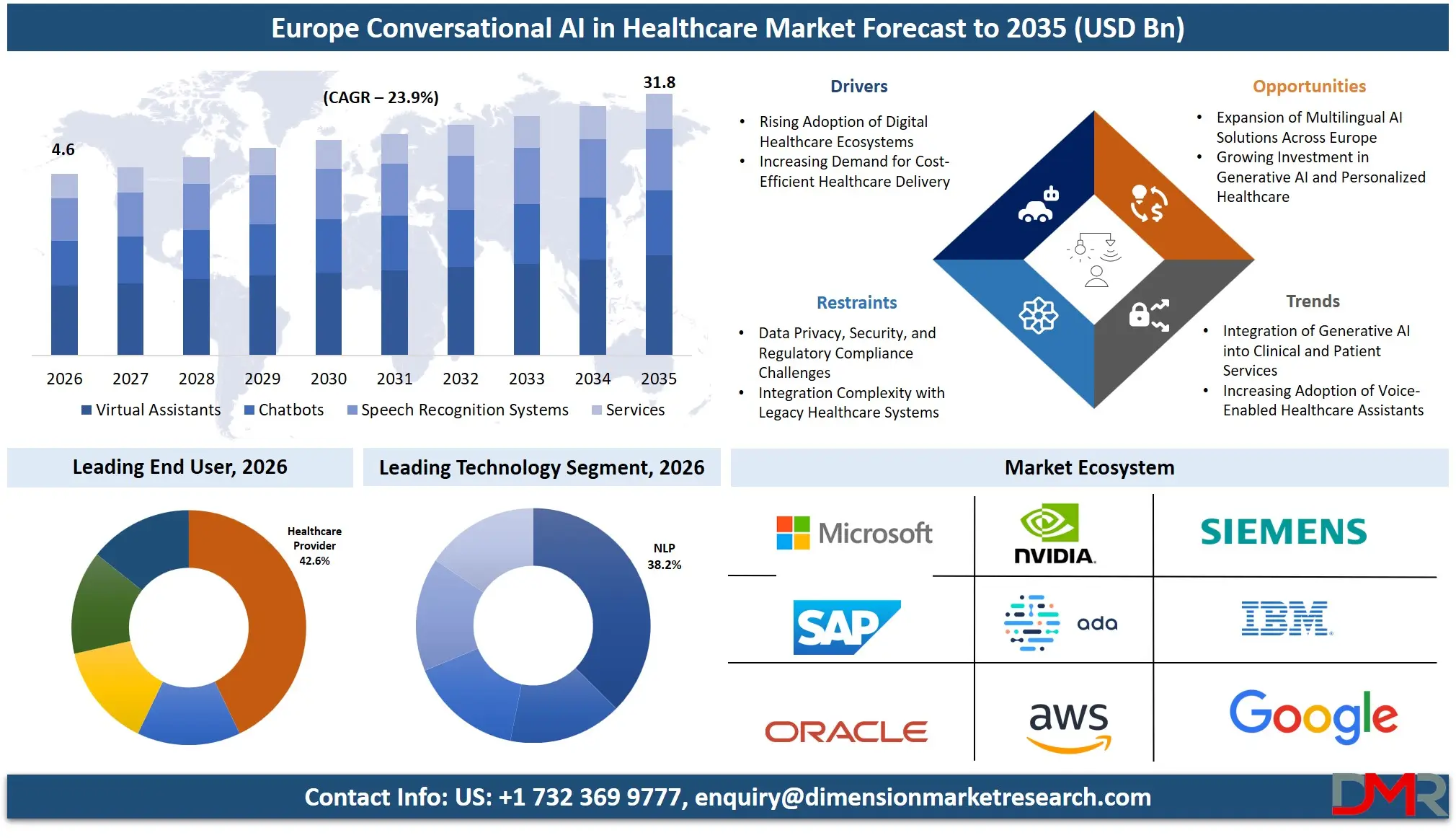
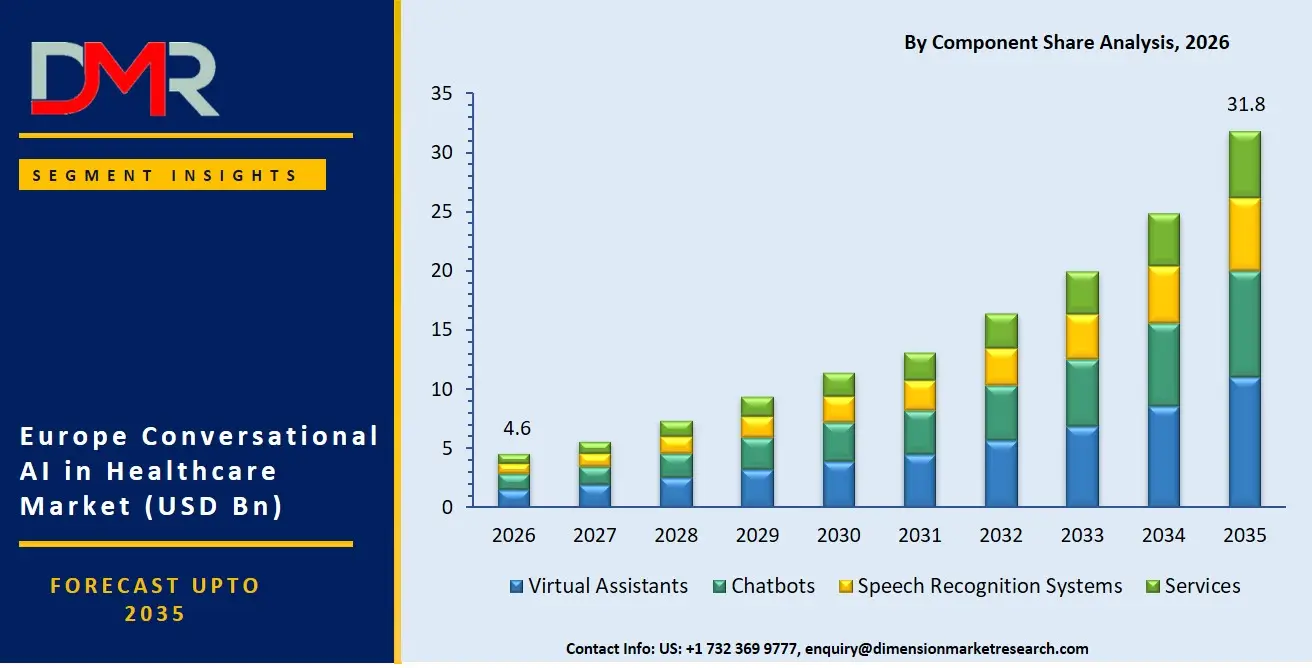
Europe Conversational AI in Healthcare Market size is expected to be USD 4.6 billion in 2026 and increase at a compound annual growth rate of 23.9% to USD 31.8 billion in 2035 owing to rising adoption of digital healthcare ecosystems.
ℹ
To learn more about this report –
Download Your Free Sample Report Here
The Europe Conversational AI in Healthcare Market comprises intelligent conversational technologies designed to improve healthcare delivery through automated patient interactions, clinical support, administrative assistance, and personalized communication. The market includes AI-powered chatbots, virtual assistants, speech recognition platforms, and related services utilizing natural language processing, machine learning, and context-aware computing. Growing pressure on healthcare systems, increasing digital health adoption, expanding telemedicine services, and demand for improved patient engagement are accelerating market growth. Advances in generative AI, multilingual healthcare solutions, stronger data integration capabilities, and supportive digital healthcare initiatives are further transforming the competitive landscape across European healthcare ecosystems.
Key Takeaways
- Market Size & Forecast: Europe Conversational AI in Healthcare Market size is projected to reach USD 4.6 billion in 2026 and is anticipated to have a value of USD 31.8 billion in 2035.
- Growth Rate & Outlook: Europe Conversational AI in Healthcare Market size is set to grow at a compound annual growth rate of 23.9% during the forecast period of 2026 to 2035.
- Primary Growth Drivers: Some of the major growth drivers in the market are Rising Adoption of Digital Healthcare Ecosystems, and more.
- Key Market Trends: Some of the major trends in the market are Increasing Adoption of Voice-Enabled Healthcare Assistants and more.
- By Component Type: Virtual Assistants is expected to get the largest revenue share in 2026 in Europe Conversational AI in Healthcare Market.
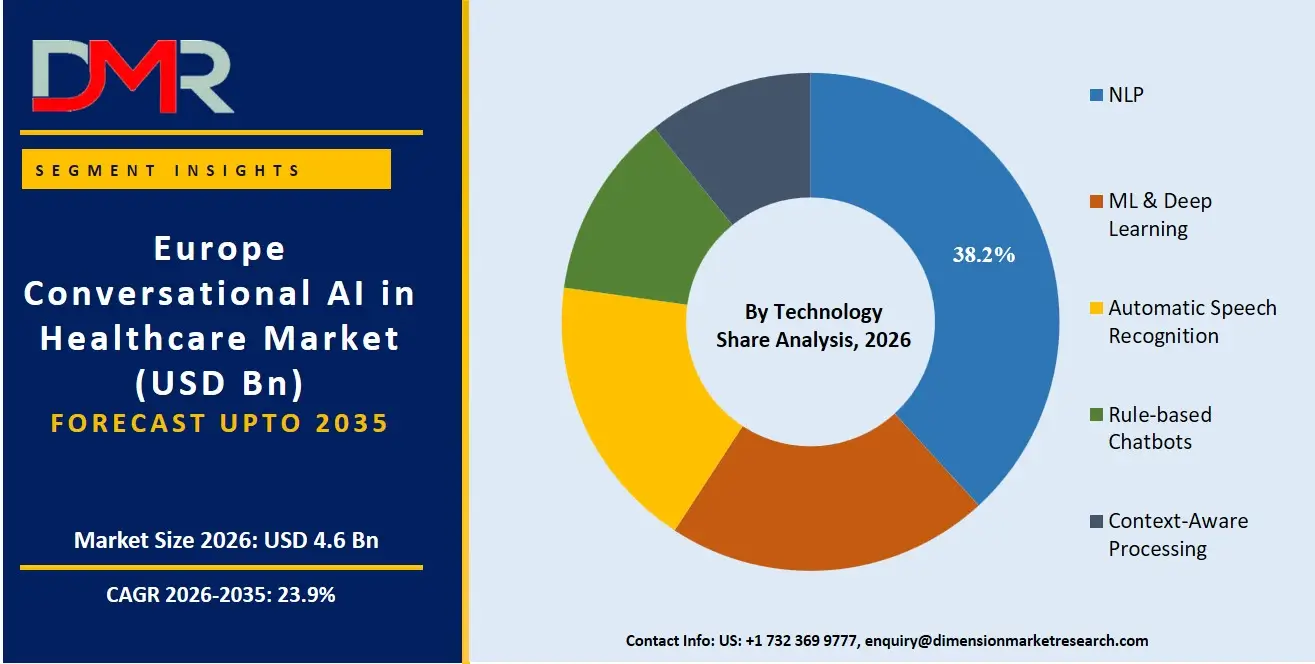
- By Technology Type: NLP is expected to get the largest revenue share in 2026 in Europe Conversational AI in Healthcare Market.
- By End User Type: Healthcare Provider segment is expected to get the largest revenue share in 2026 in Europe Conversational AI in Healthcare Market.
What is the Europe Conversational AI in Healthcare?
Conversational AI in healthcare refers to artificial intelligence-powered systems that simulate human conversations through text or voice to support healthcare services. These solutions leverage natural language processing, machine learning, speech recognition, and contextual understanding to answer patient queries, schedule appointments, assist clinicians, automate administrative workflows, provide medication guidance, monitor patients remotely, and deliver personalized healthcare experiences while improving operational efficiency, accessibility, and clinical decision-making across healthcare environments.
Use Cases
- Patient Engagement and Appointment Management: Healthcare organizations deploy conversational AI to automate appointment scheduling, reminders, prescription refill requests, symptom triage, and frequently asked questions. These systems provide 24/7 assistance, reduce waiting times, improve patient satisfaction, and minimize administrative workload while ensuring timely communication throughout the patient care journey.
- Clinical Decision Support: Conversational AI assists physicians and healthcare professionals by retrieving medical knowledge, summarizing patient histories, recommending evidence-based treatment options, and supporting diagnostic workflows. These capabilities reduce information retrieval time, improve decision accuracy, and enable clinicians to focus more on patient care.
- Remote Patient Monitoring: AI-powered virtual assistants communicate regularly with patients suffering from chronic diseases by collecting symptoms, medication adherence information, and health updates. Healthcare providers receive timely alerts regarding abnormal conditions, enabling early intervention, reducing hospital admissions, and supporting continuous patient management outside traditional clinical settings.
- Administrative Workflow Automation: Hospitals and healthcare institutions utilize conversational AI to automate insurance verification, patient registration, billing inquiries, documentation assistance, and internal helpdesk functions. Automation improves operational efficiency, lowers administrative costs, reduces manual errors, and enables healthcare staff to dedicate more time to value-added clinical activities.
How AI Is Transforming the Europe Conversational AI in Healthcare Market
Artificial intelligence significantly enhances conversational healthcare platforms by enabling accurate natural language understanding, contextual dialogue management, predictive analytics, and intelligent automation. AI-powered systems improve patient engagement through personalized interactions, faster symptom assessment, automated appointment scheduling, medication reminders, and continuous support that is available around the clock. These capabilities improve patient satisfaction while reducing administrative workloads across healthcare organizations.
AI also strengthens clinical decision support by analyzing medical information, summarizing patient histories, identifying potential health risks, and providing evidence-based recommendations to healthcare professionals. Continuous learning algorithms improve conversational accuracy over time, enabling more effective remote patient monitoring, operational efficiency, multilingual communication, and personalized healthcare experiences while supporting broader digital transformation initiatives throughout Europe's healthcare sector.
Market Dynamic
Driving Factors in the Europe Conversational AI in Healthcare Market
Rising Adoption of Digital Healthcare Ecosystems
Healthcare providers across Europe are increasingly investing in digital transformation initiatives to improve operational efficiency and patient outcomes. Conversational AI supports seamless communication between patients, physicians, and healthcare organizations while reducing administrative burden and enhancing service accessibility. The continued expansion of telehealth services, electronic health records, and AI-assisted clinical workflows significantly strengthens demand for intelligent conversational platforms throughout the healthcare ecosystem.
Restraints in the Europe Conversational AI in Healthcare Market
Data Privacy, Security, and Regulatory Compliance Challenges
Healthcare conversational AI solutions process highly sensitive patient information, requiring strict compliance with European privacy regulations and healthcare data governance standards. Organizations must invest substantially in cybersecurity, encryption, consent management, and secure cloud infrastructure. Complex regulatory requirements increase implementation costs, extend deployment timelines, and discourage smaller healthcare providers from adopting advanced conversational AI technologies.
Opportunities in the Europe Conversational AI in Healthcare Market
Expansion of Multilingual AI Solutions Across Europe
Europe's linguistic diversity creates significant opportunities for conversational AI platforms capable of supporting multiple regional languages with high contextual accuracy. Healthcare organizations increasingly require AI systems that communicate effectively with diverse patient populations while maintaining medical precision. Vendors developing multilingual and culturally adaptive conversational models are well positioned to expand market penetration across European countries.
Trends in the Europe Conversational AI in Healthcare Market
Increasing Adoption of Voice-Enabled Healthcare Assistants
Voice-based conversational AI is gaining traction across hospitals, clinics, and home healthcare environments due to improvements in speech recognition accuracy and multilingual processing. Healthcare professionals use voice assistants for clinical documentation, while patients benefit from hands-free communication, medication reminders, health monitoring, and improved accessibility, particularly among elderly and physically challenged individuals.
Research Scope and Analysis
The research scope covers the Europe Conversational AI in Healthcare Market across components, technologies, applications, and end users. The analysis evaluates market drivers, restraints, opportunities, trends, competitive dynamics, and technological advancements influencing AI adoption in healthcare systems across European countries.
ℹ
To learn more about this report –
Download Your Free Sample Report Here
By Component Analysis
The Europe Conversational AI in Healthcare Market is segmented by component into chatbots, virtual assistants, speech recognition systems, and services. Among these, virtual assistants are estimated to hold the leading market share of approximately 34.5% in 2026 due to their expanding adoption among hospitals, clinics, and healthcare organizations for patient communication, clinical support, appointment management, and workflow automation.
ℹ
To learn more about this report –
Download Your Free Sample Report Here
Virtual assistants provide more advanced contextual understanding compared with traditional chatbot systems, enabling personalized healthcare interactions. The fastest-growing segment is expected to be speech recognition systems, driven by increasing demand for voice-enabled healthcare applications, clinical documentation automation, and hands-free interactions. Improvements in speech accuracy, multilingual capabilities, and integration with electronic health records are accelerating adoption of voice-based AI solutions across European healthcare facilities.
By Technology Analysis
The Europe Conversational AI in Healthcare Market is categorized by technology into natural language processing (NLP), machine learning and deep learning, automatic speech recognition, rule-based chatbots, and context-aware processing. Among these technologies, natural language processing is expected to dominate with an estimated market share of approximately 38.2% in 2026 due to its essential role in enabling human-like communication, understanding medical terminology, and improving conversational accuracy. NLP technologies allow healthcare AI systems to interpret patient queries, analyze clinical information, and deliver relevant responses. The fastest-growing technology segment is anticipated to be context-aware processing, supported by rising demand for personalized healthcare interactions and intelligent virtual assistants capable of understanding patient history, preferences, and real-time healthcare requirements. Increasing adoption of generative AI models is further accelerating advancements in contextual healthcare conversations.
By Application Analysis
Based on application, the Europe Conversational AI in Healthcare Market is segmented into patient engagement and support, mental health support and therapy bots, medical diagnosis and clinical decision support, remote patient monitoring, administrative and workflow automation, telemedicine and virtual consultations, medical training and education, and pharmaceutical and drug information assistance. The patient engagement and support segment is estimated to lead the market with an approximate share of 29.8% in 2026, driven by widespread implementation of AI assistants for appointment scheduling, patient queries, health education, and communication management. Healthcare providers are prioritizing solutions that improve patient experiences while reducing operational pressure. The fastest-growing segment is expected to be medical diagnosis and clinical decision support due to increasing demand for AI-assisted clinical workflows, faster diagnostic processes, and improved access to medical knowledge. Integration of AI with healthcare data platforms is enabling more advanced decision-support capabilities.
By End User Analysis
The Europe Conversational AI in Healthcare Market is segmented by end user into healthcare providers, patients and individuals, pharmaceutical and life sciences companies, healthcare IT and research organizations, and others. Healthcare providers are projected to remain the dominant end-user segment, accounting for an estimated 42.6% market share in 2026, as hospitals and clinics increasingly deploy conversational AI to improve operational efficiency, patient engagement, and clinical workflows. These organizations benefit from AI-driven automation of administrative processes, virtual patient assistance, and enhanced healthcare delivery models. The fastest-growing segment is expected to be pharmaceutical and life sciences companies, supported by increasing adoption of AI solutions for drug information services, patient assistance programs, clinical research support, and medical communication. Growing investments in digital therapeutics and personalized medicine are further expanding AI adoption among life sciences organizations.
The Europe Conversational AI in Healthcare Market Report is segmented on the basis of the following:
By Component
- Chatbots
- Virtual Assistants
- Speech Recognition Systems
- Services
By Technology
- NLP
- ML & Deep Learning
- Automatic Speech Recognition
- Rule-based Chatbots
- Context-Aware Processing
By Application
- Patient Engagement & Support
- Mental Health Support & Therapy Bots
- Medical Diagnosis & Clinical Decision Support
- Remote Patient Monitoring
- Administrative & Workflow Automation
- Telemedicine & Virtual Consultations
- Medical Training & Education
- Pharmaceutical & Drug Information Assistance
By End User
- Healthcare Providers
- Patients & Individuals
- Pharmaceutical & Life Sciences Companies
- Healthcare IT & Research Organizations
- Others
Country Analysis
The Europe Conversational AI in Healthcare Market is witnessing strong growth across countries due to increasing digital healthcare adoption, AI investments, and modernization of healthcare infrastructure. The United Kingdom, Germany, and France represent major markets, supported by advanced healthcare systems, favorable AI strategies, and growing demand for automation. Germany benefits from healthcare digitalization initiatives, while the UK emphasizes AI-driven clinical innovation and remote care solutions. Nordic countries are also adopting conversational AI rapidly due to strong digital health ecosystems. Increasing regulatory support and demand for efficient healthcare delivery continue driving adoption across European nations.
By Country
Europe
- Germany
- The U.K.
- France
- Italy
- Russia
- Spain
- Benelux
- Nordic
- Rest of Europe
Competitive Landscape
The Europe Conversational AI in Healthcare Market is characterized by strong competition among technology providers, healthcare software companies, cloud infrastructure developers, and specialized digital health solution vendors. Market participants are focusing on improving AI accuracy, developing healthcare-specific language models, strengthening regulatory compliance, and expanding interoperability with electronic health record systems. Companies are pursuing strategic partnerships with hospitals, research organizations, and healthcare platforms to accelerate adoption. High entry barriers include data security requirements, clinical validation standards, regulatory approvals, and the need for advanced AI capabilities. Continuous investment in research and development, multilingual capabilities, and personalized healthcare solutions remains essential for maintaining competitive positioning.
Some of the prominent players in the Europe Conversational AI in Healthcare are:
- SAP
- Siemens Healthineers
- Philips
- Dedalus Group
- Doctolib
- Ada Health
- Infermedica
- Babylon Health
- Caresyntax
- Liva Healthcare
- Kry
- Cera
- Orbita
- Hyro
- Microsoft
- Google Cloud
- Amazon Web Services
- Oracle Health
- IBM
- NVIDIA
- Other Key Players
Recent Developments
- In March 2025, healthcare AI researchers introduced advancements in conversational AI systems designed for disease management and long-term patient support. The research focused on AI agents capable of managing patient interactions, analyzing health information, and assisting clinical decision-making. These developments highlighted the transition from basic chatbot solutions toward intelligent healthcare assistants that integrate medical knowledge, patient history, and personalized recommendations, supporting the growth of AI-driven chronic disease management across Europe.
- In February 2025, Microsoft strengthened its healthcare AI ecosystem by expanding generative AI capabilities for clinical documentation, workflow automation, and intelligent patient communication. The company focused on secure cloud-based solutions that help healthcare organizations reduce administrative workload and improve operational efficiency. Enhanced integration with healthcare information systems supported hospitals and providers in adopting conversational AI technologies while addressing data security, privacy, and compliance requirements across European healthcare markets.
- In January 2025, Google continued advancing healthcare conversational AI capabilities through improvements in large language models and clinical reasoning technologies. The company focused on developing AI systems for medical information retrieval, patient communication, and healthcare support applications. These advancements aimed to improve accuracy, safety, and contextual understanding, enabling more personalized interactions between patients and healthcare professionals. The developments encouraged European healthcare organizations to evaluate AI assistants for patient engagement, clinical workflows, and decision-support applications.
Report Details
| Report Characteristics |
| Market Size (2026) |
USD 4.6 Bn |
| Forecast Value (2035) |
USD 31.8 Bn |
| CAGR (2026–2035) |
23.9% |
| Historical Period |
2021 – 2025 |
| Forecast Period |
2027 – 2035 |
| Base Year |
2025 |
| Estimate Year |
2026 |
| Segments Covered |
By Component, By Technology, By Application, By End User |
| Regional Coverage |
Europe – Germany, The UK, France, Russia, Spain, Italy, Benelux, Nordic, & Rest of Europe |
Frequently Asked Questions
How big is Europe Conversational AI in Healthcare Market?
▾ Europe Conversational AI in Healthcare Market size is expected to reach USD 4.6 billion by 2026 and is projected to reach USD 31.8 billion by the end of 2035.
What is the CAGR of Europe Conversational AI in Healthcare Market from 2026 to 2035?
▾ The market is growing at a CAGR of 23.9 percent over the forecasted period.
What factors are driving the growth of Europe Conversational AI in Healthcare Market?
▾ Rising Adoption of Digital Healthcare Ecosystems, and more are the factors driving the growth of Europe Conversational AI in Healthcare Market.
What are the major trends in Europe Conversational AI in Healthcare Market?
▾ Increasing Adoption of Voice-Enabled Healthcare Assistants, and more are some of the major trends in the market.
Who are the key players in Europe Conversational AI in Healthcare Market?
▾ Some of the key players in Europe Conversational AI in Healthcare Market include AWS, Google, IBM, and more.
How is Europe Conversational AI in Healthcare Market segmented?
▾ Europe Conversational AI in Healthcare Market is segmented component, technology, application, end user.