Market Overview
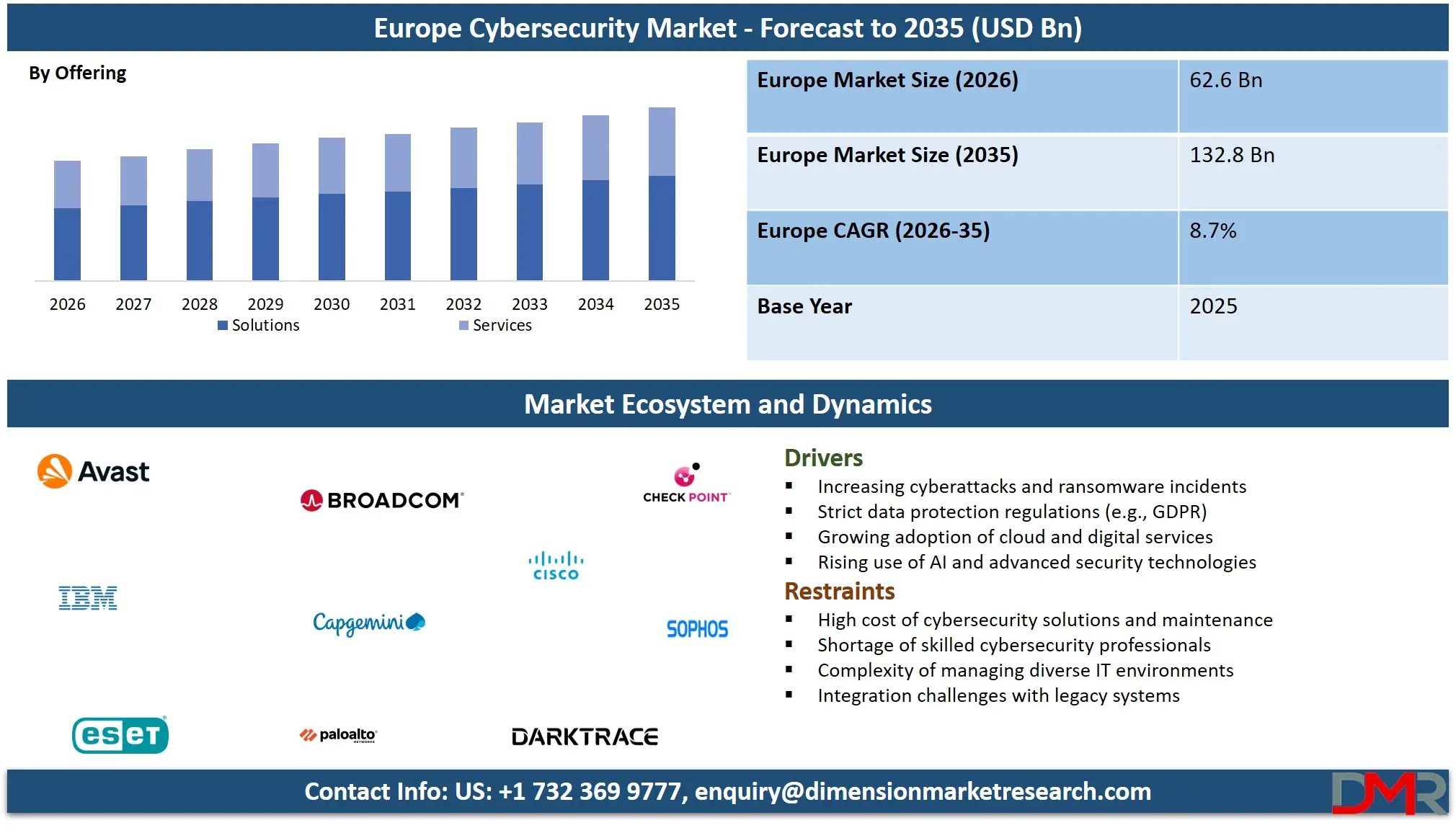
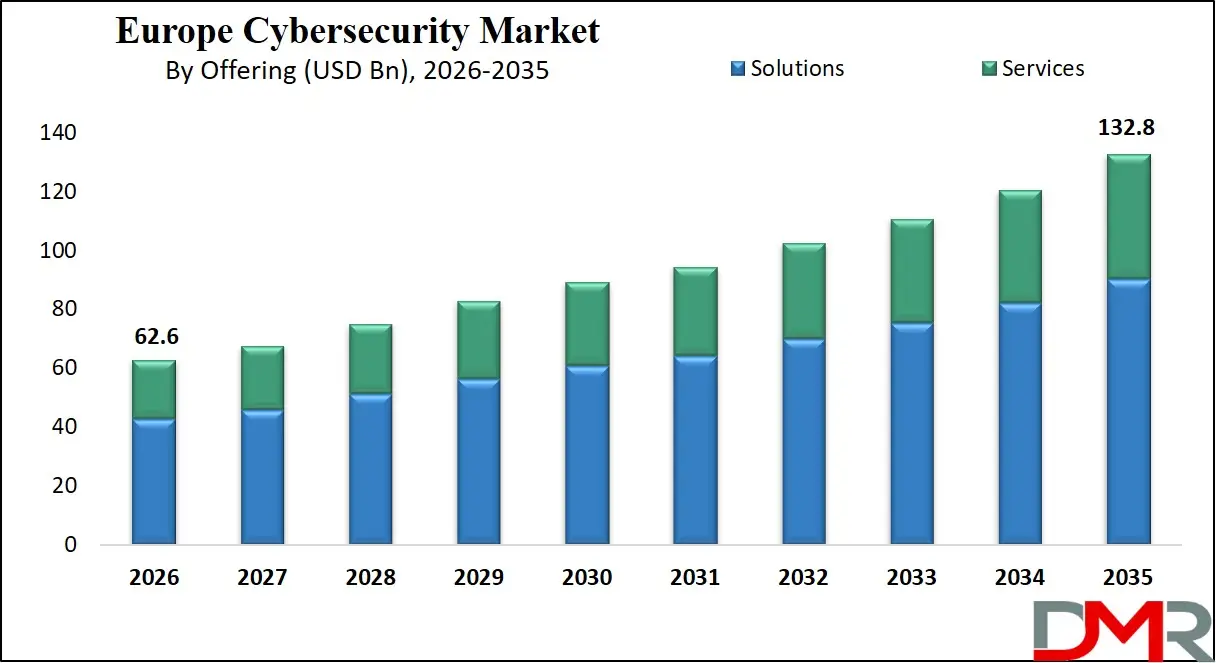
The Europe Cybersecurity Market size is projected to reach USD 62.6 billion in 2026 and grow at a compound annual growth rate of 8.7% to reach a value of USD 132.8 billion in 2035.
ℹ
To learn more about this report –
Download Your Free Sample Report Here
Cybersecurity refers to the practice of protecting digital systems, networks, applications, and data from unauthorized access, cyberattacks, and damage through advanced technologies, protocols, and services. It encompasses solutions such as encryption, threat intelligence, identity management, and risk mitigation tools. The market plays a critical role in safeguarding digital transformation across industries.
Increasing cloud adoption, rising cyber threats, and regulatory compliance requirements are accelerating demand. Emerging trends such as zero-trust architecture, AI-driven security, and integration of automation into threat detection are significantly influencing the market’s expansion and innovation trajectory globally.
ℹ
To learn more about this report –
Download Your Free Sample Report Here
Europe Cybersecurity Market: Key Takeaways & Influencing Factors
- Market Growth: The Europe Cybersecurity Market size is expected to grow by USD 62.6 billion, at a CAGR of 8.7%, during the forecasted period of 2027 to 2035.
- By Offering: The solutions segment is anticipated to get the majority share of 68% of the Europe Cybersecurity market in 2026.
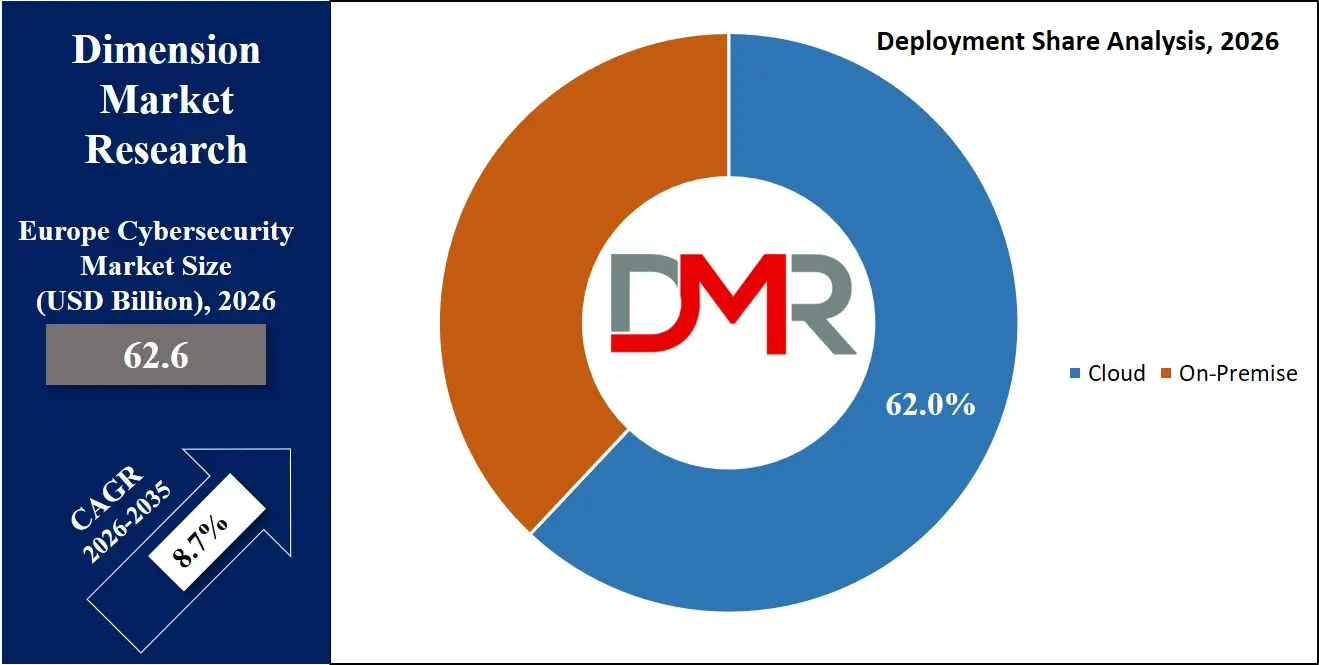
- By Deployment: The cloud segment is expected to get the largest revenue share of 62% in 2026 in the Europe Cybersecurity market.
- Use Cases: Some of the use cases of Cybersecurity include enterprise cloud security, financial fraud prevention, and more.
- ENISA (European Union Agency for Cybersecurity): The agency stated in 2024 that ransomware attacks in Europe increased by 45% year-over-year, making it the most dominant cyber threat category.
- Eurostat: It indicated in 2025 that 72% of large enterprises in the EU implemented advanced cybersecurity measures, compared to only 38% of SMEs.
- OECD (Organization for Economic Co-operation and Development): The organization reported that in 2024, cybersecurity spending across European economies grew by 12% annually due to stricter data protection regulations and digital transformation initiatives.
Europe Cybersecurity Market: Use Cases
- Financial Fraud Prevention: Cybersecurity solutions have been widely implemented in the banking sector, enabling banks to identify and prevent financial fraud, thereby increasing customer trust and security, and ensuring compliance with stringent European Union directives, including PSD2.
- Healthcare Data Protection: Healthcare organizations, including hospitals, have been implementing cybersecurity solutions to ensure security and protection of customer data, thereby preventing ransomware attacks, and ensuring the availability of medical services in the highly digitalized healthcare sector.
- Critical Infrastructure Security: Governments have been implementing cybersecurity solutions to ensure security and protection against cyber threats targeting critical infrastructure, including power and transport, which has significant security implications for national security.
- Enterprise Cloud Security: Cybersecurity solutions have been implemented in organizations to ensure security and protection of cloud infrastructure, considering that organizations are increasingly adopting cloud technologies, including multiple cloud platforms.
Market Dynamic
Driving Factors in the Europe Cybersecurity Market
Rising Cyber Threat Landscape
Increasing frequency and sophistication of cyberattacks, including ransomware, phishing, and advanced persistent threats, are significantly driving demand for cybersecurity solutions in Europe. Organizations are investing heavily in proactive threat detection and response systems to protect sensitive data and maintain operational continuity. The surge in remote work and digital transactions has further expanded the attack surface, making cybersecurity a top priority across sectors.
Stringent Regulatory Frameworks
Europe’s strong regulatory environment, including GDPR and NIS2 Directive, compels organizations to adopt robust cybersecurity practices. Compliance requirements are pushing companies to invest in advanced security technologies, risk management systems, and data protection solutions. These regulations not only drive market growth but also standardize cybersecurity practices across industries, enhancing overall resilience.
Restraints in the Europe Cybersecurity Market
High Implementation and Operational Costs
Deploying advanced cybersecurity solutions involves significant capital investment, especially for SMEs with limited budgets. Costs associated with infrastructure upgrades, skilled workforce, and continuous monitoring create financial barriers, slowing adoption. Additionally, maintaining and updating security systems to counter evolving threats further adds to operational expenses, impacting market penetration.
Shortage of Skilled Cybersecurity Professionals
Europe faces a critical shortage of qualified cybersecurity experts, which limits the effective implementation and management of security systems. The skills gap leads to vulnerabilities in organizational defenses and delays in incident response. This challenge is particularly pronounced in smaller enterprises and emerging markets, hindering overall market growth.
Opportunities in the Europe Cybersecurity Market
Growth in Cloud and Digital Transformation
Rapid adoption of cloud computing and digital technologies presents significant opportunities for cybersecurity providers. Organizations require advanced cloud security solutions to protect distributed environments. The increasing shift toward hybrid work models further amplifies demand for scalable and flexible cybersecurity offerings.
Government Initiatives and Funding Programs
European governments are actively investing in cybersecurity infrastructure and innovation through funding programs and public-private partnerships. Initiatives aimed at strengthening digital sovereignty and resilience create new growth avenues for market players, particularly in sectors like defense and critical infrastructure.
Trends in the Europe Cybersecurity Market
Adoption of Zero-Trust Security Models
Organizations are increasingly adopting zero-trust architectures, which require continuous verification of users and devices. This approach minimizes risks associated with insider threats and unauthorized access, aligning with modern security requirements in highly distributed digital environments.
Integration of AI and Automation
Artificial intelligence and automation are transforming cybersecurity by enabling real-time threat detection, predictive analytics, and faster response times. Automated systems reduce reliance on manual processes and improve efficiency in handling complex cyber threats.
Impact of Artificial Intelligence in Europe Cybersecurity Market
Artificial intelligence has significantly impacted the cybersecurity domain, particularly in terms of threat detection, analytics, and response. AI-based systems have the capability to process data in real-time, thereby identifying anomalies and security threats. AI-based machine learning assists in increasing accuracy in identifying security threats, and AI-based automated response assists in reducing response time and cost. AI-based systems enhance identity and fraud detection tools. AI assists organizations in implementing proactive security measures, thereby enabling organizations to address security risks and threats in a proactive manner.
Impact of Iran War on Europe Cybersecurity Market
The Iran war may heighten concerns in Europe, especially for energy, transport, finance, healthcare, and government networks. In March 2026, the UK NCSC urged organisations to review cyber posture as Middle East tensions escalated. In September, UK and allied agencies warned that Iranian state-linked actors were using phishing and spyware against targets, including people in the UK. These developments could increase demand for threat intelligence, managed detection, identity security, incident response, and operational-technology protection. The conflict may accelerate cybersecurity spending, although it is one of several drivers shaping Europe’s market.
Research Scope and Analysis
By Offering Analysis
Solutions as an offering is the largest segment in the Europe cybersecurity market, which held an approximate 68% market share in 2026, due to the high adoption rates of sophisticated solutions such as network security, identity, and data protection solutions. Organizations are looking for integrated solutions to address the complexities of cyber threats and regulatory challenges. The need for integrated security solutions is driven by the rising rates of digital transformation in the industry. In addition, services, particularly managed services, are the fastest-growing segment, as organizations are moving to outsource services due to skill shortages and cost considerations, which is positively affecting the cybersecurity market.
By Deployment Analysis
Cloud deployment currently holds the highest market position with an estimated market share of 62% in 2026, primarily due to the high rate of adoption of cloud-based infrastructure and remote work environment systems. Cloud security solutions have high scalability, flexibility, and cost-effectiveness, making them an attractive choice for digitally transforming enterprises.
ℹ
To learn more about this report –
Download Your Free Sample Report Here
In addition, the popularity of SaaS and hybrid cloud solutions is further propelling this market. In addition, the on-premise deployment market is experiencing slower growth, although it remains an essential choice for industries where data security and sovereignty regulations are extremely high.
By Organization Size Analysis
Large enterprises have a massive 65% share in the market in 2026, considering that they have more budgetary allocation towards cybersecurity and higher exposure to cyber risks. On the other hand, SMEs enjoy the fastest growth rate considering that there is more awareness about cyber threats and cost-effective cloud security options. Moreover, there has been significant support from governments and industries towards SMEs, making them more effective in enhancing their cybersecurity.
By End User Analysis
The BFSI segment has the maximum market share, i.e., around 24% in 2026, due to high regulatory compliance requirements and the need to protect sensitive data. In addition, the adoption of digital banking and fintech services will drive the need for cybersecurity solutions in the BFSI industry. The healthcare segment has the highest growth rate due to the rising number of cyber-attacks on medical data and the need to protect digital data in the healthcare industry. Other industries, including IT, telecommunications, and government, are also witnessing high adoption rates due to the need to protect digital data.
The Europe Cybersecurity Market Report is segmented on the basis of the following:
By Offering
- Solutions
- Application Security
- Cloud Security
- Data Security
- Identity and Access Management
- Infrastructure Protection
- Integrated Risk Management
- Network Security Equipment
- Consumer Security
- Other Solutions
- Services
- Professional Services
- Managed Services
By Deployment
By Organization Size
By End User
- BFSI
- Healthcare
- Construction
- Government & Defense
- IT and Telecommunication
- Retail
- Energy and Utilities
- Manufacturing
- Other End Users
Country Analysis
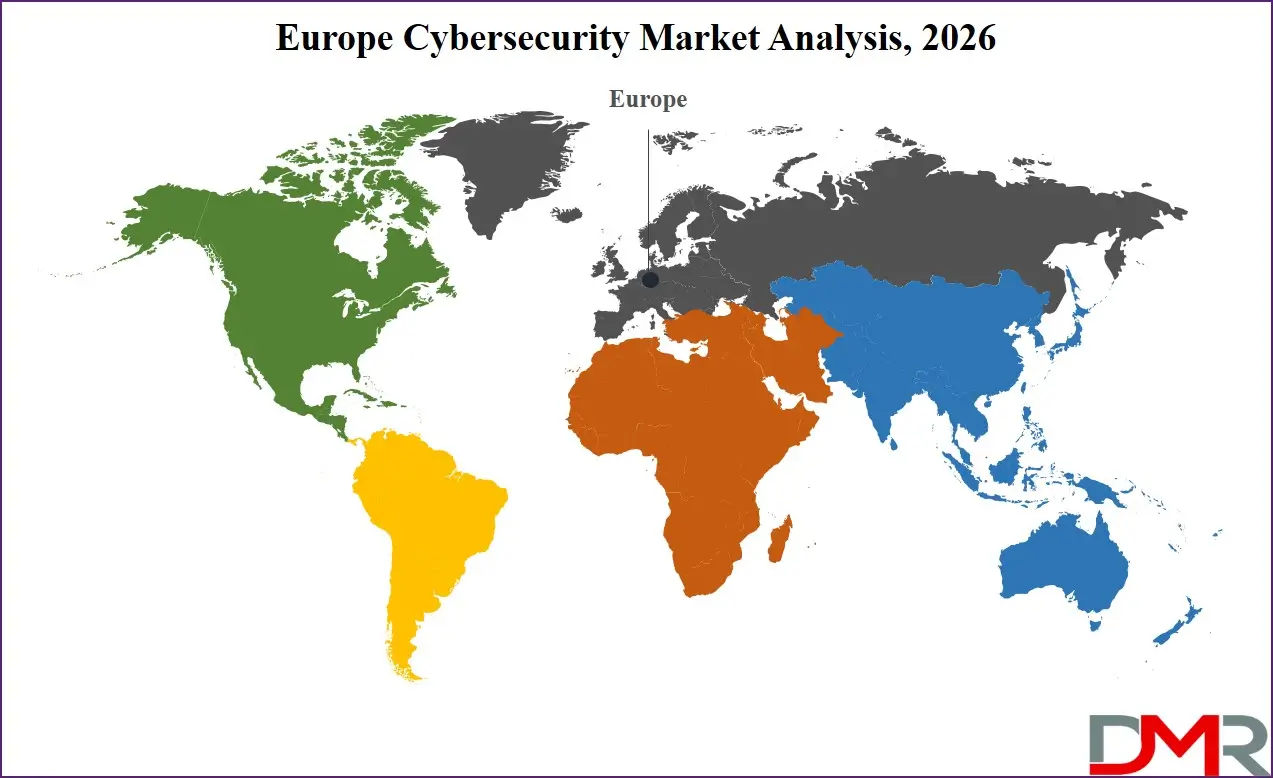
Europe’s cybersecurity market is driven by factors such as the need to adhere to stringent regulations, the rise in ransomware attacks, and the increased rate of digitalization. The market is dominated by countries like Germany, the UK, and France, owing to the high degree of government initiatives and the high level of IT infrastructure. However, the market is slightly affected by fragmentation and skills gaps.
ℹ
To learn more about this report –
Download Your Free Sample Report Here
By Country
- Germany
- The U.K.
- France
- Italy
- Russia
- Spain
- Benelux
- Nordic
- Rest of Europe
Competitive Landscape
The Europe cybersecurity market is a competitive market with high levels of innovation, partnership, and R&D focus. The high barriers to entry can be attributed to compliance and technology factors. The players are focusing on AI-based technology, cloud security, and threat intelligence to stay at the top of this market. There are instances of M&A and partnership, thus promoting the sustainability of players in this market.
Some of the prominent players in the Europe Cybersecurity Market are:
- Accenture
- Airbus
- Akamai
- Acronis
- Advenica
- Atos
- BAE Systems
- Bitdefender
- BT Group
- Capgemini
- Check Point Software Technologies
- Cisco
- Cloudflare
- CrowdStrike
- Deutsche Telekom Security
- ESET
- Fortinet
- G DATA CyberDefense
- HarfangLab
- IBM
- Indra Group
- Kudelski Security
- Leonardo
- Microsoft
- NCC Group
- Netskope
- Orange Cyberdefense
- Palo Alto Networks
- Qualys
- Rapid7
- Rohde & Schwarz Cybersecurity
- secunet Security Networks
- Sekoia.io
- SentinelOne
- Siemens
- Telefónica Tech
- Thales
- Trend Micro
- WithSecure
- Zscaler
- Other Key Players
Recent Developments
- In January 2026, The European Commission introduced a new cybersecurity package to enhance EU resilience against evolving threats. It simplifies compliance and risk management for organizations, proposing to replace the Cybersecurity Act 2019 with Cybersecurity Act 2, and align and streamline the NIS2 Directive framework.
- In December 2025, The European Cyber Security Organisation announced its participation in the EU-funded INCIDENTRON.eu project to enhance cybersecurity incident reporting and management. The initiative will create a unified framework and platform to clarify reporting obligations, streamline required information, and help organizations navigate complex regulatory requirements without increasing operational burden.
- In June 2025, Microsoft announced a new initiative to strengthen Europe’s cybersecurity, aligning with its European Digital Commitments. The company launched a European Security Program to expand its Government Security Program, extend regional coverage, integrate AI into cybersecurity efforts, and enhance protection of both digital systems and AI infrastructure.
Report Details
| Report Characteristics |
| Market Size (2026) |
USD 62.6 Bn |
| Forecast Value (2035) |
USD 132.8 Bn |
| CAGR (2026–2035) |
8.7% |
| Historical Data |
2021 – 2025 |
| Forecast Data |
2027 – 2035 |
| Base Year |
2025 |
| Estimate Year |
2026 |
| Report Coverage |
Market Revenue Estimation, Market Dynamics, Competitive Landscape, Growth Factors and etc. |
| Segments Covered |
By Offering (Solutions and Services), By Deployment (Cloud and On-Premise), By Organization Size (SMEs and Large Enterprises), By End User (BFSI, Healthcare, Construction, Government & Defense, IT and Telecommunication, Retail, Energy and Utilities, Manufacturing, and Other End Users) |
| Regional Coverage |
Europe – Germany, The UK, France, Russia, Spain, Italy, Benelux, Nordic, & Rest of Europe |
| Prominent Players |
Accenture, Airbus, Akamai, Acronis, Advenica, Atos, BAE Systems, Bitdefender, BT Group, Capgemini, Check Point Software Technologies, Cisco, Cloudflare, CrowdStrike, Deutsche Telekom Security, ESET, Fortinet, G DATA CyberDefense, HarfangLab, IBM, Indra Group, Kudelski Security, Leonardo, Microsoft, and Other Key Players |
| Purchase Options |
We have three licenses to opt for: Single User License (Limited to 1 user), Multi-User License (Up to 5 Users) and Corporate Use License (Unlimited User) along with free report customization equivalent to 0 analyst working days, 3 analysts working days and 5 analysts working days respectively. |
Frequently Asked Questions
How big is the Europe Cybersecurity Market?
▾ The Europe Cybersecurity Market size is expected to reach USD 62.6 billion by 2026 and is projected to reach USD 132.8 billion by the end of 2035.
Who are the key players in the Europe Cybersecurity Market?
▾ Some of the major key players in the Europe Cybersecurity Market include Accenture, Airbus, Akamai, Acronis, Advenica, Atos, BAE Systems, Bitdefender, BT Group, Capgemini, Check Point Software Technologies, Cisco, Cloudflare, CrowdStrike, Deutsche Telekom Security, ESET, Fortinet, G DATA CyberDefense, HarfangLab, IBM, Indra Group, Kudelski Security, Leonardo, Microsoft and others.
What is the growth rate in the Europe Cybersecurity Market?
▾ The market is growing at a CAGR of 8.7 percent over the forecasted period.