Market Overview
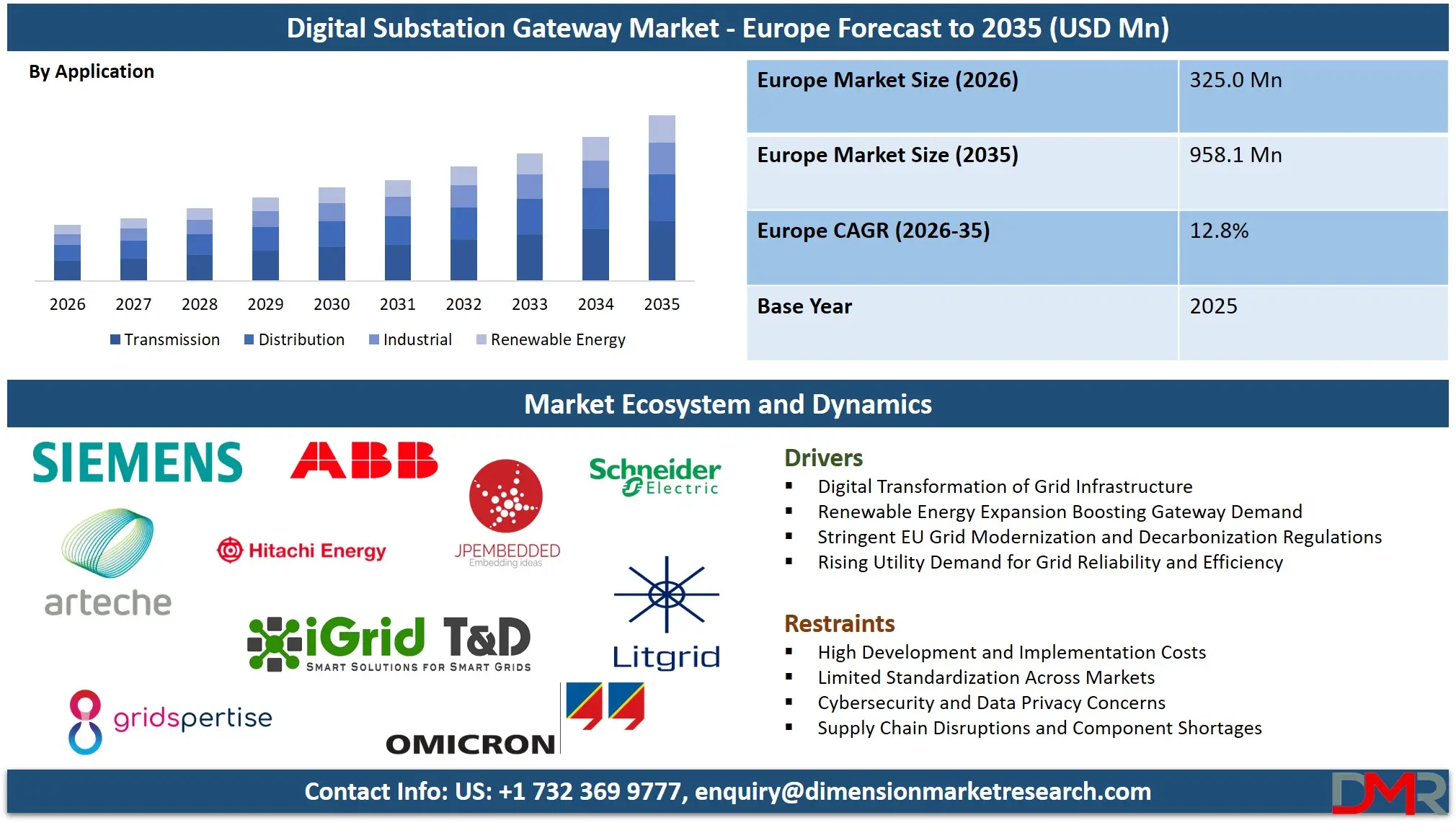
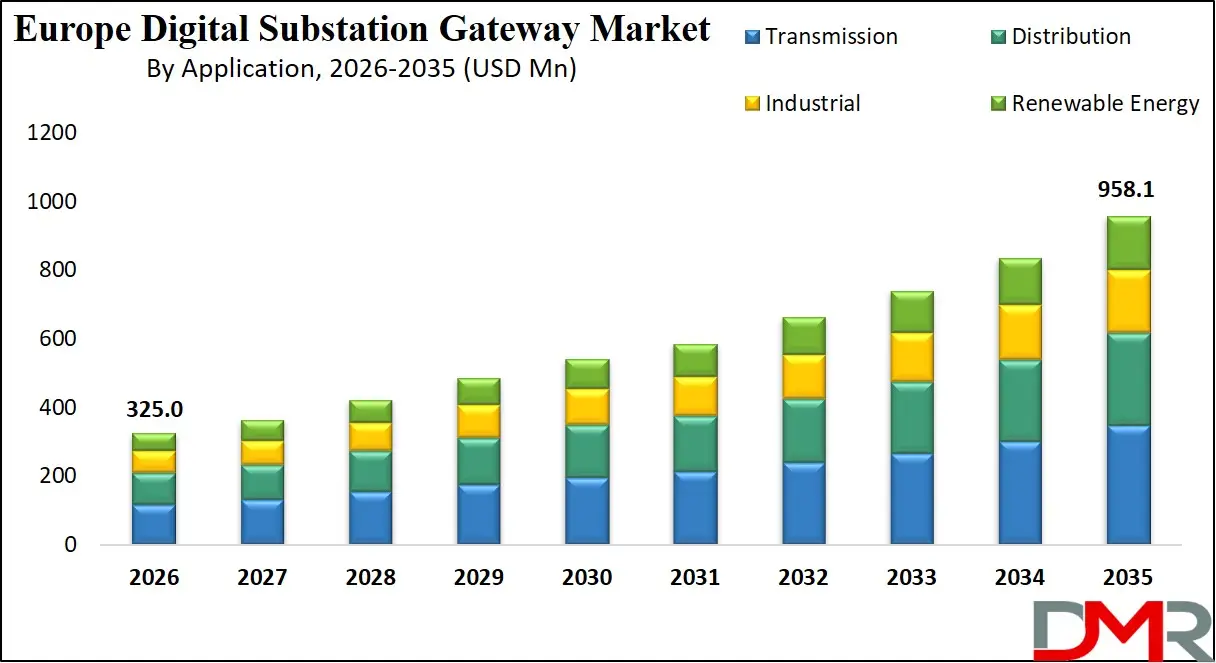
The Europe Digital Substation Gateway Market size is expected to reach a value of USD 325.0 million in 2026, and it is further anticipated to reach a market value of USD 958.1 million by 2035 at a CAGR of 12.8%.
ℹ
To learn more about this report –
Download Your Free Sample Report Here
The digital substation gateway market is an important part of the power grid modernization and energy transition ecosystem in Europe, driven by stringent decarbonization targets and the region's commitment to renewable energy integration—eliminating reliance on legacy analog infrastructure. As a global leader in energy innovation and grid digitalization standards, Europe occupies a privileged position in the development and adoption of advanced substation automation technologies. The sector covers a wide range of solutions, from hardware protocol gateways and communication interfaces to protocol conversion software and cybersecurity services, which are crucial in reducing grid downtime and supporting the growth of interconnected and distributed energy resources. The European Union's commitment to enhancing grid resilience has resulted in substantial investment in research, infrastructure, and technology, significantly transforming the energy management landscape.
Over the last few years, the digital substation gateway market in Europe has witnessed a strategic transition in adopting advanced technologies like AI, edge computing, and cloud-based data aggregation. These technologies are making grid communication systems more effective, developing real-time situational awareness, facilitating easier decision-making, and further helping in the mitigation of outage risks. Also, with the rapid growth of renewable energy sources and distributed generation, the need for sophisticated data aggregation and protocol conversion systems has accelerated the demand for companies to scale up their digitalization portfolios. All these evolutions of technology and the market are likely to drive the sector's growth, signifying a good future outlook for the market.
Key trends currently evident within the digital substation gateway arena in Europe are digital transitions taking hold of grid operations by moving from traditional electromechanical systems to proactive, tech-based ecosystems. Aside from this, further integration of AI and edge computing brings predictive analytics and real-time decisions with enhanced data processing for better outputs of efficiency. Furthermore, with the augmenting emphasis on sustainability and grid flexibility in line with the European Green Deal, the adaptation of interoperable and secure communication technologies, such as IEC 61850-compliant gateways and advanced cybersecurity software, is on the rise. Similarly, the rise in distributed energy resources and smart grids has changed strategies for system integration as companies try to meet utility expectations of reliable and secure power transmission.
ℹ
To learn more about this report –
Download Your Free Sample Report Here
The market is consequently witnessing huge opportunities on the back of high investments by the European government in smart infrastructure development. Initiatives such as the construction of intelligent transmission networks and connected substation infrastructure are creating a robust digital backbone to support regional energy security. Megaprojects like the development of cross-border synchronization corridors for renewable integration illustrate the strategic importance of digital substation gateways in enabling Europe's ambitious energy and climate goals. The technological prowess of the region enhances its potential to become a global hub for grid automation innovation, offering unparalleled access to key markets across the continent. Further, the focus on smart technologies like AI, edge computing, and high-speed data processing provides companies with opportunities to gain a competitive edge by improving system interoperability and reducing operational costs.
Impact of Iran Conflict on Europe Digital Substation Gateway Market
The Iran conflict can influence the Europe Digital Substation Gateway Market through its effects on energy prices, supply chains, and economic stability. Rising geopolitical tensions in the Middle East often led to higher oil and fuel prices, which increase manufacturing and transportation costs for European energy and technology companies. Higher production costs can raise infrastructure project expenses and may slow the adoption of advanced grid digitalization technologies such as digital substation gateways in the short term.
The conflict can also disrupt global logistics and trade routes, causing delays in the supply of critical electronic components such as microprocessors, communication modules, and cybersecurity hardware used in digital gateway technologies. These supply chain disruptions may affect project schedules for grid modernization and renewable energy integration across Europe.
Additionally, economic uncertainty caused by geopolitical tensions can influence government spending and infrastructure investment across Europe. However, rising energy costs may encourage greater adoption of renewable energy sources and grid efficiency technologies, which could support long-term growth of the digital substation gateway market in the region.
Europe Digital Substation Gateway Market: Key Takeaways
- Market Value: The Europe Digital Substation Gateway Market size is estimated to have a value of USD 325.0 million in 2026 and is expected to reach USD 958.1 million by the end of 2035.
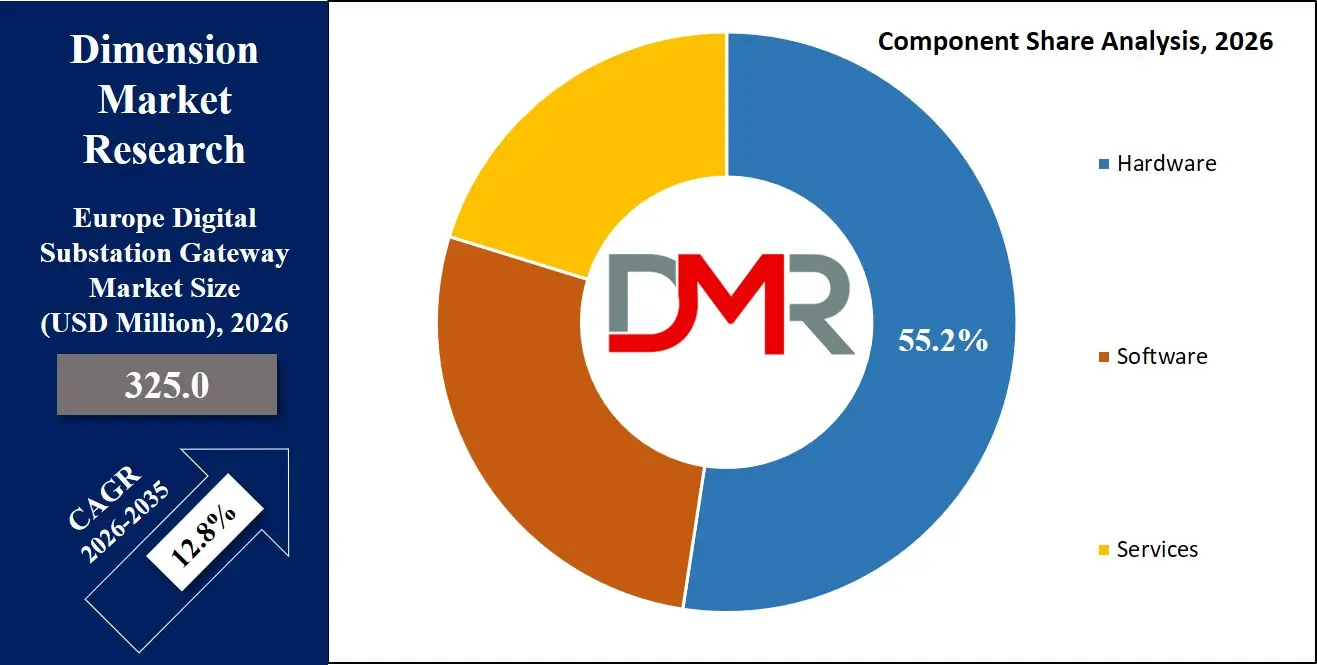
- By Component Segment Analysis: Hardware components, particularly Protocol Gateways, are anticipated to dominate this segment in this market as they will hold 55.2% of market share in 2026.
- By Communication Protocol Segment Analysis: IEC 61850 is projected to dominate the communication protocol segment in the Europe Digital Substation Gateway Market with the highest market share in 2026.
- By Deployment Type Segment Analysis: Retrofit Brownfield Upgrades are anticipated to dominate the Europe digital substation gateway market with a major market share in 2026.
- By Voltage Level Segment Analysis: High Voltage (HV) and Extra High Voltage (EHV) are projected to hold the leading positions in the voltage level segment of this market in 2026.
- By Application Segment Analysis: Transmission Substations is projected to dominate the application segment in the Europe digital substation gateway market in 2026.
- By End-User Segment Analysis: Utilities are projected to dominate the end-user segment in the Europe digital substation gateway market in 2026.
- Key Players: Some of the major key players in the Europe Digital Substation Gateway Market are Siemens Energy, ABB, iGrid T&D, JPEmbedded, Eaton Corporation, Mitsubishi Electric, and many others.
- Market Growth Rate: The market is growing at a CAGR of 12.8% over the forecasted period.
Europe Digital Substation Gateway Market: Use Cases
- Renewable Energy Integration in Wind Farms: This application utilizes digital substation gateways to aggregate data from multiple wind turbines, enabling seamless communication between distributed generation assets and central control systems using IEC 61850 protocols, significantly improving grid stability.
- Transmission Substation Modernization: Gateway systems in high-voltage transmission networks facilitate real-time data exchange between legacy protection relays and modern SCADA systems, reducing outage risks and enhancing operational visibility for grid operators across European transmission corridors.
- Distribution Automation in Urban Networks: Digital gateways in distribution substations enable remote monitoring and control of medium-voltage networks, allowing utilities to detect faults and restore power faster in congested urban environments.
- Cybersecurity Monitoring for Critical Infrastructure: In industrial substations, cybersecurity software integrated with gateway hardware ensures continuous monitoring of communication traffic, providing a critical protection layer against cyber threats for Europe's energy infrastructure.
Europe Digital Substation Gateway Market: Stats & Facts
European Commission (EU Energy & Infrastructure)
- Around 85% of Europe's transmission substations are over 30 years old and require digital upgrades by 2035.
- The EU recorded an average of 120 minutes of power interruptions per customer in 2024, with digitalization expected to reduce this by 40%.
- The European Union aims to reduce greenhouse gas emissions by 55% by 2030 under the European Green Deal, driving grid modernization.
- EU grid digitalization initiatives are expected to save about 12 million tons of CO2 annually through efficiency improvements.
- These digitalization efforts could also prevent approximately 8,000 GWh of transmission losses every year.
- The EU Energy System Integration Strategy affects over 500 million energy consumers across EU member states.
European Network of Transmission System Operators (ENTSO-E)
- European transmission grid length reached 350,000 circuit kilometers in 2023.
- More than 65% of substations in Europe require communication protocol upgrades to support renewable integration.
- Around 40% of European utilities consider digital substation gateways essential for grid modernization projects.
- Europe recorded 50 GW of new renewable capacity installed in 4, representing an 8.3% annual increase.
- Cross-border electricity trading in Europe grew 14.6% in 2023 before the 2024 increase.
EU Agency for the Cooperation of Energy Regulators (ACER)
- Nearly 95% of new substation projects in Europe comply with IEC 61850 standards.
- Europe has more than 5,000 high-voltage substations operating across its network.
- ACER introduced cybersecurity requirements for digital substations in 2021.
- In 2021, only 35% of substations had interoperable communication gateways meeting cybersecurity standards.
- By 2024, over 60% of new installations achieved compliance with enhanced cybersecurity protocols.
Eurostat (European Union Statistics Office)
- The European Union has over 250 million electricity connection points served by distribution networks.
- Electricity consumption in the EU reached 2,400 TWh in 2023, with digitalization enabling demand-side management.
European Energy Security Strategy
- EU grid digitalization investments could prevent approximately 15 major blackouts by 2038.
- These measures could also reduce curtailment of renewable energy by 30% by 2038.
European Smart Grid Studies
- Digital substation gateways with IEC 61850 compliance could reduce substation commissioning time by 25% to 35% when widely implemented.
- Advanced protocol conversion software could reduce integration costs for legacy equipment by 20% to 30%.
- Cybersecurity monitoring solutions can reduce breach detection time from months to minutes.
- Around 30% of communication failures in European substations occur at gateway interfaces, where digitalization is crucial.
Europe Digital Substation Gateway Market: Market Dynamic
Driving Factors in the Europe Digital Substation Gateway Market
Digital Transformation of Grid Infrastructure
The digital substation gateway sector in Europe is also becoming a hub of digital transformation due to the initiatives laid down by the EU's Digital Decade for integrating technology across all energy sectors. Companies are leveraging technologies such as AI, edge computing, and cloud-based data aggregation for real-time grid monitoring, predictive analytics, and enhanced operational visibility. For example, AI-enabled gateway software provides timely insights into potential equipment failures, hence reducing any inefficiencies in decision-making. Edge computing enhances data processing speed in complex substation scenarios, building trust among stakeholders.
Renewable Energy Expansion Boosting Gateway Demand
This rapid growth in renewable energy integration has produced high demand in Europe for the sector to implement efficient and reliable digital substation gateway solutions. Utilities such as EDF, Enel, and RWE have partnered with leading technology providers to try to meet today's demanding expectations around grid flexibility and automation. As renewable sources are increasingly integral to future energy systems, this trend is producing real investment in the hard infrastructure of testing and validation, but also increasingly in digital platforms that then tie the operation together in one seamless interface for grid operators and consumers alike.
Restraints in the Europe Digital Substation Gateway Market
High Development and Implementation Costs
Advanced digital substation gateway technologies and validation processes require huge capital investment, although regulations are very supportive. Smaller utility companies can hardly afford high-end gateway hardware, AI processing units, or comprehensive cybersecurity testing. This may impede market entry and further widen the gap between large corporations and SMEs in access to next-generation grid digitalization solutions.
Limited Standardization Across Markets
The grid automation industry will have challenges with varying national interpretations of EU directives and differing infrastructure readiness across member states. While digital harmonization is included in EU energy policy, the pace of its implementation often outpaces the standardization of technical requirements. Normally, companies incur additional costs for region-specific protocol configuration and validation. Getting over this restraint will involve considerable investments in cross-border collaboration and unified technical standards.
Opportunities in the Europe Digital Substation Gateway Market
Integration of Emerging Technologies
The adoption of technologies such as AI, edge computing, and cloud-based data management presents an excellent opportunity for digital substation gateway optimization. Automated data processing and decision-making cut down response times, while AI-powered systems enhance predictive maintenance capabilities. Startups and established firms alike are testing such integrations, which offer an excellent opportunity for technology providers and investors to reach the European grid automation market.
Expansion of Distributed Energy Resources (DER) Management
With growing demand for grid integration solutions in solar parks, wind farms, and battery storage systems, this digital gateway segment is developing at a very fast pace. There is also more inflow of investments into IEC 61850-compliant gateways and cybersecurity software tailored for renewable energy applications. Additionally, distributed generation development in Europe and changing energy consumption patterns will further contribute to this segment and open doors for value-added service providers through innovative solution design.
Trends in the Europe Digital Substation Gateway Market
EU Energy Regulations and Mandates
Europe's Clean Energy Package underlines mandatory requirements for grid digitalization and interoperability, making the digital substation gateway industry one of the mainstays of energy infrastructure modernization. Huge investments in research and testing facilities across Germany, France, and Denmark have been driving growth. In addition, it also comprises energy-friendly policies like smart grid incentives, which also attract investment in higher levels of automation. This helps strengthen the region's standing as a leading grid technology hub globally.
Increasing Utility Demand for Grid Efficiency
European utilities are also actively seeking substations equipped with advanced gateway systems, with participation in grid modernization programs increasing the demand for facilities with high digitalization ratings, which in turn are raising demand for more sophisticated communication and data aggregation solutions. The integration of these systems in transmission networks, the expansion of features to distribution and industrial substations, and the development of more affordable gateway technology are easing the way to broader adoption. All these growth drivers increase the region's penetration of digital technologies and ensure the prosperity of the grid automation sector in the globalized energy economy.
Europe Digital Substation Gateway Market: Research Scope and Analysis
By Component Analysis
Hardware components, particularly Protocol Gateways, are projected to dominate the component segment in this market as they will hold 55.2% of market share in 2026. The dominance of hardware gateways in the component segment of the Europe Digital Substation Gateway Market is owing to stringent grid modernization mandates and high utility demand for reliable communication infrastructure in the region. Utilities in Europe are heavily investing in integrating protocol gateways and communication interfaces across their substation networks; hence, advanced solutions are being used to smooth data operations, ranging from high-speed processors and redundant communication modules to ruggedized enclosures. Europe's Clean Energy Package underlines the emphasis on mandating technology for the enhancement of grid reliability. It therefore raises demand for hardware gateways that help in seamless protocol conversion with real-time data processing and build system reliability, critical to maintaining grid performance in this highly competitive market. Such huge volumes of transmission substation upgrades spur demand for high-class digital gateway hardware.
ℹ
To learn more about this report –
Download Your Free Sample Report Here
It will help in the complete interconnectivity of substation automation and smart grid functions within the energy network, thus making its future in the market indispensable. SCADA, renewable integration, and distributed energy management completely depend on this basic hardware infrastructure for gathering and synchronizing data within their systems. Growth in the offshore wind industry also adds to the contribution of advanced communication interfaces integrated with gateway systems that optimize the processes of remote monitoring. Government-backed grid modernization programs and initiatives advocate the use of the latest available technology to reduce outages, thus supporting the market of hardware gateways. Hence, hardware components remain an integral factor as they provide the foundational communication skeleton for modern grid digitalization in Europe.
By Communication Protocol Analysis
IEC 61850 is anticipated to dominate the share in the communication protocol segment of the digital substation gateway market in Europe, owing to the strategic reliance on standardized, interoperable communication protocols for advanced grid automation applications. Europe has vast energy infrastructure capabilities with a supply chain connecting important manufacturing regions for easier distribution of compliant components to utilities across Germany, France, and Central Europe. IEC 61850 offers a proven balance of performance and interoperability that no other protocol can match for functions like substation automation and protection. First-generation digitalization functions, being very essential, do happen with transmission substations and also in distribution network applications. There is an unparalleled growth in the number of grid regulations, as with a growing demand for higher levels of automation, utilities would want to expect reliable data communication under all conditions.
The protocol technology investments involve the expansion of production capacity for IEC 61850-compliant gateways and software tools, adding testing facilities along major development hubs, and furthering protocol conversion algorithms. This development also aligns with the EU's Digital Decade in positioning Europe as a leader in grid communication electronics. The proximity of energy R&D centers to gateway production facilities further cements their position as the main protocol enabler for digital substations. Among many factors, interoperability comes forward. Compared with proprietary protocols, IEC 61850 offers lower integration costs for multi-vendor applications, thus making it perfectly fit for meeting regulatory requirements across grid segments. The increased use of technologies for protocol conversion, like AI-based data mapping, improves the operational efficiency-cum-situation more in enhancing IEC 61850 dominance.
By Deployment Type Analysis
The deployment segment in the Europe Digital Substation Gateway Market is projected to be dominated by Retrofit Brownfield Upgrades, having become essential for extending asset life, regulatory compliance, and seamless grid modernization. Due to the increased adoption of stringent digitalization standards by utilities in Europe, retrofit solutions offer deterministic performance and robust architecture support for complex substation automation operations. This is also aligned with the aim of grid reliability standards toward ensuring system interoperability and embracing technological rigor. Retrofit solutions make the existing infrastructure adaptable for modern communication protocols, enabling better data exchange and automation without complete replacement. This becomes even more important in a region like Europe, where aging grid assets and varied infrastructure conditions require cost-effective upgrades. Moreover, retrofit deployments reduce capital expenditure associated with greenfield construction, appealing to utilities of all sizes, who are a growth segment in Europe's energy ecosystem.
Not to say that the capability for advanced incremental modernization of the retrofit platforms stands in their favor, too. Interoperability, high-integrity communication, and real-time data processing integrated with these retrofit systems further enable utilities in grid operations relevant to achieving high levels of automation. This dream is partly driven by initiatives from the European Commission aimed at improving grid resilience and partnering with major global technology manufacturers. This will enable them to support dynamic grid demands and ensure operational integrity, hence remaining the dominant deployment method within the digital substation gateway market.
By Voltage Level Analysis
High Voltage (HV) and Extra High Voltage (EHV) are projected to lead in the Europe Digital Substation Gateway Market due to their highly transformative effect in achieving immediate grid reliability improvements and widespread application across transmission networks. These voltage levels power backbone transmission infrastructure, respectively, and, most importantly, provide stepping stones toward full grid digitalization in solving the complexity brought along by modern energy scenarios. Europe's Clean Energy Package focuses on mandating digitalization functions across all high-voltage networks. All these objectives also align with HV and EHV applications focused on improved outage prevention and grid operator convenience. Firms utilize HV and EHV technologies to meet regulatory requirements, reduce transmission losses, and create better asset value.
Transmission system operator adoption has gained momentum in Europe, thus increasing the need for HV and EHV solutions. For example, digital gateways improve real-time monitoring of power flows, and protocol conversion prevents communication failures. HV and EHV functions enhance the end-user experience for grid operators, which is an important factor in the competitive energy market. Government-backed digitalization mandates and partnerships with global tech leaders further fuel HV and EHV adoption. These are increasingly being integrated into cross-border interconnectors, packaging what is to be expected in the future. Having already proven their potential through improvement in reliability, efficiency, and scalability, HV and EHV remain among the major voltage levels that will still dominate in the European digital substation gateway sector.
By Application Analysis
Transmission Substations are projected to dominate the application segment in this market as they will hold 36.5% of market share in 2026. The dominance of transmission substations in the application segment of the Europe Digital Substation Gateway Market is owing to stringent grid stability mandates and high utility demand for advanced monitoring capabilities in the region. Transmission system operators in Europe are heavily investing in integrating digital gateways across their high-voltage networks; hence, advanced solutions are being used to smooth automation operations, ranging from high-speed data processors and redundant communication modules to cybersecurity software. Europe's trans-European energy infrastructure guidelines underline the emphasis on mandating technology for the enhancement of cross-border grid reliability. It therefore raises demand for gateway systems that help in seamless data exchange with real-time monitoring and build system interoperability, critical to maintaining transmission performance in this highly competitive market. Such huge volumes of cross-border interconnector projects spur demand for high-class digital gateway applications.
It will help in the complete interconnectivity of grid automation and energy market functions within the transmission network, thus making its future in the market indispensable. Renewable integration, load balancing, and frequency control completely depend on this basic application infrastructure for gathering and synchronizing data within their systems. Growth in the offshore grid development also adds to the contribution of advanced gateway applications integrated with SCADA systems that optimize the processes of remote control. Government-backed interconnection programs and initiatives advocate the use of the latest available technology to reduce transmission losses, thus supporting the market of transmission substation applications. Hence, transmission substations remain an integral factor as they provide the foundational automation skeleton for modern grid digitalization in Europe.
By End-User Analysis
Utilities are projected to dominate the end-user segment in this market as they will hold 68.5% of market share in 2026. The dominance of utilities in the end-user segment of the Europe Digital Substation Gateway Market is owing to their ownership and operation of the majority of transmission and distribution infrastructure across the region. Utilities in Europe are heavily investing in integrating digital gateways across their asset base; hence, advanced solutions are being used to smooth grid operations, ranging from high-speed communication processors and protocol conversion software to cybersecurity monitoring tools. Europe's energy policy framework underlines the emphasis on mandating technology for the enhancement of grid reliability. It therefore raises demand from utilities for gateway systems that help in seamless data exchange with real-time monitoring and build system interoperability, critical to maintaining grid performance in this highly competitive market. Such huge volumes of network assets under utility ownership spur demand for high-class digital gateway solutions.
It will help in the complete interconnectivity of grid automation and energy market functions within the utility network, thus making its future in the market indispensable. Renewable integration, load balancing, and outage management completely depend on this basic end-user infrastructure for gathering and synchronizing data within their systems. Growth in the smart meter rollout also adds to the contribution of advanced gateway solutions integrated with distribution management systems that optimize the processes of demand response. Government-backed grid modernization programs and initiatives advocate the use of the latest available technology by utilities to reduce operational costs, thus supporting the market of utility end-users. Hence, utilities remain an integral factor as they provide the foundational investment skeleton for modern grid digitalization in Europe.
The Europe Digital Substation Gateway Market Report is segmented on the basis of the following:
By Component
- Hardware
- Protocol Gateways
- Communication Interfaces
- Embedded Data Aggregators
- Software
- Protocol Conversion Software
- Data Aggregation Tools
- Cybersecurity Software
- Services
- Installation and Commissioning
- Cybersecurity Consulting and Monitoring
- Maintenance and Support Contracts
By Communication Protocol
- IEC 61850
- DNP3
- Modbus
- PROFIBUS/PROFINET
- Others
By Deployment Type
- New Installations
- Retrofit Brownfield Upgrades
By Voltage Level
- Low Voltage (LV)
- Medium Voltage (MV)
- High Voltage (HV)
- Extra High Voltage (EHV)
By Application
- Transmission Substations
- Distribution Substations
- Industrial Substations
- Renewable Energy Substations
By End-User
- Utilities
- Independent Power Producers (IPPs)
- Industrial Enterprises
- Commercial Establishments
Impact of Artificial Intelligence on the Europe Digital Substation Gateway Market
- Strong Energy Regulations: Strict grid digitalization requirements by the European Union, including the Clean Energy Package, are driving the mandatory adoption of advanced substation automation systems such as intelligent gateways and real-time data processors.
- Growing Adoption of Digital Substation Technologies: Increasing integration of protocol conversion software, cybersecurity tools, and data aggregation platforms in transmission and distribution networks is accelerating the deployment of digital gateway solutions across Europe.
- Rising Focus on Grid Reliability: Europe continues to prioritize grid resilience initiatives aimed at reducing power outages and improving energy security, which is encouraging utilities to implement advanced communication and monitoring technologies.
- Expansion of Renewable Energy Sources: The growth of wind and solar generation and the development of distributed energy resources are increasing demand for advanced grid integration solutions, including digital substation gateways for seamless data exchange.
- Technological Advancements and Innovation: Continuous innovation in artificial intelligence, machine learning, and edge computing is enhancing the performance and reliability of digital substation gateways in modern energy networks.
By Region
Europe
- Germany
- The U.K.
- France
- Italy
- Russia
- Spain
- Benelux
- Nordic
- Rest of Europe
Europe Digital Substation Gateway Market: Competitive Landscape
The competitive landscape is fueled by participation, both domestic and international, in the Europe Digital Substation Gateway Market, with dissimilar capabilities across hardware manufacturing, software development, and system integration. Major companies, therefore, strategize to develop advanced technologies such as AI, edge computing, and cybersecurity to enhance gateway capabilities to better competitiveness. The leading players are Siemens Energy, ABB, and General Electric in integrated substation automation solutions, while in software and AI-based data processing, the leading players include Schneider Electric, Honeywell, and Eaton Corporation. These companies leverage Europe's Clean Energy Package initiatives by aligning their offerings with regulatory priorities meant to attract investments and improve grid reliability. It addresses both the rising transmission utility and distribution network sectors, where these focus more on niche capabilities: renewable integration and industrial automation, while Tier 1 suppliers have emerged, providing end-to-end solutions in hardware integration and software development.
ℹ
To learn more about this report –
Download Your Free Sample Report Here
Mergers and partnerships are common strategies that allow companies to expand service portfolios and reach. For instance, technology companies partnering with utilities enhance data-driven decision-making and operational agility. While the leading companies are competitive, innovation in the fields of AI, protocol conversion, and predictive analytics separates the leaders. These opportunities are likely to come along with an intense competitive landscape for both established players and new entrants, with strong governmental support for developing energy innovation clusters.
Some of the prominent players in the Europe Digital Substation Gateway Market are:
- Siemens Energy
- ABB Ltd.
- Schneider Electric SE
- Hitachi Energy Ltd.
- Omicron Electronics
- iGrid T&D
- SISCO
- Arteche
- JPEmbedded
- Gridspertise
- Moxa Europe
- COPA‑DATA
- LF Energy / DSAS initiative
- Terna Group
- Litgrid AB
- National Grid ESO
- Réseau de Transport d’Électricité (RTE)
- Enel
- Iberdrola
- Energinet
- Other Key Players
Recent Developments in the Europe Digital Substation Gateway Market
- December, 2025: ABB Ltd. signed an agreement to acquire Netcontrol Oy, a provider of grid automation and substation solutions, expanding its automation and digital grid portfolio to better support utility digitalization and advanced communications, with the transaction expected to close in Q1 2026.
- November 2025: Schneider Electric SE debuted its One Digital Grid Platform, an AI‑enabled grid modernization platform integrating planning, operations, and asset management to help utilities modernize and improve operational performance.
- October, 2025: Siemens Energy in collaboration with EU LIFE funded the Blue 420 kV GIS project at the Belgian TSO Elia, developing low‑power instrument transformers with digital measurement capabilities for substations, part of its roadmap toward digitalized grid instrumentation.
- December 2024: Hitachi Energy Ltd. announced that its PCM600 and IET600 substation tools achieved IEC 61850 Edition 2.1 conformance certification, enhancing interoperability and the deployment of digital substation automation systems.
Report Details
| Report Characteristics |
| Market Size (2026) |
USD 325.0 Mn |
| Forecast Value (2035) |
USD 958.1 Mn |
| CAGR (2026–2035) |
12.8% |
| Historical Data |
2021 – 2025 |
| Forecast Data |
2027 – 2035 |
| Base Year |
2025 |
| Estimate Year |
2026 |
| Report Coverage |
Market Revenue Estimation, Market Dynamics, Competitive Landscape, Growth Factors and etc. |
| Segments Covered |
By Component (Hardware, Software and Services), By Communication Protocol (IEC 61850, DNP3, Modbus, PROFIBUS/PROFINET, Others), By Deployment Type (New Installations and Retrofit Brownfield Upgrades), By Voltage Level (Low Voltage (LV), Medium Voltage (MV), High Voltage (HV) and Extra High Voltage (EHV)), By Application (Transmission Substations, Distribution Substations, Industrial Substations and Renewable Energy Substations), By End-User (Utilities, Independent Power Producers (IPPs), Industrial Enterprises and Commercial Establishments) |
| Regional Coverage |
Europe – Germany, The UK, France, Russia, Spain, Italy, Benelux, Nordic, & Rest of Europe |
| Prominent Players |
Siemens Energy, ABB Ltd., Schneider Electric SE, Hitachi Energy Ltd., Omicron Electronics, iGrid T&D, SISCO, Arteche, JPEmbedded, Gridspertise, Moxa Europe, COPA‑DATA, LF Energy / DSAS initiative, Terna Group, Litgrid AB, National Grid ESO, Réseau de Transport d’Électricité (RTE), Enel, Iberdrola, Energinet, and Other Key Players |
| Purchase Options |
We have three licenses to opt for: Single User License (Limited to 1 user), Multi-User License (Up to 5 Users) and Corporate Use License (Unlimited User) along with free report customization equivalent to 0 analyst working days, 3 analysts working days and 5 analysts working days respectively. |
Frequently Asked Questions
How big is the Europe Digital Substation Gateway Market?
▾ The Europe Digital Substation Gateway Market size is estimated to have a value of USD 325.0 million in 2026 and is expected to reach USD 958.1 million by the end of 2035.
Who are the key players in the Europe Digital Substation Gateway Market?
▾ Some of the major key players in the Europe Digital Substation Gateway Market are iGrid T&D, SISCO, Arteche, JPEmbedded, Gridspertise, and many others.
What is the growth rate in the Europe Digital Substation Gateway Market?
▾ The market is growing at a CAGR of 12.8% over the forecasted period.