Market Overview
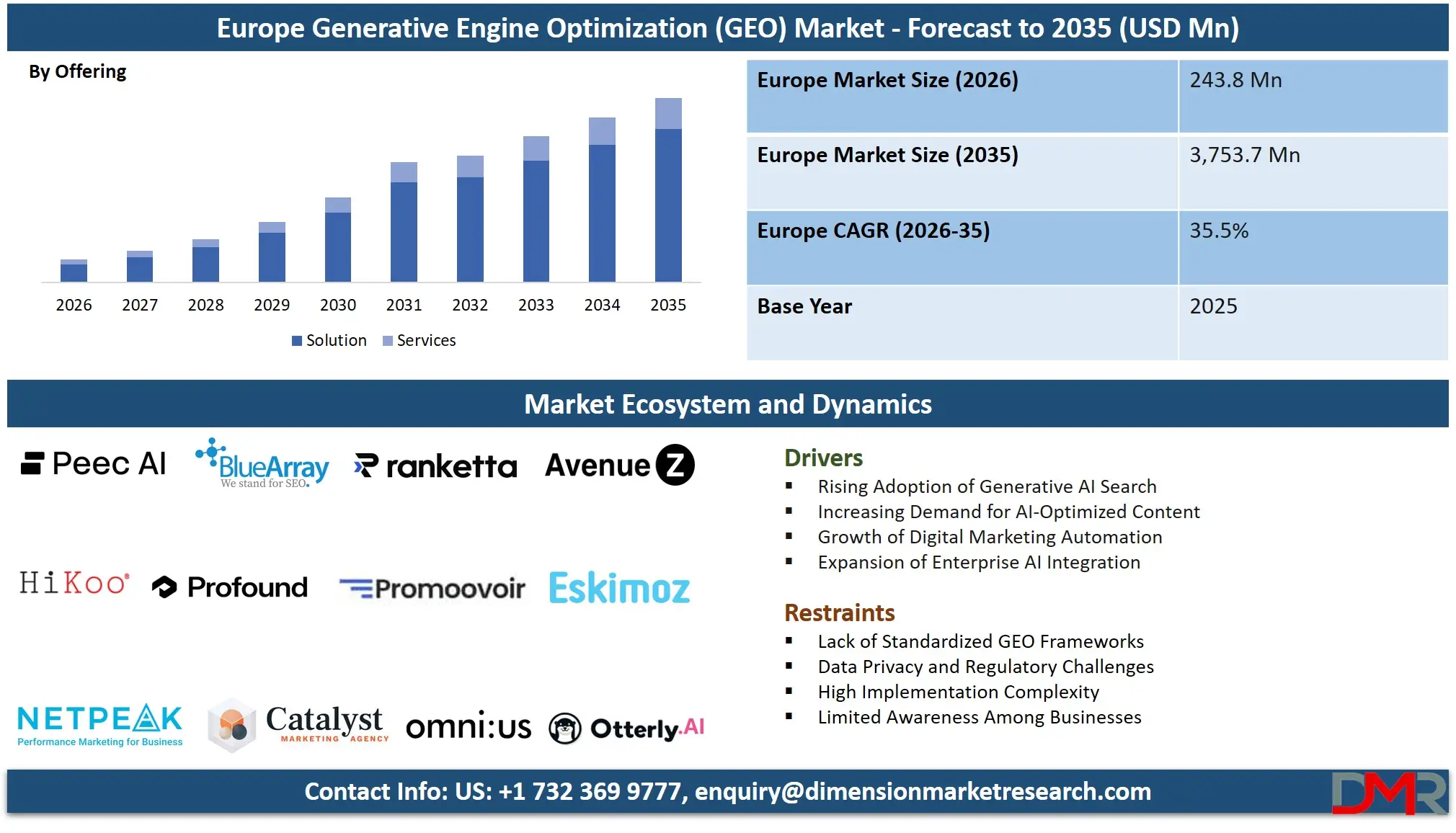
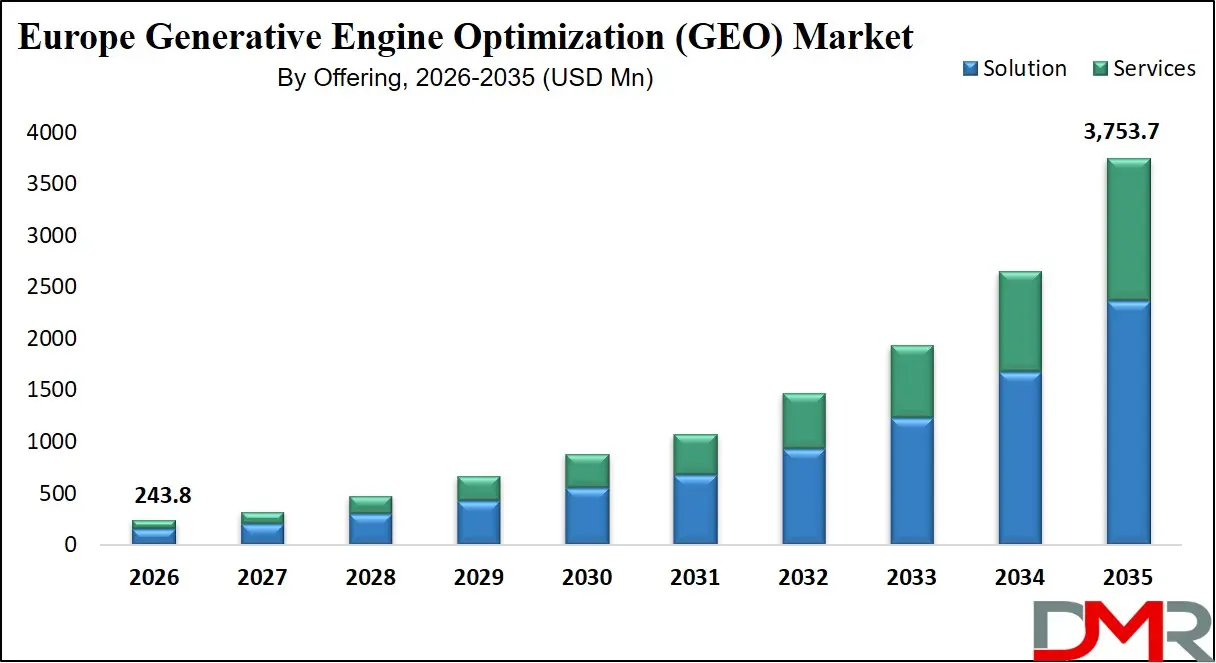
The Europe Generative Engine Optimization (GEO) market size is projected to reach a value of USD 243.8 million in 2026, and it is further anticipated to reach a market value of USD 3,753.7 million by 2035 at a CAGR of 35.5%.
ℹ
To learn more about this report –
Download Your Free Sample Report Here
The Generative Engine Optimization market is becoming an integral part of the digital economy in Europe, driven by the rapid adoption of generative AI technologies across industries. Situated at the forefront of technological innovation and stringent data privacy regulations, Europe occupies a privileged position in shaping how businesses optimize content for AI-driven search and conversational interfaces. The sector covers a wide range of activities, from content optimization and prompt engineering to GEO analytics and knowledge graph structuring, which are important in facilitating discoverability and supporting the growth of strategic sectors such as retail, media, healthcare, and technology. The European Commission's commitment to fostering digital sovereignty and ethical AI has resulted in substantial investment in AI infrastructure and regulatory frameworks, significantly transforming the digital marketing landscape.
Over the last few years, the Generative Engine Optimization market of Europe has witnessed a strategic transition in adopting advanced technologies like large language models (LLMs), natural language processing (NLP), and knowledge graphs. These technologies are making digital content more discoverable, developing real-time visibility in AI-generated responses, facilitating easier brand reputation management, and further helping in the optimization of conversational interfaces. Also, with the rapid growth of generative AI platforms like ChatGPT, Gemini, and Perplexity, the need for cost-effective visibility optimization has accelerated the demand for businesses to scale their digital presence. All these evolutions of technology and the market are likely to drive the sector's growth, signifying a good future outlook for the market.
Key trends currently evident within the Generative Engine Optimization arena in Europe are digital transitions taking hold of marketing operations by moving from traditional search engine optimization to generative AI-oriented ecosystems. Aside from this, further integration of AI and NLP brings predictive content analytics and real-time optimization with cost reductions along a value chain for better outputs of efficiency. Furthermore, with the augmenting emphasis on data privacy in line with GDPR compliance, adaptation to ethical AI practices, such as transparent data usage and bias mitigation in generative models, is on the rise. Similarly, the rise in conversational commerce has changed strategies for content creation as companies try to meet consumer expectations of accurate and contextually relevant AI-generated responses.
The market is consequently witnessing huge opportunities on the back of high investments by European technology companies and venture capital firms in AI infrastructure. Initiatives such as the development of sovereign AI models and European LLMs are creating a robust digital backbone to support regional and global competitiveness. Megaprojects like GAIA-X and the EU's Horizon Europe illustrate the strategic importance of digital infrastructure in enabling Europe's ambitious technological goals. The regulatory environment of the region enhances its potential to become a global leader in ethical AI, offering unparalleled access to privacy-conscious markets across the continent. Further, the focus on emerging technologies like multimodal AI, retrieval-augmented generation (RAG), and automated content personalization provides companies with opportunities to gain a competitive edge by improving discoverability and reducing customer acquisition costs.
Still, some significant challenges may impede the market. Regulatory fragmentation across European member states creates complexity for cross-border GEO implementations, thereby threatening to put uncertainty into business strategies. On the other hand, an emerging skill gap is appearing in the GEO sector amidst a growing shortage of skilled professionals with advanced knowledge of generative AI and optimization techniques. This factor may hamper the adoption of modern means of digital presence management practices. Other regulatory challenges include evolving AI compliance requirements and data localization mandates that make other difficulties worse and hence may discourage foreign investment in this market.
ℹ
To learn more about this report –
Download Your Free Sample Report Here
The Generative Engine Optimization industry is valued at an estimated 0.5% of the digital marketing spend for the year 2025, which is tremendous growth trajectory in Europe's digital economy. Major AI platforms handling about 15 billion monthly queries across European languages confirm the ever-increasing importance of GEO. The sector employs more than 50,000 professionals, and this number is expected to increase further with the opening of new AI research centers. This boom in the generative AI sector has powered GEO service adoption to grow by 40% in 2025 and is highly indicative of the evolution happening within the sector.
The growth prospects of the European Generative Engine Optimization market are very positive and promising for the future. With the focus on digital sovereignty and ethical AI under EU initiatives, besides the integration of advanced language technologies, the sector is likely to continue expanding. Infrastructural investments by technology companies will be further complemented by AI startup developments and innovation hubs to give a fillip to the development of the overall digital ecosystem. Though regulatory hurdles and fragmentation are prevailing challenges, opportunities for innovation and development in the GEO market are huge. Standing at the bedrock of the digital transformation process in Europe, this sector will be very instrumental in shaping the region for a future as a world leader in ethical and effective AI-powered discoverability.
Europe Generative Engine Optimization (GEO) Market: Key Takeaways
- Market Value: The Europe Generative Engine Optimization Market size is estimated to have a value of USD 243.8 million in 2026 and is expected to reach USD 3,753.7 million by the end of 2035.
- By Offering Segment Analysis: Solutions are anticipated to dominate this segment in this market as they will hold 62.4% of market share in 2026.
- By Deployment Mode Segment Analysis: The cloud-based solutions are projected to dominate the deployment segment in the Europe GEO Market with highest market share in 2026.
- By Application Segment Analysis: Content and discoverability optimization is projected to hold the leading position in the application segment of this market in 2026.
- By End User Industry Segment Analysis: The software and technology sector is projected to dominate the end-user segment in the Europe GEO market in 2026.
- Key Players: Some of the major key players in the Europe Generative Engine Optimization Market are Google, Microsoft, OpenAI, Anthropic, Cohere, Algolia, Bloomreach, Yext, and many others.
- Market Growth Rate: The market is growing at a CAGR of 35.5 percent over the forecasted period.
Europe Generative Engine Optimization (GEO) Market: Use Cases
- AI-Driven E-commerce Product Discovery Optimization: This application focuses on enhancing product data and digital listings for AI-powered shopping assistants, enabling seamless conversational commerce experiences. Businesses optimize structured product information to deliver highly relevant, context-aware responses that improve conversion rates across European e-commerce platforms.
- AI-Optimized Media Content Syndication: Media organizations refine articles, videos, and digital assets to ensure inclusion in AI-generated summaries and intelligent search responses. Through structured metadata, semantic tagging, and attribution frameworks, publishers maintain brand visibility while driving organic traffic. This use case supports enhanced discoverability within generative AI ecosystems and strengthens audience reach across diverse content platforms.
- Accessible AI-Powered Healthcare Information Delivery: Healthcare providers optimize patient-centric educational materials and service-related content for generative AI-driven health queries. This ensures accurate, compliant, and easy-to-understand medical information dissemination aligned with European healthcare standards. Multilingual optimization enhances accessibility, enabling broader patient engagement and improved healthcare literacy across regions.
- Intelligent Financial Services Interaction Enablement: Financial institutions leverage GEO strategies to optimize conversational AI systems for handling customer queries related to banking products, compliance, and financial advisory services. This enables highly personalized, secure, and regulation-compliant digital interactions. The approach enhances customer experience across diverse
Europe Generative Engine Optimization (GEO) Market: Stats & Facts
Eurostat (European Union Statistics Office)
- 32.7% of people aged 16–74 in the EU used generative AI tools in 2025.
- 25.1% of EU citizens used generative AI for personal purposes in 2025.
- 15.1% of EU citizens used generative AI for work-related activities in 2025.
- 9.4% of EU citizens used generative AI for formal education in 2025.
- 48.4% of individuals in Denmark used generative AI tools in 2025 (highest in EU).
- 17.8% of individuals in Romania used generative AI tools in 2025 (lowest in EU).
- 20.0% of EU enterprises used AI technologies in 2025.
- AI adoption among EU enterprises increased from 13.5% in 2024 to 20.0% in 2025.
- AI adoption among EU enterprises was 7.7% in 2021.
- 11.8% of EU enterprises used AI for analyzing written language in 2025.
- 13.5% of EU enterprises used AI technologies in 2024.
- 8.0% of EU enterprises used AI technologies in 2023.
- Sweden recorded a 14.7 percentage point increase in enterprise AI adoption between 2023 and 2024.
- 8% of EU enterprises used AI technologies in 2023 (baseline confirmation).
- 15.2% of enterprises in Denmark used AI in 2023 (highest that year).
- 1.5% of enterprises in Romania used AI in 2023 (lowest that year).
Eurostat – Digitalisation in Europe Report
- 94% of EU citizens used the internet in the last three months in 2025.
- 56% of EU citizens had at least basic digital skills in 2023.
- 41% of large EU enterprises used AI technologies compared to 13% of SMEs.
- 7% of EU businesses used AI for written language analysis.
- 5% of EU businesses used AI for generating written or spoken language.
- 5% of EU businesses used AI for speech-to-text conversion.
- 28% of enterprises in Denmark used AI (leading country in dataset).
- 3% of enterprises in Romania used AI (lowest adoption group).
European Commission (EU Policy Data)
- The EU aims for 100% of key public services to be available online by 2030 under the Digital Decade strategy.
- The EU targets at least 80% of adults with basic digital skills by 2030.
Eurobarometer (European Commission Survey)
- 64% of Europeans believe AI literacy will be essential by 2030.
Institutional & Public Data Sources (Aggregated from Official Publications)
- AI adoption among EU enterprises increased by 12.3 percentage points since 2021.
- Approximately 26% of the EU population actively used generative AI platforms in 2025.
Eurostat ICT Survey (Enterprise AI Usage Breakdown)
- 17% of small enterprises (10–49 employees) in the EU use AI technologies.
- 30% of medium enterprises (50–249 employees) use AI technologies.
- 55% of large enterprises (250+ employees) use AI technologies.
- 62.5% of enterprises in the information & communication sector use AI (highest sector adoption).
- 40% of enterprises in professional and technical services use AI.
- 11% of enterprises in construction use AI (lowest among major sectors).
Europe Generative Engine Optimization (GEO) Market: Market Dynamic
Driving Factors in Europe Generative Engine Optimization (GEO) Market
EU Digital Strategy and AI Development Initiatives
Europe's Digital Decade framework plays a crucial role in advancing the GEO market by prioritizing AI integration and digital transformation. Investments in AI infrastructure, including regional language models and innovation hubs, are fostering technological advancement. Supportive policies such as regulatory sandboxes and streamlined cross-border data flows further encourage innovation and attract global technology investments, strengthening Europe's digital economy.
Expanding Enterprise Adoption of Artificial Intelligence
Businesses across Europe are increasingly embedding AI into their operations, leading to a surge in AI-generated content and digital interactions. This drives demand for advanced GEO solutions capable of managing content optimization, conversational interfaces, and data infrastructure. The development of proprietary AI systems and improved digital frameworks enhances integration efficiency, supporting sustained growth in the GEO ecosystem.
Restraints in Europe Generative Engine Optimization (GEO) Market
High Capital Investment Requirements
The implementation of advanced GEO technologies, including LLM integration, automation platforms, and knowledge graph systems, requires substantial financial resources. Small and medium enterprises often face barriers in adopting these solutions, limiting market penetration and widening the technological gap between large corporations and smaller players.
Complex Regulatory and Compliance Frameworks
The evolving regulatory landscape, including frameworks such as the EU AI Act and GDPR, presents challenges for GEO adoption. Organizations must navigate complex compliance requirements while keeping pace with rapid AI advancements. This often leads to increased reliance on legal expertise and higher operational costs, necessitating investment in compliance automation and governance systems.
Opportunities in Europe Generative Engine Optimization (GEO) Market
Integration of Advanced and Emerging AI Technologies
The incorporation of cutting-edge technologies such as multimodal AI, retrieval-augmented generation (RAG), and automated personalization presents significant growth potential. These innovations enable predictive analytics, reduce operational costs, and enhance decision-making capabilities. Both startups and established enterprises are exploring these technologies, creating strong opportunities for investors and solution providers in the European GEO market.
Expansion of Multilingual Optimization Capabilities
The increasing demand for localized and multilingual content optimization across Europe is driving innovation in language-specific AI solutions. Investments in localization technologies and linguistic AI training are accelerating. Additionally, digital inclusion initiatives and evolving consumer language preferences are fostering the development of advanced multilingual GEO platforms, opening new avenues for service providers.
Trends in Europe Generative Engine Optimization (GEO) Market
Transformation of Digital Content Discovery Ecosystems
The European GEO landscape is witnessing a major shift driven by digital transformation initiatives aligned with regional AI strategies. Organizations are increasingly adopting advanced technologies such as large language models (LLMs), natural language processing (NLP), and semantic knowledge graphs to enhance real-time content optimization. These technologies improve content relevance, reduce inefficiencies in discoverability, and strengthen data accuracy in complex digital infrastructures. This trend not only boosts operational efficiency but also positions Europe as a global leader in AI-driven content ecosystems.
Rising Adoption of Generative AI Accelerating GEO Demand
The rapid integration of generative AI tools across industries is significantly increasing demand for GEO solutions in Europe. Leading technology providers are collaborating with optimization platforms to enhance AI-generated content accuracy and personalization. Automated content optimization systems and conversational interfaces are evolving rapidly, enabling businesses to deliver dynamic and user-centric experiences. This growing reliance on AI-powered discovery systems is driving investments in GEO infrastructure and unified digital platforms.
Europe Generative Engine Optimization (GEO) Market: Research Scope and Analysis
By Offering Analysis
The solutions segment is expected to lead the Europe Generative Engine Optimization (GEO) market due to the rapid acceleration of digital transformation and widespread expansion of artificial intelligence infrastructure across the region. Organizations are increasingly prioritizing investment in advanced GEO solutions such as content optimization platforms, prompt engineering frameworks, AI-driven search visibility tools, and semantic data structuring systems. These technologies enable enterprises to enhance content discoverability, improve contextual relevance, and deliver accurate responses within generative AI ecosystems. The integration of knowledge graphs, natural language processing, and real-time analytics further strengthens the ability of businesses to maintain competitive positioning in a highly dynamic digital environment.
Moreover, these solutions function as the foundational layer of GEO strategies by seamlessly connecting technical infrastructure with creative content processes. Enterprises are leveraging automated monitoring systems, performance dashboards, and predictive analytics to continuously optimize digital assets across multiple channels. The increasing reliance on large language models and conversational AI interfaces has further amplified the need for scalable and intelligent optimization systems capable of adapting to evolving user queries and search behaviors. Additionally, public sector initiatives and EU-backed digital innovation programs are encouraging the deployment of advanced GEO solutions by supporting infrastructure development and technology adoption. As a result, the solutions segment continues to dominate, acting as the core enabler of efficient, data-driven, and AI-integrated content optimization across Europe's digital economy.
By Deployment Mode Analysis
Cloud-based deployment is emerging as the dominant segment in the Europe GEO market, primarily due to the region's robust cloud infrastructure and highly interconnected digital ecosystems. Organizations across industries are increasingly adopting cloud-native GEO platforms to benefit from enhanced scalability, flexibility, and real-time processing capabilities. These platforms allow businesses to deploy, update, and optimize content strategies dynamically, which is essential in environments driven by generative AI and continuously evolving user interactions. Leading European economies such as Germany, France, and the United Kingdom are supported by advanced cloud networks, enabling seamless integration of GEO technologies across enterprise systems.
Furthermore, ongoing investments in hyperscale data centers, artificial intelligence hubs, and digital innovation corridors are strengthening the cloud ecosystem. Cloud deployment significantly reduces operational complexity and infrastructure costs compared to traditional on-premises models, making it an attractive option for both large enterprises and growing businesses. Technologies such as serverless computing, containerization, and microservices architecture are further enhancing performance efficiency and enabling faster deployment cycles. These advancements support continuous optimization, real-time analytics, and automated content adaptation, which are critical for GEO success.
In addition, cloud platforms facilitate cross-border digital operations, aligning with Europe's goal of creating a unified digital market. They also enable seamless integration with AI tools, analytics engines, and content management systems, ensuring consistent performance across multiple channels. This combination of cost efficiency, scalability, and technological advancement firmly establishes cloud-based deployment as the preferred model in the Europe GEO market.
By Application Analysis
Content and discoverability optimization stands as the leading application segment within the Europe GEO market, driven by its critical role in enhancing digital visibility, user engagement, and overall content performance. As generative AI increasingly becomes central to information retrieval and online interactions, businesses are focusing on optimizing their digital content to ensure relevance, accuracy, and accessibility. Advanced GEO systems utilize natural language processing, semantic search capabilities, knowledge graphs, and predictive analytics to deliver context-aware and high-quality outputs that align with user intent.
These technologies enable organizations to monitor content performance in real time, identify gaps in discoverability, and implement dynamic optimization strategies. By improving the alignment between user queries and generated responses, businesses can significantly enhance engagement levels and conversion rates. The integration of AI-powered content platforms with distribution networks further reduces latency, ensuring faster response times and a seamless user experience across digital channels.
Additionally, the growing role of third-party digital agencies and GEO service providers is contributing to the expansion of this segment. These entities offer specialized expertise in managing complex optimization processes across industries such as retail, media, healthcare, and financial services. Government-backed digital transformation initiatives and innovation hubs are also supporting the adoption of advanced content optimization technologies.
Due to its direct impact on operational efficiency, customer satisfaction, and digital competitiveness, content and discoverability optimization continues to dominate as the most critical application in the Europe GEO market.
By End User Industry Analysis
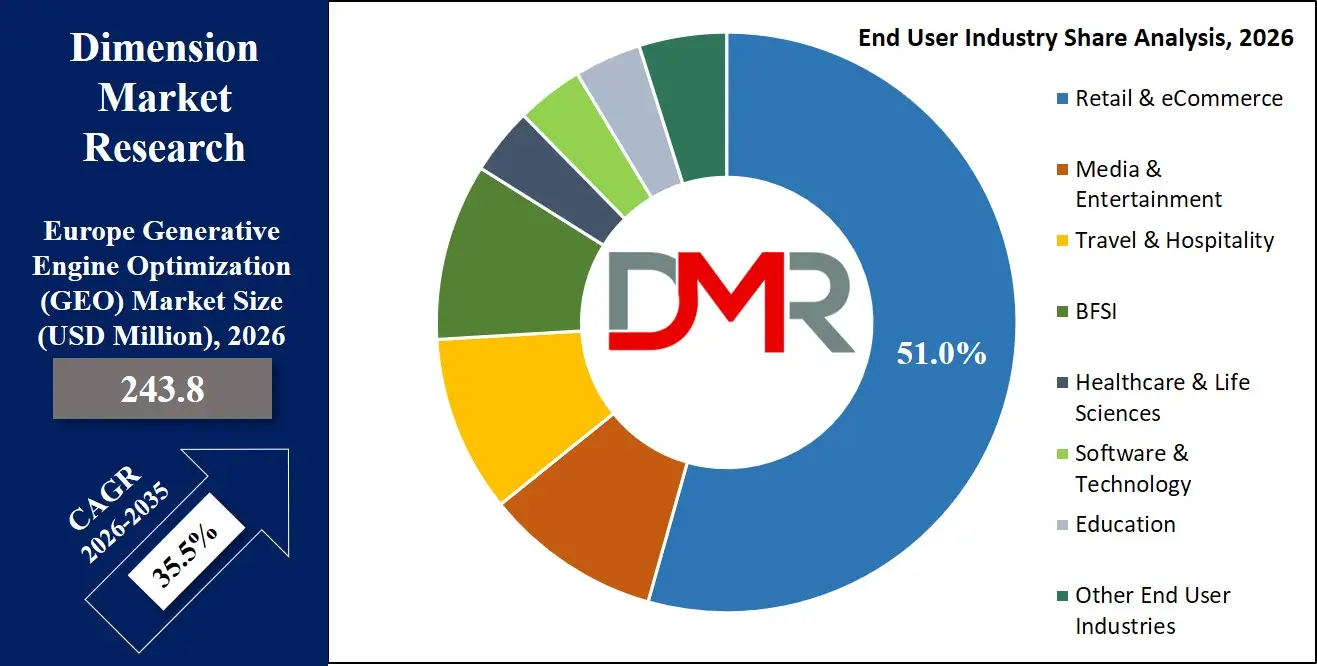
The retail and e-commerce sector dominates the Europe Generative Engine Optimization (GEO) market due to its strong dependence on digital visibility, personalized customer engagement, and AI-driven commerce experiences. As online shopping continues to expand across European markets, businesses are increasingly adopting GEO solutions to optimize product discovery, enhance search relevance, and improve conversion rates. Generative AI-powered shopping assistants, recommendation engines, and conversational interfaces are transforming how consumers interact with online platforms, making GEO a critical component of retail strategies.
ℹ
To learn more about this report –
Download Your Free Sample Report Here
Retailers and e-commerce companies are heavily investing in advanced technologies such as AI-driven content optimization tools, product data enrichment systems, and real-time analytics platforms. These investments enable dynamic content updates, personalized product recommendations, and improved alignment with user intent. GEO frameworks help optimize structured product data, metadata, and multilingual content, ensuring seamless discoverability across diverse European markets with varying language preferences.
Additionally, the integration of omnichannel retail strategies—combining online platforms with physical store experiences—further drives the adoption of GEO solutions. Businesses require unified systems that can manage content consistency, track customer behavior, and deliver accurate AI-generated responses across multiple touchpoints. Third-party platforms and digital agencies also play a crucial role in supporting retailers with end-to-end optimization services.
Government initiatives promoting digital commerce, cross-border e-commerce, and AI adoption further strengthen this segment. As retail and e-commerce remain key contributors to Europe's digital economy, their continuous focus on personalization, scalability, and customer-centric innovation ensures their leadership in shaping the GEO market landscape.
Europe Generative Engine Optimization (GEO) Market Report is segmented on the basis of the following:
By Offering
- Solution
- Content Optimization & Prompt Engineering Tools
- GEO Analytics & Monitoring Tools
- AI Search Visibility Optimization Platforms
- Knowledge Graph & Structured Data Optimization Solutions
- Services
- Consulting & Strategy Design
- Implementation & Integration
- Managed GEO Services
- Training & Enablement
By Deployment Mode
- Cloud-based GEO Solutions
- On-premises GEO Solutions
By Application
- Content & Discoverability Optimization
- Brand & Reputation Visibility
- Commerce & Conversion Enablement
- Data & Model Interaction Optimization
By End User Industry
- Retail & eCommerce
- Media & Entertainment
- Travel & Hospitality
- BFSI
- Healthcare & Life Sciences
- Software & Technology
- Education
- Other End User Industries
Impact of Artificial Intelligence in Europe Generative Engine Optimization (GEO) Market
- Enhanced Content Relevance and Contextual Accuracy: Artificial Intelligence significantly improves the quality and relevance of digital content by leveraging technologies such as natural language processing (NLP) and large language models (LLMs). These systems analyze user intent, search patterns, and contextual signals to generate highly accurate and personalized responses. This enables businesses to optimize content for generative search engines, ensuring higher visibility, better engagement, and improved user satisfaction across multilingual European markets.
- Automation of Content Optimization Processes: AI enables the automation of complex GEO workflows, including content structuring, keyword mapping, semantic tagging, and performance monitoring. Advanced algorithms can continuously analyze data, identify optimization gaps, and implement real-time improvements without manual intervention. This reduces operational costs, enhances efficiency, and allows organizations to scale their content strategies across multiple platforms and regions with minimal resource dependency.
- Improved Predictive Analytics and Decision-Making: AI-driven analytics tools empower organizations with predictive insights into content performance, user behavior, and emerging trends. By utilizing machine learning models, businesses can forecast demand patterns, optimize content strategies proactively, and refine digital campaigns. This data-driven approach enhances decision-making capabilities and ensures that GEO strategies remain adaptive in a rapidly evolving AI-driven ecosystem.
Europe Generative Engine Optimization (GEO) Market: Regional Analysis
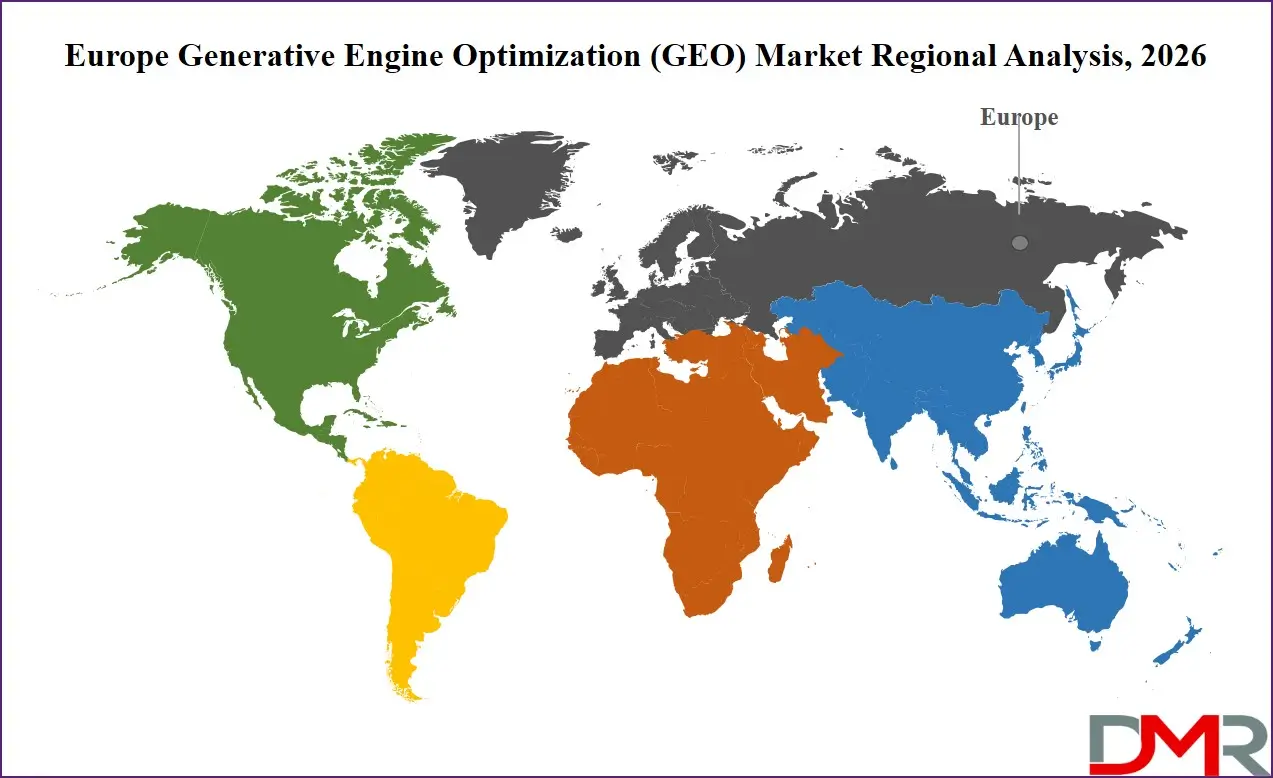
The Europe Generative Engine Optimization (GEO) market demonstrates a highly diverse regional landscape, shaped by varying levels of digital maturity, artificial intelligence adoption, and infrastructure development across member states. Western and Northern Europe, including countries such as Germany, France, and the Nordic nations, lead the market due to strong cloud ecosystems, advanced AI integration, and high enterprise digitalization. These regions benefit from well-established technology hubs, significant investments in data centers, and widespread adoption of generative AI tools, which collectively enhance content optimization and discoverability capabilities.
ℹ
To learn more about this report –
Download Your Free Sample Report Here
In contrast, Southern and Eastern European countries are gradually catching up, supported by increasing government initiatives, digital funding programs, and growing enterprise awareness of AI-driven solutions. However, disparities in digital skills and infrastructure remain a challenge, creating a multi-speed digital transformation across the region. For instance, while internet penetration in Europe is very high, digital skill levels and AI adoption vary significantly between countries, influencing the pace of GEO implementation.
Additionally, the European Union's Digital Decade strategy plays a crucial role in harmonizing regional development by promoting AI adoption, cloud computing, and cross-border data integration. Investments in AI infrastructure, innovation hubs, and digital ecosystems are further strengthening regional capabilities. As enterprises increasingly adopt AI technologies for content optimization and customer engagement, the GEO market continues to expand across all regions, with leading economies driving innovation while emerging markets contribute to long-term growth potential.
By Region
Europe
- Germany
- The U.K.
- France
- Italy
- Russia
- Spain
- Benelux
- Nordic
- Rest of Europe
Europe Generative Engine Optimization (GEO) Market: Competitive Landscape
The Europe GEO market is highly competitive, with participation from global technology leaders and regional innovators. Companies differentiate themselves through advancements in AI technologies, digital platforms, and content optimization frameworks. Leading players such as Google, Microsoft, and OpenAI dominate the AI platform space, while firms like Algolia, Bloomreach, and Yext specialize in enterprise GEO solutions.
Strategic partnerships, mergers, and acquisitions are common approaches to expand capabilities and market reach. Organizations are focusing on automation, predictive analytics, and real-time optimization to gain competitive advantage. The emergence of digital agencies providing end-to-end GEO services further intensifies competition, supported by strong government initiatives promoting digital innovation.
Some of the prominent players in Europe Generative Engine Optimization (GEO) Market are:
- Hikoo
- Otterly.ai
- Ranketta
- Eskimoz
- Blue Array
- Promoovoir
- Catalyst Marketing Agency
- Omnius
- Avenue Z
- Netpeak
- Peec AI
- BrandLight AI
- Profound
- AIScope
- Azoma
- Siftly
- Goodie AI
- LLMO Metrics
- Mention
- GEOfast
- Other Key Players
Recent Developments in Europe Generative Engine Optimization (GEO) Market
- October 2025: Microsoft launched an AI-driven content optimization platform to enhance enterprise visibility across generative search ecosystems, improving multilingual content accuracy.
- September 2025: Algolia partnered with a European e-commerce association to integrate conversational AI into search and discovery systems, enabling personalized digital commerce experiences.
- August 2025: The European Commission established the EU AI Innovation Hub to strengthen AI infrastructure across key industries.
- November 2024: OpenAI introduced a knowledge graph integration solution to improve transparency and reduce inaccuracies in AI-generated responses.
- July 2024: Google unveiled predictive content analytics tools powered by big data to enhance GEO decision-making and optimization efficiency.
- April 2024: DeepL expanded its language AI solutions to support multilingual content optimization across European markets.
Report Details
| Report Characteristics |
| Market Size (2026) |
USD 243.8 Mn |
| Forecast Value (2035) |
USD 3,753.7 Mn |
| CAGR (2026–2035) |
35.5% |
| Historical Data |
2021 – 2025 |
| Forecast Data |
2027 – 2035 |
| Base Year |
2025 |
| Estimate Year |
2026 |
| Report Coverage |
Market Revenue Estimation, Market Dynamics, Competitive Landscape, Growth Factors and etc. |
| Segments Covered |
By Offering (Solutions and Services), By Deployment Mode (Cloud-based GEO Solutions and On-premises GEO Solutions), By Application (Content & Discoverability Optimization, Brand & Reputation Visibility, Commerce & Conversion Enablement and Data & Model Interaction Optimizations), By End User Industry (Retail & eCommerce, Media & Entertainment, Travel & Hospitality, BFSI, Healthcare & Life Sciences, Software & Technology, Education and Other End User Industries) |
| Regional Coverage |
Europe – Germany, The UK, France, Russia, Spain, Italy, Benelux, Nordic, & Rest of Europe |
| Prominent Players |
Hikoo, Otterly.ai, Ranketta, Eskimoz, Blue Array, Promoovoir, Catalyst Marketing Agency, Omnius, Avenue Z, Netpeak, Peec AI, BrandLight AI, Profound, AIScope, Azoma, Siftly, Goodie AI, LLMO Metrics, Mention, GEOfast, and Other Key Players |
| Purchase Options |
We have three licenses to opt for: Single User License (Limited to 1 user), Multi-User License (Up to 5 Users) and Corporate Use License (Unlimited User) along with free report customization equivalent to 0 analyst working days, 3 analysts working days and 5 analysts working days respectively. |
Frequently Asked Questions
How big is the Europe' Generative Engine Optimization Market?
▾ The Europe Generative Engine Optimization Market size is estimated to have a value of USD 243.8 million in 2026 and is expected to reach USD 3,753.7 million by the end of 2035.
Who are the key players in the Europe Generative Engine Optimization Market?
▾ Some of the major key players in the Europe Generative Engine Optimization Market are OpenAI, Google, IBM, Microsoft, Salesforce, Oracle, Cognizant, and many others.
What is the growth rate in the Europe Generative Engine Optimization Market?
▾ The market is growing at a CAGR of 35.5 percent over the forecasted period.