Europe Healthcare HR Software Market Snapshot
- Europe Healthcare HR Software Market Size in 2026: USD 860.0 Million
- Europe Healthcare HR Software Market Size in 2035: USD 1,350.0 Million
- Europe CAGR from 2026 to 2035: 5.1%
- Workforce Scheduling and Staffing Management Software is the leading solution type segment in 2026: 34.2%
- Cloud-Based is the leading deployment mode segment in 2026: 59.7%
- Large Healthcare Systems and Hospital Networks is the leading organization size segment in 2026: 57.3%
- Hospitals is the leading end user segment in 2026: 49.5%
What is the Europe Healthcare HR Software Market and its Market Size?
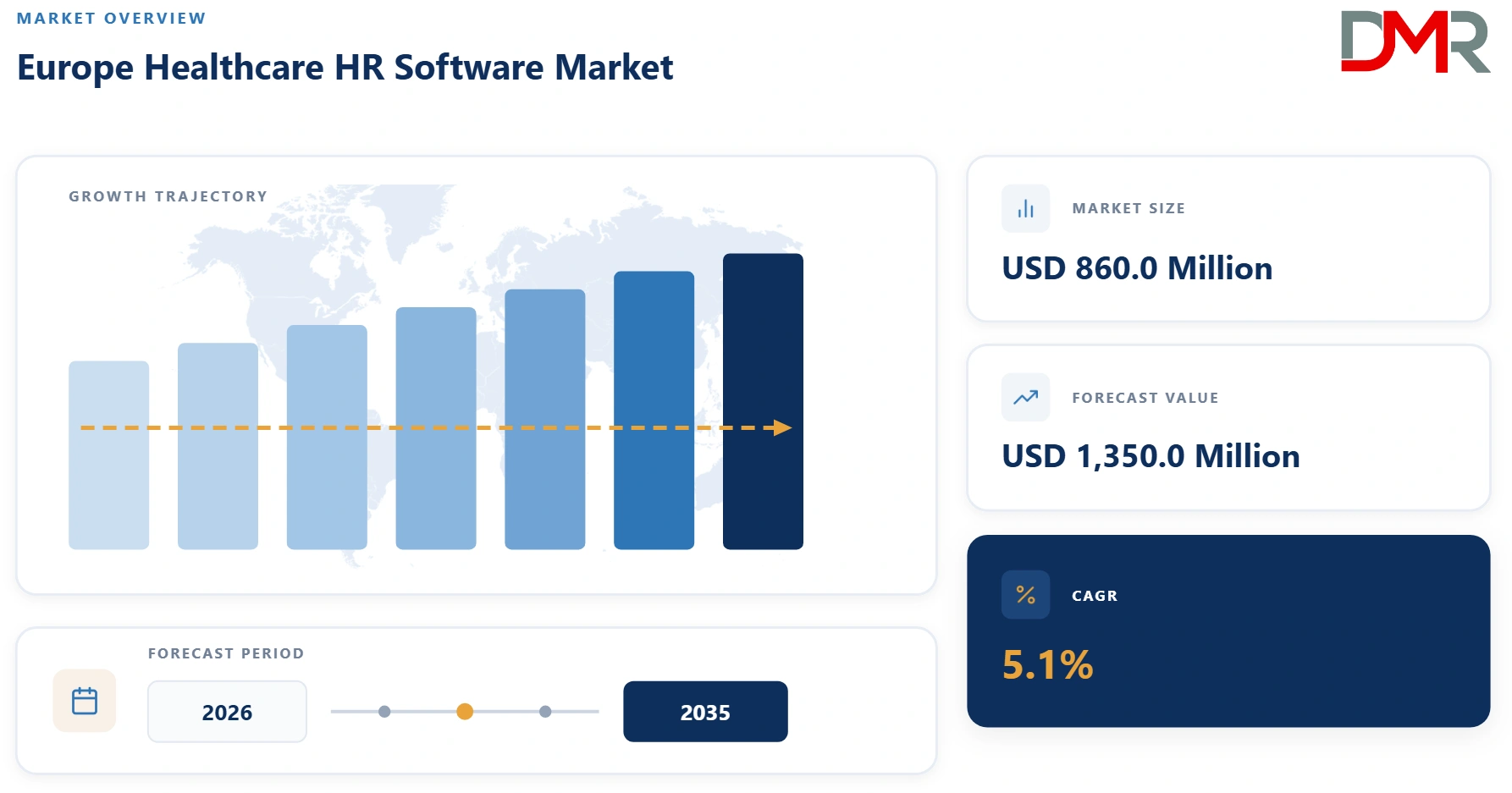
The Europe Healthcare HR Software Market is projected to be valued at USD 860.0 Million in 2026 and is projected to reach USD 1,350.0 Million by 2035, expanding at a CAGR of 5.1% during the forecast period.
ℹ
To learn more about this report –
Download Your Free Sample Report Here
Growth is being propelled by persistent nursing and clinical workforce shortages across Europe pushing hospitals and care providers toward smarter scheduling, staffing, and workforce optimization software, continued consolidation of hospital groups and multi-site health systems requiring standardized, centralized human capital management platforms, and rising regulatory and credentialing complexity linked to cross-border clinical staff mobility, working-time directives, and continuing professional development tracking. The maturing of cloud-based, subscription-model HR and workforce platforms offering improved accessibility and reduced IT infrastructure burden for smaller care providers, growing integration of AI-enabled predictive staffing and demand forecasting tools improving shift coverage and reducing reliance on costly agency labor, and continued national health system and private hospital group expansion driving demand for standardized, multi-location HR software supporting centralized administrative and compliance oversight are reshaping the market from a largely fragmented, facility-specific administrative software category into an increasingly cloud-native, integrated healthcare workforce technology ecosystem. Investment is accelerating as software vendors expand cloud-based platform capability and AI-enhanced scheduling and compliance features to serve both consolidating hospital networks and independent care providers across Europe.
Use Cases
- Multi-Site Workforce and Rostering Management for Hospital Networks: European hospital groups, health boards, and private healthcare networks use integrated workforce and rostering software to standardize scheduling, time and attendance, and staffing-level oversight across multiple facilities, supporting centralized operational oversight and consistent patient-to-staff ratios.
- Credentialing and Regulatory Compliance Tracking for Clinical Staff: Hospitals and health systems across Europe use credentialing and compliance management software to track professional licensure, continuing education, and mandatory training requirements for physicians, nurses, and allied health professionals, reducing compliance risk and supporting regulatory reporting.
- AI-Enabled Predictive Staffing for Shift Coverage and Burnout Reduction: Health systems use AI-enabled workforce management software to forecast patient demand and staffing needs, filling open shifts earlier and reducing overtime, agency reliance, and clinician burnout across nursing and allied health teams.
- Payroll and Benefits Administration Across Complex Healthcare Pay Structures: Healthcare providers use payroll and compensation management software to accurately apply shift enhancements, unsocial-hours payments, overtime, and pension contributions across large, diverse clinical and administrative workforces spanning multiple employment structures.
Key Takeaways
- Market Size: The Europe Healthcare HR Software Market is anticipated to be valued at USD 860.0 Million in 2026 and is forecast to reach USD 1,350.0 Million by 2035, expanding at a CAGR of 5.1%.
- Growth Outlook: Market expansion is sustained by persistent clinical workforce shortages requiring smarter staffing and scheduling systems, continued hospital and care group consolidation, and rising regulatory and credentialing complexity across European health systems.
- Primary Growth Drivers: Persistent nursing and clinical workforce shortages, continued hospital group and multi-site health system consolidation, rising credentialing and regulatory compliance complexity, and growing adoption of AI-enabled predictive staffing tools are accelerating market growth.
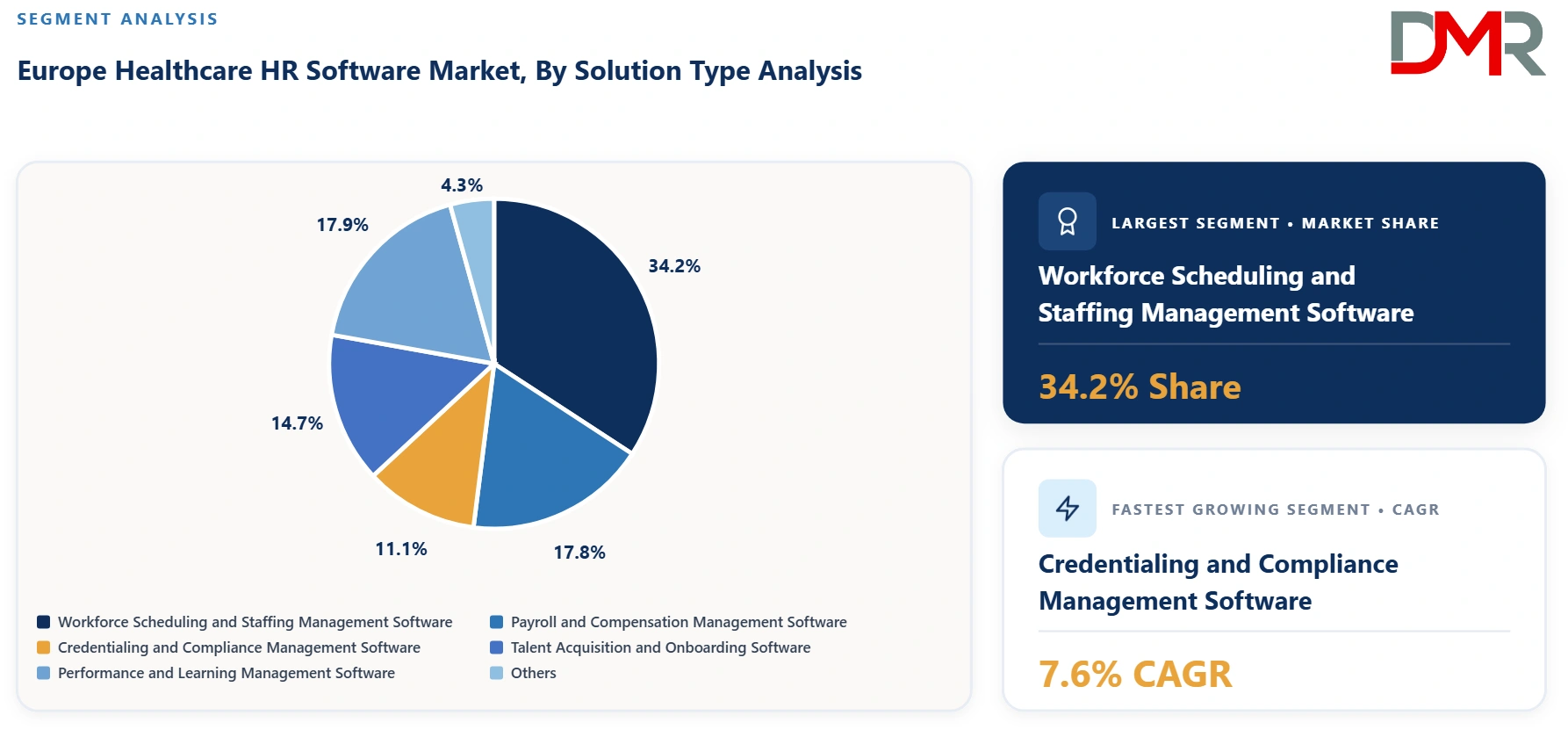
- By Solution Type Analysis: Workforce Scheduling and Staffing Management Software is projected to lead the solution type segment with a 34.2% share in 2026, reflecting its foundational role in addressing acute clinical staffing shortages. Credentialing and Compliance Management Software is the fastest-growing solution type segment at 7.6% CAGR, driven by rising regulatory complexity and cross-border staff mobility.
- By Deployment Mode Analysis: Cloud-Based is expected to dominate with a 59.7% share in 2026, supported by growing preference for reduced IT infrastructure burden and improved multi-site accessibility. Cloud-Based is also the fastest-growing deployment mode segment as hospital networks increasingly favor centralized, cloud-hosted platforms.
- By Organization Size Analysis: Large Healthcare Systems and Hospital Networks are projected to lead with a 57.3% share in 2026, reflecting concentrated demand from multi-site providers. Small and Medium-Sized Healthcare Facilities are the fastest-growing organization size segment at 6.8% CAGR, driven by growing affordability of cloud-based platforms.
- By End User Analysis: Hospitals are poised to lead with a 49.5% share in 2026, reflecting the scale and staffing complexity of hospital workforces across Europe. Ambulatory Care Centers and Clinics are the fastest-growing end user segment at 6.9% CAGR, driven by growing outpatient care volumes and administrative digitization.
Key Drivers in the Europe Healthcare HR Software Market
Persistent Nursing and Clinical Workforce Shortages Across European Health Systems
European health systems continue to face acute nursing and clinical staffing shortages, particularly across the United Kingdom, Germany, and Southern Europe, driven by an aging clinical workforce, competitive international labor markets, and rising patient demand. This structural shortage directly drives demand for workforce scheduling, staffing optimization, and predictive demand-forecasting software capable of maximizing existing staff utilization, reducing costly agency and locum reliance, and improving shift coverage, positioning workforce shortages as a primary structural driver of software market expansion.
Continued Hospital Group and Multi-Site Health System Consolidation
European hospital care delivery continues to consolidate from historically fragmented, single-site administrative structures toward larger hospital groups, integrated health systems, and private care networks, particularly across markets where private equity-backed consolidation of care homes and clinics has proceeded rapidly. This consolidation trend drives demand for standardized, scalable HR software capable of supporting centralized payroll, credentialing, and workforce oversight across multiple facility locations.
Restraints in the Europe Healthcare HR Software Market
Data Privacy Compliance Complexity Under GDPR Affecting Employee Health and Personal Data
The European Union's General Data Protection Regulation creates substantial data privacy compliance requirements for HR software handling sensitive employee data, including health and occupational information for clinical staff, representing a meaningful restraint on the Europe Healthcare HR Software Market. Software vendors must invest significantly in data protection infrastructure, works council and labor union consultation processes, and consent management functionality, increasing development costs and potentially slowing deployment timelines, particularly for smaller vendors with more limited compliance resources relative to larger, well-capitalized competitors.
Growth Opportunities in the Europe Healthcare HR Software Market
AI-Enabled Predictive Staffing and Workforce Forecasting Tool Development
Growing hospital and health system interest in AI-enabled predictive staffing tools capable of forecasting patient demand and optimizing shift coverage presents a substantial opportunity for software vendors to differentiate through advanced workforce intelligence capability integrated within broader scheduling and payroll platforms. Companies capable of demonstrating measurable reductions in agency spend and overtime can capture premium positioning and stronger health system adoption as AI-enabled workforce software capability continues maturing.
Integrated, Interoperable HR Ecosystems Supporting Multi-Site Health System Scalability
Growing hospital network and health system demand for fully integrated HR ecosystems spanning scheduling, payroll, credentialing, and talent management functionality presents a substantial opportunity for vendors capable of offering comprehensive, interoperable platform solutions rather than standalone point products. Companies developing integrated software ecosystems that reduce the operational complexity of managing multiple disconnected systems across growing multi-site provider networks can capture significant value from continued health system consolidation.
Trends in the Europe Healthcare HR Software Market
Growing Adoption of Cloud-Based, Subscription-Model Workforce Platforms
European healthcare providers are increasingly transitioning from traditional on-premise, licensed HR software toward cloud-based, subscription-model platforms, reflecting both reduced upfront capital investment requirements and improved software update and support accessibility. This transition is particularly pronounced among hospital networks seeking centralized software management capability across multiple facility locations without requiring separate on-premise IT infrastructure at each site.
Rising Focus on Staff Self-Service, Mobile Access, and Employee Experience
HR and workforce software vendors are increasingly expanding staff-facing digital functionality, including mobile shift-swapping, self-service rostering, and digital payslip access, reflecting broader clinical workforce expectations for convenient, mobile-first interaction. This trend is encouraging healthcare providers to view workforce experience software as an increasingly important staff retention and engagement tool rather than a purely administrative convenience.
Research Scope and Analysis
The Europe Healthcare HR Software Market is segmented by solution type, deployment mode, organization size, and end user, covering workforce scheduling, payroll, credentialing, and talent management software across cloud-based and on-premise deployment models and various healthcare provider settings.
ℹ
To learn more about this report –
Download Your Free Sample Report Here
By Solution Type Analysis
Workforce Scheduling and Staffing Management Software is projected to dominate the Europe Healthcare HR Software Market with 34.2% share in 2026, reflecting its foundational and essential role in addressing acute clinical staffing shortages and complex, round-the-clock rostering requirements across hospitals and care facilities of all sizes. Credentialing and Compliance Management Software is expected to register the highest CAGR of 7.6% during 2026-2035, driven by rising regulatory complexity, cross-border clinical staff mobility, and growing continuing-education tracking requirements.
By Deployment Mode Analysis
Cloud-Based deployment is anticipated to dominate the Europe Healthcare HR Software Market, accounting for 59.7% share in 2026, supported by growing provider preference for reduced IT infrastructure burden, improved software accessibility, and simplified update and support management, particularly valuable for smaller independent care providers with limited dedicated IT resources. Cloud-Based deployment is also projected to register the highest CAGR as hospital networks increasingly favor cloud platforms supporting centralized, multi-site software management and reporting capability.
By Organization Size Analysis
Large Healthcare Systems and Hospital Networks are projected to dominate the Europe Healthcare HR Software Market with 57.3% share in 2026, reflecting concentrated software spend among multi-site providers managing large, complex clinical workforces. Small and Medium-Sized Healthcare Facilities are expected to register the fastest CAGR of 6.8% through 2035, driven by growing affordability and accessibility of cloud-based, subscription-priced platforms suited to smaller operating budgets.
By End User Analysis
Hospitals are projected to lead the Europe Healthcare HR Software Market with an estimated 49.5% share in 2026, reflecting the scale, shift complexity, and round-the-clock staffing requirements of hospital workforces across Europe. Ambulatory Care Centers and Clinics are expected to register the fastest CAGR of 6.9% through 2035, driven by growing outpatient care volumes and increasing administrative digitization among clinic networks.
The Europe Healthcare HR Software Market Report is segmented based on the following:
By Solution Type
- Workforce Scheduling and Staffing Management Software
- Payroll and Compensation Management Software
- Credentialing and Compliance Management Software
- Talent Acquisition and Onboarding Software
- Performance and Learning Management Software
- Others
By Deployment Mode
By Organization Size
- Large Healthcare Systems and Hospital Networks
- Small and Medium-Sized Healthcare Facilities
By End User
- Hospitals
- Long-Term Care and Nursing Facilities
- Ambulatory Care Centers and Clinics
- Home Healthcare Providers
- Academic and Research Medical Centers
Country Analysis
The United Kingdom is poised to dominate the Europe Healthcare HR Software Market, supported by the scale of National Health Service workforce management requirements, an acute clinical staffing shortage, and the concentration of leading workforce and payroll software vendors headquartered in the country. Hospital trusts and care providers across the country increasingly use integrated software for rostering, staff engagement, credentialing, and payroll processing. Germany also represents a significant market, supported by a large hospital sector and strong local HR technology vendors serving multi-country compliance needs. France and Italy are witnessing steady adoption as hospital groups modernize administrative and workforce processes, while Spain is expanding through growing digitalization of public and private healthcare providers. The Rest of Europe is growing through increasing awareness of digital workforce management, wider adoption of cloud-based platforms, and growing demand for efficient, compliant, and staff-focused HR software solutions.
By Country
Europe
- The U.K.
- Germany
- France
- Italy
- Spain
- Rest of Europe
Technology Analysis
Technology development is increasingly shaping competitiveness in the Europe Healthcare HR Software Market as vendors invest in AI-enabled predictive staffing and demand-forecasting capability, cloud-native workforce architecture supporting seamless multi-site deployment, and interoperability standards enabling integration across diverse scheduling, payroll, and credentialing software systems. Growing use of workforce analytics is supporting staff retention and burnout-reduction insights for hospital networks managing multiple facility locations. Opportunities are expanding for companies developing validated predictive staffing tools, comprehensive integrated HR ecosystems reducing multi-system management complexity, and GDPR-compliant data architecture supporting confident cross-border health system data management. However, achieving robust interoperability across the historically fragmented European healthcare HR software vendor landscape remains an ongoing technical and industry coordination challenge.
Investment and White Space Analysis
Investment opportunities in the Europe Healthcare HR Software Market are expanding alongside continued hospital and care group consolidation, persistent clinical workforce shortages, and growing provider demand for AI-enabled staffing tools. Significant white space exists in predictive staffing and workforce forecasting tool development, integrated HR ecosystems supporting multi-site health system scalability, and GDPR-compliant cloud infrastructure supporting confident cross-border data management. Companies with strong workforce analytics capability, established relationships with growing hospital networks, and robust data privacy compliance infrastructure are positioned to capture premium, longer-duration growth opportunities. However, data privacy compliance complexity under GDPR, along with the challenge of achieving interoperability across a historically fragmented vendor landscape, can constrain smaller vendors' ability to compete effectively for larger hospital network software contracts.
Competitive Landscape
The Europe Healthcare HR Software Market is fragmented and increasingly competitive, comprising large diversified global human capital management companies with substantial European operations, specialized European healthcare workforce and payroll vendors with deep regional regulatory knowledge, and emerging AI-focused workforce analytics startups. Competition centers on software integration and interoperability capability, AI-enabled predictive staffing functionality, GDPR compliance and data privacy infrastructure, and established relationships with growing hospital networks and independent care providers. Large diversified global companies benefit from broad product portfolios and substantial research and development resources, while specialized European vendors compete through deep regional regulatory knowledge and closer, more responsive client relationships. Companies increasingly differentiate through AI staffing capability and integrated ecosystem functionality rather than standalone scheduling or payroll features alone.
Some of the prominent players in the Europe Healthcare HR Software Market are:
- RLDatix (Allocate Software)
- Zellis Group
- IRIS Software Group
- The Access Group
- Civica UK Ltd.
- symplr
- HealthStream, Inc.
- QGenda, LLC
- WorkForce Software, LLC
- UKG Inc.
- Dayforce, Inc.
- ADP, Inc.
- SAP SE
- Oracle Corporation
- Workday, Inc.
- ServiceNow, Inc.
- Cornerstone OnDemand, Inc.
- ELMO Software Limited
- The Sage Group plc
- Personio SE & Co. KG
- HiBob Inc.
- Cezanne HR Ltd.
- Softworks Ltd.
- TeamSystem S.p.A.
- Cegid Group
- Factorial HR
- rexx systems GmbH
- Alight Solutions LLC
- SumTotal Systems, LLC
- PeopleFluent
- IBM Corporation
- ATOSS Software SE
- Infor, Inc.
- Quinyx AB
- SD Worx NV
- SISQUAL Workforce Management, Lda.
- Protime NV
- Lantum Ltd.
- Florence
- Sona Technologies Ltd.
- Other Key Players
Recent Developments
- February 2026: symplr unveiled AI-powered innovations across its Operations Platform at ViVE 2026, adding predictive scheduling and automated labor-policy tools to its combined Workforce and Smart Square platform following its 2025 Smart Square acquisition.
- March 2026: Personio released Q1 2026 platform updates adding gender pay gap reporting, long-term leave management, and an EU Whistleblower Directive compliance module, extending its European regulatory compliance capability for regulated employers, including healthcare organizations.
- May 2026: Care UK went live with Zellis HCM AIR, rolling out a new HR and payroll platform across an initial 150 of its more than 260 UK care homes to reduce manual administrative effort and strengthen compliance.
- June 2026: Ashford and St Peter's Hospitals NHS Foundation Trust appointed RLDatix to deploy its Allocate Optima electronic rostering platform, alongside its SafeCare staffing-insight tool and Loop staff engagement app, across the trust's workforce.
Report Details
| Report Characteristics |
| Market Size (2026) |
USD 860.0 Mn |
| Forecast Value (2035) |
USD 1,350.0 Mn |
| CAGR (2026–2035) |
5.1% |
| Historical Data |
2021 – 2025 |
| Forecast Data |
2026 – 2035 |
| Base Year |
2025 |
| Segments Covered |
By Solution Type, By Deployment Mode, By Organization Size, and By End User |
| Country Coverage |
Europe – Germany, France, The UK, Italy, Spain, Rest of Europe |
Frequently Asked Questions
How big is the Europe Healthcare HR Software Market?
▾ The Europe Healthcare HR Software Market is poised to be valued at USD 860.0 Million in 2026 and is projected to reach USD 1,350.0 Million by 2035, reflecting persistent clinical workforce shortages and continued hospital group consolidation.
What is the CAGR of the Europe Healthcare HR Software Market from 2026 to 2035?
▾ The market is projected to expand at a compound annual growth rate (CAGR) of 5.1% between 2026 and 2035, supported by continued consolidation, growing AI-enabled staffing tool adoption, and rising regulatory compliance requirements.
What factors are driving the growth of the Europe Healthcare HR Software Market?
▾ Growth is driven by persistent nursing and clinical workforce shortages, continued hospital group and multi-site health system consolidation, rising credentialing and regulatory compliance complexity, and growing adoption of AI-enabled predictive staffing tools.
What are the major trends in the Europe Healthcare HR Software Market?
▾ Major trends include growing adoption of cloud-based, subscription-model workforce platforms, rising focus on staff self-service and mobile access, and increasing development of AI-enabled predictive staffing and compliance capability.
Who are the key players in the Europe Healthcare HR Software Market?
▾ Key market participants include RLDatix (Allocate Software), Zellis Group, symplr, UKG, and SAP SE, among other global and specialized European healthcare HR and workforce software vendors.
How is the Europe Healthcare HR Software Market segmented?
▾ The market is segmented by solution type, deployment mode, organization size, and end user, with demand analysis concentrated across the United Kingdom, Germany, France, Italy, Spain, and Rest of Europe.