Market Overview
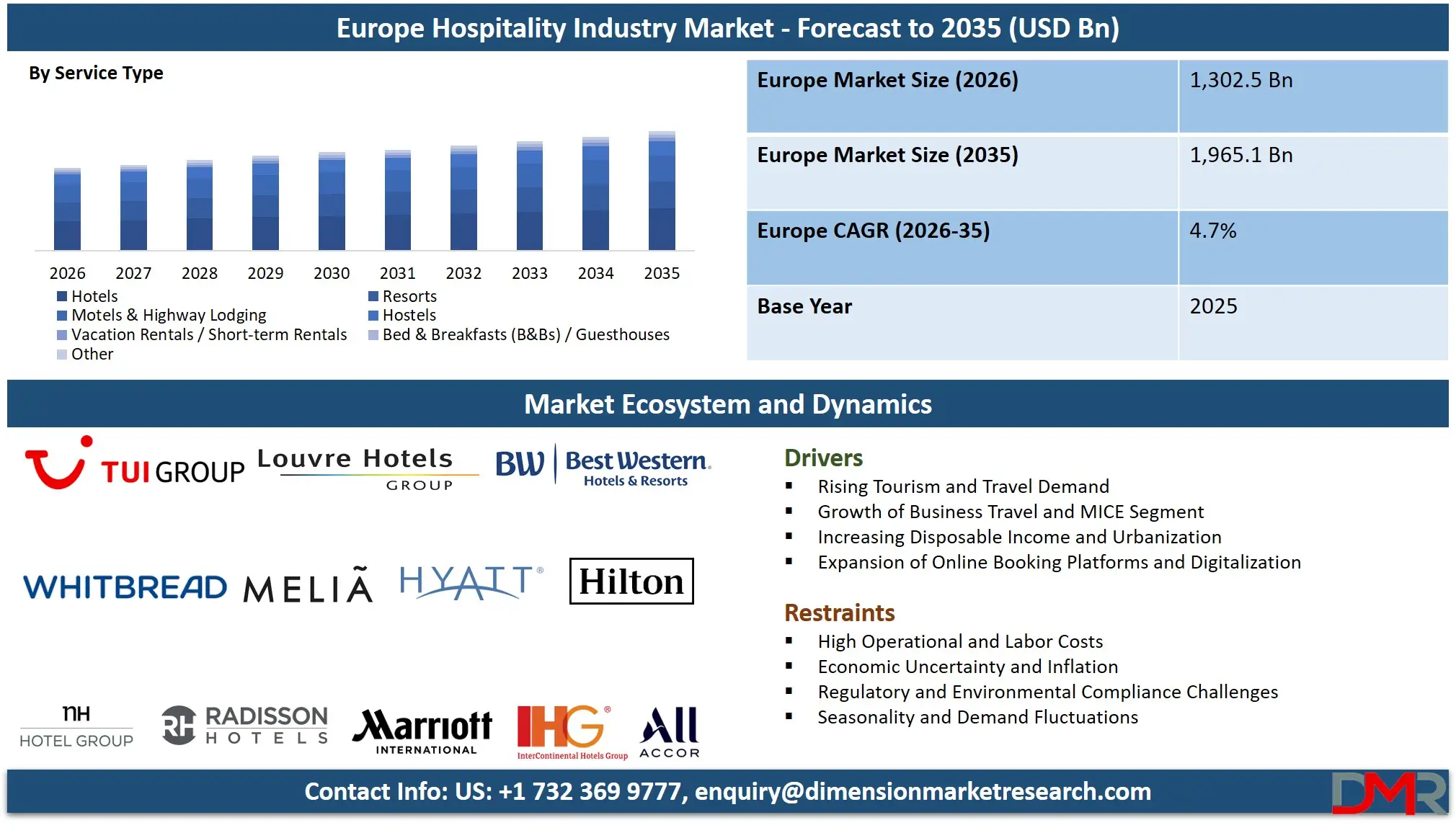
Europe hospitality industry market size is expected to reach a value of USD 1,302.5 billion in 2026, and it is further anticipated to reach a market value of USD 1,965.1 billion by 2035 at a CAGR of 4.7%.
ℹ
To learn more about this report –
Download Your Free Sample Report Here
The European hospitality market is a fully developed but fosters a dynamic ecosystem with high international inbound tourism, high-speed rail connectivity, and a variety of cultural attraction. Big cities like London, Paris, Rome, Berlin, Barcelona serve as major centers, which are reinforced by historic hotels, boutique hotels, and an expanding serviced apartment industry.
Sustainability regulations and heritage preservation are becoming two factors that influence hospitality in Europe. Consumers are demanding eco-certified rooms, local cuisine, and cross-border booking services. The increased use of hostel chains and the hybrid hotel-hostel is making cities more affordable. Digitalization and emergence of alternative accommodations have resulted in a tremendous change in the market.
ℹ
To learn more about this report –
Download Your Free Sample Report Here
Europe Hospitality Industry Market: Key Takeaways and Other Influencing Factors
- Market Growth Insights: The market is anticipated to reach USD 1,302.5 billion in 2026 and is projected to expand to around USD 1,965.1 million by 2035, registering a CAGR of 4.7% during the forecast period.
- By Service Type Insights: Accommodation services is projected to remain the dominant segments due to the high consumer spending on cultural tourism, culinary experiences and intra-European travel both in leisure and business markets.
- By Booking Channel Insights: Indirect booking by the Online Travel Agency (OTAs), especially Booking.com, is predominant because the cross-border traveling is highly complex, consumers trust the OTAs to make international bookings.
- Key Players Insights: The key players in the market are Accor S.A., IHG Hotels & Resorts (Europe), Marriott International (Europe), Hilton Worldwide (Europe), Meliá Hotels International, Whitbread PLC, Airbnb Ireland UC, Booking.com B.V., and TUI Group.
- European Travel Commission (ETC): Over 2.9 billion overnight stays were recorded across EU-27 plus UK and Switzerland during 2025, up 7.2% year-on-year. France, Spain and Italy recorded about 50.0% of the total number of international tourism nights in Europe. By 2025, there were 780 million international tourist arrivals in Europe, and the amount spent was about 620 billion.
- Eurostat / HOTREC: EU hospitality industry has about 2.1 million businesses, with more than 90.0% SMEs employing fewer than 10 workers. The industry has an employment of more than 12.5 million in EU-27. More than 60.0% of European hotels are certified with sustainability, and this is increasing, as compared to 35.0% in 2020.
- World Travel & Tourism Council (WTTC): The direct contribution of travel and tourism to the EU-27 GDP was estimated to be in the year 2025 at a figure of 720 billion (around 4.5 of the GDP). In 2025, the industry had 22 million direct employment opportunities in Europe.
Impact of the Iran Conflict on Europe Hospitality Industry Market
The impact of the Iran conflict on the European hospitality industry is mainly high cost of energy and low consumer confidence. The escalating tensions have driven up the oil prices in the world leading to the rising costs of jet fuel by the airlines that operate in Europe. This will cause an increase in airfares, especially the long-haul flights between Asia and the Middle East and this may decrease the number of inbound tourists to European destinations. Unpredictability in the geo-political situation also makes some travelers, particularly the ones in risk-aversive markets like the United States and East Asia, delay or cancel their European travel plans.
This softens forward reservations of hotels, restaurants, and attractions in major gateway cities such as London, Paris, Rome, and Barcelona. Also, supply chain shocks and inflationary pressures increase the operating expenses of food, utilities and insurance of European hospitality businesses. Although the immediate effect is not as intense as the Middle East, the war generates short-term demand fluctuations and cost long-term pressures that pose a threat to profitability, especially to the smaller independent operators that have little financial reserves.
Europe Hospitality Industry Market: Use Cases
- Heritage and Boutique Hotel Conversions: Historic buildings such as monasteries, palaces, and former factories are being transformed into unique boutique hotels, balancing modern guest expectations with strict European heritage preservation laws and sustainability retrofits.
- Sustainable Farm-to-Table Dining Integration: European full-service restaurants and hotel dining programs lead global trends in locally sourced, organic, seasonal, and zero-waste menus, with direct relationships between chefs and regional producers.
- Rail-Linked Travel and Tourism Packages: Tour operators and travel agencies integrate high-speed rail passes (Eurostar, TGV, ICE, Frecciarossa) with accommodation booking, creating seamless cross-border itineraries for sustainability-conscious travelers seeking low-carbon options.
- Extended Stay and Aparthotel Growth: Brands like Adagio (Accor), Staycity, and Locke offer apartment-style accommodations with kitchenettes and co-working spaces, catering to digital nomads, remote workers, and blended business-leisure travelers across major European cities.
Europe Hospitality Industry Market: Market Dynamics
Driving Factors in Europe Hospitality Industry Market
Strong Intra-European and Inbound International Travel Recovery
The complete resurgence of travel in Europe, as well as in major long haul markets like the United States and China, has considerably boosted occupancy, ADR, and RevPAR in most European destinations. The introduction of ETIAS and EES systems is likely to facilitate the process of border crossings among qualified travelers and improve security. The low Euro against the US dollar and British pound has seen Europe become cheaper to American and British tourists, and it has created booming transatlantic business, especially to high-end hotels and experiences in France, Italy, Spain, and the United Kingdom.
Sustainability Regulation and EU Green Deal Driving Investment
The Green Deal and related policies by the European Union, such as the Energy Performance of Buildings Directive and the Single-Use Plastics Directive are requiring the hospitality industry to make major sustainability changes. Hotels should report on their energy use, minimize emissions, eliminate single-use plastics, and enhance waste management. Although short term cost burden accompanies compliance, it leads to long term efficiency of operations by reducing energy and water charges, enhances brand loyalty among the environmentally conscious consumers, and supports corporate sustainability objectives in business traveling and MICE customers.
Restraints in Europe Hospitality Industry Market
High and Volatile Energy Costs
The cost of energy has been a major and volatile cost to European hospitality operators especially in nations that are highly reliant on natural gas imports like Germany, Italy, and the United Kingdom. Although the energy prices have stabilized during the 2022-2023, they are significantly higher than they were in 2021 in most European markets. Hotel operations are energy-intensive, with heating, hot water, cooling, kitchen equipment, and laundry being energy-demanding and the hotel can do little to pass through costs increases to guests without decreasing its competitiveness, particularly in the low-end and mid-tier segments. Independent and small properties that lack funds to get energy efficiency retrofits such as insulation, heat pumps, solar panels, LED lights, and smart thermostats are also disproportionately impacted.
Acute Seasonal and Geographic Labor Shortages
European hospitality industry is under a sustained and serious shortage of labour, especially in seasonal destinations like Mediterranean coast, Ski resorts in the Alps, and the Balearic and Canary Islands, rural locations and in specific jobs such as housekeeping, kitchen staff, waiters and front of house jobs. Although there are other countries like Germany, Spain and Portugal which have increased seasonal work visa programs and which have also recruited foreign workers who are not EU citizens like Latin America, North Africa and Southeast Asia, there are still some issues which have posed problems to the country and these include language barriers, accommodation expenses of the temporary workers and complicated visa procedures.
Opportunities in Europe Hospitality Industry Market
Expansion in Secondary and Under-Visited Destinations
Among the most accessible opportunities available to the European hospitality industry is the exploration of opportunities beyond the overtouristed and saturated gateways to secondary cities, rural areas, and under-travelled regions around the continent. Places like Porto over Lisbon, Bologna over Venice or Florence, Lyon over Paris, Leipzig over Berlin, Bilbao over Barcelona, and Slovenia as a whole over Croatia are experiencing a booming tourist attraction, especially among repeat Europe travelers in search of new and original experiences. This gap offers easy possibilities to investors, developers, and hospitality brands to build properties with desirable supply-demand relationships, less land and building prices than in gateway cities, and incentives to local economic development such as tax breaks, grants, and expedited permitting.
Green and Sustainable Hospitality as Competitive Advantage
Sustainability has ceased to be a niche differentiator and become a mainstream expectation and in the eyes of many European travelers is a factor in booking decisions. European hospitality operators that engage in green initiatives vigorously will be able to charge a premium rate, win corporate and MICE contracts where sustainability procurement is a policy, and voluntarily meet the existing and future rules in the European Union. The opportunities can be divided into a variety of domains such as energy with on-site solar panels, heat pumps, geothermal systems, biomass boilers, smart energy management systems, and EV charging stations.
Trends in Europe Hospitality Industry Market
Phygital Guest Experiences and Direct Booking Push
European hotels are increasingly blending physical amenities and local experiences with digital booking, communication, and payment systems, often bypassing OTAs to drive direct margin and customer data ownership. Hotels providing local tours, cooking lessons, and museum tickets, as well as restaurant reservations, are all part of the phygital trend, and these services capture an ancillary revenue stream, and improve the guest experience. Digital guide books are being used in lieu of printed in-room binders with local suggestions, maps and service requests. The rooms have QR codes that are used to request services, menus, and collect feedbacks.
Short-Term Rental Regulation and Professionalization
Cities across Europe are also progressively licensing short-term rentals provided by Airbnb, Booking.com, and Vrbo to deal with the costs of living and overtourism issues. Barcelo will eliminate all short-term rental permits by 2029, eliminating thousands of property entries on the market. Amsterdam restricts 30 nights a year without a permit and requires hosts to be registered. Paris has registration numbers on every listing and rents are restricted to 120 days a year. Berlin also needs a permit when renting out their whole house and they are very strict with fines being imposed on the cases of violation.
Europe Hospitality Industry Market: Research Scope and Analysis
By Type of Establishment Analysis
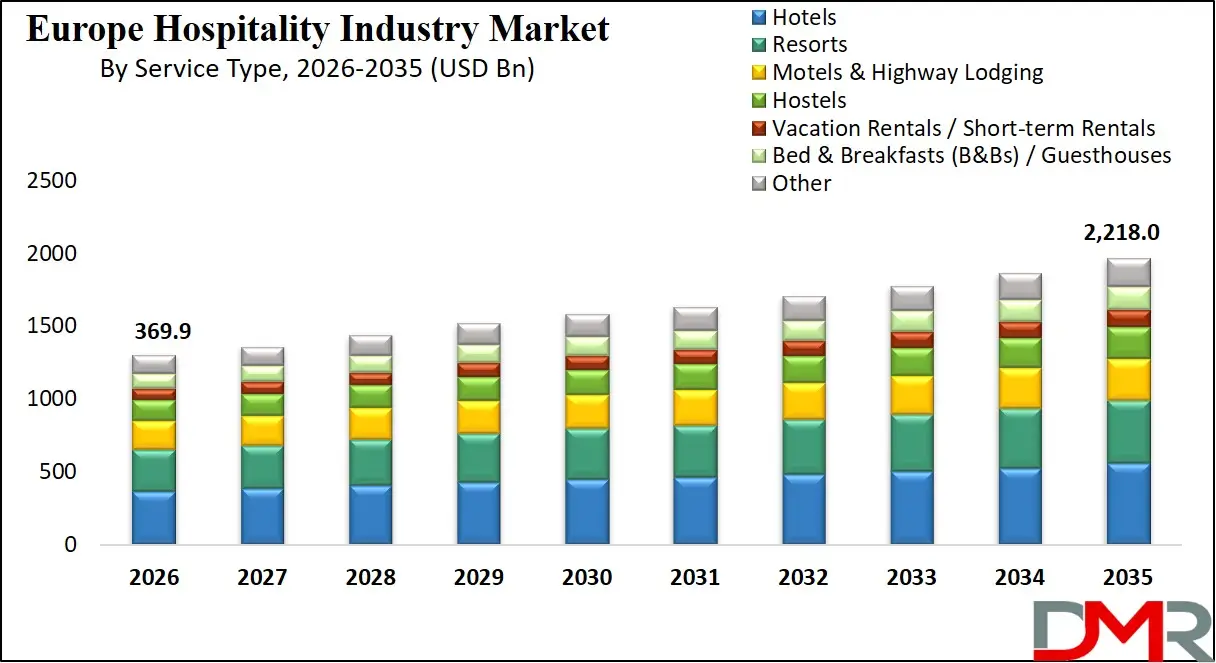
Hotels are expected to dominate the European hospitality industry because of their comprehensive infrastructure, their wide range of services as well as their recognition of international and national traveler expectations in 27 countries. Thousands of properties are run by major international chains, such as Accor, IHG, Marriott, Hilton, and Melià, whereas the budget and economy segments are dominated by small chains and individual hotels in such countries as Italy, France, Germany and Spain. Resorts are a large and expanding market, especially in coastal Mediterranean resorts such as Costa del Sol in Spain, Cote d Azur in France, the Amalfi Coast in Italy, the islands of Greece, and the Dalmatian coast of Croatia, and the Alpine ski resorts of France, Switzerland, Austria and Italy.
By Service Type Analysis
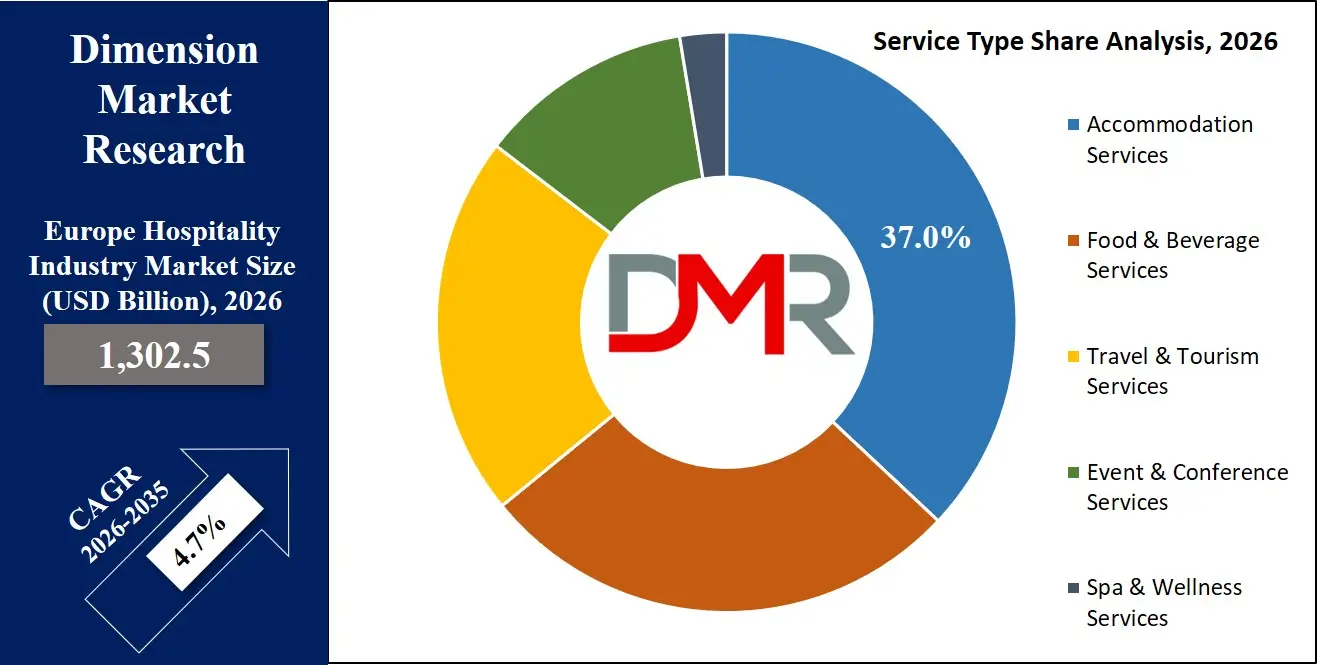
Accommodation services including hotels and resorts, motels, vacation rentals, hostels, and serviced apartments are anticipated to top the European market in the hospitality sector due to the high intra-European and inbound international travel, cultural tourism and the increased popularity of alternative and extended-stay hotels.
ℹ
To learn more about this report –
Download Your Free Sample Report Here
The largest sub-segments in terms of revenue are the hotels and resorts, with international chains controlling the upper-midscale to luxury segments in Western Europe, on the other hand, the budget and economy segments in Southern and Eastern Europe are dominated by independent properties and small chains. Vacation rentals are still gaining market share especially in family travel, group and long-term stays, but they are also under mounting regulation in large cities such as Barcelona, Paris, Amsterdam, Berlin, and Venice.
By Ownership Type Analysis
Chain-affiliated Establishments is poised to dominate the European hospitality market by ownership type, holding the largest revenue share. There are a few large global brands (Accor (France), IHG, Marriott, Hilton, and Meliá (Spain)) that manage thousands of properties in the continent. These facilities enjoy the advantage of centralized marketing, international loyalty schemes, uniformity in service delivery and excellent brand equity that has been able to draw in business travelers as well as vacationers. Chain-affiliated properties also enjoy better access to capital to invest in technology, sustainability retrofitting and secondary market expansion. Though the number of independent establishments still is high especially in the rural market and in the historical city centres, their revenues are dwindling as chains are buying independent properties or contracting management deals with property owners.
By Booking Channel Analysis
Indirect booking through online travel agency indirect booking is expected to take over the European hospitality market because cross-border travel is highly complex, consumers place trust in OTAs when booking international hotels, and because the individual property is very fragmented across 27 countries. Booking.com, a subsidiary of Booking Holdings based in Amsterdam, controls a leading market share in Europe, then Expedia Group brands such as Expedia, Hotels.com, and Vrbo, and Agoda. OTAs spend much on marketing, search engine optimization and user experience that give it high visibility and booking volume in various languages and currencies. Nevertheless, they cut operator margins by commissioning them, generally 15.0-25.0% of the room rate. Global Distribution Systems such as Sabre, Amadeus and Travelport are essential in corporate travel reservation through travel management companies, and especially to large multinational customers with complex travel policies.
Europe Hospitality Industry Market Report is segmented on the basis of the following:
By Type of Establishment
- Hotels
- Resorts
- Beach resorts
- Mountain/ski resorts
- All-inclusive resorts
- Motels & Highway Lodging
- Hostels
- Vacation Rentals / Short-term Rentals
- Bed & Breakfasts (B&Bs) / Guesthouses
- Other
By Service Type
- Accommodation Services
- Food & Beverage Services
- Restaurants
- Cafés
- Fast Food Chains
- Travel & Tourism Services
- Tour Packages
- Travel Agencies
- Guides & Interpretation Services
- Event & Conference Services
- Banquet Halls
- MICE (Meetings, Incentives, Conferences, Exhibitions)
- Spa & Wellness Services
By Ownership Type
- Chain-affiliated Establishments
- Independent Establishments
- Franchise Operations
- Government-owned Hospitality Facilities
By Booking Channel
- Direct Booking
- Online Travel Agencies (OTAs)
- Travel Agents / Intermediaries
- Corporate Bookings
- Government / Institutional Bookings
Europe Hospitality Industry Market: Regional Analysis
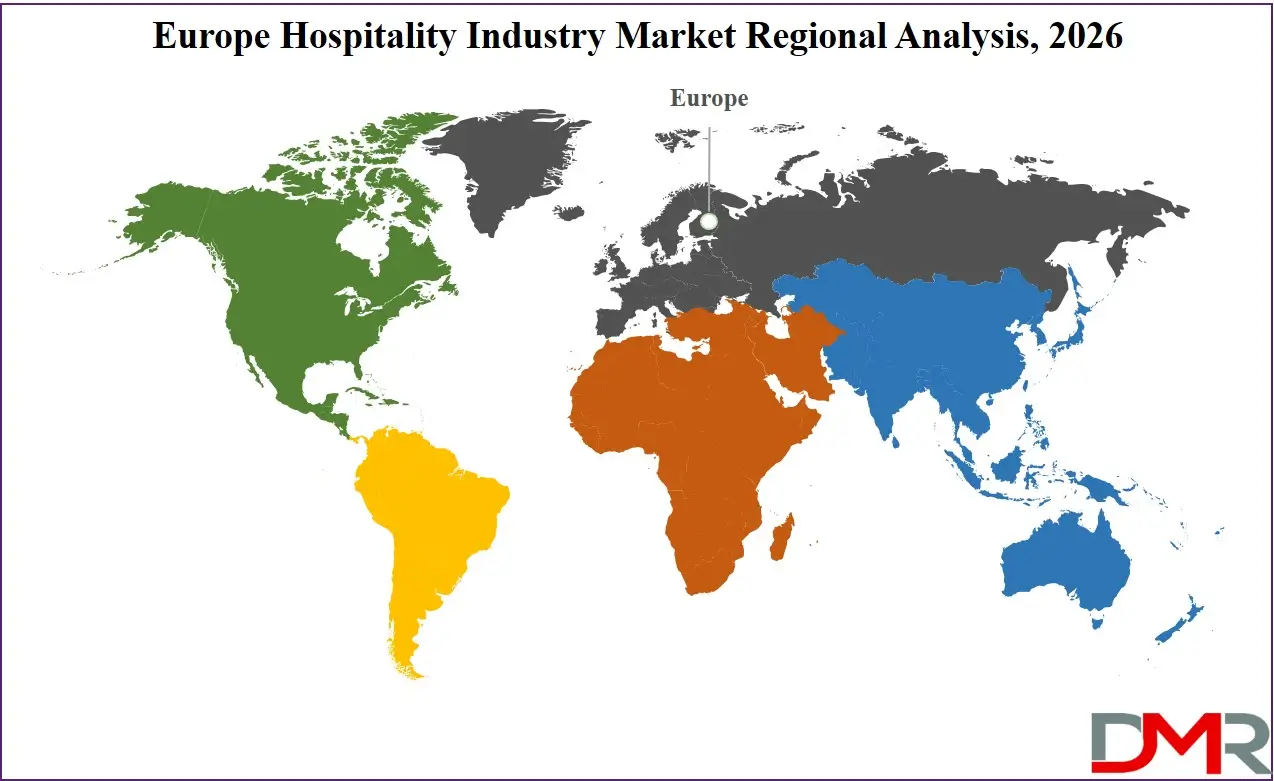
The Europe hospitality industry market has different regional dynamics that are guided by tourism dynamics, economic power, and infrastructure. The Western Europe, headed by France, Germany and UK, dominates on the basis of high international arrivals, good business travel as well as well developed hotel networks. Southern Europe, such as Spain, Italy and Greece enjoy the benefits of leisure tourism, seaside resorts and peak seasonal demand.
ℹ
To learn more about this report –
Download Your Free Sample Report Here
Northern Europe is experiencing consistent growth with the aid of sustainability-centered hospitality and luxury experiences. Eastern Europe is becoming cost effective and is attracting low-end travelers and investments in infrastructure and hotel development. In general, the regional development is encouraged through better connectivity, online reservation systems, and the rise in demand of experience-driven and sustainable travel in Europe.
By Region
Europe
- Germany
- The U.K.
- France
- Italy
- Russia
- Spain
- Benelux
- Nordic
- Rest of Europe
Impact of Artificial Intelligence in Europe Hospitality Industry Market
Use of artificial intelligence is also enabling smarter revenue management in the European hospitality through constant analysis of real-time data, such as competitor pricing, local events, weather forecasts, booking lead times, and demand patterns across different countries and seasons. This allows hotels and other hospitality providers to be dynamic in setting room rates, package deals, and upsell, which minimizes revenue leakage and enhances RevPAR (Revenue Per Available Room).
Pricing decisions made using AI based systems can be made in milliseconds and respond to market dynamics quicker than human revenue managers who are unable to handle the same amount of data in a single property and across different currencies and languages. This feature is specifically useful in the disjointed cross-border market in Europe, where the demand trends differ notably with country, season, local event calendar.
Europe Hospitality Industry Market: Competitive Landscape
A key feature of the European hospitality market is a very strong competitive rivalry among the existing international brands, innovative independent operators, alternative booking platforms, all seeking to dominate a rapidly transforming sector due to changing consumer preferences, technology adoption, and post-pandemic travel patterns europe. The market is being led by international chains such as Accor S.A. (based in France), IHG Hotels and Resorts (with substantial operations in Europe), Marriott International (Europe), Hilton Worldwide (Europe) and Meliá Hotels International (based in Spain) with their large collections of brands in the economy and luxury segments.
Some of the prominent players in Europe Hospitality Industry Market are:
- Accor
- Marriott International
- Hilton Worldwide Holdings
- InterContinental Hotels Group (IHG)
- Hyatt Hotels Corporation
- Radisson Hotel Group
- Meliá Hotels International
- NH Hotel Group
- Whitbread plc
- Louvre Hotels Group
- TUI Group
- Best Western
- Scandic Hotels
- Kempinski Hotels
- Club Med
- Motel One
- Pestana Hotel Group
- PPHE Hotel Group
- Vila Galé Hotels
- Generator Hostels
- Other Key Players
Recent Developments in Europe Hospitality Industry Market
- March 2026: Accor S.A. declared a strategic alliance with Tesla to install high-speed electric vehicle chargers in more than 800 Accor establishments in France, Germany, Italy, and Spain to help achieve the sustainability objectives and appeal to EV-driving clients. The implementation will be finished by the year 2028.
- February 2026: Hilton Worldwide launched a new AI-based hotel concierge, Hilton Conrad Concierge, in all its European Conrad brand properties, providing itinerary planning, restaurant reservation, and local experience booking using natural language chat in seven languages. The system also cut work at the front desk and increased the level of guest satisfaction by 22% in pilot properties.
- February 2026: Airbnb Inc. declared a significant growth of its Airbnb Rooms segment in Europe, which includes private rooms in host-occupied properties with superior safety protocols, verified host profiles, and affordable prices aimed at low-end, solo travelers, and younger audiences. The relocation is supposed to offset the declining demand of whole-home rentals in controlled urban markets.
Report Details
| Report Characteristics |
| Market Size (2026) |
USD 1,302.5 Bn |
| Forecast Value (2035) |
USD 1,965.1 Bn |
| CAGR (2026–2035) |
4.7% |
| Historical Data |
2021 – 2025 |
| Forecast Data |
2027 – 2035 |
| Base Year |
2025 |
| Estimate Year |
2026 |
| Report Coverage |
Market Revenue Estimation, Market Dynamics, Competitive Landscape, Growth Factors and etc. |
| Segments Covered |
By Type of Establishment (Hotels, Resorts, Motels & Highway Lodging, Hostels, Vacation Rentals / Short-term Rentals, Bed & Breakfasts (B&Bs) / Guesthouses, and Other), By Service Type (Accommodation Services, Food & Beverage Services, Travel & Tourism Services, Event & Conference Services, Spa & Wellness Services), By Ownership Type (Chain-affiliated Establishments, Independent Establishments, Franchise Operations, Government-owned Hospitality Facilities), By Booking Channel (Direct Booking, Online Travel Agencies (OTAs), Travel Agents / Intermediaries, Corporate Bookings, Government / Institutional Bookings) |
| Regional Coverage |
Europe – Germany, UK, France, Russia, Spain, Italy, Benelux, Nordic, Rest of Europe |
| Prominent Players |
Accor, Marriott International, Hilton Worldwide Holdings, InterContinental Hotels Group (IHG), Hyatt Hotels Corporation, Radisson Hotel Group, Meliá Hotels International, NH Hotel Group, Whitbread plc, Louvre Hotels Group, TUI Group, Best Western, Scandic Hotels, Kempinski Hotels, Club Med, Motel One, Pestana Hotel Group, PPHE Hotel Group, Vila Galé Hotels, Generator Hostels, and Other Key Players |
| Purchase Options |
We have three licenses to opt for: Single User License (Limited to 1 user), Multi-User License (Up to 5 Users) and Corporate Use License (Unlimited User) along with free report customization equivalent to 0 analyst working days, 3 analysts working days and 5 analysts working days respectively. |
Frequently Asked Questions
How big is Europe Hospitality Industry Market?
▾ Europe Hospitality Industry Market size is estimated to have a value of USD 1,302.5 billion in 2026 and is expected to reach USD 1,965.1 billion by the end of 2035.
Who are the key players in Europe Hospitality Industry Market?
▾ Some of the major key players in Europe Hospitality Industry Market are InterContinental Hotels Group (IHG), Best Western Hotels & Resorts, Extended Stay America, Aimbridge Hospitality, Sonesta International Hotels, G6 Hospitality, and many others.
What is the growth rate in Europe Hospitality Industry Market in 2025?
▾ The market is growing at a CAGR of 4.7% over the forecasted period of 2025.