Market Overview
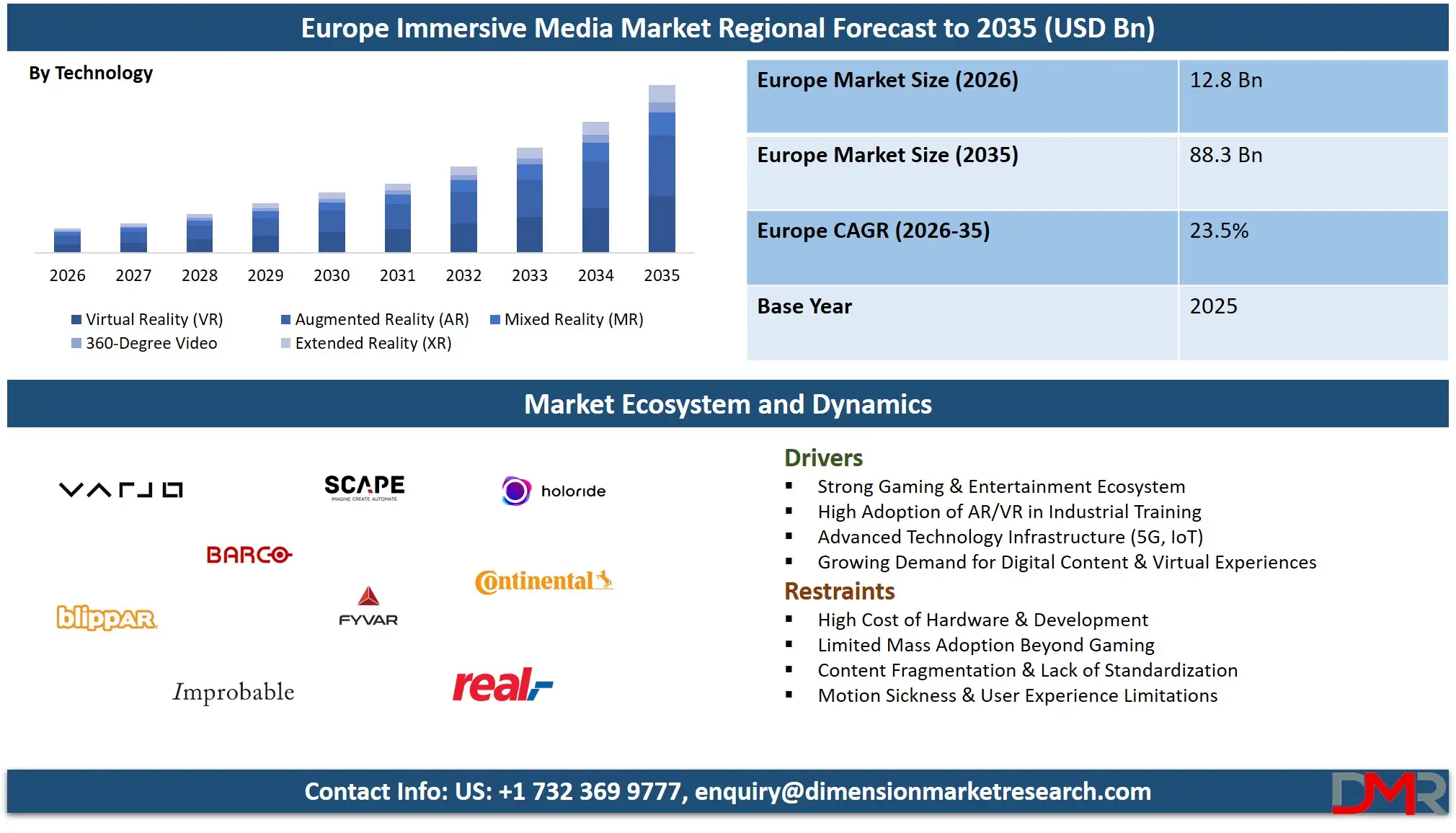
The Europe immersive media market size is projected to be valued at USD 12.8 billion in 2026 and is expected to grow at a CAGR of 23.5%, reaching approximately USD 88.3 billion by 2035, driven by increasing adoption of virtual reality, augmented reality, spatial computing, and interactive digital experiences across enterprise and consumer applications.
ℹ
To learn more about this report –
Download Your Free Sample Report Here
Immersive media refers to a broad category of digital experiences that blend the physical and virtual worlds to create highly interactive and engaging environments for users. It leverages technologies such as virtual reality, augmented reality, mixed reality, and extended reality to enable real time interaction, spatial awareness, and sensory engagement. By integrating 3D visualization, computer generated environments, and advanced user interfaces, immersive media allows individuals to experience content rather than simply view it. This form of media is widely used across sectors such as entertainment, education, healthcare, and industrial training, where realistic simulations and experiential learning enhance user understanding and engagement.
The Europe immersive media market represents a rapidly evolving ecosystem driven by strong technological infrastructure, digital innovation, and increasing enterprise adoption. Countries across the region are actively investing in immersive technologies to enhance workforce training, improve customer engagement, and support advanced product design processes. The presence of established technology providers, growing startup ecosystems, and supportive regulatory frameworks has contributed to the expansion of applications such as virtual simulation, augmented visualization, and interactive digital platforms. Industries including manufacturing, automotive, and healthcare are increasingly integrating immersive solutions to optimize operational efficiency and decision making.
ℹ
To learn more about this report –
Download Your Free Sample Report Here
In addition, the market is benefiting from rising consumer interest in interactive entertainment, gaming, and virtual social experiences. The adoption of immersive content across media, retail, and marketing sectors is transforming how businesses communicate with customers through personalized and engaging digital environments. The integration of emerging technologies such as artificial intelligence, cloud computing, and high speed connectivity is further strengthening the scalability and accessibility of immersive platforms. As a result, Europe continues to position itself as a key hub for immersive innovation, with growing demand for experiential media, spatial computing, and next generation digital interaction solutions.
Europe Immersive Media Market: Key Takeaways
- Strong Market Expansion Outlook: The market is projected to grow from USD 12.8 billion in 2026 to USD 88.3 billion by 2035, reflecting a significant multi-fold expansion across the forecast period.
- High Growth Rate Momentum: A robust CAGR of 23.5% (2026–2035) highlights accelerated adoption of immersive technologies across enterprise and consumer applications.
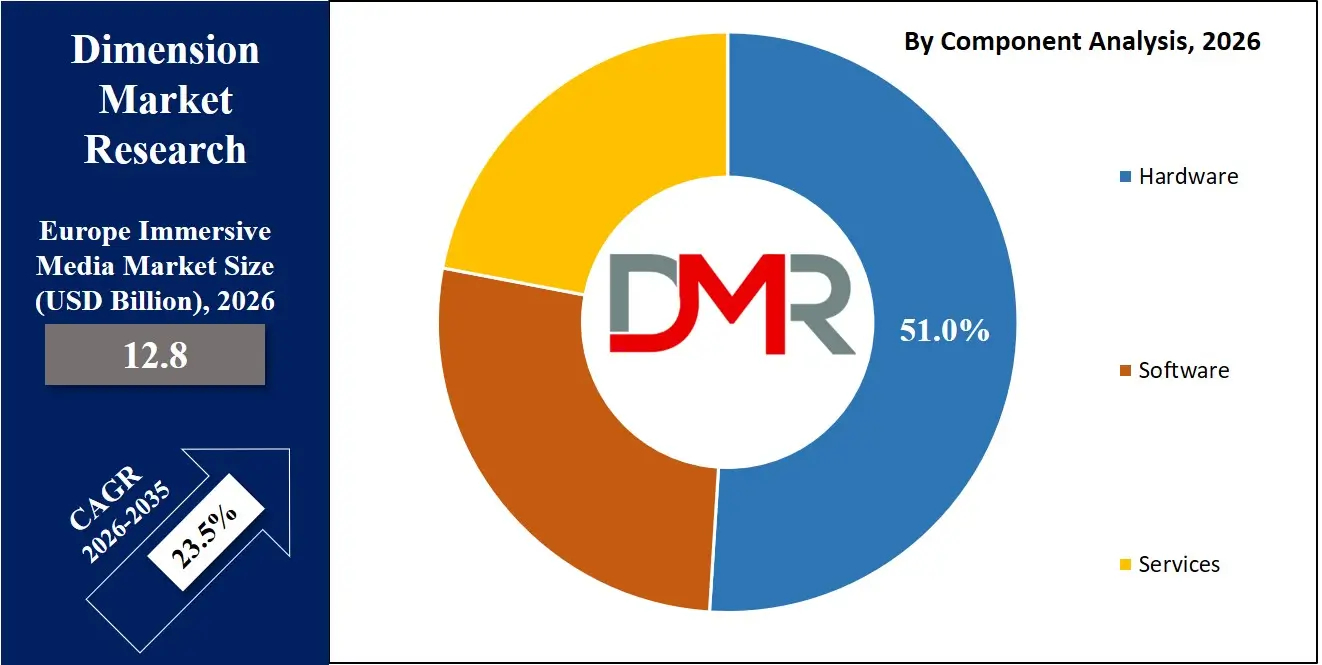
- Hardware Segment Dominance: Hardware leads the market with approximately 51.0% share in 2026, driven by increasing demand for VR headsets, AR glasses, and advanced sensing devices.
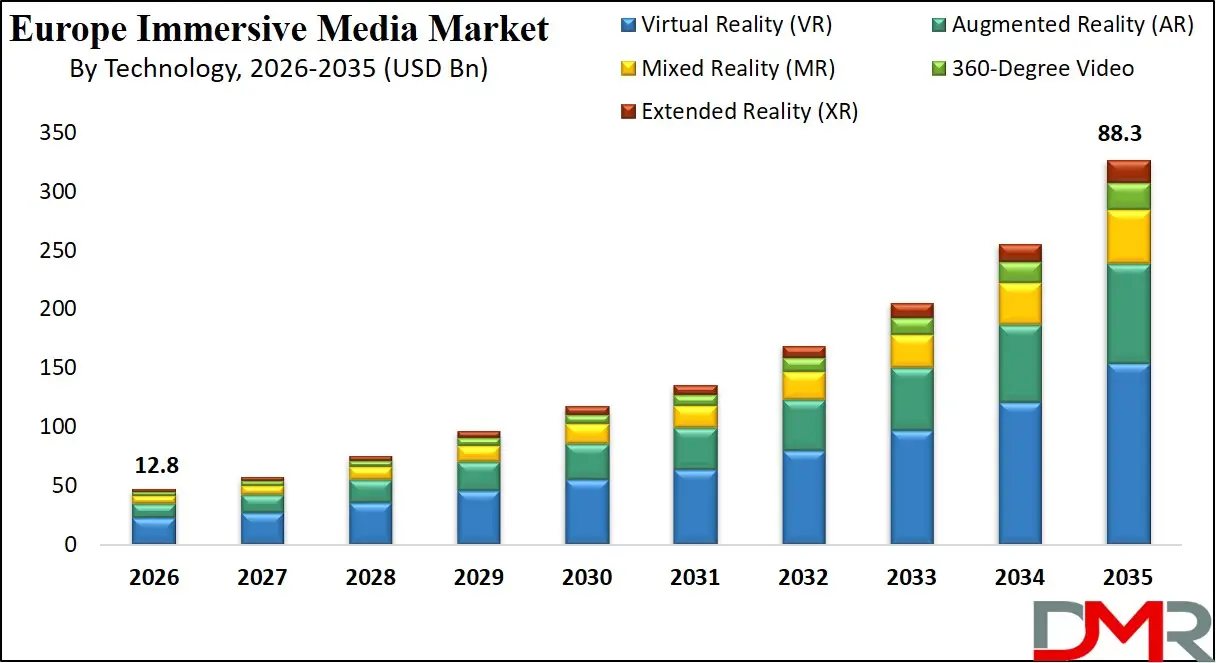
- Virtual Reality Leading Technology: Virtual reality dominates the technology landscape with around 47.0% market share in 2026, supported by strong use in gaming, training, and simulation.
- Training & Learning as Top Application: Training and learning emerges as the leading application, accounting for nearly 22.0% of total market share in 2026, fueled by rising enterprise adoption of immersive training solutions.
Europe Immersive Media Market: Use Cases
- Enterprise Training and Simulation: Companies use virtual reality and mixed reality for interactive training, enabling realistic simulations, better skill development, and improved safety across industries like manufacturing and healthcare.
- Gaming and Interactive Entertainment: Immersive media enhances gaming with 3D environments, real time interaction, and immersive storytelling, driving demand for virtual reality and augmented reality experiences.
- Product Design and Prototyping: Businesses leverage 3D visualization and spatial computing to design, test, and refine products faster, reducing development costs and improving innovation efficiency.
- Marketing and Customer Engagement: Brands use augmented reality and interactive digital experiences to create engaging campaigns, virtual showrooms, and personalized customer journeys, boosting engagement and conversions.
Europe Immersive Media Market: Stats & Facts
- Eurostat (European Commission Statistical Office)
- In 2023, 56% of EU citizens had basic or above basic digital skills, supporting adoption of immersive technologies.
- Around 44% of EU citizens lacked basic digital skills in 2023, indicating a key barrier for XR adoption.
- Over 90% of individuals in the EU used the internet at least once a week in 2023, enabling access to immersive digital platforms.
- The EU targets 80% of adults to have basic digital skills by 2030, accelerating future immersive media adoption.
- The Netherlands recorded 83% population with basic digital skills in 2023, among the highest in Europe.
- Finland followed with 82% digital skill penetration in 2023, indicating strong readiness for XR technologies.
- Ireland reported 73% digital skill levels in 2023, supporting enterprise adoption of immersive solutions.
- Denmark achieved 70% digital skills penetration in 2023, strengthening digital ecosystem maturity.
- Czechia recorded 69% digital skills penetration in 2023, showing growing technological readiness.
- In 2024, approximately 27% of EU population could not afford a one week holiday, indicating potential demand for virtual tourism and immersive experiences.
- This share declined by 1.5 percentage points from 2023 to 2024, reflecting improving economic conditions for digital spending.
- In 2025, EU tourism nights reached 3.08 billion total overnight stays, supporting immersive tourism and virtual experience demand.
- International tourism nights increased by 46.1 million in 2025, driving demand for virtual travel previews and AR navigation tools.
- Domestic tourism nights increased by 15.4 million in 2025, supporting local immersive tourism applications.
- Tourism demand remained balanced with 49% international and 51% domestic share in 2025.
Europe Immersive Media Market: Market Dynamic
Driving Factors in the Europe Immersive Media Market
Rapid Enterprise Adoption of XR-Based Training
Enterprises across Europe are increasingly integrating virtual reality, augmented reality, and mixed reality into training programs. Immersive learning platforms, 3D simulation tools, and spatial computing solutions enable realistic, risk free environments that enhance workforce productivity and knowledge retention. This growing reliance on experiential learning is accelerating demand for advanced immersive technologies.
Expansion of Digital Entertainment Ecosystem
The strong presence of gaming studios and digital media companies is driving demand for immersive content. Technologies such as real time rendering, interactive storytelling, and 360 degree video are enhancing user engagement. Rising consumer interest in virtual experiences and social interaction platforms is further fueling market growth.
Restraints in the Europe Immersive Media Market
High Cost of Immersive Hardware and Development
The adoption of immersive media is limited by the high cost of VR headsets, AR glasses, sensors, and advanced content creation tools. Additionally, developing high quality 3D environments and interactive applications requires significant investment, making it challenging for small and medium enterprises.
Data Privacy and Security Challenges
Immersive platforms often collect sensitive user data, including behavioral patterns and spatial information. Concerns around data protection, cybersecurity risks, and compliance with European regulations can hinder adoption, especially in sectors dealing with confidential information.
Opportunities in the Europe Immersive Media Market
Integration with Artificial Intelligence and Cloud Technologies
The convergence of immersive media with artificial intelligence, cloud computing, and edge processing is creating scalable and intelligent digital environments. AI driven analytics, real time data processing, and cloud based XR platforms are enabling personalized and adaptive immersive experiences across industries.
Growing Adoption in Healthcare and Industrial Applications
There is increasing use of immersive technologies in medical training, remote assistance, and industrial maintenance. Virtual simulation, augmented visualization, and digital twin technologies are improving operational efficiency and enabling advanced use cases in healthcare and manufacturing sectors.
Trends in the Europe Immersive Media Market
Rise of Spatial Computing and Digital Twin Technology
Spatial computing is gaining traction as businesses adopt digital twins and virtual replicas of physical assets. These technologies enable real time monitoring, predictive analysis, and enhanced decision making, particularly in smart manufacturing and infrastructure management.
Shift Toward Web-Based and Cross-Platform XR Experiences
There is a growing trend toward browser based immersive experiences and cross platform compatibility. WebXR and cloud delivered immersive content are reducing hardware dependency and improving accessibility, allowing users to engage with interactive digital environments across multiple devices.
Europe Immersive Media Market: Research Scope and Analysis
By Component Analysis
Hardware is anticipated to dominate the component segment of the Europe immersive media market, capturing around 51.0% of the total market share in 2026. This dominance is primarily driven by the growing adoption of physical devices such as virtual reality head mounted displays, augmented reality glasses, sensors, and gesture tracking systems that enable immersive experiences. The increasing demand for high performance devices capable of delivering real time interaction, enhanced 3D visualization, and spatial computing capabilities is encouraging both enterprises and consumers to invest in advanced hardware solutions. In addition, continuous innovation in display technologies, motion tracking, and wearable devices, along with the expansion of 5G infrastructure, is further strengthening the hardware segment as it forms the foundational layer for delivering immersive digital experiences across industries such as gaming, healthcare, and industrial training.
ℹ
To learn more about this report –
Download Your Free Sample Report Here
On the other hand, the software segment plays a critical supporting role by enabling the creation, management, and delivery of immersive content across platforms. This segment includes AR VR content management systems, 3D modeling and simulation tools, and game engines that are essential for building interactive environments and applications. The growing demand for immersive storytelling, virtual simulation, and enterprise level XR applications is driving the adoption of advanced software solutions. Moreover, the integration of artificial intelligence, cloud computing, and real time rendering technologies is enhancing the scalability and functionality of immersive platforms, allowing businesses to develop more personalized, data driven, and interactive digital experiences. As a result, while hardware leads in terms of revenue share, software continues to gain traction as a key enabler of innovation and long term ecosystem growth in the Europe immersive media market.
By Technology Analysis
Virtual reality is anticipated to dominate the technology segment of the Europe immersive media market, capturing around 47.0% of the total market share in 2026. This leadership is driven by its strong adoption across gaming, entertainment, and enterprise training, where fully immersive environments enable users to engage in highly interactive and realistic simulations. The increasing use of VR in sectors such as healthcare, education, and industrial training is further strengthening its position, as organizations leverage virtual simulation and 3D environments to enhance learning outcomes and operational efficiency. Advancements in head mounted displays, motion tracking, and real time rendering technologies, along with improved content ecosystems, are also contributing to the widespread adoption of VR solutions across the region.
Augmented reality, while holding a smaller share compared to VR, is witnessing rapid growth due to its ability to overlay digital information onto the real world. AR is increasingly being used in applications such as retail visualization, remote assistance, navigation, and marketing, where interactive digital content enhances real world experiences. The adoption of AR enabled smart glasses, mobile based AR platforms, and spatial computing solutions is expanding across industries including automotive, healthcare, and manufacturing. Furthermore, the integration of AR with artificial intelligence and cloud based systems is enabling more scalable and context aware applications, positioning it as a key growth driver in the evolving immersive media landscape in Europe.
By Application Analysis
Training and learning are anticipated to dominate the application segment of the Europe immersive media market, capturing around 22.0% of the total market share in 2026. This dominance is driven by the increasing use of immersive technologies such as virtual reality, augmented reality, and mixed reality for experiential learning and skill development across industries. Organizations are leveraging virtual simulation, interactive training modules, and 3D learning environments to improve knowledge retention, reduce training risks, and enhance workforce productivity. Sectors such as healthcare, manufacturing, aviation, and education are actively adopting immersive learning platforms to provide realistic, hands on experiences in controlled digital environments. The growing focus on upskilling, remote training, and digital transformation is further accelerating the adoption of immersive media in training and learning applications.
Entertainment and media represent another significant segment, supported by strong consumer demand for immersive storytelling and interactive digital experiences. The use of virtual reality, augmented reality, and 360 degree video is transforming content consumption by enabling users to engage more deeply with digital media. Gaming, live events, virtual concerts, and interactive films are increasingly incorporating real time rendering and 3D environments to deliver enhanced user engagement. In addition, social media platforms and content creators are adopting immersive formats to provide more personalized and engaging experiences. The continuous evolution of content creation tools, combined with increasing access to immersive devices, is driving steady growth of the entertainment and media segment in the Europe immersive media market.
The Europe Immersive Media Market Report is segmented on the basis of the following:
By Component
- Hardware
- Head-Mounted Displays (HMDs)
- Gesture Tracking Devices
- Sensors and Cameras
- AR Glasses and Smart Glasses
- Software
- AR/VR Content Management Systems
- 3D Modeling & Simulation
- Game Engines
- Services
- Integration & Deployment
- Support & Maintenance
- Consulting & Training
- Solution
- Immersive Media Platforms
- Content Creation Tools
By Technology
- Virtual Reality (VR)
- Augmented Reality (AR)
- Mixed Reality (MR)
- 360-Degree Video
- Extended Reality (XR)
By Application
- Entertainment & Media
- Training & Learning
- Emergency Services
- Product Development
- Sales & Marketing
- Gaming
- Social Media
- Commercial
- Other Applications
Impact of Artificial Intelligence on the Europe Immersive Media Market
Artificial intelligence is significantly enhancing the capabilities of the Europe immersive media market by enabling more intelligent, adaptive, and personalized digital experiences. AI driven algorithms are being integrated with virtual reality, augmented reality, and mixed reality platforms to improve real time interaction, object recognition, and spatial computing. This allows immersive environments to respond dynamically to user behavior, creating more engaging and realistic simulations. In addition, AI powered content generation, including automated 3D modeling, natural language processing, and computer vision, is reducing development time and cost while enabling scalable creation of immersive content across industries such as training, healthcare, and gaming.
Furthermore, AI is playing a crucial role in optimizing performance and expanding the commercial potential of immersive technologies. Through predictive analytics and user data insights, companies can deliver highly personalized experiences in areas such as digital marketing, virtual retail, and interactive entertainment. AI is also supporting advanced applications like digital twins, smart simulations, and remote collaboration by enabling real time data processing and decision making. The integration of cloud computing and AI driven platforms is improving accessibility and cross platform compatibility, allowing businesses to deploy immersive solutions more efficiently. As a result, artificial intelligence is acting as a key enabler of innovation and long term growth in the Europe immersive media ecosystem.
Europe Immersive Media Market: Regional Analysis
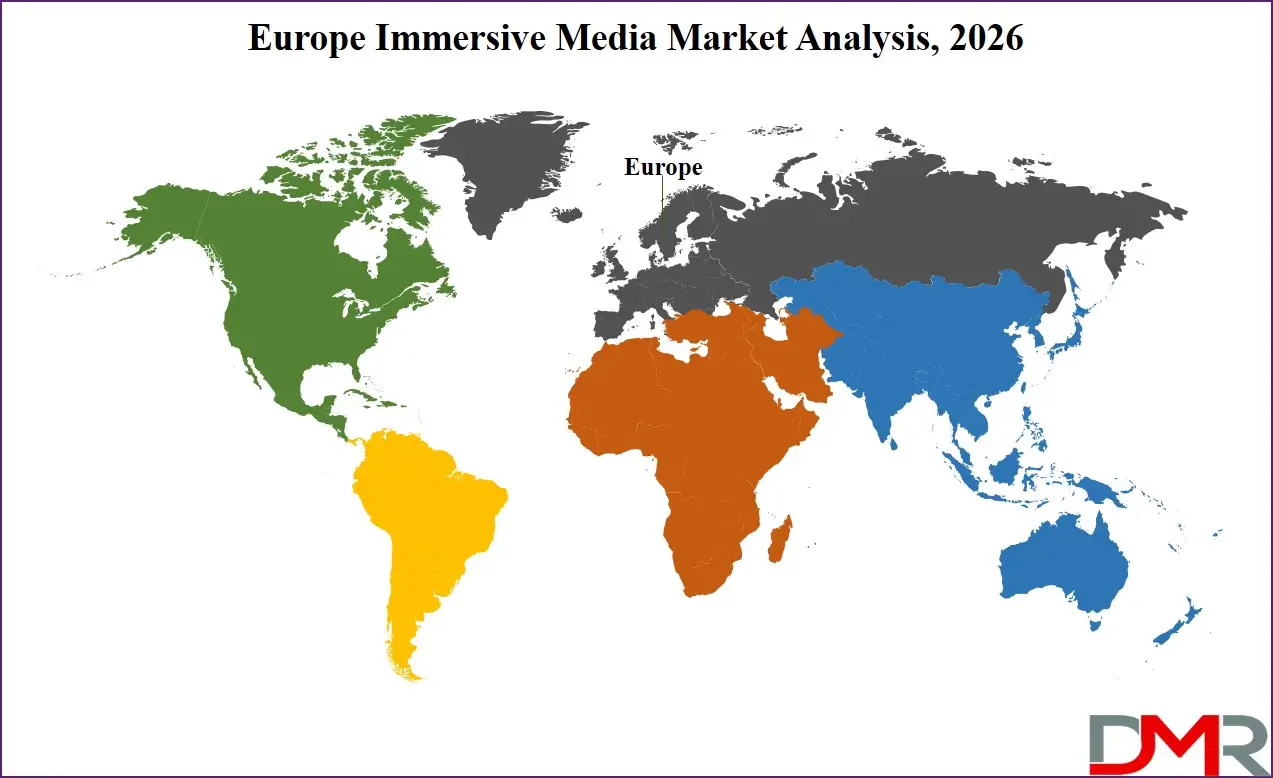
The Europe immersive media market demonstrates strong regional diversity, with countries such as the UK, Germany, and France leading in adoption due to advanced digital infrastructure, strong gaming ecosystems, and high enterprise investment in virtual reality, augmented reality, and mixed reality solutions. Western Europe dominates the market, driven by widespread use of immersive technologies in training, healthcare, automotive, and media sectors, while Northern Europe shows significant innovation through startups and research initiatives focused on spatial computing and interactive digital experiences.
ℹ
To learn more about this report –
Download Your Free Sample Report Here
Meanwhile, Southern and Eastern Europe are gradually expanding their presence, supported by increasing digital transformation efforts, rising adoption of 3D visualization tools, and growing interest in immersive content across education and entertainment. Overall, the region benefits from supportive regulatory frameworks, high internet penetration, and continuous advancements in cloud computing and artificial intelligence, positioning Europe as a key hub for immersive media innovation.
By Region
Europe
- Germany
- The U.K.
- France
- Italy
- Russia
- Spain
- Benelux
- Nordic
- Rest of Europe
Europe Immersive Media Market: Competitive Landscape
The Europe immersive media market is characterized by a dynamic and moderately fragmented competitive landscape, with a mix of established technology providers, specialized solution developers, and emerging startups competing across hardware, software, and platform-based offerings. Companies are focusing on innovation in virtual reality, augmented reality, and mixed reality technologies to enhance user experience through advanced 3D visualization, real time interaction, and spatial computing capabilities. Strategic partnerships, mergers, and collaborations with enterprises, content creators, and research institutions are common to expand technological expertise and market reach. Additionally, players are investing in artificial intelligence integration, cloud-based immersive platforms, and scalable content creation tools to strengthen their competitive positioning. The market is also witnessing increasing emphasis on industry-specific solutions, particularly in training, healthcare, gaming, and digital marketing, as organizations seek customized and high-performance immersive applications.
Some of the prominent players in the Europe Immersive Media Market are:
- Varjo
- Barco
- Blippar
- Improbable
- Scape Technologies
- WayRay
- Virtually Live
- Holoride
- Continental AG
- Make Real
- Warpin Media
- Gleechi
- 4Experience
- Craftars
- Atlantic Productions
- Lookport
- Cluetivity
- Dear Reality
- Immersive Gamebox
- nDreams
- Other Key Players
Recent Developments in the Europe Immersive Media Market
- March 2026: Banijay Entertainment announced a merger with All3Media to create a major global content and immersive media powerhouse, strengthening capabilities in digital content production and experiential media.
- January 2026: HOLYWATER raised USD 22 million in a funding round led by Horizon Capital to expand AI driven immersive content and interactive media production capabilities.
- November 2025: Felix & Paul Studios launched Interstellar Arc, a location based virtual reality experience combining immersive storytelling, physical environments, and interactive effects to enhance next generation experiential media offerings.
Report Details
| Report Characteristics |
| Market Size (2026) |
USD 12.8 Bn |
| Forecast Value (2035) |
USD 88.3 Bn |
| CAGR (2026–2035) |
23.5% |
| Historical Data |
2021 – 2025 |
| Forecast Data |
2027 – 2035 |
| Base Year |
2025 |
| Estimate Year |
2026 |
| Report Coverage |
Market Revenue Estimation, Market Dynamics, Competitive Landscape, Growth Factors and etc. |
| Segments Covered |
By Component (Hardware, Software, Services, Solution), By Technology (Virtual Reality (VR), Augmented Reality (AR), Mixed Reality (MR), 360-Degree Video, Extended Reality), By Application (Entertainment & Media, Training & Learning, Emergency Services, Product Development, Sales & Marketing, Gaming, Social Media, Commercial, Other Applications) |
| Regional Coverage |
Europe – Germany, The UK, France, Russia, Spain, Italy, Benelux, Nordic, & Rest of Europe |
| Prominent Players |
Varjo, Barco, Blippar, Improbable, Scape Technologies, WayRay, Virtually Live, Holoride, Continental AG, Make Real, Warpin Media, Gleechi, 4Experience, Craftars, Atlantic Productions, Lookport, Cluetivity, Dear Reality, Immersive Gamebox, nDreams, and Other Key Players |
| Purchase Options |
We have three licenses to opt for: Single User License (Limited to 1 user), Multi-User License (Up to 5 Users) and Corporate Use License (Unlimited User) along with free report customization equivalent to 0 analyst working days, 3 analysts working days and 5 analysts working days respectively. |
Frequently Asked Questions
How big is the Europe Immersive Media Market?
▾ The Europe Immersive Media Market size is estimated to have a value of USD 12.8 billion in 2026 and is expected to reach USD 88.3 billion by the end of 2035.
What is the growth rate in the Europe Immersive Media Market in 2026?
▾ The market is growing at a CAGR of 23.5% over the forecasted period of 2026.
Who are the key players in the Europe Immersive Media Market?
▾ Some of the major key players in the Europe Immersive Media Market are Varjo, Barco, Blippar, Improbable, Scape Technologies, WayRay, Virtually Live, Holoride, Continental AG, Make Real, Warpin Media, Gleechi, 4Experience, and many others.