Market Overview
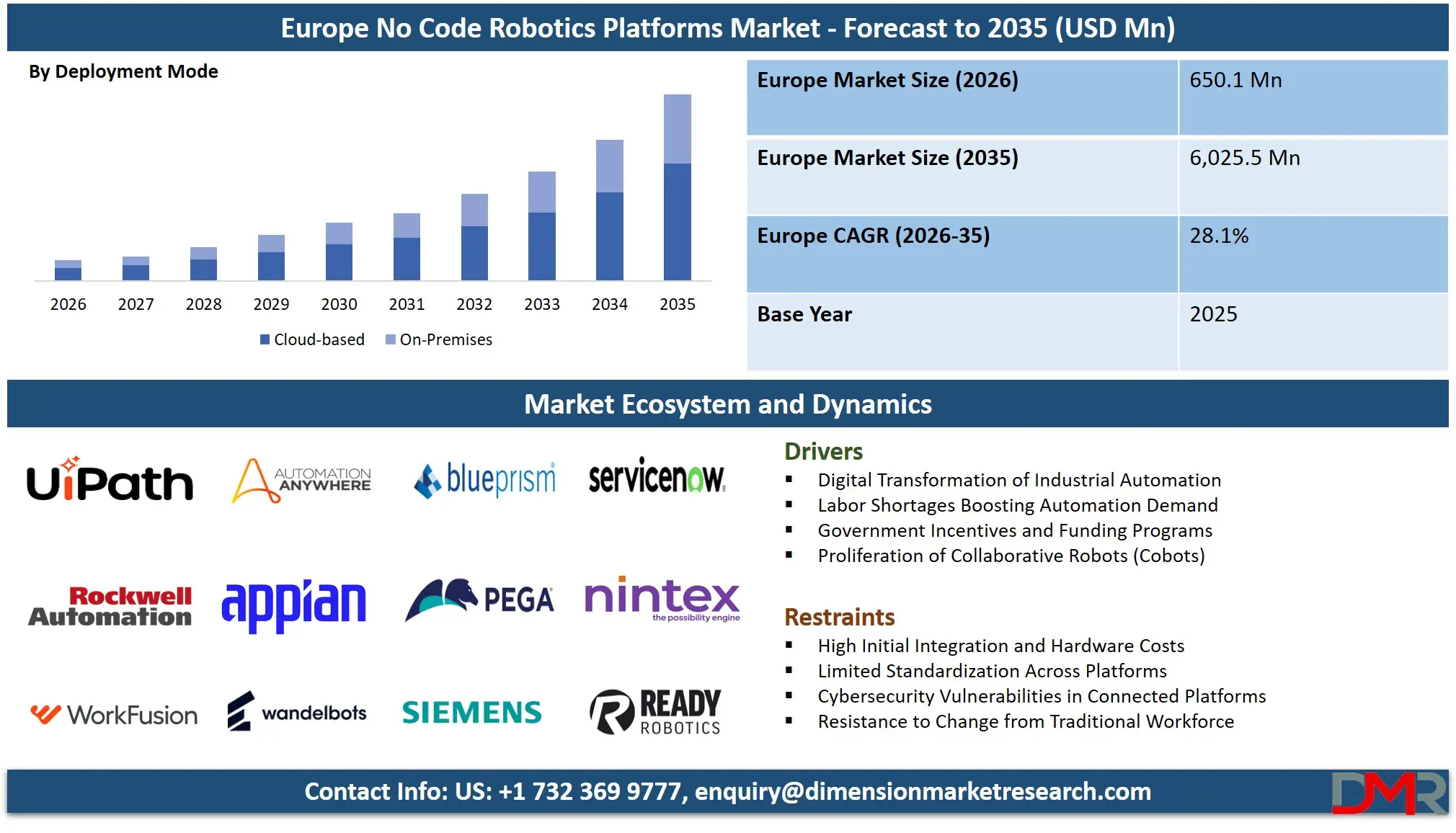
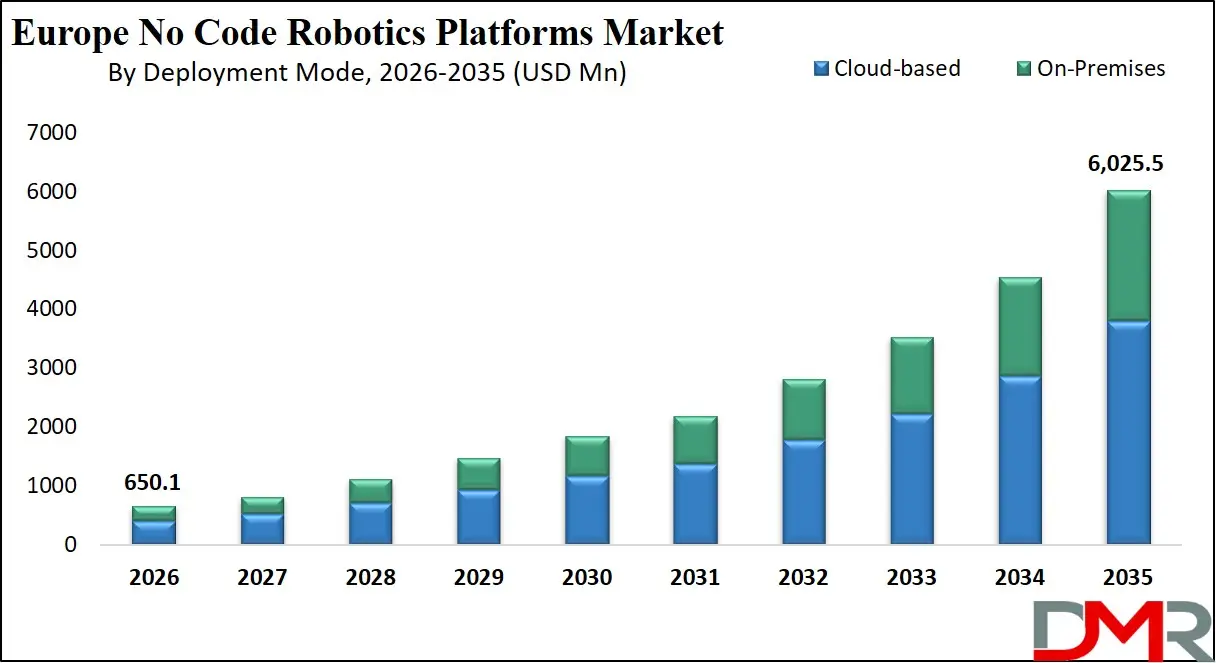
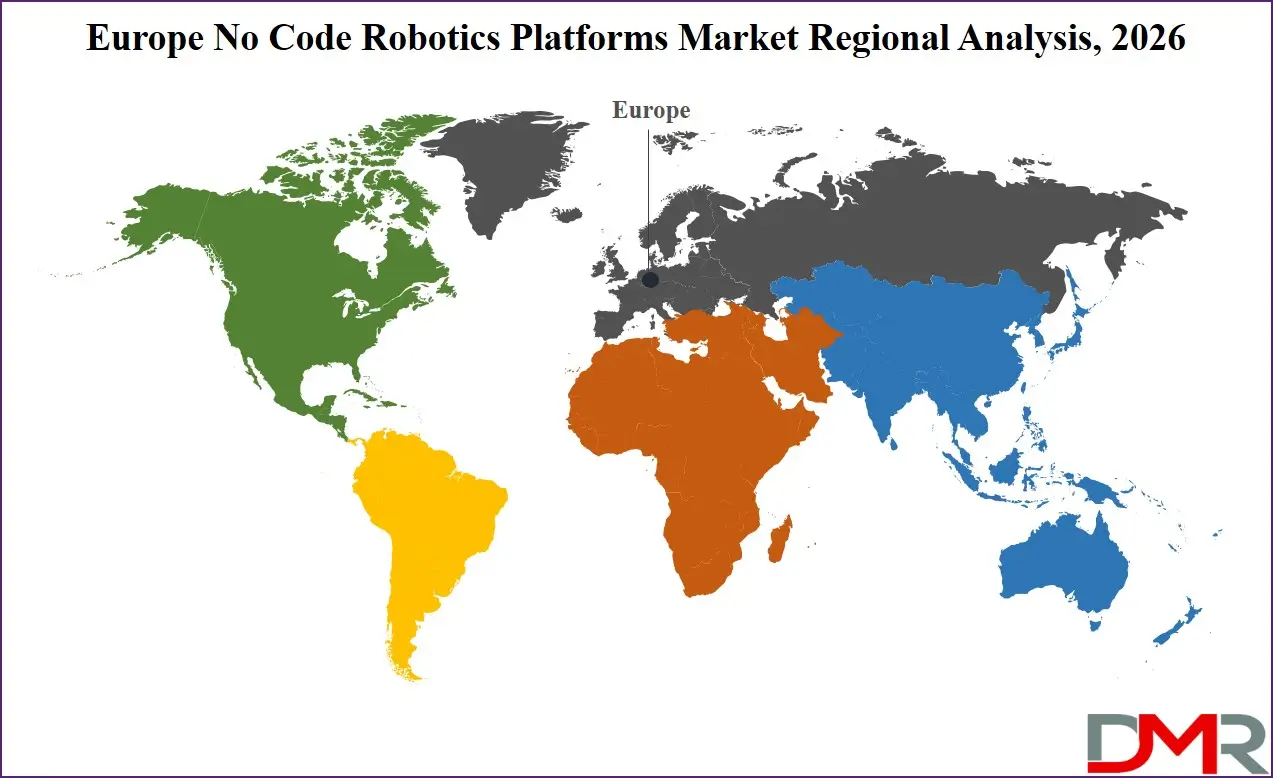
The Europe No Code Robotics Platforms Market size is expected to reach a value of USD 650.1 million in 2026, and it is further anticipated to reach a market value of USD 6,025.5 million by 2035 at a CAGR of 28.1%.
ℹ
To learn more about this report –
Download Your Free Sample Report Here
The no-code robotics platform market is an integral part of the industrial automation and digital revolution in Europe, considering the acute shortage of skilled software developers in the region and its focus on developing Industry 5.0, which is based on human-centric, resilient, and sustainable manufacturing. Europe is considered a global leader in advanced manufacturing and industrial automation. Therefore, it is in an ideal position to pioneer the adoption of no-code robotics platform solutions. This market includes a wide variety of tools, such as visual workflow-based tools and form-based configuration tools. These are of vital importance in terms of promoting robotics, reducing costs of operation, and enhancing automation in various industries. The European Union's focus on developing its industrial competitiveness has led to significant investment in digitalization, which has revolutionized the landscape of industrial automation.
In the past few years, the no-code robotics platform market in Europe has witnessed a strategic shift in embracing advanced technologies such as AI-based simulation, cloud-based orchestration, and digital twin integration. These technologies are revolutionizing robotics, promoting its accessibility, and facilitating its deployment without coding. In addition, with the rapid growth of e-commerce logistics and the need for flexible manufacturing, the need for flexible and easy-to-program.
Some of the key trends which are presently seen in the no-code robotics platform market in Europe include digitalization, which is gradually becoming a part of every industry by moving away from conventional coding-based programming to drag-and-drop interfaces. In addition to this, another key trend which is being witnessed is the integration of AI and simulation tools, which provide predictive analytics and allow for faster commissioning. In addition to this, with an increasing focus being laid on sustainability in line with the European Green Deal, the adoption of lightweight robotic applications, which are programmed through no-code interfaces, is also witnessing an uptick. In addition to this, with the advent of mass customization and just-in-time manufacturing, integration strategies are also changing in order to meet production demands.
ℹ
To learn more about this report –
Download Your Free Sample Report Here
The market is therefore witnessing huge opportunities due to the high investments being made by the European government in digital infrastructure development. In addition to this, initiatives such as creating 'AI Factories' are also being undertaken, which are creating a strong digital backbone for regional industry. In addition to this, megaprojects such as the implementation of 5G in industrial settings are also being undertaken in order to provide seamless connectivity between robots and the cloud. This is an example of the strategic importance of no-code platforms in enabling Europe's digital and sustainability ambitions. In addition to this, the technological capabilities of the region also provide it with an opportunity to become a global hub for accessible automation innovation, which can provide unparalleled access to key markets across the European region. In addition to this, with an increasing focus being laid on smart technologies such as AI, edge computing, and digital twins, companies are also being provided with an opportunity to attain a competitive edge in the market.
Europe No Code Robotics Platforms Market: Key Takeaways
- Market Value: The Europe No Code Robotics Platforms Market size is estimated to have a value of USD 650.1 million in 2026 and is expected to reach USD 6,025.5 million by the end of 2035.
- By Component Segment Analysis: Platform solutions are anticipated to dominate this segment in the Europe No-Code Robotics Platforms Market, accounting for more than 70% of the market share in 2026, driven by the growing adoption of visual, user-friendly automation tools.
- By Deployment Mode Segment Analysis: Cloud-based platforms are projected to dominate the deployment mode segment in the Europe No Code Robotics Platforms Market with the highest market share in 2026.
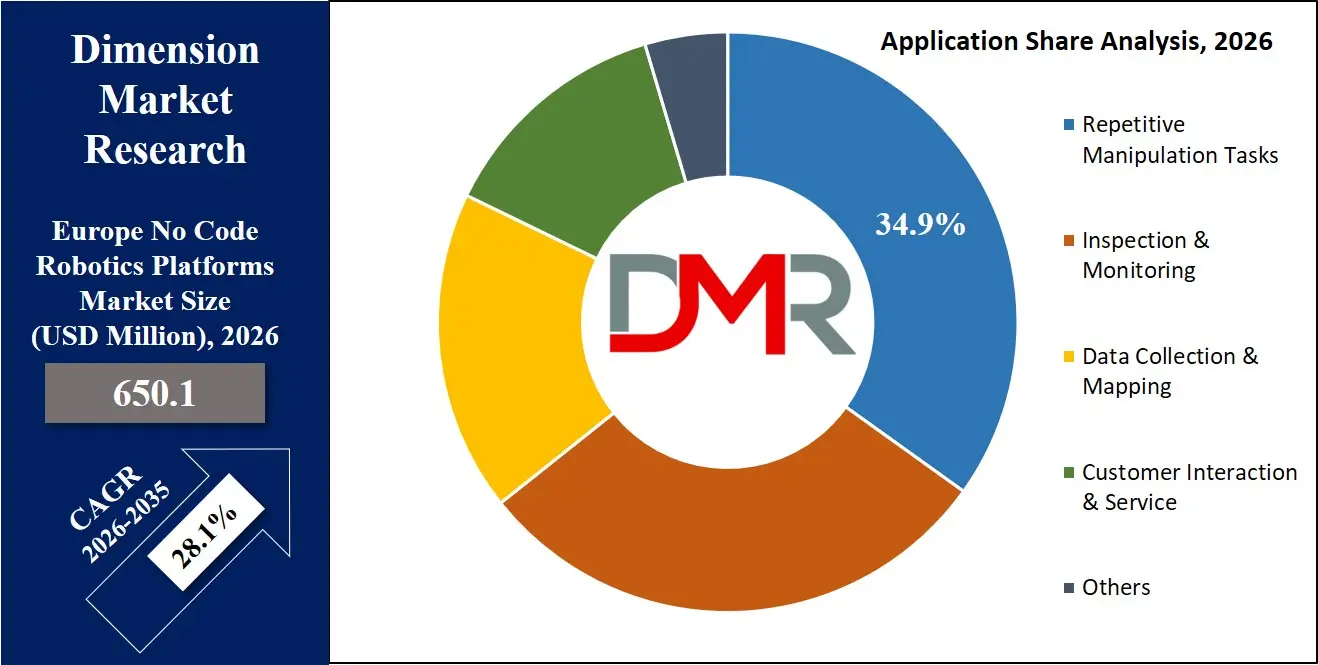
- By Application Segment Analysis: The repetitive manipulation tasks segment is expected to dominate the Europe No-Code Robotics Platforms Market in 2026, driven by strong adoption in manufacturing and logistics, while inspection and monitoring remains the second-largest segment.
- Key Players: Some of the major key players in the Europe No Code Robotics Platforms Market are UiPath Inc., Automation Anywhere, Inc., Blue Prism Group plc, ServiceNow, Inc., Appian Corporation, and many others.
- Market Growth Rate: The market is growing at a CAGR of 28.1% over the forecasted period.
Impact of the Iran conflict on the Europe No Code Robotics Platforms Market
- Heightened Focus on Supply Chain Resilience: The conflict exposed the weaknesses in global supply chains, which in turn accelerated the U.S. push for domestic manufacturing. No-code robotics platforms have been at the heart of this push, helping manufacturers deploy automated production lines with a workforce that is not dependent on scarce programming talent.
- Increased Demand for Rapid Re-tooling: The geopolitical tensions have created an environment that is more volatile than ever. No-code robotics platforms have been at the heart of helping businesses respond to this volatility by providing the tools for rapid re-tooling of robotic work cells for new products or components. This is a significant advantage in today’s volatile global marketplace.
- Competition for Hardware Components: While the software side of no-code robotics platforms is thriving, there is also volatility in the global supply chain for physical hardware components used in robotics. Actuators, sensors, controllers, etc., have all been impacted by global events. This has forced platform providers to develop more robust supply chains for hardware components in order to ensure platform stability.
- Accelerated Development of Simulation Capabilities: With hardware components being impacted by global events, there is an accelerated focus on simulation tools that allow businesses to design, test, and validate robotic work cells in a simulated environment.
Europe No Code Robotics Platforms Market: Use Cases
- Automated Quality Inspection in Automotive Manufacturing: This application utilizes no-code software to program the robotic arms for visual inspections. The visual inspections are carried out with the aid of cameras and AI algorithms. The application ensures quality control in the automotive industry.
- Mobile Robot Fleet Management for Warehouse Logistics: The application of no-code software helps manage the fleet of autonomous robots in the warehouse. The robots are used for the transportation of materials. The application helps optimize the operations in the warehouse.
- Repetitive Palletizing in Food & Beverage: In the food and beverage industry, the application of no-code software helps manage the robots in the palletizing process. The application helps address the problem of labor shortages in the industry.
- Educational Robotics for STEM Programs: The application of no-code software helps students learn about robotics and the benefits of the industry in the future. The application helps create a skilled workforce in the region.
Europe No Code Robotics Platforms Market: Stats & Facts
European Commission (Digital & Industrial Strategy)
- Around 78% of industrial companies in Europe are investing in AI and automation technologies to improve productivity and competitiveness.
- Under the Digital Decade policy, the EU aims to digitize 20% of the industrial value chain by 2030.
- The EU is targeting a 50% increase in robotics adoption among SMEs by 2030, reflecting a strong push toward wider automation.
- Digital upskilling initiatives are expected to train over 20 million ICT specialists, helping to close the skills gap.
- These programs are likely to support automation integration in more than 10,000 manufacturing SMEs across member states.
- The Digital Europe Program is already impacting over 500,000 industrial companies by supporting their digital transformation efforts.
European Robotics & Automation Associations
- Robot shipments reached 78,000 units in 2023, keeping Europe among the top global adopters.
• More than 65% of new automation projects now include user-friendly programming interfaces.
• Around 45% of manufacturers still see the shortage of skilled programmers as a key barrier to scaling automation.
• In 2024, no-code software adoption grew by 12%, showing a clear shift toward more accessible tools.
- Eurostat (European Union Statistics Office)
• The EU has over 2.5 million manufacturing enterprises, creating a large addressable market for no-code robotics.
• SMEs account for 99% of all businesses, highlighting the need for simple and cost-effective automation solutions.
Eurostat (European Union Statistics Office)
- The European Union has over 2.5 million enterprises in the manufacturing sector, representing a significant addressable market for no-code robotics.
- Small and medium-sized enterprises (SMEs) account for 99% of all businesses in the EU, highlighting the importance of accessible automation tools.
European Industrial & Automation Studies
- No-code automation platforms could reduce robot programming time by up to 70% compared to traditional coding methods.
- Visual workflow-based programming can cut deployment costs for robotic cells by 30% to 40%.
- User-friendly programming interfaces can reduce the time to train operators on robotic systems by 50%.
- Around 35% of industrial downtime in Europe is due to a shortage of skilled labor for reprogramming and maintaining robots, where no-code solutions are crucial.
Europe No Code Robotics Platforms Market: Market Dynamic
Driving Factors in the Europe No Code Robotics Platforms Market
Digital Transformation of Industrial Automation
The no-code robotics platforms sector in Europe is becoming the focal point of digital transformation, in line with the European Union's Digital Decade initiatives that seek to incorporate digital technology in all industrial sectors. Businesses are using digital technology, including artificial intelligence, cloud-based orchestration, and digital twins, to enable the remote monitoring and maintenance of their facilities. For example, artificial intelligence-based simulation tools provide insights into potential bottlenecks in the production process, thereby reducing inefficiencies in the process. Digital twins improve the accuracy of complex manufacturing processes, thereby instilling trust in the process.
Labor Shortages Boosting Automation Demand
The current shortage of skilled programmers of robotic systems has created a significant demand for the industry to develop efficient and user-friendly solutions for automation in Europe. Major companies such as Volkswagen, Siemens, and Airbus have joined hands with the leading providers of no-code platforms to meet the current requirements of flexibility and efficiency in production. With the increasing importance of flexible automation in the future of production, investment in the physical infrastructure for the deployment of the solution is accompanied by investment in digital platforms to integrate the solution with a single interface for both businesses and users.
Restraints in the Europe No Code Robotics Platforms Market
High Initial Integration and Hardware Costs
The capital investment required in the latest no-code solutions and the robotic hardware they manage is high, though the benefits are obvious. Small manufacturing SMEs may not be in a position to afford the latest robotic arms, end-effectors, or sensors required for complex robotic applications. This could be another factor that would hinder their entry into the market and increase the gap between the large corporations and the SMEs.
Limited Standardization Across Platforms
The no-code industry will have challenges with varying platform architectures and differing levels of hardware compatibility across vendors. While interoperability is included in EU digital policy, the pace of innovation often outpaces the standardization of application programming interfaces (APIs). Normally, companies incur additional costs for platform-specific integration and customization. Getting over this restraint will involve considerable investments in cross-industry collaboration and unified technical standards.
Opportunities in the Europe No Code Robotics Platforms Market
Integration of Emerging Technologies
The adoption of technologies such as AI, edge computing, and digital twins presents an excellent opportunity for no-code robotics optimization. Automated path planning and decision-making cut down deployment times, while AI-powered systems enhance adaptability to new tasks. Startups and established firms alike are testing such integrations, which offer an excellent opportunity for technology providers and investors to reach the European automation market.
Expansion into New Industries and SMEs
This is particularly true with the rise in demand for accessible automation solutions in sectors such as agriculture, healthcare, and retail. This particular sector is also witnessing tremendous growth in terms of no-code robotics. Moreover, there is also an increase in investment in modular plug-and-play robots that cater to small and medium-sized businesses. Industrial development in Europe, along with demographic changes in terms of labor, is also likely to fuel this sector.
Trends in the Europe No Code Robotics Platforms Market
EU Industrial Strategy and Digital Mandates
Europe’s strong focus on maintaining industrial competitiveness continues to highlight the need for advanced automation solutions, including no-code robotics. As a result, these platforms are becoming an increasingly important part of modern manufacturing environments. Ongoing investments in R&D facilities across countries like Germany, France, and Italy are playing a key role in supporting this growth. At the same time, policy-level support, such as the European Union’s Important Projects of Common European Interest (IPCEI) in areas like microelectronics and connectivity, is encouraging further investment in higher levels of automation. Taken together, these factors are reinforcing Europe’s position as a leading region in the global industrial automation landscape.
Increasing Demand for Flexible Automation
Manufacturers across European countries are increasingly looking for automation solutions that offer greater flexibility. Their growing involvement in Industry 4.0 initiatives is driving demand for systems that can adapt quickly to changing operational needs. This, in turn, is pushing the need for more advanced no-code platforms that simplify deployment and customization. At the same time, wider adoption in mass-market robotics, added capabilities in logistics and service applications, and the availability of more cost-effective hardware are opening up new growth opportunities for these solutions. Together, these factors are strengthening Europe’s position in automation while also supporting the broader expansion of the no-code robotics segment in the global market.
Europe No Code Robotics Platforms Market: Research Scope and Analysis
By Component Analysis
Platform solutions, and more specifically visual workflow platforms, are expected to lead the market in the component segment, with more than 70% market share in 2026. The dominance of platform solutions in the Europe No Code Robotics Platforms Market’s component segment is mainly because of the acute programmer skill set shortage and the high demand for user-friendly automation solutions in Europe. The significant investment of industrial end-users in Europe in integrating drag and drop interfaces and simulation tools in their operations is also a major reason for the dominance of platform solutions in the market’s component segment. The Europe digital strategy is based on democratizing technology to improve industrial productivity in the region, and hence the demand for visual platforms that support robot deployment with real-time monitoring and intervention and improve system reliability, which is critical in maintaining system performance in such a highly competitive market. The high production volumes of manufacturing SMEs also support the market’s demand for quality visual workflow platforms.
These platforms provide complete interconnectivity of flexible automation and digital workflows in organizations, making them absolutely essential in the market in the future. Industry 5.0, smart manufacturing, and connected factories are based on visual programming platforms, which are essential in the data collection and synchronization processes in these operations. The growth of the SME sector in the European market also contributes to the market’s demand for visual workflow platforms, which is based on the government initiatives and digitalization programs that support the adoption of the latest available technology in the market to bridge the skill set shortage in the European market. Thus, platform solutions are an essential factor in the market, as it is the foundation of modern industrial automation in Europe.
By Deployment Mode Analysis
Cloud-based platforms are expected to lead the deployment mode segment in Europe’s no-code robotics platforms market. This trend is mainly due to the increasing reliance on scalable and remotely accessible software for modern industrial use. The region has a solid digital infrastructure, with strong connectivity linking key industrial zones in Germany, France, and Central Europe. This connectivity makes cloud service distribution more efficient. Compared to other deployment models, cloud solutions provide a practical blend of accessibility and cost-effectiveness, especially for applications like fleet management and remote monitoring. Early digitalization efforts are already visible in large enterprises and are increasingly present among SMEs as well. At the same time, the rising number of connectivity standards and regulations is pushing manufacturers to focus on systems that can ensure reliable remote access while supporting higher levels of data integration across operations.
Investment in cloud technology continues to strengthen this trend. This includes expanding data center capacity to support edge computing and faster processing. It also involves developing testing facilities near major innovation hubs and improving connectivity frameworks. These efforts support the EU's Digital Decade vision of making Europe a leader in cloud-driven automation. The close presence of industrial R&D centers next to cloud infrastructure further reinforces its role in enabling no-code robotics. Scalability remains one of the strongest advantages. Cloud-based systems generally require lower upfront investment than on-premises setups. This makes them more accessible for a wider range of applications while still meeting regulatory needs. In addition, the growing adoption of edge-cloud integration and AI-based analytics is helping to improve operational efficiency, further strengthening the position of cloud platforms in the market.
By Application Analysis
The application segment in the Europe no-code robotics platforms market is expected to be driven by inspection and monitoring. These functions are key for quality assurance, predictive maintenance, and overall operational visibility. In Europe, industrial players are increasingly operating under strict quality standards. No-code solutions help simplify the setup of complex vision systems. This does not require deep technical expertise. This change connects to the broader goals of Industry 4.0, where reliability and consistent performance are top priorities. With real-time access to sensor data, these platforms allow teams to make quicker decisions and trigger maintenance actions right away. This is especially important in Europe, where high-value manufacturing and complex supply chains require immediate and precise quality feedback. Additionally, no-code deployment reduces the need for specialized programming skills, particularly for tasks like debugging or system integration. This ease of use makes the technology attractive to businesses of all sizes, including small and medium enterprises, which are becoming increasingly important in the region’s industrial landscape.
ℹ
To learn more about this report –
Download Your Free Sample Report Here
Another factor working in favor of these platforms is their ability to support advanced, AI-driven analytics. Built-in flexibility, along with pre-configured modules and user-friendly dashboards, allows companies to adapt systems quickly while maintaining strong oversight of safety and operational performance. Much of this progress is being supported by initiatives from the European Commission, particularly those focused on strengthening digital innovation hubs and encouraging collaboration with global technology providers. As a result, businesses are better equipped to respond to changing quality requirements while maintaining operational stability. All of this reinforces inspection and monitoring as the leading application area within the Europe no-code robotics platforms market.
By Enterprise Size Analysis
Large enterprises are expected to lead the European no-code robotics platforms market mainly because they spend more on automation, have complex operational needs, and adopt new technologies faster. These companies often need to implement automation at scale while keeping a strong focus on efficiency. Across Europe, the move toward digitalization, especially under Industry 4.0 initiatives, has encouraged large manufacturing sectors to invest more in these solutions. This trend is particularly evident in countries like Germany, France, and Italy, where major industrial players run extensive production networks. Managing these networks requires advanced software for tasks like fleet coordination, process optimization, and digital twin applications. Additionally, large enterprise OEMs are in a better position to adopt new technologies like cloud-based orchestration and AI, which improve productivity and provide better operational visibility. Their size also gives them an edge when negotiating with platform providers and deploying fully integrated automation systems.
Support from European Commission-led initiatives has bolstered the position of large enterprises in this market. Programs like Horizon Europe have provided funding, infrastructure, and research support to help companies grow their digital capabilities. At the same time, large enterprises play a crucial role in driving Europe’s industrial export economy, reinforcing their focus on efficiency and innovation. By leading the adoption of new automation practices, these organizations often set standards for productivity and technology implementation across industries. As a result, they are likely to keep their leading position in the European no-code robotics platforms market.
By End User Analysis
The industrial sector is expected to dominate the end-user segment in the Europe no-code robotics platforms market, largely because it accounts for the highest volume of automation initiatives and depends heavily on efficient, performance-driven operations. Industrial activity across Europe continues to show steady demand, supported by a strong focus on productivity and the ongoing integration of automation technologies. The region’s broader industrial strategy places significant emphasis on improving efficiency across manufacturing, which naturally strengthens the role of this sector. As automation requirements become more advanced, companies are increasingly turning to no-code solutions to simplify software selection, system integration, and validation processes. Major industrial players, along with local automation providers, are investing heavily in both R&D and production capabilities, which keeps the market highly competitive. At the same time, manufacturers are offering more integrated automation packages that combine digital and physical operations, further increasing the need for flexible and scalable no-code robotics platforms.
Support from the European Union is also playing an important role in reinforcing this trend. Investments in testing infrastructure and the development of innovation hubs are helping improve supply chain efficiency and accelerate technology adoption within the industrial ecosystem. Given that the industrial sector remains a key contributor to both GDP and employment across Europe, its continued focus on automation and operational efficiency is not surprising. With ongoing adoption of advanced technologies and increasingly comprehensive automation systems, the sector is expected to remain the leading end-user segment in the Europe no-code robotics platforms market.
The Europe No Code Robotics Platforms Market Report is segmented on the basis of the following:
By Component
- Platform
- Visual Workflow
- Form-based
- Others
- Services
- Professional Services
- Managed Services
By Deployment Mode
By Application
- Inspection & Monitoring
- Customer Interaction & Service
- Data Collection & Mapping
- Repetitive Manipulation Tasks
- Others
By Enterprise Size
- Small & Medium Enterprises
- Large Enterprises
By End User
- Industrial
- Commercial
- Educational
- Others
Impact of Artificial Intelligence on the Europe No Code Robotics Platforms Market
- Democratized AI Integration: No code robotics platforms are increasingly embedding AI-assisted capabilities such as vision recognition, predictive maintenance, and adaptive control, enabling non-technical users to deploy advanced functionalities without requiring data science expertise, thereby accelerating automation adoption across European SMEs.
- Intelligent Workflow Generation: Generative AI is being integrated into no code platforms, allowing users to define robot tasks through natural language inputs and automatically generate optimized workflows, significantly reducing programming time and improving operational efficiency.
- Enhanced Vision Capabilities: AI-powered computer vision modules are expanding inspection and monitoring applications by enabling high-accuracy object recognition, defect detection, and real-time situational awareness, particularly in precision-driven European manufacturing sectors.
- Predictive Maintenance Optimization: Embedded AI algorithms analyze machine and operational data to predict potential failures and recommend preventive actions, helping organizations minimize downtime, reduce maintenance costs, and improve asset utilization.
- Accelerated Training and Onboarding: AI-driven guided programming, smart suggestions, and contextual assistance features are reducing the learning curve, enabling faster onboarding of users and supporting workforce upskilling amid the ongoing talent shortage in Europe.
By Region
Europe
- Germany
- The U.K.
- France
- Italy
- Russia
- Spain
- Benelux
- Nordic
- Rest of Europe
Europe No Code Robotics Platforms Market: Competitive Landscape
The competitive landscape is characterized by a diverse mix of established industrial automation leaders and innovative software-focused entrants in the Europe No Code Robotics Platforms Market, with distinct capabilities across platform usability, hardware integration, and enterprise features. Major companies are pursuing differentiated strategies, with some focusing on comprehensive platforms that support diverse robotic hardware, while others specialize in specific applications or deployment environments. Market leaders include the existing large industrial automation companies (e.g., ABB Ltd., KUKA AG & Siemens AG) who already have extensive installed bases and expertise to build no-code robotics extensions into their existing automation portfolios and software-native companies (e.g., UiPath, Rockwell Automation) who are competing based on their focus on user-centered design, agile design with rapid innovation cycles, and usage of cloud delivery models which are attractive to organizations wanting to deploy robotic solutions quickly & easily. Furthermore, these companies are aligning themselves with the priorities of the digital transformation initiatives in Europe to create no-code robot platforms that will strengthen regional focus on developing digital skills and enhancing industrial competitiveness.
ℹ
To learn more about this report –
Download Your Free Sample Report Here
Many companies are increasingly using mergers and acquisitions as a way to expand their platform capabilities and enter new markets. For instance, it is quite common to see an automation hardware manufacturer collaborate with a no-code software developer to improve the programmability of robotic systems. Alongside this, platform providers are also forming partnerships with system integrators to accelerate product deployment and reach customers more efficiently. The competitive landscape also includes a number of specialized players that focus on specific verticals such as agriculture, healthcare, and logistics, often developing tailored platforms designed to meet the unique requirements of these industries. While large enterprises still represent the core customer base, there is a noticeable shift toward building solutions for small and medium-sized enterprises, given the untapped growth potential in this segment. Support from the European Union, particularly through digital innovation hubs and open-source initiatives, is encouraging more collaborative environments where platform providers and integrators can work together, and even cooperate with each other to improve interoperability through shared standards. As the market becomes more competitive, companies are placing greater emphasis on strengthening AI integration, expanding ecosystem partnerships, and clearly demonstrating productivity gains across a wide range of industrial and commercial applications.
Some of the prominent players in the Europe No Code Robotics Platforms Market are:
- UiPath Inc.
- Automation Anywhere, Inc.
- Blue Prism Group plc
- ServiceNow, Inc.
- Appian Corporation
- Pegasystems Inc.
- Nintex Global Ltd.
- WorkFusion, Inc.
- Kryon Systems Ltd.
- ABBYY Solutions Ltd.
- ABB Ltd.
- KUKA AG
- Rockwell Automation, Inc.
- Siemens AG
- FANUC Corporation
- Mitsubishi Electric Corporation
- Ready Robotics, Inc.
- Wandelbots GmbH
- Vention Inc.
- General Bionix, Inc.
- Other Key Players
Recent Developments in the Europe No Code Robotics Platforms Market
- October 2025: ABB Ltd. agreed to divest its robotics division to SoftBank Group in a deal valued at approximately $5.4 billion, aiming to strengthen the development of next-generation AI-driven robotics. The move reflects increasing strategic focus on intelligent automation and scalable robotics ecosystems.
- June 2025: ABB Ltd. announced the expansion of its industrial robotics portfolio at Automatica 2025 in Munich, introducing new AI-enabled robots and autonomous mobile platforms powered by advanced controllers. The launch emphasizes improved flexibility, ease of deployment, and reduced programming complexity, supporting the growing demand for user-friendly and intelligent automation solutions.
- November 2024: Wandelbots GmbH launched “NOVA,” an agnostic operating system for industrial robots designed to simplify programming and enable cross-platform robot deployment. The solution integrates modern programming tools and AI capabilities to make robotics more accessible, particularly for SMEs facing skilled labor shortages.
- August 2024: Siemens AG expanded its collaboration with Universal Robots A/S and Mobile Industrial Robots (MiR) to accelerate industrial automation adoption through integrated robotic systems and unified control interfaces. The partnership focuses on reducing integration complexity and enabling faster deployment of collaborative robots across manufacturing environments.
- July 2024: Universal Robots A/S advanced its collaborative robotics ecosystem through enhanced interoperability and simplified programming interfaces, enabling faster deployment and reducing the need for specialized coding expertise in industrial applications.
- April 2024: UiPath Inc. continued to expand its automation ecosystem by enhancing integrations between robotic process automation and physical robotics systems, supporting end-to-end workflow orchestration across digital and physical operations. This development strengthens the role of unified automation platforms in industrial environments.
Report Details
| Report Characteristics |
| Market Size (2026) |
USD 650.1 Mn |
| Forecast Value (2035) |
USD 6,025.5 Mn |
| CAGR (2026–2035) |
28.1% |
| Historical Data |
2021 – 2025 |
| Forecast Data |
2027 – 2035 |
| Base Year |
2025 |
| Estimate Year |
2026 |
| Report Coverage |
Market Revenue Estimation, Market Dynamics, Competitive Landscape, Growth Factors and etc. |
| Segments Covered |
By Component (Platform and Services), By Deployment Mode (Cloud-based and On-Premises), By Application (Inspection & Monitoring, Customer Interaction & Service, Data Collection & Mapping, Repetitive Manipulation Tasks, and Others), By Enterprise Size (Small & Medium Enterprises and Large Enterprises), By End-User (Industrial, Commercial, Educational, and Others) |
| Regional Coverage |
Europe – Germany, The UK, France, Russia, Spain, Italy, Benelux, Nordic, & Rest of Europe |
| Prominent Players |
UiPath Inc., Automation Anywhere, Inc., Blue Prism Group plc, ServiceNow, Inc., Appian Corporation, Pegasystems Inc., Nintex Global Ltd., WorkFusion, Inc., Kryon Systems Ltd., ABBYY Solutions Ltd., ABB Ltd., KUKA AG, Rockwell Automation, Inc., Siemens AG, FANUC Corporation, Mitsubishi Electric Corporation, Ready Robotics, Inc., Wandelbots GmbH, Vention Inc., General Bionix, Inc., and Other Key Players. |
| Purchase Options |
We have three licenses to opt for: Single User License (Limited to 1 user), Multi-User License (Up to 5 Users) and Corporate Use License (Unlimited User) along with free report customization equivalent to 0 analyst working days, 3 analysts working days and 5 analysts working days respectively. |
Frequently Asked Questions
How big is the Europe No Code Robotics Platforms Market?
▾ The Europe No Code Robotics Platforms Market size is estimated to have a value of USD 650.1 million in 2026 and is expected to reach USD 6,025.5 million by the end of 2035.
Who are the key players in the Europe No Code Robotics Platforms Market?
▾ Some of the major key players in the Europe No Code Robotics Platforms Market are UiPath Inc., Automation Anywhere, Inc., Blue Prism Group plc, ServiceNow, Inc., Appian Corporation and many others.
What is the growth rate in the Europe No Code Robotics Platforms Market?
▾ The market is growing at a CAGR of 28.1% over the forecasted period.