Market Overview
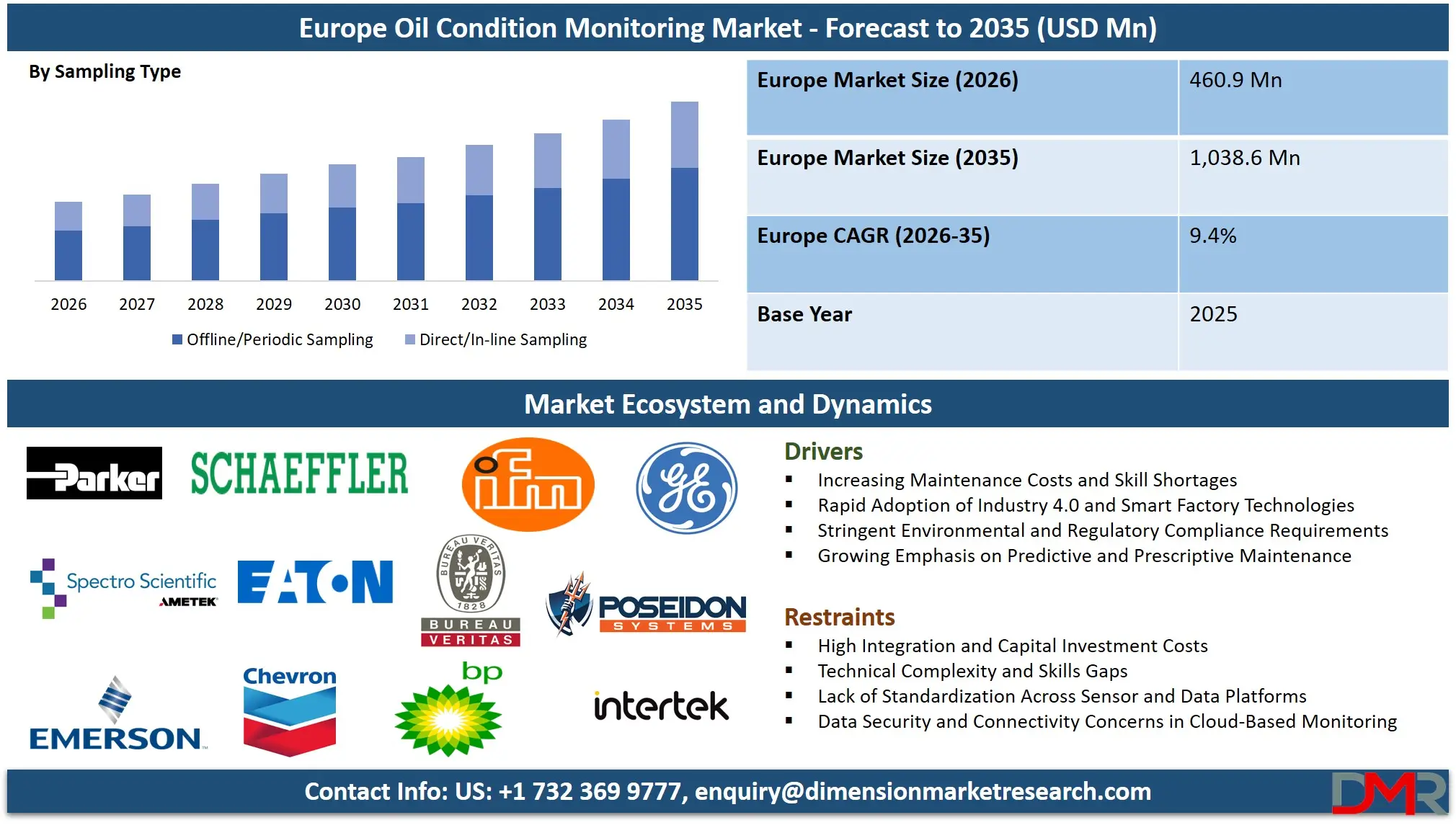
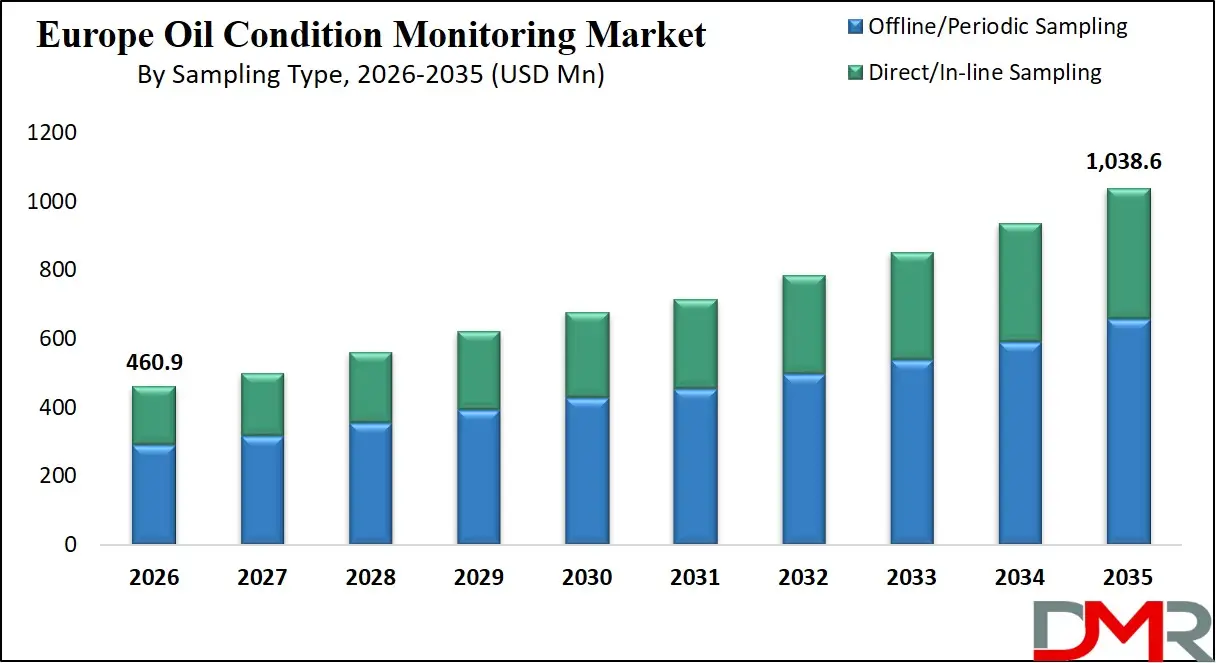
The Europe Oil Condition Monitoring Market size is projected to attain a value of USD 460.9 million in 2026, witnessing growth at a CAGR of 9.4% to reach a value of USD 1,038.6 million in 2035.
ℹ
To learn more about this report –
Download Your Free Sample Report Here
Oil condition monitoring is an automated or semi-automated analytical process used to assess the health, contamination, and wear debris in lubricants, hydraulic fluids, and industrial oils, whereas laboratory-based services provide deeper spectroscopic and ferrographic analysis. The market for Europe Oil Condition Monitoring is increasing with the increased adoption of predictive maintenance, Industry 4.0 technologies, and real-time asset health monitoring in countries such as Germany, France, and the United Kingdom.
The market growth is also supported by increased pressure on operational uptime, a shortage of skilled maintenance staff, and the integration of IoT sensors into European industries. Also, together with the strict regulations concerning environmental compliance, equipment safety, and efficiency in the functioning of industries like energy, transportation, and manufacturing, the further adoption of more sophisticated oil condition monitoring systems is gaining momentum in Europe.
ℹ
To learn more about this report –
Download Your Free Sample Report Here
Europe Oil Condition Monitoring Market: Key Takeaways and Other Influencing Factors
- Strong Market Growth Projections: Although the market is still in its maturity stage, the Europe Oil Condition Monitoring Market is estimated to increase by USD 460.9 million in 2026 and USD 1,038.6 million by 2035 with a healthy CAGR of 9.4% and growing usage of industrial IoT and smart predictive maintenance tools.
- Dominance of On-site Monitoring: On-site monitoring kits & portable analyzers dominate with 38.5% share, showing a great preference for real-time asset surveillance and mature industrial infrastructure in Europe.
- Transportation Segment Leading Industry Vertical: With 33.8% share, transportation is the leading industry vertical supported by increasing demand for engine health monitoring, fuel efficiency optimization, and extended oil drain intervals across automotive, aviation, marine, and rail sectors in Europe.
- Move to Integrated and AI-Driven Systems: Increasing use of integrated oil sensors (with engine/gearbox controllers) and flexible/portable monitoring units is changing maintenance workflows, shortening downtime, and enhancing the reliability of operations in Europe.
- Large Maintenance Cost Load: Unplanned downtime expenses constitute more than 42.5% of total operating costs in European heavy industries, and the average annual cost of equipment failure per plant is approximately USD 11.5 thousand, which makes oil condition monitoring solutions a major demand.
- High Industrialization in Europe: In European manufacturing, energy, and transport sectors, approximately 62 million people are working, and this provides a high demand for oil monitoring to eliminate catastrophic failures and enhance throughput, as suggested by OECD.
- High Condition Monitoring Opportunity: According to industry associations, automated oil monitoring adoption is 32.4% of all predictive maintenance investments in the EU, and system integration rates are over 2,100 units per 100,000 industrial assets.
Impact of the Iran conflict on the Europe Oil Condition Monitoring Market
The Iran war is leading to disruption of the supply chain in the European market and increased cost and time in transporting and delivering some of the oil monitoring systems' components (e.g., sensors, particle counters, spectrometric cells). The cost of production of condition monitoring equipment, therefore, is on the rise due to the Iran conflict, coupled with the rise in energy prices and raw materials (steel, aluminum, semiconductors), which are contributing to the cost of production. Short-term impacts on the market through diversified sourcing, however, long-term market fluctuation can cause pricing and stagnation in the market.
Europe Oil Condition Monitoring Market: Use Cases
- Real-Time Engine Oil Monitoring in Automotive Fleets: On-site monitoring kits provide automated analysis of viscosity, TAN, and soot in commercial vehicle engines, which reduces unplanned downtime and integrates maintenance data in real-time to achieve better fleet operational efficiency.
- Wear Debris Detection in Wind Turbine Gearboxes: These systems help detect ferrous particles and water ingress in wind turbine gearboxes through continuous online sensors, improving turbine availability and reducing damage rates in remote renewable energy assets.
- Hydraulic Fluid Condition Monitoring in Industrial Manufacturing: Hydraulic oil is analyzed after sampling using laboratory-based services to facilitate the preservation of fluid integrity, machine reliability, and improved compliance with ISO cleanliness codes.
- Marine and Rail Logistics Automation: Portable analyzers are becoming more popular, allowing automatic onboard oil testing, fuel dilution measurement, and just-in-time maintenance scheduling, in order to enhance the accuracy of asset health and reduce the number of catastrophic failures at work.
Europe Oil Condition Monitoring Market: Market Dynamics
Driving Factors in the Europe Oil Condition Monitoring Market
Increasing Maintenance Costs and Skill Shortages
The rising costs of unplanned downtime and the long-lasting lack of proficient predictive maintenance employees are fueling the demand for automated oil analysis, real-time sensor systems, and flexible condition monitoring solutions in Europe. This has been aided by the enhanced focus on the safety and reliability of industrial assets as well.
Rapid Adoption of Industry 4.0 and Smart Factory Technologies
Increases in industrial IoT and digital manufacturing are increasing the pace at which connected oil monitoring systems are being used to provide real-time lubricant health tracking to enhance uptime and operational efficiency. The uptake is also being enhanced by increased adoption of cloud-based asset management and predictive maintenance.
Restraints in the Europe Oil Condition Monitoring Market
High Integration and Capital Investment Costs
High-end continuous online monitoring equipment is quite expensive in terms of both hardware and software integration as well as sensor retrofitting, making it not affordable to many small and medium-sized businesses. In traditional industries, budget constraints also limit large scale implementation.
Technical Complexity and Skills Gaps
Both stringent safety protocols and the fact that oil analysis sensors require specialized calibration and data interpretation skills introduce complexities in their implementation, which will influence their compatibility with existing asset management systems. There are compliance demands like ISO 17025 and ASTM standards, which contribute to the operation burden among end-users.
Opportunities in the Europe Oil Condition Monitoring Market
Increased Flexible and Portable Monitoring Kits
The increased emphasis on remote and distributed asset maintenance is opening up possibilities of portable and on-site oil analyzers, which allows rapid field testing and immediate decision-making. This tendency favors decentralized maintenance and minimizes sample-to-answer time.
Integration with AI and Cloud-Based Analytics
The use of AI-based anomaly detection and predictive wear algorithms is improving the monitoring of irregular contamination patterns or sudden oil degradation, which allows smarter maintenance scheduling and condition-based alerting. Machine learning is a continuous area of innovation that widens the scope of applications.
Trends in the Europe Oil Condition Monitoring Market
Shift toward Continuous Online Monitoring Systems
Autonomous online oil sensors and real-time condition monitoring units are gaining popularity compared to offline sampling methods because of superior data continuity, the ability to capture transient events, and reduced labor costs. This is driving faster innovation of products on sensor design and fleet management software.
Rising Use of Cloud-Related Oil Analysis Platforms
Cloud-based oil condition orchestration systems are being implemented by manufacturing, energy, and transport providers to monitor their equipment remotely, optimize their maintenance fleets, and simplify their workflow in oil sampling activities. Integration with enterprise asset management (EAM) systems and CMMS is improving access to data and coordination of maintenance.
Europe Oil Condition Monitoring Market: Research Scope and Analysis
By Product Type Analysis
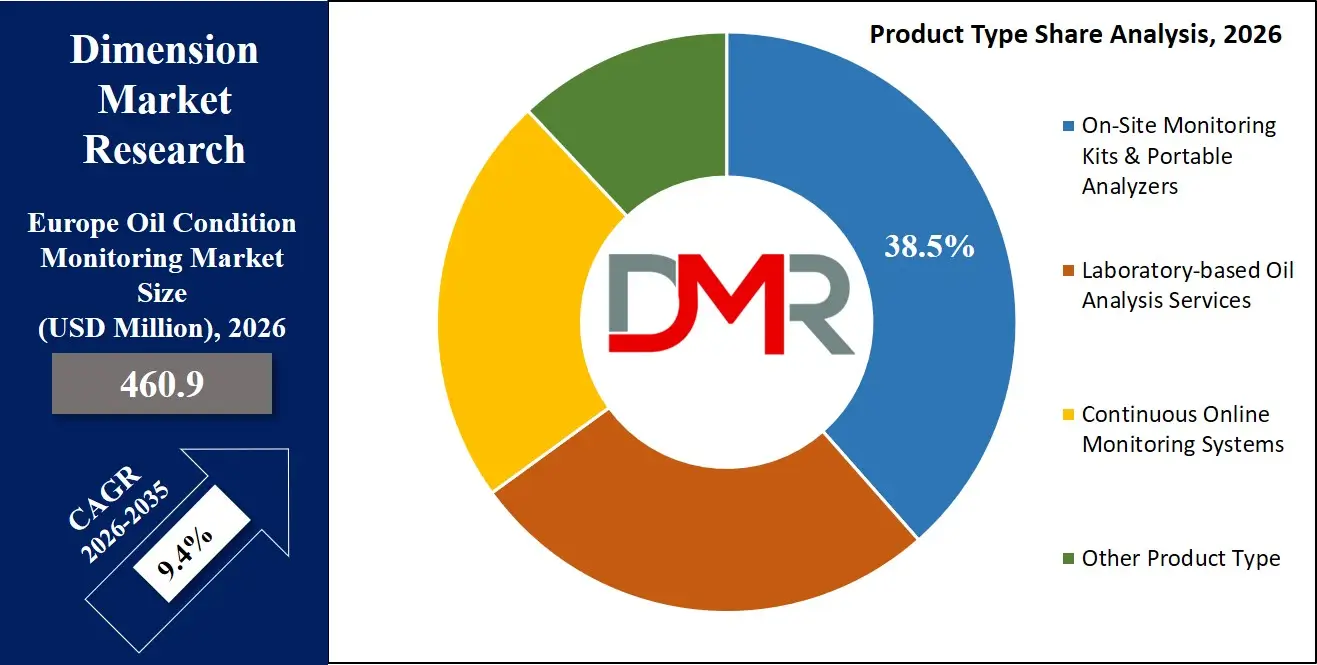
It is projected that in 2026, On-Site Monitoring Kits & Portable Analyzers will have the largest market share at 38.5%. This is because they will be relied upon for collecting real-time data, round-the-clock operations, and high-value assets and critical rotating equipment. The capacity for providing real-time alerts and avoiding unplanned downtime is driving their adoption.
ℹ
To learn more about this report –
Download Your Free Sample Report Here
On-site monitoring kits & portable analyzers continue to be in demand in field maintenance and applications requiring immediate testing. This is attributed to their relatively lower costs and user-friendliness despite the lack of continuous data, which is tilting the desire towards full online monitoring.
By Sampling Type Analysis
It is estimated that offline/periodic sampling will dominate the Europe oil condition monitoring market with around 55.2% share in 2026 due to its popularity in existing industrial maintenance and its relatively easy implementation and low cost of application in both manufacturing, transportation, and energy sectors. The offline sampling is still favored in the regular oil diagnostics and routine maintenance programs. Nevertheless, direct/in-line sampling systems are experiencing tremendous growth as industries are adopting real-time monitoring, automation, and predictive maintenance approaches in order to enhance the reliability of assets as well as minimize unplanned downtime.
By Measurement Type Analysis
In the Europe Oil Condition Monitoring Market, wear & contamination monitoring is projected to occupy a share of about 41.3% in 2026 because of the high demand for particle counting, wear debris in critical machinery like engines, gears, and hydraulic systems. These parameters are critical to predictive maintenance and early fault detection. Chemical property analysis is also on the increase with the rising use of Total Acid Number (TAN), Total Base Number (TBN), oxidation, and additive depletion analysis to determine oil degradation. Analysis of physical property and contamination of fluids remains a backup to the assessment of the baseline conditions in industrial applications.
By Industry Vertical Analysis
Transportation is expected to dominate the industry vertical segment in 2026 with about 33.8% market share in the industry, as both automotive, aviation, marine, and railway industries are highly embracing it to enhance engine reliability, fuel efficiency, and increased maintenance intervals. The industry manufacturing is close behind since it heavily uses rotating machines and predictive maintenance systems, with energy and power generation and oil and gas industries also having a high number of monitors with turbines, compressors, and heavy machinery. Continued attention on asset reliability and operational effectiveness is helping to drive market growth in all end-use markets.
The Europe Oil Condition Monitoring Market Report is segmented on the basis of the following:
By Product Type
- On-Site Monitoring Kits & Portable Analyzers
- Laboratory-based Oil Analysis Services
- Continuous Online Monitoring Systems
- Other Product Type
By Sampling Type
- Offline/Periodic Sampling
- Direct/In-line Sampling
By Measurement Type
- Physical Properties
- Viscosity
- Density
- Temperature
- Wear & Contamination Monitoring
- Wear Debris Analysis
- Particle Counting
- Ferrous Density Measurement
- Fluid Contamination Analysis
- Water Content
- Fuel Dilution
- Soot & Insolubles
- Chemical Property Analysis
- Total Acid Number (TAN)
- Total Base Number (TBN)
- Oxidation & Nitration
- Additive Depletion
- Spectrometric Analysis
- Other Measurement Parameters
By Industry Vertical
- Transportation
- Automotive (Passenger & Commercial Vehicles)
- Aviation
- Marine
- Railways
- Energy & Power Generation
- Conventional Power (Coal, Gas, Nuclear)
- Renewable Energy (Wind Turbines, Hydropower)
- Industrial Manufacturing
- Heavy Machinery
- Process Industries
- Food & Beverage Equipment
- Mining & Construction Equipment
- Oil & Gas (Upstream, Midstream, Downstream)
- Other Industry Verticals
Impact of Artificial Intelligence on the Europe Oil Condition Monitoring Market
The Europe Oil Condition Monitoring Market is changing as a result of artificial intelligence that allows for faster and more accurate detection of wear particle patterns, oil degradation trends, and contamination sources due to the further development of AI-based anomaly detection. Through the algorithms, which are AI-based, the accuracy of remaining useful life prediction is enhanced by detecting the optimal maintenance windows and failure precursors that are frequently missed in threshold-based programming.
Flexible monitoring systems are integrated to enable real-time adaptive oil analysis and automated alerting of different equipment types and operating conditions. AI-assisted predictive maintenance is improving system availability and minimizing unexpected downtime in smart factory implementations, and workflow functionality by lessening manual data interpretation time and accelerating maintenance response times.
By Region
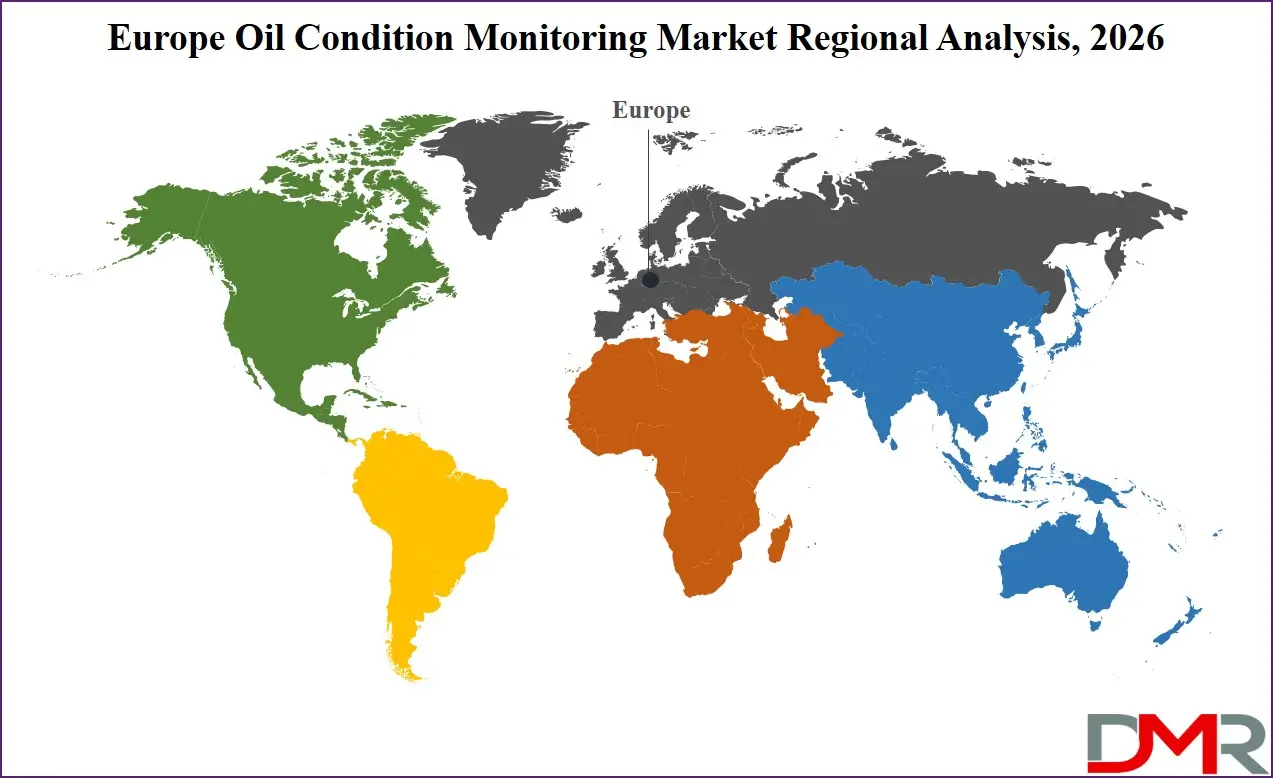
Europe
- Germany
- The U.K.
- France
- Italy
- Russia
- Spain
- Benelux
- Nordic
- Rest of Europe
Europe Oil Condition Monitoring Market: Competitive Landscape
Europe Oil Condition Monitoring Market is a very competitive one, as its development is based on the constant innovations of sensor technology, spectrometric analysis, and cloud-based analytics.
ℹ
To learn more about this report –
Download Your Free Sample Report Here
Advanced particle counters, AI diagnostics, and portable capabilities are also areas that companies are emphasizing on to reinforce their position. The competition is increasing due to strategic alliances, product innovation and diversification across the industrial, energy, and transport verticals, facilitating the market growth.
Some of the prominent players in the Europe Oil Condition Monitoring Market are:
- Parker Hannifin Corporation
- Schaeffler AG
- ifm electronic gmbh
- Eaton Corporation plc
- TE Connectivity Ltd.
- General Electric Company
- Emerson Electric Co.
- SGS S.A.
- Bureau Veritas S.A.
- Intertek Group plc
- Veritas Petroleum Services
- Shell plc
- BP p.l.c.
- TotalEnergies SE
- Exxon Mobil Corporation
- Chevron Corporation
- Spectro Scientific, Inc.
- TestOil, Inc.
- Tan Delta Systems plc
- Other Key Players
Recent Developments in the Europe Oil Condition Monitoring Market
- November 2025: Parker Hannifin Corporation announced a definitive agreement to acquire Filtration Group Corporation for USD 9.3 billion, significantly expanding its filtration and oil condition monitoring capabilities.
- March 2025: Emerson Electric Co. introduced enhanced AI-driven asset monitoring capabilities within its AMS platform to improve predictive maintenance, including lubrication and oil condition insights.
- February 2025: Shell plc expanded its digital lubricant analysis and monitoring services, strengthening real-time oil condition monitoring and predictive maintenance offerings.
Report Details
| Report Characteristics |
| Market Size (2026) |
USD 460.9 Mn |
| Forecast Value (2035) |
USD 1,038.6 Mn |
| CAGR (2026–2035) |
9.4% |
| Historical Data |
2021 – 2025 |
| Forecast Data |
2027 – 2035 |
| Base Year |
2025 |
| Estimate Year |
2026 |
| Report Coverage |
Market Revenue Estimation, Market Dynamics, Competitive Landscape, Growth Factors, etc. |
| Segments Covered |
By Product Type (On-Site Monitoring Kits & Portable Analyzers, Laboratory-based Oil Analysis Services, Continuous Online Monitoring Systems, Other Product Types), By Sampling Type (Offline/Periodic Sampling, Direct/In-line Sampling), By Measurement Type (Physical Properties, Wear & Contamination Monitoring, Fluid Contamination Analysis, Chemical Property Analysis, Other Measurement Parameters), By Industry Vertical (Transportation, Energy & Power Generation, Industrial Manufacturing, Mining & Construction Equipment, Oil & Gas, Other Industry Verticals) |
| Regional Coverage |
Europe – Germany, The UK, France, Russia, Spain, Italy, Benelux, Nordic, & Rest of Europe |
| Prominent Players |
Parker Hannifin Corporation, Schaeffler AG, ifm electronic gmbh, Eaton Corporation plc, TE Connectivity Ltd., General Electric Company, Emerson Electric Co., SGS S.A., Bureau Veritas S.A., Intertek Group plc, Veritas Petroleum Services, Shell plc, BP p.l.c., TotalEnergies SE, Exxon Mobil Corporation, Chevron Corporation, Spectro Scientific, Inc., TestOil, Inc., Tan Delta Systems plc., and Other Key Players |
| Purchase Options |
We have three licenses to opt for: Single User License (Limited to 1 user), Multi-User License (Up to 5 Users) and Corporate Use License (Unlimited User) along with free report customization equivalent to 0 analyst working days, 3 analysts working days and 5 analysts working days respectively. |
Frequently Asked Questions
How big is the Europe Oil Condition Monitoring Market?
▾ The Europe Oil Condition Monitoring Market size is estimated to have a value of USD 460.9 million in 2026 and is expected to reach USD 1,038.6 million by the end of 2035.
Who are the key players in the Europe Oil Condition Monitoring Market?
▾ Some of the major key players in the Europe Oil Condition Monitoring Market are Parker Hannifin Corporation, Schaeffler AG, ifm electronic gmbh, SGS S.A., Bureau Veritas S.A., Intertek Group plc, and many others.
What is the growth rate in the Europe Oil Condition Monitoring Market?
▾ The market is growing at a CAGR of 9.4% over the forecasted period.