Market Overview
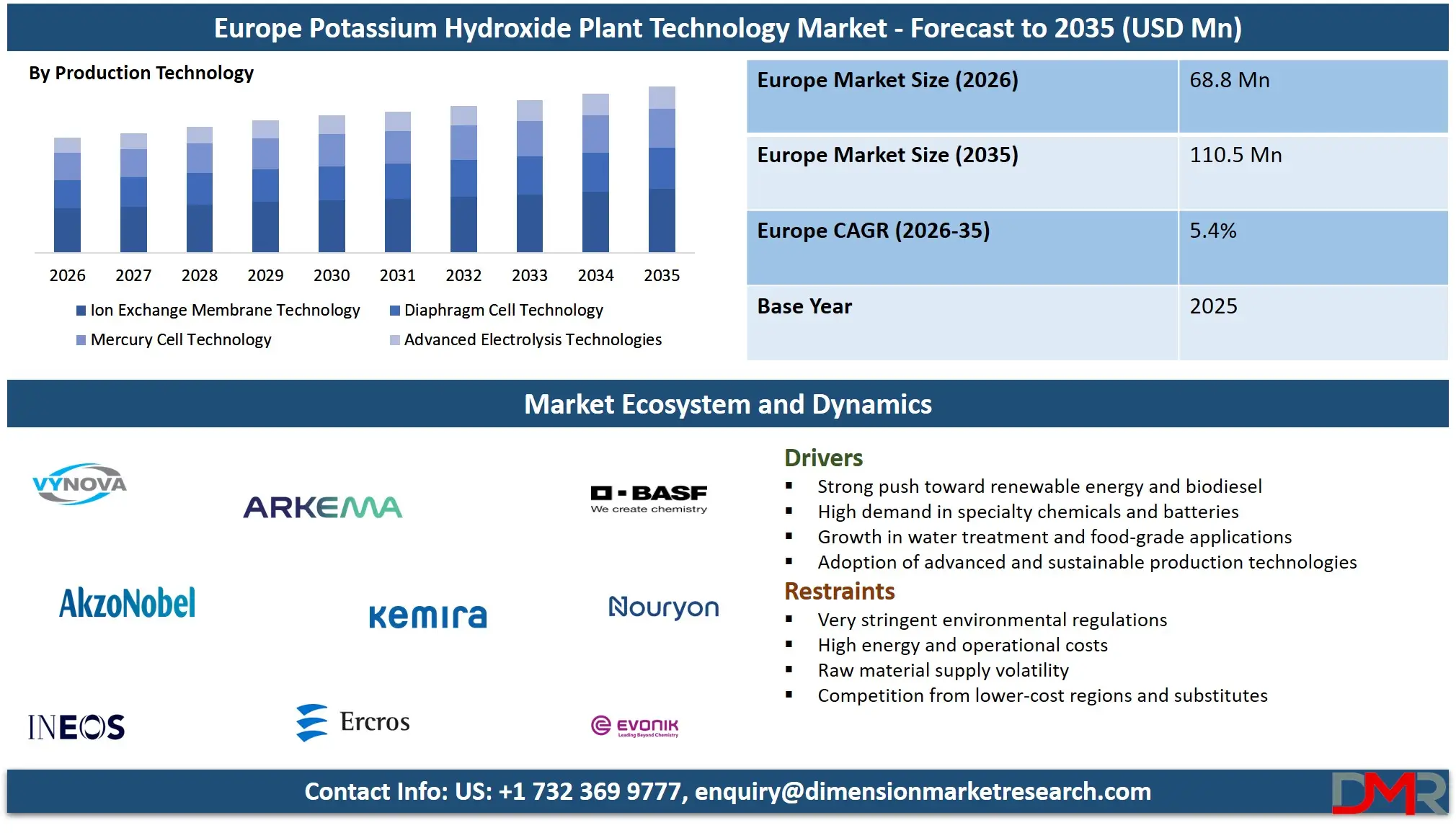
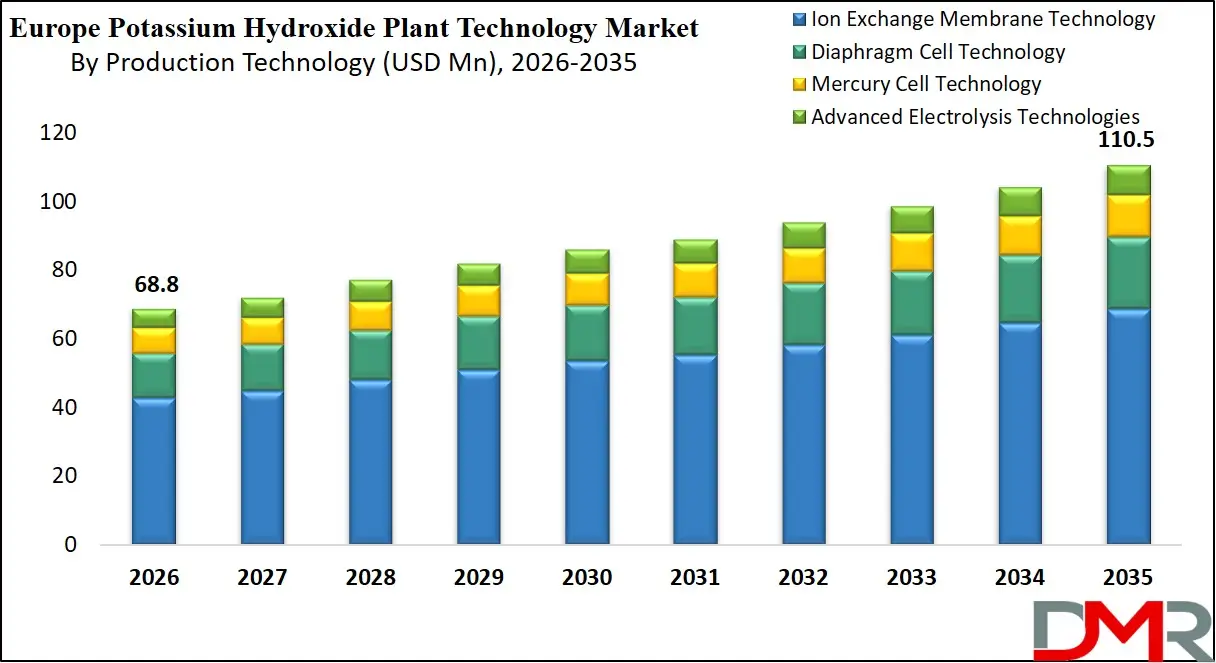
The Europe Potassium Hydroxide Plant Technology Market size is projected to reach USD 68.8 million in 2026 and grow at a compound annual growth rate of 5.4% to reach a value of USD 110.5 million in 2035.
ℹ
To learn more about this report –
Download Your Free Sample Report Here
Potassium hydroxide plant technology refers to the industrial processes, equipment, and systems used to produce potassium hydroxide through electrolysis of potassium chloride solutions. It includes membrane cell systems, diaphragm cells, mercury-based methods, and advanced electrolysis technologies designed for higher efficiency, reduced environmental impact, and improved product purity.
These technologies encompass automation systems, energy optimization tools, and plant integration solutions, making them vital for chemical manufacturing, battery production, and specialty applications. The sector plays a significant role in enabling sustainable chemical processing and supporting downstream industries with reliable and high-quality alkali supply.
ℹ
To learn more about this report –
Download Your Free Sample Report Here
Europe Potassium Hydroxide Plant Technology Market: Key Takeaways & Influencing Factors
- Market Growth: The Europe Potassium Hydroxide Plant Technology Market size is expected to grow by USD 38.3 million, at a CAGR of 5.4%, during the forecasted period of 2027 to 2035.
- By Production Technology: The ion exchange membrane technology segment is anticipated to get the majority share of the Europe Potassium Hydroxide Plant Technology market in 2026.
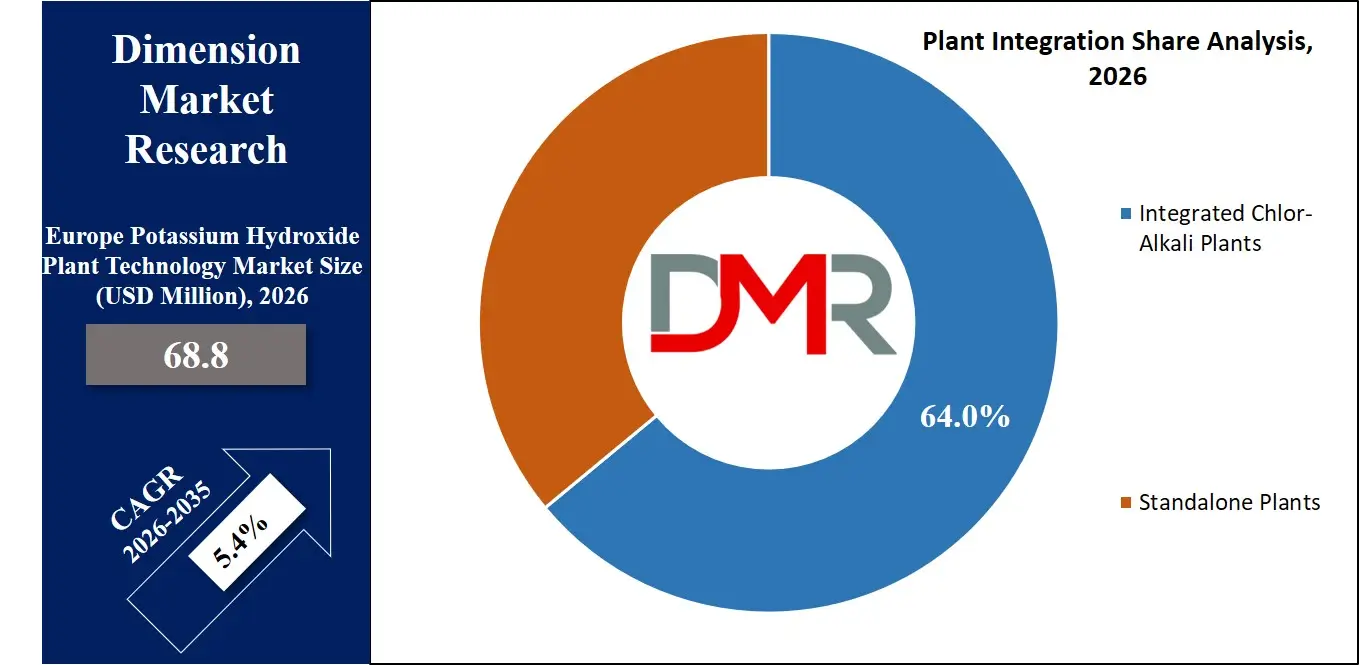
- By Plant Integration: The integrated chlor-alkali plants segment is expected to get the largest revenue share in 2026 in the Europe Potassium Hydroxide Plant Technology market.
- Use Cases: Some of the use cases of Potassium Hydroxide Plant Technology include agricultural sector applications, battery & energy storage systems, and more.
- European Commission reported in 2025 that over 70% of new chlor-alkali capacity additions in Europe are based on membrane cell technology due to environmental compliance requirements.
- International Energy Agency stated in 2024 that electrification of chemical processes could reduce industrial emissions in Europe by up to 30% by 2030, supporting electrolysis-based KOH production.
- Eurostat indicated in 2025 that specialty chemical production in Europe grew by approximately 4.2% year-on-year, increasing demand for alkali-based inputs like potassium hydroxide.
- European Environment Agency highlighted in 2024 that mercury-based industrial processes have declined by over 95% in the EU due to strict environmental regulations.
- German Federal Ministry for Economic Affairs noted in 2026 that industrial energy efficiency investments increased by 18%, boosting adoption of advanced electrolysis technologies.
Europe Potassium Hydroxide Plant Technology Market: Use Cases
- Industrial Chemical Manufacturing: Potassium hydroxide plants support production of soaps, detergents, and specialty chemicals, ensuring consistent supply through advanced electrolysis systems that enhance efficiency and reduce operational costs.
- Battery and Energy Storage Applications: High-purity KOH is essential in alkaline batteries and emerging energy storage technologies, with modern plants enabling ultra-pure output required for performance-critical applications.
- Agriculture Sector Applications: KOH is used in fertilizers and pH regulation solutions, with plant technologies ensuring scalable production to meet growing agricultural demand across Europe.
- Food and Pharmaceutical Processing: Specialized plant setups produce food-grade and pharma-grade KOH, supporting applications like food stabilization, drug synthesis, and processing aids with strict quality standards.
Market Dynamic
Driving Factors in the Europe Potassium Hydroxide Plant Technology Market
Shift Toward Sustainable and Energy-Efficient Technologies
The transition to environmentally sustainable production processes is a major driver in the market. European regulations targeting emissions reduction and energy efficiency are pushing manufacturers to adopt membrane-based and advanced electrolysis systems. These technologies consume less power, eliminate hazardous materials like mercury, and align with circular economy goals, making them increasingly attractive for both new installations and retrofits.
Rising Demand from Energy Storage and Electronics Industries
Growing adoption of alkaline batteries and expanding semiconductor manufacturing are significantly driving demand for high-purity potassium hydroxide. Advanced plant technologies are required to meet stringent purity standards, encouraging investments in modern electrolysis systems. This demand is further fueled by Europe's push for energy independence and local battery manufacturing capabilities.
Restraints in the Europe Potassium Hydroxide Plant Technology Market
High Capital Investment and Retrofit Costs
Establishing or upgrading potassium hydroxide plants with advanced technologies requires significant capital expenditure. Membrane systems, automation infrastructure, and energy optimization tools involve high upfront costs, making it challenging for small and medium-scale operators to transition from traditional methods, thereby slowing overall market adoption.
Regulatory Complexity and Compliance Challenges
Strict environmental and safety regulations in Europe, while beneficial for sustainability, create compliance challenges for manufacturers. Meeting emission standards, waste disposal norms, and operational guidelines requires continuous investment and monitoring, which can increase operational complexity and limit rapid expansion of new facilities.
Opportunities in the Europe Potassium Hydroxide Plant Technology Market
Expansion of Green Hydrogen and Electrochemical Ecosystems
The growth of green hydrogen infrastructure presents opportunities for integrating potassium hydroxide production with electrochemical processes. Shared technology platforms and renewable energy integration can reduce operational costs and enhance efficiency, creating new growth avenues for plant technology providers.
Increasing Demand for High-Purity Specialty Chemicals
Rising demand for electronic-grade and pharmaceutical-grade chemicals opens new opportunities for advanced plant technologies. Manufacturers investing in ultra-pure production systems can capture premium market segments, especially in semiconductors and healthcare industries, where quality and consistency are critical.
Trends in the Europe Potassium Hydroxide Plant Technology Market
Adoption of Zero-Gap and ODC Electrolysis Technologies
Emerging electrolysis innovations such as zero-gap systems and oxygen depolarized cathodes are gaining traction due to their ability to significantly reduce energy consumption. These technologies are becoming key differentiators for companies aiming to improve operational efficiency and meet sustainability targets.
Integration of Digitalization and Smart Plant Systems
Digital transformation is influencing the market through the adoption of IoT-enabled monitoring, predictive maintenance, and AI-driven optimization. Smart plant technologies improve operational reliability, reduce downtime, and enhance production efficiency, supporting long-term cost savings and competitiveness.
Impact of Artificial Intelligence in Europe Potassium Hydroxide Plant Technology Market
Artificial intelligence is transforming plant operations by enabling predictive maintenance, real-time monitoring, and process optimization. AI-driven analytics help reduce energy consumption and improve electrolysis efficiency by identifying performance gaps. It enhances quality control for high-purity KOH production and minimizes downtime through automated fault detection. AI also supports supply chain optimization and demand forecasting, improving overall operational efficiency and cost management across production facilities.
Impact of Iran War on Europe Potassium Hydroxide Plant Technology Market
The Iran war has influenced the market by disrupting global energy supply chains and increasing electricity costs, which directly impact electrolysis-based production. ارتفاع energy prices have pushed manufacturers to adopt energy-efficient technologies. Additionally, supply chain uncertainties for raw materials and equipment have led to delays in plant expansion projects, while also encouraging regional self-sufficiency in chemical production.
Research Scope and Analysis
By Production Technology Analysis
Ion exchange membrane technology is expected to dominate the market with an estimated 62% share in 2026, driven by its superior energy efficiency, lower environmental impact, and compliance with European regulations. Within this segment, cation exchange membranes lead due to proven reliability, while hybrid systems are gaining traction. Advanced electrolysis technologies represent the fastest-growing segment, supported by innovations like zero-gap electrolysis and ODC, which significantly reduce power consumption. Meanwhile, diaphragm technology is gradually declining, and mercury-based systems are nearly phased out due to strict environmental bans, reinforcing the shift toward cleaner production methods.
By Plant Capacity Analysis
Large-scale plants (>200 TPD) are projected to hold around 55% market share in 2026, as major chemical manufacturers prefer economies of scale and integrated production capabilities. These facilities benefit from optimized energy consumption and higher output efficiency. Medium-scale plants are witnessing steady growth due to flexibility and moderate investment requirements. Small-scale plants, while limited in share, are emerging in niche and specialty chemical applications where localized production and customized outputs are needed, particularly in high-purity and pharmaceutical-grade KOH segments.
By Product Grade Analysis
Industrial grade potassium hydroxide is expected to dominate with a 58% share in 2026, owing to its widespread use in bulk chemical manufacturing and agriculture. However, high purity/electronic grade is the fastest-growing segment due to rising demand in semiconductor and battery industries. Food and pharmaceutical grade KOH is also expanding steadily, driven by strict regulatory requirements and increasing demand for high-quality inputs in processing and drug manufacturing, pushing advancements in purification and quality control technologies.
By Plant Integration Analysis
ℹ
To learn more about this report –
Download Your Free Sample Report Here
Integrated chlor-alkali plants are anticipated to lead with a 64% share in 2026, as they offer cost efficiencies through shared infrastructure, raw materials, and energy systems. These integrated setups enable better resource utilization and reduce operational costs. Standalone plants are growing in niche applications and smaller markets where integration is not feasible. However, integration remains a key strategic focus due to its ability to enhance overall plant efficiency and sustainability.
By End-Use Industry Analysis
The chemicals sector is expected to dominate with a 46% share in 2026, driven by extensive use of potassium hydroxide in manufacturing various chemical compounds. The energy & batteries segment is the fastest-growing due to increasing demand for alkaline batteries and energy storage systems. Agriculture remains a stable contributor, while food & pharmaceuticals and electronics & semiconductors are expanding steadily, supported by the need for high-purity KOH and stringent quality requirements.
The Europe Potassium Hydroxide Plant Technology Market Report is segmented on the basis of the following:
By Production Technology
- Ion Exchange Membrane Technology
- Cation Exchange Membrane (CEM)
- Anion Exchange Membrane (AEM)
- Hybrid Membrane Systems
- Diaphragm Cell Technology
- Asbestos Diaphragm
- Non-Asbestos Diaphragm
- Mercury Cell Technology
- Advanced Electrolysis Technologies
- Zero-gap Electrolysis
- Oxygen Depolarized Cathode (ODC)
By Plant Capacity
- Small Scale (<50 TPD)
- Medium Scale (50–200 TPD)
- Large Scale (>200 TPD)
By Product Grade
- Industrial Grade
- High Purity / Electronic Grade
- Food & Pharmaceutical Grade
By Plant Integration
- Standalone Plants
- Integrated Chlor-Alkali Plants
By End-Use Industry
- Chemicals
- Agriculture
- Energy & Batteries
- Food & Pharmaceuticals
- Electronics & Semiconductors
Country Analysis
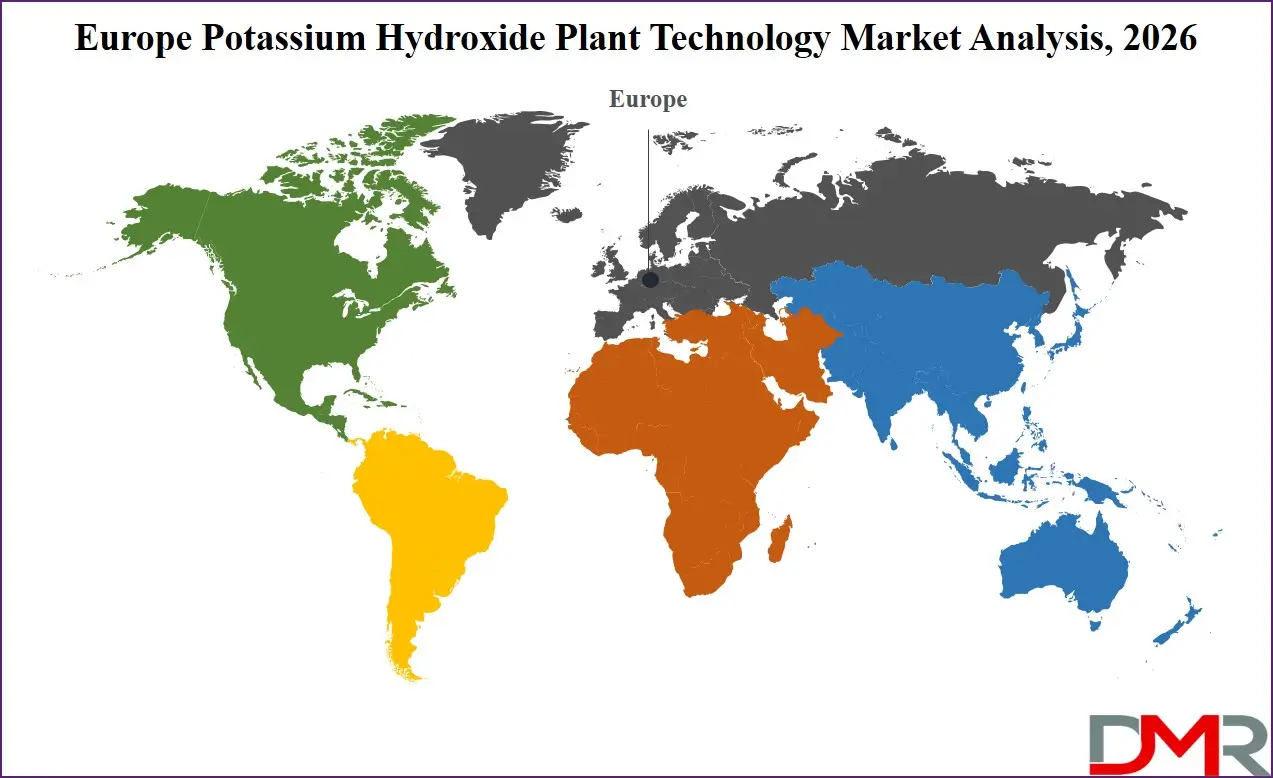
Europe's Potassium Hydroxide plant technology market is driven by strong chemical manufacturing bases in Germany, France, and Netherlands. Growth is supported by demand from agrochemicals, pharmaceuticals, and energy sectors. Advanced membrane cell technology adoption and strict environmental regulations promote efficiency, while high energy costs and regulatory compliance challenges slightly restrain market expansion.
ℹ
To learn more about this report –
Download Your Free Sample Report Here
By Country
- Germany
- The U.K.
- France
- Italy
- Russia
- Spain
- Benelux
- Nordic
- Rest of Europe
Competitive Landscape
The Europe Potassium Hydroxide Plant Technology Market is characterized by strong technological competition, with players focusing on innovation, energy efficiency, and compliance with environmental regulations. High entry barriers exist due to capital-intensive infrastructure and strict regulatory requirements. Companies are investing in R&D to develop advanced electrolysis technologies and forming strategic partnerships to expand capabilities. Integration strategies, digital transformation, and sustainability-focused solutions are key approaches adopted to strengthen market position and maintain competitive advantage.
Some of the prominent players in the Europe Potassium Hydroxide Plant Technology are:
- INEOS Group
- BASF SE
- Solvay S.A.
- Evonik Industries
- Nouryon
- Vynova Group
- Ercros S.A.
- Kemira Oyj
- Arkema Group
- Akzo Nobel N.V.
- Lanxess AG
- Covestro AG
- Wacker Chemie AG
- PCC Rokita SA
- Grupa Azoty S.A.
- Tessenderlo Group
- Altair Chimica S.p.A.
- Spolchemie
- BorsodChem
- Nobian
- Other Key Players
Report Details
| Report Characteristics |
| Market Size (2026) |
USD 68.8 Mn |
| Forecast Value (2035) |
USD 110.5 Mn |
| CAGR (2026–2035) |
5.4% |
| Historical Data |
2021 – 2025 |
| Forecast Data |
2027 – 2035 |
| Base Year |
2025 |
| Estimate Year |
2026 |
| Report Coverage |
Market Revenue Estimation, Market Dynamics, Competitive Landscape, Growth Factors and etc. |
| Segments Covered |
By Production Technology (Ion Exchange Membrane Technology, Diaphragm Cell Technology, Mercury Cell Technology, Advanced Electrolysis Technologies), By Plant Capacity (Small Scale (<50 TPD), Medium Scale (50–200 TPD), Large Scale (>200 TPD)), By Product Grade (Industrial Grade, High Purity / Electronic Grade, Food & Pharmaceutical Grade), By Plant Integration (Standalone Plants, Integrated Chlor-Alkali Plants), By End-Use Industry (Chemicals, Agriculture, Energy & Batteries, Food & Pharmaceuticals, Electronics & Semiconductors) |
| Regional Coverage |
Europe – Germany, The UK, France, Russia, Spain, Italy, Benelux, Nordic, & Rest of Europe |
| Prominent Players |
INEOS Group, BASF SE, Solvay S.A., Evonik Industries, Nouryon, Vynova Group, Ercros S.A., Kemira Oyj, Arkema Group, Akzo Nobel N.V., Lanxess AG, Covestro AG, Wacker Chemie AG, PCC Rokita SA, Grupa Azoty S.A., Tessenderlo Group, Altair Chimica S.p.A., Spolchemie, BorsodChem, Nobian, and Other Key Players |
| Purchase Options |
We have three licenses to opt for: Single User License (Limited to 1 user), Multi-User License (Up to 5 Users) and Corporate Use License (Unlimited User) along with free report customization equivalent to 0 analyst working days, 3 analysts working days and 5 analysts working days respectively. |
Frequently Asked Questions
How big is the Europe Potassium Hydroxide Plant Technology Market?
▾ The Europe Potassium Hydroxide Plant Technology Market size is expected to reach USD 68.8 million by 2026 and is projected to reach USD 110.5 million by the end of 2035.
Who are the key players in the Europe Potassium Hydroxide Plant Technology Market?
▾ Some of the major key players in the Europe Potassium Hydroxide Plant Technology Market include BASF, INEOS, Solvay, and others.
What is the growth rate in the Europe Potassium Hydroxide Plant Technology Market?
▾ The market is growing at a CAGR of 5.4 percent over the forecasted period.