Market Overview
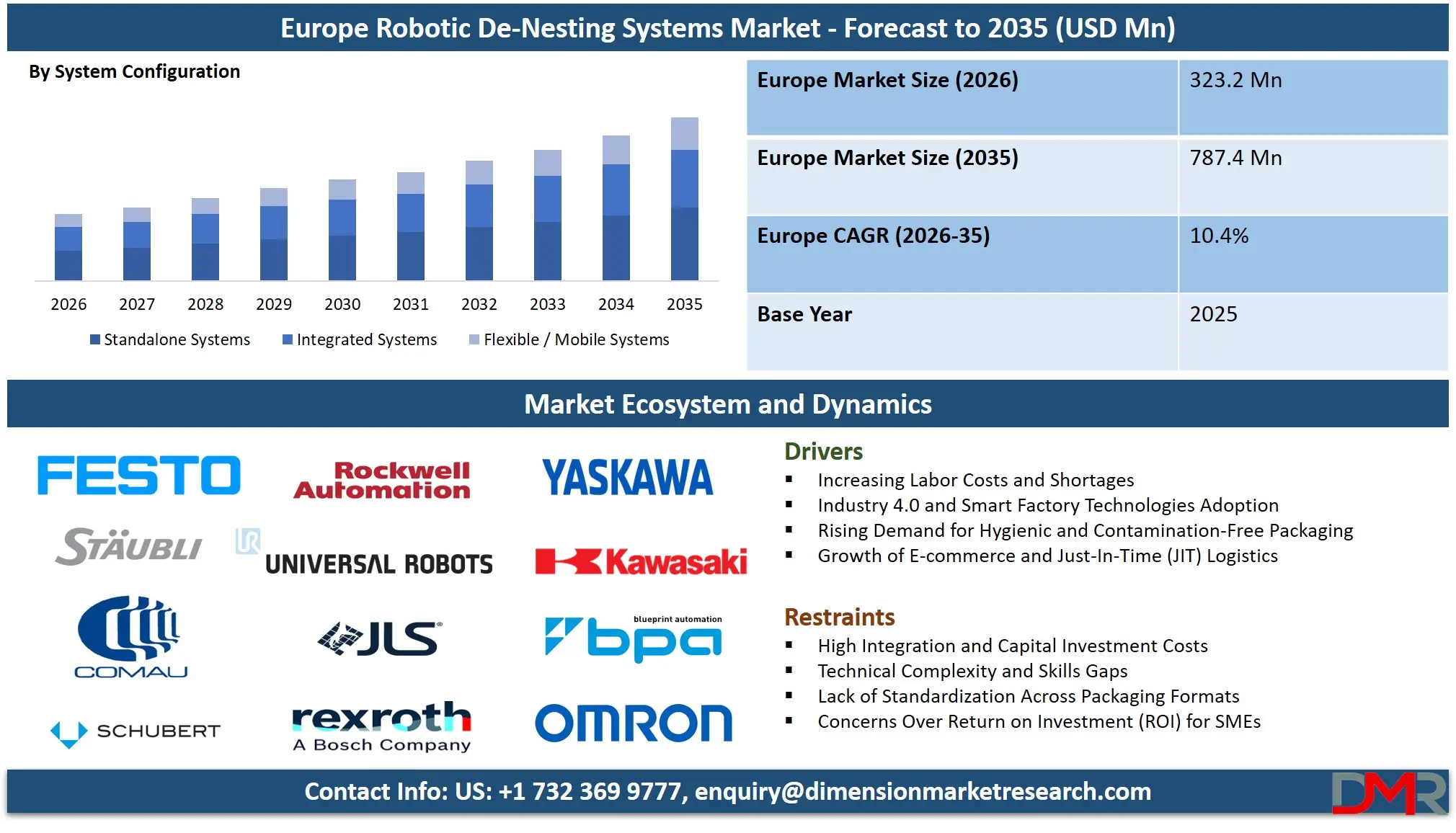
The Europe Robotic De-Nesting Systems Market size is projected to attain a value of USD 323.2 billion in 2026, witnessing growth at a CAGR of 10.4% to reach a value of USD 787.4 billion in 2035.
ℹ
To learn more about this report –
Download Your Free Sample Report Here
A robotic de-nesting is an automated system that is created to isolate and withdraw items, trays, or parts from molds, nests, or stacking layouts, whereas semi-automatic systems need some human involvement to work with. The market of Europe Robotic De-Nesting Systems is increasing with the increased adoption of flexible manufacturing, Industry 4.0 technologies, and automated material handling in countries such as Germany, France, and the United Kingdom.
Growth is also supported by increased pressure of packaging at high speed, shortage of labor force, and integration of robots into the European industries. Also, together with the strict regulations concerning hygiene, safety, and efficiency in the functioning of industries like food and beverage and pharmaceutical, the further adoption of more sophisticated robotic de-nesting systems is gaining momentum in Europe.
ℹ
To learn more about this report –
Download Your Free Sample Report Here
Europe Robotic De-Nesting Systems Market: Key Takeaways and Other Influencing Factors
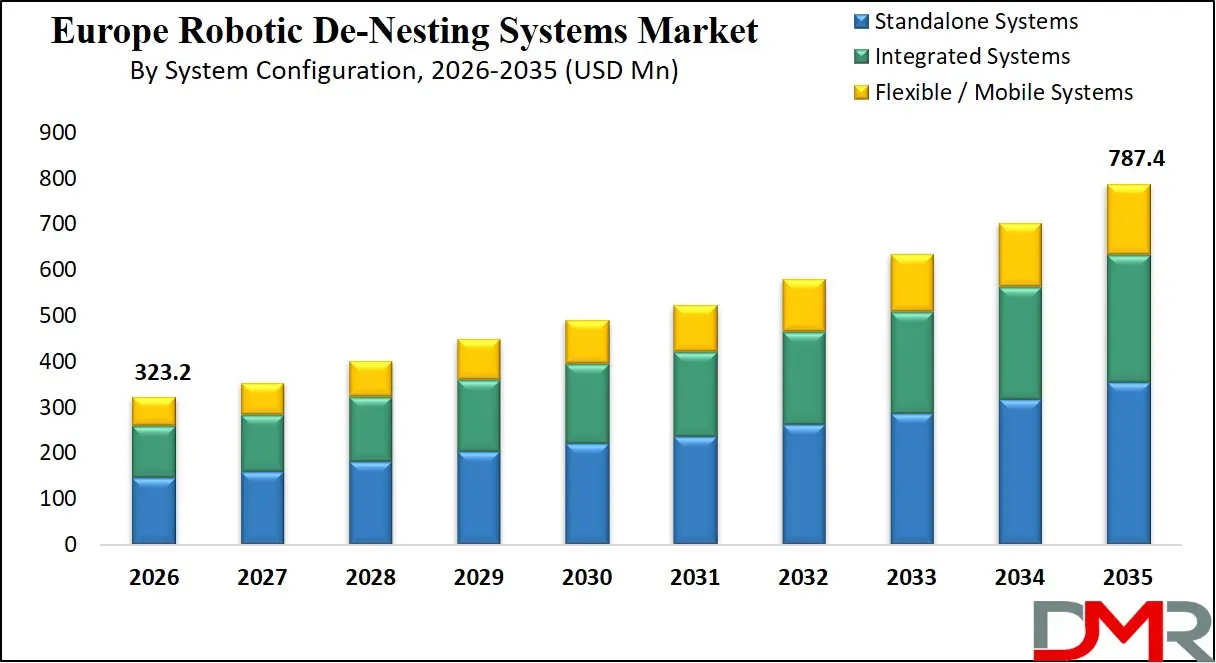
- Strong Market Growth Projections: Although the market is still in its maturity stage, the Europe Robotic De-Nesting Systems Market is estimated to increase by USD 323.2 million in 2026 and USD 787.4 million by 2035 with a healthy CAGR of 10.4% and growing usage of industrial robots and smart manufacturing tools.
- Dominance of Automatic Systems and Manufacturing Sector: Automatic robotic de-nesting systems dominate with 54.8% share, with manufacturing end-users taking approximately 65.0% share, showing a great preference for fully automated processes and mature industrial infrastructure in Europe.
- Food & Beverage Segment Leading Application: With 60.1% share, food and beverage is the leading application because of the rising demand of hygienic, high-speed de-nesting of trays, lids, and containers in packaging lines in the European production plants.
- Move to Integrated and Flexible Systems: Increasing use of integrated de-nesting systems (with production lines) and flexible/mobile robotic units is changing material handling, shortening changeover time, and enhancing the efficiency of operations in Europe.
- Large Labor Cost Load: Labor expenses constitute more than 42.5% of total operating costs in European manufacturing, and the average annual cost of labor in automated jobs per worker is approximately USD 11.5 thousand, which makes robotic de-nesting solutions a major demand.
- High Industrialisation in Europe: In European manufacturing and logistics, approximately 62 million people are working, and this provides a high demand for robotic de-nesting to eliminate repetitive stress and enhance throughput, as suggested by OECD.
- High Automation Opportunity: According to industry associations, automated de-nesting adoption is 32.4% of all packaging line investments in the EU, and system integration rates are over 2,100 units per 100,000 manufacturing facilities.
Impact of the Iran conflict on the Europe Robotic De-Nesting Systems Market
The Iran war is leading to disruption of the supply chain in the European market and increased cost and time in transporting and delivering some of the robots' de-nesting systems parts (e.g. controllers, sensors, servo motors). The cost of production of industrial robots, therefore, is on the rise due to the Iran conflict, coupled with the rise in energy prices and raw materials (steel, aluminum, semiconductors), which are contributing to the cost of production. Short-term impacts on the market through diversified sourcing, however, long-term market fluctuation can cause pricing and stagnation in the market.
Europe Robotic De-Nesting Systems Market: Use Cases
- Robotic De-Nesting of Stacked Trays, Lids, and Containers in Food Packaging: Robotic systems provide automated separation of stacked trays, lids, and containers to be filled on high-speed lines, which reduces manual labor and integrates production data in real-time to achieve better operational efficiency.
- High-Speed Component Separation in Electronics Manufacturing: These systems help remove delicate electronic components from injection-molded nests or trays through precision end-effectors, improving throughput and reducing damage rates in surface-mount technology lines.
- Pharmaceutical Blister Pack De-Nesting: Pharmaceutical blister packs are separated after molding using robot de-nesting to facilitate the preservation of sterility, batch integrity, and improved compliance with GMPs.
- Warehouse and Logistics Automation: Flexible de-nesting systems are becoming more popular, allowing the automatic solution to orders, depalletizing mixed cases, and just-in-time component kitting, in order to enhance the accuracy of inventory and reduce the number of injuries at work.
Europe Robotic De-Nesting Systems Market: Market Dynamics
Driving Factors in the Europe Robotic De-Nesting Systems Market
Increasing Labor Costs and Shortages
The rising wage rates and the long-lasting lack of proficient industrial employees are fueling the demand for automated de-nesting, robotic material handling, and flexible manufacturing solutions in Europe. This has been aided by the enhanced focus on the safety and ergonomics of workers as well.
Industry 4.0 and Smart Factory Technologies Adoption
Increases in industrial IoT and digital manufacturing are increasing the pace at which connected robotic de-nesting systems are being used to provide real-time production tracking to enhance uptime and operational efficiency. The uptake is also being enhanced by increased adoption of cloud-based robot management and predictive maintenance.
Restraints in the Europe Robotic De-Nesting Systems Market
High Integration and Capital Investment Costs
High-end robotic de-nesting equipment is quite expensive in terms of both hardware and software integration as well as end-of-arm tooling, making it not affordable to many small and medium-sized businesses. In traditional industries, budget constraints also limit large scale implementation.
Technical Complexity and Skills Gaps
Both stringent safety protocols and the fact that de-nesting robots require specialized programming skills introduce complexities in their implementation, which will influence their compatibility with existing production lines. There are compliance demands like the CE marking and ISO standards, which contribute to the operation burden among manufacturers.
Opportunities in the Europe Robotic De-Nesting Systems Market
Increased Flexible and Collaborative Robotics
The increased emphasis on high-mix, low-volume manufacture is opening up possibilities of mobile and collaborative de-nesting systems, which allows quick reconfigurability and human-robot cooperation. This tendency favors decentralized production and minimizes changeover time.
Integration with AI and Vision-Guided Systems
The use of AI-based object recognition and predictive gripper control is improving the de-nesting of irregularly shaped or randomly stacked objects, which allows smarter sorting and picker adaption. The 3D vision is a continuous area of innovation that widens the scope of applications.
Trends in the Europe Robotic De-Nesting Systems Market
Shift toward Flexible / Mobile Robotic Systems
Autonomous mobile robots (AMRs) and flexible de-nesting units are gaining popularity compared to fixed standalone systems because of superior layout flexibility, the ability to use multiple lines, and reduced costs of installation. This is driving faster innovation of products on end-effector design and fleet management software.
Rising Use of Cloud-related Robotics Platforms
Cloud-based robot orchestration systems are being implemented by manufacturing and logistics providers to monitor their operations remotely, optimize their fleets, and simplify their workflow in de-nesting activities. Integration with warehouse management systems (WfMS) and MES is improving access to data and coordination of production.
Europe Robotic De-Nesting Systems Market: Research Scope and Analysis
By Product Type Analysis
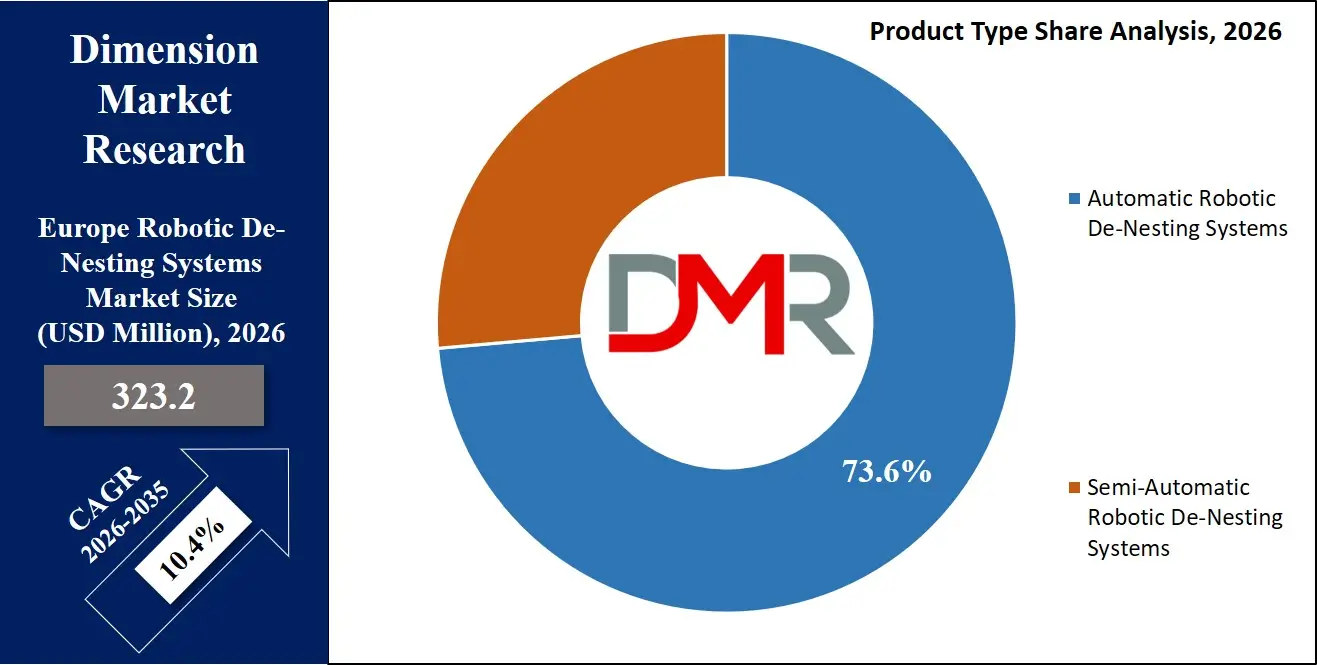
The Europe Robotic De-Nesting Systems Market is projected to have approximately 54.8% share of the total market in 2026, based on the fact that automatic robotic de-nesting systems are set to dominate the market due to their high throughput rate, 24/7 operations, and increased application in high-speed packaging lines and assembly automation.
ℹ
To learn more about this report –
Download Your Free Sample Report Here
Their capability to offer reliable separation force and reduce labor dependence is increasing adoption. Semi-automatic ones, however, are still popular in the production of small batches and the activities that involve human intervention every now and then. Their demand is supported by lower initial cost and reprogrammability, but the lack of speed is slowly swinging the desire towards fully automatic systems.
By System Configuration Analysis
The Europe Robotic De-Nesting Systems Market is projected to be dominated by standalone systems with approximately 45.1% percent share in 2026 due to the simplicity of its deployment and compatibility with the existing production lines. They are popular in dedicated de-nesting applications in food, pharma, and electronics. The use of integrated systems is increasing at a high rate as more people are embracing inline automation and end-to-end production lines, which have provided them with increased efficiency and less material handling. The main trend is the emergence of flexible/mobile systems, which are facilitated by the growing demand of multi-purpose cells and reconfigurable factory floors.
By Application Analysis
It is anticipated that the Europe Robotic De-Nesting Systems Market will be dominated by food and beverage with an approximate market share of 60.1% in 2026 owing to the high demand of hygienic and high-speed separation of trays, containers, and lids in packaging and processing lines. These systems are common in primary and secondary packaging processes. The pharmaceutical segment is expanding due to increased usage of aseptic de-nesting of blister packs and syringe nests, and compliance with regulations. The growth is further being aided by increased attention to traceability and contamination control.
By Distribution Channel Analysis
The need for customization of the system design, integration support, and long-term service agreements will make direct sales dominate the Europe Robotic De-Nesting Systems Market with approximately 55.0% share in 2026. Mission-critical automation is favored by large manufacturers through direct relationships. The distributors have a robust second position, especially standardized and lower-cost systems used by SMEs. The sales online are increasing slowly with the help of digital B2B platforms, particularly with spare parts, end-effectors, and smaller semi-automatic units.
By End-User Analysis
In 2026, the Europe Robotic De-Nesting Systems Market is projected to be dominated by manufacturing with approximately 65.0% percent share, as the manufacturing sector is expected to be characterized by high volumes of production, well-developed infrastructure of automation, and the intensive usage of de-nesting in the assembly and packaging lines. Such environments are based on automatic and semi-automatic systems that maintain a steady material flow and quality. Accessibility of integration engineers and positive ROI models are other factors that contribute to their dominance. The increase in demand for e-commerce fulfillment and automated depalletizing is causing growth in logistics and warehousing. Their use is on the rise as more people are adopting mobile robotics and their order cycle time has shortened, particularly in mixed-case handling.
The Europe Robotic De-Nesting Systems Market Report is segmented on the basis of the following:
By Product Type
- Automatic Robotic De-Nesting Systems
- Semi-Automatic Robotic De-Nesting Systems
By System Configuration
- Standalone Systems
- Integrated Systems
- Flexible / Mobile Systems
By Application
- Food and Beverage
- Pharmaceuticals
- Packaging
- Automotive
- Electronics
- Others
By Distribution Channel
- Direct Sales
- Distributors
- Online Sales
- Others
By End-User
- Manufacturing
- Logistics
- Warehousing
- Others
Impact of Artificial Intelligence on the Europe Robotic De-Nesting Systems Market
The Europe Robotic De-Nesting Systems Market is changing as a result of artificial intelligence that allows for quicker and more precise recognition of items that are nested, random orientations, and mixed SKUs due to the further development of vision-based object recognition. Through the algorithms, which are AI-based, the precision of picking is enhanced by detecting the optimal grip points and separation sequence that are frequently missed in rule-based programming.
Flexible robotic systems are integrated to enable real-time adaptive de-nesting and automated path correction of product geometries of different sizes. AI-assisted predictive maintenance is improving system availability and minimizing unexpected downtime in smart factory implementations, and workflow functionality by lessening manual teach-in time and accelerating changeovers.
By Region
Europe
- Germany
- The U.K.
- France
- Italy
- Russia
- Spain
- Benelux
- Nordic
- Rest of Europe
Europe Robotic De-Nesting Systems Market: Competitive Landscape
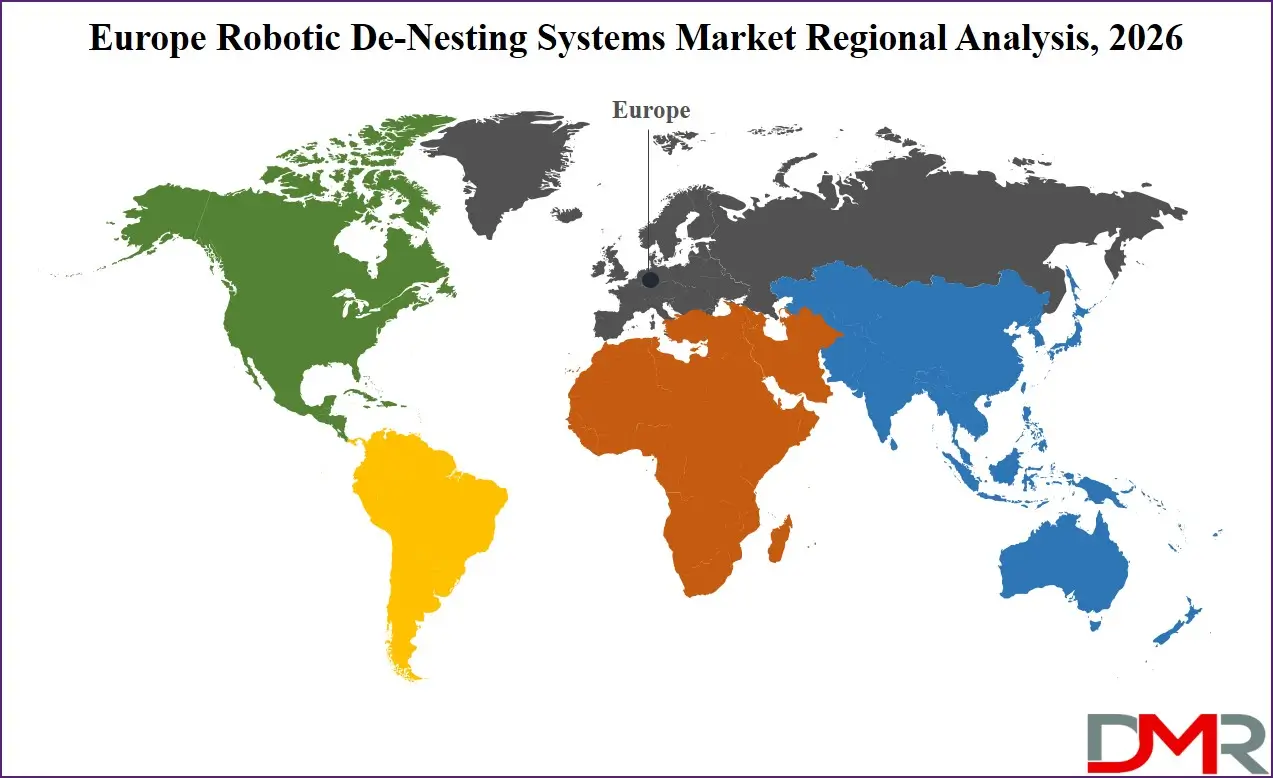
Europe Robotic De-Nesting Systems Market is a very competitive one, as its development is based on the constant innovations of end-of-arm tooling, vision guidance and flexible automation technologies.
ℹ
To learn more about this report –
Download Your Free Sample Report Here
Advanced robotic grippers, AI vision, and collaborative abilities are also areas that companies are emphasizing on to reinforce their position. The competition is increasing due to strategic alliances, product innovation and diversification across the manufacturing lines and facilitating the market growth.
Some of the prominent players in the Europe Robotic De-Nesting Systems Market are:
- ABB Ltd.
- KUKA AG
- FANUC Corporation
- Universal Robots A/S
- Yaskawa Electric Corporation
- Stäubli International AG
- Schneider Electric SE
- Rockwell Automation, Inc.
- Bosch Rexroth AG
- Omron Corporation
- Festo AG & Co. KG
- Kawasaki Heavy Industries, Ltd.
- Schubert Group
- Marel hf.
- Comau S.p.A.
- JLS Automation
- FlexLink (Coesia Group)
- BluePrint Automation (BPA)
- Brillopak Ltd.
- IMA Group
- Other Key Players
Recent Developments in the Europe Robotic De-Nesting Systems Market
- June 2025: ABB Ltd. launched the Flexley Mover P603 autonomous mobile robot, featuring AI-driven navigation and no-code programming to improve intralogistics and automated material handling efficiency.
- June 2025: KUKA AG introduced AI-assisted robot programming (iiQWorks.Copilot) and showcased its full portfolio of autonomous mobile robots (AMRs) at Automatica 2025, focusing on simplifying automation and improving industrial handling processes.
- April 2025: Stäubli International AG demonstrated high-precision robotic systems including hygienic robots and vision-guided pick-and-place solutions for medical and food applications, highlighting ease of integration and advanced material handling capabilities.
Report Details
| Report Characteristics |
| Market Size (2026) |
USD 323.2 Mn |
| Forecast Value (2035) |
USD 787.4 Mn |
| CAGR (2026–2035) |
10.4% |
| Historical Data |
2021 – 2025 |
| Forecast Data |
2027 – 2035 |
| Base Year |
2025 |
| Estimate Year |
2026 |
| Report Coverage |
Market Revenue Estimation, Market Dynamics, Competitive Landscape, Growth Factors and etc. |
| Segments Covered |
By Product Type (Automatic Robotic De-Nesting Systems, Semi-Automatic Robotic De-Nesting Systems), By System Configuration (Standalone Systems, Integrated Systems, Flexible / Mobile Systems), By Application (Food and Beverage, Pharmaceuticals, Packaging, Automotive, Electronics, Others), By Distribution Channel (Direct Sales, Distributors, Online Sales, Others), By End-User (Manufacturing, Logistics, Warehousing, Others) |
| Regional Coverage |
Europe – Germany, The UK, France, Russia, Spain, Italy, Benelux, Nordic, & Rest of Europe |
| Prominent Players |
ABB Ltd., KUKA AG, FANUC Corporation, Universal Robots A/S, Yaskawa Electric Corporation, Stäubli International AG, Schneider Electric SE, Rockwell Automation, Inc., Bosch Rexroth AG, Omron Corporation, Festo AG & Co. KG, Kawasaki Heavy Industries, Ltd., Schubert Group, Marel hf., Comau S.p.A., JLS Automation, FlexLink (Coesia Group), BluePrint Automation (BPA), Brillopak Ltd., IMA Group and Other Key Players. |
| Purchase Options |
We have three licenses to opt for: Single User License (Limited to 1 user), Multi-User License (Up to 5 Users) and Corporate Use License (Unlimited User) along with free report customization equivalent to 0 analyst working days, 3 analysts working days and 5 analysts working days respectively. |
Frequently Asked Questions
How big is the Europe Robotic De-Nesting Systems Market?
▾ The Europe Robotic De-Nesting Systems Market size is estimated to have a value of USD 323.2 billion in 2026 and is expected to reach USD 787.4 billion by the end of 2035.
Who are the key players in the Europe Robotic De-Nesting Systems Market?
▾ Some of the major key players in the Europe Robotic De-Nesting Systems Market are KUKA AG, ABB Ltd., FANUC Corporation, Yaskawa Europe GmbH, Kawasaki Robotics GmbH, Stäubli International AG, Universal Robots A/S, and many others.
What is the growth rate in the Europe Robotic De-Nesting Systems Market?
▾ The market is growing at a CAGR of 10.4% over the forecasted period.