Market Overview
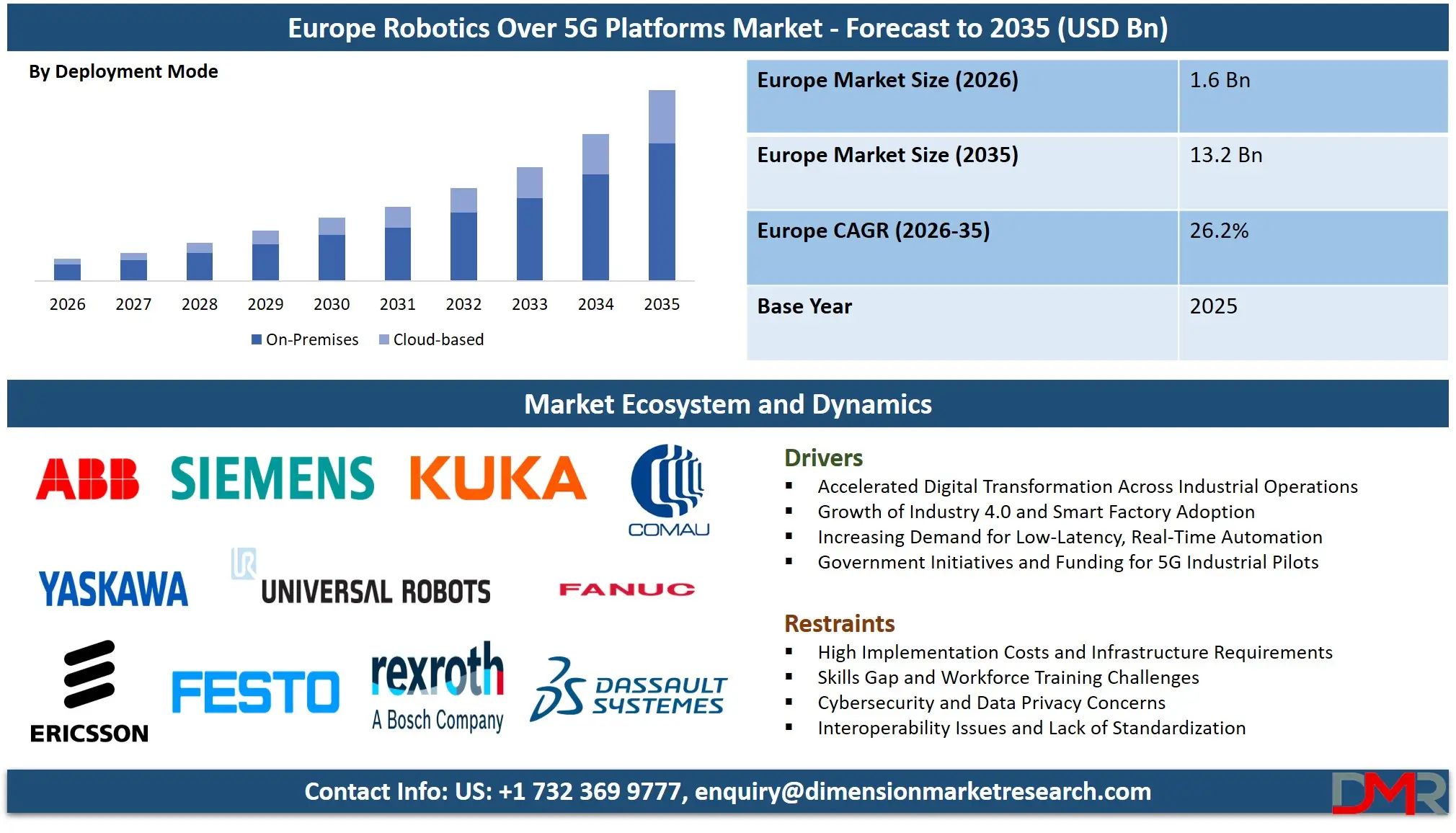
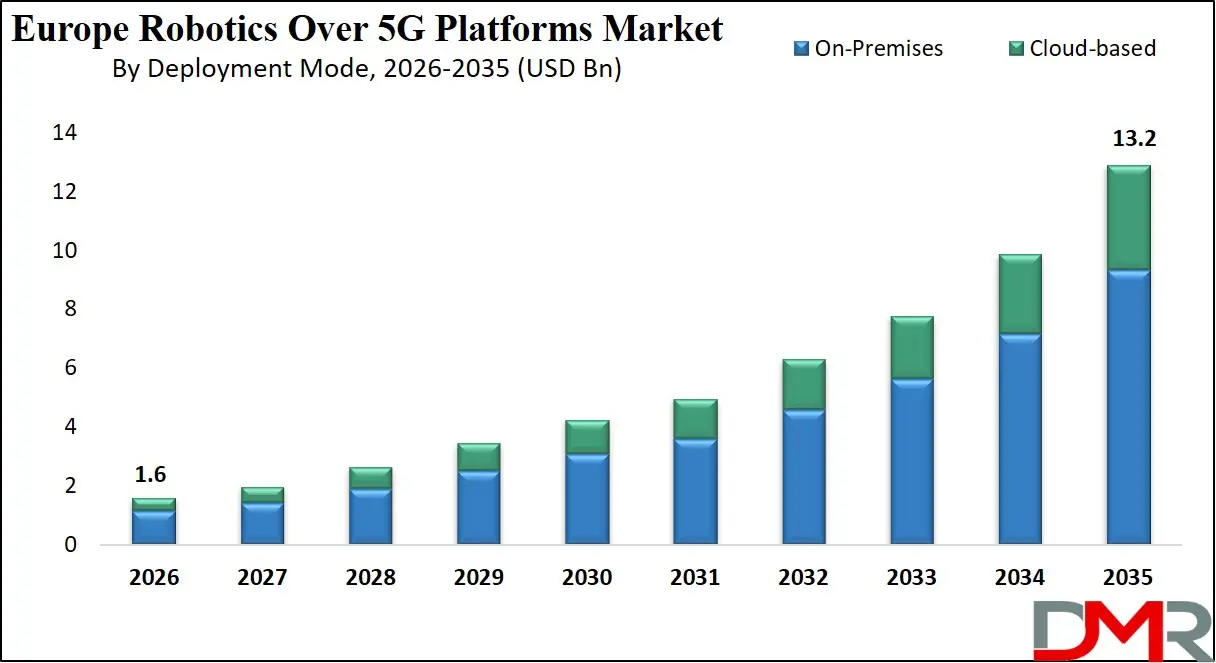
The Europe Robotics Over 5G Platforms Market size is expected to reach a value of USD 1.6 billion in 2026, and it is further anticipated to reach a market value of USD 13.2 billion by 2035 at a CAGR of 26.2%.
ℹ
To learn more about this report –
Download Your Free Sample Report Here
The robotics over 5G platforms market is an important part of the industrial automation and digital infrastructure ecosystem in Europe, driven by the region's leadership in Industry 4.0 and its ambitious connectivity targets. As a global frontrunner in both advanced manufacturing and telecommunications standards, Europe occupies a privileged position in the development and adoption of low-latency, high-reliability robotic control. The sector covers a wide range of components and systems, from hardware like 5G modules and sensors to sophisticated AI software and deployment services, which are crucial in enabling real-time automation, flexible production, and the growth of autonomous systems. The European Union's commitment to enhancing digital sovereignty and industrial competitiveness has resulted in substantial investment in 5G infrastructure, edge computing, and robotics R&D, significantly transforming the industrial automation landscape.
Over the last few years, the robotics over 5G platforms market in Europe has witnessed a strategic transition in adopting advanced technologies like edge AI, network slicing, and time-sensitive networking (TSN). These technologies are making robotic systems more effective, enabling deterministic wireless communication, facilitating easier remote operation, and further helping in the optimization of complex production processes. Also, with the rapid growth of smart factories and the need for flexible automation, the demand for high-bandwidth, low-latency connectivity has accelerated, pushing companies to scale up their 5G-integrated robotics portfolios. All these evolutions of technology and the market are likely to drive the sector's growth, signifying a good future outlook for the market.
Key trends currently evident within the robotics over 5G arena in Europe are digital transitions taking hold of factory operations by moving from fixed, wired automation to flexible, wireless ecosystems. Aside from this, further integration of AI and edge computing brings predictive analytics and real-time decisions with enhanced operational perception for better outputs of efficiency. Furthermore, with the augmenting emphasis on sustainability and reshoring in line with the European Green Deal, the adaptation of energy-efficient robotics and private 5G networks is on the rise. Similarly, the rise in collaborative and mobile robotics has changed strategies for system integration as companies try to meet the demands for human-robot collaboration and dynamic reconfiguration of production lines.
ℹ
To learn more about this report –
Download Your Free Sample Report Here
The market is consequently witnessing huge opportunities on the back of high investments by the European government in 5G corridor and infrastructure development. Initiatives such as the construction of 5G industrial campuses and cross-border testing facilities are creating a robust digital backbone to support regional industrial autonomy. Megaprojects like the development of 5G-enabled port logistics and smart manufacturing hubs illustrate the strategic importance of robotics over 5G in enabling Europe's ambitious digital and sustainability goals. The technological prowess of the region enhances its potential to become a global hub for industrial 5G innovation, offering unparalleled access to key markets across the continent. Further, the focus on smart technologies like AI, digital twins, and private 5G networks provides companies with opportunities to gain a competitive edge by improving system flexibility and reducing operational costs.
Europe Robotics Over 5G Platforms Market: Key Takeaways
- Market Value: The Europe Robotics Over 5G Platforms Market size is estimated to have a value of USD 1.6 billion in 2026 and is expected to reach USD 13.2 billion by the end of 2035.
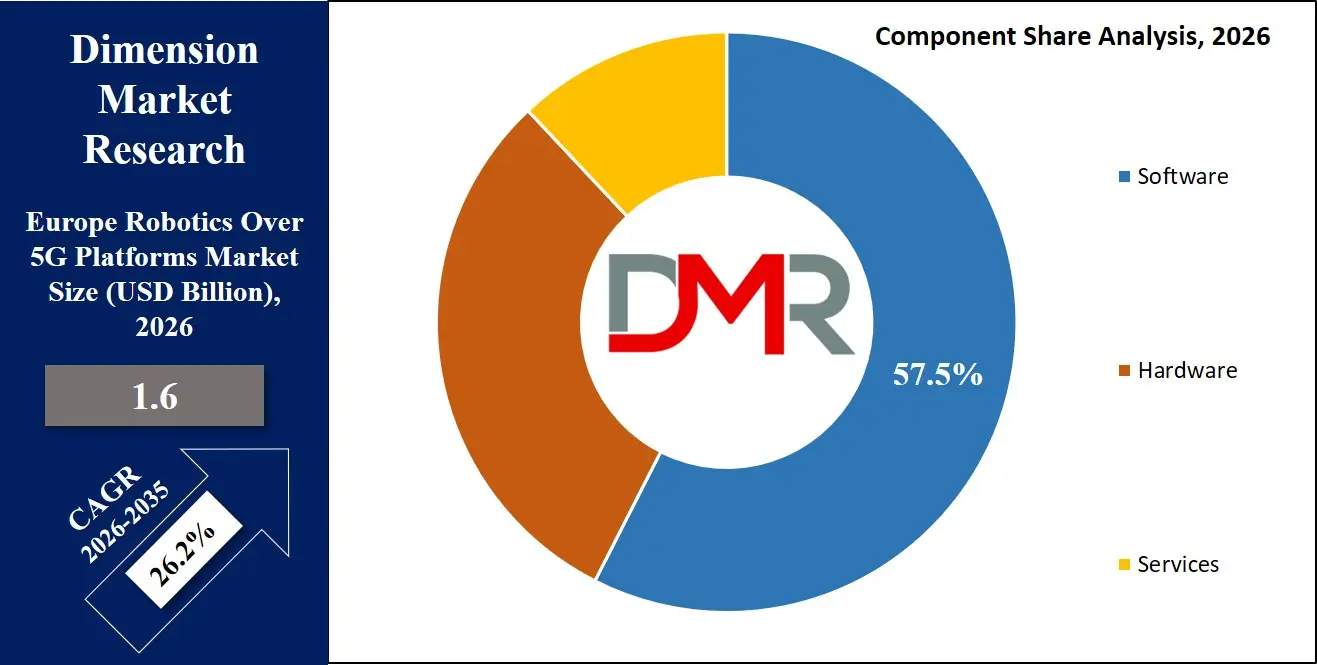
- By Component Segment Analysis: Software, including AI platforms, digital twins, and robotic control solutions, is anticipated to dominate this segment in the market, accounting for the largest share in 2026, while hardware such as 5G modules and sensors will continue to play a critical supporting role.
- By Deployment Mode Segment Analysis: Cloud-based deployment is expected to dominate the Europe Robotics Over 5G Platforms Market in 2026, driven by the scalability, flexibility, and seamless integration offered by cloud robotics combined with edge computing for real-time control and AI-enabled operations.
- By Robot Type Segment Analysis: The Autonomous Mobile Robots (AMRs) segment is anticipated to dominate the Europe robotics over 5G platforms market with a major market share in 2026.
- By End-User Industry Segment Analysis: Manufacturing and Logistics & Warehousing are projected to hold the largest shares in the Europe Robotics Over 5G Platforms Market in 2026, supported by the adoption of smart factory solutions, industrial automation, and robotics-enabled logistics optimization.
- Key Players: Some of the major key players in the Europe Robotics Over 5G Platforms Market are ABB, KUKA AG, Siemens AG, Yaskawa Electric Corporation, Fanuc Corporation, Nokia Corporation, Ericsson, and many others.
- Market Growth Rate: The market is growing at a CAGR of 26.2% over the forecasted period.
Europe Robotics Over 5G Platforms Market: Use Cases
- Cloud-Controlled Collaborative Robots in Automotive Assembly: This application leverages 5G's low latency to offload heavy computation to the cloud, allowing multiple lightweight cobots to adapt in real-time to changing assembly tasks, enhancing flexibility on the production line.
- Real-Time Control of Autonomous Mobile Robots (AMRs) in Warehousing: 5G enables centralized fleet management of AMRs in large logistics hubs, allowing for dynamic path planning, collision avoidance, and coordinated goods movement without the need for extensive on-board computing.
- Remote Operation of Industrial Robots in Hazardous Environments: In energy or mining sectors, 5G's high reliability and low latency allow operators to precisely control robotic arms for maintenance or repair tasks in dangerous or inaccessible areas from a safe remote control center.
- AI-Powered Predictive Maintenance for Manufacturing Robots: 5G-connected robots continuously stream high-fidelity sensor data to AI platforms in real-time, enabling the early prediction of component failures and optimizing maintenance schedules to minimize production downtime.
Europe Robotics Over 5G Platforms Market: Stats & Facts
European Commission (Digital Decade & Industrial Strategy)
- Around 185,000 industrial robots are expected to be connected to 5G networks at major European manufacturing sites by 2026.
- The EU recorded an average of 4.2 million hours of 5G-enabled robotic operations per month in 2024 across member states.
- The European Union aims to reduce industrial production downtime by 35% by 2030 under the Digital Decade initiative through robotics automation.
- EU 5G corridor initiatives are expected to save about €3.5 billion annually in industrial logistics costs.
- These digitalization efforts could also reduce robot programming time by approximately 45% through cloud-based platforms.
- The EU Industrial Strategy affects over 2 million manufacturing enterprises across member states.
Eurostat (European Union Statistics Office)
- European robotics shipments reached 92,000 units in 2023, with 5G-enabled models growing at 28% annually.
- More than 68% of new industrial robot installations in Europe now feature 5G connectivity options.
- Around 41% of European manufacturers consider real-time control reliability essential when selecting robotics platforms.
- Europe recorded €2.1 trillion in manufacturing value added in 2024, representing a 5.8% annual increase.
- Robotics automation accounts for approximately 23% of EU manufacturing productivity gains, despite representing only 8% of capital expenditure.
European Telecommunications Standards Institute (ETSI)
- Nearly 85% of major European industrial zones have invested in 5G private network infrastructure.
- Europe has more than 120 industrial 5G testbeds operating across member states.
- ETSI introduced enhanced ultra-reliable low-latency communication standards for industrial robotics in 2022.
- In 2021, only 35% of robotics manufacturers offered 5G-integrated control systems.
- By 2024, over 72% of major robotics vendors offered 5G-ready automation platforms.
European Robotics Association
- The European robotics industry employs over 170,000 people across the continent.
- Robotics over 5G platforms accounts for approximately 18% of total industrial automation spending in Europe.
- Healthcare robotics shipments grew by 32% annually between 2020 and 2024.
- Collaborative robot installations increased by 27% in 2023 alone.
European Environment Agency
- Industrial robotics operations contribute approximately 4% of EU manufacturing-related energy consumption.
- 5G-enabled energy optimization in robotics could reduce factory power consumption by up to 25%.
- Over 65 major European manufacturers have committed to carbon-neutral production targets by 2040.
European Industrial Automation Studies
- Cloud-based robot control platforms can reduce robotics deployment costs by 30% to 40% when widely implemented.
- Real-time monitoring and predictive maintenance solutions could reduce unplanned downtime by 35% to 45%.
- 5G-enabled collaborative robot systems can increase production flexibility by 40% to 55%.
- Around 25% of industrial robot installations in Europe involve small-batch, high-mix production, where reprogrammability is crucial.
Europe Robotics Over 5G Platforms Market: Market Dynamic
Driving Factors in the Europe Robotics Over 5G Platforms Market
Accelerated Digital Transformation Across Industrial Operations
The European robotics over 5G platforms market is undergoing rapid digital transformation, driven by strong regulatory support under the EU's Digital Decade strategy and increasing demand for operational efficiency. Manufacturers and logistics providers are actively integrating advanced technologies such as artificial intelligence, edge computing, and cloud-based control platforms to streamline robotic operations. These technologies enable real-time robot coordination, predictive maintenance scheduling, and optimized production routing across complex industrial networks. The transition toward cloud-based robot control and digital twin simulation is further improving operational accuracy and reducing programming complexity, allowing companies to enhance production flexibility and decision-making in time-sensitive manufacturing environments.
Growth of Industry 4.0 and Smart Factory Adoption
The continued expansion of Industry 4.0 initiatives is a major demand driver for robotics over 5G platforms across Europe. Leading industrial players such as Volkswagen, Siemens, and Airbus are setting high standards for production efficiency and flexibility, pushing automation providers to rely more heavily on 5G-connected robotics for manufacturing operations. The need to meet short production windows for customized and high-value products is accelerating demand for efficient robotic solutions. This trend is also driving investments in automated production cells, flexible assembly lines, and integrated digital platforms that connect machinery, robots, and control systems within a unified network.
Restraints in the Europe Robotics Over 5G Platforms Market
High Implementation Costs and Infrastructure Requirements
Robotics over 5G platforms in Europe face significant cost pressures due to high investment requirements for private 5G networks, specialized hardware components, and ongoing expenditures for system integration and cybersecurity. 5G modules, sensors, and robotic arms represent a substantial portion of total automation costs, and infrastructure requirements directly impact adoption rates, particularly for small and medium-sized enterprises. Additionally, compliance with evolving technical standards and security regulations increases implementation expenses, particularly for smaller manufacturers that may lack the financial capacity to invest in advanced robotics solutions. This creates a competitive imbalance between large multinational corporations and smaller regional players.
Skills Gap and Workforce Training Challenges
Limited availability of skilled personnel capable of programming, operating, and maintaining 5G-connected robotic systems remains a critical challenge for the market. The convergence of robotics, 5G telecommunications, and AI requires multidisciplinary expertise that is scarce across European labor markets. Training requirements, implementation complexity, and ongoing support needs can lead to project delays and increased operational costs. While ongoing educational initiatives and EU digital skills programs aim to address these gaps, workforce development efforts often lag behind technological advancement, forcing companies to rely on external consultants or simplified platforms.
Opportunities in the Europe Robotics Over 5G Platforms Market
Expansion of Healthcare and Service Robotics Applications
Europe's strong healthcare and aging population presents a significant growth opportunity for robotics over 5G platforms specializing in medical and service applications. The increasing demand for surgical robotics, rehabilitation systems, and assisted living solutions requires highly reliable connectivity that maintains strict performance requirements throughout operation. Robotics providers are investing in advanced 5G modules, real-time control systems, and certified safety processes to ensure compliance with medical regulations and protect patient outcomes. As Europe remains a major healthcare innovation hub, the demand for specialized robotics over 5G platforms in this segment is expected to grow steadily.
Adoption of Cloud-Based Robot Control and AI-Driven Automation
The integration of cloud computing and artificial intelligence into robotics operations is creating new opportunities for efficiency and scalability. Advanced digital platforms are enabling companies to deploy robot fleets with centralized control, share learning across multiple units, and automate programming processes. Cloud-based analytics, combined with real-time data from production systems and supply chains, allows manufacturers to proactively manage production schedules and improve operational reliability. These innovations are transforming traditional automation models into more agile, data-driven systems capable of delivering enhanced flexibility and operational control.
Trends in the Europe Robotics Over 5G Platforms Market
Advancement of Digital Twins and Simulation Technologies
Europe is at the forefront of digital twin adoption, with initiatives focused on virtual commissioning, production simulation, and integrated lifecycle management. These advancements are significantly improving the efficiency of robotics deployment by reducing programming time and enabling offline testing before physical installation. Countries such as Germany, Sweden, and Finland are leading investments in digital manufacturing infrastructure, strengthening Europe's position as a global automation hub. Programs such as Industry 4.0 certification further enhance trust, interoperability, and operational efficiency within the robotics ecosystem.
Rising Demand for Sustainability and Energy-Efficient Automation
Sustainability is becoming a defining trend in the European robotics over 5G platforms market, driven by strict environmental regulations and increasing customer demand for green manufacturing solutions. The adoption of energy-efficient robot designs, optimized motion planning, and smart power management is gaining momentum among robotics manufacturers and integrators. Companies are increasingly offering eco-mode operations and energy monitoring capabilities, enabling manufacturers to reduce the environmental impact of their automation activities. As regulatory pressure intensifies and corporate sustainability commitments grow, green robotics is expected to play a central role in shaping the future of industrial automation in Europe.
Europe Robotics Over 5G Platforms Market: Research Scope and Analysis
By Component Analysis
Hardware is projected to dominate the component segment in this market as they will hold 52.3% of market share in 2026. The dominance of hardware in the component segment of the Europe Robotics Over 5G Platforms Market is owing to high manufacturing output and consistent demand for physical automation infrastructure in the region. Manufacturers and logistics providers in Europe are heavily investing in robotic hardware solutions to automate production lines, warehouses, and assembly operations; hence, advanced components are being used to smooth automation processes, ranging from 5G modules and sensors to robotic arms and end-effectors. Europe's position as a major industrial hub underlines the emphasis on deploying physical automation equipment, therefore raising demand for high-quality hardware components that help in maintaining continuous production with real-time monitoring and building operational reliability, critical to maintaining manufacturing performance in this highly competitive market. Such huge deployment volumes of industrial robots spur demand for advanced hardware components. Within hardware, 5G modules are essential for enabling ultra-reliable low-latency communication, sensors provide the perception capabilities for environmental awareness, and robotic arms serve as the primary actuators for material handling and assembly tasks.
ℹ
To learn more about this report –
Download Your Free Sample Report Here
It will help in the complete interconnectivity of manufacturing and logistics supply chains within the automation ecosystem, thus making hardware's future in the market indispensable. Smart manufacturing, flexible production, and global supply chains completely depend on this basic robotic hardware for executing and synchronizing operations within their networks. Growth in the industrial automation sector also adds to the contribution of advanced sensors integrated with standard robotic platforms that optimize the processes of operational visibility. Government-backed Industry 4.0 programs and initiatives advocate the use of the latest available technology to reduce production times, thus supporting the market of robotic hardware. Hence, hardware remains an integral factor as it provides the foundational physical skeleton for modern European automation.
Software components, including AI and algorithms for decision-making, real-time control systems for precise coordination, and data processing platforms for analytics, are essential enablers that unlock the full potential of hardware investments. Services such as deployment, maintenance, consulting, professional services, and managed services ensure successful implementation and ongoing operation of robotics over 5G platforms.
By Deployment Mode Analysis
Cloud-based deployment is anticipated to dominate the share in the deployment mode segment of the robotics over 5G platforms market in Europe, owing to the strategic reliance on scalable computing resources and Europe's position as a digital innovation hub. Europe has vast cloud infrastructure capabilities with networks connecting major industrial regions for easier distribution of computing resources across Germany, France, and the Nordic countries. Cloud-based deployment offers a proven balance of flexibility and cost-efficiency that no other mode can match for applications like centralized robot control, fleet management, and data analytics. First-generation industrial cloud platforms, being very essential, do happen with both private and public cloud implementations across European and global production networks. There is an unparalleled growth in the number of industrial cloud agreements, as with a growing demand for faster deployment times, manufacturers would want to expect scalable computing resources under all conditions.
The automation technology investments involve the expansion of cloud connectivity for robotic systems, adding edge computing nodes along major production corridors, and furthering data processing algorithms. This development also aligns with the EU's Digital Decade in positioning Europe as a leader in cloud-enabled manufacturing. The proximity of major industrial clusters to cloud data centers further cements cloud-based deployment as the main deployment mode for robotics over 5G platforms. Among many factors, scalability comes forward. Compared with on-premises systems, cloud-based robotic control operates at higher flexibility for distributed applications, thus making it perfectly fit for meeting production requirements across industry segments. The increased use of technologies for remote monitoring, like cloud-based dashboards, improves the operational efficiency-cum-visibility more in enhancing cloud-based deployment dominance.
On-premises deployment remains important for applications requiring deterministic latency, strict data sovereignty, or operation in environments with limited cloud connectivity, particularly in defense, critical infrastructure, and certain manufacturing scenarios.
By Robot Type Analysis
The Industrial Robots segment is poised to dominate the Europe robotics over 5G platforms market due to several reasons, such as high manufacturing output, long-standing automation practices, and complex production requirements. Industrial robots are at the forefront of robotics over 5G adoption, driven by their high payload capacity and industrial demand for precision and repeatability. Europe's manufacturing base places a strong emphasis on reliable robotic systems for production tasks, a factor that industrial companies across Germany, France, and Italy are eyeing with great interest. These manufacturers could be operating very extensive production lines for which they need reliable robotic platforms to enable functions like welding, assembly, and material handling. Industrial robot manufacturers also boast scale for the adoption of innovative technologies like 5G control and AI optimization, paving the way to enhance efficiency and complete transparency in operations. The reason industrial robot vendors can negotiate better with component suppliers and deploy integrated automation solutions is because of their overall production volumes.
Industrial robot manufacturers have benefited from such initiatives funded by the European Commission, examples of which are the research programs under Horizon Europe to provide different types of funding and infrastructure to extend the automation capabilities of their networks. In summary, this dominant position has also been enabled by driving the wheel of Europe's industrial production economy. At the forefront in the implementation of state-of-the-art automation best practices, leading industrial robot manufacturers continue to help set new thresholds in terms of operational reliability and innovative applications across the industry, therefore continuing their top market performance.
Service robots are gaining traction in healthcare, hospitality, and professional cleaning applications, while collaborative robots are increasingly deployed for human-robot interaction in assembly tasks. Autonomous mobile robots are revolutionizing logistics with flexible material transport capabilities.
By End-User Industry Analysis
The manufacturing sector is projected to dominate the end-user industry segment in the Europe robotics over 5G platforms market because this sector has the highest concentration of production tasks and the most stringent reliance on automation reliability and process repeatability. Manufacturing production is showing stable demand in Europe, driven by automotive assembly and industrial equipment fabrication, with seamless automation integration driving this segment to dominate. Europe's position in global manufacturing trade emphasizes automated operations across production supply chains, with a key focus on the industrial sector. Further, this segment would need the implementation of advanced robotic solutions to guarantee production windows and quality standards, impacting robot selection, programming, and process monitoring, since product specifications evolve continuously. Heavy investments have been made in automation partnerships and integration capabilities not only by leading manufacturers like Volkswagen and Bosch but also by specialized robotics integrators, making the market competitive in reality. Enhanced automation packages for production and material handling are increasingly being offered by integrators, further raising the requirement for sophisticated robotics over 5G platforms.
The EU's support in enhancing digital infrastructure, thereby establishing innovation hubs, improves the production capabilities for manufacturing companies. Because this industry is considered a major contributor to the EU GDP and employment, it is considered one of the most dominant end-user industries. The manufacturing sector continues to lead with the latest technologies and comprehensive automation solutions in shaping the region's robotics over 5G ecosystem.
Logistics and warehousing represent the fastest-growing segment due to e-commerce expansion, while automotive remains a traditional stronghold for robotics adoption. Healthcare applications are emerging rapidly with surgical and rehabilitation robots. Energy and utilities, agriculture, mining and construction, and other sectors are increasingly exploring robotics over 5G for specialized applications.
The Europe Robotics Over 5G Platforms Market Report is segmented on the basis of the following:
By Component
- Hardware
- 5G Modules
- Sensors
- Robotic Arms
- Software
- AI & Algorithms
- Real-Time Control
- Data Processing
- Services
- Deployment
- Maintenance
- Consulting
- Professional Services
- Managed Services
By Deployment Mode
By Robot Type
- Industrial Robots
- Service Robots
- Collaborative Robots
- Autonomous Mobile Robots
By End-User Industry
- Manufacturing
- Logistics & Warehousing
- Automotive
- Healthcare
- Energy & Utilities
- Agriculture
- Mining & Construction
- Others
Impact of Artificial Intelligence on the Europe Robotics Over 5G Platforms Market
- Automation of Robot Programming and Task Planning: Artificial intelligence is streamlining complex robot programming across Europe by automating code generation, motion planning, and task sequencing under frameworks such as Industry 4.0. AI-powered systems reduce programming time, accelerate deployment timelines, and improve operational flexibility in robotic applications.
- Enhanced Predictive Maintenance and Disruption Management: AI-driven analytics tools are enabling manufacturers to anticipate potential disruptions such as component failures, calibration drift, or performance degradation. By leveraging real-time and historical sensor data, these systems allow proactive decision-making, including maintenance scheduling and robot reconfiguration, significantly improving uptime.
- Optimization of Multi-Robot Coordination and Fleet Management: AI is transforming how companies manage robot fleets by enabling dynamic task allocation and real-time traffic management. Intelligent algorithms analyze production demands, workspace constraints, and robot capabilities to optimize workflow and improve throughput while ensuring safe operation in shared environments.
- Improved Human-Robot Collaboration and Safety: AI-powered perception systems are enhancing collaborative robot capabilities by providing accurate human detection, intent prediction, and adaptive behavior. This shift from safety-rated monitoring to intelligent collaboration is improving productivity, enabling closer human-robot interaction, and strengthening workplace safety.
- Automation of Quality Inspection and Process Control: The integration of AI with vision systems and sensors is improving accuracy in quality inspection, defect detection, and process adjustment at major European manufacturing facilities. Automated systems reduce scrap rates, minimize rework costs, and support the production of high-precision components.
By Region
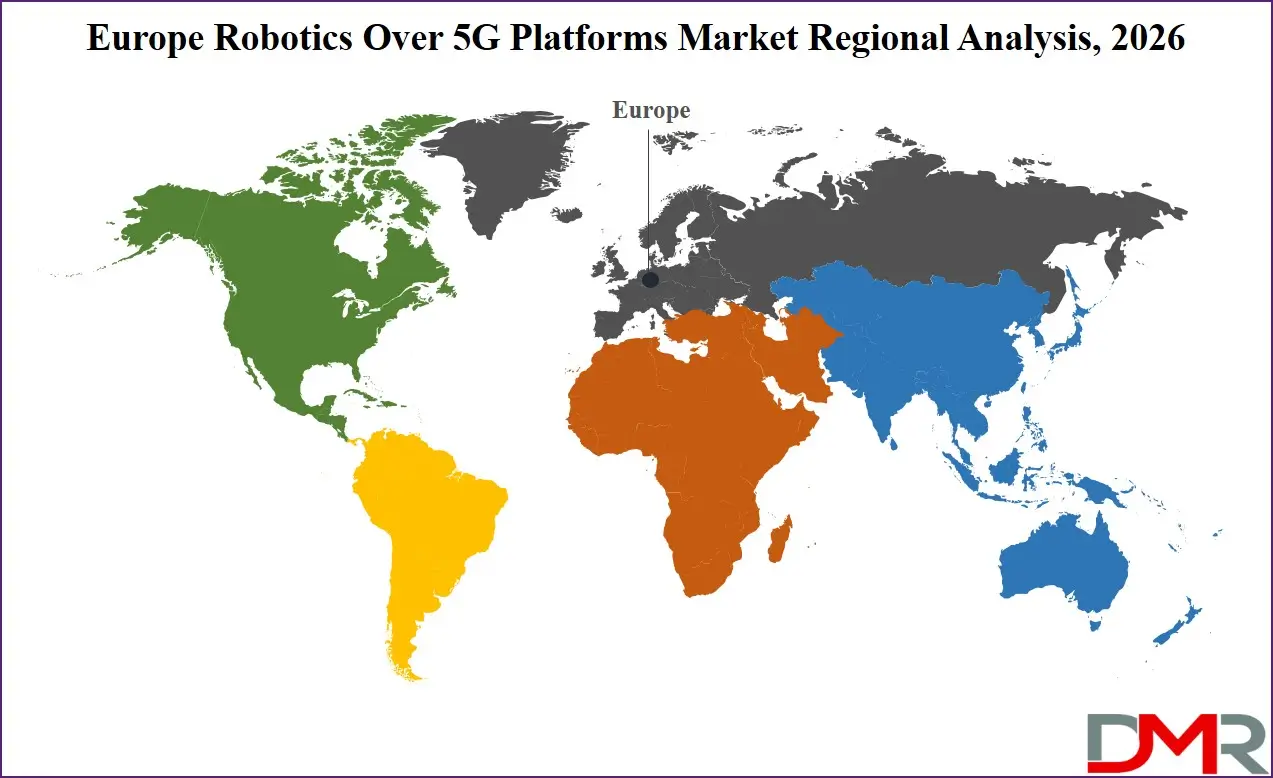
Europe
- Germany
- The U.K.
- France
- Italy
- Russia
- Spain
- Benelux
- Nordic
- Rest of Europe
Europe Robotics Over 5G Platforms Market: Competitive Landscape
The competitive landscape is fueled by participation, both domestic and international, in the Europe Robotics Over 5G Platforms Market, with dissimilar capabilities across hardware manufacturing, software platforms, and integration services. Major companies, therefore, strategize to develop advanced technologies such as AI, 5G connectivity, and real-time control to enhance robotic capabilities to better competitiveness. The leading players are ABB Ltd., KUKA AG, and Siemens AG in integrated automation solutions, while in AI and cloud-based platforms, the leading players include cloud providers and specialized software companies. These companies leverage Europe's digital transformation initiatives by aligning their offerings with regulatory priorities meant to attract investments and improve efficiency. It addresses both the growing manufacturing and service sectors, where these focus more on niche capabilities: healthcare robotics and collaborative automation, while global automation providers have emerged, providing end-to-end solutions in hardware development and system integration.
ℹ
To learn more about this report –
Download Your Free Sample Report Here
Mergers and partnerships are common strategies that allow companies to expand service portfolios and reach. For instance, technology companies partnering with robot manufacturers enhance data-driven decision-making and operational agility. While the leading companies are competitive, innovation in the fields of AI, 5G modules, and predictive analytics separates the leaders. These opportunities are likely to come along with an intense competitive landscape for both established players and new entrants, with strong governmental support for developing automation innovation clusters.
Some of the prominent players in the Europe Robotics Over 5G Platforms Market are:
- ABB Ltd.
- Siemens AG
- KUKA AG
- FANUC Corporation
- Yaskawa Electric Corporation
- Universal Robots A/S
- Comau S.p.A.
- Stäubli International AG
- Bosch Rexroth AG
- Festo AG & Co. KG
- Schneider Electric SE
- Dassault Systèmes SE
- Ericsson AB
- Nokia Corporation
- Deutsche Telekom AG
- Orange S.A.
- BT Group plc
- Vodafone Group plc
- Ocado Group plc
- Blue Ocean Robotics
- Other Key Players
Recent Developments in the Europe Robotics Over 5G Platforms Market
- March 2026: Ericsson AB launched a new industrial research initiative (VICTOR6G) focused on real-time network virtualization, aimed at enabling advanced industrial automation and future robotics applications through ultra-low latency connectivity.
- January 2026: Nokia Corporation highlighted the need for increased investment in 5G Standalone, edge computing, and high-performance networks to support AI-driven robotics and industrial automation across Europe.
- October 2025: Siemens AG launched an edge-native AI solution via its Xcelerator platform in collaboration with industrial partners, improving real-time manufacturing efficiency and supporting advanced automation use cases.
- September 2025: Ericsson AB and Nokia Corporation secured an approximately USD 2.7 billion contract with VodafoneThree to deploy large-scale 5G infrastructure across the UK, enabling advanced industrial automation and robotics applications.
- April 2025: ABB Ltd. announced plans to spin off its robotics division into a separately listed entity by 2026, aiming to enhance strategic focus and unlock growth potential in industrial robotics and automation markets.
- November 2025: Nokia Corporation introduced a new AI-focused business strategy, restructuring operations to accelerate development in 5G and future network technologies critical for industrial automation and robotics applications.
Report Details
| Report Characteristics |
| Market Size (2026) |
USD 1.6 Bn |
| Forecast Value (2035) |
USD 13.2 Bn |
| CAGR (2026–2035) |
26.2% |
| Historical Data |
2021 – 2025 |
| Forecast Data |
2027 – 2035 |
| Base Year |
2025 |
| Estimate Year |
2026 |
| Report Coverage |
Market Revenue Estimation, Market Dynamics, Competitive Landscape, Growth Factors and etc. |
| Segments Covered |
By Component (Hardware, Software and Services), By Deployment Mode (On-Premises and Cloud-based), By Robot Type (Industrial Robots, Service Robots, Collaborative Robots and Autonomous Mobile Robots), By End-User Industry (Manufacturing, Logistics & Warehousing, Automotive, Healthcare, Energy & Utilities, Agriculture, Mining & Construction and Others) |
| Regional Coverage |
Europe – Germany, The UK, France, Russia, Spain, Italy, Benelux, Nordic, & Rest of Europe |
| Prominent Players |
ABB Ltd., Siemens AG, KUKA AG, FANUC Corporation, Yaskawa Electric Corporation, Universal Robots A/S, Comau S.p.A., Stäubli International AG, Bosch Rexroth AG, Festo AG & Co. KG, Schneider Electric SE, Dassault Systèmes SE, Ericsson AB, Nokia Corporation, Deutsche Telekom AG, Orange S.A., BT Group plc, Vodafone Group plc, Ocado Group plc, Blue Ocean Robotics, and Other Key Players. |
| Purchase Options |
We have three licenses to opt for: Single User License (Limited to 1 user), Multi-User License (Up to 5 Users) and Corporate Use License (Unlimited User) along with free report customization equivalent to 0 analyst working days, 3 analysts working days and 5 analysts working days respectively. |
Frequently Asked Questions
How big is the Europe Robotics Over 5G Platforms Market?
▾ The Europe Robotics Over 5G Platforms Market size is estimated to have a value of USD 1.6 billion in 2026 and is expected to reach USD 13.2 billion by the end of 2035.
Who are the key players in the Europe Robotics Over 5G Platforms Market?
▾ Some of the major key players in the Europe Robotics Over 5G Platforms Market are ABB Ltd., Siemens AG, KUKA AG, FANUC Corporation, Yaskawa Electric Corporation, Universal Robots A/S, and many others.
What is the growth rate in the Europe Robotics Over 5G Platforms Market?
▾ The market is growing at a CAGR of 26.2% over the forecasted period.