What is the Europe Solid State Battery Market Size?
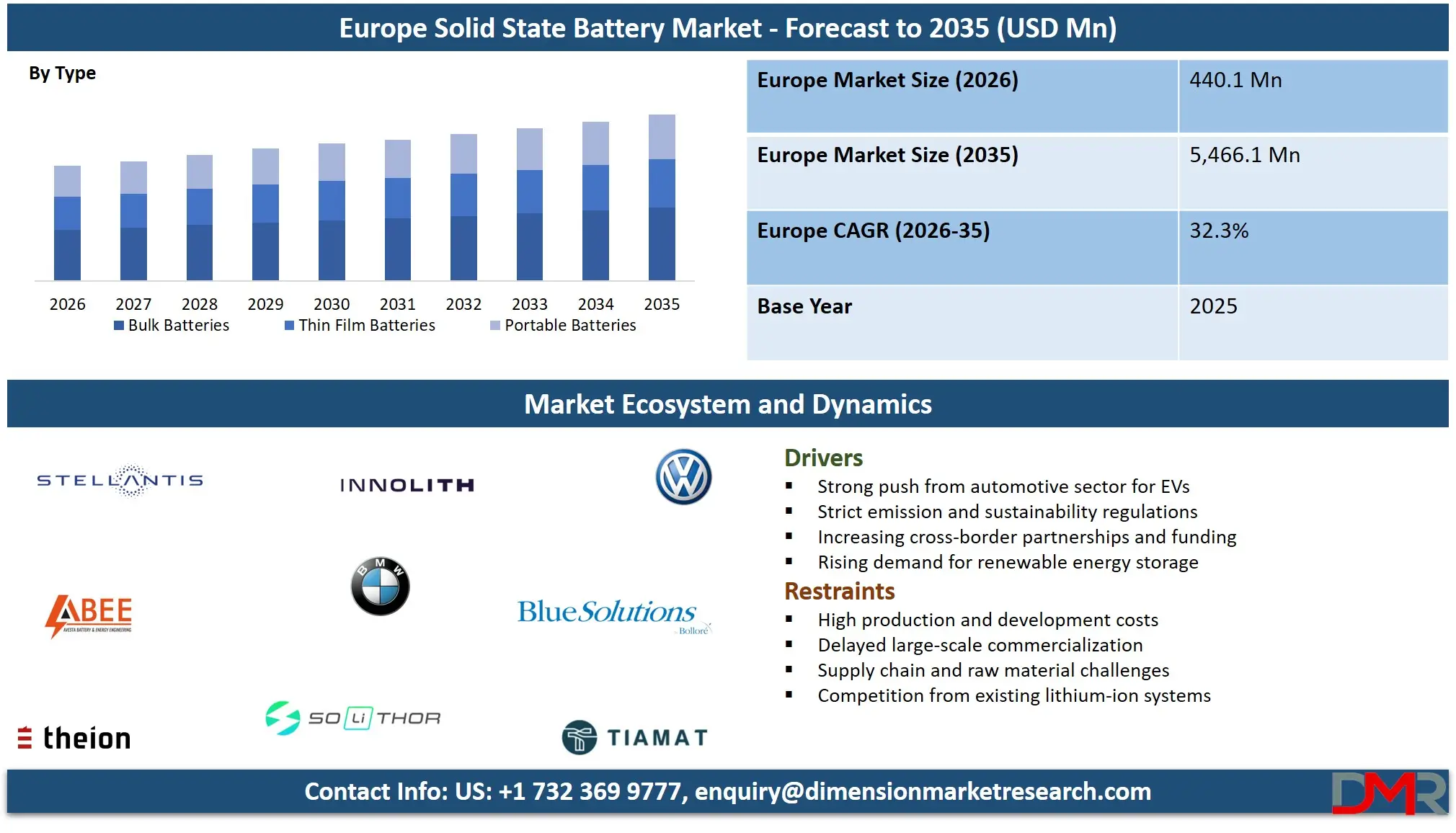
The Europe Solid State Battery Market size is projected to reach USD 440.1 million in 2026 and grow at a compound annual growth rate of 32.3% to reach a value of USD 5,466.1 million in 2035, driven by rapid expansion of electric vehicle adoption across Europe.
ℹ
To learn more about this report –
Download Your Free Sample Report Here
Europe Solid State Battery are those advanced energy storage systems that use solid electrolytes rather than liquid or gel-based, with increased safety, energy density and lifecycle performance. The components used in these batteries are solid electrolytes, electrodes, and advanced packaging technologies that make these batteries superior in efficiency.
They are important because they will allow the next generation of electric mobility, consumer electronics, and battery storage of renewable energy. There is innovation in response to increasing demand on safer and high capacity batteries and decarbonization. New activities such as commercialization of lithium-metal solid-state designs, strategic alliances and investments in scale-up manufacturing all bode well to place this technology as a disruptive solution in the emerging energy storage ecosystem.
ℹ
To learn more about this report –
Download Your Free Sample Report Here
Europe Solid State Battery Market: Key Takeaways & Influencing Factors
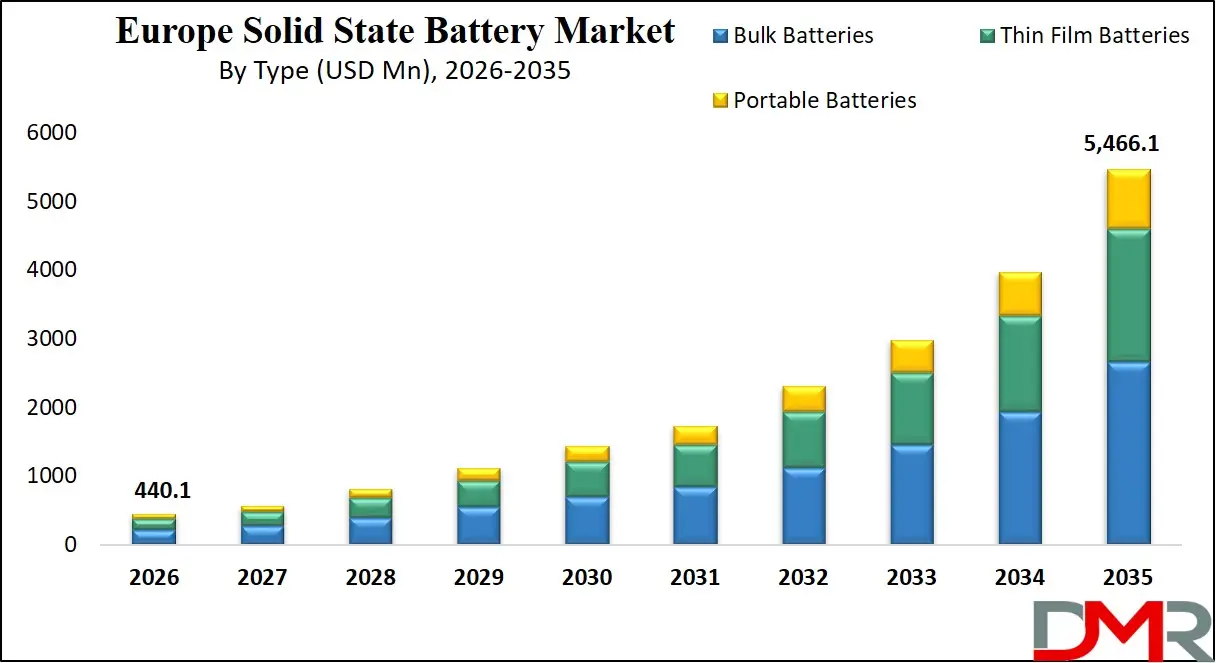
- Market Size & Forecast: The Europe Solid State Battery Market size is projected to reach USD 440.1 million in 2026 and is anticipated to have a value of USD 5,466.1 million in 2035.
- Growth Rate & Outlook: The Europe Solid State Battery Market size is set to grow at a compound annual growth rate of 32.3% during the forecast period of 2026 to 2035.
- Primary Growth Drivers: Some of the major growth drivers in the market include growing electric vehicle adoption, advancements in battery technology and R&D investments, and more.
- Key Market Trends: Some of the major trends in the market are shift toward lithium-metal solid-state batteries, increasing focus on sustainable and localized production, and more.
- By Type: The bulk batteries segment is anticipated to get the majority share of the Europe Solid State Battery market in 2026.
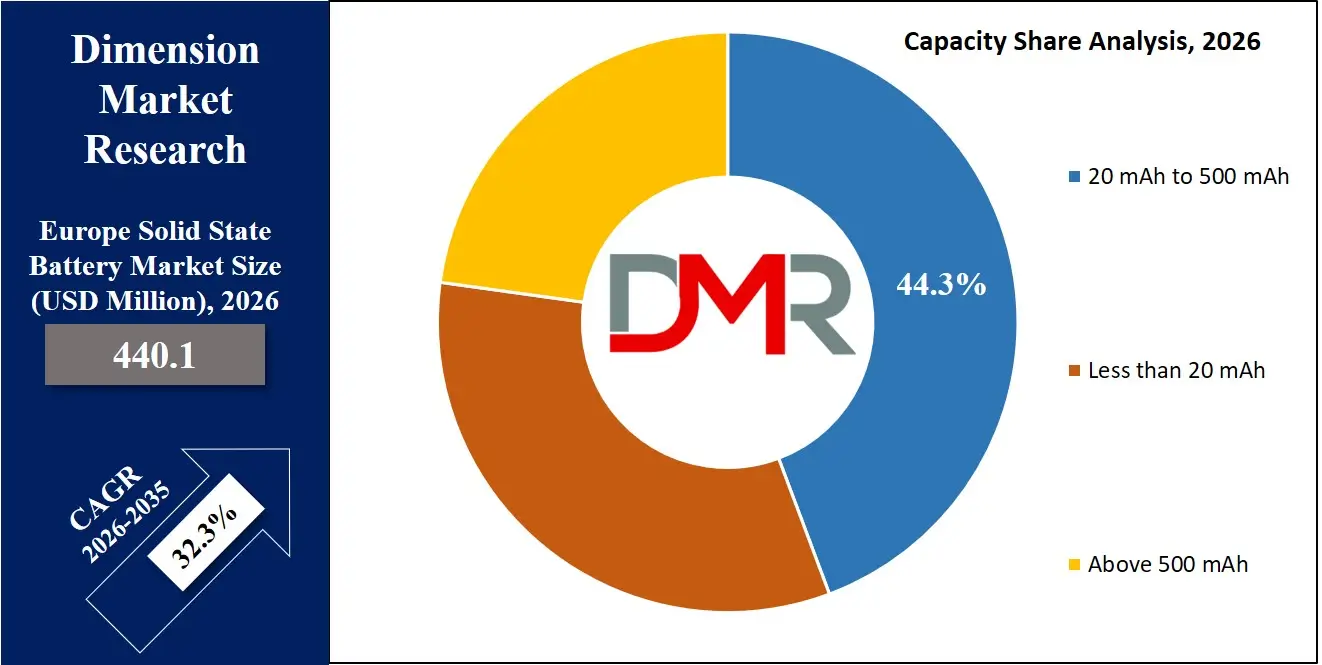
- By Capacity: The 200 mAh to 500 mAh segment is expected to get the largest revenue share in 2026 in the Europe Solid State Battery market.
- By Application: The EVs segment is expected to get the largest revenue share in 2026 in the Europe Solid State Battery market.
What is the Solid State Battery?
A solid-state battery is a new form of energy storage technology, in which the electrolyte is not liquid or gel, but rather a solid material. Such design enhances safety as it minimizes the chances of fire and facilitates increased power density leading to more power availability. The solid-state batteries are also more suitable in terms of charging potential, lifespan and stability, hence, suitable in electric vehicles, consumer electronics, and large scale energy storage systems.
Use Cases
- Electric Vehicles: EVs use solid state batteries to enhance driving range, shorten charging time, and increase safety because electrolytes are non-flammable. These batteries are increasingly being incorporated in automakers with the aim of satisfying the high emission standards and consumer need to have efficient cars.
- Consumer Electronics: These batteries are used to power smartphones, laptops, and wearable devices with more energy density and longer life. Their miniature architecture allows slimmer and lighter devices without compromising on performance.
- Medical Devices: Solid state batteries find use in implantable and portable medical devices, and provide reliability, safety and long operation life which are imperative in patient care and monitoring.
- Renewable Energy Storage: They enhance the storage of energy, energy efficiency, and durability, which help in balancing the intermittent renewable power sources like solar and wind.
How AI Is Transforming the Europe Solid State Battery Market
Artificial intelligence is also making a revolutionary contribution to the development and optimization of solid state batteries. Simulations and predictive models based on AI assist scientists in finding the most ideal materials and configurations, making experiments based on them less time-consuming and expensive. Machine learning algorithms can be used to improve the design of the battery, making it more efficient in performance and safety, and lifecycle.
Moreover, AI is enhancing the production process by automating and quality control. Real-time monitoring and predictive maintenance guarantee efficient production and minimise defects. AI can also increase demand forecasting and supply chain management, allowing manufacturers to streamline their operations and satisfy the needs of the market.
Market Dynamic
Driving Factors in the Europe Solid State Battery Market
Growing Electric Vehicle Adoption
The fast pace adoption of electric vehicle adoption in Europe is one of the key factors that have pushed solid state batteries. Governments are enforcing stringent emission policies and providing incentives to encourage the use of EV. Solid state batteries are more energy-dense, quicker to charge and safer than the traditional lithium-ion batteries and are the best choice in next-generation EVs. To boost the performance of their vehicles, improve range, and satisfy consumer expectations, automakers are investing more in such batteries, driving faster market expansion and technological progress.
Advancements in Battery Technology and R&D Investments
Significant investments in research and development are propelling innovations in solid state battery technology. Governments and individual companies in Europe are investing in the development of projects aimed at increasing energy density, lowering production costs, and increasing scalability. Advances in solid electrolytes and lithium-metal anodes are enhancing battery performance and life. These innovations are facilitating commercialization and mass manufacturing, and solid state batteries are increasingly becoming feasible in a variety of uses and enhancing the European dominance in state of the art battery technologies.
Restraints in the Europe Solid State Battery Market
High Production Costs and Scalability Challenges
A major challenge to its large-scale adoption is the high cost of producing solid state batteries. The use of sophisticated materials, intricate production processes, and economies of scale are among the factors that increase the costs of production. Also, there are technical challenges in scaling up laboratory prototypes to commercial production. These aspects impede affordability and reduce the market penetration especially in price-sensitive applications, which affects the competitiveness of solid state batteries over their conventional counterparts.
Limited Commercialization and Supply Chain Constraints
Although it looks promising, solid state batteries are yet to be commercialized. The supply chain is influenced by the scarcity of raw materials and specialized materials. Furthermore, lack of standardized manufacturing processes and infrastructure restricts large-scale deployment. Such challenges pose uncertainties to manufacturers and investors, stalling product launches and slacking market expansion in Europe.
Opportunities in the Europe Solid State Battery Market
Expansion of Renewable Energy Storage Solutions
The growing incorporation of renewable energy sources in Europe is a big opportunity to solid state batteries. They are designed to be high efficiency and with a long lifecycle hence suitable to grid-scale energy storage systems. The demand of high-level storage has been increasing as countries strive to lessen the use of fossil fuels. The intermittency problem of renewable energy can be solved through solid state batteries, which can provide stable and reliable power supply, thus paving way to new growth opportunities in the energy sector.
Government Support and Strategic Collaborations
The opportunities to expand the market is being created by a strong government support in terms of funding programmes, incentives and policy frameworks. Alliances among car makers, battery makers, and research centers are expediting innovation and commercialization. These collaborations allow the exchange of knowledge, cost-efficiency and accelerated introduction of solid state technologies, creating a competitive and dynamic marketplace.
Trends in the Europe Solid State Battery Market
Shift Toward Lithium-Metal Solid-State Batteries
The shift to lithium-metal solid-state batteries is a prominent market trend, with energy density being much higher than in the case of traditional lithium-ion batteries. To improve the performance and safety, companies are working on the creation of stable lithium-metal anodes. This is leading to innovation and investments and making lithium-metal designs a future standard in advanced battery technologies.
Increasing Focus on Sustainable and Localized Production
Europe is highlighting the need to produce batteries in a sustainable way and eliminate reliance on imports. There is an attempt to introduce manufacturing facilities locally and to implement greener processes. This is a movement that meets the principles of the circular economy and regulatory needs, which advance recycling and minimize carbon footprint, as well as reinforce the regional supply chain.
Research Scope and Analysis
By Type Analysis
The Europe solid state battery market is anticipated to be dominated by bulk batteries segment with a share of about 48.7 in 2026 because of its wide application in electric vehicles and energy storage system. Bulk batteries have a greater capacity and are more durable and hence they can be used in large scale. In the meantime, the fastest-growing segment is the thin film batteries due to their lightweight design and ability to fit into small electronics and medical devices. Their use is growing because of technological improvements and an increasing need to miniaturise energy solutions, and portable batteries are steadily growing in consumer electronics use.
By Capacity Analysis
It is estimated that the 20 mAh to 500 mAh category will have the highest share of 44.3% in 2026, as it will be extensively used in consumer electronics, wearables, and medical devices. The range of capacities is balanced as it provides a compromise between size and performance and can be used in compact and portable devices that need a stable power output.
ℹ
To learn more about this report –
Download Your Free Sample Report Here
Its flexibility in its use in various applications guarantees a steady demand, particularly with the proliferation of smart devices and IoT-friendly products. It is likely that the 500 mAh segment will be the highest growing segment as there will be higher demand in electric vehicles as well as in industry where high energy storage will be required. Ongoing battery development with increased energy density and charging efficiency is expanding capacity, and further boosting uptake in diverse sectors.
By Application Analysis
It is expected that electric vehicles will take up over 39.6% share of the market in the year 2026 due to the high policy support as well as increasing adoption of EV in Europe. Batteries based on solid state offer greater safety, shorter chances of thermal runaway, and increased driving range, which are suitable in the next-generation EVs. The dominance of this segment is further growing as more investments are made by automakers and favorable regulatory frameworks. The energy harvesting sector is the most rapidly expanding, with the need to use sustainable and self-powered systems growing in smart infrastructure and IoT ecosystem. Also the consumer electronics and medical equipment industry remain a major contributor to overall consumption because of the requirement of compact, high-performance batteries with increased focus on reliability and long lifecycle in vital applications.
By End User Industry Analysis
The automotive sector will dominate with a 41.2% market share in 2026 due to the high rate of electrification and high investment in advanced battery technologies. Car manufacturers are now using solid state batteries to enhance efficiency in their vehicles, to shorten the time required to charge the battery, and to increase safety levels. The move to zero-emission mobility and government incentives are also driving the uptake in this sector. The healthcare industry is expected to be the quickest expanding industry, as more sophisticated medical equipment will be used, which needs to be powered by long-term and dependable energy sources. In the meantime, the industrial and aerospace industries also have high development perspectives because of the increasing need in high-performance sustainable energy sources that can work in harsh and specialized conditions.
The Europe Solid State Battery Market Report is segmented on the basis of the following:
By Type
- Bulk Batteries
- Thin Film Batteries
- Portable Batteries
By Capacity
- Less than 20 mAh
- 20 mAh to 500 mAh
- Above 500 mAh
By Application
- Electric Vehicles
- Consumer Electronics
- Medical Devices
- Aerospace
- Wearables
- Energy Harvesting
- Industrial
By End User Industry
- Automotive
- Electronics
- Healthcare
- Aerospace & Defense
- Industrial
Country Analysis
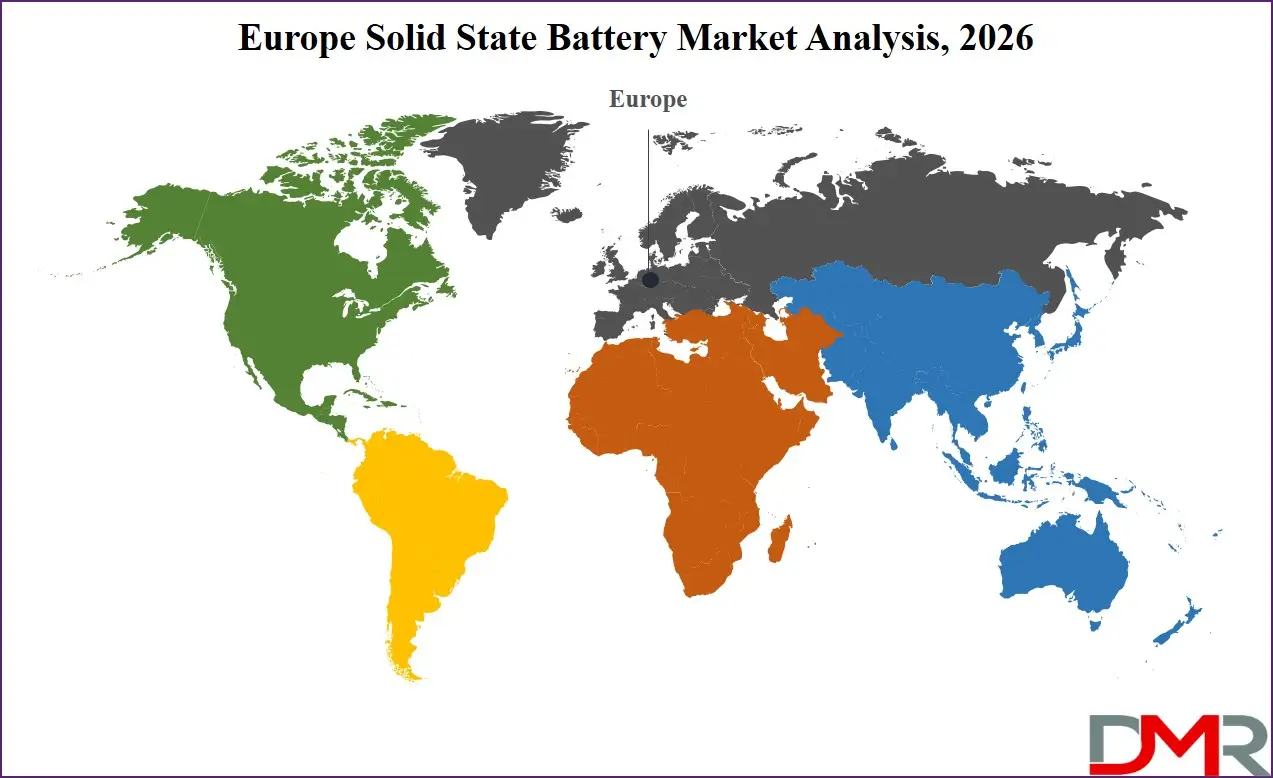
The solid-state battery market in Europe is developing at a high pace with Germany, France and United Kingdom being the major users. It is supported by strong government funding, EV adoption, and automaker-startup partnerships to grow.
ℹ
To learn more about this report –
Download Your Free Sample Report Here
Countries such as Sweden and Netherlands are geared towards innovation and sustainability. The policies in the region, including decarbonization and battery localization, enhance the competitiveness of Europe in terms of next-generation energy storage technologies.
By Country
- Germany
- The U.K.
- France
- Italy
- Russia
- Spain
- Benelux
- Nordic
- Rest of Europe
Competitive Landscape
The Europe solid state battery is a competitive market, where innovation, strategic partnerships and the high investment in R&D drive competition. In order to achieve a competitive advantage, companies are working on scalable production technologies and improving the performance of batteries. New entrants are restricted by high barriers to entry, in terms of capital requirements and technical know-how. Development of strategic alliances between technology providers and automotive manufacturers are enhancing commercialization. Moreover, the local manufacturing plants and optimization of the supply chain are the main measures towards the consolidation of market positions and long-term development.
Some of the prominent players in the Europe Solid State Battery are:
- Blue Solutions
- SOLiTHOR
- ABEE (Avesta Battery & Energy Engineering)
- Innolith
- Ilika plc
- Tiamat Energy
- Theion
- Volkswagen AG
- BMW Group
- Mercedes-Benz Group
- Stellantis
- Renault Group
- Saft Groupe (TotalEnergies)
- Northvolt
- Umicore
- BASF SE
- Solvay
- Arkema
- Johnson Matthey
- Varta AG
- Other Key Players
Recent Developments
- In March 2026, MG Motor revealed that it will launch semi-solid-state batteries to mainstream EVs in Europe and the UK, marking the first. The SolidCore battery will be first introduced in the MG4 EV Urban line in 2026, and two other models will follow suit with the technology, which will be a major advance in EV battery technology.
- In January 2026, Syensqo and Axens launched Argylium, a new firm to develop solid-state battery materials in Europe. The company will use the current R&D strengths to further industrialize the sulfide solid electrolytes, which will enable next-generation all-solid-state batteries, which are safer, offer higher energy density, and can charge faster.
- In January 2026, ProLogium Technology collaborated with Kyushu Electric Power and Nakayama Iron Works to introduce a 24 V solid-state battery module at CES 2026. The cooperation incorporates the use of advanced lithium ceramic cells into construction equipment to establish a vertically integrated value chain and increase safety by eliminating thermal runaway.
Report Details
| Report Characteristics |
| Market Size (2026) |
USD 440.1 Mn |
| Forecast Value (2035) |
USD 5,466.1 Mn |
| CAGR (2026–2035) |
32.3% |
| Historical Period |
2021 – 2025 |
| Forecast Period |
2027 – 2035 |
| Base Year |
2025 |
| Estimate Year |
2026 |
| Segments Covered |
By Type (Bulk Batteries, Thin Film Batteries, Portable Batteries), By Capacity (Less than 20 mAh, 20 mAh to 500 mAh, Above 500 mAh), By Application (Electric Vehicles, Consumer Electronics, Medical Devices, Aerospace, Wearables, Energy Harvesting, Industrial), By End User Industry (Automotive, Electronics, Healthcare, Aerospace & Defense, Industrial) |
| Regional Coverage |
Europe – Germany, The UK, France, Russia, Spain, Italy, Benelux, Nordic, & Rest of Europe |
Frequently Asked Questions
How big is the Europe Solid State Battery Market?
▾ The Europe Solid State Battery Market size is expected to reach USD 440.1 million by 2026 and is projected to reach USD 5,466.1 million by the end of 2035.
What is the CAGR of the Europe Solid State Battery Market from 2026 to 2035?
▾ The market is growing at a CAGR of 32.3 percent over the forecasted period.
What factors are driving the growth of the Europe Solid State Battery Market?
▾ Growing electric vehicle adoption, advancements in battery technology and R&D investments, and more are the factors driving the growth of the Europe Solid State Battery Market.
What are the major trends in the Europe Solid State Battery Market?
▾ Shift toward lithium-metal solid-state batteries, increasing focus on sustainable and localized production, and more are some of the major trends in the market.
Who are the key players in the Europe Solid State Battery Market?
▾ Some of the key players in the Europe Solid State Battery Market includes BASF, Blue Solution, ABEE and more.
How is the Europe Solid State Battery Market segmented?
▾ The Europe Solid State Battery Market is segmented into type, capacity, application and end use industry.