Global Executive Coaching and Leadership Development Market Snapshot
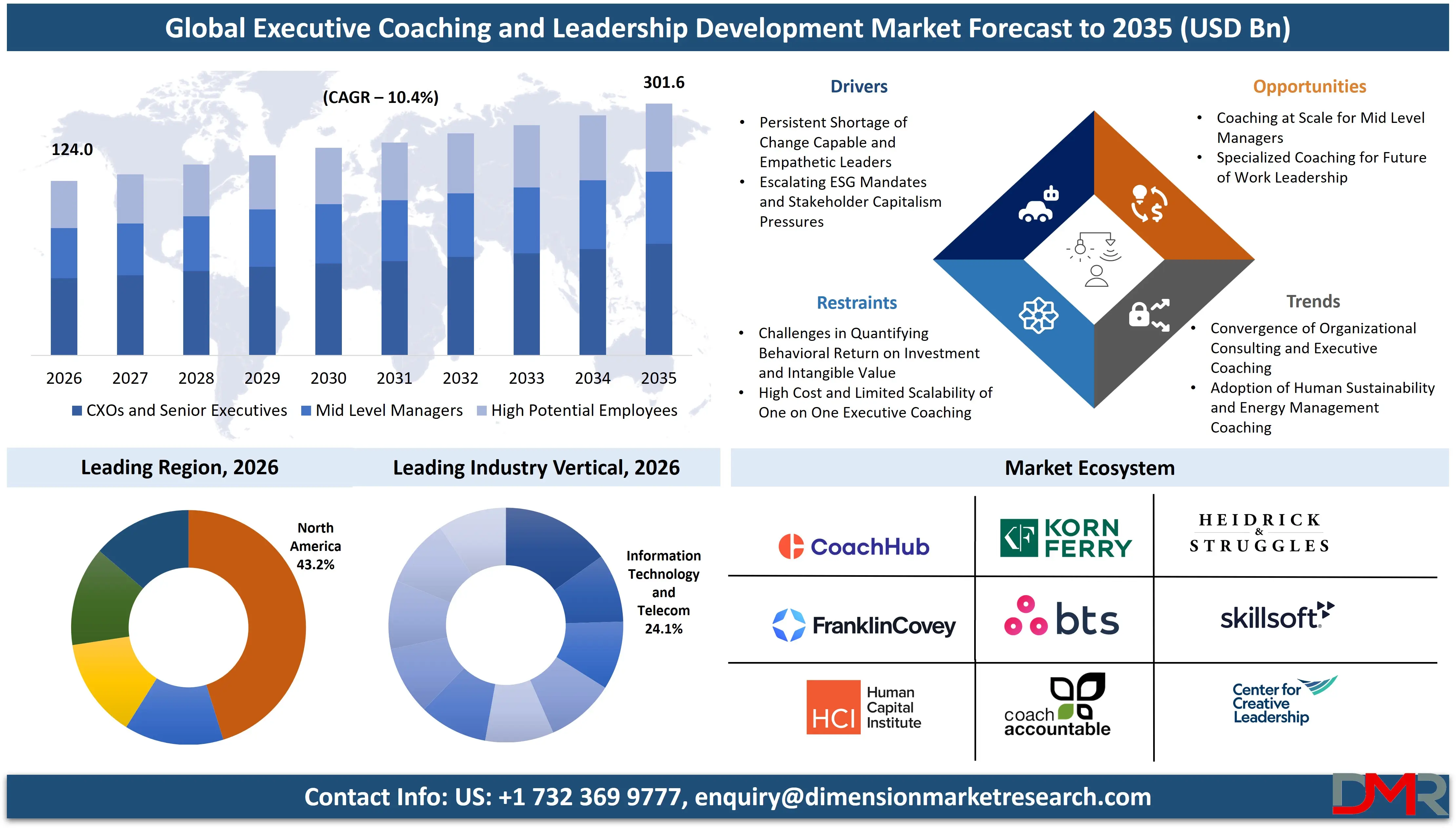
- Global Executive Coaching and Leadership Development Market Size in 2026: USD 124.0 Billion
- Global Executive Coaching and Leadership Development Market Size in 2035: USD 301.6 Billion
- Global CAGR from 2026 to 2035: 10.4%
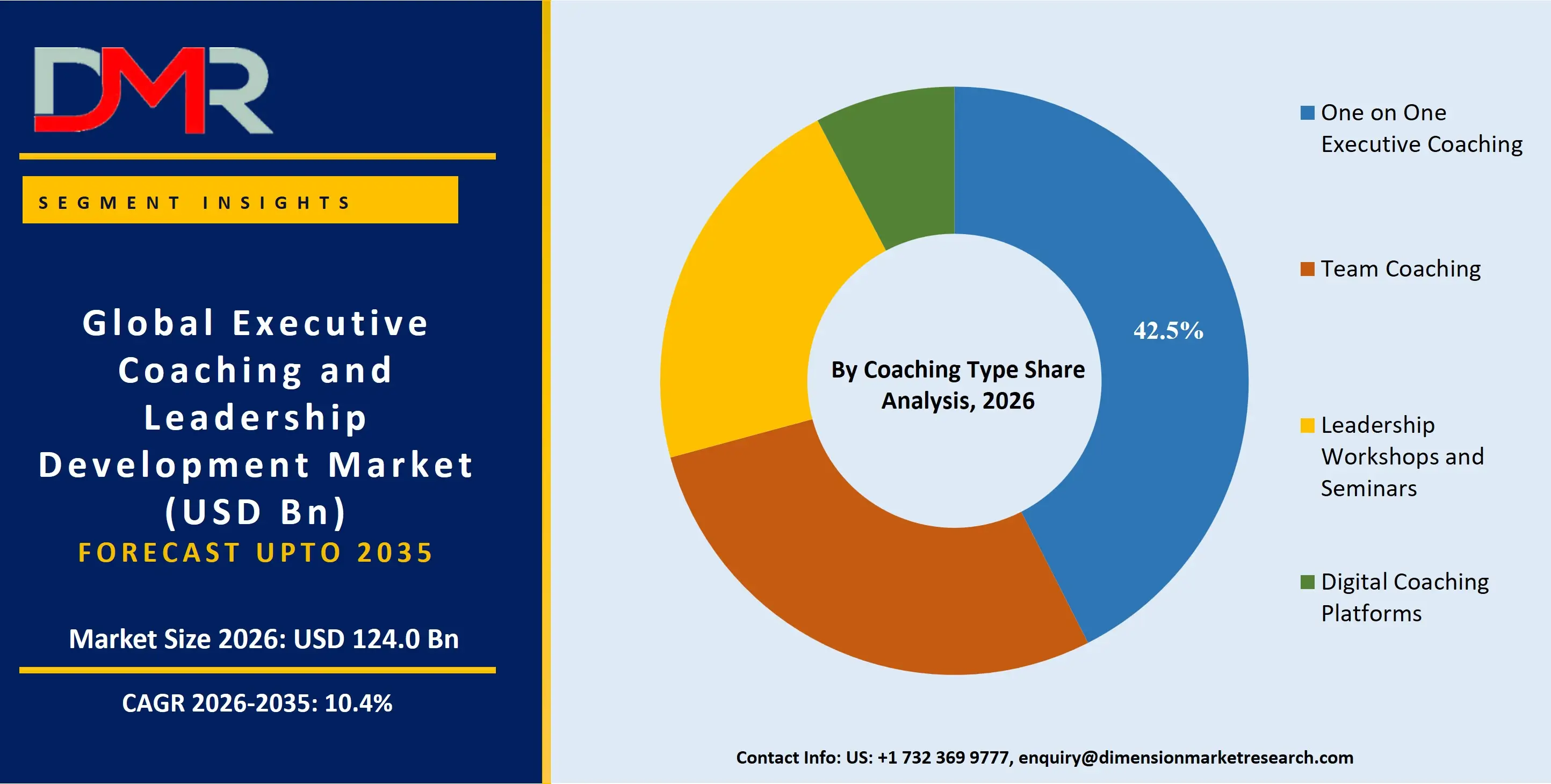
- One-on-One Executive Coaching is the leading coaching type segment in 2026: 42.5%
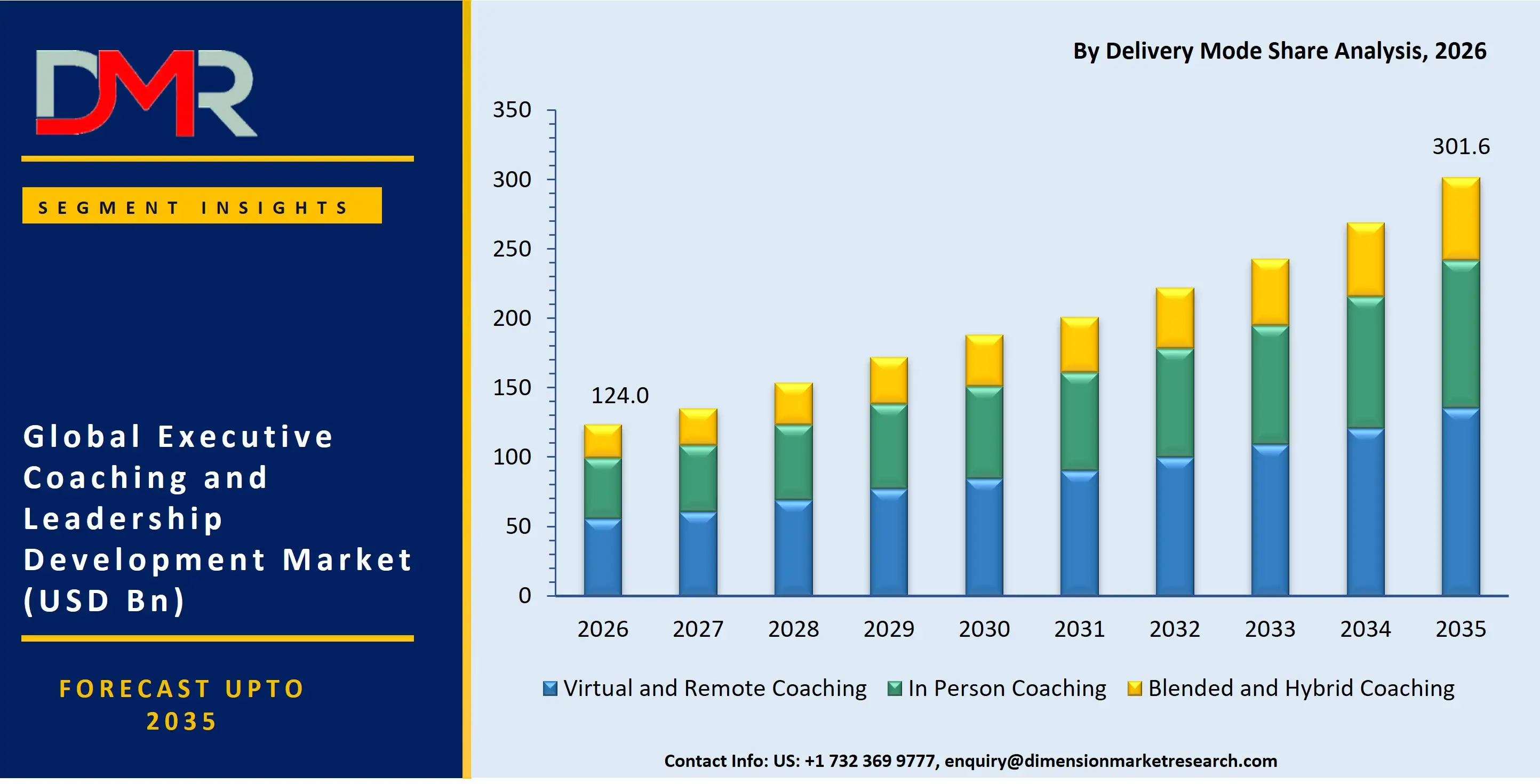
- In-Person Coaching is the leading delivery mode segment in 2026: 48.2%
- CXOs and Senior Executives is the leading end user segment in 2026: 45.8%
- Information Technology and Telecom is the leading industry vertical segment in 2026: 24.1%
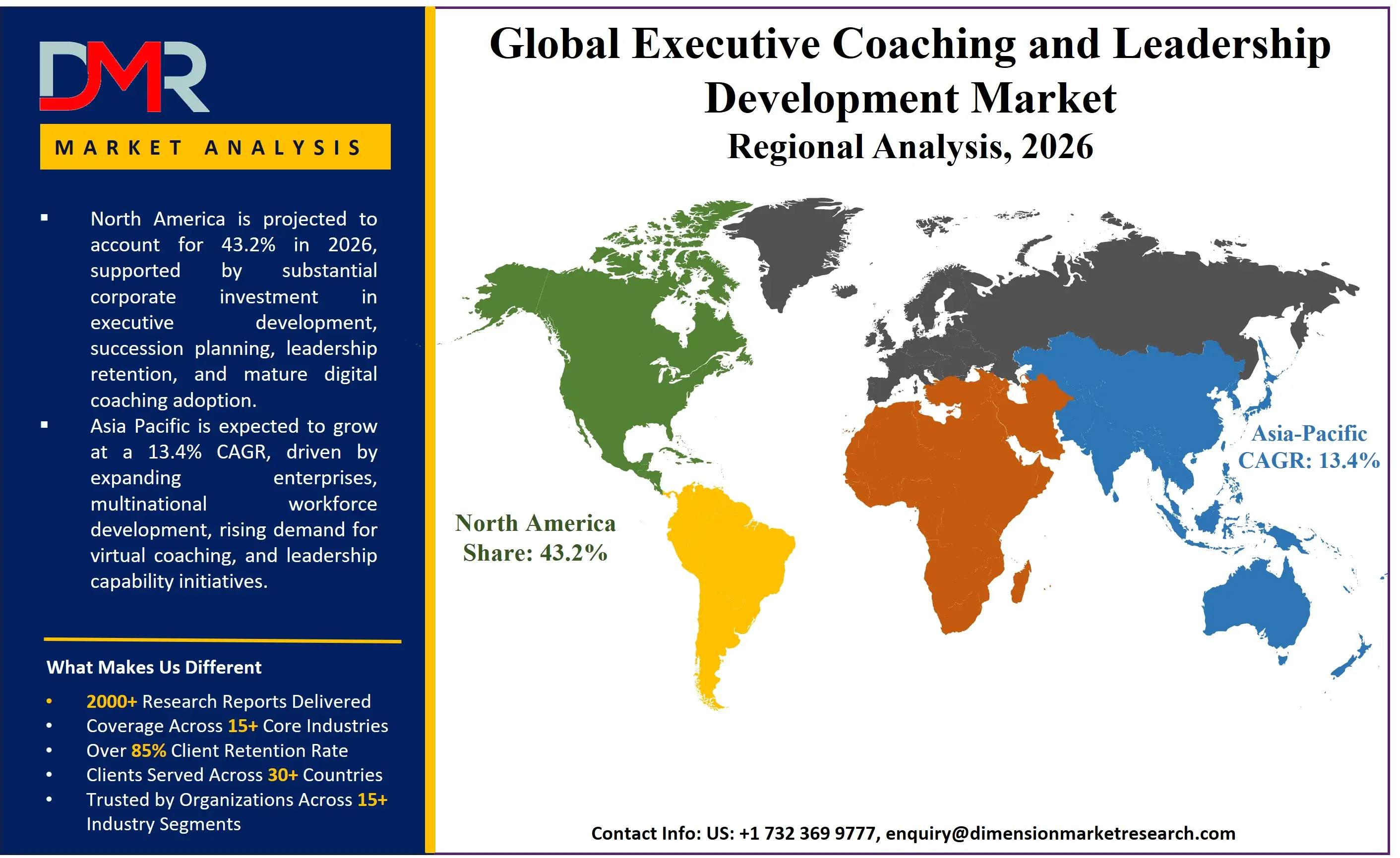
- North America is the leading region in 2026: 43.2%
What is the Global Executive Coaching and Leadership Development Market and its Market Size?
Executive Coaching and Leadership Development is a strategic human capital discipline that provides organizations with tailored, evidence-based interventions to enhance leadership agility, emotional intelligence, and organizational performance through personalized coaching engagements and systemic development programs. It integrates a comprehensive ecosystem of psychometric assessments, 360-degree feedback mechanisms, behavioral science methodologies, and digital coaching platforms to validate critical parameters such as leadership pipeline readiness, succession planning efficacy, engagement scores, and talent retention rates across C-suite, mid-level, and high-potential cohorts. Fortune 500 corporations, growth-stage enterprises, and public sector agencies facing disruptive change and a volatile business landscape depend on leadership development to ensure a robust talent bench, accelerate cultural transformation, and build a resilient, adaptive leadership capability against the backdrop of the future of work.
ℹ
To learn more about this report –
Download Your Free Sample Report Here
The Global Executive Coaching and Leadership Development Market is projected to be valued at USD 124.0 billion in 2026 and is projected to reach USD 301.6 billion by 2035, expanding at a CAGR of 10.4% during the forecast period. Growth is being driven by the accelerating pace of digital transformation demanding new leadership competencies, a global crisis of employee disengagement and "quiet quitting," the mass entry of Gen Z into the workforce requiring a fundamentally different leadership style, and the increasing recognition of empathetic, inclusive leadership as a core driver of bottom-line performance. Investment is accelerating as Human Resources (HR) and Learning & Development (L&D) functions move beyond episodic training toward continuous, AI-powered learning journeys, integrated micro-coaching, and real-time behavioral nudges to embed and sustain new leadership habits at scale.
Use Cases
- Accelerating C-Suite Transition and Onboarding: Organizations leverage one-on-one executive coaching for newly appointed CEOs and C-level leaders to navigate the first 100 days, rapidly assess organizational culture, build strategic alignment with the board, and establish executive presence, mitigating the high failure rate of external leadership hires.
- Building High-Performing, Cohesive Leadership Teams: Enterprises deploy team coaching to address dysfunctions at the senior-most level, enhancing psychological safety, productive conflict, and collective accountability. This ensures strategic decisions are translated into cohesive execution, directly impacting organizational agility and speed-to-market.
- Developing a Scalable Pipeline of Future-Ready Leaders: Multinational corporations utilize structured leadership workshops and digital coaching platforms to operationalize high-potential (HiPo) development, moving from a "nominate-and-wait" approach to a dynamic, data-driven talent management strategy that provides real-time skills gap analysis, stretch assignments, and continuous mentoring to accelerate readiness for P&L roles.
- Embedding a Diversity, Equity, and Inclusion (DEI) Mindset: Progressive organizations use specialized coaching programs to dismantle unconscious bias and cultivate inclusive leadership behaviors. This involves sponsorship programs for underrepresented talent and systemic team coaching to create an environment where diverse perspectives are sourced and amplified, driving innovation.
Key Takeaways
- Market Size: The Global Executive Coaching and Leadership Development Market is anticipated to be valued at USD 124.0 billion in 2026 and is forecast to reach USD 301.6 billion by 2035, expanding at a CAGR of 10.4%.
- Growth Outlook: Market expansion is supported by the systemic shift from a managerial to a coaching leadership paradigm, the dissolution of traditional hierarchical structures toward agile squads, the critical need for digital dexterity at the top, the rise of employee well-being as a boardroom metric, and a growing enterprise mandate for a measurable return on investment (ROI) in human capital over generic, one-size-fits-all training solutions.
- Primary Growth Drivers: An overwhelming volume of change fatigue and burnout causing leadership attrition, the immense complexity of leading hybrid and geographically distributed teams, strict stakeholder demands for ESG and DEI governance, and the inability of traditional MBA-style pedagogy to teach adaptive, empathetic leadership in real-time are accelerating global investment in holistic coaching ecosystems.
- By Coaching Type Analysis: One-on-One Executive Coaching is projected to lead the service segment with a dominant 42.5% share in 2026, driven by the non-negotiable requirement for confidential, high-touch behavioral change interventions, stakeholder-centered coaching, and advanced leadership presence work to refine the strategic mindsets of the C-suite and senior executives.
- By Delivery Mode Analysis: In-Person Coaching is expected to dominate the delivery segment with a 48.2% share in 2026, supported by the irreplaceable value of deep, trust-based human connection for sensitive leadership transformation, nuanced body language observation, and intensive offsite team immersions that build foundational relational capital.
- By End User and Client Level Analysis: CXOs and Senior Executives is anticipated to dominate with a 45.8% share in 2026, driven by the direct line of sight between C-suite behavior and enterprise value, the highly complex, confidential nature of boardroom dynamics, and the need for an external, objective thinking partner to pressure-test strategy and navigate enterprise-wide transformation.
- By Industry Vertical Analysis: Information Technology and Telecom is projected to lead with a 24.1% share in 2026, driven by the sector's war for technical leadership talent, the hyper-growth scaling challenges of startups to unicorns, and the acute need for "soft skills" to translate complex technical roadmaps into compelling commercial narratives and inspire Gen Z engineers.
How AI/Gen AI is Transforming the Executive Coaching and Leadership Development Market?
Artificial intelligence is fundamentally transforming leadership development by enabling hyper-personalized coaching journeys and predictive talent analytics across vast psychometric and performance datasets. Machine learning algorithms dynamically curate micro-learning content, nudge behaviors based on real-time 360-degree feedback, and predict a leader's derailment risk under specific business scenarios. Generative AI assistants are being integrated into digital coaching platforms, allowing leaders to practice difficult conversations, run scenario-planning for change management communications, and receive AI-generated journaling prompts for self-reflection, significantly scaling the accessibility of coaching beyond the executive suite to mid-level managers.
The next frontier of adoption involves agentic AI workflows that orchestrate a holistic leadership growth loop autonomously. In this paradigm, a natural language processing engine analyzes a leader's communication on collaboration platforms for linguistic markers of stress or command-and-control behavior, instantly instructs the digital coaching platform to push a personalized cognitive reframing exercise, and then correlates the intervention with subsequent pulse survey data on team psychological safety to perform causal impact analysis. This capability compresses the behavioral change feedback loop from months to minutes. However, for these AI models to be trusted for sensitive developmental insights, they require strict governance on debiased, high-integrity training data derived from validated psychological constructs and expert-reviewed coaching logs to prevent damaging, context-ignorant advice.
Key Drivers in the Global Executive Coaching and Leadership Development Market
Persistent Shortage of Change-Capable and Empathetic Leaders
The acute global deficit of leaders skilled in navigating constant transformation, fostering psychological safety, and leading with empathy is a primary driver for the coaching market. Organizations struggle to promote technically brilliant individual contributors into roles requiring high emotional intelligence and team orchestration. This talent vacuum directly fuels demand for structured coaching engagements that provide a safe, immediate space for perspective-taking, communication skill-building, and adaptive leadership muscle development.
Escalating ESG Mandates and Stakeholder Capitalism Pressures
A tightening web of global reporting standards and investor demands for ethical, inclusive, and sustainable leadership is forcing organizations to rewire their leadership DNA. Frameworks like the EU's Corporate Sustainability Reporting Directive (CSRD) and SEC climate disclosure rules increasingly mandate demonstrable tone-from-the-top leadership on ESG issues. Furthermore, institutional investors now strictly audit human capital management maturity before allocating capital, often requiring evidence of succession plan robustness and inclusive leadership training as prerequisites for investment.
Restraints in the Global Executive Coaching and Leadership Development Market
Challenges in Quantifying Behavioral ROI and Intangible Value
The central premise of coaching is a qualitative shift in mindset and behavior—inherently difficult to map to a balance sheet. Entrusting significant L&D budgets to external coaches introduces considerable scrutiny over demonstrable return on investment. Organizations may struggle to connect a 12-month coaching engagement directly to EPS growth or P&L improvement, fearing it is a "soft cost" with an attribution problem. This measurement friction can delay or block scaled coaching adoption, particularly for mid-level managers and HiPo programs, where procurement demands a clear, linear link between the intervention and tangible business outcomes like quota attainment or reduced regrettable turnover, rather than relying on narrative success stories and sentiment analysis.
Growth Opportunities in the Global Executive Coaching and Leadership Development Market
Coaching at Scale for the "Forgotten Middle" Manager
A significant growth opportunity lies in democratizing executive-quality coaching for mid-level managers who are currently the most stretched, driving the majority of strategic execution while receiving the least development investment. This approach addresses the "cost and accessibility" restraint by providing a technology-enabled blend of AI-driven micro-coaching, virtual group coaching sessions with peer cohorts, and targeted behavioral nudges. This model is particularly attractive to large enterprises with thousands of people managers who want to build a universal coaching culture and reverse burnout trends without the prohibitive cost of a dedicated 1:1 executive coach for every manager. It creates a sticky, high-volume recurring revenue relationship built on a platform-plus-human-touch ecosystem.
Specialized Coaching for the Future-of-Work Architect
The convergence of hybrid work, AI workforce augmentation, and a focus on human sustainability creates a massive opportunity for specialized coaching niches. A generic leadership coach is ill-equipped to help a leader navigate the ethical implications of deploying AI across a creative team, or to design an asynchronous, globally inclusive team rhythm. Coaching providers who develop deep domain expertise in "hybrid leadership design," "leading augmented teams," and "organizational energy management," and integrate with workflow analytics tools (Viva Insights, etc.) to offer data-informed coaching, can unlock a high-value, underserved market segment with critical enterprise transformation requirements. This moves coaching from a remedial or accelerative function to a strategic advisory role for the CEO and CHRO on work design itself.
Trends in the Global Executive Coaching and Leadership Development Market
Convergence of Organizational Consulting and Executive Coaching
The market is witnessing a convergence of management consulting, business psychology, and coaching into a unified, insight-led human capital advisory stack. Rather than simply working on an individual leader's behavior, modern coaching contracts are defined by systemic outcomes like "accelerating business line growth" or "reducing culture risk." This trend is driving providers to tightly integrate organizational network analysis (ONA), culture diagnostics, and top-team alignment processes into their coaching core. The focus is shifting from isolated individual development to a holistic leadership system intervention, where coaching the CEO is intrinsically linked to facilitating the executive team's strategic offsite and measuring a subsequent uptick in enterprise agility scores, accelerating the entire leadership lifecycle from potential to performance.
Adoption of a Human Sustainability and Energy Management Philosophy
A forward-looking trend is the integration of leader and team energy management into the coaching lifecycle. Service providers are evolving beyond purely competency-based development to proactively safeguard a leader's cognitive and emotional capacity. This involves continuous well-being sensing, resilience diagnostics, and structured recovery narrative coaching to validate whether a leader's operating model is truly sustainable. By providing this holistic energy and resilience program alongside 1:1 coaching, providers are positioning themselves as strategic partners for human sustainability, capable of preventing C-suite burnout and fostering a regenerative leadership culture, not just driving a high-performance, burnout-prone one.
Research Scope and Analysis
The Global Executive Coaching and Leadership Development Market is segmented by coaching type, delivery mode, end user and client level, and industry vertical. Coaching types include one-on-one executive coaching, team coaching, leadership workshops and seminars, and digital coaching platforms. The study evaluates delivery across in-person, virtual, and blended modalities, and analyzes adoption across CXOs, mid-level managers, and high-potential employees across key vertical industries.
ℹ
To learn more about this report –
Download Your Free Sample Report Here
By Coaching Type Analysis
One-on-One Executive Coaching is poised to dominate the Global Leadership Development Market with a 42.5% market share in 2026, underpinned by the core value proposition of confidential, bespoke behavioral transformation, stakeholder-centered feedback analysis, and advanced cognitive reframing for the C-suite and senior executives. These engagements are essential for achieving a lasting shift in leadership presence, strategic narrative building, and emotional regulation in high-stakes roles. Leadership Workshops and Seminars hold the second-highest share, driven by the critical need for scalable, cohort-based development that builds a shared leadership language and drives cultural alignment across a wide population of leaders. Digital Coaching Platforms are projected to record a strong CAGR, as organizations increasingly demand AI-enabled, asynchronous coaching, app-based nudges, and virtual group coaching to scale micro-learning and leadership development engagement to HiPo and mid-manager populations cost-effectively.
By Delivery Mode Analysis
In-Person Coaching is anticipated to dominate the market with a 48.2% share in 2026, as the deeply human, trust-based work of transformational leadership development—particularly for C-suite assessment, team dynamics, and sensitive personal behavior change—remains most effective in a face-to-face, immersive context. The richness of non-verbal communication and the creation of a confidential holding environment are foundational to this mode.
ℹ
To learn more about this report –
Download Your Free Sample Report Here
Virtual and Remote Coaching accounts for the second-highest share, owing to the permanence of hybrid work and the democratization of coaching access across a global, distributed talent pool. Blended and Hybrid Coaching is anticipated to expand at the highest CAGR, supported by the ideal model of combining the deep relational bonding of periodic in-person intensives with the continuity, accessibility, and AI-powered nudging of a digital coaching platform, creating a single, cohesive developmental journey.
By End User and Client Level Analysis
CXOs and Senior Executives is projected to lead with a 45.8% market share in 2026, due to the unparalleled organizational impact of senior leadership behavior, the complexity of enterprise-wide strategic leadership challenges, and the confidential, high-stakes nature of board and C-suite dynamics. This cohort requires an elite, battle-tested executive coach as a strategic thinking partner. Mid-Level Managers are expected to register the highest CAGR, driven by the systemic "middle manager crunch" where organizations are now strategically investing in coaching to combat burnout, improve team retention, and build the foundational management skills of their largest leadership population, who translate corporate strategy into frontline execution on a daily basis.
By Industry Vertical Analysis
Information Technology and Telecom is projected to dominate the market with a 24.1% share in 2026, supported by an unparalleled, venture-capital-subsidized war for talent and the critical need to rapidly transform technical experts into inspirational people leaders during hyper-scaling. The sector requires specialized coaching for agile leadership, product management influence, and leading a multi-generational, globally distributed, high-burnout-risk workforce, making continuous leadership development and career coaching a critical talent retention strategy. Banking, Financial Services, and Insurance (BFSI) holds the second-highest share, driven by the intense regulatory pressure for conduct and culture change at the top. Healthcare and Life Sciences is anticipated to record the highest CAGR, driven by the post-pandemic imperative for resilient, compassionate leadership, the complexities of leading scientific and clinical talent, and the critical need for innovation leadership in a highly regulated, life-impacting environment.
The Global Executive Coaching and Leadership Development Market Report is segmented on the basis of the following:
By Coaching Type
- One on One Executive Coaching
- C Suite and Senior Executive Coaching
- Mid Level Manager Coaching
- High Potential Employee Coaching
- Team Coaching
- Leadership Team Coaching
- Cross Functional Team Coaching
- Project Team Coaching
- Leadership Workshops and Seminars
- Leadership Development Workshops
- Communication and Influence Programs
- Change Management Programs
- Digital Coaching Platforms
- Artificial Intelligence Enabled Coaching
- App Based Coaching
- Virtual Group Coaching
By Delivery Mode
- Virtual and Remote Coaching
- In Person Coaching
- Blended and Hybrid Coaching
By End User and Client Level
- CXOs and Senior Executives
- Mid Level Managers
- High Potential Employees
By Industry Vertical
- Information Technology and Telecom
- Banking Financial Services and Insurance
- Healthcare and Life Sciences
- Manufacturing
- Retail and Consumer Goods
- Government and Public Sector
- Education
- Professional Services
- Non Profit Organizations
- Others
Regional Analysis
North America is the Leading Region in the Global Executive Coaching and Leadership Development Market
North America is poised to lead the Global Market with an estimated 43.2% revenue share in 2026. The region's dominance is anchored by a dense concentration of Fortune 500 headquarters, a deeply embedded human capital management culture, and the world's most mature venture capital-backed leadership advisory ecosystem. Aggressive early adoption of AI-powered coaching platforms, a massive installed base of global, matrixed corporations requiring leadership agility, and the presence of the most innovative, well-funded digital coaching start-ups and elite boutique advisory firms solidify its position as the primary global hub for advanced talent strategy and executive development.
ℹ
To learn more about this report –
Download Your Free Sample Report Here
Asia Pacific is the Fastest-Growing Region in the Global Executive Coaching and Leadership Development Market
Asia Pacific is projected to register the fastest CAGR of 13.4% through 2035, driven by its status as a booming engine for unicorn creation, digital transformation, and family-business professionalization. Massive high-potential employee (HiPo) development needs in India, China, and ASEAN nations, coupled with a dire shortage of leaders ready for global P&L roles, necessitates rapid adoption of structured leadership interventions. Accelerating investments in leadership diversity, government-linked corporation modernization, and the expansion of regional headquarters for MNCs in Singapore and Australia further fuel demand for specialized coaching covering cross-cultural leadership, succession planning, and the development of a "founder-to-CEO" mindset to navigate hyper-growth.
The Europe Executive Coaching and Leadership Development Market
The Europe Market is estimated to be valued at USD 31.0 billion in 2026 and is further anticipated to reach USD 75.4 billion by 2035 at a CAGR of 9.8%. Europe represents the second-largest regional market, distinguished by its stringent labor laws, powerful works councils, and a deeply rooted social partnership model that demands a uniquely consultative, empathetic leadership style. The region's powerhouse manufacturing sector, particularly Germany's "Mittelstand" and their global scaling challenges, is a significant growth engine, requiring specialized coaching for innovation leadership, Industry 4.0 digitization, and navigating complex multi-generational family governance systems. The EU's regulatory push for boardroom diversity and sustainable corporate governance is a major driver for structured CEO and board-level coaching mandates.
Latin America Executive Coaching and Leadership Development Market
The Latin America Market is expanding steadily as the region's vibrant entrepreneurial ecosystem and maturing venture capital landscape drive demand for professionalizing leadership in scale-up technology firms and established family conglomerates. Brazil and Mexico lead regional adoption, driven by their large domestic markets, a growing millennial C-suite transition, and the need for culturally nuanced, Spanish and Portuguese-speaking executive coaches who understand the relational, high-context business culture. The demand is particularly strong for coaching interventions that blend leadership presence, strategic communication, and navigating volatile macroeconomic realities. International coaching federations partnering with local firms for accreditation-fluent, culturally congruent coaching represent a key pathway to capturing this relationship-driven market.
Middle East and Africa Executive Coaching and Leadership Development Market
The Middle East and Africa Market is developing alongside massive Vision-led economic transformation projects, sovereign wealth fund investments, and an ambitious nationalization agenda across the Gulf states. Saudi Arabia and the UAE are the primary investment hubs, driven by a state-mandated push to build a cadre of future-ready local leaders to lead giga-projects and diversify away from oil. This necessitates intense executive coaching, sponsorship programs for female leaders, and top-team alignment for newly formed mega-entities. South Africa leads the Sub-Saharan African continent with its mature corporate governance frameworks and B-BBEE transformation requirements. The growing focus on intrapreneurship and creating an innovation culture in the public sector is spurring demand for systemic team coaching and action-learning leadership programs designed to build a foundational growth mindset and break down bureaucratic silos.
Major Countries Analysis
The US Executive Coaching and Leadership Development Market
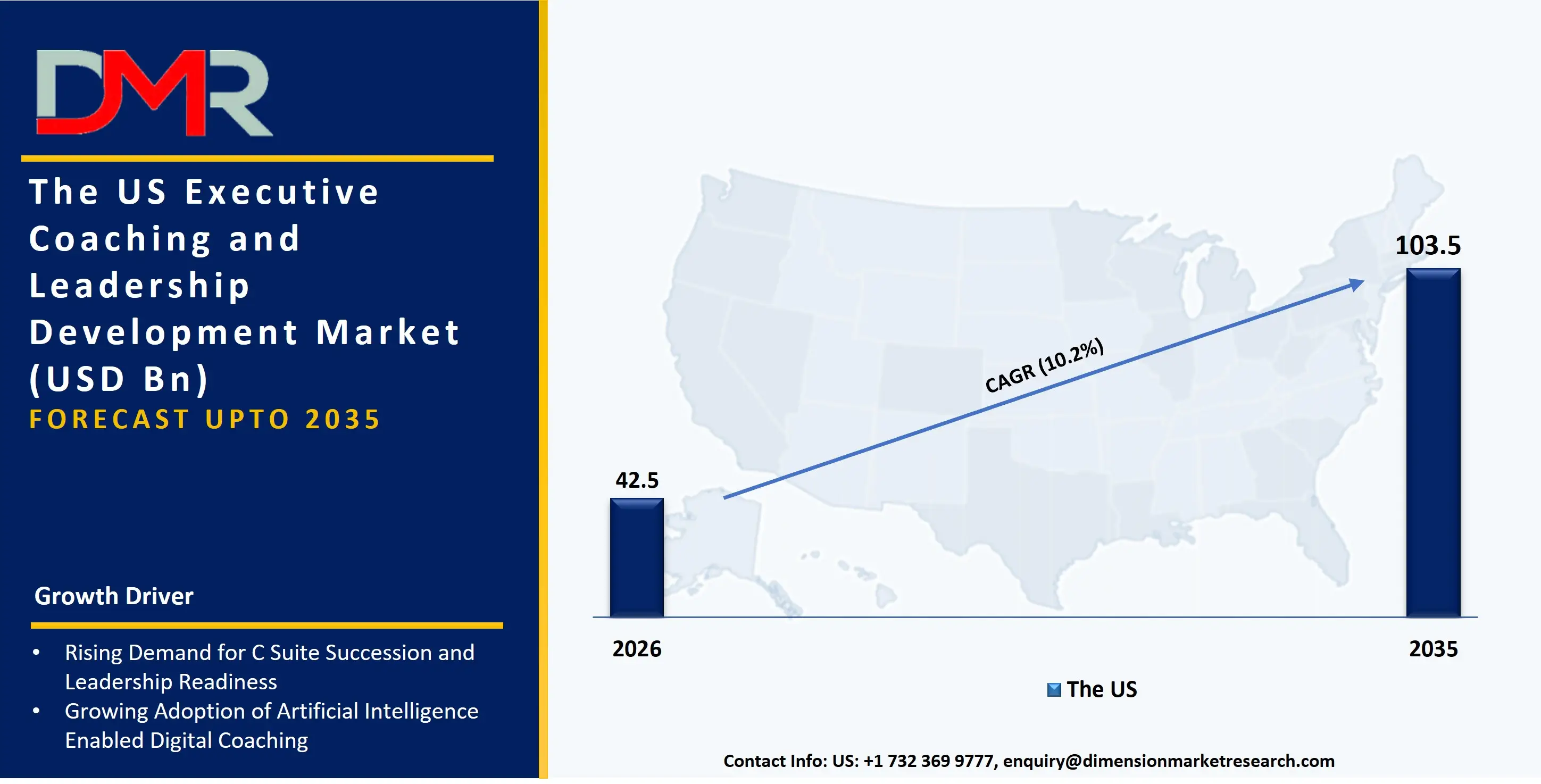
The United States Market is projected to be valued at USD 42.5 billion in 2026 and is expected to reach USD 103.5 billion by 2035, registering a CAGR of approximately 10.2% from 2026 to 2035.
ℹ
To learn more about this report –
Download Your Free Sample Report Here
This robust trajectory reflects the U.S.'s position as the world's most advanced market for human capital innovation. Growth is fueled by the S&P 500's mass adoption of evidence-based coaching for all people leaders, a historic surge in Chief Human Resources Officer (CHRO) influence and budget, and a relentless war for talent that requires a compelling leadership development value proposition to attract and retain top-tier intellectual capital. The shift from periodic, artisanal coaching for a select few to a tech-enabled, data-driven, enterprise-wide coaching culture is a defining driver of market expansion.
Japan Executive Coaching and Leadership Development Market
The Japan Market is valued at USD 6.0 billion in 2026 and is forecast to reach USD 14.6 billion by 2035, expanding at a CAGR of approximately 9.5% between 2026 and 2035. Market development is heavily influenced by Japan's historic corporate governance reform and the urgent need to dismantle rigid, consensus-driven hierarchies to foster autonomous, empowered leadership. The country's globally integrated automotive and high-tech manufacturing sectors demand meticulous cross-cultural coaching and the development of assertive, globally-minded leaders who can navigate ambiguity and drive innovation. A strong cultural preference for deep, long-term mentoring relationships is giving way to structured, outcome-focused executive coaching from trusted, external sensei-like advisors, driving a quiet but quality-focused revolution in leadership identity and empowerment.
Saudi Arabia Executive Coaching and Leadership Development Market
The Saudi Arabia Market is estimated at USD 2.0 billion in 2026 and is projected to reach USD 5.4 billion by 2035, expanding at a CAGR of 11.8%. Hyper-growth is directly tied to the Vision 2030 human capability development pillar and the government's mandate for public and private sector leaders to embody a new paradigm of performance, accountability, and agility. These massive, greenfield economic ecosystems in smart cities, logistics, and tourism require a total shift from a paternalistic, administrative leadership style to an entrepreneurial, empowering, and meritocratic one. The market presents significant opportunities for international coaching providers and business schools who establish in-kingdom presence and partner with local champions to deliver culturally authentic, sovereignty-respecting leadership transformation programs that blend global best practices with deep national identity.
Regulatory Landscape
The regulatory landscape is a powerful, non-negotiable catalyst for leadership development investment. In the EU, the Corporate Sustainability Reporting Directive (CSRD) demands detailed disclosures on leadership's role in corporate culture and ethics, turning a coaching-led inclusive leadership mindset from a "nice-to-have" into a compliance-related, board-level metric. In the US, the SEC's human capital disclosure requirements and NASDAQ's board diversity rule are compelling public companies to demonstrably invest in pipeline development and inclusive leadership coaching. Across jurisdictions, stock exchange listing requirements and investor stewardship codes are increasingly linking executive compensation to measurable human capital performance indicators. These global frameworks collectively transform leadership development from a discretionary HR expense into a core pillar of corporate governance, risk management, and demonstrable sustainable value creation.
Investment and White Space Analysis
The strongest investment opportunities lie in AI-native digital coaching platforms that fuse behavioral psychology, real-time feedback analytics, and personalized learning paths into a single, habit-forming interface that reduces the cost and scales the access of quality coaching. Significant white space exists in developing cost-effective, verticalized coaching bundles for the "heartbeat of the enterprise"—the mid-level managers in manufacturing, retail, and logistics who are being left behind by the C-suite coaching boom. Providers can differentiate through "talent intelligence" platforms that integrate coaching engagement data with HRIS performance and turnover data to prove clear ROI. Emerging growth areas include specialized micro-coaching for leading hybrid teams, conversational AI simulations for practicing difficult conversations, and dedicated human sustainability coaching for preventing executive burnout and fostering resilience as a competitive advantage.
By Region
North America
Europe
- Germany
- The U.K.
- France
- Italy
- Russia
- Spain
- Benelux
- Nordic
- Rest of Europe
Asia-Pacific
- China
- Japan
- South Korea
- India
- ANZ
- ASEAN
- Rest of Asia-Pacific
Latin America
- Brazil
- Mexico
- Argentina
- Colombia
- Rest of Latin America
Middle East & Africa
- Saudi Arabia
- UAE
- South Africa
- Israel
- Egypt
- Rest of MEA
Competitive Landscape
The Global Market features a dynamic landscape ranging from pure-play digital coaching disruptors to global human capital consultancies with integrated leadership advisory services portfolios. At the high end, firms like BetterUp, CoachHub, and Torch compete on the depth of their behavioral science, AI-driven personalization engines, and the scale of their credentialed coach networks. This tier competes intensely on engagement analytics, behavior change verifiability, and platform stickiness. The competitive field broadens significantly in the enterprise domain, where legacy firms like Korn Ferry, Spencer Stuart, and Heidrick & Struggles, alongside professional services giants like Deloitte and Accenture, differentiate on deep verticalized advisory expertise, C-suite succession counsel, and the depth of their organizational psychology and board advisory capabilities. Strategic differentiation increasingly hinges on providing a unified ecosystem that fuses high-touch, elite-level coaching with AI-powered, data-rich platform scalability, supported by transparent outcome-based pricing and guaranteed leadership development ROI, not just coach hours logged.
Some of the prominent players in the Global Executive Coaching and Leadership Development Market are:
- BetterUp
- CoachHub
- Korn Ferry
- Heidrick and Struggles
- FranklinCovey
- CCL Leadership Development
- BTS Group
- Human Capital Institute
- Skillsoft
- CoachAccountable
- Torch
- Ezra
- Sounding Board
- Bravely
- Pluma
- AceUp
- Growthspace
- Maven
- The Leadership Circle
- Marshall Goldsmith Stakeholder Centered Coaching
- Other Key Players
Recent Developments
- November 2025: CoachHub launched AIMY 2.0, adding dynamic self-assessments and enhanced personalization to help employees monitor development across communication, leadership and self-awareness capabilities.
- July 2025: Torch acquired Praxis Labs, combining its contextual coaching platform with AI-powered skill-practice simulations, coaching and assessments to connect leadership development with organizational change priorities.
- February 2025: CoachHub introduced AIMY, an AI coaching solution developed with Microsoft technology collaboration to deliver continuous and tailored employee development at enterprise scale.
- January 2025: BetterUp launched an AI coaching offering that combines personalized AI guidance with access to human coaches, enabling organizations to extend coaching and leadership development across their workforce.
Report Details
| Report Characteristics |
| Market Size (2026) |
USD 124.0 Bn |
| Forecast Value (2035) |
USD 301.6 Bn |
| CAGR (2026–2035) |
10.4% |
| The US Market Size (2026) |
USD 42.5 Bn |
| Historical Data |
2021 – 2025 |
| Forecast Data |
2027 – 2035 |
| Base Year |
2025 |
| Estimate Year |
2026 |
| Segments Covered |
By Coaching Type, By Delivery Mode, By End User and Client Level, and By Industry Vertical |
| Regional Coverage |
North America – The US and Canada; Europe – Germany, The UK, France, Russia, Spain, Italy, Benelux, Nordic, & Rest of Europe; Asia-Pacific – China, Japan, South Korea, India, ANZ, ASEAN, Rest of APAC; Latin America – Brazil, Mexico, Argentina, Colombia, Rest of Latin America; Middle East & Africa – Saudi Arabia, UAE, South Africa, Turkey, Egypt, Israel, & Rest of MEA |
Frequently Asked Questions
How big is the Global Executive Coaching and Leadership Development Market?
▾ The Global Market is valued at USD 124.0 billion in 2026 and is projected to reach USD 301.6 billion by 2035, reflecting strong global demand for strategic talent development, empathetic leadership capabilities, and systemic culture transformation.
What is the CAGR of the Global Market from 2026 to 2035?
▾ The market is projected to expand at a compound annual growth rate (CAGR) of 10.4% between 2026 and 2035, supported by sustained investment in human capital as a primary source of competitive advantage.
What factors are driving the growth of the Global Market?
▾ Growth is driven by an unrelenting surge in burnout and the great resignation, a global leadership skills gap, mandatory compliance with ESG and DEI governance reporting, and the adoption of hybrid work models that necessitate a fundamentally new, coaching-centric leadership style.
What are the major trends in the Global Market?
▾ Major trends include the convergence of organizational consulting and executive coaching, the integration of generative AI for hyper-personalized development, a shift toward measuring human sustainability and energy management, and the rapid democratization of executive-quality coaching for mid-level managers via digital platforms.
Which region held the largest share of the Global Market in 2026?
▾ North America is expected to lead the global market with a 43.2% share in 2026, supported by a highly mature human capital advisory culture, stringent SEC diversity and human capital disclosure mandates, widespread VC investment in leadership tech, and the presence of market-leading pure-play and legacy advisory providers.
Which region is expected to grow the fastest in the Global Market?
▾ Asia Pacific is expected to record the fastest growth at a 13.4% CAGR through 2035, driven by a vast, digitally transforming talent base, an acute leadership shortage for global roles, and state-led economic transformation and nationalization agendas demanding a new generation of empowered, entrepreneurial leaders.
Who are the key players in the Global Market?
▾ Key market participants include BetterUp, CoachHub, Torch, Korn Ferry, Heidrick & Struggles, Spencer Stuart, Deloitte, and Accenture, among other global technology platform and elite human capital advisory firms.
How is the Global Market segmented?
▾ The market is segmented by coaching type, delivery mode, end user and client level, and industry vertical, with regional analysis covering North America, Europe, Asia Pacific, Latin America, and the Middle East and Africa.