Market Overview
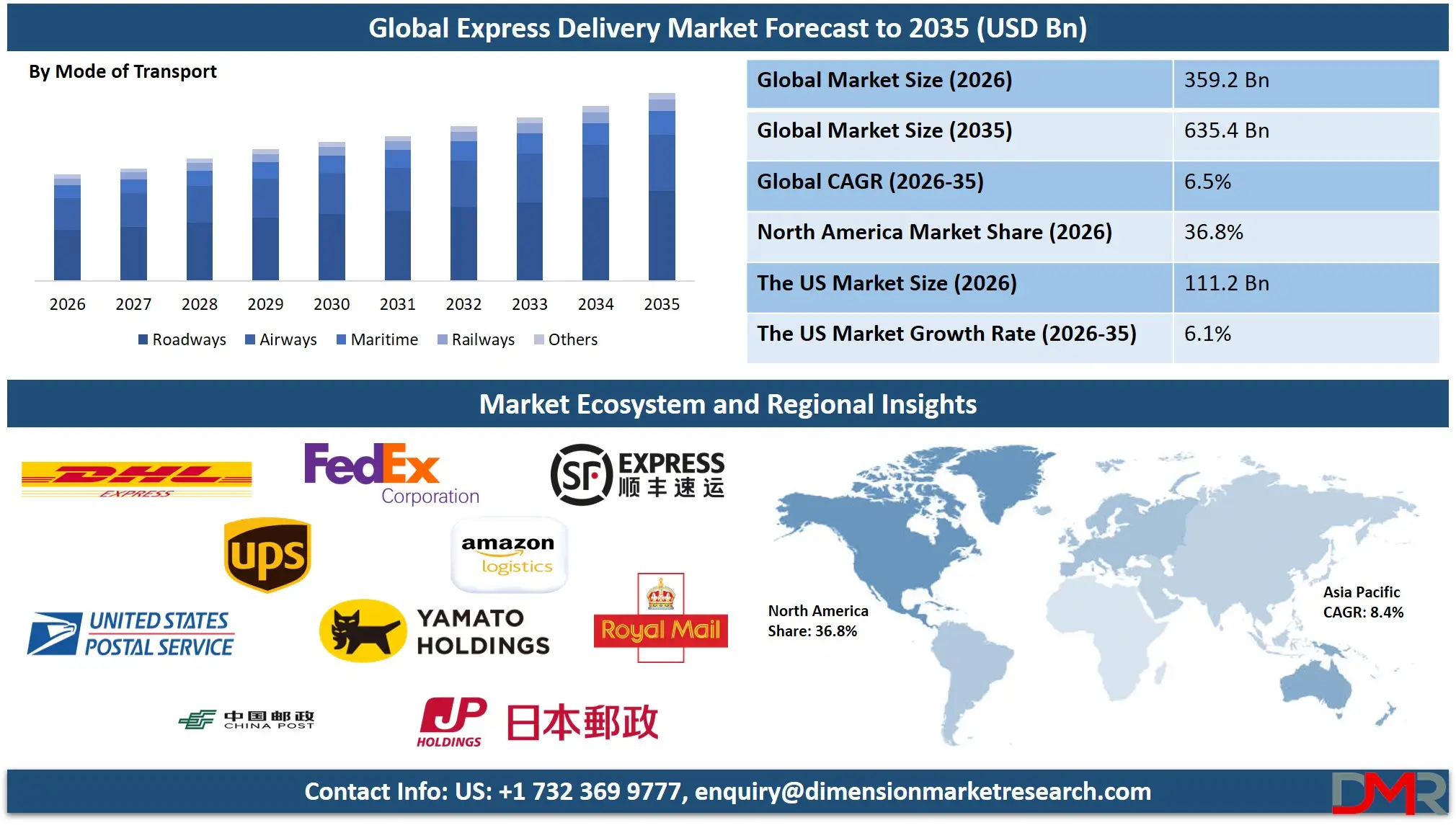
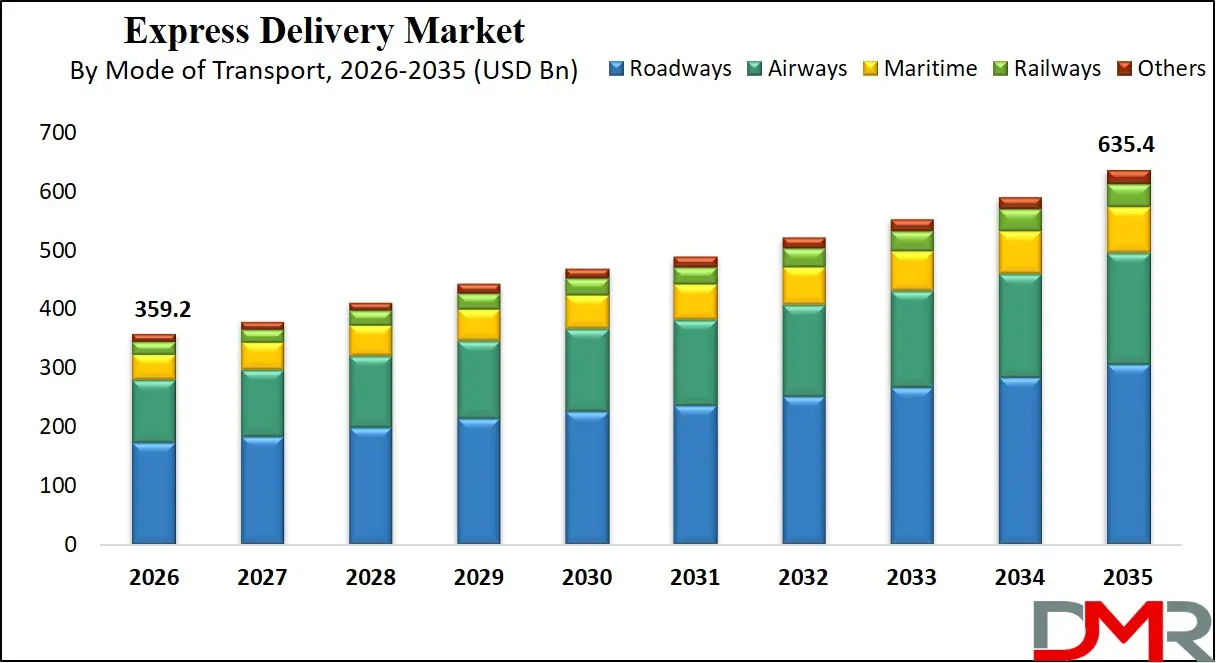
The Global Express Delivery Market is projected to reach USD 359.2 billion in 2026 and grow at a compound annual growth rate of 6.5% from there until 2035 to reach a value of USD 635.4 billion. The market's robust growth is driven by the exponential expansion of e-commerce, shifting consumer expectations for speed and transparency, rising B2B supply chain digitization, and the accelerated adoption of AI-driven logistics optimization and automated sorting technologies.
ℹ
To learn more about this report –
Download Your Free Sample Report Here
Express delivery enables precise, time-definite, and increasingly flexible movement of parcels and freight through advanced route optimization, real-time tracking infrastructure, and predictive demand modeling. The model addresses critical industry challenges related to last-mile efficiency, delivery cost compression, reverse logistics complexity, and urban congestion, supporting enterprises in achieving higher customer satisfaction and operational agility.
Technological advancements, including autonomous delivery vehicles, drone-based instant logistics, AI-powered dynamic routing, blockchain-based shipment traceability, and fully integrated warehouse execution systems, are transforming the market into a scalable and highly responsive ecosystem. Integration of machine learning algorithms for demand forecasting, network capacity planning, and adaptive pricing is reshaping service offerings and profitability structures.
ℹ
To learn more about this report –
Download Your Free Sample Report Here
Growing government and industry initiatives promoting digital trade infrastructure, sustainable last-mile mobility, and cross-border facilitation further accelerate global adoption. However, barriers such as rising fuel costs, driver shortages, urban access restrictions, and data privacy concerns remain. Despite these limitations, the convergence of automation, real-time visibility, and consumer-centric logistics positions express delivery as a central pillar of global commerce infrastructure through 2035.
The US Express Delivery Market
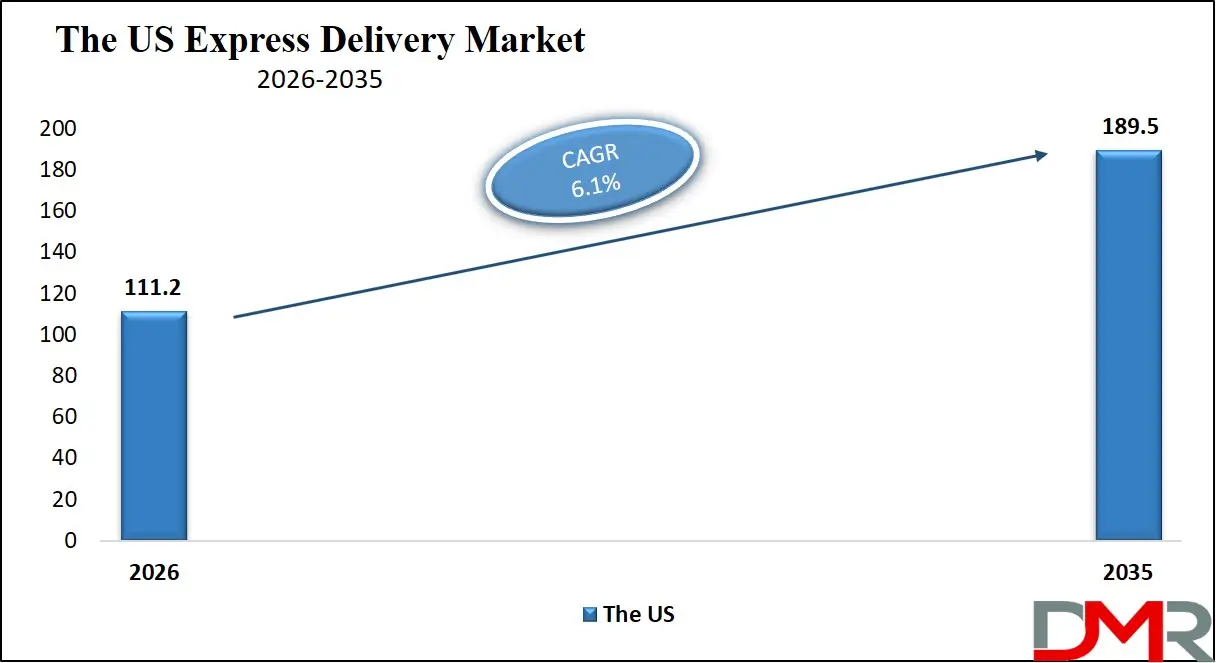
The US Express Delivery Market is projected to reach USD 111.2 billion in 2026 and grow at a CAGR of 6.1%, reaching USD 189.5 million by 2035. The U.S. leads global adoption due to its mature e-commerce penetration, extensive transportation infrastructure, and intense competitive dynamics among incumbent carriers and new-entrant platform logistics providers.
The pressing need to fulfill two-day and same-day delivery expectations across continental distances, coupled with rising labor and real estate costs, fuels demand for automated sortation and flexible final-mile solutions. Major retailers, marketplace aggregators, and logistics firms are deploying robotic distribution centers and gig-economy delivery fleets to compress delivery windows while managing cost-to-serve. Companies such as Amazon Logistics, UPS, FedEx, and Walmart are piloting and scaling drone delivery, sidewalk bots, and electric cargo vans across metropolitan markets.
ℹ
To learn more about this report –
Download Your Free Sample Report Here
U.S. regulatory support for autonomous vehicle testing and zero-emission last-mile fleets, alongside infrastructure investment under federal modernization programs, encourages capital deployment. Workforce retraining initiatives and partnerships with community colleges are emerging to develop logistics technology expertise, ensuring smooth integration of automation into legacy carrier networks.
The rapid rise of consolidated delivery platforms, real-time shipment visibility APIs, and integration with retail order management systems continues to redefine the U.S. logistics landscape, positioning the country as a global bellwether in express delivery innovation.
The Europe Express Delivery Market
The Europe Express Delivery Market is estimated to be valued at USD 95.2 billion in 2026 and is further anticipated to reach USD 168.4 billion by 2035 at a CAGR of 6.5%. Europe's leadership is anchored by dense urban populations, strong cross-border trade integration, and stringent regulatory emphasis on sustainable urban logistics and driver welfare.
Countries such as Germany, the U.K., France, the Benelux region, and Italy are witnessing intense express delivery adoption, driven by rapid e-commerce penetration, high expectations for next-day and scheduled delivery, and EU-backed initiatives like the Green Deal and Urban Mobility Framework. The German Mittelstand of specialized logistics and engineering firms is particularly active in developing electric last-mile fleets and micro-hub consolidation strategies.
Europe's fragmented urban geography, demand for low-emission delivery zones, and push for circular economy integration further drive adoption. Funding through Horizon Europe and national digital transport programs supports R&D in cargo bike logistics, autonomous urban freight, and interoperable tracking standards. Retail consolidators, healthcare logistics providers, and industrial distributors increasingly deploy AI-optimized delivery networks, dynamic time-slot management, and returns-integrated reverse logistics. With strong consumer protection frameworks, emphasis on driver working conditions, and cross-border harmonization, Europe remains one of the most advanced regions in sustainable express delivery penetration.
The Japan Express Delivery Market
The Japan Express Delivery Market is projected to be valued at USD 23.3 billion in 2026. It is further expected to witness subsequent growth in the upcoming period, holding USD 50.6 billion in 2035 at a CAGR of 9.0%. Japan's focus on precision logistics, exceptional service reliability, and severe last-mile labor shortage drives high demand for automation and re-delivery reduction solutions.
The Ministry of Land, Infrastructure, Transport and Tourism actively supports logistics digitalization and consolidation through smart supply chain initiatives, subsidies for automated locker deployment, and integration of delivery data into urban planning systems. Japan's leadership in robotics, compact automation, and consumer-facing delivery technology accelerates innovation in secure parcel lockers, temperature-controlled instant delivery, and AI-based route compression suitable for dense metropolitan environments.
Japan's concept of "Society 5.0", driven by companies like Yamato Holdings, Sagawa Express, and Hitachi Transport, integrates IoT, robotics, and predictive analytics into seamless delivery workflows. Express delivery systems are being deployed in fresh food e-commerce, pharmaceutical cold chain, and regional same-day logistics networks. Japan's cultural emphasis on precise time-definite service and exceptional customer experience, combined with advanced logistics technology, positions the country as a high-growth innovator in urban express delivery.
Global Express Delivery Market: Key Takeaways
- Steady Global Market Growth Outlook: The Global Express Delivery Market is expected to be valued at USD 359.2 billion in 2026 and is projected to reach USD 635.4 billion by 2035, showcasing consistent expansion supported by rising e-commerce penetration and B2B supply chain modernization.
- Healthy CAGR Driven by Digitalization: The market is expected to grow at a CAGR of 6.5% from 2026 to 2035, fueled by accelerating AI-driven route optimization, automated warehouse integration, real-time shipment visibility, and increasing consumer expectations for compressed delivery windows.
- Strong Growth Trajectory in the United States: The U.S. Express Delivery Market stands at USD 111.2 billion in 2026 and is projected to reach USD 189.5 billion by 2035, expanding at a CAGR of 6.1% due to robust e-commerce activity, intense carrier competition, and advanced logistics automation adoption.
- North America Maintains Regional Dominance: North America is expected to capture approximately 36.8% of the global market share in 2026, supported by mature logistics infrastructure, significant technology investment, and early adoption of autonomous and drone-based delivery systems.
- Rapid Advancement in Delivery Technologies: Innovations including autonomous ground vehicles, beyond-visual-line-of-sight drone delivery, AI-based dynamic pricing, and blockchain-enabled cross-border clearance are significantly accelerating the speed, reliability, and cost-efficiency of express delivery services.
- Growing Focus on Sustainability Boosts Investment: Rising global pressure to decarbonize last-mile logistics, coupled with urban congestion pricing and low-emission zone regulations, is driving sustained demand for electric fleets, cargo bike integration, and micro-hub consolidation strategies.
Global Express Delivery Market: Use Cases
- Retail & E-Commerce Fulfillment: Express carriers provide next-day and same-day delivery for online orders, integrating with retailer inventory systems to offer precise time-slot selection, real-time tracking, and frictionless returns processing directly from consumer doorsteps.
- Healthcare & Pharmaceutical Logistics: Time-critical and temperature-controlled express services transport prescription medications, diagnostic specimens, and clinical trial materials under strict chain-of-custody and regulatory compliance requirements.
- Automotive & Industrial Spare Parts: Just-in-time express delivery of critical components to manufacturing lines and dealership service centers prevents production stoppages and reduces dealer inventory carrying costs through rapid replenishment networks.
- Technology & Electronics Launches: High-value, lightweight consumer electronics and enterprise hardware are expedited through dedicated express channels for new product launches, pre-order fulfillment, and urgent field service replacement.
- Financial & Legal Document Exchange: Time-definite express services transport sensitive contracts, negotiable instruments, and regulatory filings under secure chain-of-custody protocols with precise delivery windows and proof-of-delivery validation.
Global Express Delivery Market: Stats & Facts
- The Universal Postal Union (UPU) reports that cross-border e-commerce volumes are growing at around 17% annually, with express delivery representing the fastest-growing segment due to consumer demand for tracked, time-definite international shipments.
- The U.S. Department of Transportation projects that autonomous delivery vehicles could reduce last-mile operating costs by up to 40%, reinforcing how express delivery automation through route compression and labor optimization can maintain profitability, especially where over 60% of total shipment cost is concentrated in final-mile delivery.
- McKinsey & Company data indicates that advanced delivery density optimization can reduce failed delivery attempts by 30–50% and cut per-parcel delivery costs by up to 25% compared to traditional route planning, validating AI-based optimization as essential for cost-competitive express operations.
- The European Commission’s Sustainable Transport Forum notes that urban last-mile deliveries account for up to 25% of city transport CO2 emissions and 30–50% of particulate matter, driving regulatory mandates for zero-emission fleets and consolidated delivery models in major metropolitan areas.
- According to Global Logistics Technology Surveys, adoption of AI-enhanced dynamic routing and real-time shipment visibility platforms is growing at over 22% annually in emerging markets, as cloud-based logistics software becomes more accessible and adaptable to fragmented carrier networks.
- The World Economic Forum (WEF) projects that demand for urban last-mile delivery will grow by 78% by 2035, driven by e-commerce penetration; express delivery mitigates congestion and emissions through route optimization, delivery density consolidation, and alternative vehicle deployment.
Global Express Delivery Market: Market Dynamic
Driving Factors in the Global Express Delivery Market
Rising Consumer Expectations for Speed and Convenience
The escalating demand for compressed delivery windows from two-day to same-day and instant, across both B2C and B2B segments is a major driver for express delivery adoption. The need to secure customer loyalty, reduce cart abandonment, and compete with platform-native logistics providers significantly increases reliance on high-velocity delivery networks. Express systems provide precise time-slot commitment, real-time visibility, and frictionless returns, enabling retailers and manufacturers to differentiate service levels and command premium pricing, especially in saturated e-commerce markets.
Technology Innovation and Logistics Automation
Express delivery benefits heavily from rapid progress in autonomous mobile robots, AI-based dynamic routing, drone technology, and cloud-based transportation management systems. Advanced platforms feature real-time traffic integration, predictive ETAs, automated dispatch optimization, and customer preference learning, with seamless last-mile handoffs. These innovations enable compressed delivery windows in dense urban environments, adjust to real-time demand fluctuations, and optimize asset utilization. The convergence of delivery platforms with retail order management systems and inventory visibility networks further enhances service reliability and cost efficiency, making express delivery a cornerstone of modern omnichannel commerce.
Restraints in the Global Express Delivery Market
Escalating Last-Mile Operating Costs and Labor Constraints
The significant and rising cost of final-mile delivery, including driver wages, vehicle maintenance, fuel, and failed delivery reattempts, pressures margins across the express industry. Many carriers face acute labor shortages in mature markets and require sustained productivity gains to offset wage inflation. Additionally, integration of delivery operations into congested urban environments requires further investment in micro-hubs, low-emission fleets, and parcel locker networks, creating capital intensity challenges.
Infrastructure Gaps and Regulatory Fragmentation
Delivery infrastructure, access restrictions, and clearance protocols vary widely across countries and municipalities, creating complexity in network standardization and cross-border service consistency. Issues include inconsistent urban delivery time windows, heterogeneous electric vehicle charging infrastructure, and fragmented customs digitization. Furthermore, not all cross-border trade corridors, especially those with manual clearance processes or inadequate transport connectivity, are easily adaptable to time-definite express commitments without significant buffer inventory and contingency routing.
Opportunities in the Global Express Delivery Market
Expansion into Emerging Economies and Tier-2 Cities
Emerging markets represent major growth opportunities due to rapidly expanding middle-class consumption, mobile-first e-commerce adoption, and underpenetrated organized logistics infrastructure. Countries in Southeast Asia, Latin America, and the Middle East are launching digital trade corridors and modernizing postal networks where express delivery can leapfrog legacy service paradigms. Local logistics partnerships, gig-economy delivery models, and government facilitation of cross-border e-commerce can improve accessibility. Furthermore, the expansion of e-commerce beyond Tier-1 cities into secondary urban centers presents new density-building opportunities for express carriers.
AI-Driven Dynamic Yield Management and Pricing Optimization
The integration of AI not only for route planning but for real-time demand-based pricing, capacity allocation optimization, and customer willingness-to-pay segmentation creates new revenue management capabilities. AI can analyze historical shipment data, real-time order intake, and network capacity to dynamically adjust service rates, optimize consolidation decisions, and continuously improve profitability by shipment profile. Integration with e-commerce checkout platforms allows for contextual delivery option presentation, transforming express delivery from a cost center into a strategic revenue and retention asset.
Trends in the Global Express Delivery Market
Shift to Consolidated and Sustainable Last-Mile Models
The rise of micro-consolidation hubs, cargo bike integration, and multi-carrier aggregation platforms is gaining traction, especially in congested European and Asian metropolitan areas. These models provide rapid, low-emission delivery solutions for same-day and instant segments, enabling efficient curb access and reduced failed delivery rates. This trend lowers entry barriers for specialized local carriers, improves delivery density economics, and addresses regulatory sustainability mandates.
Unified Visibility and Carrier-Agnostic Orchestration
Centralized orchestration platforms are enabling multi-carrier rate shopping, shipment tracking normalization, and proactive exception management across fragmented logistics networks. Supply chain managers can monitor delivery performance, cost-to-serve, and carrier compliance in real time, optimizing mode selection and contingency routing. This trend supports the scalable deployment of hybrid delivery networks across enterprises with diverse shipment profiles and geographic footprints.
Global Express Delivery Market: Research Scope and Analysis
By Destination Analysis
Domestic Delivery is projected to dominate the Destination segment of the Global Express Delivery Market. This dominance is driven by the sheer volume of intra-country e-commerce parcels, the ability to offer compressed delivery windows (next-day, same-day) within established transport networks, and the operational control carriers maintain over domestic line-haul and last-mile assets. Domestic express provides the highest density economics and enables premium service tiers with reliable time-definite commitments. While International Delivery addresses the critical need for cross-border trade and global supply chain connectivity, its adoption is constrained by customs clearance variability, longer transit times, and higher unit costs. Therefore, the imperative for rapid, cost-efficient fulfillment of domestic e-commerce orders, coupled with continuous investment in automated sortation and urban delivery infrastructure, secures Domestic Delivery's leading market position throughout the forecast period.
By Business Model Analysis
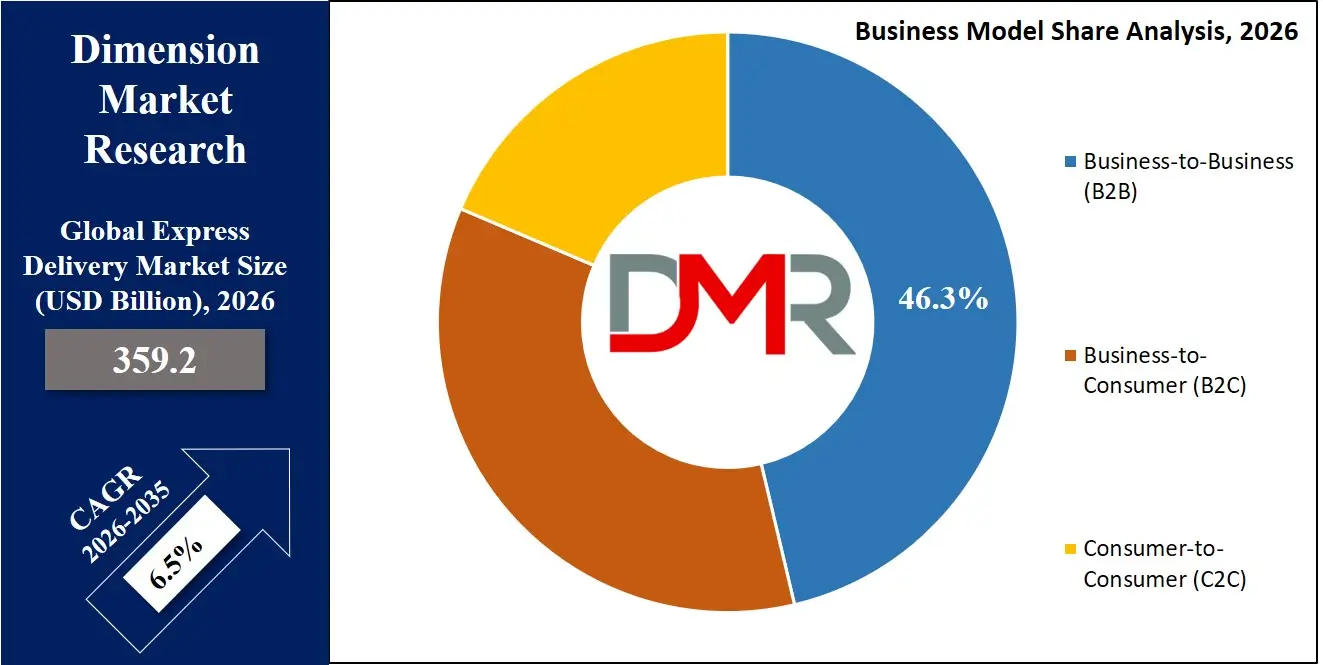
Business-to-Consumer (B2C) Delivery is projected to dominate the global market, as it represents the fastest-growing and most volume-intensive segment of express logistics. Its dominance stems from the structural shift of retail to online channels, consumer expectations for transparent, flexible delivery experiences, and the strategic importance of delivery performance in e-commerce conversion and retention. The driving forces are the maturation of omnichannel retail, the proliferation of direct-to-consumer brands, and the increasing willingness of consumers to pay for delivery speed and convenience.
ℹ
To learn more about this report –
Download Your Free Sample Report Here
Business-to-Business (B2B) Delivery remains a crucial and high-revenue segment, serving the time-definite transport of documents, spare parts, and finished goods across industrial and commercial supply chains. By providing reliable, auditable, and often contractually-guaranteed service, it enables just-in-time inventory strategies and operational continuity. This balance of revenue stability and high-value shipment composition makes it a foundational and enduring segment.
By Mode of Transport Analysis
Roadways forms a fundamental and dominant transport mode segment, as trucks and light commercial vehicles provide the essential connectivity between air hubs, sortation centers, and final delivery destinations. Surface transportation is indispensable for first-mile collection, line-haul between metropolitan markets, and the vast majority of last-mile customer contacts.
Airways is another critical and high-value segment, directly correlated to time-definite commitments over long distances and international corridors. Freighters and commercial belly-cargo capacity enable next-morning delivery commitments across continents and maintain the integrity of integrated express networks.
Maritime serves specialized heavyweight express applications and integrated sea-air hybrid solutions where extreme cost sensitivity outweighs marginal transit time compression.
By Shipment Weight Analysis
Lightweight shipments dominate global express volume, driven by e-commerce parcels, documents, and small electronics. Its dominance stems from the exponential growth of online retail, where the majority of consumer purchases fall within lightweight categories. The driving forces are rising B2C parcel volumes, consumer expectations for affordable shipping, and continuous compression of carrier cost-to-serve through route optimization. As e-commerce penetration deepens globally, the economic and operational case for lightweight shipment scale becomes compelling.
Heavyweight shipments form the premium revenue tier for B2B freight express, industrial equipment, and bulk healthcare logistics. This segment serves assets where shipment value justifies expedited, white-glove treatment and where production stoppage costs far exceed transport premiums. By providing time-definite, heavy-lift capability, it enables just-in-time manufacturing replenishment and capital equipment installation. This balance of premium pricing and mission-critical application makes it a resilient and high-margin practice, addressing the reality that not every heavyweight move requires express speed, but for those that do, the cost is readily justified.
By Service Type Analysis
Time-Definite Delivery (Express) is the foundational premium tier guaranteeing delivery by a specified time, typically 10:30 AM or end-of-day, with full tracking and proof of delivery. Its dominance stems from the non-negotiable nature of legal, financial, and healthcare shipments where lateness carries contractual penalties or clinical consequences. The driving forces are globalized commerce, just-in-time business processes, and regulatory requirements for auditable chain-of-custody. As enterprises continue to externalize inventory holding costs to transport speed, the economic case for time-definite commitments remains resilient.
Next-Day Delivery is now the universal e-commerce baseline across mature markets, frequently included in standard shipping thresholds or loyalty program benefits. This segment serves the expectation that online orders placed today arrive tomorrow, a standard now embedded in consumer purchasing behavior. Its strength lies in massive addressable volume and the operational discipline of evening cutoff, overnight line-haul, and dawn sortation cycles. This equilibrium of consumer expectation and carrier economics makes it the volume anchor of the integrated express industry, addressing the reality that next-day is no longer a premium upcharge but a competitive necessity.
By End-User Industry Analysis
Retail & E-commerce is poised to be the largest and most dominant vertical, encompassing omnichannel merchants, marketplace sellers, and direct-to-consumer brands. The high velocity of parcel generation, intense delivery speed competition, and strategic importance of returns logistics create a perfect use case for time-definite and same-day express services to secure customer loyalty and repeat purchase behavior.
Healthcare & Pharmaceuticals ranks as the second-fastest-growing vertical, fueled by the expansion of direct-to-patient pharmacy, specialty drug distribution, and clinical trial logistics. The criticality of cold-chain integrity, chain-of-custody documentation, and regulatory compliance positions express delivery as essential infrastructure for modern healthcare supply chains.
Technology & Electronics is a major adopter, driven by product launch cycles, high-value compact shipments, and urgent field replacement requirements. The push towards direct sales models and premium unboxing experiences directly integrates express delivery into technology brand positioning.
The Global Express Delivery Market Report is segmented on the basis of the following:
By Destination
By Business Model
- Business-to-Business (B2B)
- Business-to-Consumer (B2C)
- Consumer-to-Consumer (C2C)
By Mode of Transport
- Roadways
- Airways
- Railways
- Maritime
- Others
By Shipment Weight
- Lightweight
- Medium Weight
- Heavyweight
By Service Type
- Time-Definite Delivery (Express)
- Deferred Delivery (Standard)
- Same-Day Delivery
- Next-Day Delivery
- Instant Delivery (On-Demand)
- Freight Express
By End-User Industry
- Retail & E-commerce
- Healthcare & Pharmaceuticals
- Automotive & Industrial
- Banking, Financial Services & Insurance (BFSI)
- Technology & Electronics
- Manufacturing
- Construction
- Others
Impact of Artificial Intelligence in the Global Express Delivery Market
- AI for Dynamic Routing & Real-Time Optimization: AI analyzes continuous streams of traffic data, order intake, and driver availability to dynamically adjust pickup and delivery sequences, reducing miles driven and improving on-time performance while adapting to real-time disruptions.
- AI-Driven Demand Forecasting & Capacity Planning: Advanced algorithms correlate historical shipment patterns, promotional calendars, and macroeconomic indicators to predict volume surges and optimize workforce scheduling, vehicle deployment, and sortation capacity across network nodes.
- Predictive ETA & Proactive Exception Management: AI models use real-time telematics and historical route performance to provide precise, continuously updated delivery time predictions, enabling proactive customer communications and automated re-routing when disruptions occur.
- AI-Based Delivery Density Optimization: AI analyzes customer density and order profiles to consolidate deliveries, optimize stop sequencing, and recommend micro-hub placement, driving significant reduction in cost-per-stop and emissions-per-parcel.
- Learning from Returns and Preference Data: AI systems aggregate data across failed delivery attempts, customer rescheduling requests, and alternative drop-off selections to continuously improve first-attempt success rates and personalize delivery experience options.
Global Express Delivery Market: Regional Analysis
Region with the Largest Revenue Share
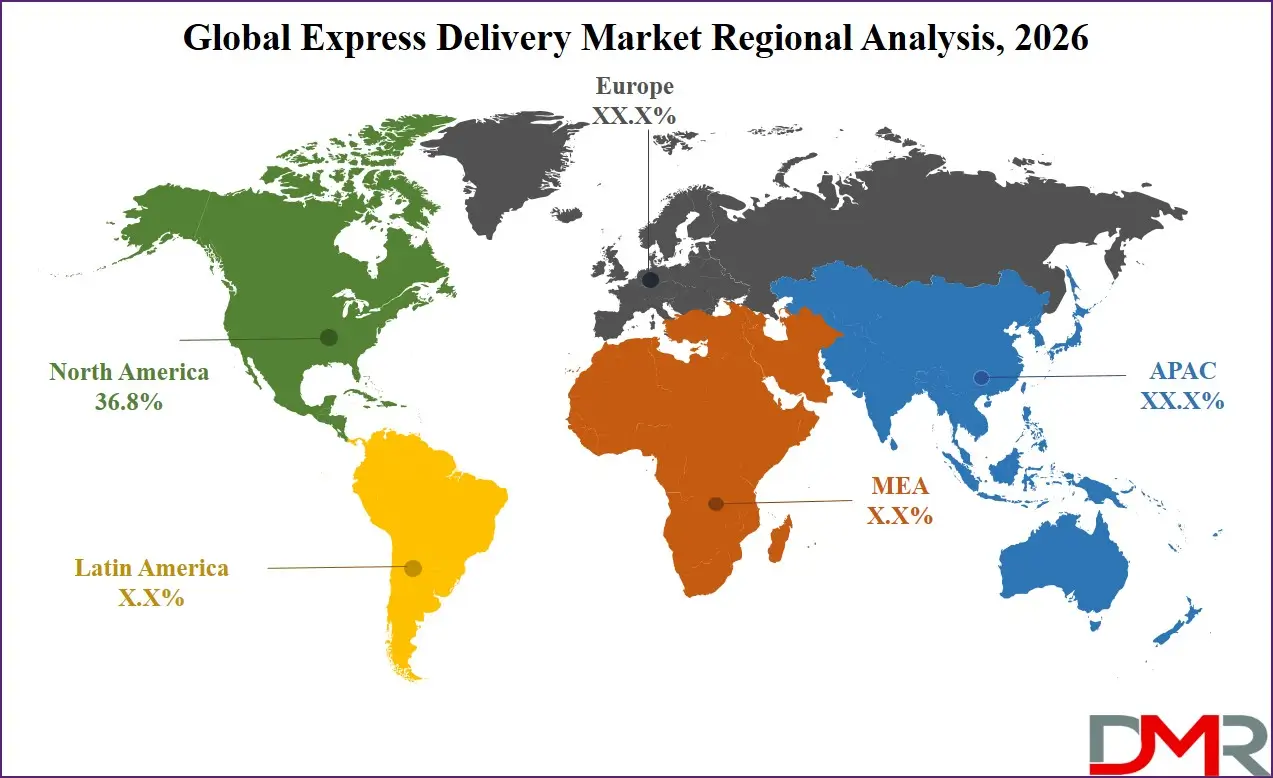
North America is projected to dominate the Global Express Delivery Market with 36.8% of market share by the end of 2026, owing to a powerful combination of mature e-commerce penetration, high consumer spending capacity, advanced transportation infrastructure, and the presence of dominant global integrators. The United States and Canada have rapidly integrated AI-based routing and automated sortation into express networks, supported by a culture of delivery speed competition and service innovation. Major retailers and carriers are institutionalizing express delivery capabilities to maintain market position and customer retention.
ℹ
To learn more about this report –
Download Your Free Sample Report Here
The region's high labor costs and intense competitive pressure, coupled with consumer willingness to pay for delivery speed and convenience, create a compelling economic case for continuous automation investment. Supportive regulatory frameworks for autonomous vehicle testing and a well-capitalized venture ecosystem for logistics technology startups further solidify North America's leadership position.
Region with the Highest CAGR
Asia-Pacific holds the highest CAGR and is poised to achieve rapid market share growth due to its massive and expanding e-commerce consumer base, rapid logistics infrastructure modernization, government-led digital trade facilitation, and mobile-first shopping behavior. Countries like China, India, Japan, and Southeast Asian nations are investing heavily in express delivery networks to serve rising middle-class consumption and cross-border trade integration. China's cross-border e-commerce pilot zones and India's logistics digitization initiatives are creating fertile ground for adoption. The region's price sensitivity is being addressed through localized last-mile models, gig-economy delivery platforms, and partnerships between global express carriers and regional e-commerce ecosystems. This, combined with an immense and still-underpenetrated parcel volume potential, positions APAC as the fastest-growing market for express delivery services.
By Region
North America
Europe
- Germany
- The U.K.
- France
- Italy
- Russia
- Spain
- Benelux
- Nordic
- Rest of Europe
Asia-Pacific
- China
- Japan
- South Korea
- India
- ANZ
- ASEAN
- Rest of Asia-Pacific
Latin America
- Brazil
- Mexico
- Argentina
- Colombia
- Rest of Latin America
Middle East & Africa
- Saudi Arabia
- UAE
- South Africa
- Israel
- Egypt
- Rest of MEA
Global Express Delivery Market: Competitive Landscape
The Global Express Delivery Market is highly competitive and moderately consolidated, featuring a mix of global integrated carriers, national postal operators, regional parcel specialists, and technology-native platform logistics providers. Leading global integrators UPS, FedEx, and DHL Group leverage their extensive air networks, global clearance capabilities, and comprehensive service portfolios. Pure-play express innovators such as Amazon Logistics, Aramex, and ZTO Express are driving market dynamics with agile, technology-centric operating models.
E-commerce and technology platforms like Shopify (for fulfillment network integration), Alibaba's Cainiao, and JD Logistics play increasingly influential roles as orchestrators of multi-carrier delivery ecosystems. Major retailers are also entering the space through captive logistics units, aiming to own the customer delivery experience and compress fulfillment cycles.
Some of the prominent players in the Global Express Delivery Market are:
- DHL Express
- FedEx Corporation
- United Parcel Service (UPS)
- SF Express (Group) Co., Ltd.
- Amazon Logistics
- United States Postal Service (USPS)
- Yamato Holdings Co., Ltd.
- Japan Post Holdings Co., Ltd.
- Royal Mail Group
- La Poste Group
- China Post Group Corporation
- Aramex International
- PostNL
- TNT Express
- JD Logistics
- CJ Logistics
- Singapore Post Limited
- Pos Malaysia Berhad
- General Logistics Systems B.V. (GLS)
- Other Key Players
Recent Developments in the Global Express Delivery Market
- February 2026: FedEx and Advent‑led consortium agreed to acquire European automated parcel locker provider InPost in approximately USD 9.2 billion deal, strengthening FedEx’s last‑mile delivery network and automated pickup/storage infrastructure in Europe.
- October 2025: Delhivery completed its acquisition of Ecom Express after regulatory approval, integrating the network and expanding express parcel delivery capabilities in India, one of the largest consolidation moves in the country’s logistics sector in 2025.
- September 2025: The newly enlarged Evri Group (merger of Evri and DHL eCommerce UK) continued strategic investments in its UK parcel network ahead of peak seasons, building network capacity and enhancing service offerings.
- September 2025: The UK’s Competition and Markets Authority (CMA) granted unconditional approval for the merger between Evri and DHL eCommerce UK, paving the way for the new enlarged parcel delivery business.
- March 2025: Parcel delivery companies significantly expanded automated parcel locker networks worldwide in response to increasing online shopping demand, with major carriers reporting double‑digit growth in locker installations across Europe and Asia.
Report Details
| Report Characteristics |
| Market Size (2026) |
USD 359.2 Bn |
| Forecast Value (2035) |
USD 635.4 Bn |
| CAGR (2026–2035) |
6.5% |
| The US Market Size (2026) |
USD 111.2 Bn |
| Historical Data |
2020 – 2025 |
| Forecast Data |
2027 – 2035 |
| Base Year |
2025 |
| Estimate Year |
2026 |
| Report Coverage |
Market Revenue Estimation, Market Dynamics, Competitive Landscape, Growth Factors and etc. |
| Segments Covered |
By Destination (Domestic and International), By Business Model (Business-to-Business (B2B), Business-to-Consumer (B2C) and Consumer-to-Consumer (C2C)), By Mode of Transport (Roadways, Airways, Railways, Maritime and Others), By Shipment Weight (Lightweight, Medium Weight and Heavyweight), By Service Type (Time-Definite Delivery (Express), Deferred Delivery (Standard), Same-Day Delivery, Next-Day Delivery, Instant Delivery (On-Demand) and Freight Express), By End-User Industry (Retail & E-commerce, Healthcare & Pharmaceuticals, Automotive & Industrial, Banking, Financial Services & Insurance (BFSI), Technology & Electronics, Manufacturing, Construction and Others) |
| Regional Coverage |
North America – The US and Canada; Europe – Germany, The UK, France, Russia, Spain, Italy, Benelux, Nordic, & Rest of Europe; Asia-Pacific – China, Japan, South Korea, India, ANZ, ASEAN, Rest of APAC; Latin America – Brazil, Mexico, Argentina, Colombia, Rest of Latin America; Middle East & Africa – Saudi Arabia, UAE, South Africa, Turkey, Egypt, Israel, & Rest of MEA |
| Prominent Players |
DHL Express, FedEx Corporation, United Parcel Service (UPS), SF Express (Group) Co., Ltd., Amazon Logistics, United States Postal Service (USPS), Yamato Holdings Co., Ltd., Japan Post Holdings Co., Ltd., Royal Mail Group, La Poste Group, China Post Group Corporation, Aramex International, PostNL, TNT Express, JD Logistics (China), CJ Logistics (South Korea), Singapore Post Limited, Pos Malaysia Berhad, General Logistics Systems B.V. (GLS), YTO Express International (China), and Other Key Players |
| Purchase Options |
We have three licenses to opt for: Single User License (Limited to 1 user), Multi-User License (Up to 5 Users) and Corporate Use License (Unlimited User) along with free report customization equivalent to 0 analyst working days, 3 analysts working days and 5 analysts working days respectively. |
Frequently Asked Questions
How big is the Global Express Delivery Market?
▾ The Global Express Delivery Market size is estimated to have a value of USD 359.2 billion in 2026 and is expected to reach USD 635.4 billion by the end of 2035.
What is the growth rate in the Global Express Delivery Market in 2026?
▾ The market is growing at a CAGR of 6.5 percent over the forecasted period of 2026.
What is the size of the US Express Delivery Market?
▾ The US Express Delivery Market is projected to be valued at USD 111.2 billion in 2026. It is expected to witness subsequent growth in the upcoming period as it holds USD 189.5 billion in 2035 at a CAGR of 6.1%.
Which region accounted for the largest Global Express Delivery Market?
▾ North America is expected to have the largest market share in the Global Express Delivery Market with a share of about 36.8% in 2026.
Who are the key players in the Global Express Delivery Market?
▾ Some of the major key players in the Global Express Delivery Market are DHL Express, FedEx Corporation, United Parcel Service (UPS), Amazon Logistics, Yamato Holdings Co., Ltd., and many others.