What is the Extended Detection and Response (XDR) Market Size?
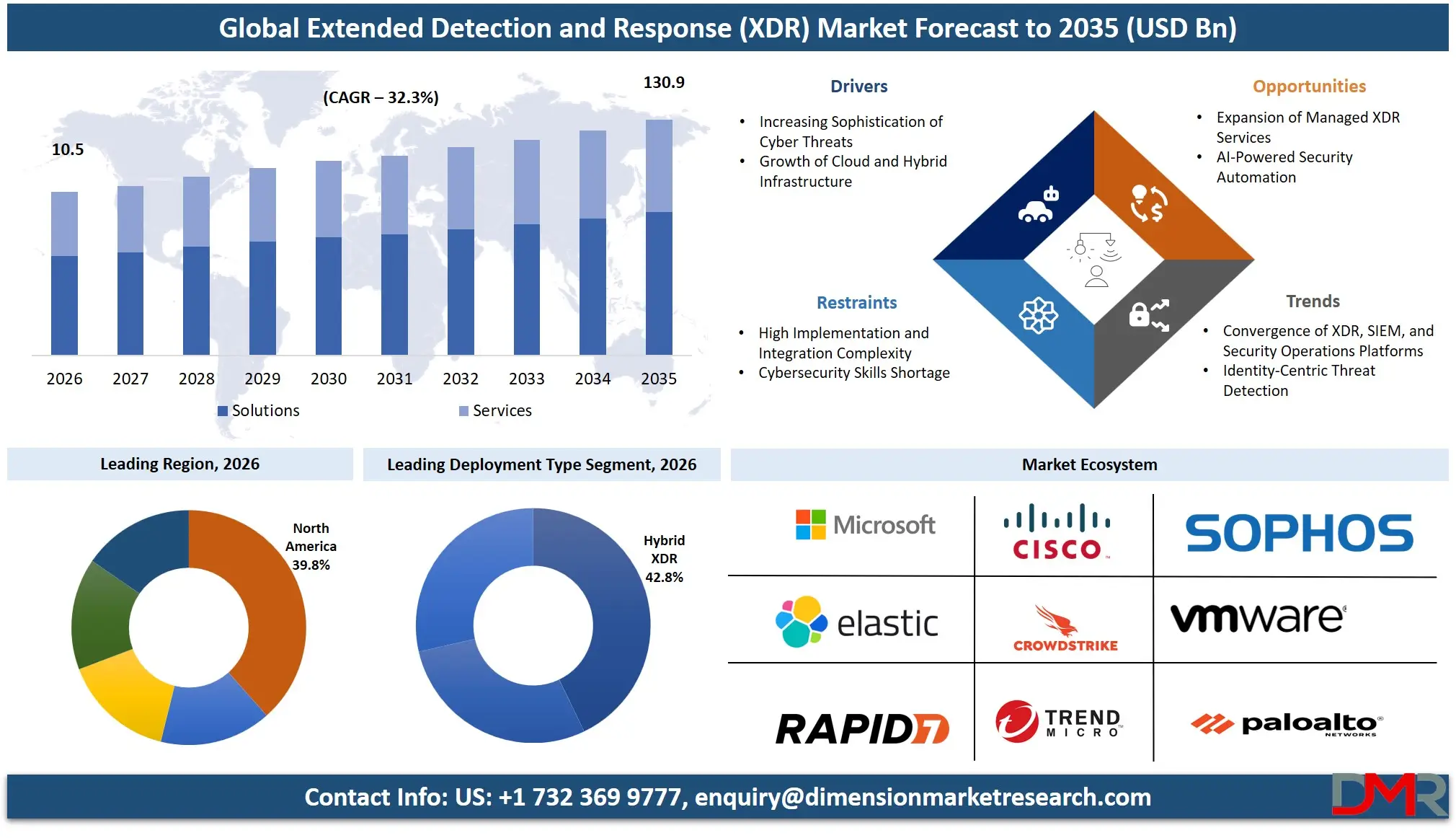
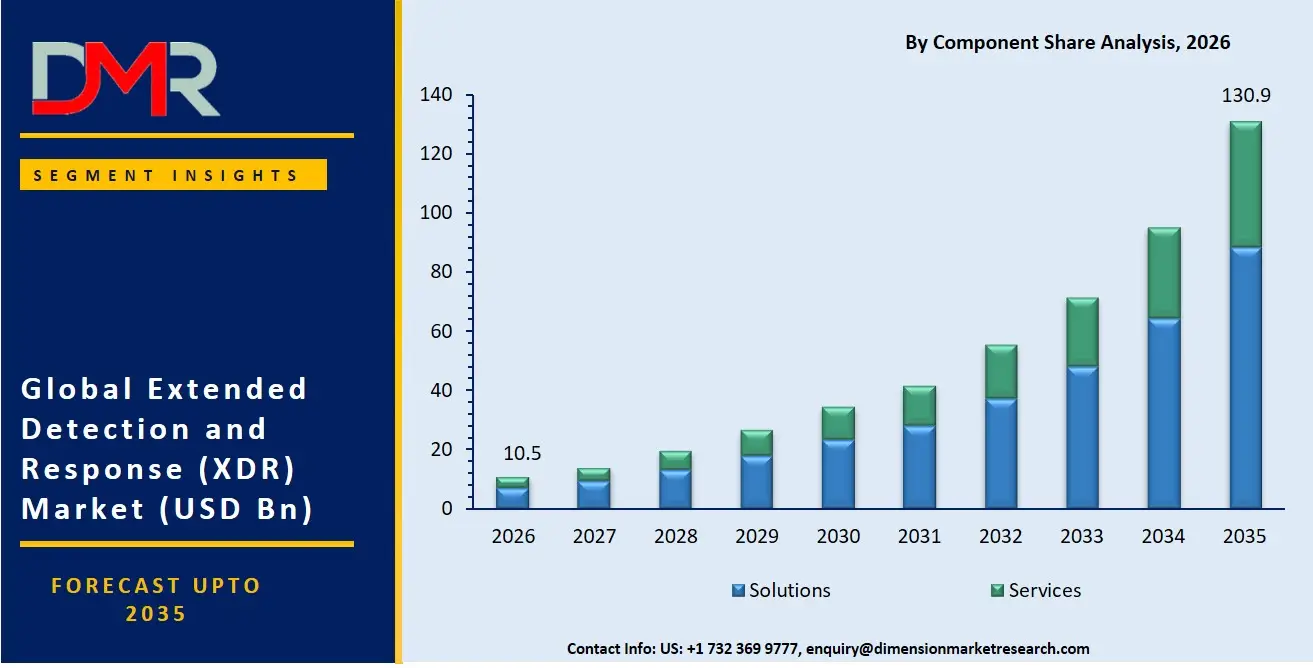
The Extended Detection and Response (XDR) Market size is expected to be USD 10.5 billion in 2026 and increase at a compound annual growth rate of 32.3% to USD 130.9 billion in 2035 due to increased complexity of cyber threats.
ℹ
To learn more about this report –
Download Your Free Sample Report Here
There is an increased growth in the Extended Detection and Response (XDR) market with the need for a unified cybersecurity approach in detecting, investigating, and responding to advanced threats in endpoints, network, cloud, identity, and application security gaining importance. Increased ransomware attacks, expansion of digital infrastructure, and the increased adoption of hybrid work models is fueling the demand for integration in security solutions. The adoption of XDR solutions is increasing among enterprises to ensure better visibility in terms of threats, minimize alert fatigue, and increase security operations efficiency. There have been advancements in AI, automation, and cloud-based security which is helping in increasing growth in the market.
The US Extended Detection and Response (XDR) Market
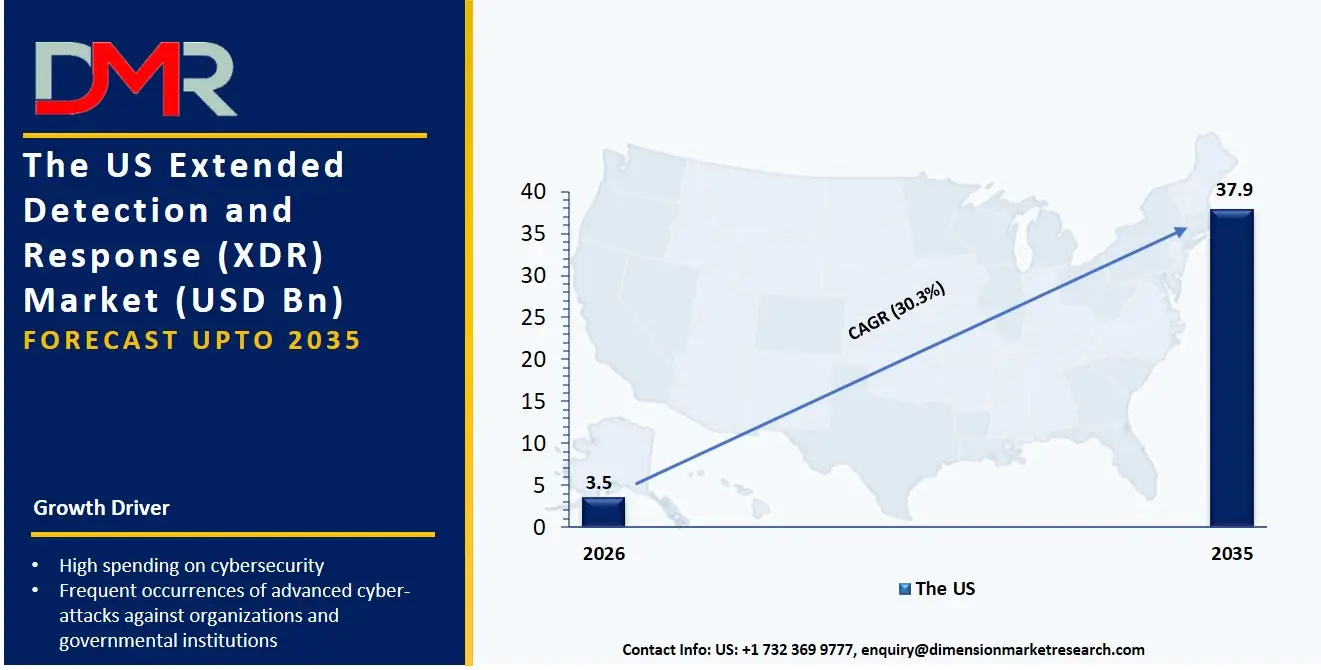
The US Extended Detection and Response (XDR) Market size is estimated to be USD 3.5 billion in 2026 and is expected to increase at a CAGR of 30.3% over the forecast period.
ℹ
To learn more about this report –
Download Your Free Sample Report Here
The U.S. is among the most advanced nations in terms of XDR markets owing to the high spending on cybersecurity, the prevalence of digital transformation programs and frequent occurrences of advanced cyber-attacks against organizations and governmental institutions. The presence of numerous cybersecurity solutions providers, cloud computing adoption, and the emergence of new regulatory standards for data security help drive the market. The availability of government programs related to cybersecurity and critical infrastructure protection is yet another factor that stimulates XDR implementation.
Europe Extended Detection and Response (XDR) Market
The Europe Extended Detection and Response (XDR) Market size is estimated to be USD 2.6 billion in 2026 and is expected to increase at a CAGR of 29.8% over the forecast period.
The XDR market in Europe is propelled by the high levels of regulations concerning cybersecurity issues, increasing digitalization, and worries related to ransomware and data breaches. The regulatory frameworks that include the GDPR, NIS2 Directive, and cybersecurity strategies in line with the NIS2, DORA, the EU Cyber Resilience Act push companies to improve their cybersecurity strategies. Financial services, manufacturing firms, healthcare companies, and government agencies are some of the frontrunners when it comes to adopting XDR technology. There is increased spending on cloud security and improved security operations in the European market.
Japan Extended Detection and Response (XDR) Market
The market size of Japan Extended Detection and Response (XDR) will be USD 525 million in 2026 and at a CAGR of 30.2% in the forecast period.
XDR market in Japan is seeing growth owing to rising awareness of cybersecurity issues, the digital transformation journey, and advancement of cyber threats faced by businesses and critical infrastructure systems. Programs that promote cybersecurity readiness and resilient digital ecosystems have been launched by the government, which encourage the adoption of XDR solutions. Some of the rapidly adopting verticals include manufacturing industry, financial services, telecom, and public sector. XDR solutions can be widely applied in Japan owing to the emphasis on Industry 4.0, smart manufacturing, and cloud migration.
Key Takeaways
- Market Size & Forecast: The Extended Detection and Response (XDR) Market size is projected to reach USD 10.5 billion in 2026 and is anticipated to have a value of USD 130.9 billion in 2035.
- Growth Rate & Outlook: The Extended Detection and Response (XDR) Market size is set to grow at a compound annual growth rate of 32.3% during the forecast period of 2026 to 2035.
- Primary Growth Drivers: Some of the major growth drivers in the market are Increased Complexity of Cyber Threats, and more.
- Key Market Trends: Some of the major trends in the market are Convergence of XDR, SIEM, and Security Operations Platforms and more.
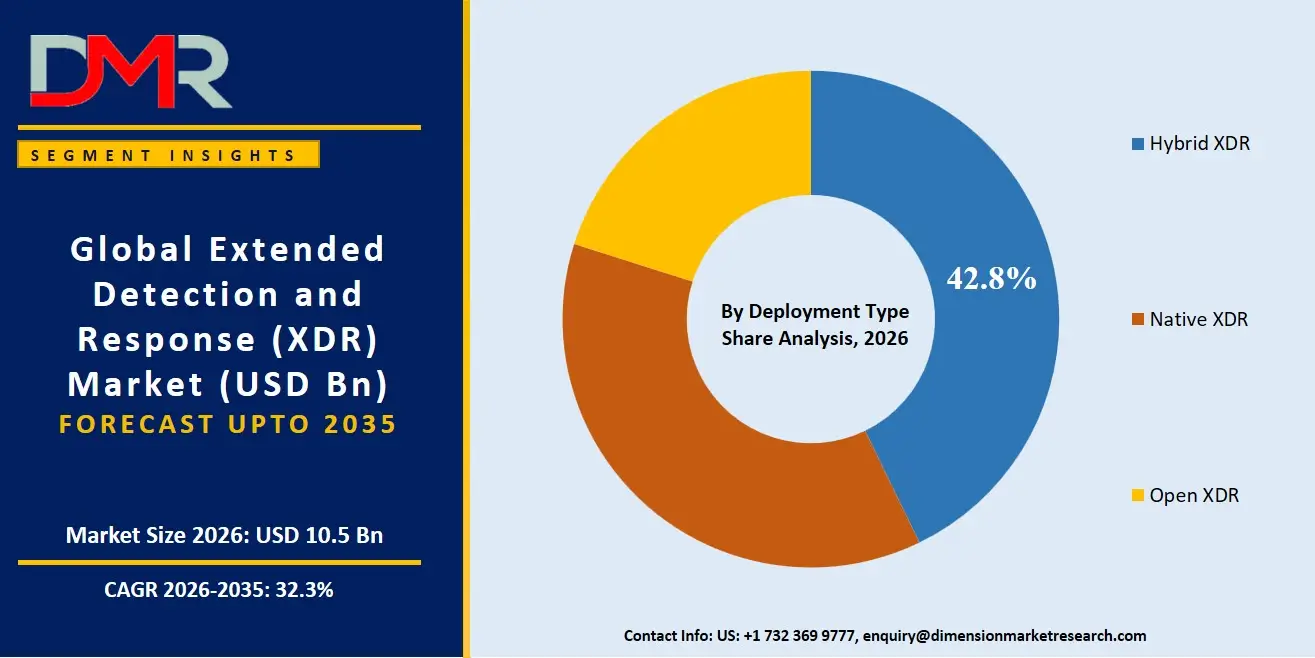
- By Deployment Type: Hybrid XDR segment is anticipated to get the majority share of the Extended Detection and Response (XDR) Market in 2026.
- By Component Type: Solutions is expected to get the largest revenue share in 2026 in the Extended Detection and Response (XDR) Market.
- By Organization Size Type: Large Enterprise segment is expected to get the largest revenue share in 2026 in the Extended Detection and Response (XDR) Market.
- Regional Leadership: North America is set to lead the Extended Detection and Response (XDR) Market with an estimated 39.8% share in 2026.
What is the Extended Detection and Response (XDR)?
Extended Detection and Response (XDR) can be defined as a kind of cybersecurity that integrates data gathered from endpoint, network, cloud infrastructure, emails, identity, and application to detect, investigate, and respond to threats. XDR technologies utilize analytics, automation, artificial intelligence, threat intelligence, and orchestration. The significance of XDR lies in its ability to address the problem of security silos and provide holistic visibility. Future trends like threat hunting powered by AI, cloud-native security architecture, identity-driven security, and automated incident response are contributing to the increasing use of XDR by organizations due to cyberattacks.
Use Cases
- Detection of Threats in Hybrid Environments: XDR gathers and correlates data from various sources such as endpoint devices, cloud workloads, network connections, and identity systems to recognize complex attack patterns. With the help of XDR, organizations can detect sophisticated threats that could go unnoticed by other security solutions.
- Enhancement of SOC Operations: With the use of XDR, organizations aim to eliminate the issue of alert fatigue and incident investigation. The automated prioritization of alerts helps SOC teams investigate only significant incidents, thereby improving the efficiency of their operations and lowering operational costs.
- Protection against Ransomware Attacks: XDR tools can detect any unusual activity related to ransomware attacks and prevent them. They provide containment and remediation functionalities that can limit the risk and reduce any kind of business disruption due to ransomware attacks.
- Cloud Security Monitoring: XDR allows enterprises to perform ongoing cloud security monitoring and detects threats in cloud environments, helping identify suspicious activities, misconfigurations, and unauthorized access across distributed cloud infrastructure.
How AI Is Transforming the Extended Detection and Response (XDR) Market
AI is revolutionizing XDR platforms through enhanced threat detection and behavioral analytics and investigations. AI-powered algorithms perform analysis of huge amounts of security telemetry data in order to detect anomalies and suspicious behavior which otherwise might be overlooked. With the help of AI, businesses can detect threats faster and more accurately without generating false positives.
The technology also helps with incident response through automations of repetitive security tasks, alert prioritization according to risk levels and provision of recommendations for security teams. With generative AI capabilities, threat hunting and root cause analysis become much easier and efficient.
Market Dynamic
Driving Factors in the Extended Detection and Response (XDR) Market
Increasing Sophistication of Cyberattacks
The growing frequency and sophistication of cyberattacks are driving demand for Extended Detection and Response (XDR) solutions. Organizations face increasingly coordinated threats, including ransomware, phishing, advanced persistent threats, and identity-based attacks that can bypass traditional security controls. XDR platforms collect and correlate telemetry from endpoints, networks, cloud environments, email, and identity systems to identify suspicious activities across multiple attack surfaces. By providing centralized threat visibility, behavioral analytics, and automated investigation, these solutions help security teams detect threats earlier and coordinate responses more effectively. Rising cybersecurity risks across banking, healthcare, manufacturing, and government sectors are encouraging organizations to strengthen their detection and response capabilities.
Growing Adoption of Cloud and Distributed IT Environments
The expansion of cloud computing, hybrid infrastructure, remote work, and connected enterprise applications is increasing the complexity of cybersecurity management. Traditional security tools often operate independently, creating visibility gaps and making it difficult to identify threats that move across different environments. XDR platforms integrate security data from distributed systems, enabling organizations to correlate events and investigate incidents through a centralized interface. This unified approach improves threat detection, streamlines security operations, and supports consistent monitoring across on-premises and cloud infrastructure. As enterprises adopt multi-cloud strategies and digital business applications, demand for integrated detection and response capabilities continues to strengthen.
Restraints in the Extended Detection and Response (XDR) Market
Integration Complexity with Existing Security Infrastructure
Integrating XDR solutions with existing security tools and enterprise IT infrastructure remains a significant market restraint. Organizations often operate diverse endpoint protection, security information and event management, identity management, network monitoring, and cloud security platforms. Connecting these systems requires compatible interfaces, reliable data pipelines, standardized telemetry, and careful configuration. Integration challenges can increase deployment time, implementation expenses, and ongoing maintenance requirements. Inconsistent data formats and limited interoperability may also affect threat correlation and detection accuracy. Organizations with complex legacy environments may therefore delay XDR adoption or require additional consulting and integration services to achieve effective security operations.
High Implementation Costs and Shortage of Skilled Professionals
The cost of deploying and maintaining XDR platforms can limit adoption, particularly among small and medium-sized enterprises with restricted cybersecurity budgets. Expenses may include software subscriptions, infrastructure upgrades, integration services, staff training, and ongoing platform management. Effective implementation also requires professionals with expertise in threat hunting, incident response, security analytics, and cloud security. A shortage of qualified cybersecurity personnel can make it difficult to configure detection rules, investigate alerts, and optimize automated response workflows. These financial and workforce constraints may slow adoption among resource-limited organizations, despite the potential benefits of improved threat visibility and operational efficiency.
Opportunities in the Extended Detection and Response (XDR) Market
Rising Demand for Managed Detection and Response Services
The growing need for continuous cybersecurity monitoring creates opportunities for XDR vendors and managed security service providers. Many organizations lack the personnel and infrastructure required to operate sophisticated security operations centers around the clock. Managed detection and response providers can use XDR platforms to deliver continuous threat monitoring, investigation, threat hunting, and incident response through subscription-based services. This model reduces the need for substantial upfront investment while providing access to specialized expertise. Demand is particularly relevant among small and medium-sized businesses, distributed enterprises, and organizations undergoing cloud transformation. Partnerships between XDR vendors and service providers can expand market reach and create recurring revenue opportunities.
Expansion of AI-Powered Security Automation
Artificial intelligence and machine learning create opportunities to improve the analytical and operational capabilities of XDR platforms. AI-enabled systems can examine large volumes of security telemetry, identify abnormal behavior, correlate related alerts, and prioritize incidents according to their potential impact. Automated investigation and response workflows can reduce repetitive analyst tasks and accelerate containment of security threats. Generative AI can further assist security teams by summarizing incidents, explaining detection findings, and recommending remediation actions. As cyberattacks become more adaptive and security data volumes increase, organizations are likely to seek intelligent XDR solutions that improve investigation efficiency while helping security teams manage complex threat environments.
Trends in the Extended Detection and Response (XDR) Market
Integration of Generative AI and Autonomous Security Operations
XDR providers are increasingly incorporating generative AI and intelligent automation into security operations. These capabilities help analysts interpret alerts, summarize attack sequences, investigate suspicious behavior, and identify appropriate response actions using natural-language interfaces. Some platforms are also expanding automated workflows to coordinate containment and remediation across endpoints, networks, and cloud systems. This evolution supports faster incident investigation and reduces reliance on manual analysis for routine security tasks. However, human oversight remains important for high-impact response decisions, particularly where automated actions could disrupt business operations. The trend reflects a broader shift toward more proactive, intelligent, and efficient security operations.
Convergence of XDR with SIEM, SOAR, and Cloud Security
The XDR market is experiencing increasing convergence with security information and event management (SIEM), security orchestration, automation and response (SOAR), endpoint detection and response (EDR), and cloud security platforms. Vendors are developing integrated security ecosystems that combine telemetry collection, threat analytics, centralized investigation, and automated response within connected workflows. This convergence can reduce tool fragmentation, improve cross-domain threat visibility, and simplify security operations. Organizations increasingly favor platforms that integrate with existing security investments rather than requiring complete infrastructure replacement. As enterprise environments become more distributed, interoperability and unified security management are becoming important considerations in XDR procurement decisions.
Research Scope and Analysis
The Extended Detection and Response (XDR) market research scope includes solutions and services, deployment modes, company size, deployment types, and end-user industry verticals. This study analyzes adoption patterns, investments in cybersecurity, evolving threat landscapes, artificial intelligence, regulatory factors, competitive landscape, technology trends, and other aspects. Segment-wise analysis and growth potential, drivers and barriers, and future growth prospects till 2035 and later have been examined.
ℹ
To learn more about this report –
Download Your Free Sample Report Here
By Component Analysis
The Solutions segment is anticipated to lead in the Extended Detection and Response (XDR) market, as it is expected to contribute 67.4% market share by 2026. Enterprises are becoming more focused on implementing security solutions that can correlate threats among endpoints, cloud, network, and identity data.
ℹ
To learn more about this report –
Download Your Free Sample Report Here
Solutions offer advanced analytics, automated responses, threat intelligence, and management features that can help enterprises deal with new cybersecurity threats. Growing sophistication in cyber attacks, along with the need for enhanced visibility and efficiency, drives adoption. On the other hand, the Managed Services segment is expected to experience the fastest growth rate because of the lack of cybersecurity talent worldwide and growing outsourcing needs of enterprises.
By Deployment Mode Analysis
Cloud Based is anticipated to account for around 72.1% of market share in 2026, thus, becoming the most prominent deployment type in the XDR market space. The cloud-based approach has scalability and allows centralized management and simplified deployment while offering hybrid working environment support. Enterprises are embracing the use of cloud-native architecture in their security measures to ensure security of their distributed architecture and remote workforce. With an increased uptake of software-as-a-service applications, public cloud services and hybrid clouds, the need for the XDR platform continues to grow. Although cloud deployment holds majority of the market share, on-premises type is important for businesses that operate in regulated environments.
By Organization Size Analysis
The Large Enterprises segment will be responsible for capturing about 69.3% market share by 2026. The complex and sophisticated IT infrastructure of large enterprises creates a wide area for threats to penetrate into. They can afford to have sophisticated tools and systems due to their huge budget on cybersecurity. In addition, they need to modernize their security operations and comply with regulation. Threats against smaller companies are growing which further drives the adoption of XDR solutions. On the other hand, SMEs are currently the fastest-growing segment since cyber threats are expanding to target smaller companies.
By Deployment Type Analysis
Hybrid XDR is predicted to occupy nearly 42.8% market share in 2026 as it will take lead position due to the fact that it can offer combination of native platform functionality and third party integration. It is required by organizations to have flexibility in utilizing their previous security investments along with gaining better visibility from various environments. Hybrid XDR allows organizations to gain more extensive telemetry and better threat correlation without having to replace their entire security architecture. Open XDR will emerge as the fastest growing category among all the other segments.
By End User Industry Analysis
The BFSI segment is anticipated to hold a significant market share of around 23.7% in 2026, which makes it the biggest end user segment. Financial services organizations have to deal with various cyber attacks, stringent regulations, and the increasing digitization trends; therefore, there is a high investment in security technology by them. XDR solutions assist in improving visibility, reducing response time, and ensuring compliance with regulations for the organization. The healthcare & life sciences segment is predicted to have the highest CAGR owing to the growing number of ransomware attacks, connected medical devices, and use of electronic health record systems.
The Extended Detection and Response (XDR) Market Report is segmented on the basis of the following:
By Component
- Solutions
- Services
- Professional Services
- Managed Services
By Deployment Mode
By Organization Size
- Large Enterprises
- Small & Medium-Sized Enterprises (SMEs)
By Deployment Type
- Native XDR
- Hybrid XDR
- Open XDR
By End User Industry
- Banking, Financial Services & Insurance (BFSI)
- Government & Defense
- Healthcare & Life Sciences
- IT & Telecommunications
- Retail & E-Commerce
- Manufacturing
- Energy & Utilities
- Others
Regional Analysis
Leading Region in the Extended Detection and Response (XDR) Market
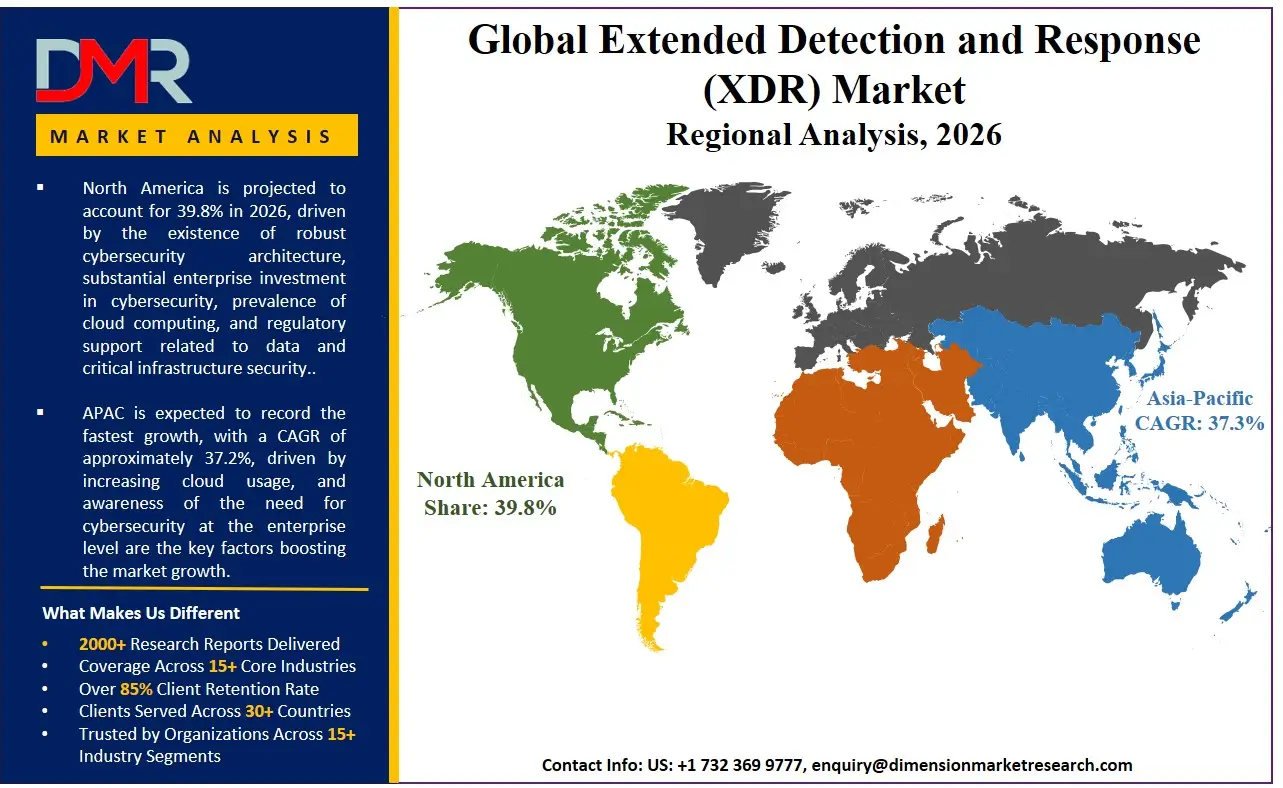
The North American region is anticipated to maintain its dominance in terms of being the most prominent regional market, representing about 39.8% of market share in 2026. The regional success is driven by the existence of robust cybersecurity architecture, substantial enterprise investment in cybersecurity, prevalence of cloud computing, and regulatory support related to data and critical infrastructure security. BFSI, healthcare, government, and technology sectors invest greatly in enhancing their security operations. The existence of major players within the cybersecurity market and use of AI-driven security solutions is another reason why North America remains the leader.
ℹ
To learn more about this report –
Download Your Free Sample Report Here
Fastest Growing Region in the Extended Detection and Response (XDR) Market
The Asia Pacific region is expected to experience the highest growth rate among all regions in terms of XDR solutions market. Digital transformation, increasing cloud usage, and awareness of the need for cybersecurity at the enterprise level are the key factors boosting the market growth. The countries such as Japan, India, Australia, Singapore, and South Korea are making massive investments in cyber security upgrades. Increasing number of cyberattacks, development of e-commerce platforms, and usage of interconnected technologies are creating huge demand for threat detection systems. Government cybersecurity projects and investments in AI-based cybersecurity technologies will drive further market growth.
By Region
North America
Europe
- Germany
- The U.K.
- France
- Italy
- Russia
- Spain
- Benelux
- Nordic
- Rest of Europe
Asia-Pacific
- China
- Japan
- South Korea
- India
- ANZ
- ASEAN
- Rest of Asia-Pacific
Latin America
- Brazil
- Mexico
- Argentina
- Colombia
- Rest of Latin America
Middle East & Africa
- Saudi Arabia
- UAE
- South Africa
- Israel
- Egypt
- Rest of MEA
Competitive Landscape
The Extended Detection and Response (XDR) market is highly competitive with competition in the form of innovations in technologies, integration in platforms and efficiency of operations. The key strengths of the vendors in the market revolve around AI-based threat detections, automation, cloud-native designs, and compatibility within an ecosystem to improve competitiveness in the market. Partnerships, acquisition, expanding managed services, and ongoing research & development investment continue to be key strategies for growth in the market. Highly technical knowledge base and threat intelligence capabilities act as significant barriers to entry in the market.
Some of the prominent players in the global Extended Detection and Response (XDR) Market are:
- Microsoft Corporation
- CrowdStrike Holdings, Inc.
- Palo Alto Networks, Inc.
- SentinelOne, Inc.
- Trend Micro Incorporated (TrendAI)
- Bitdefender
- Broadcom Inc.
- Cisco Systems, Inc.
- Fortinet, Inc.
- Check Point Software Technologies Ltd.
- Sophos Limited
- Trellix
- Elastic N.V.
- Cybereason
- Cynet Security
- Fidelis Security
- McAfee, LLC
- Rapid7, Inc.
- eSentire, Inc.
- G DATA CyberDefense
- Stellar Cyber, Inc.
- Other Key Players
Recent Developments
- In October 2026, Palo Alto Networks introduced Cortex XDR 6.0, adding AI-driven endpoint protection designed to address emerging threats from autonomous AI agents. The release includes capabilities for discovering AI agents, monitoring their activities, enforcing security policies, and detecting malicious behavior. These enhancements extend XDR protection across endpoints, identities, and AI-related attack surfaces, reflecting the growing integration of AI-powered security into enterprise detection and response platforms.
- In June 2026, G DATA CyberDefense launched G DATA XDR, a platform designed to consolidate security events, correlate threats, and help organizations investigate and contain cyber incidents. The solution targets businesses and managed service providers, offering multi-tenant management, automated processes, and flexible pay-per-use pricing. The launch expands the company's security portfolio and provides service providers with scalable capabilities for delivering extended detection and response services.
- In June 2026, Vembu Technologies launched XDRShield globally, expanding its cyber resilience portfolio beyond backup and recovery into extended detection and response. The platform enables IT and security teams to detect, investigate, and respond to advanced cyber threats through coordinated workflows. The company plans to expand third-party integrations and improve asset visibility, supporting organizations seeking to connect proactive threat detection with broader incident response and recovery strategies.
- In June 2026, Microsoft was named a Leader in Forrester's The Forrester Wave: Extended Detection and Response Platforms, Q2 2026. Microsoft received the highest score in the Strategy category and the highest possible scores across several current-offering criteria, including identity detection, cloud detection, threat intelligence, and threat hunting. The recognition highlights the continued development of integrated security platforms that combine threat detection across endpoints, identities, email, applications, and cloud environments.
Report Details
| Report Characteristics |
| Market Size (2026) |
USD 10.5 Bn |
| Forecast Value (2035) |
USD 130.9 Bn |
| CAGR (2026–2035) |
32.3% |
| Historical Period |
2021 – 2025 |
| Forecast Period |
2027 – 2035 |
| Base Year |
2025 |
| Estimate Year |
2026 |
| Segments Covered |
By Component, By Deployment Mode, By Organization Size, By Deployment Type, By End User Industry |
| Regional Coverage |
North America – The US and Canada; Europe – Germany, The UK, France, Russia, Spain, Italy, Benelux, Nordic, & Rest of Europe; Asia-Pacific – China, Japan, South Korea, India, ANZ, ASEAN, Rest of APAC; Latin America – Brazil, Mexico, Argentina, Colombia, Rest of Latin America; Middle East & Africa – Saudi Arabia, UAE, South Africa, Turkey, Egypt, Israel, & Rest of MEA |
Frequently Asked Questions
How big is the Extended Detection and Response (XDR) Market?
▾ The Extended Detection and Response (XDR) Market size is expected to reach USD 10.5 billion by 2026 and is projected to reach USD 130.9 billion by the end of 2035.
What is the CAGR of the Extended Detection and Response (XDR) Market from 2026 to 2035?
▾ The market is growing at a CAGR of 32.3 percent over the forecasted period.
What factors are driving the growth of the Extended Detection and Response (XDR) Market?
▾ Increased Complexity of Cyber Threats, and more are the factors driving the growth of the Extended Detection and Response (XDR) Market.
What are the major trends in the Extended Detection and Response (XDR) Market?
▾ Convergence of XDR, SIEM, and Security Operations Platforms, and more are some of the major trends in the market.
Who are the key players in the Extended Detection and Response (XDR) Market?
▾ Some of the key players in the Extended Detection and Response (XDR) Market include Microsoft Corporation, CrowdStrike Holdings, Inc., Palo Alto Networks, Inc., SentinelOne, Inc., Trend Micro Incorporated (TrendAI), Bitdefender, Broadcom Inc., Cisco Systems, Inc., Fortinet, Inc, and more.
How is the Extended Detection and Response (XDR) Market segmented?
▾ The Extended Detection and Response (XDR) Market is segmented by component, deployment mode, organization size, deployment type, end user industry.
Which region held the largest share of the Extended Detection and Response (XDR) Market in 2026?
▾ North America is set to lead the Extended Detection and Response (XDR) Market with an estimated 39.8% share in 2026.
Which region is expected to grow the fastest in the Extended Detection and Response (XDR) Market?
▾ Asia Pacific is the fastest-growing region in the Extended Detection and Response (XDR) Market during the forecast period.