Market Overview
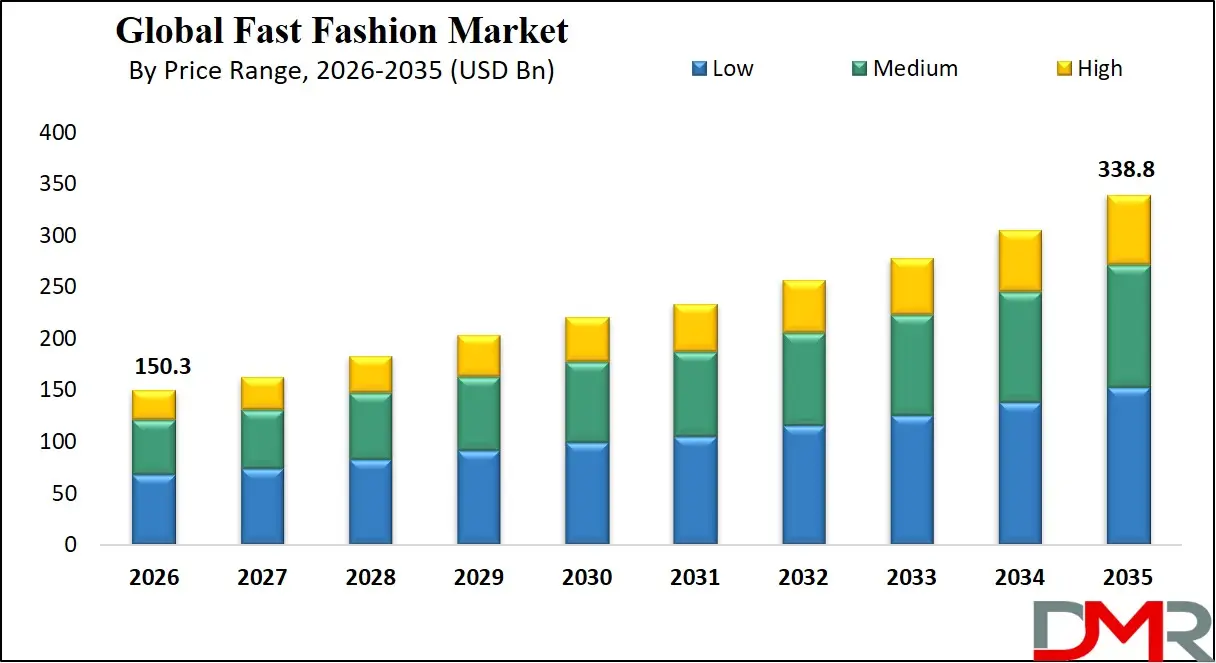
The Global Fast Fashion Market is poised for substantial expansion, with its value estimated to reach USD 150.3 billion in 2026 and projected to grow at a CAGR of 8.8% from 2026 to 2035, attaining a market value of USD 338.8 billion by 2035.

ℹ
To learn more about this report –
Download Your Free Sample Report Here
This is primarily due to the growing trend of changing consumer behavior and their increased preference for fast fashion. Moreover, the growing trend of social media and digital marketing is also contributing to the growth of the fast fashion industry. The fast fashion business model is witnessing tremendous growth due to the growing trend of changing consumer behavior and their increased preference for fast fashion. This is primarily due to the ability to reach a large number of consumers across the globe with the help of growing digital penetration and the increasing trend of e-commerce platforms.
The ability to reduce the product life cycle to just a few weeks is the major strength of fast fashion. This is forcing traditional players to either become fast fashion themselves or partner with the fast fashion industry leaders. In addition, the growing trend of logistics and supply chain innovations, especially in countries like China, Bangladesh, and Vietnam, is making the fast fashion business model an efficient one. This is evident from the fact that fast fashion is making use of data analytics to forecast trends.
ℹ
To learn more about this report –
Download Your Free Sample Report Here
The US Fast Fashion Market
The U.S. Fast Fashion Market is projected to reach USD 47.3 billion in 2026 and grow at a CAGR of 8.8%, reaching USD 101.2 billion by 2035.

ℹ
To learn more about this report –
Download Your Free Sample Report Here
The U.S. is the home of one of the largest numbers of fast fashion giants. They are known for their influence over the fashion word which leads different trend and decide the fashion concept of the year. The rise in internet usage and the growth in the adoption of e-commerce have helped fast fashion brands effectively reach different categories of consumers in Europe. The capability to swiftly move runway trends to retail in a matter of weeks remains a key differentiating factor for fast fashion brands, driving repeat business and new products. The rise in the concept of ‘see now, buy now’ and the increase in social media engagement are driving conventional retailers to move to more agile business models.
The Europe Fast Fashion Market
The Europe fast fashion market is poised for steady growth, with its value estimated to reach USD 49.8 billion in 2026 and projected to expand at a CAGR of around 6.5% from 2026 to 2035, reaching nearly USD 87.8 billion by 2035.
This is fueled by the dynamic nature of consumer demand in favor of affordable, fashionable clothing, as well as the significant impact of digital technologies and fashion-conscious youth in key European countries such as France, Germany, Italy, and the UK. Significant improvements in the penetration rate of the internet and the adoption of electronic commerce have allowed fast fashion brands to efficiently serve different consumer segments in the European market. The capacity of fast fashion brands to rapidly translate fashion trends into their product lines in a matter of weeks remains one of the key differentiators in the market. The rise of the ‘see now, buy now’ culture, fueled by the engagement of customers with social media platforms, is pressuring conventional retailers to adopt more dynamic business models.
The Japan Fast Fashion Market
The Japan Fast Fashion Market is anticipated to be valued at approximately USD 8.2 billion in 2026 and is expected to attain nearly USD 13.8 billion by 2035, expanding at a CAGR of about 5.9% during the forecast period.
The Japanese fast fashion market is known for its unique quality and trend adoption. The Japanese fast fashion market has already reached the mature stage. The growth in the Japanese fast fashion market is driven by the continued demand for basic products such as minimalistic clothing and trendy products. The Japanese fast fashion market has seen significant growth in the past few years. The Japanese fast fashion market has seen the successful integration of fast fashion with quality supply chain management and inventory control by the top domestic players. The Japanese fast fashion market has seen the trend of unisex clothing gaining traction. The trend of unisex clothing has been successful in attracting the younger generation.
Global Fast Fashion Market: Key Takeaways and Other Influencing Factors
- Strong Global Market Growth Outlook: The Global Fast Fashion Market is estimated to be worth USD 150.3 billion in 2026, which is further expected to reach USD 338.8 billion by the end of 2035.
- Steady CAGR Driven by Digital Commerce: The global fast fashion market is set to grow at a compound annual growth rate of 9.4% from 2026 to 2035, as more investments are made in digital commerce platforms, social commerce, and flexible supply chains.
- Strong Growth Trajectory in the United States: The U.S. Fast Fashion Market is currently valued at USD 47.3 billion USD in 2026, which is set to grow to 101.2 billion USD by 2035, growing at a compound annual growth rate of 8.8%.
- Regional Dominance: The North America region is projected to dominate the global fast fashion market, with 37.4% of market share in 2026, owing to its status as the manufacturing hub and its massive consumer base.
- Rapid Advancement in Supply Chain & Logistics: The fast fashion industry has seen a significant increase in its supply chain and logistics, including the introduction of AI-based trend prediction, automated warehouses, and just-in-time production.
- World Bank & International Labour Organization (ILO): The garment sector has an estimated number of 60-75 million workers around the world. Most of these workers are women, especially in third-world countries. The clothing sector has extremely low profit margins, and manufacturers are always looking to reduce their expenses, and in the process, they frequently end up struggling to offer decent pay to employees.
- Earth.org & Ellen MacArthur Foundation: The equivalent of one garbage truck of textiles is sent to landfills and incinerators every second. The economic value of clothing thrown away, unused, and undonated is 500 billion dollars every year. Laundry contributes to an annual of 0.5 million tons of microplastics in the ocean.
Impact of Iran Conflict on the Global Fast Fashion Market
The current Iran war is seriously affecting the world's fast fashion industry by interfering with supply. As an example, the rising expenses in the fast fashion sector have been caused by oil prices and limited shipping routes, particularly in the Strait of Hormuz. The fast fashion industry has also been affected by delays in goods transit since the industry has lost its competitive advantage in speed. The fast fashion market has not been left out of the inflation as it has lowered the purchasing power of the consumers. Thus, the current conflict in Iran has affected the global fast fashion market in many forms in which it makes it reconsider sourcing and focus on supply chain resilience rather than cost effectiveness.
Global Fast Fashion Market: Use Cases
- Trend Replication and Rapid Production: Fast fashion brands analyze runway shows, celebrities, and social media influencer's trends. They will then copy the trends and generate look-alike products within the record time, which they can exploit the temporary interests of consumers.
- Influencer and Celebrity Collaborations: Fast fashion brands work with the influencer's and celebrities to release limited-edition products. By making them use the followers of the influencers as a form of immediate brand promotion, this strategy enables them to make record sales within hours.
- Hyper-Personalized Digital Marketing: Fast fashion companies use customer information and browsing history to deliver personalized ads and promotions to customers. This approach assists them in generating high rates of sales by consumers.
- "See Now, Buy Now" Livestream Shopping: Fast fashion brands are utilizing e-commerce websites and social media platforms to do live shopping. They demonstrate goods and provide answers to consumers in real-time, assisting consumers to make immediate buying choices.
- Omnichannel Retail Experience: This enables the customer to search products online, make online bookings, and then try on products at the stores or place online bookings and pick up the products either the same day or on a later date. This makes the shopping experience smooth to the customer.
Global Fast Fashion Market: Market Dynamic
Driving Factors in the Global Fast Fashion Market
Accelerating Digital and Social Commerce
The emergence of social media applications like Tik Tok and Instagram has changed how consumers purchase fashion items. Fast fashion retailers are very effective when it comes to advertisement of their products on these social media sites. This gives fast fashion retailers a direct-to-consumer experience in purchasing. This gives consumers a hassle-free buying experience. This slashes the process of consumer purchase drastically. This translates to fast fashion retailers buying at high frequency.
Rapidly Shifting Consumer Trends and the "Newness" Demand
The current consumers are very demanding. Especially for fast fashion retailers, younger generations have insatiable demand for new products. This is mainly due to micro-trends in fashion. Micro-trends fluctuate on a weekly basis. The art of responding to these micro-trends has been perfected by fast fashion retailers. This hugely shortens the fashion cycle of six months to a couple of weeks. This experience to fast fashion retailers forms a repetitive loop of being new that promotes revisiting and buying.
Restraints in the Global Fast Fashion Market
Growing Consumer Awareness of Sustainability and Ethical Issues
The other major reason why fast fashion is being constrained is the increased scrutiny that fast fashion is subjected to in regard to environmental and social effects. This encompasses water pollution, waste of clothing, carbon emission and inhumane labor. This has produced a new breed of conscious consumers that are becoming more accepting of second-hand clothing and environmentally friendly clothing. This will be a threat to fast fashion retailers that can affect the market future severally.
Supply Chain Volatility and Rising Input Costs
The model of fast fashion is built on the globalized network that is very vulnerable to interference by other factors such as geopolitical tensions, pandemics, and disturbances caused by climatic changes. In addition, the increasing prices of raw materials such as cotton and polyester, labor prices and the cost of transportation are putting pressure on the already low margin of profit. This renders it extremely difficult that fast fashion brands will be able to sustain their highly low prices without jeopardizing quality and ethical standards.
Opportunities in the Global Fast Fashion Market
Expansion into the Circular Fashion Model
A fast fashion brand can take advantage of the opportunity of initiating in-house recycling programs, clothing take-back programs, and resale platforms. This assists them in avoiding criticism, appeal to consumers who have the disposable income to buy green products and generate new sources of revenue. Technological advances in the textile-to-textile recycling sector allow designers to create products that are made without using raw materials.
Hyper-Localization and Data-Driven Design
The idea of using data analytics to learn about regional needs enables fast fashion companies to create hyper-localized items. This minimizes inventory wastage as the products are not sold in areas where they do not fit. Additionally, by using AI technology to process billions of pieces of data, such as search terms, social media photos, posts of influencers, fast fashion companies can invest in winning trends with greater confidence.
Trends in the Global Fast Fashion Market
Preeminence of Direct-to-Consumer (D2C) Digital-First Models
Brands that enter the market with D2C model based on digital only can gain a significant market share by not eroding the traditional retail margin and having access to the first party customer data. This is forcing the conventional retail fast fashion players to furiously rethink their approaches, concentrating on their own online outlets in lieu of wholesale and physical growth.
Focus on "Sustainable" Collections and Transparency
Consumers are putting increased pressure on fast fashion brands to launch their own eco-friendly or conscious collections using recycled materials, as a result of their growing popularity. The trend is also moving towards increased transparency in the supply chain, with brands starting to publish factory lists and sustainability reports. It is a tactic of fast fashion brands to keep their value-conscious and environmentally aware customers and stay out of the regulatory risks in the future.
Global Fast Fashion Market: Research Scope and Analysis
By Product Analysis
The fast fashion market is projected to have the largest share of its products in the Apparel segment. It can be explained by the fact that fast fashion is founded on the very concept of rotating an enormous amount of clothes, including tops and dresses and denim and outerwear. The most suitable way through which fast fashion companies can replicate trends and achieve the greatest portion of consumer expenditure on fashion is through apparel.

ℹ
To learn more about this report –
Download Your Free Sample Report Here
Clothing has the lowest cost of production and most of the time consumers demand the product. The reason is that fast fashion companies are able to manufacture large quantities of various kinds of clothes in a relatively short time period, including casual, formal, and even active apparel. That is why clothing is the most important source of revenues of fast fashion outlets. The apparel category is the largest and most dynamic as fashion trends are short-lived, and it is still on the top of the agenda of fast fashion retailers.
By Price Range Analysis
The Low price range segment is projected to remain dominant in the fast fashion market. The whole concept of fast fashion is founded on selling products to consumers at highly disposable prices. This segment is appealing because it gives the consumers a chance to satisfy their need of newness without making any significant investment. The complete business model of fast fashion relies on offering the product at such prices, which makes it affordable to customers of all income levels. The low price range is very lucrative because it works on economies of scale since its products are produced in countries with extremely low manufacturing costs and raw materials like polyester which are extremely cheap. The core Gen Z and Millennial consumer groups are attracted to this price range in a significant way because these consumers are more focused on variety and instant gratification as opposed to durability.
By Distribution Channel Analysis
The Online segment has the potential to be the leader in the distribution channel category in the fast fashion market. The e-commerce site and the web site offer the most diverse selection of products and the superior availability of products. The online shopping experience that the digital platform offers appeals to the target audience. The Online system assists the fast fashion business in bypassing the gatekeepers in retail. The site offers priceless information regarding the consumers. The platform assists the fast fashion industry to react to the trend in sales on-the-fly. Online platform is the platform of social commerce, influencer marketing and viral trends. These are all important aspects to the fast fashion business. The convenience of making purchases on the online platform has become the most desired platform to the impulse-driven nature of the fast fashion business.
By End User Analysis
The Women segment is expected to dominate the end-user category within the fast fashion market. Traditionally and currently, the dominant subject of the fast fashion industry is women clothing, which represents the largest part of products diversification, advertising, and sales. Fast fashion marketing targets women and fast fashion marketing is based on the social media trends, celebrities and lifestyles. The number of categories in fashion among women, such as dresses, tops, bottoms, outerwear, and occasion wear, provides a big opportunity to the fast fashion business model. Also, the fact that the rate of new collections dropping is high, is in congruence with the shopping behavior of women who enjoy shopping new fashion as a means of self-expression and socializing.
The Global Fast Fashion Market Report is segmented on the basis of the following:
By Product
- Apparel
- Accessories
- Footwear
- Others
By Price Range
By Distribution Channel
By End User
- Men
- Women
- Children
- Unisex
Impact of Artificial Intelligence in the Global Fast Fashion Market
The fast fashion market is witnessing the impact of artificial intelligence in the form of data-driven business decisions. With the help of artificial intelligence tools, fast fashion companies can analyze the behavior of customers in real time. They can predict the demand for their products with the help of artificial intelligence tools. With the help of artificial intelligence tools, fast fashion companies can predict the demand for their products in the market. They can launch new products in the market in less time with the help of artificial intelligence tools. The artificial intelligence tools can predict the demand for their products in the market. The artificial intelligence tools can help fast fashion companies in the creation of designs in alignment with the trends in the market. With the help of artificial intelligence tools, fast fashion companies can create designs in alignment with the trends in the market. They can compete with their rivals in the market with the help of artificial intelligence tools.
Global Fast Fashion Market: Regional Analysis
Region with the Largest Revenue Share
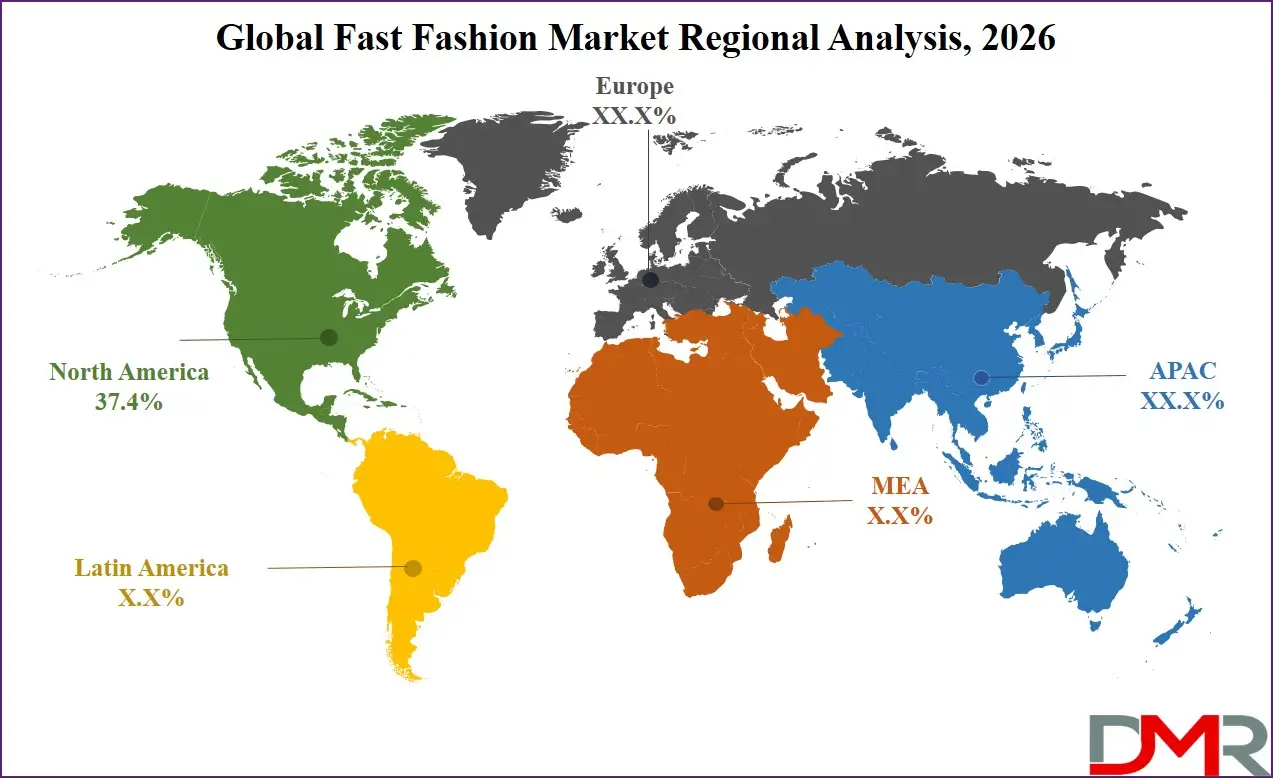
North America is poised to dominate the global fast fashion market in terms of revenue share as it holds 37.4% of the market share by the end of 2026, driven by high consumer spending, strong retail infrastructure, and widespread adoption of e-commerce. The United States, in particular, leads the region with a large base of fashion-conscious consumers who frequently purchase affordable, trend-driven apparel. This is owing to high consumer spending power, retail infrastructure, and penetration of e-commerce. The U.S. contributes to the largest market for fast fashion in North America due to a high number of fashion-conscious consumers who prefer buying fashionable clothing on a frequent basis. Moreover, fast fashion brands are able to capitalize on the presence of retail infrastructure and efficient logistics and quick delivery systems.
ℹ
To learn more about this report –
Download Your Free Sample Report Here
Region with the Highest CAGR
Asia-Pacific is expected to account for the highest CAGR for fast fashion in the global market. This is due to factors such as high urbanization rates, improving disposable income levels, and a high young population. Countries such as China and India are contributing to high demand for fast fashion clothing. This is owing to high penetration levels of e-commerce and mobile services. Moreover, Asia-Pacific serves as a manufacturing hub for fast fashion brands. This enables fast fashion brands to capitalize on low production costs and high market demand for fast fashion clothing. With high digital penetration and fashion awareness among consumers, Asia-Pacific is expected to witness high market growth for fast fashion.
By Region
North America
Europe
- Germany
- The U.K.
- France
- Italy
- Russia
- Spain
- Benelux
- Nordic
- Rest of Europe
Asia-Pacific
- China
- Japan
- South Korea
- India
- ANZ
- ASEAN
- Rest of Asia-Pacific
Latin America
- Brazil
- Mexico
- Argentina
- Colombia
- Rest of Latin America
Middle East & Africa
- Saudi Arabia
- UAE
- South Africa
- Israel
- Egypt
- Rest of MEA
Global Fast Fashion Market: Competitive Landscape
The Global Fast Fashion Market is characterized by a mix of vertically integrated giants, digitally native pure-plays, and large retail conglomerates. The Global Fast Fashion Market is dominated by large vertically integrated companies with highly developed supply chains, as well as digitally native companies with ultra-fast supply chains. The large apparel retailer Gap Inc., like Uniqlo (Fast Retailing), is adapting to the rise of fast fashion by focusing more on the digital space. Shein is one such digitally native fast fashion retailer that is disrupting the market with its ultra-fast supply chain capabilities. The competitive landscape is highly dynamic in the Global Fast Fashion Market with companies competing with each other in terms of speed, price, brand popularity, as well as sustainability.
Some of the prominent players in the Global Fast Fashion Market are:
- H&M
- Zara
- Aditya Birla Fashion and Retail Limited
- Mango
- Shein
- Gap
- Fast Retailing
- ASOS
- Fashion Nova
- Cotton On
- AARCARDIA SRL
- Esprit Holdings Ltd
- Industria de Diseño Textil SA
- Primark Stores Ltd
- Punto FA SL
- River Island
- Victoria’s Secret & Co.
- Forever 21 Inc.
- New Look Retailers
- C&A Mode GmbH & Co. KG
- Other Key Players
Recent Developments in the Global Fast Fashion Market
- October 2025: Inditex has made a new commitment to use 100.0% preferred fibers, aiming to reduce its total fiber footprint by 25.0% by 2030, with a particular focus on innovative fibers and the circular economy.
- September 2025: Shein has launched a new resale platform in Europe, enabling customers to buy and sell second-hand Shein products. This move marks a significant step in the direction of circular fashion to address sustainability concerns.
- August 2025: H&M Group has introduced a new AI-powered supply chain platform, which will enable the company to predict customer demand more accurately and thus reduce inventory waste in the process.
- July 2025: Zara (Inditex) has expanded its in-store digital integration in the US market, providing customers with augmented reality fitting rooms and automated pickup lockers.
- June 2025: ASOS has partnered with a startup focused on textile recycling to integrate recycled fibers derived from post-consumer waste into its in-house branded products, aiming to reach a target of 20.0% by 2028.
Report Details
| Report Characteristics |
| Market Size (2026) |
USD 150.3 Bn |
| Forecast Value (2035) |
USD 338.8 Bn |
| CAGR (2026–2035) |
9.4% |
| The US Market Size (2026) |
USD 47.3 Bn |
| Historical Data |
2021 – 2025 |
| Forecast Data |
2027 – 2035 |
| Base Year |
2025 |
| Estimate Year |
2026 |
| Report Coverage |
Market Revenue Estimation, Market Dynamics, Competitive Landscape, Growth Factors and etc. |
| Segments Covered |
By Product (Apparel, Accessories, Footwear, and Others), By Price Range (Low, Medium, and High), By Distribution Channel (Online, Offline, and Others), By End User (Men, Women, Children, Unisex) |
| Regional Coverage |
North America – The US and Canada; Europe – Germany, The UK, France, Russia, Spain, Italy, Benelux, Nordic, & Rest of Europe; Asia-Pacific – China, Japan, South Korea, India, ANZ, ASEAN, Rest of APAC; Latin America – Brazil, Mexico, Argentina, Colombia, Rest of Latin America; Middle East & Africa – Saudi Arabia, UAE, South Africa, Turkey, Egypt, Israel, & Rest of MEA |
| Prominent Players |
H&M, Zara, Aditya Birla Fashion and Retail Limited, Mango, Shein, Gap, Fast Retailing, ASOS, Fashion Nova, Cotton On, AARCARDIA SRL, Esprit Holdings Ltd, Industria de Diseño Textil SA, Primark Stores Ltd, Punto FA SL, River Island, Victoria’s Secret & Co., Forever 21 Inc., New Look Retailers, C&A Mode GmbH & Co. KG, and Other Key Players |
| Purchase Options |
We have three licenses to opt for: Single User License (Limited to 1 user), Multi-User License (Up to 5 Users) and Corporate Use License (Unlimited User) along with free report customization equivalent to 0 analyst working days, 3 analysts working days and 5 analysts working days respectively. |
Frequently Asked Questions
How big is the Global Fast Fashion Market?
▾ The Global Fast Fashion Market size is estimated to have a value of USD 150.3 billion in 2026 and is expected to reach USD 338.8 billion by the end of 2035.
What is the growth rate in the Global Fast Fashion Market?
▾ The market is growing at a CAGR of 9.4% over the forecasted period of 2026-2035.
What is the size of the US Fast Fashion Market?
▾ The US Fast Fashion Market is projected to be valued at USD 47.3 billion in 2026. It is expected to witness subsequent growth as it holds USD 101.2 billion in 2035 at a CAGR of 8.8%.
Which region accounted for the largest Global Fast Fashion Market?
▾ North America is expected to have the largest market share in the Global Fast Fashion Market, accounting for over 37.4% in 2026.
Who are the key players in the Global Fast Fashion Market?
▾ Some of the major key players in the Global Fast Fashion Market are Inditex (Zara), H&M Group, Shein, Fast Retailing (Uniqlo), Gap Inc., ASOS, and many others.