What is the Femtech Market Size?
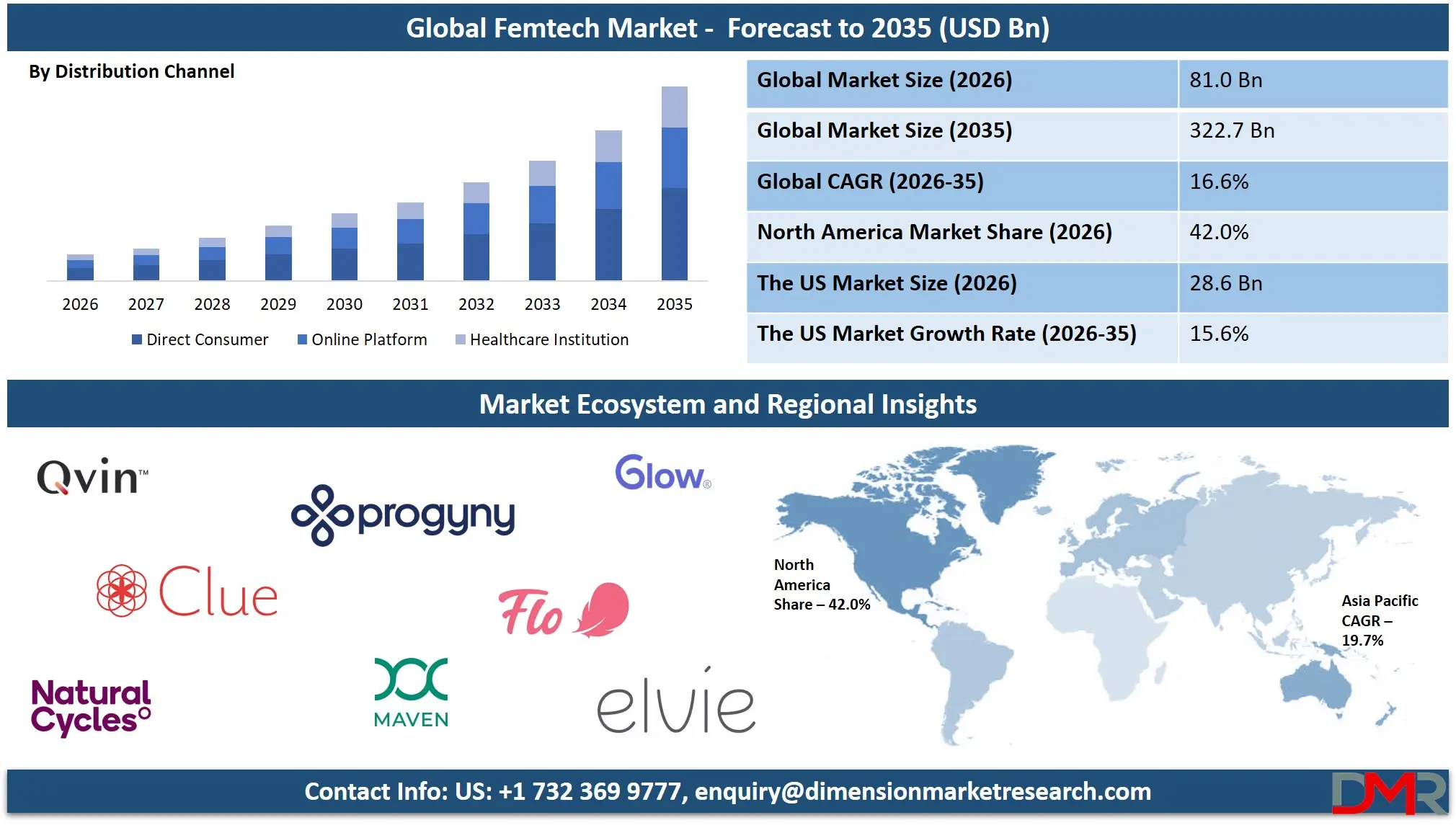
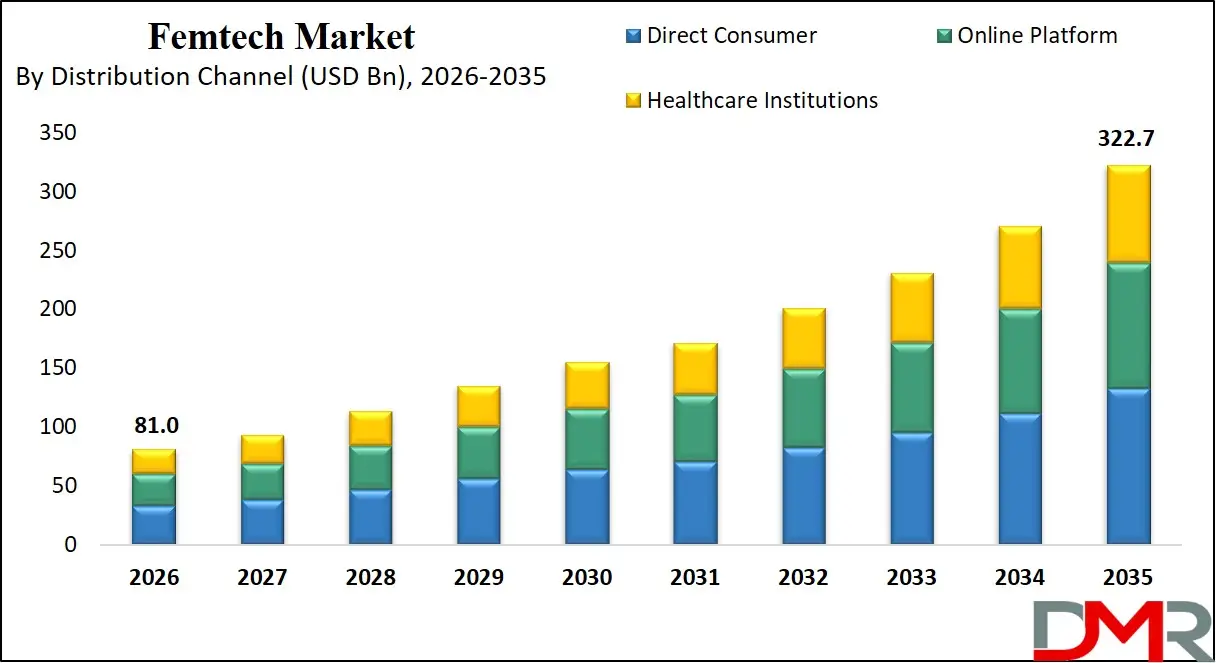
The Femtech Market size is expected to be USD 81.0 billion in 2026 and increase at a compound annual growth rate of 16.6% to USD 322.7 billion in 2035 due to knowledge about the health challenges faced by different.
ℹ
To learn more about this report –
Download Your Free Sample Report Here
The Femtech market is made up of a high portion of the growing market of healthcare technologies that caters specifically to women's health, which includes their reproductive healthcare, menstrual health, fertility issues, menopause, and management of chronic diseases. The growth can be attributed to increased awareness and innovations within the digital health market space. Developments in wearable tech, AI diagnostic solutions, and telehealth applications have been reshaping the healthcare service landscape. The market is becoming increasingly more relevant within the wider digital health market because of growing investment and supportive policy-making.
ℹ
To learn more about this report –
Download Your Free Sample Report Here
The US Femtech Market
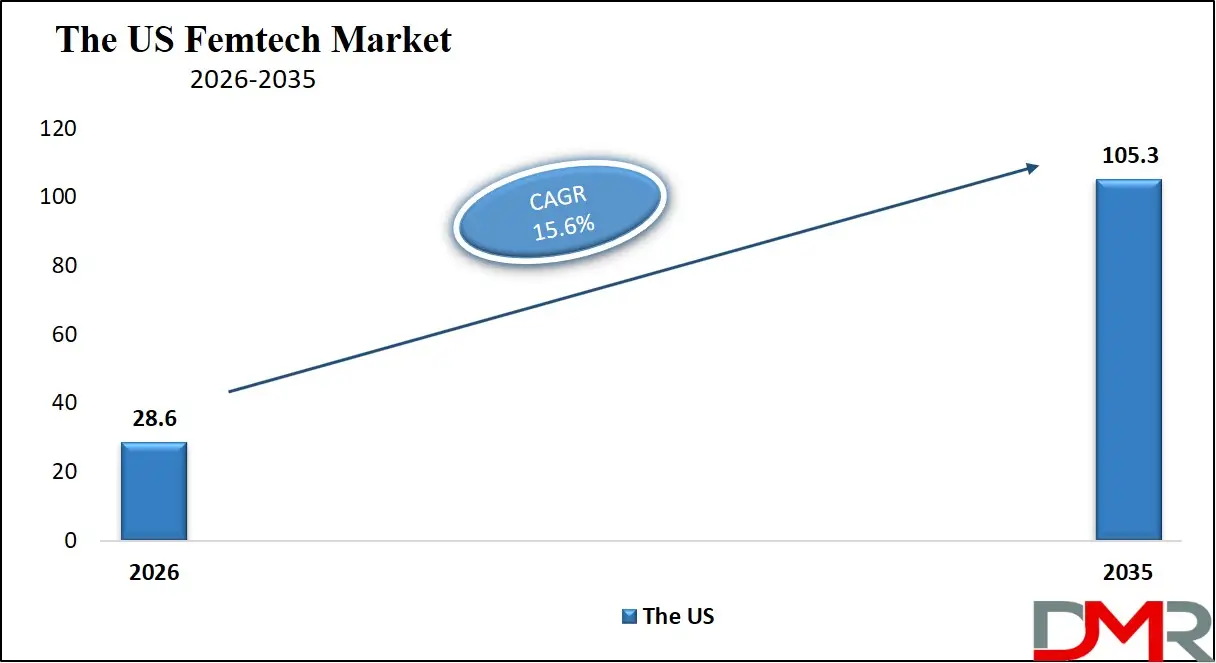
The US Femtech Market size is estimated to be USD 28.6 billion in 2026 and is expected to increase at a CAGR of 15.6% over the forecast period.
ℹ
To learn more about this report –
Download Your Free Sample Report Here
The US FemTech industry is one of the most developed because of substantial venture capital investments, technological development, and broad adoption of digital health services. Programs aimed at fostering women's health studies and telemedicine payment support also have contributed to industry expansion. The existing healthcare system and established innovators facilitate the market expansion. Moreover, increasing recognition of reproductive and psychological health, as well as corporate wellness programs, promote market adoption among different populations.
Europe Femtech Market
The Europe Femtech Market size is estimated to be USD 16.2 billion in 2026 and at a CAGR of 16.0% over the forecast period.
The Femtech Market of Europe is influenced by the healthcare policies and regulations prevailing in the region. These include initiatives like European Green Deal and digital health. The countries pay special attention to women's healthcare innovations along with ensuring compliance with data privacy regulations. Publicly funded healthcare systems and growth of startup cultures have fueled innovation in the region. Reproductive health and menopause solutions have seen the most success and adoption rate in the region.
Japan Femtech Market
The market size of Japan Femtech will be USD 2.8 billion in 2026 and at a CAGR of 15.9% in the forecast period.
The Femtech market in Japan is experiencing continuous growth owing to the aging population trends, the working class of women, and governmental policies encouraging gender equality. The urbanization process as well as awareness regarding the issues related to fertility and menopause treatment are contributing significantly to the development of Femtech. High-tech innovations and the need for quality health products promote innovation in the industry.
Key Takeaways
- Market Size & Forecast: The Femtech Market size is projected to reach USD 81 billion in 2026 and is anticipated to have a value of USD 322.7 billion in 2035.
- Growth Rate & Outlook: The Femtech Market size is set to grow at a compound annual growth rate of 16.6% during the forecast period of 2026 to 2035.
- Primary Growth Drivers: Some of the major growth drivers in the market include rising awareness and demand for women-centric healthcare, technological advancements and digital health integration, and more.
- Key Market Trends: Some of the major trends in the market are adoption of ai-powered personalized healthcare, growth of telehealth and remote monitoring, and more.
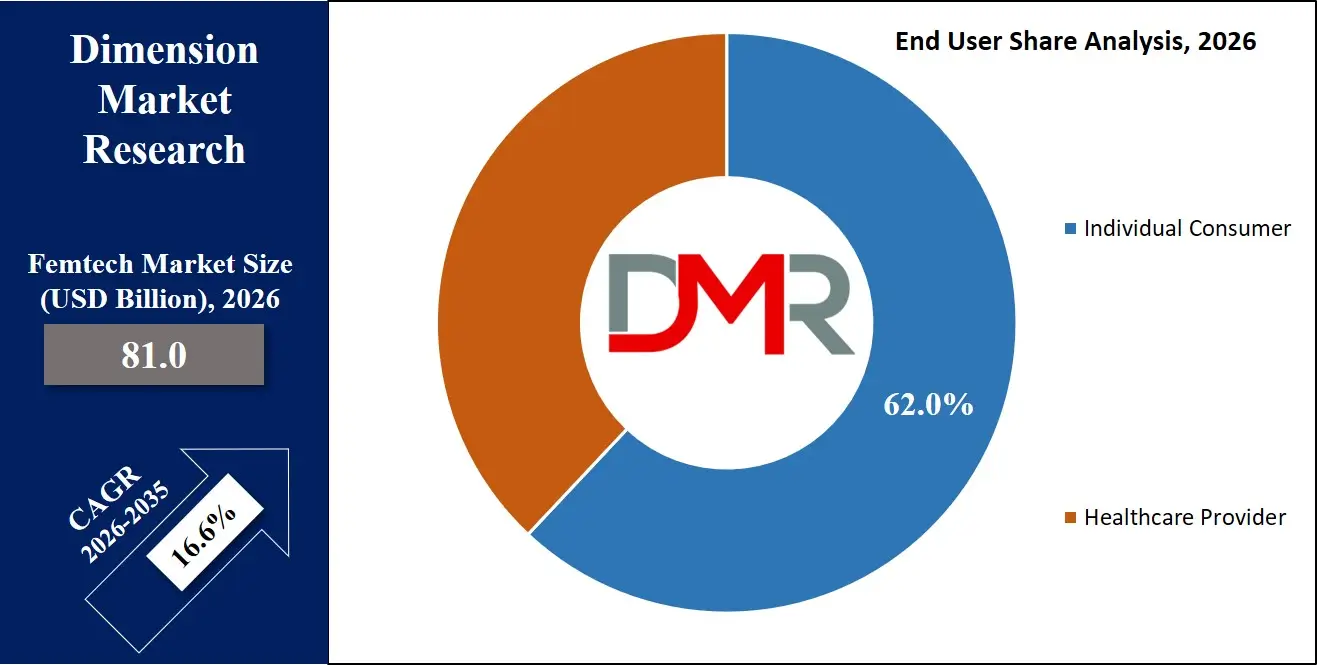
- By End User: The individual consumer segment is anticipated to get the majority share of the Femtech market in 2026.
- By Distribution Channel: The direct consumer segment is expected to get the largest revenue share in 2026 in the Femtech market.
- By Application: The reproductive health segment is expected to get the largest revenue share in 2026 in the Femtech market.
- Regional Leadership: Europe is set to lead the Femtech market with an estimated 44.0% share in 2026.
What is the Femtech?
Femtech is the term used to describe tech-based solutions created with the aim of providing remedies to women's health conditions. Examples of femtech include mobile apps, gadgets, tests, and platforms that deal with matters such as reproductive health tracking, pregnancy care, and well-being generally. Femtech uses sophisticated technology such as artificial intelligence to enhance women's health care experiences, provide convenient access to information, and offer solutions that prevent health complications in the future.
Use Cases
- Fertility & Reproductive Planning: Femtech solutions provide ovulation tracking, fertility monitoring, and IVF support tools, enabling women to plan pregnancies effectively while offering data-driven insights and personalized recommendations through mobile applications and connected devices.
- Menstrual Health Management: Period tracking apps and wearable devices help monitor cycles, symptoms, and hormonal patterns, improving awareness and enabling early detection of irregularities or underlying health conditions.
- Pregnancy & Postnatal Care: Digital platforms support expectant and new mothers with health tracking, teleconsultations, and personalized care plans, enhancing maternal and neonatal outcomes through continuous monitoring.
- Menopause & Chronic Care: Femtech solutions address menopause symptoms and chronic conditions like PCOS or osteoporosis, offering lifestyle management tools, virtual care, and targeted therapies for long-term health improvement.
How AI Is Transforming the Femtech Market?
AI has revolutionized Femtech by providing predictive analysis capabilities, customized therapy regimens, and early detection of diseases through advanced analytical algorithms. The AI algorithms make use of customer data for analyzing their menstrual cycle, fertility window, and hormone levels.
Apart from these, AI increases operational efficiency by streamlining processes in the clinic and facilitating telemedicine sessions as well as remote monitoring of patients. Furthermore, AI fosters innovation within Femtech products by introducing new smart wearables and online health portals.
Market Dynamic
Driving Factors in the Femtech Market
Rising Awareness and Demand for Women-Centric Healthcare
The growth in knowledge about the health challenges faced by different genders is one of the main factors fueling the Femtech industry. Women need specialized products to help with their health care problems due to differences in biology and hormones. Social media, marketing campaigns, and educational efforts have led to reduced stigmas surrounding menstruation and menopause, leading to increased adoption of Femtech innovations.
Technological Advancements and Digital Health Integration
The use of AI, Internet of Things (IoT), and Big Data Analytics is greatly improving Femtech products. They help to track the health status of women in real time, predict any issues, and suggest ways forward. The increased uptake of mobile phones and wearable technology also promotes the growth of the market, with telemedicine platforms increasing accessibility.
Restraints in the Femtech Market
Data Privacy and Regulatory Challenges
The Femtech products are usually based on personal health information of patients, which raises issues related to confidentiality and data security. There are strict laws governing the use of personal data, as well as certification of the safety of the products, which could slow down the production process.
Limited Awareness in Emerging Markets
Although there has been development in some developed countries, FemTech solutions continue to remain unknown to many economies that are still developing. Taboos, ignorance, and inadequate healthcare facilities hamper their usage.
Opportunities in the Femtech Market
Expansion in Emerging Economies
There are plenty of business opportunities for emerging markets because of the increasing number of smartphones, better healthcare facilities, and greater awareness. Organizations can make use of such markets through providing cheaper services that cater to local requirements.
Integration with Preventive Healthcare Models
With more emphasis being placed on preventive healthcare, there are opportunities for Femtech innovations to emerge as key players. The use of Femtech technologies for early detection, monitoring, and management will help save money and generate positive results, which will attract customers and healthcare providers alike.
Trends in the Femtech Market
Adoption of AI-Powered Personalized Healthcare
FemTech solutions powered by AI technology have gained considerable popularity in recent years due to their ability to deliver highly customized treatment plans and predict health outcomes.
Growth of Telehealth and Remote Monitoring
Telehealth applications are revolutionizing Femtech through their ability to facilitate remote consultation and constant health monitoring. Telehealth solutions prove especially valuable for women who live in rural settings since they increase access to medical care and diminish reliance on physical appointments.
Research Scope and Analysis
The Femtech market is driven by mobile apps, reproductive health demand, and AI-led innovations, with individual consumers and direct channels dominating, while wearables and IoT devices accelerate growth through continuous, data-driven health monitoring.
ℹ
To learn more about this report –
Download Your Free Sample Report Here
By Product Type Analysis
Due to increased usage of smartphones and accessibility, mobile applications constitute the most popular subcategory in Femtech, contributing to 34% of Femtech in 2026. They include solutions for all aspects of women's health, including period tracking, and hence account for high growth. Their capability to combine with wearables and provide AI-driven analysis has made these apps highly preferred among users. Wearables represent the second highest growing sub-segment due to increased use of sensors in wearables. This subsegment is projected to grow at the fastest rate due to the need for continuous health monitoring.
By Application Analysis
The segment holding the largest Femtech market share in 2026 will be reproductive health, accounting for 38%, thanks to high levels of demand for products that help users track their fertility status, manage contraception and pregnancies. Factors behind the leading position of this segment include increased awareness among consumers, postponed childbearing, and heightened risks of infertility among other factors. The popularity of menstrual health applications is increasing steadily owing to more women adopting period tracking technology and being open about their period health. Menopause management applications have also shown promising growth potential amid the aging population and growing concerns about hormones.
By Technology Analysis
AI and machine learning represent the largest portion of the Femtech market, accounting for up to 36% in 2026 because of their capability to provide customized insights, predict analytics, and early diagnosis features. Such technologies increase accuracy by tracking the reproductive cycle and detecting any possible threats to one's health. Big data and analytics are key players in the Femtech market since they improve the quality of health care services offered by providing better insights on a population and individual level. IoT-connected devices have been the fastest growing part of the Femtech market thanks to their real-time tracking ability. Telehealth technologies have developed significantly.
By End User Analysis
The individual consumer segment is predicted to have a 62% market share in 2026 owing to increased adoption of Femtech products by women to monitor and manage their health. Consumer adoption of Femtech is being spurred by its ease of access, low cost, and convenience through smartphone apps and other devices. In addition, consumers are becoming more active in monitoring their health, thus using various health management solutions to achieve that. The healthcare provider segment is emerging as an important one due to increasing adoption of Femtech products in diagnosing and treating patients.
By Distribution Channel Analysis
Direct consumer channels are dominating the Femtech industry with a forecasted market share of 41% in 2026, owing to the increased usage of mobile apps and other online channels through which Femtech solutions can easily be accessed. Companies can benefit from direct consumer channels by building better customer relationships and personalizing the experience for customers. The use of online platforms is rising at a fast pace due to e-commerce and digital marketing trends. Healthcare establishments are incorporating Femtech solutions in their systems as well, providing patients with their care services.
The Femtech Market Report is segmented on the basis of the following:
By Product Type
- Mobile Applications
- Wearable Devices
- Diagnostic Tools
- Therapeutics & Medical Devices
- Services
By Application
- Reproductive Health
- Contraception & Birth Control
- Fertility Tracking
- Pregnancy & Nursing Care
- Menstrual Health
- Period Tracking
- Pain Management
- Menopause Care
- General Health & Wellness
- Chronic Disease Management
By Technology
- AI & Machine Learning
- IoT / Connected Devices
- Big Data & Analytics
- Telehealth Platforms
By End User
- Individual Consumers
- Healthcare Providers
By Distribution Channel
- Direct-to-Consumer
- Online Platforms
- Healthcare Institutions
Regional Analysis
Leading Region in the Femtech Market
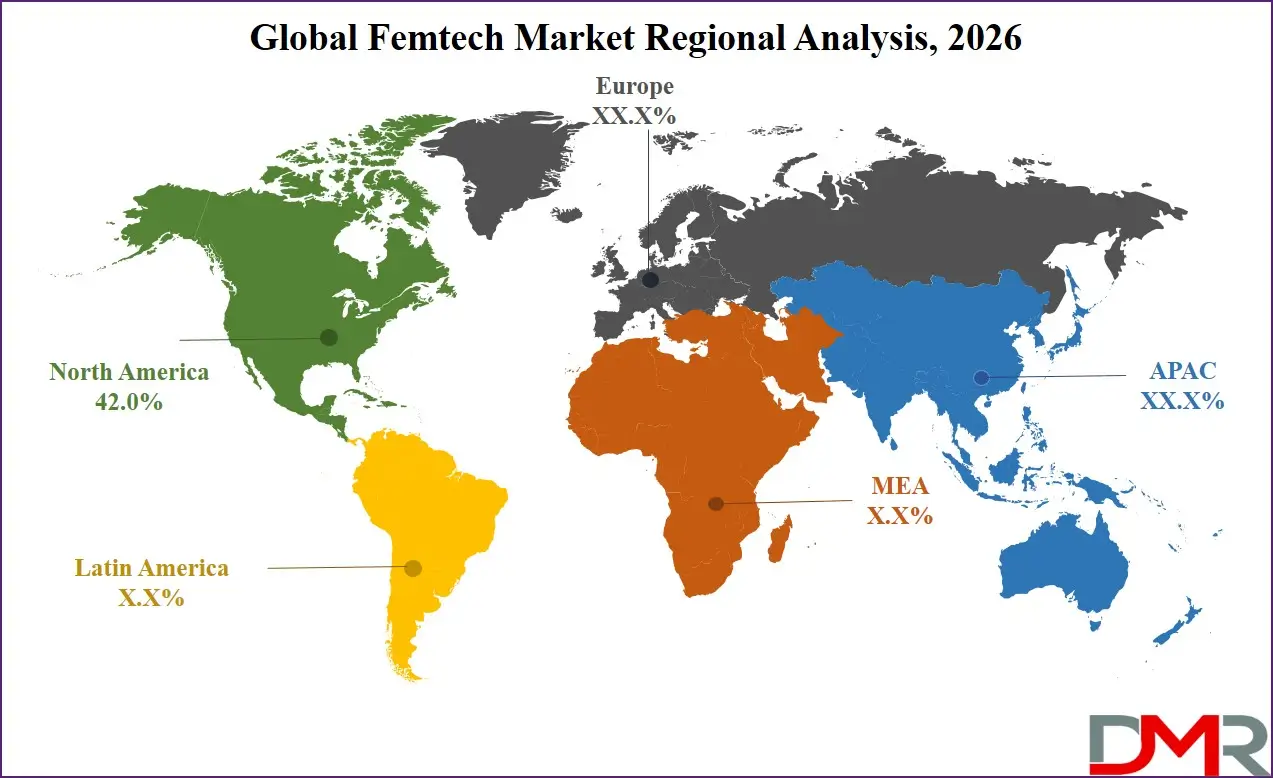
North America is one of the top performers in the FemTech market, accounting for an expected 42% market share in 2026. North America is a favorable territory for FemTech due to its highly developed healthcare system, advanced digitization levels, and heavy investments into healthcare startups. The existence of a developed regulatory structure and government support towards female health research significantly boosts FemTech growth in the region. Rising employer-backed and insurer-backed digital health initiatives also drive the adoption rates. Innovation, cutting-edge R&D capacity, and early adoption of new technologies such as AI and telemedicine further strengthen the regional leadership.
ℹ
To learn more about this report –
Download Your Free Sample Report Here
Fastest Growing Region in the Femtech Market
Asia-Pacific is the most rapidly developing market in Femtech, due to increasing health awareness, greater smartphone ownership, and expansion of middle classes. Digital health campaigns have been strongly encouraged and funded within the governments of respective countries, while there are also many new femtech startups and culturally customized solutions emerging in the region. Moreover, rapid urbanization, women entering the labor force, and use of digital health technologies accelerate Femtech adoption even further. At the same time, many rural markets that remain untapped and increasing access to internet technology offer great potential for future development.
By Region
North America
Europe
- Germany
- The U.K.
- France
- Italy
- Russia
- Spain
- Benelux
- Nordic
- Rest of Europe
Asia-Pacific
- China
- Japan
- South Korea
- India
- ANZ
- ASEAN
- Rest of Asia-Pacific
Latin America
- Brazil
- Mexico
- Argentina
- Colombia
- Rest of Latin America
Middle East & Africa
- Saudi Arabia
- UAE
- South Africa
- Israel
- Egypt
- Rest of MEA
Competitive Landscape
The FemTech industry features fierce competition owing to innovations, technology improvements, and shifting demands from consumers. The emphasis here lies in making products unique and different by implementing artificial intelligence, convenient interfaces, and personalizing services. The use of strategic alliances, mergers, as well as investments into research and development are typical ways for gaining competitive advantages in FemTech. Entry barriers include strict regulations and data privacy.
Some of the prominent players in the global Femtech are:
- Flo Health
- Clue (BioWink)
- Elvie
- Maven Clinic
- Natural Cycles
- Willow
- HeraMED
- iSono Health
- Sera Prognostics
- Athena Feminine Technologies
- Carrot Fertility
- Progyny
- Glow
- Qvin
- NextGen Jane
- Claria Medical
- OCON Healthcare
- Nuvo Cares
- Canopie
- Ava
- Other Key Players
Recent Developments
- In February 2026, Femto Technologies Inc. launched Sensera, a tech-enabled intimacy device in the U.S., offering personalized wellness experiences. Powered by Shopify, the device features a patented Smart Release System that adapts to user preferences over time. Designed for connected wellness, Sensera delivers a data-driven, evolving experience, setting a new benchmark in personalized consumer technology.
- In January 2026, Qatar Science & Technology Park, part of Qatar Foundation, partnered with Merck to launch the QSTP x Merck FemTech Accelerator. The program will support up to 30 startups using AI, robotics, and advanced materials to address women's health challenges, offering scaling support, pilot opportunities, and market access to expand across Qatar and the broader MENA region.
- In August 2025, Health Innovation Hub Ireland and University College Cork highlight Ireland's potential to lead in FemTech through stronger research and innovation support. The report underscores economic and healthcare benefits while noting underinvestment despite strong medtech capabilities, with the global FemTech market projected to surpass €60 billion, signaling significant growth opportunities in women's health innovation.
Report Details
| Report Characteristics |
| Market Size (2026) |
USD 81.0 Bn |
| Forecast Value (2035) |
USD 322.7 Bn |
| CAGR (2026–2035) |
16.6% |
| Historical Period |
2021 – 2025 |
| Forecast Period |
2027 – 2035 |
| Base Year |
2025 |
| Estimate Year |
2026 |
| Segments Covered |
By Product Type (Mobile Applications, Wearable Devices, Diagnostic Tools, Therapeutics & Medical Devices, Services), By Application (Reproductive Health, Menstrual Health, Menopause Care, General Health & Wellness, Chronic Disease Management), By Technology (AI & Machine Learning, IoT / Connected Devices, Big Data & Analytics, Telehealth Platforms), By End User (Individual Consumers, Healthcare Providers), By Distribution Channel (Direct-to-Consumer, Online Platforms, Healthcare Institutions) |
| Regional Coverage |
North America – The US and Canada; Europe – Germany, The UK, France, Russia, Spain, Italy, Benelux, Nordic, & Rest of Europe; Asia-Pacific – China, Japan, South Korea, India, ANZ, ASEAN, Rest of APAC; Latin America – Brazil, Mexico, Argentina, Colombia, Rest of Latin America; Middle East & Africa – Saudi Arabia, UAE, South Africa, Turkey, Egypt, Israel, & Rest of MEA |
Frequently Asked Questions
How big is the Femtech Market?
▾ The Femtech Market size is expected to reach USD 81.0 billion by 2026 and is projected to reach USD 322.7 billion by the end of 2035.
What is the CAGR of the Femtech Market from 2026 to 2035?
▾ The market is growing at a CAGR of 16.6 percent over the forecasted period.
What factors are driving the growth of the Femtech Market?
▾ Rising awareness and demand for women-centric healthcare, technological advancements and digital health integration, and more are the factors driving the growth of the Femtech Market.
What are the major trends in the Femtech Market?
▾ Adoption of ai-powered personalized healthcare, growth of telehealth and remote monitoring, and more are some of the major trends in the market.
Who are the key players in the Femtech Market?
▾ Some of the key players in the Femtech Market include Folow Health, Glow Qvin, and more
How is the Femtech Market segmented?
▾ The Femtech Market is segmented by product type, application, technology, end user, and distribution channel.
Which region held the largest share of the Femtech Market in 2026?
▾ North America is set to lead the Femtech market with an estimated 42.0% share in 2026.
Which region is expected to grow the fastest in the Femtech Market?
▾ Asia-Pacific is the fastest-growing region in the Femtech market during the forecast period.