What is the Fencing Market Size?
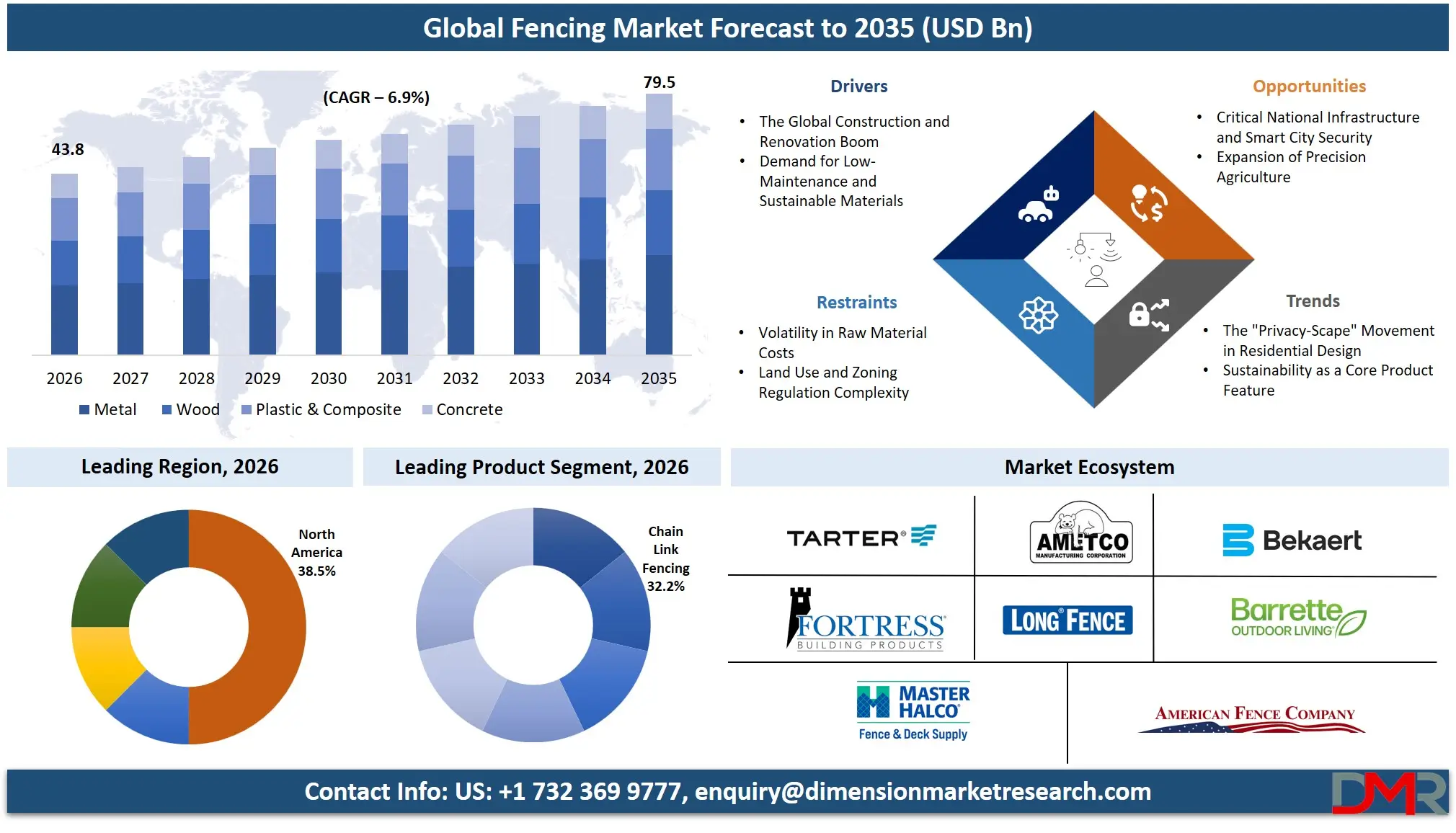
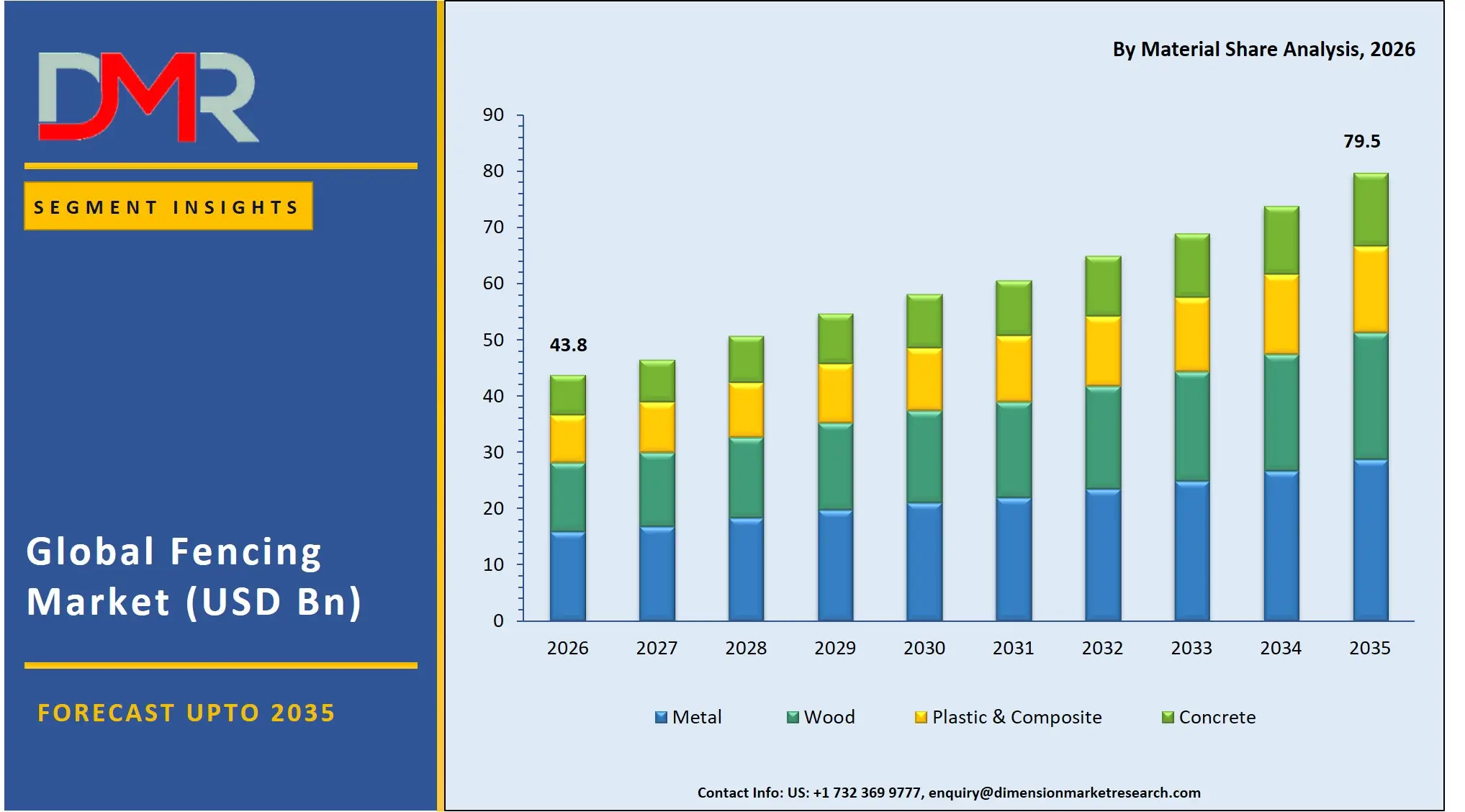
The Global Fencing Market is expected to reach a value of USD 43.8 billion in 2026, and it is further anticipated to reach USD 79.5 billion by 2035, growing at a CAGR of 6.9% during the forecast period.
ℹ
To learn more about this report –
Download Your Free Sample Report Here
The fencing industry has been witnessing a healthy growth that has been enhanced by the increased residential construction, the growth in security concerns, and the development of agricultural and industrial infrastructure. The market is composed of a broad product range, such as chain link, wooden fencing, vinyl fencing, metal fencing, and composite fencing, which have applications in areas such as marking a residential boundary, to extreme high security perimeter barriers around critical infrastructure.
The need to find special fencing solutions is prompted by the growing need for long-lasting and low-maintenance materials and the incorporation of intelligent technologies into perimeter security. The most common adopters are homeowners whose use of vinyl and composite fencing is still growing, owing to its beauty and durability. Government, military and defense, and agriculture are among the key players since they need strong, secure and compliant perimeter ecosystems.
ℹ
To learn more about this report –
Download Your Free Sample Report Here
The US Fencing Market
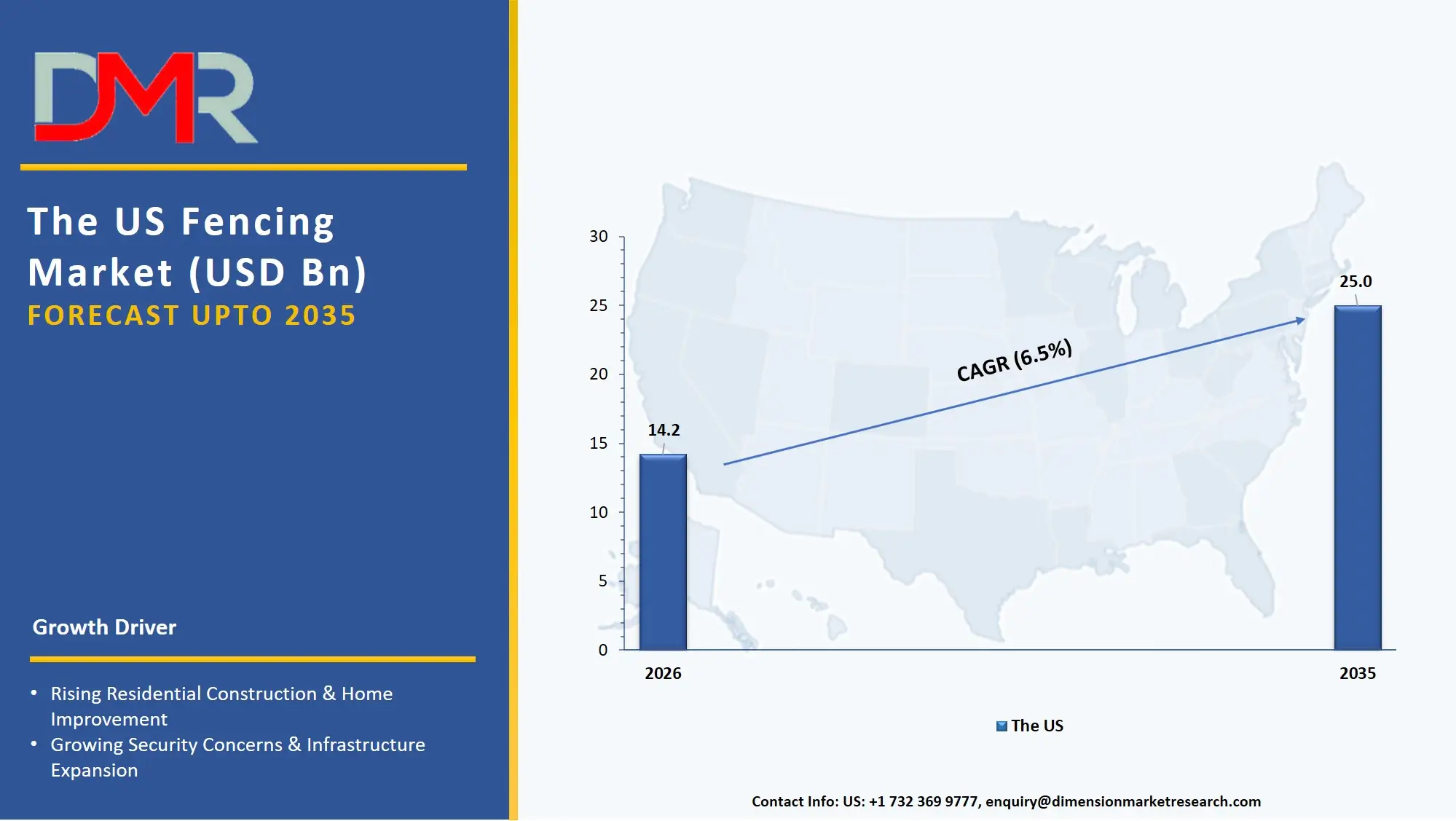
The US Fencing Market is projected to reach USD 14.2 billion in 2026 at a compound annual growth rate of 6.5% over its forecast period, which is further poised to reach a value of USD 25.0 billion by 2035.
ℹ
To learn more about this report –
Download Your Free Sample Report Here
The US remains the largest and most mature fencing market because of a robust housing market, substantial investment in infrastructure and an unrelenting emphasis on perimeter security in the public and private sector. The high demand on composite and vinyl fencing products has been characteristic of the market with residential homeowners placing more emphasis on their privacy, aesthetics, and low maintenance as opposed to the traditional wood. In addition to this, the introduction of electric fencing and automated access control in industrial and agricultural facilities is creating an analogous demand on contractor-based installation services, able to integrate these complicated systems safely and efficiently.
The Europe Fencing Market
The Europe Fencing Market is estimated to be valued at USD 12.5 billion in 2026 and is further anticipated to reach USD 22.1 billion by 2035 at a CAGR of 6.5%. The existence of stringent safety laws and high emphasis on sustainable urban planning make a huge difference in the European market and contribute to the necessity of high-quality metal and certified security fencing. The region also experiences accelerated growth in composite fencing as homeowners in Germany and France are trying to strike a balance between weather resistant and the aesthetic standards of contemporary residential architecture. Moreover, there are attempts to protect critical national infrastructure demanding fencing manufacturers to develop specific anti-climb and anti-cut fencing products offering high standards of physical security to transport and energy infrastructure throughout the European ecosystem.
The Japan Fencing Market
The Japan Fencing Market is projected to be valued at USD 1.8 billion in 2026. It is further expected to witness robust growth, holding USD 3.2 billion by 2035 at a CAGR of 6.6%. The Japanese market is unique, with a corporate and governmental drive to enhance national disaster resilience and secure aging public infrastructure. A significant portion of the expenditure is made up of metal fencing and high-durability chain link fencing as government agencies lock up transportation centers and industrial facilities. Discrete, high-strength perimeter solutions are also in high demand to integrate with urban landscapes to fill the divide between time-honored aesthetic value and new security requirements, which creates a niche in high-quality metal and composite fencing systems.
Key Takeaways
- Market Size & Forecast: The Global Fencing market is projected to reach USD 43.8 billion in 2026, expanding steadily to USD 79.5 billion by 2035, driven by the duel driver of global construction growth and the compulsory modernization of perimeter security of critical infrastructure.
- Growth Rate & Outlook: Global market growth is expected at a CAGR of 6.9%, due to an urgent requirement of replacement of old stocks of fences in developed markets and growth of sophistication of adding smart and sensor-related security systems to the physical barriers.
- Primary Growth Drivers: The major drivers are the mass exodus of traditional wood to low-maintenance plastic and composite materials, the demand to use high-security metal fencing to fight an increase in property crime, and the expansion of large-scale agricultural operations, which demand durable and cost-effective perimeter solutions.
- Key Market Trends: Some of the major trends in the industry include the emergence of industry-targeted security systems, the adoption of automated access control tools in the electric fencing systems, and the move towards sustainable materials as consumers focus on eco-friendly product lifecycles.
- By Material Analysis: Metal is projected to dominate because of its strength, durability, and resistance to corrosion, which are widely applied in industries. Wood is still ornamental and costly to maintain. Plastic and composites develop in the direction of low maintenance. Concrete would be used in the high-security requirements, but it is not cost-effective, and metal remains a choice.
- By Installation Analysis: Contractor-based installation is poised to lead as it requires technical expertise to ensure safe and compliant fencing in industrial and infrastructure work. DIY is becoming popular in residential vinyl and wood fencing but is not yet popular in complicated and large scale installations that demand reliability by professionals.
- Regional Leadership: North America is poised to dominate this market with 38.5% of the market share in 2026 since the region owns a large number of homes, has a large agricultural landmass and a highly developed industrial base that employs the best perimeter security to the maximum.
What is the Fencing?
Fencing is the technical barriers and demarcation systems provided by manufacturers, distributors, and professional installers to surround, protect and improve properties. These are products that are complete systems, not raw lumber or unprocessed metal, but the how of defining the perimeter security and property definition. This includes chain link fencing to create affordable boundaries, wooden fencing to create aesthetic residential fencing, metal fencing to create high security and decorative purposes and electric fencing to create non-lethal deterrence at the perimeter boundary. As property owners and businesses cope with a balance between security and aesthetic needs, fencing options must be capable of delivering the appropriate balance between affordability, longevity and aesthetics, such that investments in perimeters are converted into a practical safety and property value, rather than mere boundary markers.
Use Cases
- High-Security Perimeter for Petrochemical Plants: Petroleum and chemicals firms employ contractor-based installers of metal and electric fencing services to install anti-climb and anti-cut perimeters that guard volatile assets, which integrate with plant-wide security systems.
- Privacy and Aesthetics in Residential Developments: Residents install composite and vinyl fencing products to form an enclosed backyard that is privacy-protected, free of noise, enduring, with no need of painting, and with a consistent look that contributes to curb appeal and home values.
- Agricultural Asset Protection: Large commercial farms use chain link and electric fencing to form large perimeters that are used to contain livestock and to protect crops against wildlife, which is a critical investment to be operationally viable and to protect crops.
- Government Infrastructure Fortification: Government agencies install crash-rated metal fencing and automated gate integration to protect embassies, military bases, and transport hubs to establish multi-layered protection against vehicle-borne and pedestrian attacks.
How AI is Transforming the Fencing Market?
The fencing market is applied in various high-value industries and each application has its industry-specific security, functionality and aesthetic requirements. At petrochemical facilities, firms use high-security metal and electric fencing systems installed by contractors to create anti-climb and anti-cut zones to protect hazardous and volatile property, which are usually deployed alongside real-time intrusion detection and centralized plant security systems. Residential developments have seen a growing trend towards composite and vinyl fencing solutions, which offer privacy and noise reduction with durability, low maintenance and a visual consistency that improves curb appeal and property value.
Chain link and electric fencing are widely used in agriculture by large-scale farms to secure large perimeter areas to contain livestock and keep wildlife away and away their crops, and to ensure that the farms remain productive and are not subject to losses. In the meantime the government agencies are installing high crash-rated metal fencing along with automated gate systems as a means of securing sensitive infrastructure like embassies and military bases, as well as transportation hubs, with multiple layers of defense against vehicular and pedestrian attacks.
Market Dynamics
Key Drivers in the Global Fencing Market
The Global Construction and Renovation growth
Global populations are grappling with a surge in new residential and commercial construction, outpacing the capacity of aging infrastructure. The expertise to install specialized equipment, especially on complex metal and electric equipment is being demanded at a higher rate than skilled installers, resulting in structural deficiency in the labour market. This is creating a shift of relying on professional installation by contractors, instead of general handymen, in businesses and at home. These specialists help in such key activities as site planning, post-setting and system integration that enable organizations to speed up the process of security improvement and reduce the risks of inadequate installation.
Demand for Low-Maintenance and Sustainable Materials
The size of property owners also demand to maintain a large number of sites, and are moving away more and more to composite and vinyl options in place of the high-maintenance wood. Nevertheless, it is not easy to choose the right product made of polymer based on a particular climate. Organizations require the ability to match material durability, warranty, and environmental impact measures among various vendor standards. Such complexity can result in inefficiency and early failures without expert advice. Therefore, the retail and distribution channels are increasingly in need of specialists capable of helping end-users in choosing the appropriate composite and plastic materials that can be used in their respective areas in accordance with their weather conditions.
Restraints in the Global Fencing Market
Volatility in Raw Material Costs
The majority of fencing manufacturers depend on commodities such as steel, aluminum, wood and petroleum-based plastics, the prices of which have been unpredictable in the past. These essential materials are a major challenge to stable prices even though fencing is in high demand. The unpredictable costs of timber as a result of tariffs or supply chain failures can render wooden fencing prohibitively costly, and swings in prices of steel have a direct effect on the profitability of chain link fencing and ornamental metal fencing projects. The organizations are afraid of committing to fixed-price contracts with long lead times since they risk business disruption in the event that there is a spike in material cost. In turn, raw material uncertainty slows big-scale project approvals, and requires contractors to implement cautious, staged deployment approaches, instead of transformation on a large scale.
Land Use and Zoning Regulation Complexity
Complicated municipal zoning regulations and homeowners association (HOA) covenants have led organizations and homeowners to be more unwilling to invest in fencing projects without going through a lengthy process. Although perimeter security is a strategic focus, property owners are under pressure to justify all the details of an investment and show adherence to local height, material, and aesthetic regulations. The design and planning stage of installation projects that are based on contractors, thus, falls under the greater scrutiny. This has seen business and individuals move to less controversial and less contentious projects and complex or high-security fencing projects may be put on hold until contractors can overcome regulatory challenges. This transformation is compelling fencing providers to hire more consultative and results-oriented specialists.
Growth Opportunities in the Global Fencing Market
Critical National Infrastructure and Smart City Security
The development of secure, multi-layered smart perimeters in government and energy sectors is one of the major growth prospects in the fencing market. Many countries are currently demanding their own bespoke integrated solutions that suit their own geopolitical, topographical, and compliance needs. These advanced environments are developed using the advanced expertise of incorporating crash-rated metal fencing with LIDAR, fiber-optic detection and surveillance systems. Fencing contractors and system integrators can help governments construct resilient, smart perimeters which can facilitate automated threat detection and response. The market can generate the need of highly specialized design and installation services.
Expansion of Precision Agriculture
The necessity to combine not only the technical installation competence but also the knowledge of the agricultural processes is a reason to develop further since farms are getting bigger and more data-oriented. These include livestock containment systems, crop protection enclosures and perimeter monitoring solutions. Firms in the farming and animal industry must comply with the rules of animal welfare and biosecurity. They, therefore, need installation partners that understand fencing technology and agricultural compliance systems. The fencing service providers can add value by looking at the possibilities of combining electric fencing with farm management software, following rotational grazing patterns, and tailoring workflows of gate automation.
Trends in the Global Fencing Market
The "Privacy-Scape" Movement in Residential Design
The notion that an outdoor living room is something that is being increasingly embraced by homeowners as a substitute to an ordinary, unused backyard. Instead of a yard and a fence, homeowners are creating wholly enclosed, intimate oases that are an extension of their interior living spaces. These areas allow one to entertain, relax and cook outdoors in a smooth manner. As a response to this, retailers and installers of fencing have started offering experience in integrating tall, solid composite fencing with embedded lighting, planters and sound-weakening attributes to make a complete privacy-scape.
Sustainability as a Core Product Feature
Environmental awareness is also becoming a central product feature in fencing choices as companies and consumers are being pressured to achieve ESG and minimise embodied carbon. Perimeter solutions that can assist in attaining sustainability objectives without compromising on performance are of interest to businesses. This has also led to environmental product declarations and recycled content verification requirements. Professional installers and manufacturers can help organizations to choose materials that have a high post-consumer percentage of recycled content, such as metal and composite fences, and to implement zero-waste installation methods that produce less waste at the job site.
Research Scope and Analysis
The fencing market research scope highlights strong growth across residential, industrial, agricultural, and government sectors, driven by rising security needs, infrastructure development, and aesthetic demand. Metal fencing, contractor-based installation, and retail distribution continue to dominate due to durability, reliability, and widespread accessibility.
ℹ
To learn more about this report –
Download Your Free Sample Report Here
By Product Analysis
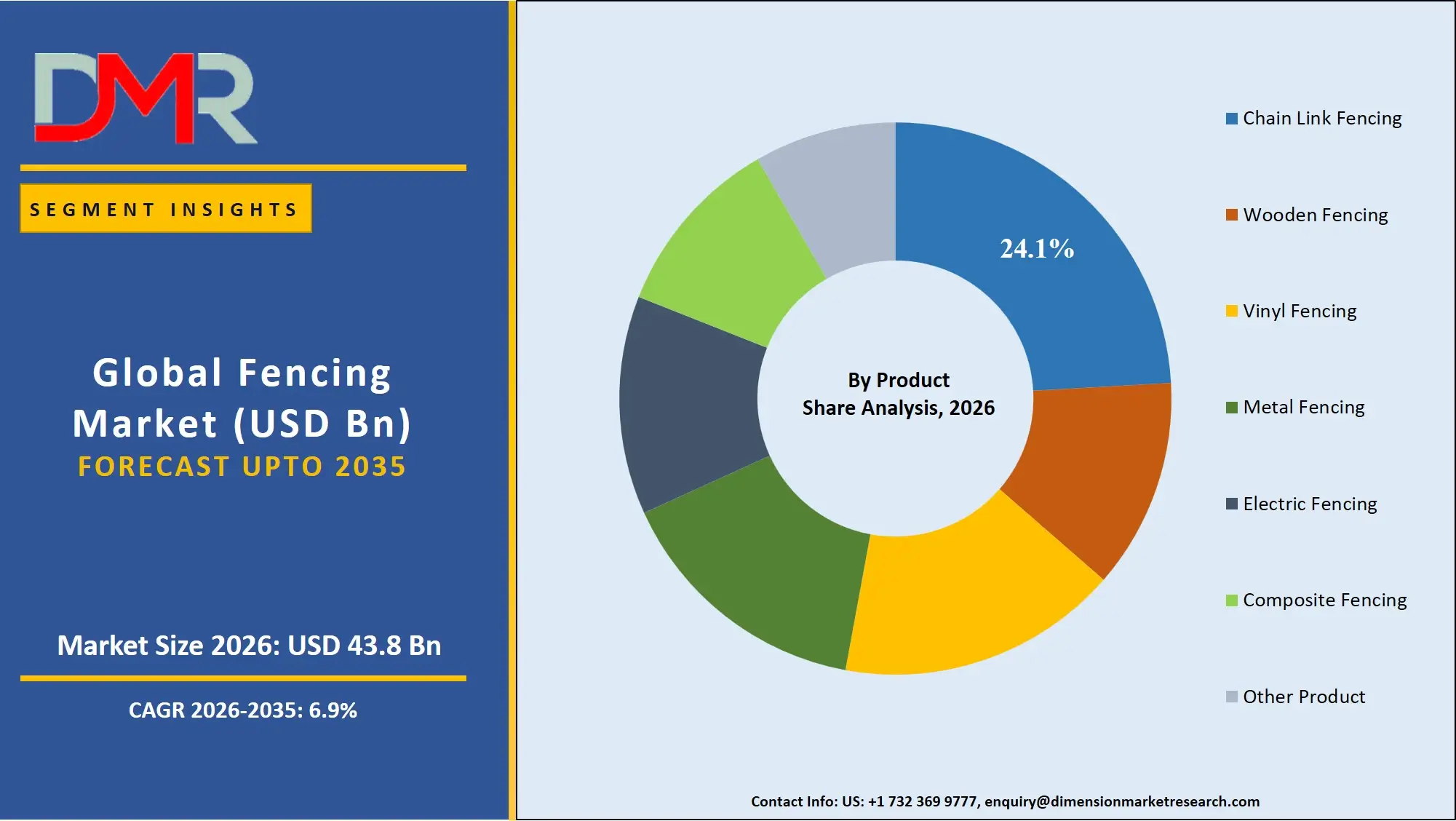
The product segment is projected to dominated by metal fencing as it offers better durability, strength and security performance when used in residential, industrial and high security environments. Chain link fencing has a huge market share due to its affordability and wide application in the security of perimeter of public structures and industrial facilities. Vinyl and composite fencing are increasingly popular in residential segments because of their low-maintenance and beauty especially in the developed regions. Its deterrence properties make electric fencing a leading choice in niche applications like agriculture and high-security zones. Wooden fencing is still used in ornamental and traditional applications, but is slowly being pushed out by more resistant options. All in all, metal-based fencing remains the leader since it has a long life cycle, versatility and flexibility in a wide range of environments and applications.
By Material Analysis
The material segment is poised to be dominated by metal, and is mainly influenced by the widespread use of steel and aluminum in fencing systems. These materials are of high tensile strength, corrosion resistant (treated), and long lasting usage, and therefore may be used in residential, commercial and industrial buildings. Wood remains a stable part of the decorative and residential fencing but is struggling because of maintenance and vulnerability to environmental degradation. Plastic and composite materials are also on the rapid rise since they are resistant to rot, insects and weather, and have reduced maintenance costs. Preference in concrete fencing is high security and infrastructure fencing but it is not widely used because of the increased installation expenses. All in all, the most common material is metal because it is reliable, has structural integrity, and covers a wide range of applications.
By Installation Analysis
This segment is expected to dominated by contractor-based installation because fencing systems can be made to need professional skills to ensure that they are properly aligned, durability and meet local regulations. Metal, electric and high-security fencing systems are complex systems that require well-trained workforce to prepare the site, install posts, and integrate the systems. Industrial, infrastructure, and government projects, which are carried out on a large scale, also support the necessity of professional contractors. In residential use, Do-It-Yourself (DIY) installation is becoming increasingly popular among vinyl and wooden fencing as it is easy to install and prefabricated fencing kits are available. Nevertheless, the use of DIY is still not widespread in large-scale or complex projects. In general, the segment is topped by the contractor-based installation because it is more reliable, efficient, and capable of addressing the technically challenging fencing needs.
By Distribution Channel Analysis
The distribution channel segment is expected to dominated by retail because of the high concentration of physical stores, home improvement centers and specialized fencing suppliers, which offer end-to-end product distribution and product consultation services. Customers (particularly residential and small commercial) would like to use retail channels to check on materials and have customization features and professional advice. There is a high rate of growth in online channels because of the growing digitalization, convenience, and availability of a variety of products. E-commerce is especially popular with DIY solutions of fencing and standardized products. Nevertheless, offline retail and distributor channels continue to be the main ways of procuring large-scale and tailored fencing solutions. The net effect is that retail is staying strong because of its personalized service, availability of products, and infrastructure that constitutes the supply chain.
By Application Analysis
The fencing market is poised to dominate by residential applications because there is growing need by homeowners to enhance privacy, security, and aesthetic appeal. This segment is also motivated by the increasing number of suburban housing developments and home renovation activities. The agricultural uses have a significant portion, which is motivated by the necessity to contain livestock, protect crops, and demarcate land. It is also important in industrial applications, especially in security and safety in manufacturing plants, warehouses, and infrastructure facilities. Nonetheless, residential fencing takes the lead in general because of its high volume demand and its uniform growth in all regions. The trend of growing consumer interest in outdoor living rooms and addition of value to property also increases the centrality of the residential market.
By End-Use Industry Analysis
The end-use industry segment is poised to be predominantly represented by government sectors because they feature extensive investment in public safety, transport networks and protection of critical infrastructure. It is also used in military and defense applications, where high-security fencing systems with sophisticated functionalities are needed. Agriculture and farms are another significant portion that is motivated by land management and livestock protection. Fencing is used in the energy and power industries to secure facilities like power plants and substations. The industrial industries, such as mining and petroleum and chemicals, demand strong fencing that is safe and regulatory. Although there are significant efforts at the national level by various sectors, the government initiative of infrastructure projects is preeminent because of the size and constant investments, as well as the urgency of the necessity of securing the perimeters.
The Global Fencing Market Report is segmented on the basis of the following:
By Product
- Chain Link Fencing
- Wooden Fencing
- Vinyl Fencing
- Metal Fencing
- Electric Fencing
- Composite Fencing
- Other Product
By Material
- Metal
- Wood
- Plastic & Composite
- Concrete
By Installation
- Contractor-based Installation
- Do-It-Yourself (DIY)
By Distribution Channel
By Application
- Residential
- Agricultural
- Industrial
By End-Use Industry
- Government
- Military & Defense
- Petroleum & Chemicals
- Mining
- Energy & Power
- Transport
- Agriculture & Farms
- Others
Regional Analysis
Leading Region by Market Share
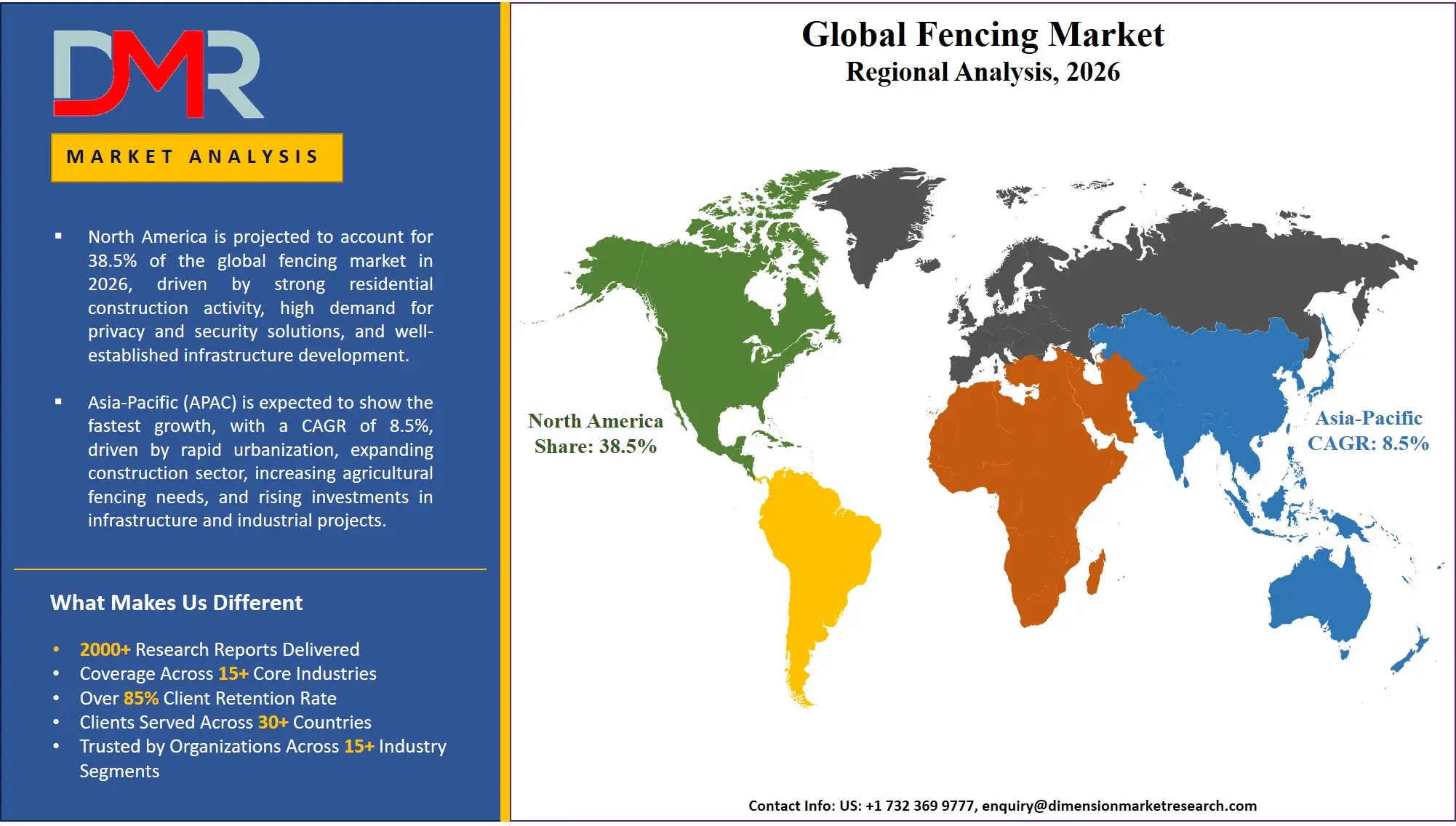
North America is poised to dominate the global fencing market as it is projected to hold 38.5% of the market share by the end of 2026. The United States, the North American powerhouse, holds the largest fencing stake due to unmatched concentration of residential homeownership and aggressive perimeter security plans of Fortune 500 industrial corporations. The region boasts of well-established ecosystem of national distributors, boutique contractor companies and abundant source of skilled installers. The high homeowner investment in outdoor living spaces, high-end property monitoring, and the general substitution of the older wooden stock helps to sustain the demand of composite and vinyl fencing and professional installation. In addition, there is a healthy agricultural climate that continues to fund new farmland enclosures requiring professional installation to ensure cost-effective livestock containment.
ℹ
To learn more about this report –
Download Your Free Sample Report Here
Fastest-Growing Regional Market
Asia-Pacific will be the fastest growing fencing market, as the region sees government-led sweeping infrastructure and smart city projects in India, China, and Southeast Asia. Economic development driven by rapid pace, emergence of middle-income generation and the dynamic growth of the industrial economy are forcing the governments and national agencies that are old to ensure the security of high-value assets. Metal and electric fencing of high security is in demand to assist these large organizations in securing energy, transport installations, and defense installations. The region is also in a dire need of defining and securing agricultural land in a responsible manner and chain link and metal fencing needs to be installed in a cost-effective and long-lasting manner to overcome the challenge of traditional livestock management and the current farm productivity.
By Region
North America
Europe
- Germany
- The U.K.
- France
- Italy
- Russia
- Spain
- Benelux
- Nordic
- Rest of Europe
Asia-Pacific
- China
- Japan
- South Korea
- India
- ANZ
- ASEAN
- Rest of Asia-Pacific
Latin America
- Brazil
- Mexico
- Argentina
- Colombia
- Rest of Latin America
Middle East & Africa
- Saudi Arabia
- UAE
- South Africa
- Israel
- Egypt
- Rest of MEA
Competitive Landscape
The competitive landscape of the world fencing market has become very dynamic with a diverse set of large-established world-wide and regional installation contractors and niche composite and smart-technology innovators. In depth strategic alliances with the large retail home improvement chains will be the key to success; they will provide the required volume sales opportunities and access to residential consumer trends early. The trend of consolidation of markets is advancing at a very high rate with the traditional metal and wood manufacturers taking over composite extrusion and electric security specialized boutiques in order to survive. Proprietary intellectual property such as patented post-to-rail connection systems, developed material blends and automated fabrication processes are increasingly an important source of competitive differentiation rather than commodity pricing or generic product catalogs.
Some of the prominent players in the Global Fencing Market are:
- Ameristar Fence Products, Inc.
- Master Halco, Inc.
- Betafence NV
- Barrette Outdoor Living, Inc.
- Fortress Building Products
- Bekaert NV
- Jacksons Fencing Ltd.
- Long Fence Company, Inc.
- Allied Tube & Conduit
- CertainTeed Corporation
- Ply Gem Holdings, Inc.
- Ametco Manufacturing Corporation
- Tarter Farm and Ranch Equipment
- Gregory Industries, Inc.
- Jerith Manufacturing Company Inc.
- Associated Materials LLC
- The American Fence Company
- CLD Fencing Systems LLP
- Praesidiad Group Limited
- F H Brundle
- Other Key Players
Recent Developments
- January 2026: Trex Company declared a significant increase in its recycling in a sustainability program. The relocation aims to assist clients in the government and the transport sector to meet green procurement targets on infrastructure projects by promoting higher-content recycled plastic in composite fencing solutions.
- November 2025: Johnson Controls expanded its partnership with Senstar Technologies, introducing a new practice called Energy & Power Perimeter Resilience. This project aims at assisting petroleum and energy customers to implement fiber-optic sensor-integrated metal fencing systems and adhere to international requirements of critical infrastructure protection rules.
- October 2025: The Home Depot purchased Cedreo (symbolic of fencing design software capabilities) to enhance its online distribution channel and DIY design ecosystem. The purchase will benefit the homeowners in terms of visualization of custom composite and vinyl fencing designs and creating the exact amount of material needed to make an order without difficulties.
Report Details
| Report Characteristics |
| Market Size (2026) |
USD 43.8 Bn |
| Forecast Value (2035) |
USD 79.5 Bn |
| CAGR (2026–2035) |
6.9% |
| The US Market Size (2026) |
USD 14.2 Bn |
| Historical Data |
2021 – 2025 |
| Forecast Data |
2027 – 2035 |
| Base Year |
2025 |
| Estimate Year |
2026 |
| Segments Covered |
By Product, By Material, By Installation, By Distribution Channel, By Application, By End-Use Industry |
| Regional Coverage |
North America – The US and Canada; Europe – Germany, The UK, France, Russia, Spain, Italy, Benelux, Nordic, & Rest of Europe; Asia-Pacific – China, Japan, South Korea, India, ANZ, ASEAN, Rest of APAC; Latin America – Brazil, Mexico, Argentina, Colombia, Rest of Latin America; Middle East & Africa – Saudi Arabia, UAE, South Africa, Turkey, Egypt, Israel, & Rest of MEA |
Frequently Asked Questions
How big is the Global Fencing Market?
▾ The Global Fencing market is poised to be valued at USD 43.8 billion in 2026 and is projected to reach USD 79.5 billion by 2035, driven by the universal need for privacy, security, and property demarcation in residential, agricultural, and industrial sectors.
Which region held the largest share of the Fencing Market in 2026?
▾ North America is poised to dominate this market 38.5% market share in 2026, driven by a mature home improvement ecosystem and aggressive residential and industrial investment in composite, metal, and high-security electric fencing capabilities.
Who are the key players in the Global Fencing Market?
▾ Key players in the global fencing market include Allied Tube & Conduit, Ameristar Fence Products, Bekaert, Betafence NV, CertainTeed Corporation, Gregory Industries, Jerith Manufacturing Company, Long Fence Company, Ply Gem Holdings, and Associated Materials LLC.
What is the CAGR of the Global Fencing Market from 2026 to 2035?
▾ The market is expected to grow at a CAGR of 6.9% from 2026 to 2035, reflecting the accelerating complexity of home improvement projects and the persistent need for modernizing perimeter security for critical infrastructure.
What factors are driving the growth of the Global Fencing Market?
▾ Key drivers include the global construction boom, the imperative to replace aging wooden fencing with low-maintenance alternatives, the management of high-security perimeters for government and energy sectors, and the surge in demand for privacy amidst rising urban density.
Which region is expected to grow the fastest in the Fencing Market?
▾ The Asia-Pacific region is expected to grow the fastest, fueled by rapid urbanization and infrastructure development in India, China, and Southeast Asia, where robust perimeter security fencing is critical for transitioning to smart city and modern agricultural operations.
What are the major trends in the Global Fencing Market?
▾ Major trends include the integration of smart security sensors into physical fences, the rise of eco-friendly and recycled composite materials, the demand for complete privacy-scape solutions, and the focus on Do-It-Yourself (DIY) friendly panel systems with online design tools.
How is the Global Fencing Market segmented?
▾ The market is segmented by Product By Material, Installation, Distribution Channel, Application, and End-Use.