Market Overview
The fixed fire and gas detection systems market covers permanently installed hardware and integrated control architectures designed to detect combustible gases, toxic gases, oxygen depletion, flame, smoke, and heat within industrial and commercial facilities. The market excludes portable gas monitors, personal protective equipment, and fire-suppression hardware, though fixed detection systems frequently interface with suppression logic as part of broader safety instrumented systems. Buyers range from oil and gas operators and chemical plant managers to hyperscale data center developers and offshore marine operators.
Process safety regulations across North America, Europe, and Asia Pacific compel operators to embed continuous monitoring into facility design rather than treat detection as a retrofit option. Fixed systems differ from portable alternatives by providing around-the-clock coverage of defined hazardous zones, generating audit-ready alarm histories, and integrating with distributed control systems and safety PLCs. A sensor network embedded at commissioning becomes part of the facility's safety case, which creates long replacement cycles and recurring calibration and service revenue for vendors.
Hydrogen economy infrastructure, battery energy storage buildout, and hyperscale data center expansion are collectively pulling fixed detection demand into facility types that did not exist at scale a decade ago. Each of these environments carries distinct hazard profiles: hydrogen ignites across a wide concentration range, lithium-ion off-gassing produces a cocktail of toxic and flammable vapors, and data centers concentrate high electrical loads in tightly sealed spaces. Vendors that can certify products for these emerging environments gain first-mover advantage before procurement standards consolidate around a smaller approved-vendor list.
Key Takeaways
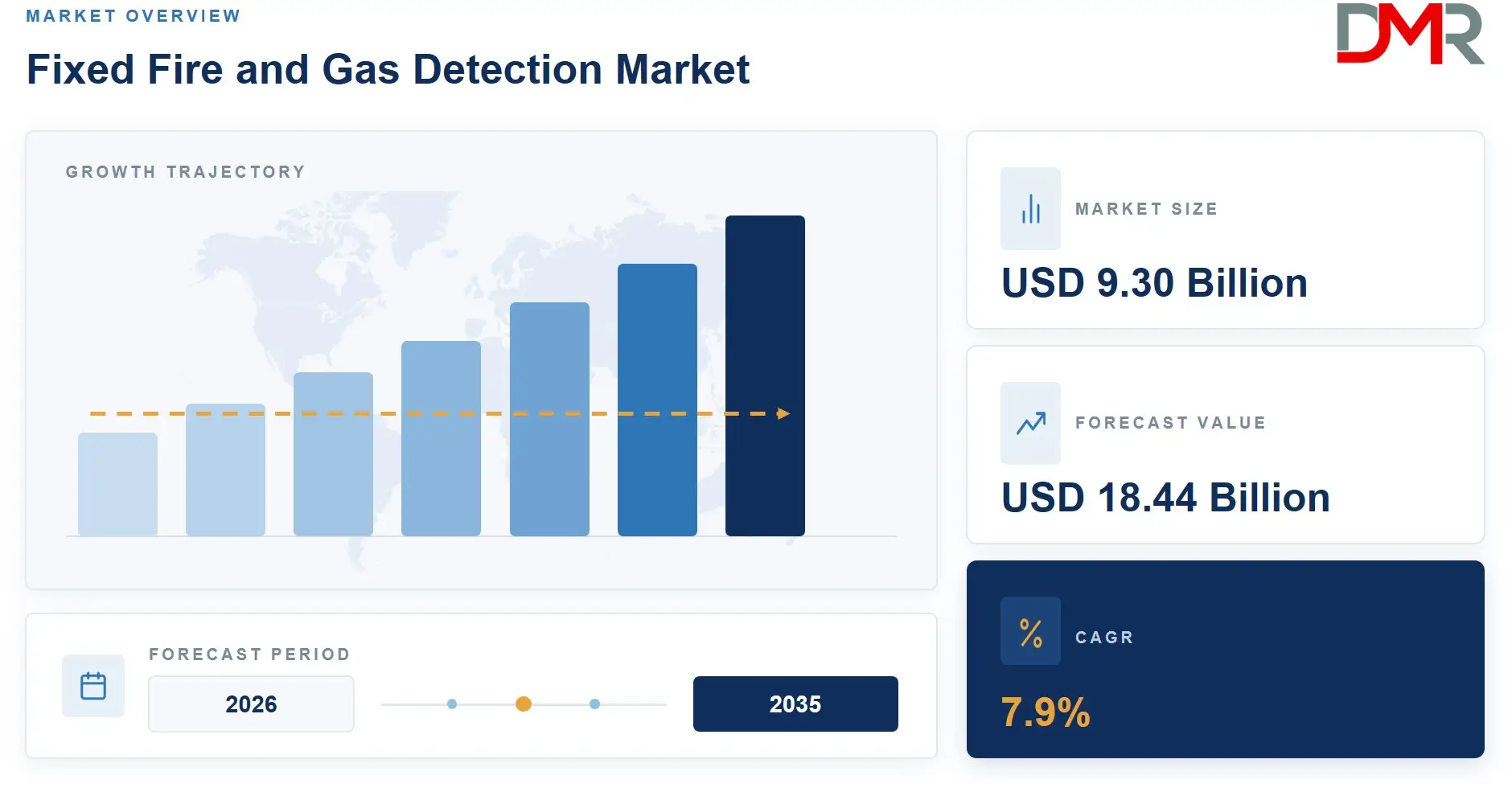
- The market size is USD 9.30 Billion in 2026, and is projected to hit USD 18.44 Billion by 2035 at a CAGR of 7.9%.
- By Product Type: Fixed Gas Detection Systems led as the largest-growth category, with the highest CAGR of 8.5% in 2026.
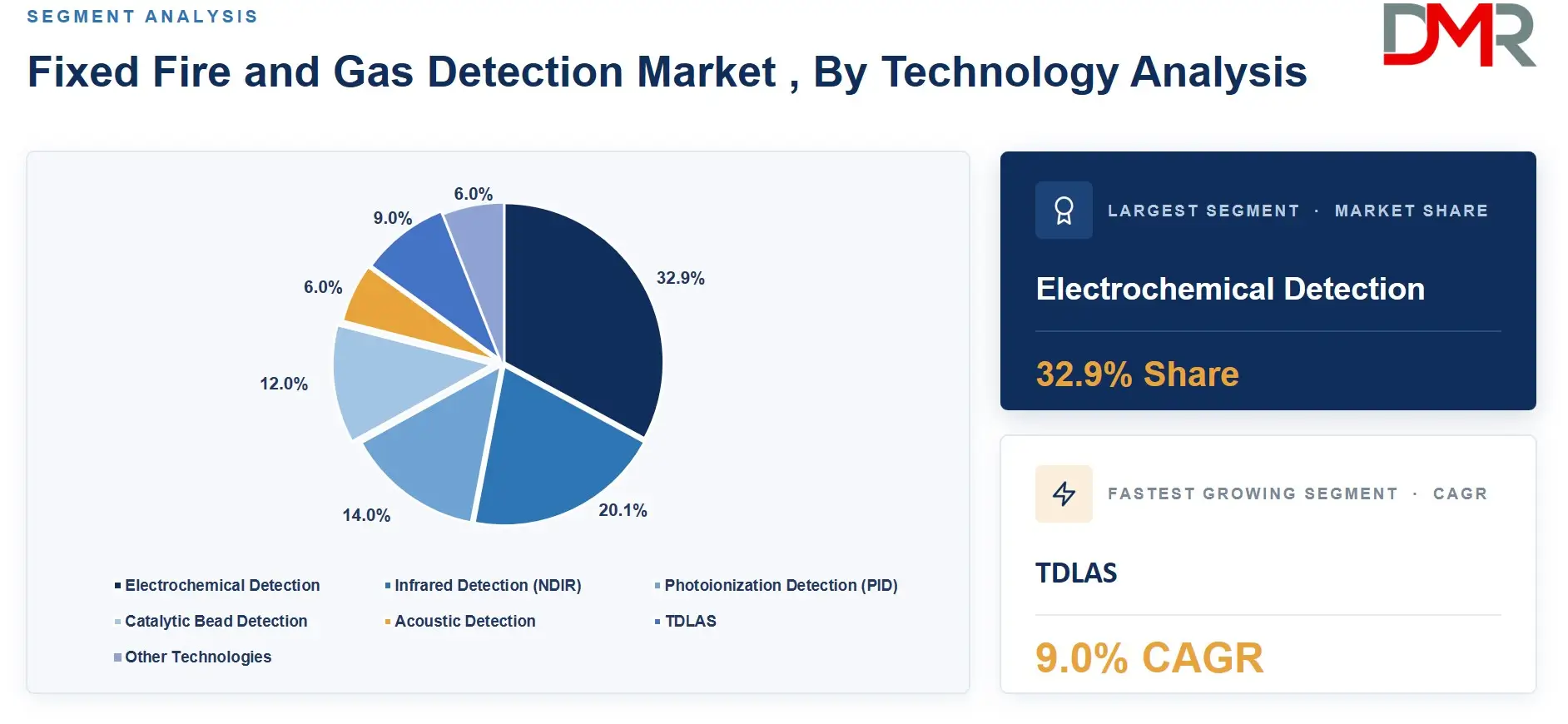
- By Technology: Electrochemical Detection led with a 32.9% share in 2026.
- By Hazard Type: Flammable and Explosive Gas Detection led as the highest-CAGR category in 2026.
- By End User: Oil and Gas led as the largest share category in 2026.
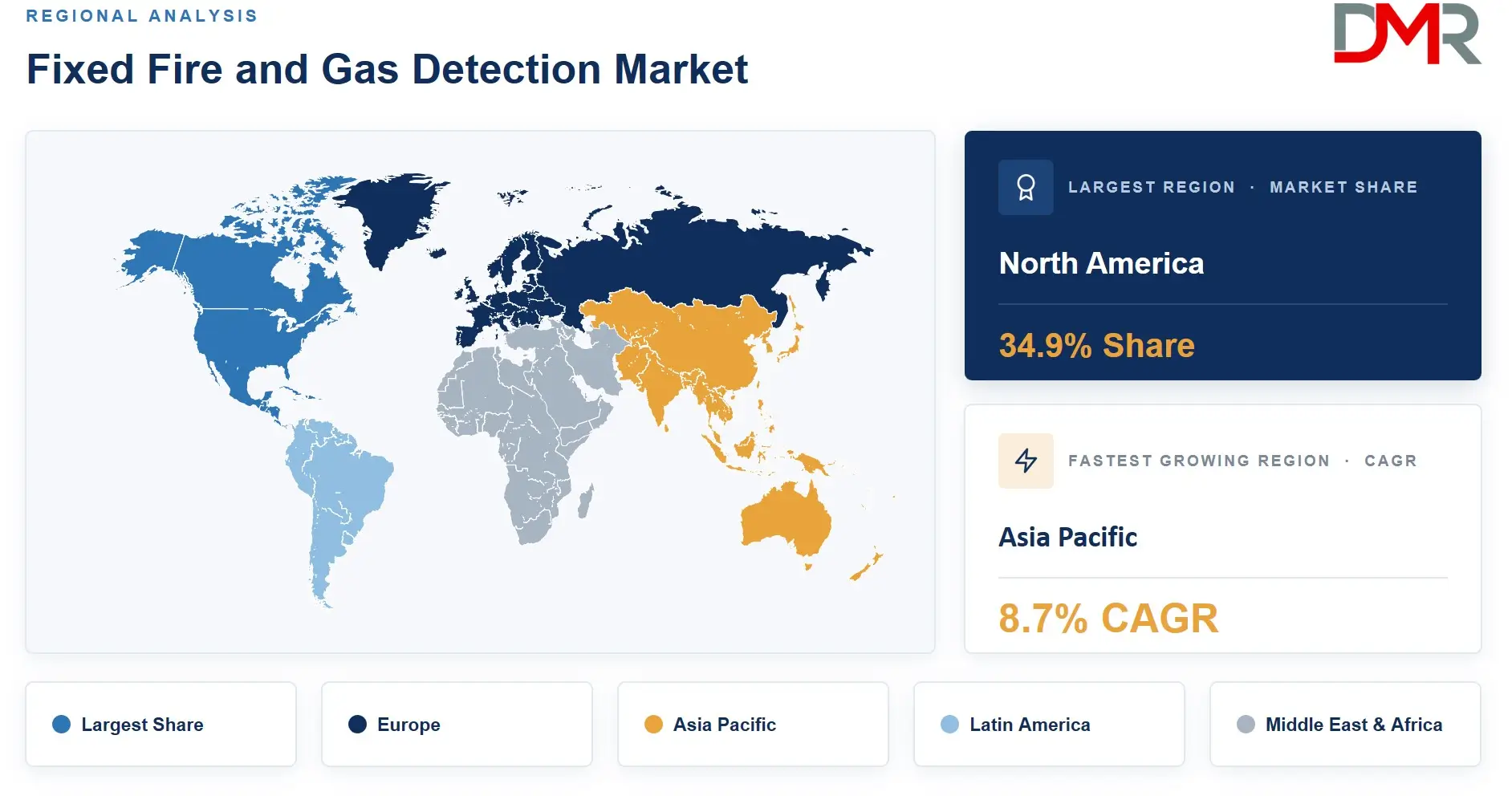
- By Region: North America led with a 34.9% share, valued at USD 3.25 Billion, in 2026.
- Asia Pacific is the fastest-growing region, driven by petrochemical expansion and tightening industrial safety enforcement across China, India, and Southeast Asia.
Market Size and Forecast
The Global Fixed Fire and Gas Detection Systems Market size is estimated at USD 9.30 Billion in 2026, and is projected to reach USD 18.44 Billion by 2035, exhibiting a CAGR of 7.9% during the forecast period.
Growth through 2035 rests on three compounding structural forces. Process safety compliance mandates continue to expand their geographic and sectoral reach, pulling new facility types into mandatory fixed-detection requirements. Simultaneously, the build-out of hydrogen infrastructure, battery storage, and hyperscale data centers creates entirely new detection demand that was absent from earlier forecast cycles. Vendors cannot rely on replacement cycle revenue alone; the greenfield component of demand is now large enough to sustain above-average growth even when brownfield modernization slows.
ℹ
To learn more about this report –
Download Your Free Sample Report Here
The 2020 to 2024 historic period established consistent mid-single-digit growth, anchored by oil and gas capital expenditure and chemical plant safety upgrades in Asia and the Middle East. The transition from that base to a 7.9% CAGR through 2035 reflects the entry of data centers and energy transition infrastructure as material end-user categories. Downside risk concentrates around commodity price volatility in oil and gas, which historically causes operators to delay detection system upgrades when upstream capital budgets compress. Upside risk sits in regulatory tightening across Southeast Asia and the Gulf, where enforcement of IEC 61508 and IEC 61511 functional safety standards remains inconsistent but is accelerating.
Product Type Analysis
Fixed Gas Detection Systems led the product type segment with the highest CAGR of 8.5%, outpacing all other product categories in 2026.
Fixed gas detection systems are growing faster than any other product category because the hazard profiles driving new demand, hydrogen leaks, lithium-ion off-gassing, ammonia from green shipping terminals, and refrigerant releases from low-GWP conversion projects, are all gas-phase phenomena. Fire alarm and fire detection systems face steady replacement demand, but the incremental growth is concentrated in gas-specific detection. Buyers in energy transition facilities are specifying gas detectors at the design stage rather than adding them post-construction, which accelerates revenue recognition for vendors with pre-certified hydrogen and off-gas solutions.
Fire alarm and notification systems hold a large installed base across commercial buildings and industrial plants, generating recurring service revenue but lower unit-volume growth than gas detection. Fire detection systems, covering smoke and heat sensing, face competition from multi-sensor fusion products that combine flame, smoke, and gas signals in a single detector head. Fire and gas control systems capture integration value by connecting detection hardware to suppression logic and plant control systems, making them strategically important to vendors seeking to move up the value chain beyond hardware sales.
Technology Analysis
Electrochemical Detection accounted for 32.9% of technology segment demand in 2026, the highest of any category.
Electrochemical sensors dominate because they deliver cost-effective, high-specificity detection of toxic gases, including hydrogen sulfide, carbon monoxide, chlorine, and ammonia, across the facility types that represent the largest installed base: oil refineries, chemical plants, and wastewater treatment facilities. Their selectivity advantage over catalytic bead sensors in mixed-gas environments justifies the higher unit cost for applications where false alarms carry significant operational and safety consequences.
ℹ
To learn more about this report –
Download Your Free Sample Report Here
Infrared detection, specifically non-dispersive infrared technology, is gaining ground in hydrocarbon-rich environments where catalytic bead sensors risk poisoning from silicone and halogen compounds. Photoionization detection captures volatile organic compound monitoring in pharmaceutical manufacturing and chemical processing, where regulatory thresholds for worker exposure are tightening. Tunable Diode Laser Absorption Spectroscopy represents the premium end of the technology spectrum, offering sub-ppm detection of specific gases across open paths, and is the preferred technology for hydrogen and methane monitoring in large-area storage facilities where point detectors cannot provide adequate coverage density.
Hazard Type Analysis
Flammable and Explosive Gas Detection led the hazard type segment as the highest-CAGR category in 2026.
Flammable and explosive gas detection growth is being driven by the same energy transition forces reshaping capital investment globally. Hydrogen operates across a flammability range of 4% to 75% by volume, far wider than methane or propane, which forces operators to specify faster-response, wider-range detectors across every point where hydrogen is produced, stored, compressed, or dispensed. LNG liquefaction plants and petrochemical complexes in the Middle East and Asia require dense detector networks across large process footprints.
Toxic gas detection serves a consistently large installed base in chemical plants and refineries, with demand tied closely to regulatory inspection cycles. Oxygen monitoring is a non-negotiable requirement in confined-space entry procedures across manufacturing, mining, and marine environments. Fire and flame detection is the most mature hazard category, benefiting from steady replacement cycles but delivering lower unit-volume growth than gas-phase detection segments.
End User Analysis
Oil and Gas captured the largest share of end-user demand in 2026, ahead of all other industry categories.
Oil and gas operators specify fixed detection systems across upstream wellheads, midstream compressor stations, LNG terminals, and downstream refineries, creating the broadest and most capital-intensive deployment base of any end-user segment. Process safety management requirements under OSHA PSM and equivalent international frameworks make continuous fixed monitoring non-negotiable at these facilities. Capital expenditure cycles in oil and gas directly determine the volume of new detector installations each year, creating revenue volatility that vendors offset by building recurring calibration and replacement contracts.
Data centers are the fastest-rising end-user category outside the traditional industrial base. Hyperscale campuses concentrate high electrical loads in sealed, climate-controlled spaces, and a single undetected smoke or gas event can result in catastrophic data loss and regulatory exposure. Chemical and petrochemical facilities follow oil and gas in detector density requirements and represent a stable, regulation-driven replacement market. Pharmaceuticals, food and beverage, and water and wastewater treatment collectively represent a broad distributed market of smaller deployments, where the shift toward continuous regulatory compliance monitoring is pulling procurement decisions away from periodic portable testing toward permanent fixed installations.
Key Market Segments
By Product Type
- Fixed Gas Detection Systems
- Point Gas Detectors
- Open-Path Gas Detectors
- Fire Alarm and Notification Systems
- Fire Detection Systems
- Fire and Gas Control Systems
By Technology
- Electrochemical Detection
- Infrared Detection (NDIR)
- Photoionization Detection (PID)
- Catalytic Bead Detection
- Acoustic Detection
- Tunable Diode Laser Absorption Spectroscopy (TDLAS)
- Other Technologies
By Hazard Type
- Flammable and Explosive Gas Detection
- Oxygen Monitoring
- Fire and Flame Detection
- Toxic Gas Detection
By End User
- Oil and Gas
- Manufacturing
- Data Centers
- Chemicals and Petrochemicals
- Food and Beverage
- Marine and Offshore
- Pharmaceuticals and Life Sciences
- Power Generation and Energy Infrastructure
- Transportation
- Mining and Metals
- Water and Wastewater Treatment
- Others
Regional Analysis
North America led the regional segment with a 34.9% share, valued at USD 3.25 Billion, in 2026.
North America
North America holds the largest regional share because U.S. regulatory architecture is among the most prescriptive in the world for process facilities. OSHA's Process Safety Management standard, EPA's Risk Management Program, and NFPA codes collectively mandate fixed detection across a wide range of industrial classifications. The Gulf Coast refining and petrochemical complex alone represents one of the highest detector-density industrial corridors globally. Canada's oil sands operations and LNG export projects on the Pacific coast add incremental demand that reinforces the region's structural lead.
Asia Pacific
Asia Pacific is the fastest-growing region, driven by simultaneous expansion across multiple end-user categories. China's chemical and petrochemical capacity additions continue at a pace that outstrips any other single country, while India's refinery expansion program and new industrial safety legislation are pulling forward detection system procurement that operators had deferred. Southeast Asian economies, led by Vietnam, Indonesia, and Thailand, are building LNG import terminals and associated regasification infrastructure, each of which requires fixed gas detection as a mandatory safety layer. Regulatory enforcement, historically inconsistent across the region, is tightening as industrial accident liability frameworks mature.
ℹ
To learn more about this report –
Download Your Free Sample Report Here
Europe
European demand is shaped by the ATEX Directive, the Seveso III Directive, and functional safety standards that impose strict equipment certification requirements on operators of hazardous sites. Germany and the Netherlands anchor demand through their large chemical manufacturing bases, while the United Kingdom's offshore oil and gas infrastructure on the North Sea continues to generate replacement and upgrade demand. The European energy transition is creating a new detection requirement profile, as hydrogen pilots, offshore wind-linked electrolyzer projects, and grid-scale battery storage facilities require hazard-specific fixed monitoring that differs materially from the hydrocarbon-centric detector specifications of the legacy installed base.
Latin America
Brazil dominates Latin American demand through Petrobras-linked offshore and onshore oil and gas infrastructure, where fixed gas and flame detection is embedded in mandatory safety cases for deepwater facilities. Mexico's refining modernization under PEMEX generates periodic procurement cycles. Regulatory enforcement across the broader region remains less consistent than in North America or Europe, which constrains the pace of brownfield modernization but creates white space for vendors willing to support local certification and commissioning requirements.
Middle East and Africa
Gulf Cooperation Council countries are among the highest per-facility detector-density markets globally, driven by massive LNG, refining, and petrochemical complexes in Saudi Arabia, Qatar, and the UAE. National oil companies in these markets require compliance with international functional safety standards as a condition of contractor qualification, creating structured procurement cycles. Green ammonia export projects under development across the Gulf represent a new hazard category requiring high-specificity NH₃ detection at scale. Sub-Saharan Africa remains an early-stage market for fixed detection, with growth tied primarily to mining operations and nascent refining capacity.
Key Regions and Countries
North America
Europe
- Germany
- France
- The UK
- Spain
- Italy
- Rest of Europe
Asia Pacific
- China
- Japan
- South Korea
- India
- Australia
- Rest of APAC
Latin America
- Brazil
- Mexico
- Rest of Latin America
Middle East & Africa
- GCC
- South Africa
- Rest of MEA
Macroeconomic Impact
Oil and gas capital expenditure is the single largest macroeconomic variable affecting this market. When Brent crude sustains above USD 70 per barrel, upstream and midstream operators proceed with facility expansions and detector upgrades on schedule. Below that threshold, procurement cycles extend, and brownfield modernization projects move to the next budget year. The 2022 to 2024 period of elevated energy prices accelerated detector procurement across the Gulf and Asia Pacific, building a revenue base that now supports the 7.9% CAGR forecast.
Currency depreciation in emerging markets raises the effective cost of USD-denominated detector hardware and calibration consumables, slowing procurement in price-sensitive markets across Southeast Asia and Latin America. Rising interest rates between 2023 and 2025 compressed capital budgets for data center and industrial construction projects in North America and Europe, but the subsequent easing cycle is releasing deferred demand into the 2026 to 2028 window. Trade policy uncertainty around semiconductor components used in detection electronics adds a procurement risk factor for vendors with concentrated Asian manufacturing bases.
Market Dynamics
Driver: Compliance Mandates Accelerating Fixed Detection Modernization
OSHA Process Safety Management, NFPA codes, IEC 61508, and IEC 61511 collectively define the minimum detection architecture for any facility classified as a major hazard site. Operators face financial penalties, facility shutdowns, and criminal liability for non-compliance, which converts regulatory timelines directly into procurement schedules. Compliance cycles also generate replacement demand independent of capacity expansion, because older detector technologies frequently cannot be certified against updated functional safety standards without hardware replacement.
Safety Integrity Level certification requirements under IEC 61511 are particularly consequential for this market. Emerson's Rosemount 625IR fixed optical gas detector is certified to SIL 2 in a 1oo1 arrangement and SIL 3 in a 1oo2 configuration, with its function test passing when response exceeds 20% of full scale, as reported by Emerson. Operators specifying SIL-rated systems must replace detectors that cannot meet these thresholds, creating a structured replacement wave in facilities that have not modernized since the IEC standards were last revised.
Restraint: Calibration Burden and Harsh-Environment Degradation Inflate Lifecycle Costs
Sensor drift, cross-sensitivity to interferent gases, and contamination from process chemicals are inherent limitations of electrochemical and catalytic bead technologies. Detectors exposed to silicones, lead compounds, or sulfur species experience accelerated poisoning that shortens service life and increases false alarm frequency. Each false alarm in a process facility triggers an emergency response protocol, which carries direct operational cost and erodes operator confidence in the detection system over time.
A 2025 peer-reviewed systematic review establishes practical T90 bump-test limits of 30 seconds or less for combustible-gas detectors and 60 seconds or less for toxic-gas detectors; results exceeding these thresholds indicate that sensor replacement may be needed, as reported in findings published in PMC. For large facilities with hundreds of fixed sensor points, systematic bump testing at these frequencies generates labor costs and process interruptions that buyers increasingly resist. Vendors that cannot demonstrate extended calibration intervals or self-diagnostic capabilities face pushback during procurement negotiations.
Opportunity: Energy Transition Infrastructure Opening New Detection Categories
Hydrogen production, storage, and refueling networks require detection systems calibrated for a gas that behaves differently from any hydrocarbon. Hydrogen is colorless, odorless, ignites at concentrations as low as 4%, and rises rapidly in enclosed spaces, which eliminates the floor-level sensor placement logic used for heavier-than-air gases. Vendors that have certified fast-response, wide-range H₂ detectors for hydrogen-specific deployment environments hold a commercially defensible position before procurement standards in this sector fully consolidate.
Grid-scale battery energy storage facilities represent a second distinct opportunity. Lithium-ion cells undergoing thermal runaway release hydrogen, carbon monoxide, hydrogen fluoride, and other toxic gases before any visible fire occurs, making early off-gas detection the only reliable intervention window. Dräger's fixed-detection portfolio covers detection of more than 400 toxic and flammable gases, vapours, and oxygen, with its Polytron 6100 EC WL wireless transmitter supporting up to 24 months of continuous operation and its VarioGard central unit accommodating up to 100 transmitters, as reported by Dräger. MSA Safety's 2026 launch of the Bacharach X30 and X50 fixed refrigerant-monitoring solutions illustrates how established vendors are extending product lines to capture the low-GWP refrigerant conversion opportunity across cold storage, food processing, and commercial HVAC facilities.
Porter's Five Forces
Competitive rivalry in Fixed Fire and Gas Detection Market is high among the top five vendors, Honeywell, Siemens, Dräger, Emerson, and MSA Safety, each of whom competes across multiple product types, technologies, and geographies. The threat of new entrants is structurally low: SIL certification, ATEX and IECEx approvals, and NFPA compliance testing require multi-year investment and specialized engineering capability that blocks rapid market entry. Supplier bargaining power is moderate, as sensor component supply is concentrated among a limited number of electrochemical cell and infrared emitter manufacturers, but large system integrators have diversified their supply chains after pandemic-era disruptions. Buyer bargaining power varies sharply by end-user scale: national oil companies and hyperscale data center operators negotiate volume contracts and demand preferred certification lists that effectively exclude smaller vendors, while smaller industrial buyers accept standard catalog pricing. Substitutes pose limited near-term risk, as portable gas monitors cannot replicate the continuous-coverage, audit-trail, and SIL-rated assurance that fixed systems provide. RKI's FlameSpec UVIR fixed detector responds to an explosion burst in 5 milliseconds and detects a 0.1 m² pan fire at up to 15 metres in 1.5 seconds, as reported by RKI Instruments. Performance specifications at this level are difficult to match with portable alternatives, reinforcing the functional moat that fixed systems hold in high-consequence environments.
AI and Gen AI Impact
Artificial intelligence is reshaping Fixed Fire and Gas Detection Market at two distinct points in the detection value chain: signal processing at the sensor level and alarm management at the control room level. At the sensor level, machine learning classifiers trained on gas concentration profiles can distinguish target gases from interferent compounds with materially higher precision than threshold-based alarm logic. A 2025 systematic review reports that a gas-sensor classification method achieved more than 97% precision for ethylene detection, while an analysis based only on baseline signals produced 94.3% precision, confirming that temporal drift in sensor performance can be identified and compensated through algorithmic monitoring rather than manual recalibration, as published in PMC findings.
At the control room level, generative AI tools are beginning to assist safety engineers in analyzing large volumes of alarm history data to identify nuisance alarm patterns, prioritize maintenance interventions, and model sensor placement scenarios for new facility designs. Early movers who embed AI-driven alarm rationalization into their software platforms build a switching cost advantage that compounds over time as the training data grows. Vendors that delay AI integration risk being displaced by software-centric safety platform providers who can offer predictive maintenance and remote diagnostics as a managed service.
Market Trends
IIoT Connectivity and 3D Mapping Redefining Fixed Detection System Design
IIoT-connected detectors are shifting safety operations from local alarm annunciation to centralized, real-time asset intelligence platforms that aggregate sensor health, calibration status, and alarm history across entire facility networks. Three-dimensional fire and gas mapping is replacing rule-of-thumb detector placement with quantified coverage validation, allowing safety engineers to demonstrate regulatory compliance through simulation rather than post-incident review. RKI's FlameSpec IR3 fixed flame detector detects a rapid fire burst in 40 milliseconds and identifies a 0.1 m² hydrocarbon pan fire at up to 30 metres in 1.5 seconds, as reported by RKI Instruments. Response speeds at this level are now a quantifiable input to 3D coverage models, raising the performance bar that buyers embed in procurement specifications.
Market Competition Overview
The fixed fire and gas detection systems market is moderately consolidated at the top, with Honeywell, Siemens, Emerson, Dräger, and MSA Safety collectively holding the dominant share of revenue across the largest end-user segments. Each of these vendors competes on the breadth of their certified product portfolios, the depth of their global service networks, and their ability to integrate detection hardware with broader safety instrumented system architectures. Acquisitions are the primary mechanism through which top-tier vendors expand into adjacent product categories and new geographies, as organic product development alone cannot match the pace of new end-user demand in hydrogen and battery storage applications.
The competitive mid-tier is occupied by specialists such as Crowcon, Yokogawa, Riken Keiki, and Det-Tronics, who compete on application-specific expertise, faster certification timelines for novel gases, and lower total cost of ownership in defined deployment environments. Crowcon's FGard UVIR fixed flame detector delivers a typical response below 5 seconds, detects a hydrocarbon pan fire from more than 130 feet in under 5 seconds, and operates at 3 W without its heater and up to 15 W with the heater, as reported by Crowcon. Low power consumption and long detection range are increasingly decisive competitive criteria in remote and offshore deployments where cable runs and power budgets are constrained.
Pricing Analysis
Fixed fire and gas detection system pricing varies substantially by technology, certification level, and end-user segment. Electrochemical point detectors at the low end of the market trade below USD 500 per unit in volume procurement, while SIL 3-rated open-path infrared systems for petrochemical applications command prices above USD 10,000 per installation point when installed with control modules and commissioning. Certified multi-gas transmitters for hydrogen-specific applications carry a significant premium over legacy hydrocarbon detectors, reflecting the engineering cost of achieving fast response across the full hydrogen flammability range.
Market leaders price on total lifecycle value rather than unit hardware cost, bundling calibration services, firmware updates, and remote diagnostics into multi-year service agreements. Challengers compete on hardware price in price-sensitive emerging markets but face margin compression as commodity sensor components become more widely available. Regulatory certification requirements create a pricing floor below which no vendor can profitably supply SIL-rated equipment, which structurally protects the pricing power of vendors with established certification portfolios.
Company Profiles
Honeywell holds a leading position in the fixed fire and gas detection market through the breadth of its certified product portfolio and its global service infrastructure. The company's strategic focus on energy transition applications is evidenced by its HLD fixed hydrogen sensor, which detects leaks as small as 50 ppm and is designed to operate for 10 years without adjustment or manual calibration when installed beside hydrogen storage tanks, piping, fuel cells, or vehicle cabins, as reported by Honeywell. A decade of maintenance-free operation directly addresses the lifecycle cost objection that procurement teams raise in hydrogen infrastructure projects, giving Honeywell a commercially differentiated position in one of the fastest-growing detector categories.
Emerson competes through application-depth in process safety instrumentation, with its Rosemount product line anchoring its fixed gas detection offering. The Rosemount 625IR fixed optical gas detector achieves T90 response times of 1.3 seconds with gas flow above 5 L/min and 1.4 seconds without its environmental shield during immersion testing, as reported by Emerson. Speed of response is a direct input to SIL-rated safety system design calculations, and Emerson's documented performance data gives safety engineers the verified parameters needed to justify the detector's inclusion in SIL 2 and SIL 3 safety loops without additional third-party testing.
Key Players
- Honeywell
- Siemens
- Johnson Controls
- Emerson
- MSA Safety
- Dräger
- Teledyne Technologies
- Schneider Electric
- ABB
- Crowcon
- Yokogawa Electric
- Rockwell Automation
- Bosch Building Technologies
- Det-Tronics
- GfG Safety
- ESP Safety
- International Gas Detectors (IGD)
- Nohmi Bosai
- Riken Keiki
- Hanwei Electronics
Supply Chain and Value Chain Analysis
The fixed fire and gas detection supply chain originates with electrochemical cell manufacturers, infrared emitter and detector component producers, and semiconductor fabricators supplying microcontrollers and signal processing chips. These components flow to detector OEMs who design, assemble, test, and certify complete sensor transmitters and control modules. Certification bodies including UL, FM Global, DEKRA, and TÜV sit at a critical gate in the value chain; products cannot reach hazardous-area markets without approval from recognized certification authorities, which creates a 12 to 24 month lead time between design freeze and market availability for new products.
Maximum value accrues to vendors who control both the certified hardware and the service relationship with the end user. Distributors and system integrators capture margin in the channel but face margin pressure from vendors who offer direct-to-operator service contracts. The biggest supply chain risk sits in electrochemical sensing element supply, where a small number of specialist manufacturers supply the majority of global OEM demand. Disruptions to this supply tier, whether from raw material shortages or geopolitical trade restrictions, propagate directly into detector production lead times.
Regulatory Landscape
North American buyers operate under OSHA's Process Safety Management standard (29 CFR 1910.119), the EPA Risk Management Program, and NFPA 72 for fire alarm systems and NFPA 101 for life safety code compliance. ATEX Directive 2014/34/EU and the EN 60079 series govern hazardous-area equipment in European Union markets, while IEC 60079 applies internationally and is adopted by reference across Asia Pacific and the Middle East. IEC 61508 and IEC 61511 define the functional safety framework within which detectors must demonstrate SIL capability to be included in safety instrumented systems.
Regulatory change is accelerating in two directions simultaneously. Hydrogen-specific detection standards are under active development by standards bodies including ISO and IEC, and vendors whose products are pre-certified against emerging hydrogen safety frameworks will have a procurement advantage when those standards are formally adopted. In Asia Pacific, China's GB standards for gas detection and fire alarm systems are being updated to align more closely with IEC frameworks, which is raising the technical bar for both domestic and imported products and creating a transition-period opportunity for vendors with dual GB and IEC certification.
Investment and White Space Analysis
Investment is concentrated in three categories: hydrogen detection systems for energy transition infrastructure, off-gas and thermal-runaway detection for battery energy storage facilities, and IIoT-connected detector platforms that generate recurring software and analytics revenue. Each of these categories is at an early stage relative to its ultimate market size, which means first-movers with certified products can establish reference installations and preferred vendor status before procurement becomes standardized.
White space exists in green ammonia export terminals and low-carbon shipping corridors, where NH₃ detection requirements are technically demanding but current detector offerings are sparse. Low-GWP refrigerant conversion across cold storage and food processing creates distributed demand for fixed leak detection at thousands of small and mid-size facilities that have historically relied on portable monitors. Regional white space is most pronounced in Sub-Saharan Africa and parts of Southeast Asia, where industrial growth is outpacing the development of local fixed-detection distribution and service networks, leaving demand partially unserved.
Recent Developments
- July 2026 MSA Safety completed its acquisition of Autronica Fire and Security for approximately $555 million, adding a specialist in fixed fire detection, gas detection, and alarm systems serving marine, oil and gas, infrastructure, and industrial facilities.
- June 2026 Siemens launched the Acend Intelligent addressable fire-notification portfolio, incorporating automated self-testing, disturbance-free testing, and cloud-and-panel connectivity for industrial and commercial facilities.
- June 2026 Siemens introduced ASD+ to the U.S. market as a UL-certified aspirating smoke-detection portfolio targeting data centers, lithium-ion battery energy-storage facilities, warehouses, and other large-scale environments.
- June 2026 Siemens introduced the Fire Install Suite, combining a detector-loop programming device with the Building X Fire Install app to digitize fire-system commissioning and troubleshooting workflows.
- March 2026 Siemens launched the Sinteso Nova and Cerberus Nova fire-detector portfolios with continuous automated testing, smoke-entry supervision, multi-wavelength optical sensing, dual-thermal detection, and Building X cloud connectivity.
Report Details
| Report Characteristics |
| Market Value (2026) |
USD 9.30 Billion |
| Forecast Revenue (2035) |
USD 18.44 Billion |
| CAGR (2026–2035) |
7.9% |
| Base Year for Estimation |
2025 |
| Historic Period |
2020 – 2024 |
| Forecast Period |
2026 – 2035 |
| Report Coverage |
Revenue Forecast, Market Dynamics, Competitive Landscape, Recent Developments |
| Segments Covered |
By Product Type (Fixed Gas Detection Systems, Fire Alarm and Notification Systems, Fire Detection Systems, Fire and Gas Control Systems), By Technology (Electrochemical Detection, Infrared Detection, Photoionization Detection, Catalytic Bead Detection, Acoustic Detection, TDLAS, Other Technologies), By Hazard Type (Flammable and Explosive Gas Detection, Oxygen Monitoring, Fire and Flame Detection, Toxic Gas Detection), By End User (Manufacturing, Oil and Gas, Data Centers, Chemicals and Petrochemicals, Food and Beverage, Marine and Offshore, Pharmaceuticals and Life Sciences, Power Generation and Energy Infrastructure, Transportation, Mining and Metals, Water and Wastewater Treatment, Others) |
| Regional Analysis |
North America – US and Canada; Europe – Germany, France, The UK, Spain, Italy, and Rest of Europe; Asia Pacific – China, Japan, South Korea, India, Australia, and Rest of APAC; Latin America – Brazil, Mexico, and Rest of Latin America; Middle East & Africa – GCC, South Africa, and Rest of MEA |
| Competitive Landscape |
Honeywell, Siemens, Johnson Controls, Emerson, MSA Safety, Dräger, Teledyne Technologies, Schneider Electric, ABB, Crowcon, Yokogawa Electric, Rockwell Automation, Bosch Building Technologies, Det-Tronics, GfG Safety, ESP Safety, International Gas Detectors (IGD), Nohmi Bosai, Riken Keiki, Hanwei Electronics |
| Customization Scope |
Customization for segments and region or country level will be provided. Additional customization can be done based on requirements. |
| Purchase Options |
Three license options: Single User License, Multi-User License (Up to 5 Users), Corporate Use License (Unlimited Users and Printable PDF) |
Frequently Asked Questions
What is the biggest investment opportunity in the Fixed Fire and Gas Detection Systems market?
▾ Hydrogen detection systems represent the most underpenetrated high-growth opportunity in this market. Hydrogen's wide flammability range and buoyancy behavior require purpose-built detector architectures that legacy hydrocarbon-calibrated sensors cannot match, and the infrastructure buildout is accelerating faster than certified product supply. Vendors with pre-certified H2 detection solutions can secure long-term preferred supplier agreements before the procurement market consolidates.
Who are the top companies in the Fixed Fire and Gas Detection Systems market?
▾ Honeywell, Siemens, Emerson, Dräger, and MSA Safety hold the largest revenue positions across the broadest combination of product types, geographies, and end-user segments. Johnson Controls, Schneider Electric, ABB, Teledyne Technologies, and Crowcon represent the competitive mid-tier, competing on application specialization and regional market depth.
Which segment is growing fastest in the Fixed Fire and Gas Detection Systems market and why?
▾ Fixed Gas Detection Systems carry the highest CAGR of 8.5% across all product type segments, and Flammable and Explosive Gas Detection leads hazard type growth. Both reflect the same underlying shift: energy transition infrastructure, hydrogen networks, battery storage, and green ammonia terminals all generate gas-phase hazard profiles that require fixed continuous monitoring rather than portable spot-checking.
Which region is growing fastest in the Fixed Fire and Gas Detection Systems market and why?
▾ Asia Pacific is the fastest-growing region, driven by China's petrochemical capacity expansion, India's refinery modernization program, and Southeast Asia's LNG import terminal construction. Regulatory enforcement of industrial safety standards is tightening across the region, converting previously deferred detection procurement into active capital budget allocations across multiple end-user categories simultaneously.
What is the biggest challenge holding Fixed Fire and Gas Detection Market back?
▾ Sensor drift, cross-sensitivity, and calibration burden are the primary operational friction points limiting faster adoption of fixed detection across price-sensitive markets. Facilities with large sensor populations face labor-intensive maintenance cycles that inflate total cost of ownership well beyond the initial hardware purchase price. Vendors that cannot offer extended calibration intervals, self-diagnostic capability, or predictive maintenance analytics face resistance during procurement renewal cycles.