Global Fleet Management Software Market Snapshot
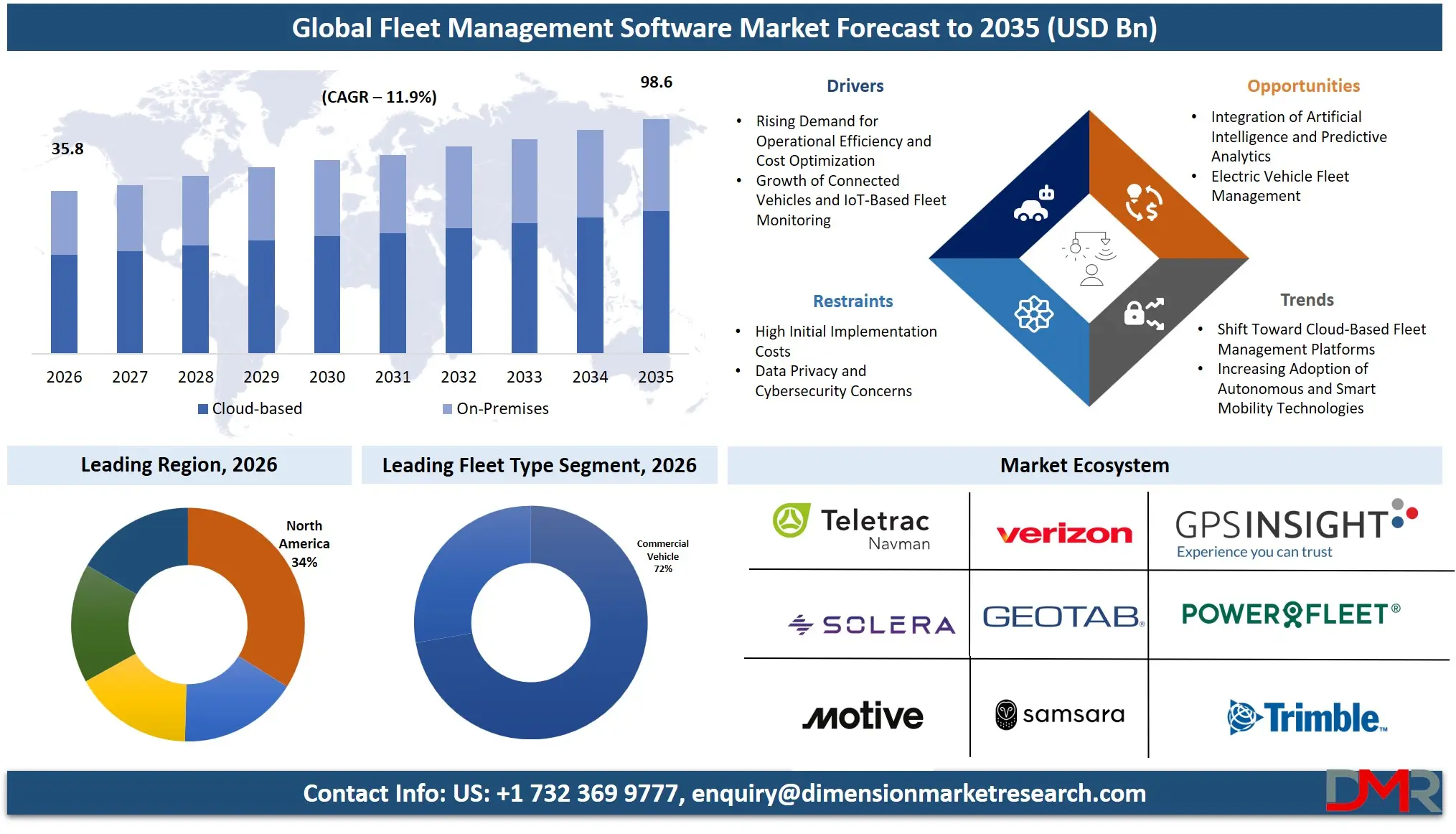
- Market Size in 2026: USD 35.8 Billion
- Market Size in 2035: USD 98.6 Billion
- Global CAGR (2026-2035): 11.9%
- Leading Solution Segment in 2026: Vehicle Tracking & Telematics, 38% share
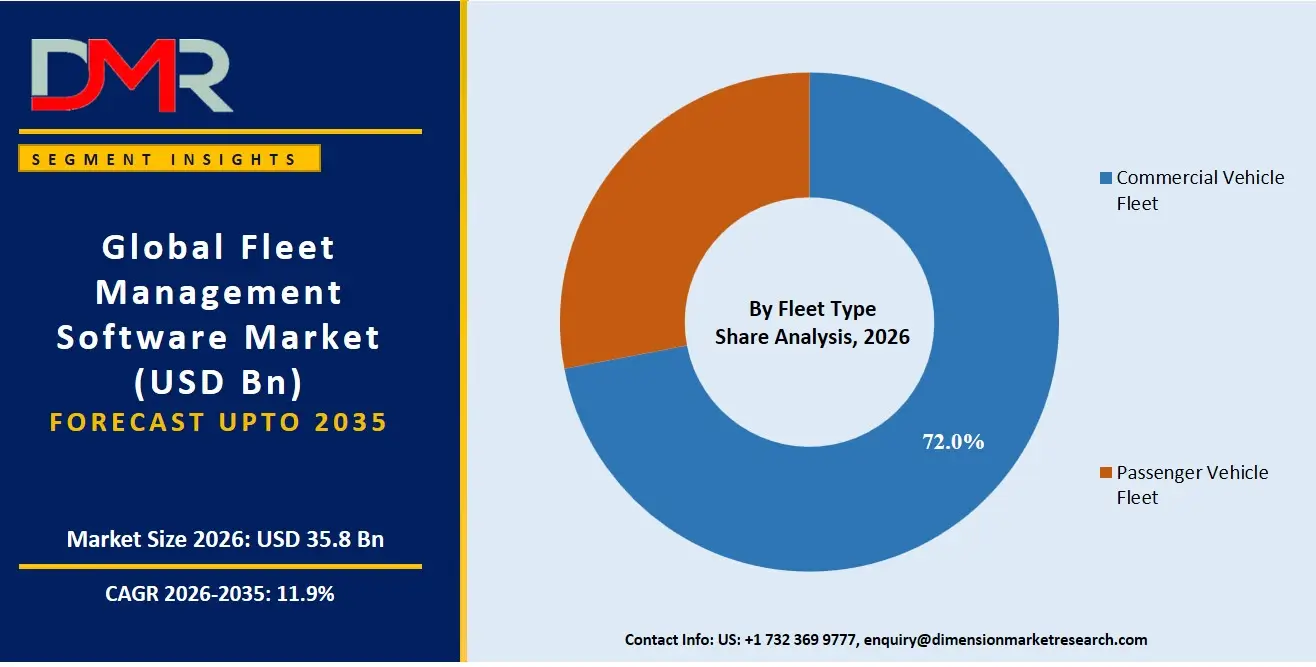
- Leading Fleet Type Segment in 2026: Commercial Vehicle Fleet, 72% share
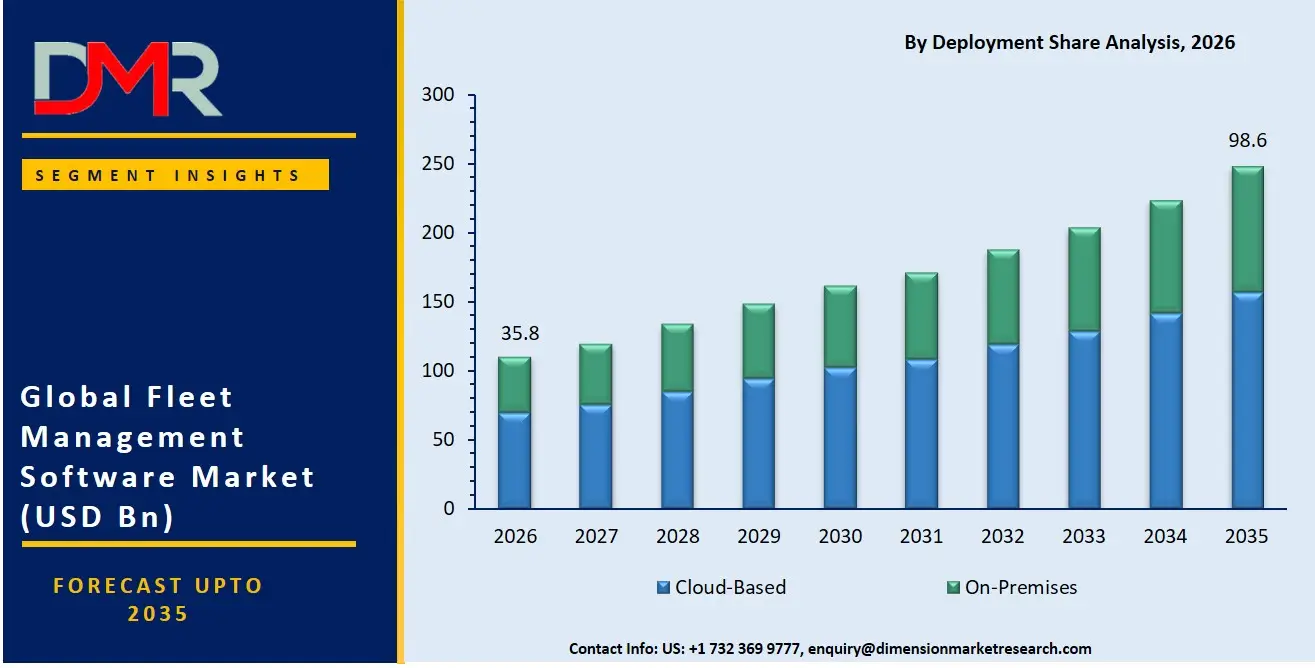
- Leading Deployment Segment in 2026: Cloud-Based Fleet Management Software, 68% share
- Fastest-Growing Segment: AI-Powered Analytics & Predictive Maintenance, 15.2% CAGR
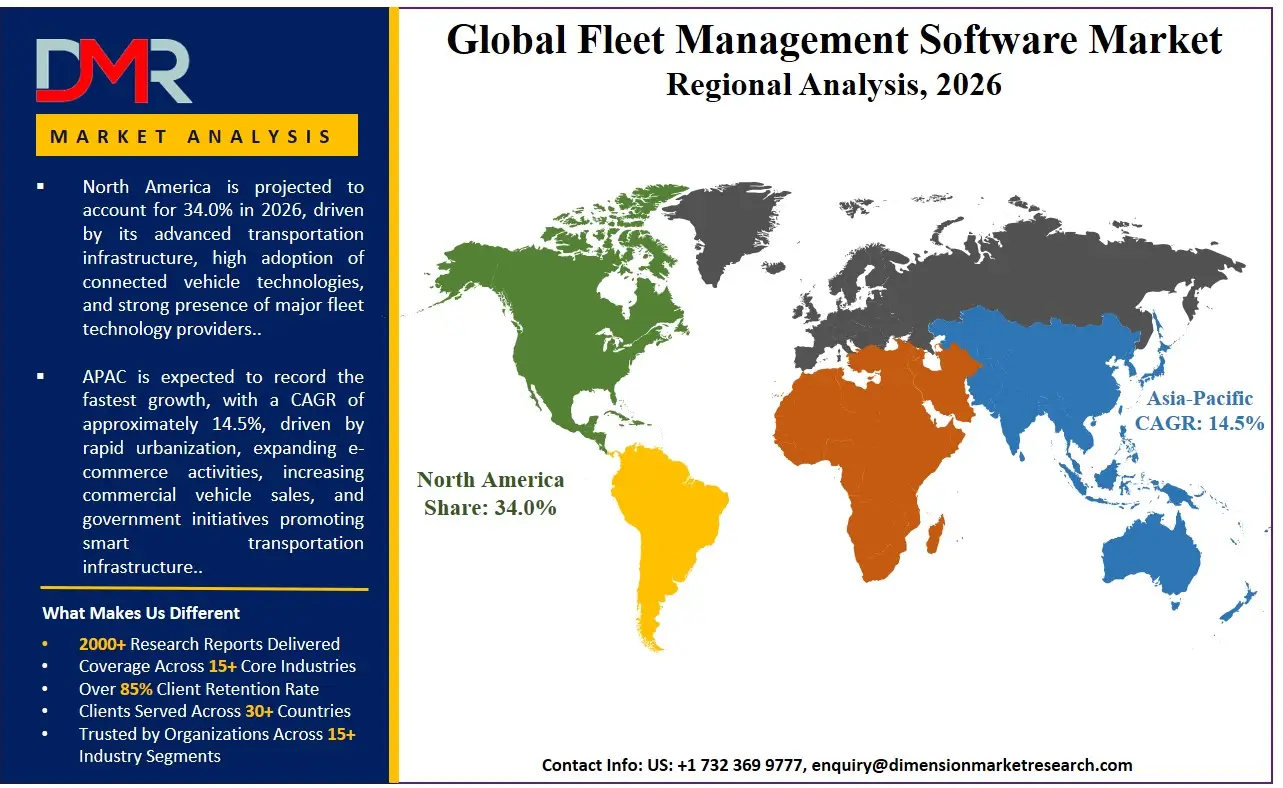
- Leading Region in 2026: North America, 34% share
What is Fleet Management Software and its Market Size?
Fleet Management Software refers to digital platforms and applications designed to monitor, manage, and optimize vehicle fleets through real-time data collection, analytics, automation, and operational control. The market includes solutions such as GPS vehicle tracking, telematics, route optimization, driver management, fuel monitoring, predictive maintenance, compliance management, and fleet analytics.
These platforms integrate technologies including IoT sensors, artificial intelligence (AI), cloud computing, and mobile connectivity to improve fleet productivity, reduce operating costs, enhance driver safety, and support regulatory compliance across commercial transportation operations.
ℹ
To learn more about this report –
Download Your Free Sample Report Here
The global Fleet Management Software Market is estimated to reach USD 35.8 billion in 2026 and is projected to expand to approximately USD 98.6 billion by 2035, registering a CAGR of 11.9% between 2026 and 2035.
Market growth is driven by increasing adoption of connected vehicle technologies, rising fuel costs, demand for operational efficiency, and growing regulatory requirements related to fleet safety and emissions management. Businesses across logistics, transportation, e-commerce, construction, retail, utilities, and government sectors are increasingly investing in cloud-based fleet management platforms to gain real-time visibility into vehicle operations. The rapid expansion of electric vehicle fleets and integration of AI-driven predictive analytics are further accelerating market adoption.
Use Cases
- Vehicle Tracking & Telematics: Real-time GPS monitoring enables companies to track vehicle locations, improve asset utilization, and enhance operational visibility.
- Route Optimization & Dispatch: Intelligent routing algorithms reduce travel time, fuel consumption, and delivery delays through automated route planning.
- Driver Management: Software monitors driver behavior, safety performance, and compliance through analytics-based driving assessments.
- Fuel Management: Digital monitoring systems identify fuel consumption patterns, prevent misuse, and optimize fleet operating expenses.
- Predictive Maintenance: AI-powered analytics forecast vehicle maintenance requirements and reduce unexpected breakdowns.
- Compliance Management: Automated reporting tools help fleets meet regulatory requirements related to safety, emissions, and operational standards.
Key Takeaways
- The global Fleet Management Software Market is expected to grow from USD 35.8 billion in 2026 to USD 98.6 billion by 2035, driven by digital transformation across transportation industries.
- Increasing adoption of IoT-enabled telematics, connected vehicles, and cloud platforms is a major growth driver for fleet management solutions.
- Vehicle Tracking & Telematics remains the dominant solution segment due to widespread demand for real-time fleet visibility and operational monitoring.
- AI-based predictive maintenance and analytics solutions represent the fastest-growing segment as companies seek to reduce downtime and improve asset efficiency.
- North America leads the global market due to high technology adoption, mature logistics infrastructure, and strong presence of fleet technology providers.
- Asia-Pacific is expected to experience the fastest growth due to rapid e-commerce expansion, urbanization, smart mobility initiatives, and increasing commercial vehicle deployment.
How AI/Gen AI is Transforming the Fleet Management Software Market?
Advanced technologies such as artificial intelligence, Internet of Things (IoT), cloud computing, and 5G connectivity are significantly transforming fleet management software capabilities. IoT sensors installed in vehicles collect real-time operational data, including location, fuel consumption, engine performance, and driver behavior. AI algorithms analyze this information to provide predictive maintenance alerts, optimize routes, identify inefficient driving patterns, and improve fleet decision-making.
Cloud-based platforms enable centralized fleet monitoring, remote access, and scalable software deployment across geographically distributed operations. The combination of AI and IoT reduces operational costs by improving fuel efficiency, minimizing vehicle downtime, and enhancing safety. 5G connectivity further improves real-time communication between vehicles and fleet platforms by enabling faster data transmission with lower latency.
These technologies are reshaping competition within the fleet management software market by shifting solutions from basic tracking tools toward intelligent mobility platforms. Vendors are increasingly differentiating through advanced analytics, automation, electric vehicle management capabilities, and integration with enterprise systems such as ERP and transportation management platforms.
Key Drivers in the Global Fleet Management Software Market
Rising Demand for Operational Efficiency and Cost Optimization
Fleet operators worldwide are adopting fleet management software to improve productivity, reduce operational expenses, and maximize vehicle utilization. Transportation companies face increasing pressure from fuel price volatility, labor shortages, delivery expectations, and competitive pricing environments. Fleet management platforms provide actionable insights that help organizations optimize routes, monitor fuel usage, minimize idle time, and improve asset allocation.
Growth of Connected Vehicles and IoT-Based Fleet Monitoring
The expansion of connected vehicles is accelerating demand for advanced fleet management solutions. Modern commercial vehicles increasingly include telematics systems, sensors, and embedded connectivity features that generate valuable operational data. Fleet software platforms transform this data into actionable insights for maintenance, safety, and efficiency improvements.
Restraints in the Global Fleet Management Software Market
High Initial Implementation Costs
Although fleet management software delivers long-term operational benefits, the initial investment required for hardware installation, software integration, employee training, and system customization can limit adoption among small and medium-sized fleet operators.
Data Privacy and Cybersecurity Concerns
Fleet management platforms collect extensive operational and vehicle-related data, creating concerns regarding cybersecurity, unauthorized access, and regulatory compliance. Increasing connectivity between vehicles and cloud platforms increases exposure to cyber threats.
Growth Opportunities in the Global Fleet Management Software Market
Integration of Artificial Intelligence and Predictive Analytics
AI-driven fleet management represents a major opportunity as companies increasingly seek automation and advanced decision-making capabilities. Predictive analytics can forecast maintenance requirements, optimize fuel usage, and identify safety risks before they occur.
Electric Vehicle Fleet Management
The transition toward electric commercial vehicles creates new opportunities for specialized fleet management solutions. Fleet operators require software capable of monitoring battery health, charging schedules, energy consumption, and vehicle range optimization.
Trends in the Global Fleet Management Software Market
Shift Toward Cloud-Based Fleet Management Platforms
Fleet operators are increasingly moving from traditional on-premise systems toward cloud-based platforms due to scalability, lower infrastructure requirements, and easier integration with enterprise applications.
Increasing Adoption of Autonomous and Smart Mobility Technologies
The development of autonomous vehicles and smart transportation systems is influencing fleet management software evolution. Future platforms are expected to incorporate advanced automation, connected infrastructure, and real-time mobility intelligence.
Research Scope and Analysis
The Global Fleet Management Software Market is segmented based on Solution Type, Deployment Model, Fleet Type, Enterprise Size, and End-Use Industry. These segmentation categories analyze adoption patterns, technology preferences, customer requirements, and growth opportunities across different fleet management applications and business environments.
ℹ
To learn more about this report –
Download Your Free Sample Report Here
By Deployment Analysis
Cloud-Based Fleet Management Software is projected to dominate the market in 2026, capturing approximately 68% share. Cloud deployment has gained significant traction due to lower infrastructure costs, flexible scalability, automatic software updates, and remote accessibility. Small and medium-sized enterprises increasingly prefer cloud-based solutions because they eliminate the need for extensive IT infrastructure investments.
ℹ
To learn more about this report –
Download Your Free Sample Report Here
The segment is supported by the rising adoption of Software-as-a-Service (SaaS) business models across transportation and logistics industries. Hybrid and advanced cloud-integrated fleet platforms represent the fastest-growing deployment approach, with adoption accelerating due to increasing enterprise demand for real-time analytics, connected vehicle integration, and multi-location fleet management. On-premises solutions continue to maintain demand among large organizations requiring customized systems and greater control over data management.
By Solution Analysis
Vehicle Tracking & Telematics is expected to remain the largest solution segment in 2026, accounting for approximately 38% market share. The dominance of this segment is attributed to the widespread requirement for real-time vehicle visibility, asset monitoring, and location-based intelligence among logistics providers, transportation companies, and commercial fleet operators. GPS tracking systems provide essential capabilities including vehicle location monitoring, geofencing, theft prevention, and operational transparency. AI-powered analytics and predictive maintenance solutions are projected to be the fastest-growing solution category, expanding at approximately 15.2% CAGR, driven by increasing demand for proactive vehicle maintenance, reduced downtime, and automated decision-making. Maintenance Management represents another significant segment due to growing emphasis on improving vehicle lifecycle management and reducing repair costs.
By Fleet Type Analysis
Commercial Vehicle Fleet is the dominant segment, representing approximately 72% market share in 2026. Commercial fleets including trucks, delivery vehicles, buses, and service vehicles require advanced monitoring solutions to optimize logistics operations, reduce fuel costs, and improve compliance. The expansion of e-commerce, last-mile delivery networks, and global logistics operations has significantly increased adoption among commercial fleet operators. The electric commercial fleet management segment is expected to experience the fastest growth due to increasing electrification of delivery vans, buses, and industrial vehicles. Passenger vehicle fleet management is also expanding through corporate transportation services, rental fleets, ride-sharing operators, and mobility-as-a-service providers.
By Enterprise Analysis
Large Enterprises represent the leading customer segment in 2026 due to their extensive vehicle networks, complex operational requirements, and greater technology investment capabilities. Large logistics companies, transportation providers, and multinational corporations use fleet management software to manage thousands of vehicles across multiple regions. However, SMEs are expected to register faster growth as affordable cloud-based subscription models reduce adoption barriers. Fleet software vendors are increasingly developing simplified platforms with flexible pricing structures targeting smaller businesses. Growing awareness regarding fuel savings, driver safety, and operational efficiency is encouraging SMEs to adopt digital fleet management solutions.
By End Use Industry Analysis
Transportation & Logistics remains the largest end-use industry segment due to extensive dependence on vehicle operations and delivery efficiency. Logistics companies utilize fleet management platforms for route optimization, shipment tracking, driver monitoring, and cost reduction. The Retail & E-Commerce sector is expected to be the fastest-growing end-use segment, supported by rapid growth in online shopping and increasing demand for efficient last-mile delivery operations. Manufacturing and construction industries are also adopting fleet management solutions to improve equipment utilization, monitor field operations, and reduce downtime.
The Global Fleet Management Software Market Report is segmented on the basis of the following:
By Deployment
By Solution
- Vehicle Tracking & Telematics
- Driver Management
- Fuel Management
- Maintenance Management
- Route Optimization & Dispatch
- Compliance Management
- Analytics & Reporting
By Fleet Type
- Commercial Vehicle Fleet
- Passenger Vehicle Fleet
By Enterprise Size
- Small & Medium Enterprises (SMEs)
- Large Enterprises
By End-Use Industry
- Transportation & Logistics
- Retail & E-Commerce
- Manufacturing
- Construction
- Oil & Gas
- Utilities
- Government & Public Sector
- Healthcare
- Others
Regional Analysis
North America is the Leading Region in the Global Fleet Management Software Market
North America is expected to maintain its leading position in the Global Fleet Management Software Market, accounting for approximately 34% market share in 2026. The region benefits from advanced transportation infrastructure, high adoption of connected vehicle technologies, and strong presence of major fleet technology providers.
ℹ
To learn more about this report –
Download Your Free Sample Report Here
The United States represents the largest contributor due to widespread adoption among logistics companies, commercial transportation operators, and government fleets. Regulatory requirements related to electronic logging devices, driver safety, and emissions monitoring are encouraging organizations to implement advanced fleet management platforms. Increasing investments in electric commercial vehicles and autonomous mobility technologies are further strengthening regional demand.
Asia Pacific is the Fastest-Growing Region in the Global Fleet Management Software Market
Asia-Pacific is projected to become the fastest-growing regional market, expanding at approximately 14.5% CAGR between 2026 and 2035. Growth is supported by rapid urbanization, expanding e-commerce activities, increasing commercial vehicle sales, and government initiatives promoting smart transportation infrastructure. Countries such as China, India, Japan, and South Korea are investing heavily in connected mobility solutions and digital logistics platforms. The growth of last-mile delivery networks and increasing awareness among fleet operators regarding operational efficiency are accelerating adoption across emerging economies.
Europe Fleet Management Software Market
The Europe Fleet Management Software Market is estimated to reach approximately USD 10.2 billion in 2026 and is projected to grow to nearly USD 26.4 billion by 2032, expanding at a CAGR of approximately 11.2%. European adoption is driven by strict vehicle emission regulations, sustainability initiatives, and increasing deployment of electric commercial fleets. Countries including Germany, the United Kingdom, France, and the Netherlands are leading adoption due to advanced transportation networks and strong focus on carbon reduction. Integration of telematics with smart mobility platforms and regulatory compliance systems continues to influence market expansion.
Latin America Fleet Management Software Market
The Latin America Fleet Management Software Market is expected to reach approximately USD 3.1 billion in 2026 and grow to around USD 7.8 billion by 2032, registering a CAGR of approximately 12.7%. Market growth is supported by expanding logistics operations, increasing commercial vehicle usage, and rising demand for theft prevention and fuel optimization solutions. Brazil and Mexico represent major markets due to large transportation industries and increasing digital transformation initiatives among businesses.
Middle East & Africa Fleet Management Software Market
The Middle East & Africa Fleet Management Software Market is projected to reach approximately USD 2.6 billion in 2026 and expand to nearly USD 6.4 billion by 2032, growing at a CAGR of around 13.2%. Growth is driven by smart city initiatives, logistics infrastructure development, oil and gas transportation requirements, and government investments in digital mobility solutions. Countries in the Gulf region are increasingly adopting advanced fleet platforms to improve transportation efficiency and sustainability.
Major Countries Analysis
United States Fleet Management Software Market
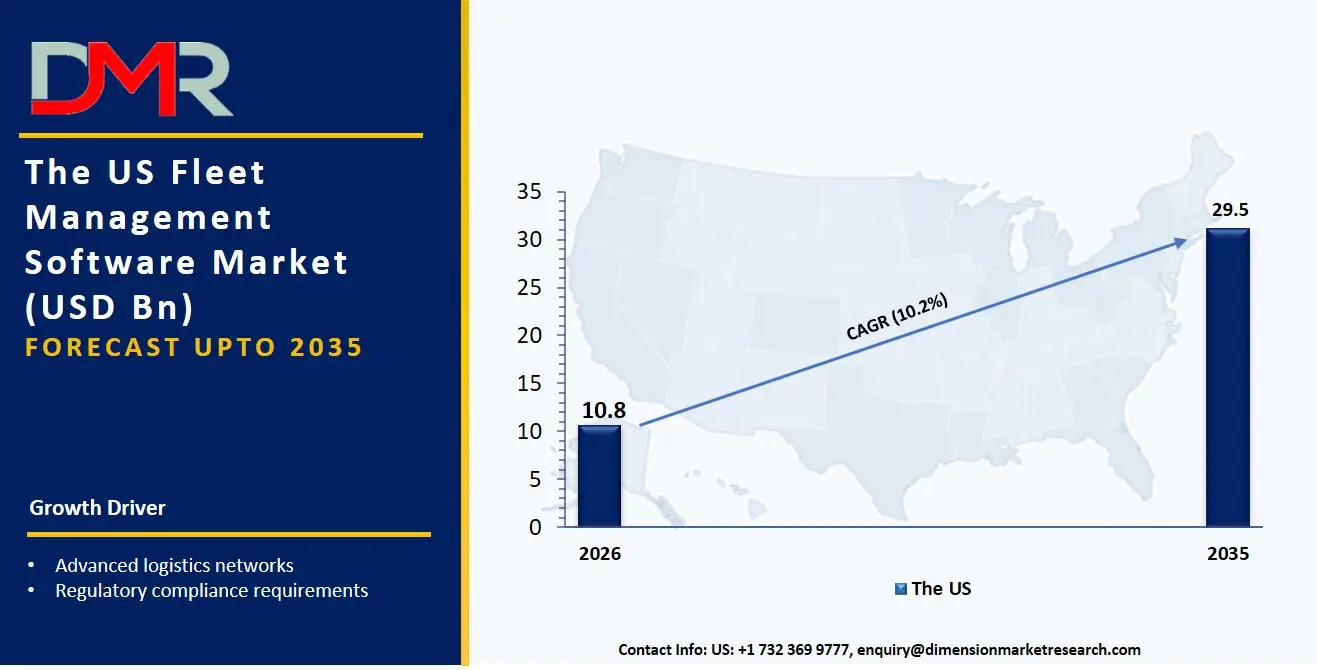
The United States Fleet Management Software Market is estimated at approximately USD 10.8 billion in 2026 and is expected to reach nearly USD 29.5 billion by 2032, growing at a CAGR of around 10.2%. Growth is driven by advanced logistics networks, regulatory compliance requirements, increasing adoption of electric fleets, and strong demand for AI-based fleet analytics. Large transportation companies and commercial operators are investing in connected fleet platforms to improve efficiency and reduce operating costs.
ℹ
To learn more about this report –
Download Your Free Sample Report Here
Japan Fleet Management Software Market
Japan's Fleet Management Software Market is projected to reach approximately USD 2.4 billion in 2026 and expand to around USD 6.1 billion by 2032, registering a CAGR of approximately 13.8%. Growth is supported by Japan's advanced automotive ecosystem, aging workforce challenges, automation initiatives, and demand for efficient transportation solutions. Integration of AI, robotics, and smart mobility technologies is accelerating fleet software adoption.
Saudi Arabia Fleet Management Software Market
Saudi Arabia's Fleet Management Software Market is estimated at approximately USD 0.8 billion in 2026 and is expected to reach nearly USD 2.2 billion by 2032, growing at a CAGR of around 16.5%. Market expansion is driven by Vision 2030 initiatives, smart city development, logistics infrastructure investments, and increasing adoption of digital transportation solutions across government and commercial sectors.
Regulatory Landscape
The Fleet Management Software Market is influenced by various transportation regulations, data privacy frameworks, cybersecurity requirements, and sustainability policies across global markets. In North America, electronic logging device (ELD) mandates and transportation safety regulations encourage commercial fleets to adopt digital monitoring and compliance solutions.
European markets are shaped by stringent emissions regulations, General Data Protection Regulation (GDPR) requirements, and sustainability targets promoting efficient fleet operations and electric vehicle adoption. In Asia-Pacific, governments are implementing smart transportation policies, connected vehicle initiatives, and digital infrastructure programs to improve mobility efficiency.
Fleet management providers must comply with data protection standards, cybersecurity requirements, vehicle communication protocols, and industry-specific regulations to ensure secure and reliable operations.
Investment and White Space Analysis
The Fleet Management Software Market offers significant investment opportunities in AI-powered analytics, electric vehicle fleet management, autonomous mobility solutions, and integrated transportation platforms. Emerging markets in Asia-Pacific, Latin America, and the Middle East represent major white-space opportunities due to increasing commercial vehicle adoption and accelerating digital transformation.
Small and medium-sized fleet operators remain an underserved segment with strong growth potential, creating opportunities for affordable SaaS-based fleet platforms. Additional investment areas include predictive maintenance, carbon emission tracking, EV charging optimization, and integration of fleet software with enterprise resource planning (ERP), supply chain management, and smart city platforms.
By Region
North America
Europe
- Germany
- The U.K.
- France
- Italy
- Spain
- Rest of Europe
Asia-Pacific
- China
- Japan
- South Korea
- India
- Australia
- Rest of APAC
Latin America
- Brazil
- Mexico
- Rest of LATAM
Middle East & Africa
- Saudi Arabia
- The UAE
- South Africa
- Rest of MEA
Competitive Landscape
The global Fleet Management Software Market is moderately consolidated, with established technology providers competing alongside specialized telematics companies and emerging SaaS-based solution providers. Leading companies focus on product innovation, artificial intelligence integration, strategic partnerships, acquisitions, and geographic expansion to strengthen their market position. Competitive differentiation is primarily based on platform scalability, real-time analytics capabilities, cybersecurity features, hardware compatibility, integration capabilities, and customer support services. Major players are increasingly transitioning from traditional tracking solutions toward comprehensive mobility management platforms offering predictive analytics, automation, electric vehicle management, and sustainability monitoring capabilities.
Some of the prominent players in the Global Fleet Management Software Market are
- Geotab
- Verizon Connect
- Samsara
- Teletrac Navman
- Motive
- Trimble
- Omnitracs
- Solera
- Fleet Complete
- Azuga
- GPS Insight
- Powerfleet
- MiX Telematics
- Lytx
- Zonar Systems
- Michelin Connected Fleet
- Webfleet
- Radius Limited
- Fleetio
- Chevin Fleet Solutions
- RTA Fleet Management Software
- AUTOsist
- AssetWorks
- Fleetworthy
- Masternaut
- Nextraq
- Cartrack
- Gurtam
- Navixy
- EROAD
- KeepTruckin
- Mapon
- Digital Matter
- Quartix
- Trackunit
- Wialon
- ORBCOMM
- CalAmp
- Descartes Systems Group
- SAP
- Other Key Players
Recent Developments
- In September 2025, Motive expanded its AI-driven fleet operations platform with improved safety monitoring tools, automated compliance capabilities, and advanced workflow management features.
- In July 2025, Verizon Connect introduced additional analytics features designed to improve driver safety, vehicle utilization monitoring, and operational reporting for commercial fleet customers.
- In May 2025, Trimble strengthened its transportation technology portfolio through enhanced software integrations focused on logistics optimization, fleet visibility, and connected transportation management.
- In March 2025, Geotab announced expanded electric vehicle fleet management capabilities, enabling organizations to improve EV monitoring, battery analytics, charging management, and sustainability reporting.
- In January 2025, Samsara expanded its connected operations platform capabilities by introducing enhanced artificial intelligence-based insights designed to improve fleet safety monitoring, operational efficiency, and automated decision-making.
Report Details
| Report Characteristics |
| Market Size (2026) |
USD 35.8 Bn |
| Forecast Value (2035) |
USD 98.6 Bn |
| CAGR (2026–2035) |
11.9% |
| Historical Period |
2021 – 2025 |
| Forecast Period |
2027 – 2035 |
| Base Year |
2025 |
| Estimate Year |
2026 |
| Segments Covered |
By Deployment, By Solution, By Fleet Type, By Enterprise Size, By End-Use Industry |
| Regional Coverage |
North America – The US and Canada; Europe – Germany, The UK, France, Spain, Italy, & Rest of Europe; Asia-Pacific – China, Japan, South Korea, India, Australia, Rest of APAC; Latin America – Brazil, Mexico, & Rest of Latin America; Middle East & Africa – Saudi Arabia, The UAE, South Africa, & Rest of MEA |
Frequently Asked Questions
What is the projected size of the Fleet Management Software Market?
▾ The global Fleet Management Software Market is expected to reach approximately USD 35.8 billion in 2026 and expand to USD 98.6 billion by 2035, supported by digital transformation and connected vehicle adoption.
What is the CAGR of the Fleet Management Software Market?
▾ The market is projected to grow at a CAGR of approximately 11.9% between 2026 and 2035, driven by increasing demand for automation, analytics, and operational efficiency.
What are the major factors driving fleet management software adoption?
▾ Key growth drivers include increasing logistics demand, fuel cost optimization requirements, connected vehicle adoption, regulatory compliance needs, and rising implementation of AI-based analytics.
Which technology trends are shaping the Fleet Management Software Market?
▾ Major trends include AI-powered predictive maintenance, IoT-based monitoring, cloud platforms, electric vehicle fleet management, autonomous mobility integration, and real-time analytics.
Which region dominates the Fleet Management Software Market?
▾ North America is the largest regional market, accounting for approximately 34% share in 2026, supported by advanced logistics infrastructure and high technology adoption.
Which region is expected to grow fastest?
▾ Asia-Pacific is projected to be the fastest-growing region, with approximately 14.5% CAGR, driven by e-commerce expansion, urbanization, and smart transportation investments.
Who are the key players in the Fleet Management Software Market?
▾ Major companies include Geotab, Samsara, Verizon Connect, Trimble, Motive, Fleet Complete, Webfleet, Michelin Connected Fleet, and Oracle.
How is the market segmented in Fleet Management Software Market ?
▾ The market is segmented by solution type, deployment model, fleet type, enterprise size, end-use industry, and region.