Market Snapshot
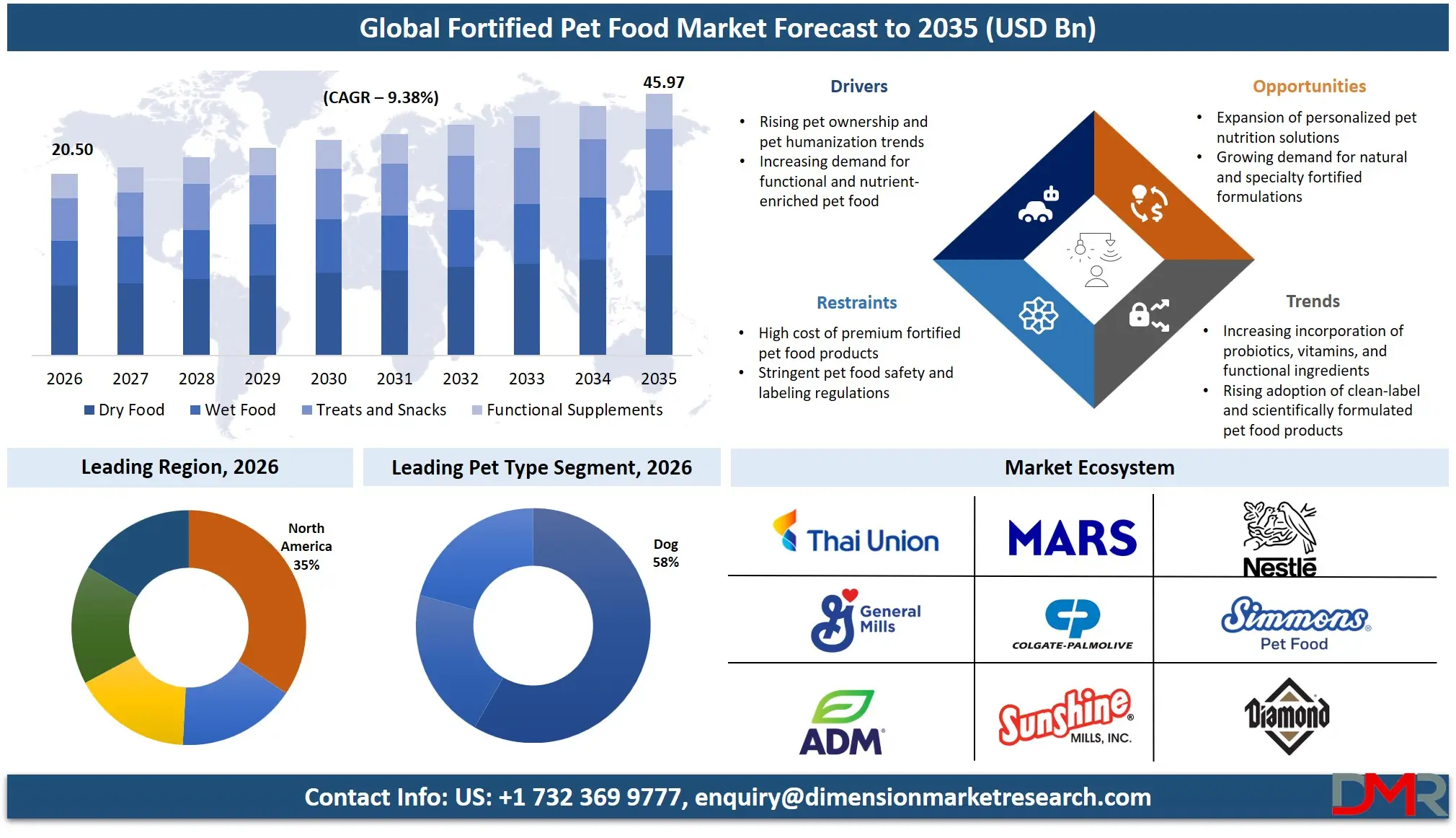
- The global fortified pet food market was valued at USD 18.74 billion in 2025, reached USD 20.50 billion in 2026, and is projected to reach USD 45.97 billion by 2035, expanding at a 9.38% CAGR.
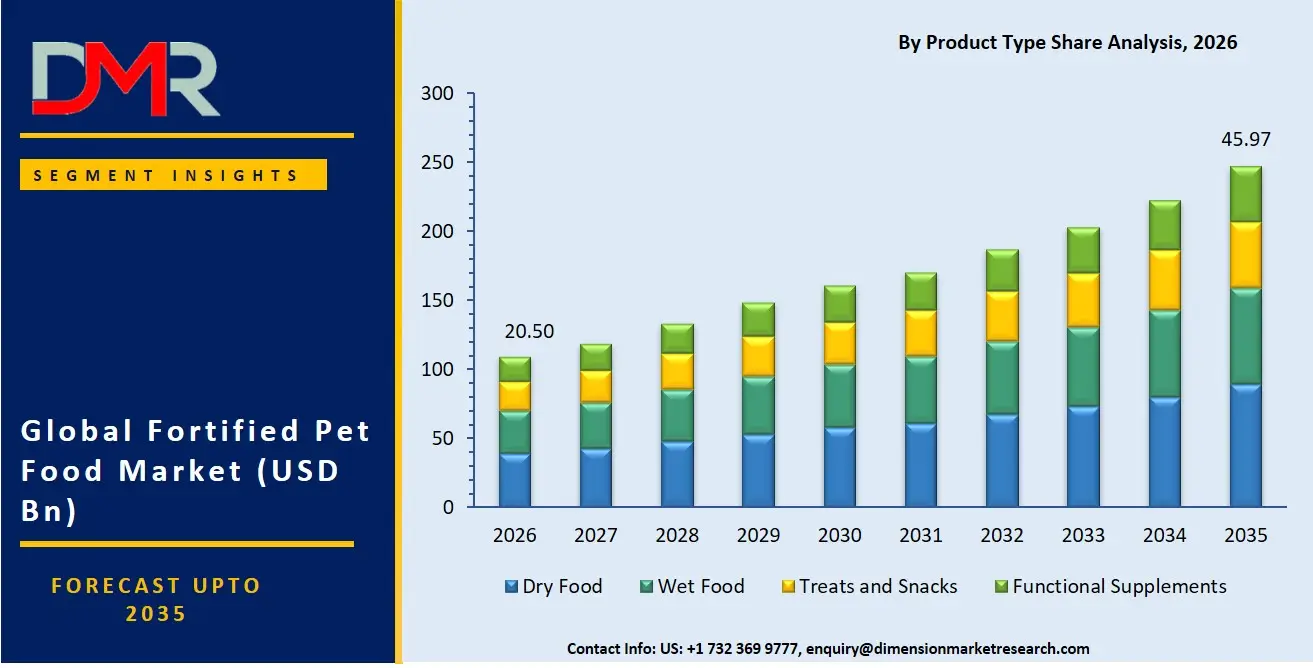
- Dry Food dominated the product type segment with a revenue share of 46.0% in 2026.
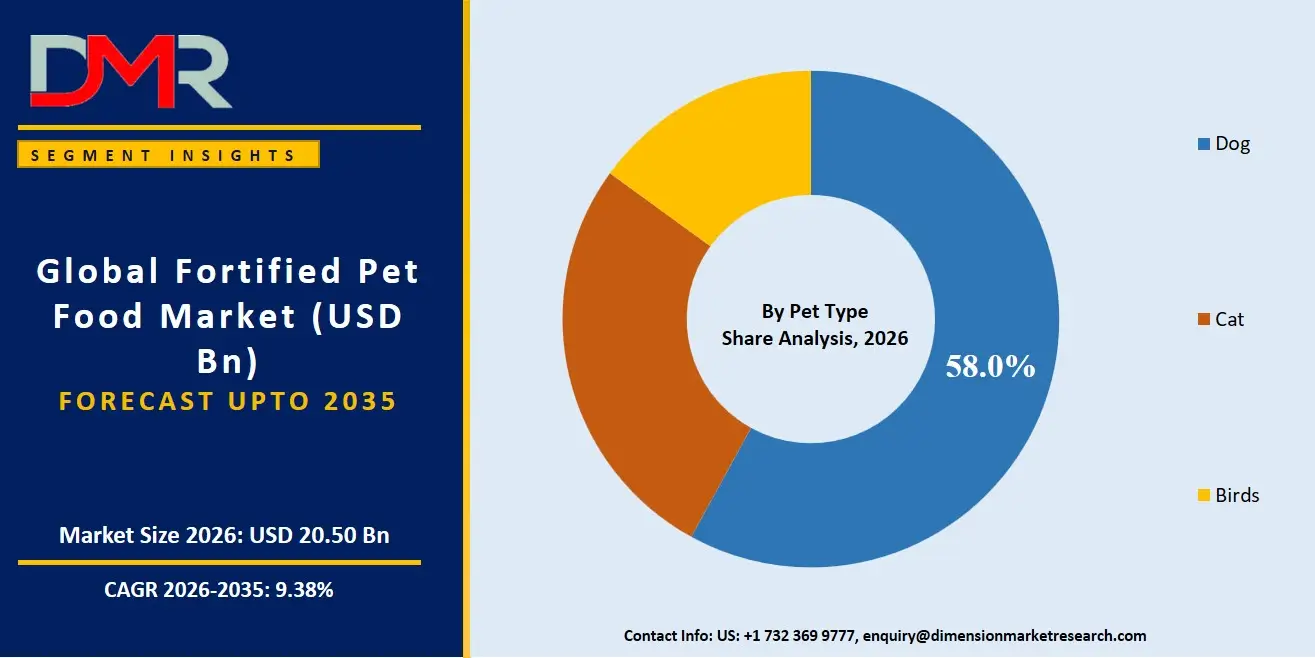
- Dog food led the pet type segment, accounting for 58.0% of total demand in 2026.
- Vitamin-enriched products held the largest fortificant segment share at 38.5% in 2026.
- Supermarkets and Hypermarkets led the distribution channel segment with a market share of 42.0% in 2026.
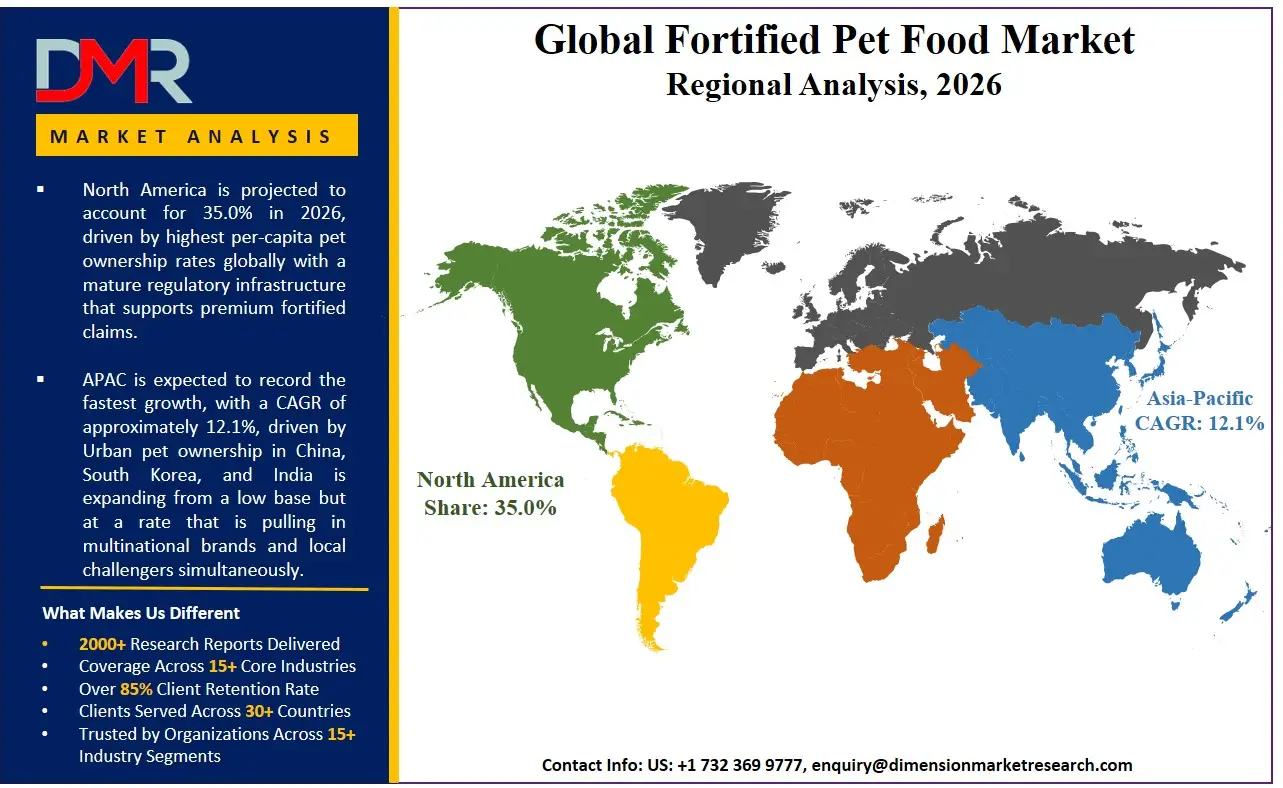
- North America was the dominant regional market, capturing 35% of global revenue and valued at USD 7.18 billion in 2026.
Market Overview
The global fortified pet food market covers commercially manufactured food products for companion animals that carry added nutrients beyond baseline requirements. Products include dry kibble, wet food, treats, snacks, and functional supplements formulated with vitamins, minerals, probiotics, omega-3 fatty acids, amino acids, antioxidants, and multi-functional blends. The market excludes standalone dietary supplements sold in capsule, powder, or liquid form, though those products increasingly compete for the same consumer spend. As per AAFCO guidelines, the Dog and Cat Food Nutrient Profiles establish practical minimum and some maximum nutrient concentrations for fortified foods, creating a clear technical floor that separates compliant fortified products from non-fortified commodity feeds.
ℹ
To learn more about this report –
Download Your Free Sample Report Here
The fortified pet food market sits within the broader USD 150+ billion global pet care industry, adjacent to veterinary nutrition, pet pharmaceuticals, and the growing standalone supplement channel. Manufacturers treat fortification as both a product differentiator and a regulatory positioning tool. In May 2024, The Kroger Co. expanded its Abound pet food portfolio with new recipes containing added vitamins, minerals, botanicals, and probiotics, illustrating how mainstream retail channels now compete directly with specialty pet nutrition brands on fortification claims.
Artificial intelligence is beginning to reshape formulation workflows, with ingredient optimization models helping R&D teams map nutrient interaction data faster than conventional lab cycles allow. Manufacturers are also applying predictive analytics to identify life-stage and breed-specific nutrient deficiency patterns, enabling targeted product launches rather than broad-spectrum reformulations. The convergence of clinical nutrition data and consumer behavior analytics gives larger players a formulation speed advantage that smaller brands struggle to match without external R&D partnerships.
Market Size and Forecast
The Global Fortified Pet Food Market size is estimated at USD 20.50 Billion in 2026 from USD 18.74 Billion in 2025, and is projected to reach USD 45.97 Billion by 2035, exhibiting a CAGR of 9.38% during the forecast period.
Historical expansion from 2020 through 2024 was anchored by an accelerating shift in owner perception. Pet owners across North America and Western Europe began treating nutrition as preventative healthcare rather than commodity feeding. U.S. manufacturers scaled production significantly to meet this shift. As reported by the Pet Food Institute and NARA in April 2025, the U.S. pet food sector produced 9.8 million tons of dog and cat food using more than 600 safe ingredients in 2024. That production scale confirms that fortified formats have moved well beyond niche positioning into mainstream manufacturing volume.
The forecast to 2035 rests on three structural assumptions. First, millennial and Gen Z households will sustain a premium spending posture on pet nutrition even through economic cycles. Second, Asia Pacific will absorb a meaningful share of incremental volume as urban pet ownership expands and incomes rise. Third, category innovation in life-stage and breed-specific formats will generate new product cycles that extend average selling prices upward. In October 2025, Mars Petcare and Big Idea Ventures selected three startups for the 2025 Next Generation Pet Food Program, backing the development of advanced nutrition ingredients that vendors expect to enter commercial production within the forecast window.
Product Type Analysis
Dry Food led the product type segment with a 46.0% share in 2026, ahead of all other format categories.
ℹ
To learn more about this report –
Download Your Free Sample Report Here
Dry food's dominance reflects economic logic as much as nutrition preference. Manufacturing economics favor kibble production at scale, and the format's long shelf life reduces retailer waste, which sustains favorable shelf placement. Fortification in dry formats has also matured technically. Manufacturers now apply heat-stable vitamins and mineral premixes that survive high-temperature extrusion, removing an earlier barrier to consistent nutrient delivery in kibble. Chicken and chicken products remained the most-used ingredients by volume in U.S. dog and cat food in 2024, as confirmed by data from the Pet Food Institute and NARA, anchoring the protein base across most dry fortified SKUs.
Wet food, treats, and functional supplements each address a distinct consumer need that dry food cannot fully capture. Wet food provides hydration-critical nutrition for cats and senior dogs, making it the natural carrier for renal and urinary tract support claims. Treats and snacks have emerged as a high-margin delivery vehicle for single-benefit fortification, such as dental health or joint support, because owners accept smaller pack sizes at premium price points for targeted outcomes. Functional supplements represent the fastest-evolving sub-format. Manufacturers incorporated more than 3 million tons of upcycled ingredients into dog food and over 1 million tons into cat food in 2024 per PFI and NARA data, indicating that sustainability-linked ingredient sourcing now runs across all product formats, not just dry food alone.
Pet Type Analysis
With a 58.0% share in 2026, Dog outpaced all other pet type categories across fortified food demand.
ℹ
To learn more about this report –
Download Your Free Sample Report Here
Dogs hold the majority share because dog owners have historically been the first adopters of nutritional innovation in pet food. The sheer size and diversity of the dog population, across breeds, life stages, and health conditions, creates more addressable sub-segments than any other pet category. Veterinary-prescribed fortified diets for dogs are an established revenue stream, and clinical endorsement of products like Purina's FortiFlora has set a replication template that other manufacturers now follow across joint, digestive, and immune health claims.
Cats represent the clearest white space for the next decade. Cat owners are historically under-targeted by fortified product innovation, and the segment is primed for the same premiumization cycle that reshaped dog nutrition over the past ten years. Bird nutrition remains a minor category by revenue, constrained by a smaller and more specialized owner base, but niche fortified seed and pellet formats do command premium pricing within avian specialty retail channels.
Fortificant Analysis
Vitamin Enriched accounted for 38.5% of fortificant demand in 2026, the highest of any category.
Vitamins hold the leading position because regulatory frameworks, specifically AAFCO profiles, mandate minimum vitamin levels for "complete and balanced" labeling. Every manufacturer producing a compliant product already fortifies with vitamins by default. That baseline compliance converts directly into market share. The strategic question for vendors is how far above minimum vitamin levels they position their premium SKUs to justify a higher shelf price.
Probiotics and omega-3 fatty acids are taking share from legacy fortification categories like glucosamine. Owner familiarity with human probiotic benefits is accelerating crossover demand for pet probiotic claims, while omega-3 formats benefit directly from the 95% rise in marine ingredient usage since 2019. Multi-functional blends are gaining traction as manufacturers seek to reduce SKU complexity by consolidating immune, joint, and skin health claims into a single product. Antioxidants and amino acids remain lower-volume categories but carry disproportionate scientific credibility in veterinary nutrition conversations.
Distribution Channel Analysis
A 42.0% share made Supermarkets and Hypermarkets the clear leader across distribution channel categories in 2026.
Mass grocery dominance is a structural reality rooted in consumer habit. Owners buy pet food on the same shopping trip as household groceries, and supermarket chains have invested in expanding dedicated pet aisles with fortified premium products to capture that trade-up behavior. The format also enables national brands to execute promotional price strategies at scale, which smaller specialty channels cannot match on volume.
Online retail is the fastest-growing distribution channel, with subscription models locking in repeat purchases for premium fortified formats at a pace that physical retailers cannot replicate. Veterinary clinics hold a disproportionately influential role despite lower volume share. A vet recommendation converts an owner to a clinical fortified SKU with far higher retention than any marketing channel. Specialty pet stores remain important for discovery of new fortified formats, especially functional supplements, where consumers want staff guidance before committing to a higher price point.
Key Market Segments
By Product Type
- Dry Food
- Wet Food
- Treats and Snacks
- Functional Supplements
By Pet Type
By Fortificant
- Vitamin Enriched
- Mineral Enriched
- Probiotic Fortified
- Omega-3 Fortified
- Multi-functional Blend
- Amino Acids
- Antioxidants
By Distribution Channel
- Supermarkets and Hypermarkets
- Specialty Pet Stores
- Veterinary Clinics
- Online Retail
- Mass Merchandisers
By Application
- Growth and Development
- Weight Management
- Skin and Coat Health
- Digestive Health
- Immune System Support
Regional Analysis
North America held a 35% revenue share in 2026, valued at USD 7.18 Billion, ahead of all other regions.
ℹ
To learn more about this report –
Download Your Free Sample Report Here
North America leads because the U.S. combines the highest per-capita pet ownership rates globally with a mature regulatory infrastructure that supports premium fortified claims. The FDA and AAFCO framework gives manufacturers clear product development guardrails, reducing time-to-market for new fortified SKUs. U.S. consumers also show the highest willingness to pay for clinically positioned pet nutrition, which pulls average selling prices well above the global mean and inflates the region's revenue share relative to its unit volume.
Asia Pacific is the fastest-growing region and will narrow the gap with North America over the forecast period. Urban pet ownership in China, South Korea, and India is expanding from a low base but at a rate that is pulling in multinational brands and local challengers simultaneously. Europe holds a strong second position, with German and French consumers exhibiting a preference for clean-label, minimally processed fortified products that differ in formulation character from North American mass-market SKUs. Latin America and the Middle East and Africa represent early-stage but structurally sound growth markets. Rising middle-class pet ownership in Brazil and GCC countries is creating first-mover advantages for brands that localize nutritional claims ahead of competitors.
Key Regions and Countries
North America
Europe
- Germany
- France
- The UK
- Spain
- Italy
- Rest of Europe
Asia Pacific
- China
- Japan
- South Korea
- India
- Australia
- Rest of APAC
Latin America
- Brazil
- Mexico
- Rest of Latin America
Middle East & Africa
- GCC
- South Africa
- Rest of MEA
Market Dynamics
Pet Humanization and Ingredient Quality Driving Premium Fortification Spend
Millennial and Gen Z pet owners have reframed fortified food as preventative-care spending, not discretionary premium. That cognitive shift is the most structurally durable driver in Fortified Pet Food Market because it removes the price elasticity that previously constrained premium pet food during economic downturns. Owners who view fortified nutrition as health maintenance do not trade down the same way they would on, say, a premium snack for themselves.
Ingredient quality data confirms the shift in formulation investment. As per PFI and NARA findings, marine ingredients rose 95% and meat/poultry inputs climbed 34% since 2019, anchoring omega-3 and high-protein fortification formats across both dog and cat SKUs. Veterinary endorsement accelerates this further. When a vet recommends a fortified clinical line, the manufacturer gains a high-retention customer who is price-insensitive at the product level.
Price Sensitivity and Regulatory Gaps Constraining Market Expansion
Premium fortified SKUs face a direct cost-sensitivity ceiling during inflationary spending cycles. Health-conscious owners who want fortified nutrition but cannot sustain premium price points trade down to mid-tier products, compressing margins for brands positioned between clinical-grade and commodity. Manufacturers that fail to offer tiered fortification portfolios lose both ends of the market simultaneously.
Regulatory science gaps also create product liability exposure. The AAFCO copper review confirmed insufficient scientific data exists to establish a safe upper limit or maximum tolerance for copper in dog food nutrient profiles, as reported by AAFCO. That unresolved gap means manufacturers formulating copper-containing fortified diets carry undefined regulatory risk, which slows innovation cycles for mineral-enriched SKUs and increases caution in veterinary channel positioning.
Life-Stage Precision and Behavioral Wellness Opening Underserved Fortification Tiers
Senior joint health and pediatric development represent two under-served precision nutrition sub-segments where brands can command premium prices without competing directly against mass-market fortified SKUs. Life-stage targeting also addresses a real clinical need, as nutrient requirements for puppies and senior dogs differ substantially from adult maintenance profiles, creating a scientifically defensible basis for product differentiation.
Behavioral wellness is the most novel white space. Cognitive function, anxiety, and stress-support functional claims extend fortification beyond traditional joint and digestive health positioning into a category that competes with standalone pet pharmaceutical products. In April 2024, Cymbiotika launched a pet supplement line featuring Probiotic+, Calm, Hip and Joint, and Allergy and Immune Health products, a signal that supplement-first brands are moving into fortified food territory and that food-first manufacturers need to respond with competing claims before the supplement channel captures the behavioral wellness consumer.
Market Trends
Immune Support, Clean Label, and Longevity Nutrition Reshaping Fortification Priorities
Immune-support claims became the most in-demand functional positioning in 2026 as owners responded to pet exposure to stress, environmental pollution, and infectious disease vectors. Probiotics and prebiotics have overtaken legacy glucosamine as the fastest-growing ingredient class in pet nutrition, a shift that forces brands with glucosamine-heavy portfolios to reformulate or lose shelf relevance. Findings from the Pet Food Institute and NARA show that 44% of pet food ingredients were upcycled in 2024, totaling 4.1 million tons, confirming that clean-label and sustainability credentials are no longer niche differentiators but mainstream formulation expectations.
Market Competition Overview
The global fortified pet food market is moderately consolidated at the top and fragmented in the mid-to-lower tiers. Four to five multinational conglomerates command the majority of revenue, operating across multiple pet types, product formats, and distribution channels simultaneously. Their competitive advantage is not formulation alone. Scale in ingredient procurement, manufacturing redundancy, and established veterinary endorsement networks compound into structural moats that smaller brands struggle to replicate organically.
Challengers from specialty, direct-to-consumer, and fresh-food segments are gaining share by targeting a single high-value consumer archetype: the owner who treats their pet as a family member and distrusts mass-market ingredient lists. Standalone supplement brands are also edging into fortified food territory, blurring the channel boundary between functional supplements and fortified meals. A consolidation wave is underway, with larger players acquiring specialty and fresh-format brands to fill portfolio gaps rather than building new propositions internally. Mid-tier brands without a clear segment focus or clinical validation pathway face the highest attrition risk over the forecast period.
Company Profiles
Mars, Incorporated holds the broadest competitive position in the global fortified pet food market through its portfolio of Pedigree, Whiskas, Royal Canin, and Purina Pro Plan equivalent brands. Royal Canin's breed-specific and clinical-veterinary product lines represent the clearest articulation of precision nutrition at commercial scale. Mars has used the veterinary channel not as a secondary distribution outlet but as a primary validation engine, with clinical endorsement feeding brand equity back into mass retail positioning. The risk for Mars is organizational scale itself. Portfolio breadth across dozens of markets creates formulation inconsistency and regulatory compliance complexity that agile challengers can exploit in focused geographies.
KatKin occupies the opposite strategic position: a single-species, premium fresh-food brand built entirely on cat-owner premiumization behavior. In January 2026, KatKin secured USD 50 million in equity and debt financing to accelerate growth and product innovation in premium feline nutrition, a capital injection that signals both investor confidence in the cat-focused fortification segment and the brand's ambition to scale its direct-to-consumer subscription model internationally. KatKin's risk is concentration. Single-species focus limits addressable market size, and the fresh-format cold chain model creates cost structures that compress margins at scale if average order values decline.
Key Players
- Mars, Incorporated
- Nestlé S.A. (Nestlé Purina PetCare)
- Colgate-Palmolive Company (Hill's Pet Nutrition)
- General Mills, Inc. (Blue Buffalo)
- Spectrum Brands Holdings, Inc. (United Pet Group)
- Archer-Daniels-Midland Company
- Diamond Pet Foods (Schell & Kampeter)
- Sunshine Mills, Inc.
- Tiernahrung Deuerer GmbH
- Wellness Pet Company
- Freshpet, Inc.
- Simmons Pet Food, Inc.
- Thai Union Group PCL
- Farmina Pet Foods Holding B.V.
- Heristo Aktiengesellschaft
- Koninklijke DSM N.V.
- Chr. Hansen Holding A/S
- Evonik Industries AG
- Land O'Lakes, Inc.
- Alltech, Inc.
- Lallemand Inc.
- KatKin
Supply Chain and Value Chain Analysis
The fortified pet food value chain runs from raw ingredient sourcing through nutrient premix manufacturing, food processing and extrusion, packaging, and distribution into retail, veterinary, and online channels. Maximum value creation sits at two points: the premix formulation stage, where nutrient suppliers like Koninklijke DSM N.V., Chr. Hansen Holding A/S, and Evonik Industries AG extract premium margins for proprietary blends, and the branded product stage, where clinical positioning and marketing justify elevated shelf prices to consumers. The biggest supply chain risk is marine ingredient concentration. Omega-3 sourcing is geographically concentrated in a small number of fisheries, and a 95% demand surge for marine inputs since 2019 has created competition for limited sustainable supply that will put upward pressure on fortification costs across the forecast period.
Regulatory Landscape
The United States operates the most codified fortified pet food regulatory framework globally. As reported by the FDA, a fortified food must contain every nutrient listed in the applicable AAFCO profile at the recommended level, or pass an AAFCO feeding trial, to carry the "complete and balanced" claim on packaging. AAFCO confirms it recognizes only three nutritional authorities for adequacy claims: the AAFCO Dog Food Nutrient Profiles, the AAFCO Cat Food Nutrient Profiles, and the AAFCO Dog and Cat Food Feeding Protocols.
Specific nutrient thresholds define what legally qualifies as fortified at minimum. Per FDA guidance, the AAFCO minimum crude protein for adult cat maintenance food is more than 26% on a dry matter basis. AAFCO vitamin E guidelines specify that a diet containing 50 IU of vitamin E achieves a ratio greater than 0.6:1 when PUFA content is 83 grams or less, setting a formula-specific threshold for antioxidant adequacy. European regulators apply a parallel but distinct framework under EU Feed Additive Regulation 1831/2003, requiring pre-authorization for each functional additive. German and other European market entries require compliance with both EU additive rules and national labeling standards, which creates a dual-layer approval burden for manufacturers entering from outside the region.
Investment and White Space Analysis
Current investment flow in the fortified pet food market concentrates in three areas: fresh and refrigerated fortified formats, direct-to-consumer subscription platforms, and ingredient innovation in probiotics and marine-derived omega-3 sources. Agrolimen's acquisition of Ollie in January 2026 and KatKin's USD 50 million raise in the same month confirm that premium fresh-format brands are the primary acquisition and financing target for strategic and financial investors in the near term.
The clearest white spaces are cat-focused fortified portfolios, where the innovation gap behind dog food remains wide, and behavioral wellness claims, where no dominant brand has established category leadership. Life-stage-specific products for senior pets also remain under-developed relative to the size of the aging pet population in North America and Europe. New entrants with clinical validation, a subscription distribution model, and a single-species focus have the most defensible entry path without competing head-on against the multinational incumbents on volume or price.
Recent Developments
- November 2025: Reliance Consumer Products entered the pet nutrition sector through the launch of Waggies, a science-backed pet food brand focused on nutritionally enhanced formulations for dogs and cats, marking one of India's most high-profile entries into the fortified pet food category.
- January 2026: Agrolimen acquired Ollie, expanding its footprint in premium nutrition-focused pet food and strengthening its position in the functional and fortified segment, with the deal signaling continued consolidation at the premium end of the market.
Report Details
| Report Characteristics |
| Market Value (2025) |
USD 18.74 Billion |
| Market Value (2026) |
USD 20.50 Billion |
| Forecast Revenue (2035) |
USD 45.97 Billion |
| CAGR (2026–2035) |
9.38% |
| Base Year for Estimation |
2025 |
| Historic Period |
2020 – 2024 |
| Forecast Period |
2026 – 2035 |
| Report Coverage |
Revenue Forecast, Market Dynamics, Competitive Landscape, Recent Developments |
| Segments Covered |
By Product Type (Dry Food, Wet Food, Treats and Snacks, Functional Supplements), By Pet Type (Dog, Cat, Birds), By Fortificant (Vitamin Enriched, Mineral Enriched, Probiotic Fortified, Omega-3 Fortified, Multi-functional Blend, Amino Acids, Antioxidants), By Distribution Channel (Supermarkets and Hypermarkets, Specialty Pet Stores, Veterinary Clinics, Online Retail, Mass Merchandisers), By Application (Growth and Development, Weight Management, Skin and Coat Health, Digestive Health, Immune System Support) |
| Regional Analysis |
North America – US and Canada; Europe – Germany, France, The UK, Spain, Italy, and Rest of Europe; Asia Pacific – China, Japan, South Korea, India, Australia, and Rest of APAC; Latin America – Brazil, Mexico, and Rest of Latin America; Middle East & Africa – GCC, South Africa, and Rest of MEA |
| Competitive Landscape |
Mars, Incorporated; Nestlé S.A. (Nestlé Purina PetCare); Colgate-Palmolive Company (Hill's Pet Nutrition); General Mills, Inc. (Blue Buffalo); Spectrum Brands Holdings, Inc.; Archer-Daniels-Midland Company; Diamond Pet Foods; Sunshine Mills, Inc.; Tiernahrung Deuerer GmbH; Wellness Pet Company; Freshpet, Inc.; Simmons Pet Food, Inc.; Thai Union Group PCL; Farmina Pet Foods Holding B.V.; Heristo Aktiengesellschaft; Koninklijke DSM N.V.; Chr. Hansen Holding A/S; Evonik Industries AG; Land O'Lakes, Inc.; Alltech, Inc.; Lallemand Inc.; KatKin |
| Customization Scope |
Customization for segments and region or country level will be provided. Additional customization can be done based on requirements. |
| Purchase Options |
Three license options: Single User License, Multi-User License (Up to 5 Users), Corporate Use License (Unlimited Users and Printable PDF). |
Frequently Asked Questions
What is the biggest investment opportunity in Fortified Pet Food Market?
▾ Cat-focused fortified portfolios and behavioral wellness claims represent the clearest white spaces. The dog segment holds a 58.0% pet type share, but cat nutrition innovation lags well behind, creating a first-mover advantage for brands that build a credible clinical positioning in feline fortification before the segment consolidates.
Who are the top companies in Fortified Pet Food Market?
▾ Mars, Incorporated and Nestlé S.A. through Purina PetCare hold the dominant positions by revenue and distribution reach. Hill's Pet Nutrition, Blue Buffalo, and Freshpet are strong challengers in clinical and premium fresh formats. KatKin's USD 50 million raise in January 2026 signals it as the most-watched challenger in cat-specific premium nutrition.
Which segment is growing fastest in Fortified Pet Food Market and why?
▾ Among fortificants, probiotics and prebiotics are outpacing all other ingredient classes. Among product formats, functional supplements are the fastest-growing sub-category. Owner familiarity with human probiotic benefits is driving crossover demand, and manufacturers with established supplement brand equity are now entering the fortified food space directly to capture that spend.
Which region is growing fastest in Fortified Pet Food Market and why?
▾ Asia Pacific is the fastest-growing region. Urban pet ownership in China, South Korea, and India is expanding rapidly, and rising disposable income is pulling consumer spending toward fortified premium formats for the first time at scale. North America retains the 35% revenue share lead, but Asia Pacific will narrow that gap meaningfully by 2035.
What is the biggest challenge holding Fortified Pet Food Market back?
▾ The premium price versus cost-sensitivity tension is the most immediate structural constraint. Health-conscious owners trade down on fortified SKUs during inflationary cycles, compressing margins for brands caught between clinical-grade and commodity price points. Unresolved regulatory science gaps, including the absence of a confirmed copper upper limit in dog food, add formulation risk that further slows premium mineral-enriched innovation.