Market Snapshot
- Market Size (2026): USD 1.2 Bn
- Forecast Value (2035): USD 3.0 Bn
- CAGR (2026-2035): 10.8%
- Leading Messaging Channel (2026): SMS, around 55%
- Leading Application (2026): Authentication and OTP, close to 32%
- Key Players: Orange, Sinch, Infobip and others
What is France A2P Messaging Market and its Market Size?
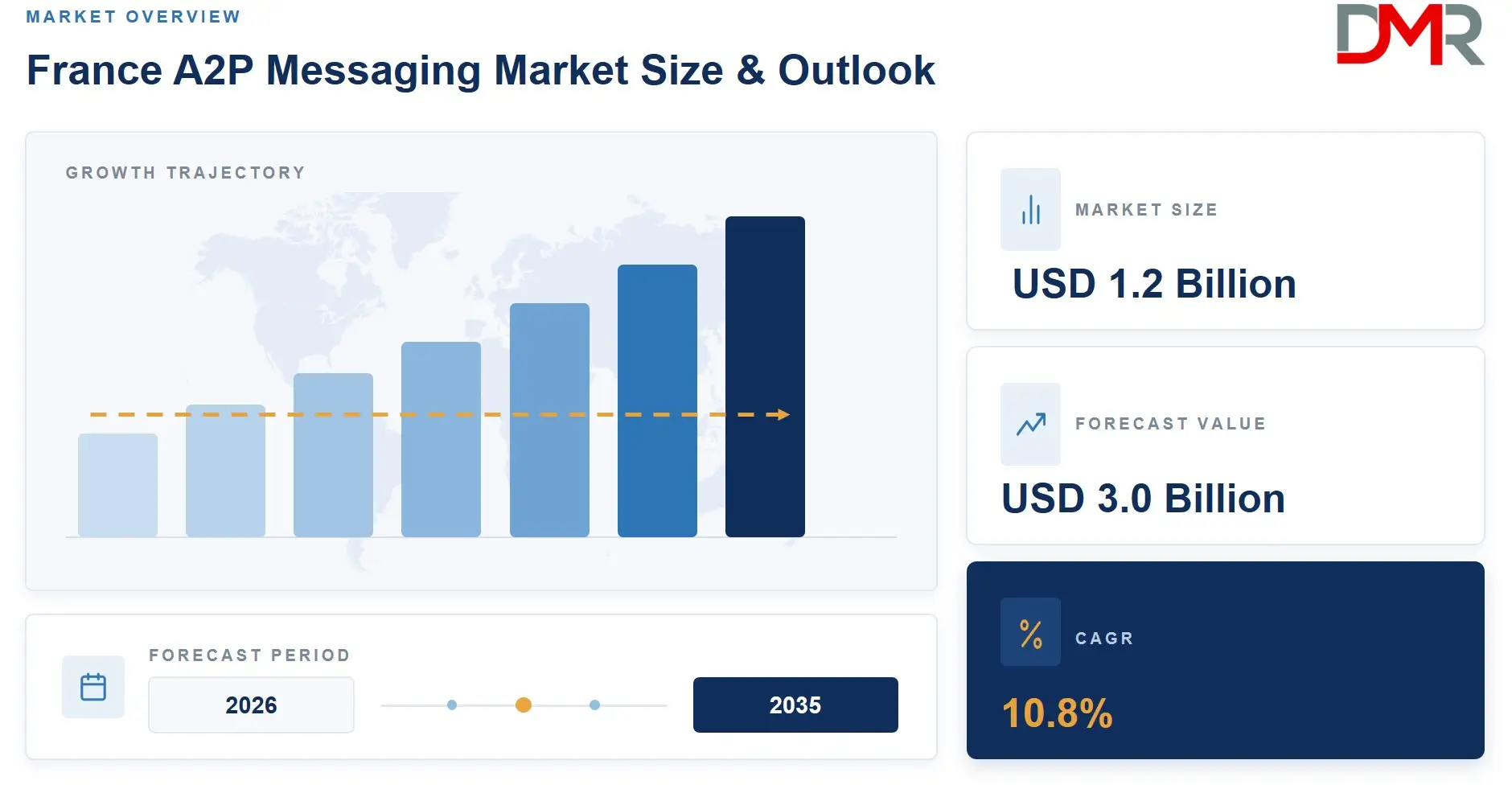
The France A2P Messaging Market size is estimated to reach USD 1.2 Bn in 2026 and is further anticipated to reach USD 3.0 Bn by 2035, at a CAGR of 10.8%.
ℹ
To learn more about this report –
Download Your Free Sample Report Here
These figures capture demand generated inside France, meaning messages originated by enterprises and public bodies and terminated on French mobile numbers, not the worldwide revenue of operators or aggregators headquartered in the country. A message routed through a French aggregator but delivered to a subscriber abroad sits outside this sizing, while a campaign run by a foreign brand but delivered to a French handset sits inside it.
Application to person messaging covers one way and two way communication sent by a business, bank, retailer or government service to an individual's mobile device, most commonly SMS but increasingly RCS Business Messaging and OTT channels layered on the same operator connections. In France the channel runs across four national networks, Orange, SFR, Bouygues Telecom and Free Mobile, each now carrying RCS traffic alongside legacy SMS, and demand is intermediated by a dense layer of aggregators and CPaaS platforms that route traffic, manage sender identity and handle compliance on senders' behalf.
Buyers cluster around use cases that depend on delivery certainty rather than open ended engagement. Banks and insurers send one time passwords, retailers confirm orders and deliveries, operators send billing and service alerts, and public bodies communicate tax, health and transport information. Authentication traffic anchors the category because regulation and fraud exposure leave enterprises little tolerance for channel substitution, while marketing traffic is more elastic and migrates toward whichever channel delivers the best engagement at the lowest cost.
What is changing structurally is the channel mix rather than the underlying use cases. RCS Business Messaging has moved from a pilot technology to a nationally available channel following Apple's extension of RCS support to iPhone, and AF2M's updated Business Messaging Charter, effective March 2026, now binds operators, aggregators and service providers to a common set of sender identity and consent rules across SMS and RCS alike. Ownership in the underlying carrier layer is shifting too, with Orange, Bouygues Telecom and Iliad's proposed acquisition of SFR's mobile assets set to concentrate network level control among fewer parties even as the aggregator layer above it stays fragmented.
Use Cases
- Banking OTP Delivery: French retail banks and neobanks, which anchor close to 29% of 2026 A2P demand as the largest end use industry, send one time passwords and transaction confirmations through SMS and RCS Business Messaging to authorise logins, card payments and fund transfers, replacing app push notifications when a device is offline.
- Retail Order and Delivery Alerts: E-commerce retailers and last mile carriers notify shoppers when an order is confirmed, dispatched and out for delivery, using RCS cards with tracking links and package images where the recipient's device supports it and falling back to plain SMS elsewhere.
- Public Sector Citizen Notifications: Tax authorities, health insurance bodies and regional transport operators send appointment reminders, benefit updates and service disruption alerts to citizens across France, a channel chosen for its universal reach on any handset rather than dependence on a particular smartphone operating system.
- Telecom Operator Self Care Alerts: Orange, SFR, Bouygues Telecom and Free Mobile use their own A2P channels to send billing notices, data usage warnings and outage updates to subscribers, a use case that doubles as a proving ground for RCS Business Messaging before it is sold to enterprise customers.
Key Takeaways
- Market Size & Share: The France A2P Messaging Market is valued at USD 1.2 Bn in 2026 and is set to expand at a CAGR of 10.8% through 2035.
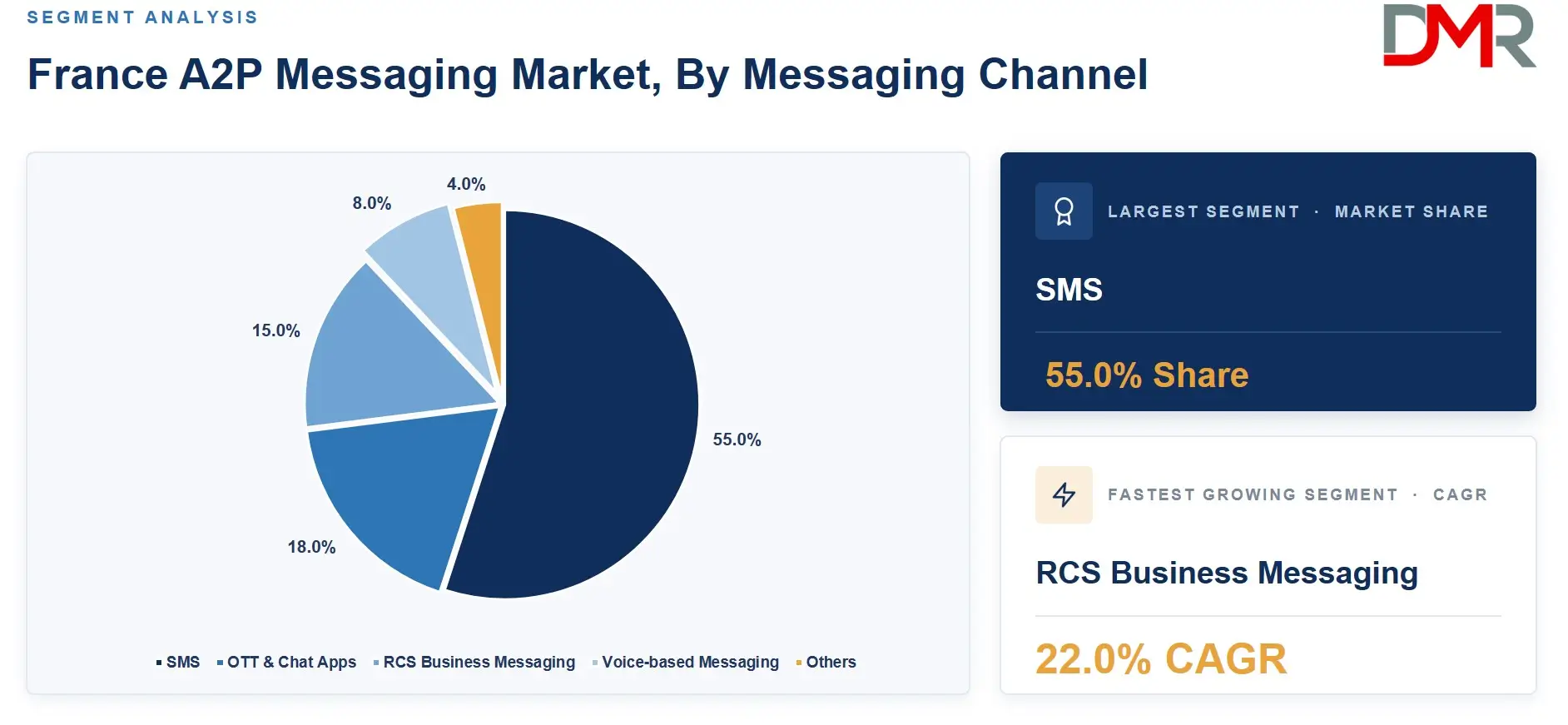
- Messaging Channel Analysis: SMS is expected to hold approximately 55% of 2026 channel revenue, while RCS Business Messaging is projected to grow at 22.0% CAGR through 2035.
- Demand Concentration: BFSI accounts for close to 29% of 2026 demand, the largest end use industry, ahead of retail and e-commerce.
- Regulatory Shift: AF2M's updated Business Messaging Charter took effect on 1 March 2026, binding operators and aggregators to common sender identity rules across SMS and RCS.
- Network Consolidation: Orange, Bouygues Telecom and Iliad's proposed carve up of SFR's mobile assets, valued at roughly EUR 20.35 Bn, is under antitrust review and would concentrate carrier level control.
- Channel Mix: RCS compatible smartphones in France passed 50 million units by the end of 2025, up from 28.3 million a year earlier, widening the addressable base for rich messaging.
How AI/Gen AI is Transforming the France A2P Messaging Market?
Artificial intelligence enters the France A2P Messaging Market less as a headline feature and more as an operating layer sitting underneath existing SMS and RCS traffic. Aggregators and operators apply machine learning to filter spam and smishing attempts before delivery, a priority sharpened by the fraud volumes AF2M has flagged around CPF, tax and parcel delivery scams, and to route each message across the lowest cost channel that still meets an enterprise's delivery guarantee.
On the enterprise side, large language models are starting to power RCS conversational agents that handle order tracking, appointment rescheduling and simple customer service queries inside a rich card interface, reducing volume that would otherwise escalate to a call centre. Generative tools also shorten the production cycle for RCS creative, letting a retailer generate multiple card layouts for a single campaign rather than commissioning each format separately.
- Conversational RCS Agents: LLM powered chat flows embedded in RCS cards handle order status, delivery rescheduling and basic account queries without routing the customer to a phone line.
- Fraud and Smishing Detection: Machine learning models score inbound sender behaviour and message content in real time, flagging the impersonation patterns behind CPF and parcel delivery scams before they reach a subscriber.
- Send Time and Channel Optimisation: Predictive models select the channel, SMS, RCS or a fallback, and the delivery window most likely to secure a read for each recipient.
- Automated Consent and Compliance Screening: Rule engines paired with classifiers check sender ID use and marketing consent against the AF2M charter before a campaign is released to the network.
Key Drivers in the France A2P Messaging Market
Demand is pulled by two forces that reinforce each other: mandatory authentication traffic that cannot be substituted away, and a rich messaging upgrade cycle that operators are actively monetising.
- Mandatory Digital Authentication: French banks, insurers and e-commerce platforms operate under strong customer authentication expectations that make a one time code sent by SMS or RCS a near mandatory step in login and payment flows. Authentication messages cannot be deferred to email or app push alone because regulators and card schemes treat the mobile channel as a trusted second factor. This keeps the volume floor of the market stable even as marketing budgets fluctuate, and gives aggregators a predictable, high margin traffic base to build services around.
- Operator Led RCS Monetisation: Orange, SFR, Bouygues Telecom and Free Mobile have each activated RCS Business Messaging and, following Apple's extension of RCS support to iPhone, coverage now reaches the great majority of French handsets regardless of manufacturer. Operators earn a per message premium on RCS traffic compared with plain SMS, giving them a direct commercial incentive to sell the format to enterprise brands rather than treat it as a defensive response to OTT apps. That incentive is now translating into active co-marketing between operators and aggregators such as Dotgo.
Restraints in the France A2P Messaging Market
Two brakes temper the pace of expansion: rising cost per engaged message as the channel mix shifts toward richer formats, and a compliance burden that falls hardest on smaller senders.
- Rising Cost per Engaged Message: RCS Business Messaging carries a materially higher termination fee than plain SMS, and Apple's rollout still lacks some interactive elements such as carousels and quick reply chips, forcing senders to maintain SMS fallback for a meaningful share of iPhone recipients. A campaign built for rich messaging often costs more to run at the same reach than the SMS equivalent it upgrades, which slows adoption among marketing teams working to a fixed cost per message budget.
- Compliance Overhead for Smaller Senders: AF2M's charter and the sender ID restrictions introduced to curb smishing add registration and monitoring steps that a large bank or retailer can absorb inside an existing compliance team but a smaller publisher often cannot. Aggregators increasingly gate premium sender IDs behind onboarding checks, pushing smaller senders toward shared or lower trust identifiers that convert less well, so compliance capacity rather than creative quality increasingly determines who can reach customers through the channel.
Growth Opportunities in the France A2P Messaging Market
The clearest white space sits in two places: healthcare engagement and the aggregator layer that intermediates access to the operator network.
- Healthcare Appointment and Adherence Messaging: Healthcare remains the smallest end use industry by 2026 revenue, but hospitals, laboratories and specialist booking platforms are only beginning to route reminders and test result notifications through rich messaging rather than plain SMS or paper mail. As France's public health system digitises patient communication and works to reduce missed appointment rates, providers that build RCS ready notification workflows now stand to capture volume currently split across email, post and unstructured SMS.
- Aggregator Consolidation and Platformisation: The proposed breakup of SFR's mobile assets among Orange, Bouygues Telecom and Iliad concentrates network level relationships among three carriers, raising the value of independent aggregators able to offer a single integration point across all networks rather than requiring enterprises to negotiate separately with each operator. Aggregators combining SMS, RCS and OTT delivery behind one API, alongside compliance tooling for the AF2M charter, are positioned to capture a growing share of enterprise budgets as buyers consolidate vendor relationships.
Trends in the France A2P Messaging Market
Two shifts are visible in how the channel is bought and used, distinct from the drivers already covered.
- Shift from One Way Campaigns to Conversational Flows: Enterprises are moving beyond one way promotional blasts toward two way RCS conversations that let a customer confirm a delivery slot, reschedule an appointment or ask a follow up question inside the same thread. This changes how messaging platforms are evaluated, with buyers now weighing conversation handling and contact centre integration alongside raw delivery rates, a criterion that barely featured when SMS was the only channel available.
- Standardisation of Sender Identity: AF2M's updated Business Messaging Charter, effective from 1 March 2026, replaces a patchwork of operator specific sender ID rules with a single set of registration and verification requirements across SMS Push, conversational SMS and RCS. Enterprises and aggregators are consolidating sender identities under this common framework ahead of full enforcement, expected to reduce disposable or shared sender IDs in circulation and make brand impersonation harder to sustain.
Research Scope and Analysis
Segment performance is assessed across four axes: messaging channel, application, end use industry and distribution channel. Each axis identifies the sub-segment carrying the largest share of 2026 revenue and the one expanding fastest through 2035, with the commercial reason behind each position.
ℹ
To learn more about this report –
Download Your Free Sample Report Here
By Messaging Channel
SMS is projected to hold the largest share by messaging channel in 2026, accounting for approximately 55% of revenue, since it remains the only format guaranteed to reach every handset on every French network regardless of operating system or RCS activation status. Its dominance rests on decades of integration into banking, retail and public sector notification systems that are costly to re-platform even as richer alternatives become available. Growth, however, is concentrated in RCS Business Messaging, expanding at a CAGR of 22.0% between 2026 and 2035 as all four operators complete rollout and Apple's iOS support removes the last major device level barrier. The steeper trajectory reflects a low base rather than SMS decline, since enterprises are adding RCS budget alongside existing SMS spend.
By Application
Authentication and OTP delivery is expected to lead by application in 2026, holding close to 32% of revenue, because banks, insurers and e-commerce platforms treat a one time code as a mandatory step in login and payment flows rather than a discretionary marketing choice. Regulatory expectations around strong customer authentication keep this volume resistant to budget cuts that affect more discretionary spend categories. The sharper growth curve sits with customer service and conversational messaging, projected at a CAGR of 19.2% through 2035, pulled by the shift toward two way RCS threads and by enterprises' interest in deflecting call centre volume into a channel customers already check throughout the day.
By End Use Industry
BFSI is projected to account for the largest share of 2026 demand by end use industry, at around 29%, reflecting the sector's reliance on authentication messaging and its comparatively high tolerance for premium RCS pricing given the fraud losses a single compromised login can cause. Retail and e-commerce follows closely behind on the strength of order and delivery notifications. Growth, however, is steepest in healthcare, forecast at a CAGR of 18.6% between 2026 and 2035, as hospitals, laboratories and appointment booking platforms digitise patient communication from a base that remains the smallest of the tracked industries, leaving room for adoption to catch up with BFSI and retail practice.
By Distribution Channel
Direct operator and carrier channel relationships are projected to hold the largest share of 2026 revenue by distribution channel, at approximately 46%, since large enterprises and public sector bodies with high volume, security sensitive traffic often negotiate directly with Orange, SFR, Bouygues Telecom or Free Mobile to control routing and pricing. The steeper growth path belongs to aggregator and CPaaS platforms, projected at a CAGR of 17.4% through 2035, as mid sized enterprises favour a single API that abstracts away the differences between four networks and the compliance requirements introduced by the AF2M charter.
The France A2P Messaging Market Report is Segmented Based on the Following
By Messaging Channel
- SMS
- OTT and Chat Apps
- RCS Business Messaging
- Voice based Messaging
- Others
By Application
- Authentication and OTP
- Marketing and Promotional Alerts
- Transactional Notifications
- Customer Service and Conversational Messaging
- Others
By End Use Industry
- BFSI
- Retail and E-commerce
- Media, Entertainment and Telecom
- Travel and Transportation
- Healthcare
- Others
By Distribution Channel
- Direct Operator and Carrier Channel
- Aggregator and CPaaS Platforms
- Systems Integrators and Agencies
- Others
Regulatory Landscape
France's Business Messaging framework tightened as AF2M, the coregulatory body linking operators and aggregators, replaced its patchwork of channel specific codes with a single Charte Business Messaging covering SMS Push, conversational SMS and RCS, effective from 1 March 2026. The charter's core mechanism is sender identity governance, restricting personalised sender IDs and requiring verification steps across the value chain from operator to aggregator to enterprise sender. ARCEP and CNIL continue to oversee network access and marketing consent respectively, but AF2M's charter is now the practical day to day rulebook. The near term risk is fragmentation, as neighbouring markets adopt incompatible sender ID regimes of their own, complicating campaigns spanning France and other territories.
Technology Analysis
RCS Business Messaging is the defining technology shift, moving from limited Android coverage to near universal reach after all four national operators activated the channel and Apple extended RCS support to iPhone from March 2025 onward. AF2M reports France closed 2025 with over 50 million RCS compatible smartphones, up from 28.3 million a year earlier, pushing device coverage close to the 85% level operators have targeted. The commercial opening is in rich card formats and in message actions that SMS cannot support, letting brands fold order tracking and payment into a single thread. The brake is inconsistent iOS feature support, which still forces SMS fallback on a share of iPhone deliveries and keeps dual channel costs elevated for senders.
Competitive Landscape
Competition runs across two layers that rarely compete head to head: the four national mobile operators that own the network and terminate every message, and a broad, moderately fragmented layer of aggregators and CPaaS platforms sitting between enterprise senders and those networks. Operators compete on RCS activation speed and wholesale pricing rather than direct enterprise sales, while aggregators compete on API breadth, delivery guarantees, compliance tooling for the AF2M charter and price per message. Consolidation pressure is building at the network layer, illustrated by the proposed carve up of SFR's mobile assets among the three remaining operators, while the aggregator layer stays open to new entrants because switching costs remain comparatively low. Global CPaaS platforms compete alongside domestic aggregators carrying deep operator relationships built over two decades of SMS+ and MMS+ governance.
Some of the Prominent Players in the France A2P Messaging Market Are
- Orange
- Sinch AB
- Infobip
- Twilio
- Vonage (Ericsson)
- MessageBird (Bird)
- CM.com
- Kaleyra (Tata Communications)
- Deutsche Telekom Global Carrier
- Syniverse
- Mitto AG
- Route Mobile
- Tanla Platforms
- Comviva (Tech Mahindra)
- LINK Mobility
- Telesign
- Clickatell
- Plivo
- Bandwidth Inc.
- GMS (Global Message Services)
- Tyntec
- iBasis
- SAP Digital Interconnect
- Dotgo (Gupshup)
- BulkSMS.com (Celerity Messaging)
- SFR (Altice France)
- Bouygues Telecom
- Iliad (Free Mobile)
- Worldline
- Digital Virgo
- Netcom
- Remmedia
- Tel-On
- smsmode
- Octopush
- SMSFactor
- Spot Hit
- Dolist
- Message Business
- Salesforce Marketing Cloud
- Other Key Players
Recent Developments
- In July 2026, France's competition watchdog opened a review of the proposed EUR 20.35 Bn carve up of Altice France's SFR mobile assets among Orange, Bouygues Telecom and Iliad, a deal that would concentrate network level ownership among three operators.
- In March 2026, AF2M's updated Charte Business Messaging entered into effect, introducing a single sender identity and verification framework covering SMS Push, conversational SMS and RCS across all French operators and aggregators.
- In October 2025, ADES, representing SMS+ publishers and aggregators, joined AF2M with two seats on its board, formalising smaller senders' representation ahead of the 2026 charter update.
- In April 2025, Dotgo completed partnerships with Orange, SFR, Bouygues Telecom and Free Mobile to deliver nationwide RCS Business Messaging coverage, extending reach to iPhone users on every network.
- In March 2025, Apple activated RCS support for Orange France through an iOS update, with SFR, Bouygues Telecom and Free following within the following months to complete coverage across all four networks.
Report Details
| Report Characteristics |
| Market Size (2026) |
USD 1.2 Bn |
| Forecast Value (2035) |
USD 3.0 Bn |
| CAGR (2026-2035) |
10.8% |
| Historical Data |
2021 - 2025 |
| Forecast Data |
2026 - 2035 |
| Base Year |
2025 |
| Segments Covered |
By Messaging Channel, By Application, By End Use Industry, and By Distribution Channel |
| Regional Coverage |
France |
Frequently Asked Questions
How big is the France A2P Messaging Market?
▾ The France A2P Messaging Market size is estimated at USD 1.2 Bn in 2026 and is projected to reach USD 3.0 Bn by 2035, expanding at a CAGR of 10.8% across the 2026 to 2035 forecast period, driven by mandatory authentication traffic and the ongoing national rollout of RCS Business Messaging across all four mobile operators.
What is the growth rate of the France A2P Messaging Market?
▾ The market is set to grow at a CAGR of 10.8% between 2026 and 2035, rising from USD 1.2 Bn to USD 3.0 Bn over the period, with RCS Business Messaging expanding far faster than the headline rate as operators complete rollout and enterprise budgets shift toward richer message formats.
What is driving demand in the France A2P Messaging Market?
▾ Demand is anchored by mandatory one time password and transaction authentication traffic from banks, insurers and e-commerce platforms, which cannot easily be substituted to another channel, alongside operator led monetisation of RCS Business Messaging following Apple's extension of RCS support to iPhone across all four French mobile networks.
Who are the key players in the France A2P Messaging Market?
▾ Leading participants include Orange, SFR, Bouygues Telecom, Iliad or Free Mobile, Sinch and Infobip, alongside domestic aggregators such as Digital Virgo, Worldline and smsmode that carry long standing operator relationships built through AF2M's governance framework, and global CPaaS platforms including Vonage and CM.com that route enterprise traffic across all four national networks.
Which messaging channel holds the largest share in the France A2P Messaging Market?
▾ SMS is expected to remain the largest messaging channel in 2026, accounting for approximately 55% of revenue, since it is the only format that reaches every handset regardless of operating system or RCS activation, while RCS Business Messaging is the fastest growing channel at a CAGR of 22.0% through 2035.
How is RCS Business Messaging changing the France A2P Messaging Market?
▾ RCS lets enterprises embed images, carousels, buttons and two way replies inside a native messaging thread rather than a plain text alert, and with over 50 million RCS compatible smartphones active in France by the end of 2025, brands are increasingly using it for order tracking, appointment booking and conversational customer service.
What role does the AF2M Business Messaging Charter play in the France A2P Messaging Market?
▾ The AF2M charter, effective from 1 March 2026, sets a single set of sender identity and verification rules across SMS Push, conversational SMS and RCS, binding operators, aggregators and enterprise senders active in the France A2P Messaging Market to common standards intended to curb smishing while giving legitimate senders a clearer path to premium sender IDs.