Market Overview
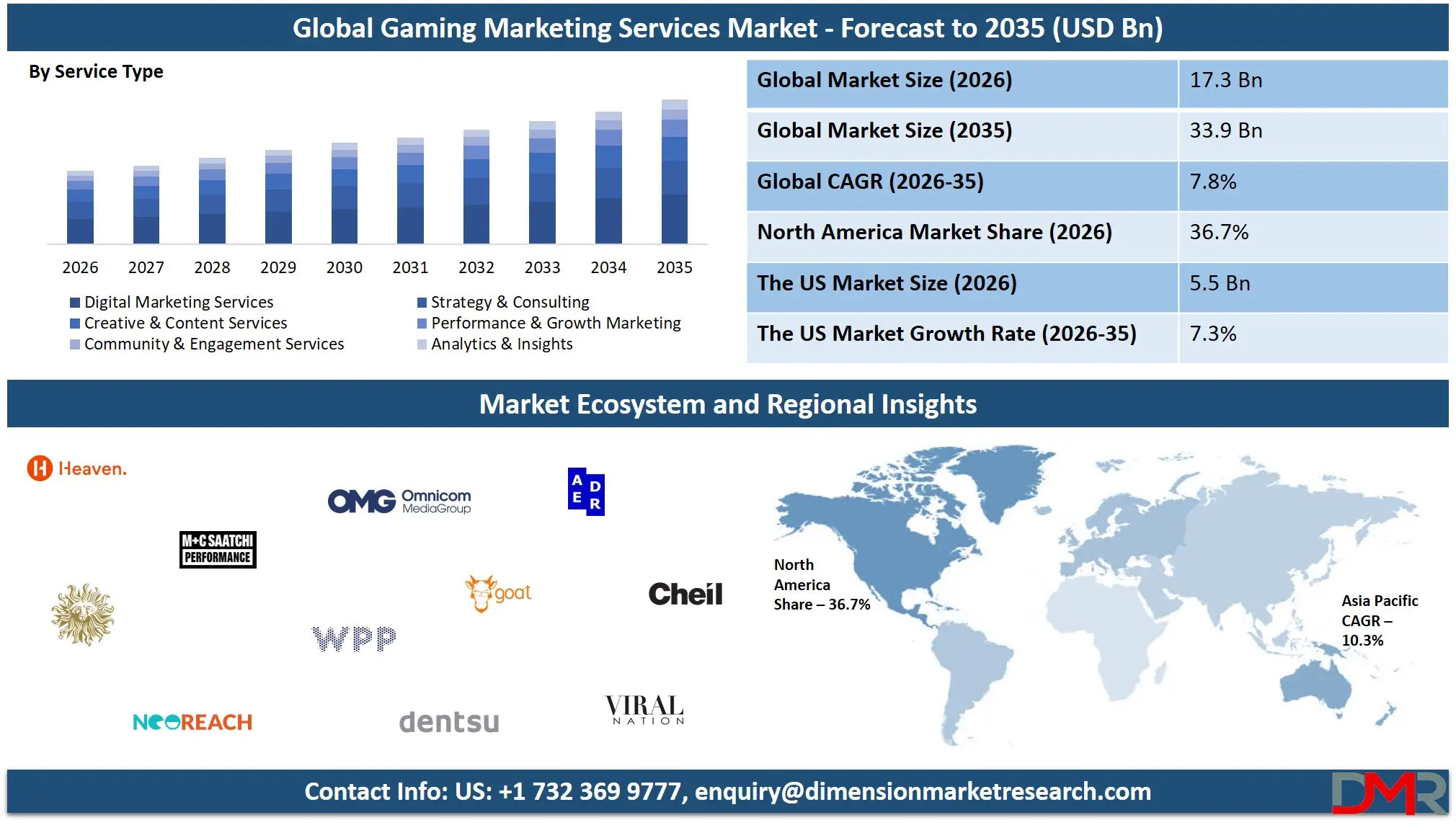
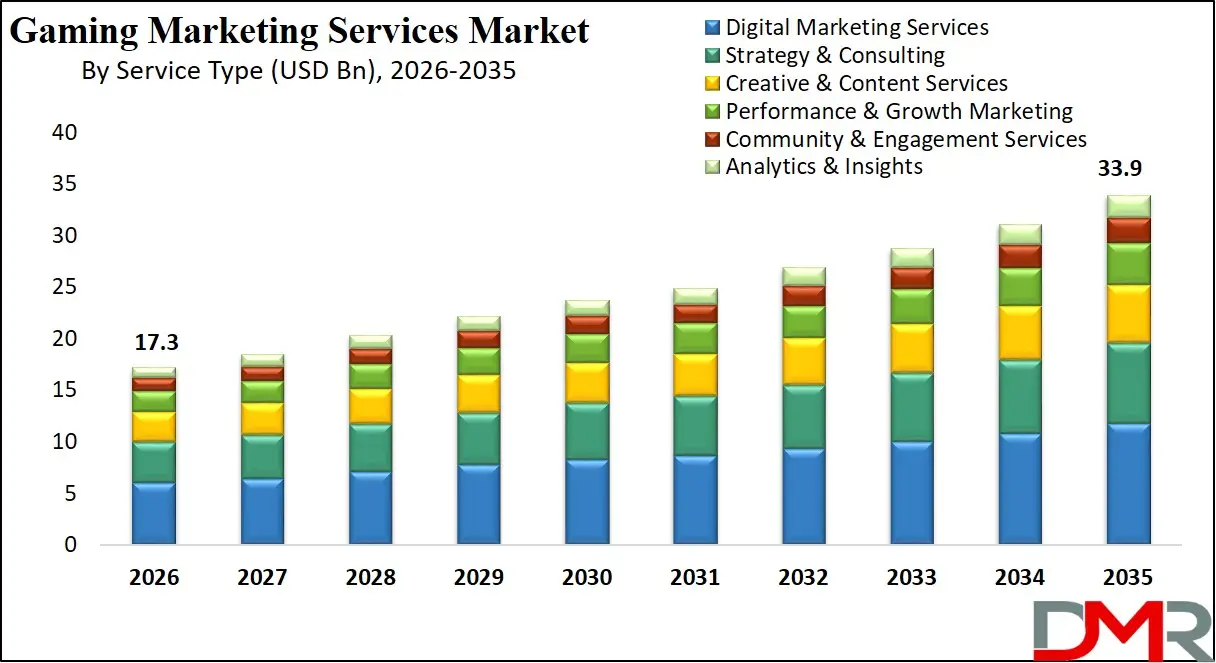
The Global Gaming Marketing Services Market size is projected to reach USD 17.3 billion in 2026 and grow at a compound annual growth rate of 7.8% to reach a value of USD 33.9 billion in 2035.
ℹ
To learn more about this report –
Download Your Free Sample Report Here
Gaming Marketing Services refers to specialized marketing solutions used to promote video games, gaming platforms, esports entities, and gaming-related brands across digital and experiential channels. The market includes strategy consulting, creative production, digital advertising, influencer collaborations, community engagement, analytics, and performance marketing tailored for gamer audiences. Its importance has increased alongside the rapid expansion of the global gaming industry, which now rivals film and music in economic impact. These services play a vital role in user acquisition, monetization, and long-term player retention within a highly competitive entertainment ecosystem.
The market operates at the intersection of advertising technology, entertainment media, and interactive digital culture. Services are delivered through social media platforms, streaming ecosystems, in-game advertising environments, and esports events. Advanced tools such as data analytics, AI-driven targeting, and real-time campaign optimization are now core components. As live-service and free-to-play models become more common, marketing has shifted from one-time launches to continuous engagement strategies that support long-term player lifecycles.
ℹ
To learn more about this report –
Download Your Free Sample Report Here
Several shifts are driving market growth, including the rise of mobile gaming, creator-led promotions, and performance-based advertising models. Brands are increasingly focused on authenticity, community building, and measurable ROI, boosting demand for agencies with gaming-native expertise. Growing convergence between gaming, social media, and entertainment streaming continues to reshape how marketing services are designed and delivered.
The US Gaming Marketing Services Market
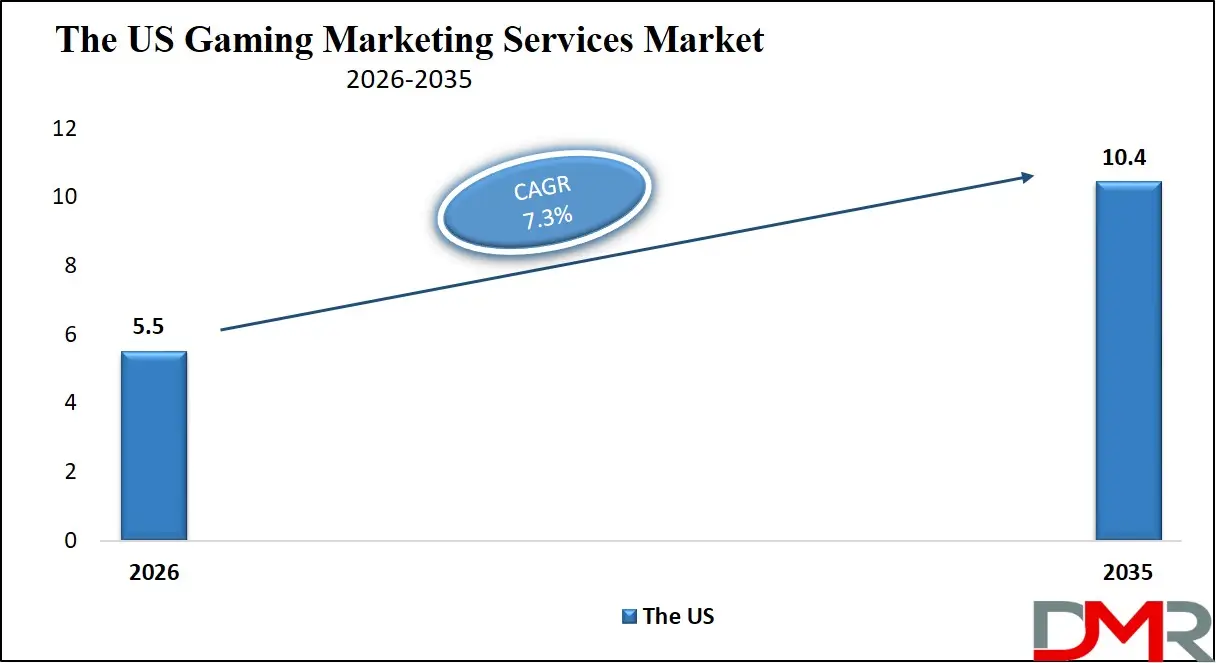
The US Gaming Marketing Services Market size is projected to reach USD 5.5 billion in 2026 at a compound annual growth rate of 7.3% over its forecast period.
ℹ
To learn more about this report –
Download Your Free Sample Report Here
The presence of major game publishers, global marketing agencies, esports organizations, and streaming platforms shapes the US market. High digital advertising spend, early adoption of emerging technologies, and a mature influencer ecosystem support strong market growth. Regulatory clarity around digital advertising and data privacy enables scalable campaign execution, while government support for creative and technology industries indirectly benefits market expansion. The US also leads in performance marketing innovation, programmatic advertising, and the adoption of AI-driven analytics for gaming-focused campaigns.
Europe Gaming Marketing Services Market
Europe Gaming Marketing Services Market size is projected to reach USD 4.3 million in 2026 at a compound annual growth rate of 7.5% over its forecast period.
Europe’s market is driven by strong regulatory frameworks, particularly data protection and consumer transparency requirements. Policies such as the European Green Deal and Digital Services Act encourage ethical advertising, sustainable digital operations, and responsible content promotion. Western Europe leads in esports marketing, influencer management, and community-driven campaigns, while Eastern Europe shows rapid adoption due to growing gaming populations. The region emphasizes brand safety, localized messaging, and multilingual campaign execution, influencing service design and delivery models.
Japan Gaming Marketing Services Market
Japan Gaming Marketing Services Market size is projected to reach USD 1.0 billion in 2026 at a compound annual growth rate of 7.1% over its forecast period.
Japan’s market is characterized by a strong console and mobile gaming culture, deep intellectual property ecosystems, and highly engaged domestic audiences. Growth is supported by urbanization, high smartphone penetration, and government initiatives promoting digital content industries. Marketing strategies emphasize brand legacy, cross-media storytelling, and long-term fan engagement rather than aggressive user acquisition. Challenges include cultural specificity and platform fragmentation, while opportunities exist in mobile gaming promotion, anime-game collaborations, and global IP expansion.
Gaming Marketing Services Market: Key Takeaways
- Market Growth: The Gaming Marketing Services Market size is expected to grow by USD 18.4 billion, at a CAGR of 7.8%, during the forecasted period of 2027 to 2035.
- By Service Type: The digital marketing services segment is anticipated to get the majority share of the Gaming Marketing Services Market in 2026.
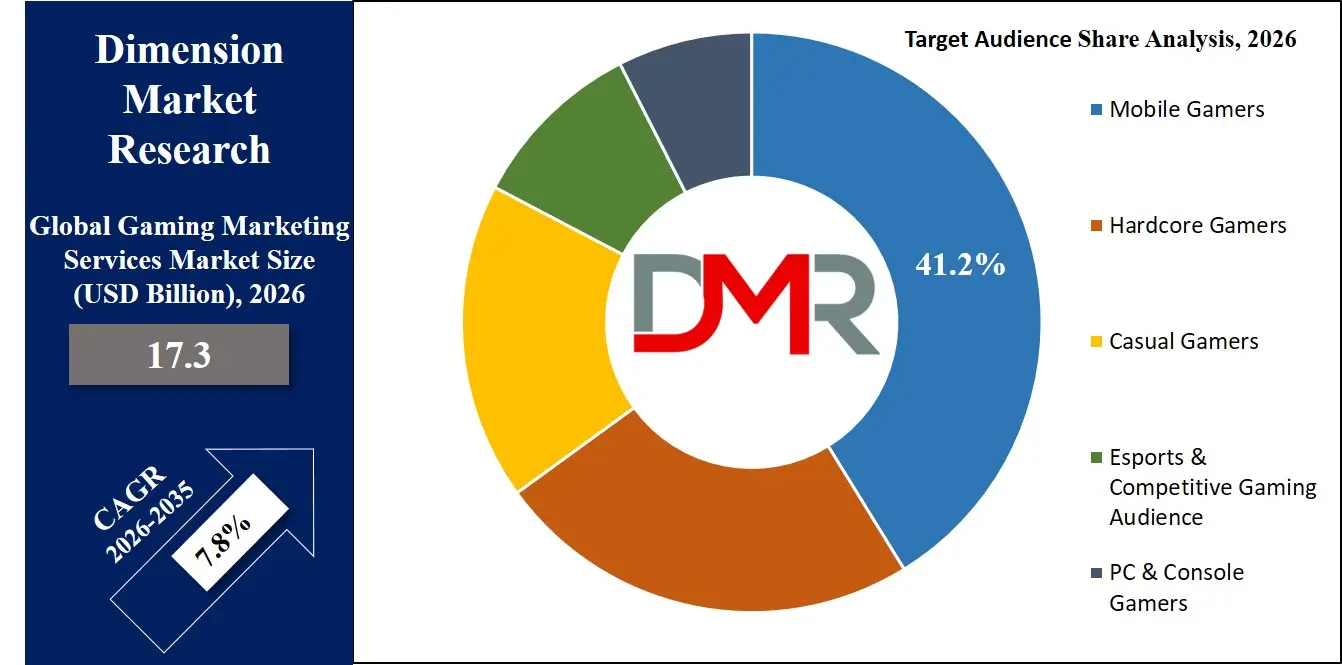
- By Target Audience: The mobile gamers segment is expected to get the largest revenue share in 2026 in the Gaming Marketing Services Market.
- Regional Insight: North America is expected to hold a 36.7% share of revenue in the Global Gaming Marketing Services Market in 2026.
- Use Cases: Some of the use cases of Gaming Marketing Services include game launch campaigns, esports event marketing, and more.
Gaming Marketing Services Market: Use Cases
- Game Launch Campaigns: Integrated campaigns combining trailers, influencer previews, paid media, and community teasers to drive pre-registrations and day-one installs.
- Influencer-Led Promotions: Strategic partnerships with streamers and creators to generate authentic gameplay exposure and peer-driven discovery.
- Live-Service Player Retention: Ongoing campaigns focused on seasonal updates, events, and loyalty programs to extend player lifetime value.
- Esports Event Marketing: Promotion of tournaments through social media, streaming ads, sponsorship activations, and offline fan experiences.
- In-Game Advertising: Placement of branded content within game environments to reach players without disrupting gameplay immersion.
- Performance User Acquisition: Data-driven campaigns optimizing CPI, ROAS, and conversion metrics across mobile and PC platforms.
- Community Management: Building and moderating online communities to foster advocacy, feedback loops, and organic growth.
Stats & Facts
- U.S. Bureau of Economic Analysis reported digital advertising services contributing over USD 310 billion to the US economy in 2024.
- European Commission stated that interactive digital content industries grew at over 8.5% annually across the EU in 2024.
- Japan Ministry of Economy, Trade and Industry recorded gaming and digital content exports exceeding JPY 4.7 trillion in 2024.
- U.S. Federal Communications Commission noted that over 92% of US households had broadband access in 2024, enabling digital campaign reach.
- Eurostat reported that 71% of Europeans aged 16–45 engaged with gaming content online in 2024.
- Statistics Canada highlighted a 14% rise in digital media advertising spend in entertainment sectors during 2024.
- UK Office for National Statistics recorded esports and gaming marketing activities growing at 11.2% in 2024.
- Australian Bureau of Statistics noted mobile gaming ad expenditure increased by 18% in 2024.
- OECD reported global digital advertising efficiency improving by 9% due to AI optimization in 2025.
- U.S. Department of Commerce stated that data-driven marketing services adoption crossed 76% among entertainment companies in 2025.
Market Dynamic
Driving Factors in the Gaming Marketing Services Market
Growth of the Global Gaming Industry
The continuous expansion of the gaming industry is a primary growth driver for Gaming Marketing Services. With rising numbers of game launches across mobile, PC, and console platforms, publishers require specialized marketing strategies to differentiate offerings in saturated markets. Live-service models and frequent content updates necessitate ongoing promotional efforts rather than one-time campaigns. Additionally, the increasing monetization through in-game purchases, subscriptions, and battle passes drives demand for performance-oriented marketing that directly links spend to player lifetime value and revenue outcomes.
Advancements in Data Analytics and Ad Technology
Technological innovation in analytics, attribution modeling, and ad delivery has transformed how gaming campaigns are executed. Real-time performance tracking, cross-platform attribution, and predictive analytics allow marketers to optimize campaigns continuously. Programmatic advertising, AI-based audience segmentation, and automated creative testing improve efficiency and ROI. These advancements reduce wastage, enable precise targeting of gamer personas, and support scalable global campaigns, making advanced marketing services indispensable for publishers and brands targeting gamers.
Restraints in the Gaming Marketing Services Market
High Cost of Premium Marketing Channels
Marketing within high-visibility gaming environments, such as top-tier influencers, esports sponsorships, and premium streaming platforms, involves substantial costs. Smaller developers and indie publishers often struggle to compete with larger firms that can afford sustained, multi-channel campaigns. Rising costs of user acquisition, particularly in mobile gaming, compress margins and increase financial risk. This cost barrier limits market accessibility for new entrants and restricts the scale of marketing initiatives for budget-constrained players.
Regulatory and Platform Constraints
Increasing regulations around data privacy, advertising transparency, and consumer protection impose compliance burdens on marketing service providers. Platform-specific rules on ad formats, content disclosure, and influencer promotions add operational complexity. Changes in algorithm policies by social media and streaming platforms can disrupt campaign performance unpredictably. These constraints require constant adaptation, legal oversight, and technical updates, which can slow execution and increase operational costs for market participants.
Opportunities in the Gaming Marketing Services Market
Expansion in Emerging Gaming Markets
Rapid growth in gaming adoption across Southeast Asia, Latin America, the Middle East, and Africa presents significant opportunities. Increasing smartphone penetration, affordable data access, and young demographics create demand for localized gaming marketing services. Publishers entering these regions require cultural adaptation, regional influencer partnerships, and localized performance campaigns. Service providers that develop regional expertise and scalable models can capture untapped demand and establish early-mover advantages.
Integration of Brand Advertising with Gaming Ecosystems
Non-gaming brands are increasingly targeting gamers as a valuable consumer segment. This creates opportunities for Gaming Marketing Services to design brand-game integrations, in-game advertising, and experiential campaigns. Collaborations between games and brands in fashion, automotive, food, and entertainment expand revenue streams beyond traditional user acquisition. Agencies capable of bridging gaming culture with brand objectives stand to benefit from this growing cross-industry convergence.
Trends in the Gaming Marketing Services Market
Shift Toward Creator-First Marketing Models
Marketing strategies are increasingly centered around creators rather than traditional advertising. Streamers and influencers offer authentic engagement, real-time interaction, and trusted recommendations. This trend drives demand for influencer management, creator analytics, and long-term partnership structuring. Agencies are evolving from campaign brokers to creator ecosystem managers, focusing on sustained collaborations that build credibility and community trust over time.
Adoption of Performance-Based Pricing Models
Clients are favoring outcome-linked pricing structures tied to installs, engagement, or revenue rather than fixed retainers. This trend aligns incentives between service providers and clients but also increases operational risk for agencies. It encourages deeper investment in analytics, optimization, and automation. Performance-based models are reshaping service delivery, contract structures, and competitive differentiation within the market.
Impact of Artificial Intelligence in Gaming Marketing Services Market
- AI-Driven Audience Segmentation: Improves targeting accuracy by analyzing player behavior and preferences.
- Predictive Campaign Optimization: Forecasts campaign outcomes and adjusts spend in real time.
- Automated Creative Testing: Rapidly tests multiple creatives to identify high-performing variants.
- Fraud Detection Systems: Identifies invalid traffic and fraudulent installs to protect ad budgets.
- Personalized Messaging Engines: Delivers tailored ads based on player lifecycle stages.
- Sentiment Analysis Tools: Tracks community feedback across social and streaming platforms.
- Dynamic Budget Allocation: Redistributes spend across channels based on live performance data.
Research Scope and Analysis
By Service Type Analysis
Digital Marketing Services is projected to hold 34.6% market share in 2026, driven by its critical role in user acquisition, engagement, and monetization across gaming platforms. This segment covers social media marketing, search engine marketing, SEO, display advertising, and programmatic campaigns designed specifically for gamer behavior. Its leadership is supported by precise performance measurement, real-time optimization, and scalability across global markets. The rapid growth of mobile gaming, free-to-play titles, and live-service models has intensified demand for always-on digital campaigns. Publishers increasingly depend on data-driven marketing to maintain player pipelines, optimize acquisition costs, and extend player lifetime value in competitive environments.
Creative & Content Services represent the fastest-growing service type due to increasing trust in creator-led recommendations and authentic gameplay exposure. Streaming platforms and short-form video channels have become primary discovery tools for gamers, enabling creators to influence purchasing and download decisions directly. This segment benefits from expanding creator ecosystems, improved attribution technologies, and performance-linked compensation models. Long-term creator partnerships are replacing one-off sponsorships, allowing brands and publishers to build sustained engagement and community credibility. As gamers value transparency and authenticity, influencer-led marketing continues to outperform traditional advertising formats, driving rapid adoption across mobile, PC, and console markets.
By Platform Analysis
Social media platforms are expected to account for 29.8% market share in 2026, supported by high engagement levels, diverse ad formats, and extensive user reach. These platforms serve as primary discovery and awareness channels for new game launches, updates, and live events. Their integration with influencer content, video ads, and performance-driven campaigns enhances campaign effectiveness. Advanced targeting options, real-time analytics, and cross-platform retargeting further strengthen their position. Social media platforms also enable direct interaction with gaming communities, allowing publishers to gather feedback, build loyalty, and sustain long-term engagement across multiple game lifecycles.
In-game advertising channels are experiencing rapid growth due to advancements in non-intrusive ad formats and improved performance measurement tools. Modern integrations blend seamlessly into gameplay environments, preserving immersion while delivering brand visibility. As games adopt persistent and realistic virtual worlds, in-game advertising offers contextual relevance and high recall rates. This channel attracts both gaming and non-gaming brands seeking direct access to engaged audiences. Enhanced analytics and attribution capabilities are increasing advertiser confidence, while publishers benefit from additional monetization streams. These factors collectively position in-game advertising as a high-growth channel within gaming marketing services.
By Target Audience Analysis
Mobile gamers are projected to represent 41.2% market share in 2026, driven by widespread smartphone adoption, affordable data access, and the popularity of casual gaming. Marketing strategies targeting this audience emphasize high-volume user acquisition, retargeting, and lifecycle optimization. Short-form video ads, playable ads, and influencer promotions are widely used to capture attention quickly. Continuous updates, events, and reward-based messaging help retain users and drive in-app purchases. The scale and diversity of mobile gamers make this segment highly attractive, encouraging sustained investment in performance marketing and analytics-driven campaign optimization.
ℹ
To learn more about this report –
Download Your Free Sample Report Here
The esports and competitive gaming audience is expanding rapidly due to rising sponsorship investments, increasing streaming viewership, and growing global tournament ecosystems. Marketing efforts in this segment focus on event-based promotions, team sponsorships, and community-driven engagement strategies. Brands leverage live broadcasts, social media interactions, and offline events to build loyalty and visibility. This audience values authenticity, skill, and competition, requiring tailored messaging and long-term partnerships. As esports continues to professionalize and attract mainstream attention, demand for specialized marketing services targeting competitive gaming communities is expected to accelerate.
By End User Analysis
Game developers and publishers are expected to hold 46.5% market share in 2026, reflecting their heavy reliance on marketing services for launches, updates, and monetization strategies. Continuous content cycles, seasonal events, and live-service models require sustained marketing support rather than one-time campaigns. These end users prioritize performance metrics, scalability, and ROI-driven strategies to manage acquisition costs and maximize player lifetime value. Marketing services also support market entry into new regions and platforms. As competition intensifies, developers increasingly depend on specialized agencies to maintain visibility and engagement throughout a game’s lifecycle.
Non-gaming brands targeting gamers represent a rapidly growing end-user segment as companies seek access to younger, digitally engaged audiences. Brands from sectors such as automotive, fashion, food, and entertainment are integrating into gaming ecosystems through sponsorships, in-game advertising, and influencer collaborations. These brands require specialized marketing expertise to align messaging with gaming culture and avoid audience backlash. Innovative activations, experiential campaigns, and community-focused strategies drive engagement. The convergence of gaming and mainstream consumer marketing continues to expand this segment’s growth potential.
By Engagement Model Analysis
Outsourced marketing services are projected to command 52.3% market share in 2026, as companies seek specialized expertise, scalability, and cost efficiency. External agencies provide access to advanced tools, platform partnerships, and gaming-native talent that may be difficult to maintain in-house. Outsourcing allows publishers and brands to adapt quickly to market changes, launch campaigns across regions, and leverage data-driven optimization. This model is particularly attractive for smaller studios and global expansions, reinforcing its dominance across service types and platforms.
The hybrid marketing model is growing steadily as organizations balance internal control with external expertise. Companies retain strategic oversight and brand alignment in-house while outsourcing execution, analytics, and specialized capabilities to agencies. This approach improves flexibility, cost management, and knowledge transfer. Hybrid models are especially popular among mid-to-large publishers managing multiple titles and regions. As marketing complexity increases across platforms and technologies, the hybrid model offers a scalable and adaptive framework, supporting faster innovation and improved performance outcomes.
The Gaming Marketing Services Market Report is segmented on the basis of the following:
By Service Type
- Strategy & Consulting
- Marketing Strategy Development
- Brand Positioning & Go-to-Market Planning
- Creative & Content Services
- Creative Design & Storytelling
- Video Trailers & Promotional Content
- Influencer & Creator Content
- Digital Marketing Services
- Social Media Marketing
- Search Engine Marketing
- Search Engine Optimization
- Display & Programmatic Advertising
- Performance & Growth Marketing
- User Acquisition Campaigns
- Retargeting & Re-engagement
- Conversion Optimization
- Community & Engagement Services
- Community Management
- Player Retention & Loyalty Programs
- Online & Offline Events
- Analytics & Insights
- Campaign Performance Analytics
- Player Behavior & Market Insights
- Competitive Intelligence
By Platform
- Social Media Platforms
- Search & Display Advertising
- Streaming & Influencer Platforms
- In-Game Advertising Channels
By Target Audience
- Casual Gamers
- Core / Hardcore Gamers
- Mobile Gamers
- PC & Console Gamers
- Esports & Competitive Gaming Audience
By End User
- Game Developers & Publishers
- Esports Organizations
- Gaming Platforms & Marketplaces
- Streaming & Content Platforms
- Non-Gaming Brands Targeting Gamers
By Engagement Model
- In-House Marketing
- Outsourced Marketing Services
- Hybrid Marketing Model
Regional Analysis
Leading Region in the Gaming Marketing Services Market
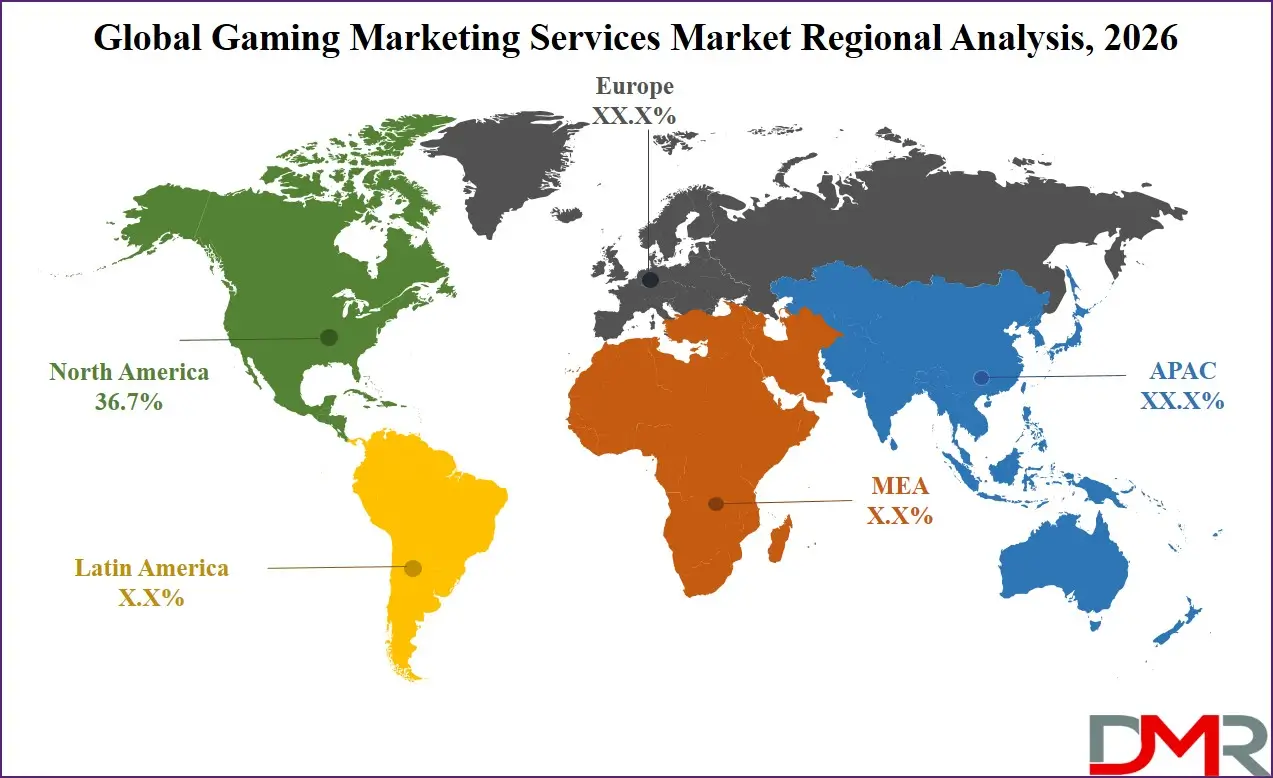
North America is projected to hold 36.7% market share in 2026, driven by high gaming expenditure, advanced digital advertising infrastructure, and early adoption of emerging technologies. The region benefits from a dense concentration of game publishers, marketing agencies, esports organizations, and streaming platforms. Strong penetration of performance marketing, programmatic advertising, and AI-driven analytics supports campaign efficiency and scalability. Favorable regulatory clarity around digital advertising and data usage further enables market growth. Additionally, the presence of global brands actively investing in gaming-focused campaigns reinforces North America’s dominant position in the market.
ℹ
To learn more about this report –
Download Your Free Sample Report Here
Fastest Growing Region in the Gaming Marketing Services Market
Asia-Pacific represents the fastest-growing region, fueled by rapid mobile gaming adoption, a young and digitally native population, and rising digital advertising expenditure. Expanding smartphone penetration and affordable internet access are accelerating gaming participation across emerging economies. Governments in the region are actively supporting digital economies, esports development, and creative industries, creating a favorable environment for market expansion. Local publishers and global brands are increasing investments in influencer marketing, in-game advertising, and performance campaigns. These factors collectively position Asia-Pacific as a high-growth hub for gaming marketing services.
By Region
North America
Europe
- Germany
- The U.K.
- France
- Italy
- Russia
- Spain
- Benelux
- Nordic
- Rest of Europe
Asia-Pacific
- China
- Japan
- South Korea
- India
- ANZ
- ASEAN
- Rest of Asia-Pacific
Latin America
- Brazil
- Mexico
- Argentina
- Colombia
- Rest of Latin America
Middle East & Africa
- Saudi Arabia
- UAE
- South Africa
- Israel
- Egypt
- Rest of MEA
Competitive Landscape
The Gaming Marketing Services market features moderate entry barriers due to the need for specialized gaming expertise, advanced technology infrastructure, and strong platform relationships. Competitive advantage is shaped by data-driven capabilities, creative differentiation, and performance accountability. Participants focus on strategic partnerships, proprietary analytics, AI integration, and geographic expansion to strengthen market position. Ongoing investment in R&D and skilled talent allows providers in the Gaming Marketing Services market to adapt to evolving platforms and gamer behavior while maintaining long-term client retention.
Some of the prominent players in the global Gaming Marketing Services are:
- WPP
- Publicis Groupe
- Omnicom Group
- Dentsu
- Cheil Worldwide
- M+C Saatchi Performance
- Viral Nation
- Kairos Media
- NeoReach
- Goat Agency
- Freaks 4U Gaming
- NewGen
- Liquid+Arcade
- Ader
- ComboStrike
- Heaven Media
- EAK Digital
- Audiencly
- Moburst
- Zorka.Agency
- Other Key Players
Recent Developments
- In January 2026, Techmagnate launched Agentic AI Digital Marketing services to strengthen its AI-driven offerings for large brands and enterprises. The new solution addresses increasing scale and complexity in digital marketing by combining AI agents with structured human oversight. This approach helps organisations speed up execution, maintain consistency, and effectively scale performance across thousands of keywords, web pages, and marketing campaigns.
- In August 2025, Deutsche Telekom unveiled its plans to introduce a new 5G+ gaming service in partnership with NVIDIA from autumn 2025. The offering will deliver cloud gaming with highly stable, low-latency performance directly to smartphones, supported by intelligent network optimization using L4S and network slicing. By integrating NVIDIA’s GeForce NOW with Germany’s largest 5G standalone network, Deutsche Telekom becomes Europe’s first operator to support latency-optimized mobile cloud gaming.
Report Details
| Report Characteristics |
| Market Size (2026) |
USD 17.3 Bn |
| Forecast Value (2035) |
USD 33.9 Bn |
| CAGR (2026–2035) |
7.8% |
| The US Market Size (2026) |
USD 5.5 Bn |
| Historical Data |
2021 – 2025 |
| Forecast Data |
2027 – 2035 |
| Base Year |
2025 |
| Estimate Year |
2026 |
| Report Coverage |
Market Revenue Estimation, Market Dynamics, Competitive Landscape, Growth Factors and etc. |
| Segments Covered |
By Service Type (Strategy & Consulting, Creative & Content Services, Digital Marketing Services, Performance & Growth Marketing, Community & Engagement Services, Analytics & Insights), By Platform (Social Media Platforms, Search & Display Advertising, Streaming & Influencer Platforms, In-Game Advertising Channels), By Target Audience (Casual Gamers, Core / Hardcore Gamers, Mobile Gamers, PC & Console Gamers, Esports & Competitive Gaming Audience), By End User (Game Developers & Publishers, Esports Organizations, Gaming Platforms & Marketplaces, Streaming & Content Platforms, Non-Gaming Brands Targeting Gamers), By Engagement Model (In-House Marketing, Outsourced Marketing Services, Hybrid Marketing Model) |
| Regional Coverage |
North America – The US and Canada; Europe – Germany, The UK, France, Russia, Spain, Italy, Benelux, Nordic, & Rest of Europe; Asia-Pacific – China, Japan, South Korea, India, ANZ, ASEAN, Rest of APAC; Latin America – Brazil, Mexico, Argentina, Colombia, Rest of Latin America; Middle East & Africa – Saudi Arabia, UAE, South Africa, Turkey, Egypt, Israel, & Rest of MEA |
| Prominent Players |
WPP, Publicis Groupe, Omnicom Group, Dentsu, Cheil Worldwide, M+C Saatchi Performance, Viral Nation, Kairos Media, NeoReach, Goat Agency, Freaks 4U Gaming, NewGen, Liquid+Arcade, Ader, ComboStrike, Heaven Media, EAK Digital, Audiencly, Moburst, Zorka.Agency, and Other Key Players |
Frequently Asked Questions
How big is the Global Gaming Marketing Services Market?
▾ The Global Gaming Marketing Services Market size is expected to reach USD 17.3 billion by 2026 and is projected to reach USD 33.9 billion by the end of 2035.
Which region accounted for the largest Global Gaming Marketing Services Market?
▾ North America is expected to have the largest market share in the Global Gaming Marketing Services Market, with a share of about 36.7% in 2026.
How big is the Gaming Marketing Services Market in the US?
▾ The US Gaming Marketing Services market is expected to reach USD 5.5 billion by 2026.
Who are the key players in the Gaming Marketing Services Market?
▾ Some of the major key players in the Global Gaming Marketing Services Market include Omnicom, Dentsu, WPP, and others.
What is the growth rate in the Global Gaming Marketing Services Market?
▾ The market is growing at a CAGR of 7.8 percent over the forecasted period.