Market Snapshot
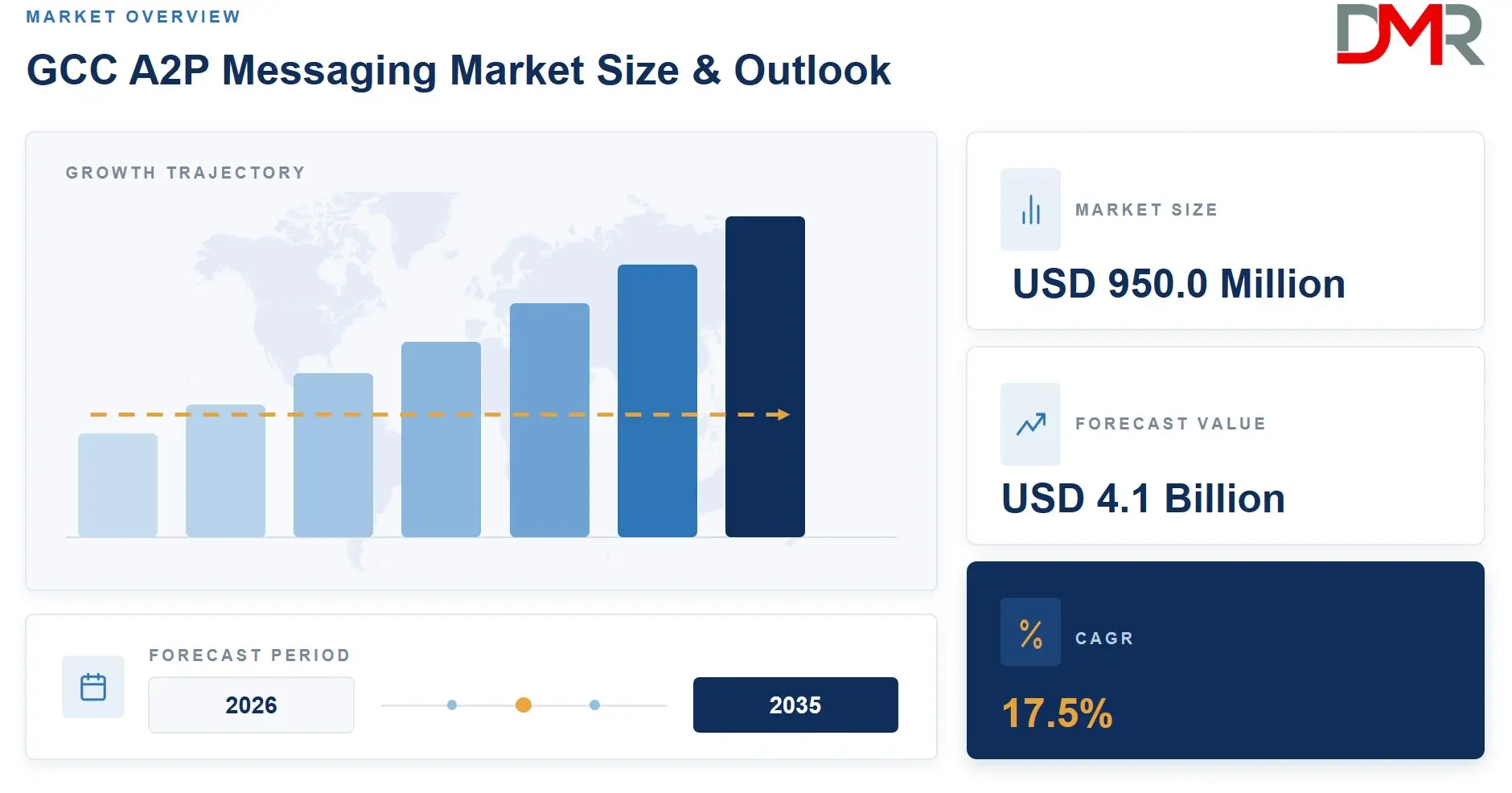
- Market Size (2026): USD 950.0 Mn
- Forecast Value (2035): USD 4.1 Bn
- CAGR (2026-2035): 17.5%
- Leading Messaging Channel (2026): SMS, around 50%
- Leading Application (2026): OTP & Authentication, close to 34%
- Key Players: stc, e&, and Unifonic, among others
What is GCC A2P Messaging Market and its Market Size?
The GCC A2P Messaging Market size is estimated to reach USD 950.0 Mn in 2026 and is further anticipated to reach USD 4.1 Bn by 2035, at a CAGR of 17.5%.
ℹ
To learn more about this report –
Download Your Free Sample Report Here
Application to person messaging covers every bulk or automated text, rich card, or voice prompt that a business, bank, government body, or platform sends to an individual over a mobile network rather than a peer to peer exchange between two people. In the Gulf Cooperation Council, that traffic runs across Saudi Arabia, the UAE, Qatar, Kuwait, Oman, and Bahrain, and the figures in this report measure demand generated inside those six markets rather than the worldwide billings of companies headquartered there. A Riyadh bank sending a one time password to a customer in Jeddah counts toward this market; the same bank routing traffic to a customer in Germany does not.
The product itself spans four delivery rails: plain SMS carried over carrier signalling, Rich Communication Services business messaging that layers branded cards and buttons onto the native messaging app, OTT and chat app channels reached through business APIs, and automated voice prompts for calls that a text cannot reliably reach. Buyers are almost entirely enterprises and public bodies rather than consumers: banks confirming transactions, telecom operators billing subscribers, delivery platforms tracking orders, and ministries pushing civic alerts, all routed through a carrier, an aggregator, or a cloud communications platform under commercial contract.
What is structurally changing is the mix of channel and the identity layer behind it. Saudi Arabia and the UAE carry some of the highest smartphone penetration rates in the world, giving RCS and OTT channels a faster runway than in markets still dominated by feature phones, while national digital identity programmes and sender registration rules are pushing every operator toward verified, traceable sending rather than anonymous bulk SMS.
Use Cases
- Retail Banking Authentication: Saudi and Emirati banks route one time passwords and transaction confirmations through primary and backup channels so that a payment is never blocked by a single carrier outage, a requirement that has become close to universal since GCC central banks tightened digital payment authentication rules.
- Airline and Hospitality Operations Messaging: Gulf carriers and hotel groups send boarding gate changes, check in reminders, and loyalty updates to travellers connecting through Dubai, Doha, and Riyadh hubs, where message volume spikes sharply around the Hajj and Umrah travel seasons.
- Utility and Municipal Alerts: Government owned utilities and municipalities across Kuwait, Oman, and Bahrain issue outage notices, billing reminders, and weather warnings to residents, a channel increasingly folded into national e government portals rather than run as a standalone system.
- E-commerce Delivery Coordination: Regional marketplaces and food delivery platforms message shoppers at every step from order confirmation to courier arrival, a high frequency, low margin use case that pushes buyers toward the cheapest reliable channel available at each stage.
Key Takeaways
- Market Size & Share: The market is set to expand from USD 950.0 Mn in 2026 to USD 4.1 Bn by 2035.
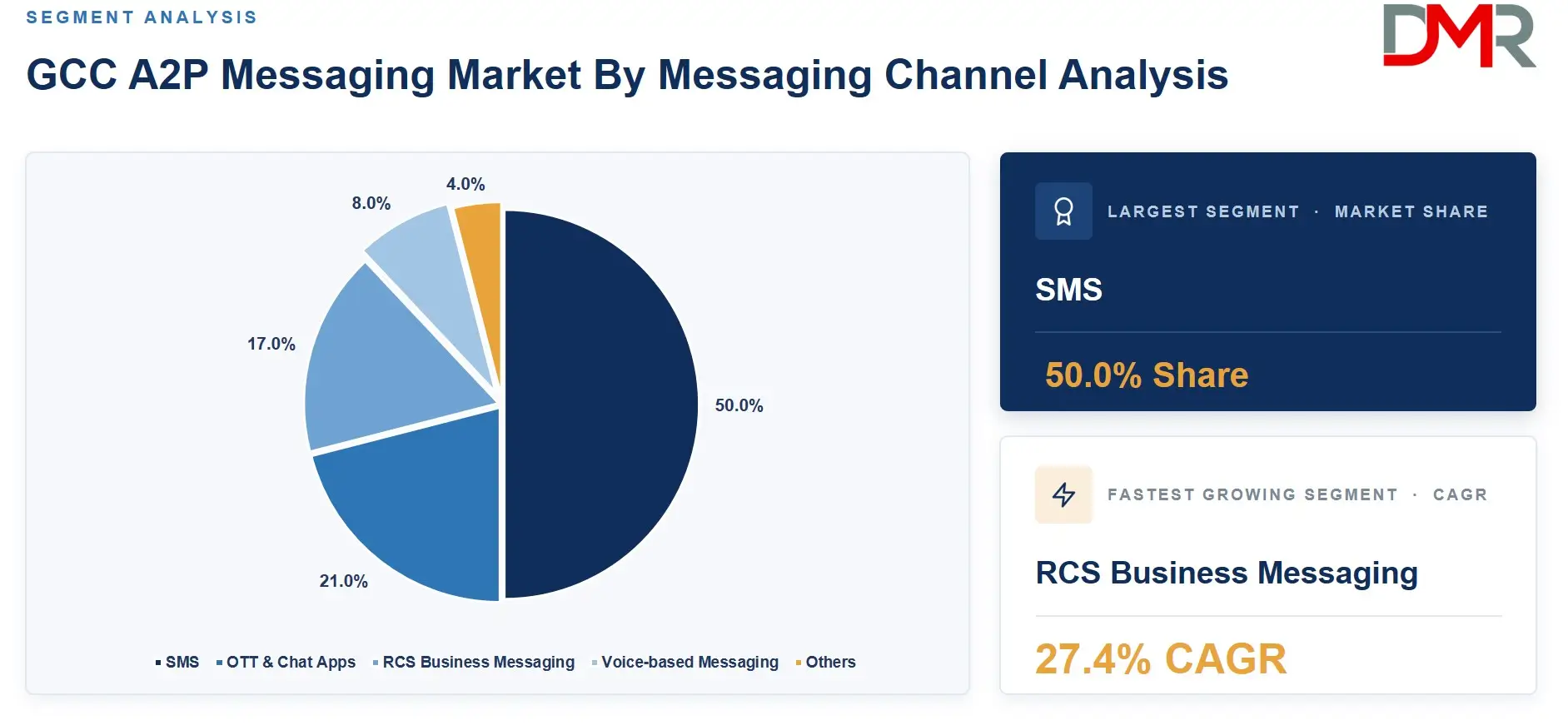
- Messaging Channel Analysis: SMS is projected to hold approximately 50% of 2026 revenue even as RCS Business Messaging scales at a CAGR of 27.4%.
- Demand Concentration: Saudi Arabia and the UAE together account for the majority of regional A2P traffic, with Qatar forming the third largest contributor.
- Application Mix: OTP and authentication traffic is expected to represent around 34% of 2026 volume, reflecting the weight of banking and fintech senders in the region.
- Regulatory Environment: Sender ID registration regimes now cover every GCC state, with the UAE alone reporting more than 1.2 Bn spam messages blocked in 2025.
- Competitive Landscape: National carriers, regional CPaaS specialists, and global aggregators together account for the 40 companies profiled in this report.
How AI/Gen AI is Transforming the GCC A2P Messaging Market?
Artificial intelligence is reshaping GCC A2P messaging less through novelty and more through routing discipline and fraud control. Carriers and aggregators use machine learning models to score sender reputation in real time, catching spoofed or unregistered traffic before it reaches a subscriber, which matters in a region where regulators now measure enforcement in the billions of blocked messages per year. Large language models are also being layered onto RCS business cards so that a single conversational thread can handle a customer query, an authentication step, and a follow up offer without handing the user off to a separate app.
Generative tooling is doing more work on the content and orchestration side than on the wire itself. Enterprises building bilingual Arabic and English campaigns increasingly rely on generative drafting to keep tone consistent across both languages, while predictive send time models decide whether a given message should default to SMS, RCS, or an OTT channel based on device capability and past open rates.
- Fraud and Spam Scoring: Machine learning models flag anomalous sending patterns against TDRA and CITC style registration rules before delivery.
- Conversational RCS Agents: LLM powered chat flows resolve authentication and support queries inside a single branded RCS thread.
- Bilingual Content Generation: Generative drafting keeps Arabic and English campaign variants consistent in tone and length.
- Channel Orchestration: Predictive models select the cheapest channel likely to reach a given device and subscriber profile.
Key Drivers in the GCC A2P Messaging Market
Two forces account for most of the demand growth reaching enterprises and public bodies across the six member states.
- Digital Banking and Fintech Authentication Mandates: Central banks across Saudi Arabia, the UAE, and Qatar require multi factor authentication on digital payments and account changes, and A2P messaging remains the fallback channel of record even as app based push notifications grow, because it reaches a subscriber regardless of whether a banking app is installed or a data connection is live. Fintech licensing waves under Vision 2030 style economic diversification programmes have added dozens of new digital lenders and payment wallets, each of which must stand up its own OTP and transaction confirmation flow from day one, and neobanks entering Saudi Arabia and the UAE are provisioning messaging capacity well ahead of their subscriber base to satisfy regulator sign off before launch.
- Government Digitisation and Smart City Programmes: National e government platforms in the UAE, Saudi Arabia, and Qatar route an expanding share of civic communication, from visa status updates to utility billing, through certified messaging channels, and smart city rollouts in cities such as Riyadh and Dubai are extending that same infrastructure into municipal alerts and public safety notices. Because these programmes are procured centrally and tied to multi year digital transformation budgets, the resulting messaging volume is more stable and less price sensitive than commercial marketing traffic, giving carriers and CPaaS vendors a durable base load to build capacity around.
Restraints in the GCC A2P Messaging Market
Two structural brakes temper the pace of adoption even as underlying demand climbs.
- Fragmented National Registration Regimes: Each GCC state runs its own sender ID and template approval process, so an enterprise operating across all six markets must register separately with Saudi CITC, the UAE TDRA, and equivalent bodies in Qatar, Kuwait, Oman, and Bahrain, each carrying its own document set, review timeline of one to several weeks, and penalty schedule that can run into hundreds of thousands of dirhams per violation. That compliance overhead pushes smaller regional enterprises toward a single aggregator relationship rather than direct carrier binds, concentrating volume with a handful of platforms and slowing the pace at which new senders can go live.
- OTT Substitution Among Younger, Data Connected Users: WhatsApp and other OTT platforms already carry a meaningful share of person to person and increasingly business communication among GCC residents under thirty, a demographic that dominates the region's population pyramid, and every message a bank or retailer can shift onto a free or low cost OTT business API is one less billed SMS. Carriers depend on OTP and other mandated transactional traffic to hold SMS volume steady, but promotional and reminder traffic is migrating faster than pricing models have adjusted to absorb.
Growth Opportunities in the GCC A2P Messaging Market
The clearest white space sits where regulation, channel, and buyer segment intersect rather than in raw volume growth alone.
- RCS Rollout to Small and Mid Sized Enterprises: Carrier grade RCS deployment has so far concentrated on large banks, telecom operators, and government accounts able to absorb registration and creative production costs, leaving small and mid sized retailers, clinics, and logistics firms still sending plain SMS. Aggregators that package verified sender onboarding, template design, and per message pricing into a single self service product stand to capture this underserved tier as device level RCS support becomes close to universal across Android handsets in the region.
- Compliance as a Managed Service: The multiplicity of national sender ID regimes creates room for a managed compliance layer, sender registration, consent record keeping, and quiet hours enforcement bundled as a subscription rather than left to each enterprise's own operations team. Vendors that can offer a single dashboard covering all six GCC jurisdictions have a defensible position against both do it yourself carrier integration and generic global aggregators unfamiliar with local rules.
Trends in the GCC A2P Messaging Market
Two shifts are visible in how buyers structure spend today, distinct from the drivers pulling overall demand.
- Consolidation Toward Multi Channel Contracts: Enterprises are increasingly signing a single contract that spans SMS, RCS, and OTT delivery with automatic channel fallback, rather than separate agreements per channel, shifting pricing negotiations from a per message basis to a blended cost per delivered interaction. This favours CPaaS platforms and larger aggregators able to guarantee cross channel reach over single channel resellers.
- Verified Sender Branding as a Trust Signal: Banks and government bodies are treating a verified RCS profile, complete with logo, checkmark, and registered name, as a fraud prevention measure as much as a marketing upgrade, since it lets a recipient distinguish an official message from a phishing attempt at a glance. Adoption of verified branding is moving fastest in Saudi Arabia and the UAE, where carrier support is most mature.
Research Scope and Analysis
Segment performance is assessed across five axes: messaging channel, application, end use industry, enterprise size, and distribution channel. Each axis identifies the sub-segment carrying the largest share of 2026 revenue and the one expanding fastest through 2035, with the commercial reason behind each position.
ℹ
To learn more about this report –
Download Your Free Sample Report Here
By Messaging Channel
SMS is projected to hold the largest share by messaging channel in 2026, accounting for around 50% of revenue, since it remains the only channel guaranteed to reach every handset regardless of operating system, app installation, or data connectivity, a requirement regulators still treat as the baseline for transactional traffic such as OTP delivery. Growth, however, is concentrated in RCS Business Messaging, expanding at a CAGR of 27.4% between 2026 and 2035 as Android device support becomes near universal across the region and carriers including stc, e&, du, and Ooredoo complete network side provisioning that lets brands send verified, interactive cards instead of plain text.
By Application
OTP and authentication traffic is expected to account for close to 34% of 2026 revenue by application, the direct result of central bank mandated multi factor authentication on digital payments and account changes across Saudi Arabia, the UAE, and Qatar. The steeper trajectory sits with customer service and support messaging, growing at a CAGR of 25.6% as banks and telecom operators fold conversational RCS threads into first line support, reducing call centre volume for routine account queries.
By End Use Industry
BFSI is set to remain the largest end use industry in 2026, holding approximately 34% of revenue, underpinned by the sheer transaction volume that digital banking, insurance, and fintech senders generate across the six member states. Growth, however, is fastest in the government and public sector segment, projected at a CAGR of 26.2% as national e government platforms and smart city programmes in the UAE, Saudi Arabia, and Qatar route an expanding share of civic communication through certified messaging channels.
By Enterprise Size
Large enterprises are estimated to account for close to 58% of 2026 revenue by enterprise size, reflecting the concentration of banking, telecom, and government accounts that generate the bulk of regional message volume and can absorb sender registration and creative production costs. The faster trajectory belongs to small and medium enterprises, forecast at a CAGR of 24.8% as self service aggregator platforms lower the cost of entry for smaller retailers, clinics, and logistics firms that previously found direct carrier integration impractical.
By Distribution Channel
Aggregators and CPaaS platforms are projected to lead distribution channel revenue in 2026 at approximately 44%, since most enterprises outside the largest banks and carriers prefer a single API relationship covering multiple GCC jurisdictions over negotiating direct binds with six separate national operators. Growth, however, is strongest among managed service providers, expanding at a CAGR of 23.6% as enterprises outsource sender registration, consent tracking, and quiet hours compliance rather than build that capability internally.
The GCC A2P Messaging Market Report is Segmented Based on the Following
By Messaging Channel
- SMS
- OTT & Chat Apps
- RCS Business Messaging
- Voice-based Messaging
- Others
By Application
- OTP & Authentication
- Notifications & Alerts
- Promotional & Marketing
- Customer Service & Support
- Others
By End Use Industry
- BFSI
- E-commerce & Retail
- Government & Public Sector
- Travel & Hospitality
- Telecom & Utilities
- Others
By Enterprise Size
- Large Enterprises
- Mid-Market Enterprises
- Small & Medium Enterprises (SMEs)
- Others
By Distribution Channel
- Aggregators & CPaaS Platforms
- Direct Carrier Connections
- Managed Service Providers
- Others
Regulatory Landscape
Every GCC state now runs its own sender ID registration and template approval regime, with the UAE's TDRA and Saudi Arabia's CITC operating the most developed frameworks: mandatory alphanumeric sender registration, an "AD-" prefix on promotional traffic in the UAE, and quiet hours restrictions on marketing messages across most member states. Enforcement has sharpened noticeably, with the UAE alone reporting more than 1.2 Bn spam messages blocked in 2025 under a tightened consumer protection framework. What is shifting now is a move from static sender lists toward continuous consent record keeping, pushing enterprises to treat compliance as an operational function rather than a one time setup step. The commercial opening sits with vendors offering a single compliance layer across all six jurisdictions; the risk is that fragmented rules keep smaller senders locked into aggregator relationships, concentrating volume and slowing direct carrier adoption at the margin.
Technology Analysis
Network side RCS provisioning has reached a turning point across the GCC, with stc, e&, du, and Ooredoo completing business messaging support that lets brands send verified, interactive cards rather than plain text, and device level support is now close to universal across the region's predominantly Android and iOS smartphone base. What is shifting now is the layering of conversational AI onto that RCS infrastructure, letting a single branded thread handle authentication, support, and follow up offers without an app hand off. The commercial opening favours vendors that can bundle verified sender branding with fraud scoring, since regulators increasingly treat a checkmarked profile as a trust signal rather than a marketing feature. The risk is uneven carrier readiness between the largest markets and smaller states such as Oman and Bahrain, where RCS rollout lags and enterprises must still fall back to SMS for guaranteed reach.
Competitive Landscape
The market sits between a small set of national carriers that control last mile delivery in each GCC state and a wider layer of regional and global aggregators competing on coverage, pricing, and compliance tooling. Competition is increasingly won on registration speed and verified sender support rather than raw per message price, since enterprises now weigh a vendor's ability to keep a campaign compliant across six separate regulatory regimes as heavily as cost. Regional specialists compete on local relationships and Arabic language support, while global CPaaS platforms lean on breadth of channel coverage and existing enterprise contracts signed outside the region.
Some of the Prominent Players in the GCC A2P Messaging Market Are
- Ericsson
- Nokia
- Huawei
- Cisco
- Twilio
- Sinch
- Infobip
- Deutsche Telekom Global Carrier
- Tata Communications
- Amazon Web Services
- Bird
- CM.com
- Mitto AG
- Route Mobile
- Tanla Platforms
- Comviva
- Netcore Cloud
- Gupshup
- Mavenir
- Plivo
- MessageMedia
- Telesign
- Syniverse
- Comarch
- ClickSend
- Esendex
- stc
- e&
- du
- Ooredoo
- Batelco
- Omantel
- Zain
- Mobily
- Virgin Mobile UAE
- Virgin Mobile Saudi
- Unifonic
- VIVA Bahrain
- VIVA Kuwait
- Cequens
- Other Key Players
Recent Developments
- In June 2026, Unifonic acquired Segmentify to add agentic marketing personalisation to its customer engagement platform, extending its reach into predictive campaign targeting for regional retail and fintech clients.
- In April 2026, Infobip published messaging trend data showing regional RCS traffic roughly tripling year on year, reflecting the pace of carrier side provisioning across GCC networks.
- In January 2026, X by Unifonic co led a USD 7 Mn funding round for Open CX, backing an AI native customer experience platform serving regional enterprise messaging clients.
- In December 2025, Unifonic expanded operations into Jordan to extend its regional cloud communications footprint alongside its core GCC business.
- In late 2025, the UAE's TDRA tightened its Consumer Protection Regulation, moving enforcement from a static sender ID list toward continuous consent record checks.
- In October 2025, Unifonic obtained ISO 42001 certification covering responsible AI governance across its messaging and customer engagement products.
Report Details
| Report Characteristics |
| Market Size (2026) |
USD 950.0 Mn |
| Forecast Value (2035) |
USD 4.1 Bn |
| CAGR (2026-2035) |
17.5% |
| Historical Data |
2021 - 2025 |
| Forecast Data |
2026 - 2035 |
| Base Year |
2025 |
| Segments Covered |
By Messaging Channel, By Application, By End Use Industry, By Enterprise Size, and By Distribution Channel |
| Regional Coverage |
GCC - Saudi Arabia, The UAE, Qatar, Kuwait, Oman, Bahrain |
Frequently Asked Questions
How big is the GCC A2P Messaging Market?
▾ The GCC A2P Messaging Market is estimated at USD 950.0 Mn in 2026 and is projected to reach USD 4.1 Bn by 2035, reflecting sustained demand for authentication, transactional, and civic messaging across the six member states.
What is the growth rate of the GCC A2P Messaging Market?
▾ The market is forecast to expand at a CAGR of 17.5% between 2026 and 2035, driven by digital banking authentication mandates, government digitisation programmes, and the shift from plain SMS toward RCS Business Messaging.
Which country holds the largest share in the GCC A2P Messaging Market?
▾ Saudi Arabia and the UAE together generate the majority of regional demand, reflecting their larger populations, deeper fintech and e-commerce sectors, and more advanced carrier RCS infrastructure, with Qatar forming the third largest contributor.
Who are the key players in the GCC A2P Messaging Market?
▾ Leading players include stc, e&, Unifonic, Infobip, Sinch, Route Mobile, and Tanla Platforms, spanning national carriers, regional CPaaS specialists, and global aggregators.
Which messaging channel leads the GCC A2P Messaging Market?
▾ SMS is expected to remain the largest channel in 2026, accounting for around 50% of revenue, while RCS Business Messaging is the fastest growing at a CAGR of 27.4% as carrier and device support matures across the region.
Which industry drives the most demand in the GCC A2P Messaging Market?
▾ BFSI is the leading end use industry, holding approximately 34% of 2026 revenue on the back of authentication and transaction confirmation traffic, while the government and public sector segment is growing fastest at a CAGR of 26.2%.
What role does regulation play in the GCC A2P Messaging Market?
▾ Sender ID registration and consent enforcement have tightened across every GCC state, with the UAE alone blocking more than 1.2 Bn spam messages in 2025, pushing enterprises toward verified branding and managed compliance services.