GCC Medical Devices Market Snapshot
- GCC Medical Devices Market Size in 2026: USD 10.4 Billion
- GCC Medical Devices Market Size in 2035: USD 18.9 Billion
- GCC CAGR from 2026 to 2035: 6.86%
- Diagnostic Imaging Devices is the leading product type segment in 2026: 29.5%
- Hospitals is the leading end user segment in 2026: 58.7%
- Saudi Arabia is the leading country segment in 2026: 52.3%
- Direct Tenders is the leading distribution channel segment in 2026: 64.2%
What is the GCC Medical Devices Market and its Market Size?
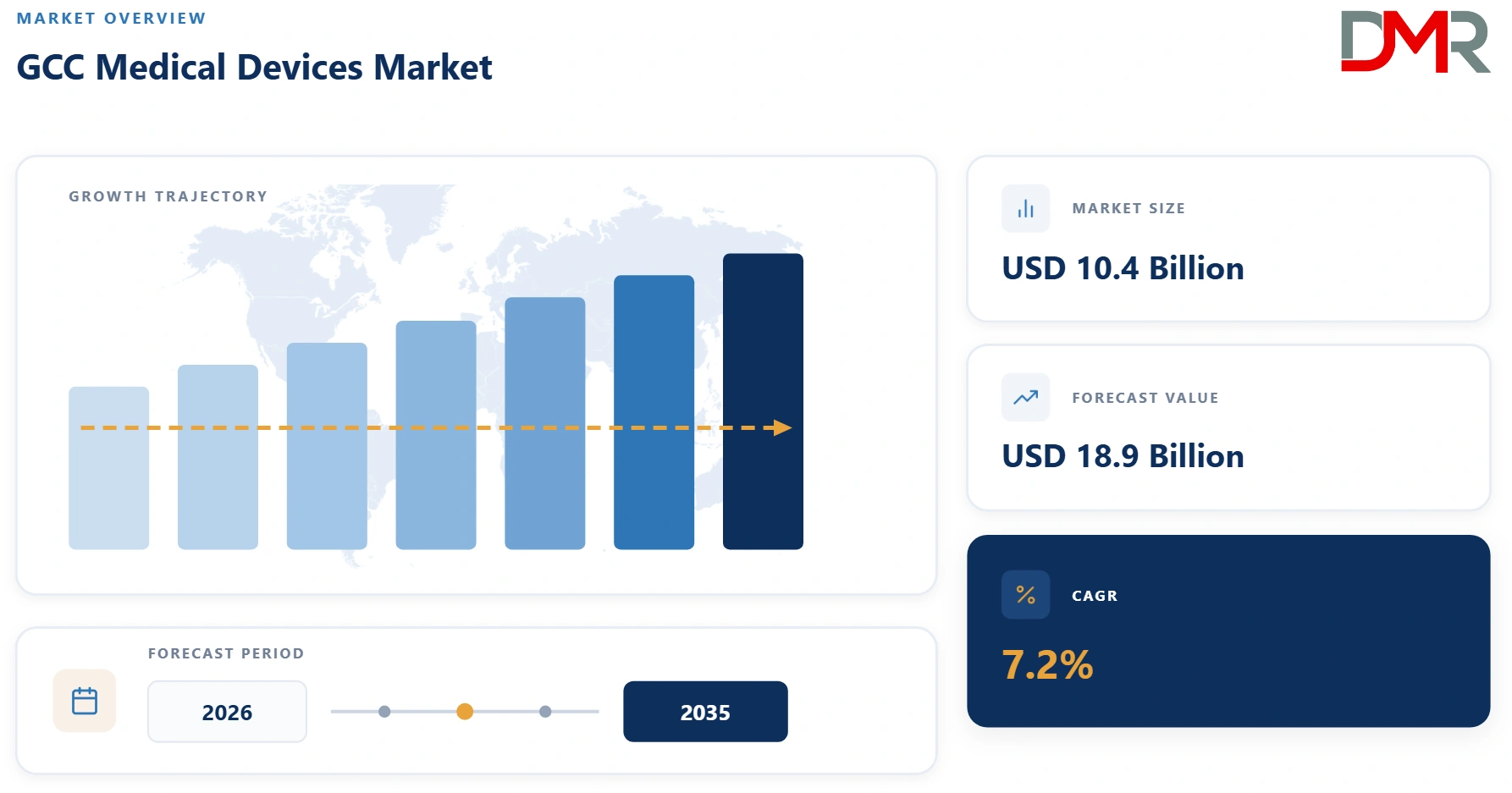
The GCC Medical Devices Market is projected to be valued at USD 10.4 Billion in 2026 and is projected to reach USD 18.9 Billion by 2035, expanding at a CAGR of 6.86% during the forecast period.
ℹ
To learn more about this report –
Download Your Free Sample Report Here
Growth is being propelled by large-scale hospital capacity expansion under Saudi Arabia's Vision 2030 and comparable national health strategies across the UAE, Qatar, and Oman, the rising regional burden of chronic and cardiovascular disease driving demand for diagnostic and interventional devices, and growing government investment in centralized procurement and domestic device registration frameworks. The maturing of the region's healthcare systems toward preventive diagnostics, home-based chronic disease management, and digitally connected monitoring devices, combined with mutual recognition agreements that ease cross-border device registration among GCC regulators, is reshaping the market from hospital-centric capital equipment purchasing toward a broader, multi-channel device ecosystem. Investment is accelerating as global device majors expand regional distribution and local assembly partnerships to meet rising procurement volumes tied to new hospital and diagnostic capacity.
Use Cases
- Hospital Capacity Expansion Procurement: Ministries of health and private hospital groups procure diagnostic imaging, ICU monitoring, and operating room equipment at scale to support new hospital beds under national Vision programs.
- Chronic Disease and Cardiovascular Care Management: The region's high cardiovascular disease burden drives demand for stents, pacemakers, and interventional cardiology devices across public and private cardiac care networks.
- Home Healthcare and Remote Monitoring: Aging populations and a shift toward patient-centered care are driving adoption of home monitoring equipment, mobility aids, and connected wearable devices for chronic disease management outside hospital settings.
- Centralized Public Procurement Programs: National procurement bodies such as NUPCO in Saudi Arabia manage large-scale tenders for MOH hospital networks, while private hospitals in the UAE tender independently, creating distinct channel dynamics across the region.
Key Takeaways
- Market Size: The GCC Medical Devices Market is anticipated to be valued at USD 10.4 Billion in 2026 and is forecast to reach USD 18.9 Billion by 2035, expanding at a CAGR of 6.86%.
- Growth Outlook: Market expansion is sustained by continued hospital and diagnostic capacity expansion, rising chronic disease prevalence, and growing government investment in digital health and home healthcare infrastructure across the region.
- Primary Growth Drivers: Vision 2030 aligned healthcare infrastructure investment, rising cardiovascular and chronic disease burden, expanding diagnostic imaging capacity, and growing regulatory harmonization across GCC states are accelerating market growth.
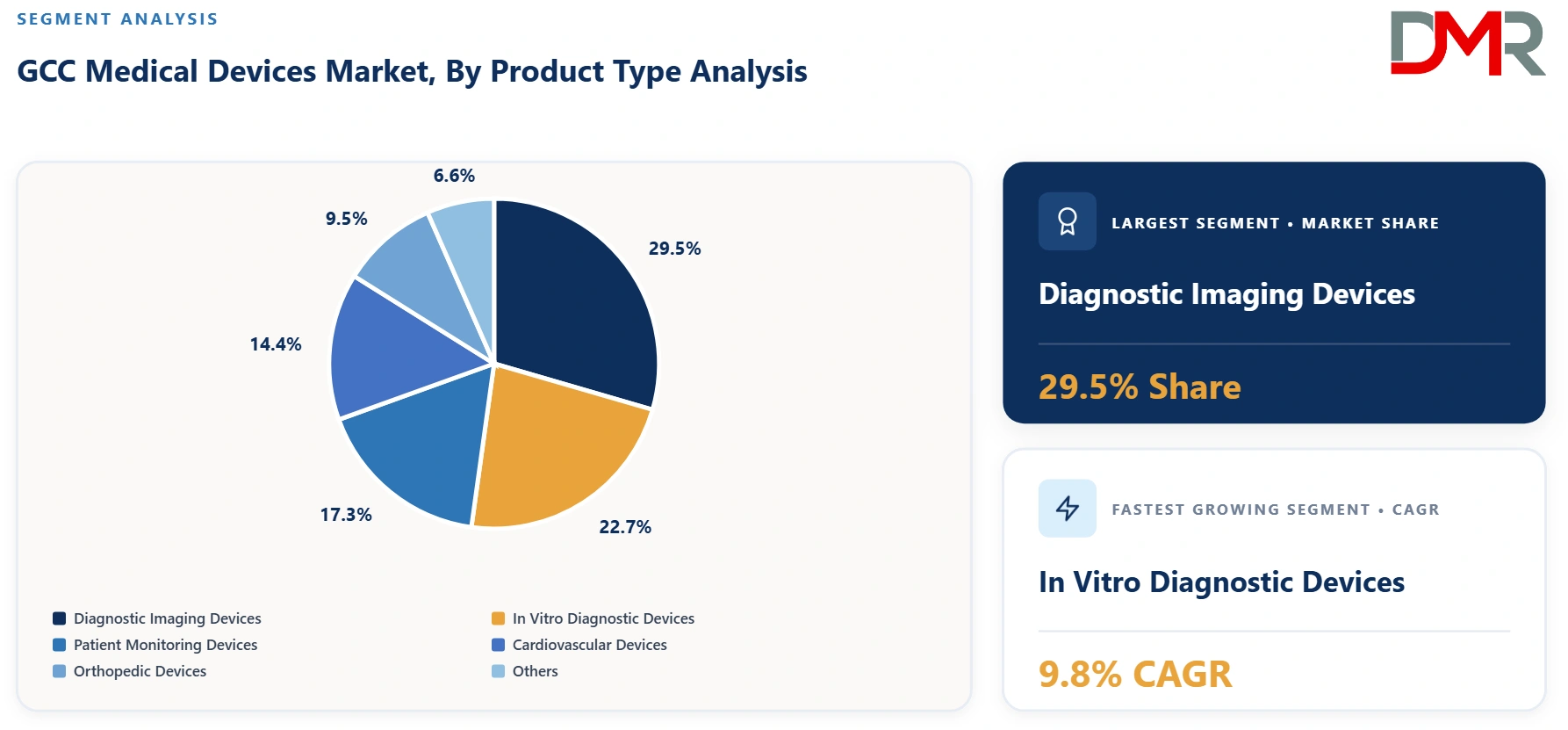
- By Product Type Analysis: Diagnostic Imaging Devices is projected to lead the segment with a 29.5% share in 2026, reflecting large-scale radiology capacity expansion across the region. In Vitro Diagnostic Devices is the fastest-growing product type at 9.8% CAGR, driven by rising demand for molecular diagnostics and early disease detection.
- By End User Analysis: Hospitals are expected to command a 58.7% share in 2026, reflecting the concentration of procurement within MOH and private hospital networks. Home Healthcare Settings is the fastest-growing end user segment at 10.4% CAGR, driven by rising demand for patient-centered, home-based chronic disease management.
- By Distribution Channel Analysis: Direct Tenders are expected to lead with a 64.2% share in 2026, reflecting the dominance of centralized public procurement bodies such as NUPCO. Online Retail is the fastest-growing distribution channel at 11.6% CAGR, driven by rising adoption of connected consumer and home healthcare devices.
Key Drivers in the GCC Medical Devices Market
Vision 2030 Aligned Healthcare Infrastructure Expansion Across Saudi Arabia and the UAE
Large-scale national health strategies, most notably Saudi Arabia's Vision 2030 program targeting over 30,000 additional hospital beds, are driving sustained procurement of diagnostic imaging, operating room, and ICU monitoring equipment. Comparable infrastructure investment in the UAE, Qatar, and Oman is reinforcing regional demand for capital medical equipment. As MOH and NGHA facilities expand alongside major private hospital groups, structural procurement volume for both capital equipment and consumables is expected to persist across the forecast period.
Rising Prevalence of Chronic Diseases and Growing Diagnostic Imaging Capacity
The GCC's high and rising burden of cardiovascular disease and diabetes is driving demand for interventional cardiology devices, stents, pacemakers, and continuous monitoring equipment. Growing radiology capacity expansion, including MRI, CT, and ultrasound systems, is being reinforced by rising demand for early disease detection and preventive healthcare. As chronic disease prevalence continues to climb across the region's population, sustained reliance on diagnostic and therapeutic device procurement is expected to continue.
Restraints in the GCC Medical Devices Market
Centralized Procurement Cycles and Registration Complexity Across National Regulators
Fragmented national regulatory frameworks across SFDA, MOHAP, DHA, DOH, NHRA, and Oman's MOH create registration complexity for manufacturers seeking pan-GCC market access. Centralized procurement cycles managed by bodies such as NUPCO can involve lengthy tender processes and volume commitments that are difficult for smaller device manufacturers to meet. These dynamics can delay market entry timelines, limit supplier diversity, and concentrate procurement among a small number of large, established device manufacturers.
Growth Opportunities in the GCC Medical Devices Market
Home Healthcare and Remote Patient Monitoring Device Adoption
Growing demand for home-based chronic disease management represents an attractive opportunity as the region's home healthcare market is projected to expand meaningfully through 2031. Manufacturers developing connected monitoring equipment, mobility aids, and remote diagnostic tools tailored to home use are well positioned to capture this underserved and rapidly growing segment as regional reimbursement frameworks evolve to support home-based care.
Localization of Medical Device Manufacturing Under National Industrial Strategies
Government-backed industrial diversification strategies are creating opportunities for manufacturers willing to establish local assembly and manufacturing partnerships within the region. Companies that localize production of consumables and mid-complexity devices can benefit from preferential procurement treatment under national content requirements while reducing exposure to import and currency-related cost pressures.
Trends in the GCC Medical Devices Market
Expansion of Digital Health and Connected Wearable Devices
The GCC Medical Devices Market is experiencing rising integration of digital health technologies, including telemedicine platforms, mobile health applications, and connected wearable devices. Saudi Arabia's Vision 2030 digital health agenda is accelerating adoption of AI-enabled diagnostic and monitoring tools, while robotic-assisted surgery is gaining traction at leading tertiary centers, reshaping the competitive landscape toward technology-integrated device offerings.
Mutual Recognition Agreements Streamlining Cross Border Device Registration
Regional regulators are increasingly adopting mutual recognition frameworks, such as Bahrain's NHRA accepting devices already cleared by SFDA or MOHAP, to simplify cross-border registration. This regulatory harmonization trend is expected to reduce time-to-market for manufacturers seeking pan-GCC distribution and encourage greater device availability across smaller markets including Kuwait, Oman, and Bahrain.
Research Scope and Analysis
The GCC Medical Devices Market is segmented by product type, end user, country, and distribution channel, covering diagnostic imaging, in vitro diagnostics, patient monitoring, cardiovascular and orthopedic devices, and demand across hospitals, diagnostic centers, ambulatory surgical centers, and home healthcare settings in Saudi Arabia, the UAE, Qatar, Kuwait, Oman, and Bahrain.
ℹ
To learn more about this report –
Download Your Free Sample Report Here
By Product Type Analysis
Diagnostic Imaging Devices are projected to dominate the GCC Medical Devices Market with a 29.5% share in 2026, supported by substantial investments in radiology infrastructure, hospital expansion, and diagnostic capabilities across GCC countries, particularly Saudi Arabia and the UAE. Growing installation of MRI, CT, ultrasound, and digital X-ray systems is strengthening segment demand. Meanwhile, In Vitro Diagnostic Devices are expected to register the highest CAGR of 9.8% during 2026-2035. Growth is driven by increasing adoption of molecular diagnostics, point-of-care testing, preventive health screening, and early disease detection, alongside rising prevalence of chronic and infectious diseases across the region.
By End User Analysis
Hospitals are anticipated to dominate the GCC Medical Devices Market by end user, accounting for a 58.7% share in 2026. Their leadership reflects the concentration of medical device procurement within large public and private hospital networks, ongoing development of specialty hospitals, and government investment in healthcare infrastructure. Hospitals remain major purchasers of diagnostic imaging, surgical, monitoring, and life-support equipment. Meanwhile, Home Healthcare Settings are projected to register the fastest CAGR of 10.4% from 2026 to 2035. Growth is supported by an aging population, increasing chronic disease burden, connected monitoring technologies, and growing preference for convenient, patient-centered home-based treatment and rehabilitation.
By Distribution Channel Analysis
Direct Tenders are expected to dominate the GCC Medical Devices Market by distribution channel, accounting for a 64.2% share in 2026. This position is supported by centralized procurement systems used by ministries of health, government hospitals, and large healthcare networks to purchase medical equipment in significant volumes. Tender-based procurement also enables standardized product selection and competitive pricing. In comparison, Online Retail is projected to record the fastest CAGR of 11.6% during 2026-2035. Expansion is driven by growing e-commerce penetration, digital healthcare adoption, and consumer demand for home-use diagnostic, monitoring, rehabilitation, and connected healthcare devices across GCC countries.
The GCC Medical Devices Market Report is segmented based on the following:
By Product Type
- Diagnostic Imaging Devices
- Magnetic Resonance Imaging Systems
- Computed Tomography Systems
- Ultrasound Imaging Systems
- X-Ray Systems
- In Vitro Diagnostic Devices
- Patient Monitoring Devices
- Cardiovascular Devices
- Stents
- Pacemakers
- Heart Valves
- Interventional Cardiology Devices
- Orthopedic Devices
- Others
By End User
- Hospitals
- Diagnostic Centers
- Ambulatory Surgical Centers
- Home Healthcare Settings
By Distribution Channel
- Direct Tenders
- Third-Party Distributors
- Online Retail
Country Analysis
Saudi Arabia is expected to dominate the GCC Medical Devices Market, supported by substantial government healthcare spending, Vision 2030 initiatives, hospital expansion, localization of medical technology, and increasing adoption of advanced diagnostic and surgical equipment. The United Arab Emirates represents another major market, driven by private healthcare investment, medical tourism, digital health adoption, and sophisticated hospital infrastructure. Qatar and Kuwait are witnessing steady demand through modernization of healthcare facilities and investment in specialized treatment capabilities. Meanwhile, Oman and Bahrain are expanding healthcare accessibility and upgrading public and private medical facilities, supporting demand for diagnostic imaging, patient monitoring, cardiovascular, and home healthcare devices. Across the GCC, aging populations, chronic disease prevalence, preventive healthcare programs, and increasing adoption of connected medical technologies are expected to sustain market expansion through 2035.
By Country
- Saudi Arabia
- United Arab Emirates
- Qatar
- Kuwait
- Oman
- Bahrain
Technology Analysis
Technology investment is increasingly central to competitiveness in the GCC Medical Devices Market as hospital networks adopt AI-enabled diagnostic imaging, robotic-assisted surgical systems, and connected patient monitoring platforms. Leading tertiary centers, including KFSH&RC and regional Cleveland Clinic partnerships, are accelerating adoption of robotic-assisted surgery. Growing use of digital health platforms and wearable monitoring devices is extending real-time patient data visibility to both providers and patients. However, high capital costs and integration complexity across legacy hospital IT systems remain adoption barriers for smaller regional facilities.
Investment and White Space Analysis
Investment opportunities in the GCC Medical Devices Market are expanding as national Vision programs continue driving hospital and diagnostic capacity investment and as chronic disease prevalence sustains structural device demand. Significant white space exists in home healthcare and remote monitoring devices, localized manufacturing of consumables and mid-complexity devices, and connected wearable technology aligned with national digital health agendas. However, centralized procurement cycles, multi-regulator registration complexity, and reimbursement policy variation across GCC states can pressure margins and limit near-term scalability for smaller manufacturers.
Competitive Landscape
The GCC Medical Devices Market is moderately consolidated, comprising large multinational device manufacturers, regional distribution partners, and a growing base of local assembly and service providers. Competition centers on regulatory registration breadth across SFDA, MOHAP, and other national authorities, tender responsiveness, product portfolio depth across imaging and interventional categories, and after-sales service capability. Multinational manufacturers benefit from established tender relationships with NUPCO and MOH networks, while regional distributors compete on local market access, servicing infrastructure, and relationship depth with private hospital groups.
Some of the prominent players in the GCC Medical Devices Market are:
- Medtronic plc
- Johnson & Johnson MedTech
- Siemens Healthineers AG
- GE HealthCare Technologies Inc.
- Koninklijke Philips N.V.
- Abbott Laboratories
- Boston Scientific Corporation
- Stryker Corporation
- Becton, Dickinson and Company
- F. Hoffmann-La Roche Ltd.
- Baxter International Inc.
- B. Braun SE
- Fresenius Medical Care AG
- Zimmer Biomet Holdings, Inc.
- Smith+Nephew plc
- Terumo Corporation
- Olympus Corporation
- FUJIFILM Corporation
- Canon Medical Systems Corporation
- Mindray Medical International Limited
- Intuitive Surgical, Inc.
- Edwards Lifesciences Corporation
- Cardinal Health, Inc.
- Hologic, Inc.
- Getinge AB
- Coloplast A/S
- BIOTRONIK SE & Co. KG
- Drägerwerk AG & Co. KGaA
- Nipro Corporation
- Sysmex Corporation
- bioMérieux SA
- Masimo Corporation
- ResMed Inc.
- Al Faisaliah Medical Systems
- Zahrawi Group
- Al-Jeel Medical & Trading Co.
- Gulf Drug LLC
- Tamer Group
- Arabian Medical Products Manufacturing Company (ENAYAH)
- Jamjoom Medical Industries Co. Ltd.
- Other Key Players
Recent Developments
- June 2026: Philips signed a multi-year strategic technology partnership with Aster Procare Hospital in Al Khobar, Saudi Arabia. The first phase includes deployment of Philips' image-guided therapy solutions, followed by integrated diagnostic imaging technologies.
- May 2026: Johnson & Johnson announced a collaboration with the Department of Health – Abu Dhabi, UAE, to establish Abu Dhabi as the first node of a global intelligent operating-room network. The initiative uses the Polyphonic platform to support AI-driven surgical innovation and connected operating rooms.
- March 2026: Siemens Healthineers Saudi Arabia was awarded a SAR 10.09 million contract by Naba Alsaha Medical Services for the supply, installation, and operation of medical equipment at its Riyadh hospital project. Equipment includes a CT scanner, cardiac catheterization system, and C-arm system.
Report Details
| Report Characteristics |
| Market Size (2026) |
USD 10.4 Bn |
| Forecast Value (2035) |
USD 18.9 Bn |
| CAGR (2026–2035) |
6.86% |
| Historical Data |
2021 – 2025 |
| Forecast Data |
2026 – 2035 |
| Base Year |
2025 |
| Segments Covered |
Product Type, By End User, By Distribution Channel |
| Country Coverage |
Saudi Arabia, United Arab Emirates, Qatar, Kuwait, Oman, Bahrain |
Frequently Asked Questions
How big is the GCC Medical Devices Market?
▾ The GCC Medical Devices Market is valued at USD 10.4 Billion in 2026 and is projected to reach USD 18.9 Billion by 2035, reflecting sustained demand from hospital capacity expansion, chronic disease management, and growing home healthcare adoption across the region.
What is the CAGR of the GCC Medical Devices Market from 2026 to 2035?
▾ The market is projected to expand at a compound annual growth rate (CAGR) of 7.2% between 2026 and 2035, supported by Vision 2030 aligned infrastructure investment, rising chronic disease prevalence, and growing diagnostic imaging capacity.
What factors are driving the growth of the GCC Medical Devices Market?
▾ Growth is driven by large-scale hospital and diagnostic capacity expansion, rising cardiovascular and chronic disease burden, growing regulatory harmonization across GCC states, and increasing adoption of digital health and home healthcare devices.
What are the major trends in the GCC Medical Devices Market?
▾ Major trends include expansion of digital health and connected wearable devices, growing adoption of robotic-assisted surgery at leading tertiary centers, and mutual recognition agreements streamlining cross-border device registration across the region.
Who are the key players in the GCC Medical Devices Market?
▾ Key market participants include Medtronic plc, Abbott Laboratories, Boston Scientific Corporation, Siemens Healthineers, and GE HealthCare, among other multinational and regional device manufacturers and distributors.
How is the GCC Medical Devices Market segmented?
▾ The market is segmented by product type, end user, country, and distribution channel, with demand analysis concentrated across Saudi Arabia, the United Arab Emirates, Qatar, Kuwait, Oman, and Bahrain.