Market Overview
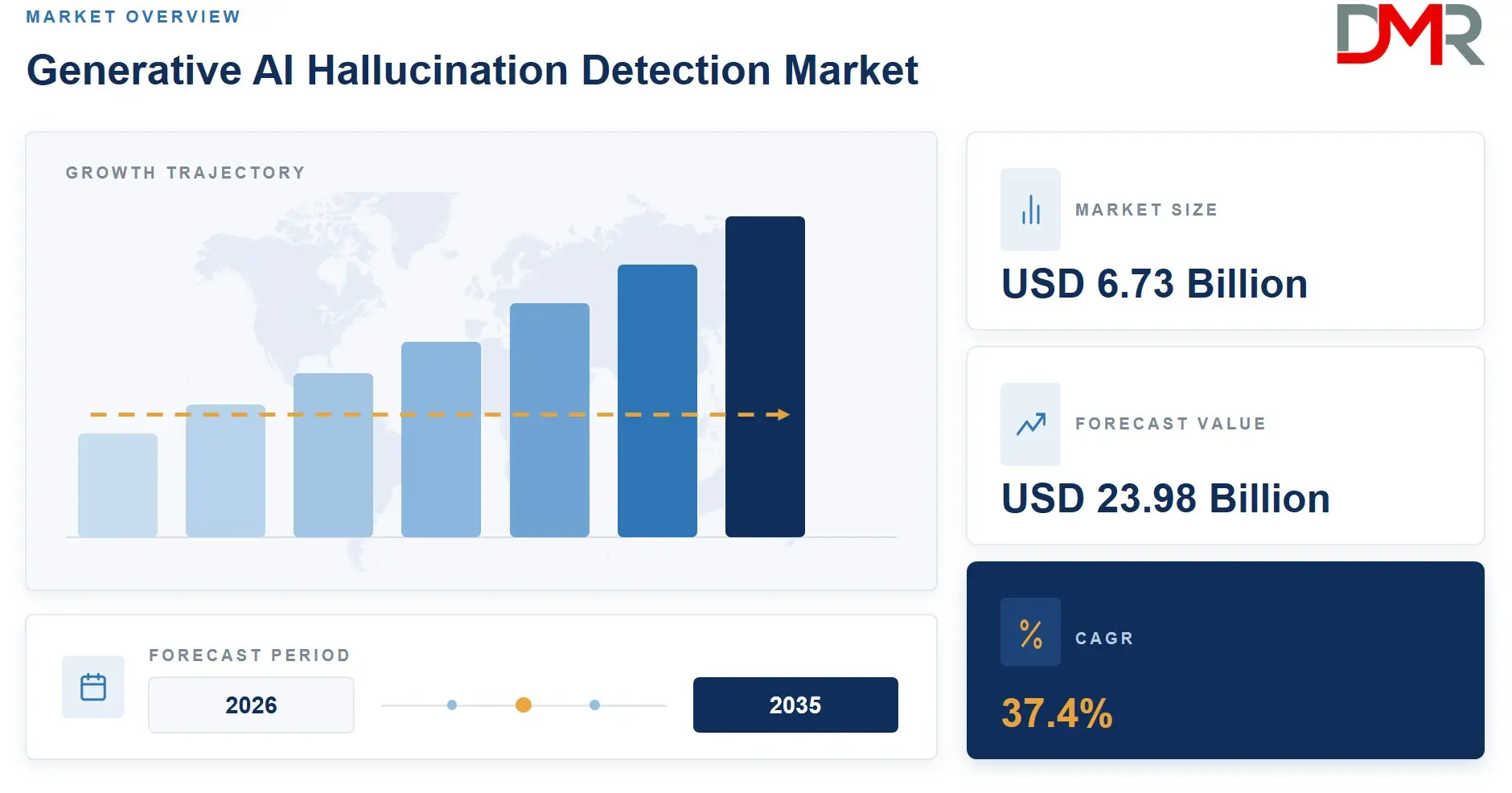
The Global Generative AI Hallucination Detection Market size is estimated at USD 6.73 Billion in 2026, and is projected to reach USD 23.98 Billion by 2035, exhibiting a CAGR of 37.4% during the forecast period.
Enterprise buyers accelerated deployment of Generative AI across production workflows between 2020 and 2024, exposing a structural weakness: foundation models produce plausible but factually incorrect outputs at rates that regulated industries cannot absorb. Output verification moved from a research concern to a procurement priority. The HalluMix benchmark evaluated 7 detection systems across approximately 6,500 balanced data points spanning natural-language inference, question answering, and summarization, as reported by arxiv 2505.00506, confirming that no single detector dominates across all task types. That performance variance is driving buyers to treat hallucination detection as a platform-level investment rather than a point solution.
A separate 2025 study applied the Finch-Zk framework to Llama 4 Maverick on GPQA-diamond benchmarks and raised answer accuracy from 68.2% to 76.8%, as published in arxiv 2508.14314. The same framework moved full-response accuracy under its own judge from 63.1% to 92.4%. Buyers can now quantify the accuracy lift from deploying detection infrastructure, which converts a compliance cost into a measurable performance improvement. That shift in buyer framing is a structural accelerant for the forecast period.
The market covers software platforms, APIs, and services that detect, score, and flag factually inconsistent outputs from large language models and Anomaly Detection-adjacent systems in enterprise AI pipelines. Adjacent markets include AI observability, model evaluation, and responsible AI governance. Retrieval-Augmented Generation architectures created the primary commercial opportunity by separating the retrieval layer from the generation layer, making grounding verification tractable as an independent function.
ℹ
To learn more about this report –
Download Your Free Sample Report Here
Key Takeaways
- The market size is USD 6.73 Billion in 2026, and is projected to hit USD 23.98 Billion by 2035 at a CAGR of 37.4%.
- By Component: Software Platforms led with a 71.9% share in 2025.
- By Detection Technique: Groundedness & Factual Consistency Detection led with a 38.4% share in 2025.
- By Deployment: Cloud-Based led with a 74.3% share in 2025.
- By Model/Application Environment: Retrieval-Augmented Generation (RAG) led with a 41.6% share in 2025.
- By Application: RAG Response Validation led with a 34.8% share in 2025.
- By Organization Size: Large Enterprises led with a 69.1% share in 2025.
- By End-Use Industry: IT & Telecom led with a 28.9% share in 2025.
- By Region: North America led with a 44.1% share, valued at USD 2.97 Billion, in 2025.
- Top 5 key players: Galileo, Patronus AI, Arize AI, Vectara, NVIDIA Corporation.
Component Analysis
Software Platforms accounted for 71.9% of Component demand in 2025, ahead of all rival categories.
Enterprise buyers treat hallucination detection as infrastructure, not a services engagement. A 71.9% software share reflects a deliberate procurement pattern: buyers want platform-level integration with their LLM orchestration stacks, not manual audit workflows. Vendors offering SDK-level detection layers and pre-built connectors to popular frameworks captured the bulk of commercial commitments.
Services commands the remaining segment and concentrates in regulated verticals where legal, healthcare, and financial buyers require custom model fine-tuning and compliance documentation that off-the-shelf platforms do not supply. Demand for bespoke hallucination evaluation services rose in parallel with regulatory scrutiny, but the long-term vector favors software as detection APIs commoditize the integration layer.
Detection Technique Analysis
Groundedness & Factual Consistency Detection led the Detection Technique segment with a 38.4% share in 2025.
RAG pipelines made retrieval grounding the dominant use case, and Groundedness & Factual Consistency Detection captured 38.4% of technique-level spend as a direct result. Detector performance across domain types varied significantly. Research published by arxiv 2505.00506 shows Patronus Lynx-8B achieved 91.1% accuracy on PubMed summarization tasks, versus 62.9% for Quotient Detections and 58.2% for Bespoke MiniCheck-7B on the same task. Domain specificity of detection architecture now dictates accuracy more than model size.
HalluMix summarization inputs averaged 439 document tokens and 174 response tokens, compared with 88 document tokens and 11 response tokens for natural-language-inference examples, as reported by arxiv 2505.00506. Longer document contexts produce harder grounding verification tasks, which explains why enterprise buyers in document-intensive workflows pay premium prices for specialized detectors. Semantic Consistency Detection and Retrieval/Source Verification are the next-fastest-growing techniques, each gaining ground as multimodal use cases and agent-based workflows demand richer verification logic than groundedness-only approaches provide. LLM-as-a-Judge and Ensemble approaches are gaining share among buyers who prioritize accuracy over latency constraints.
Deployment Analysis
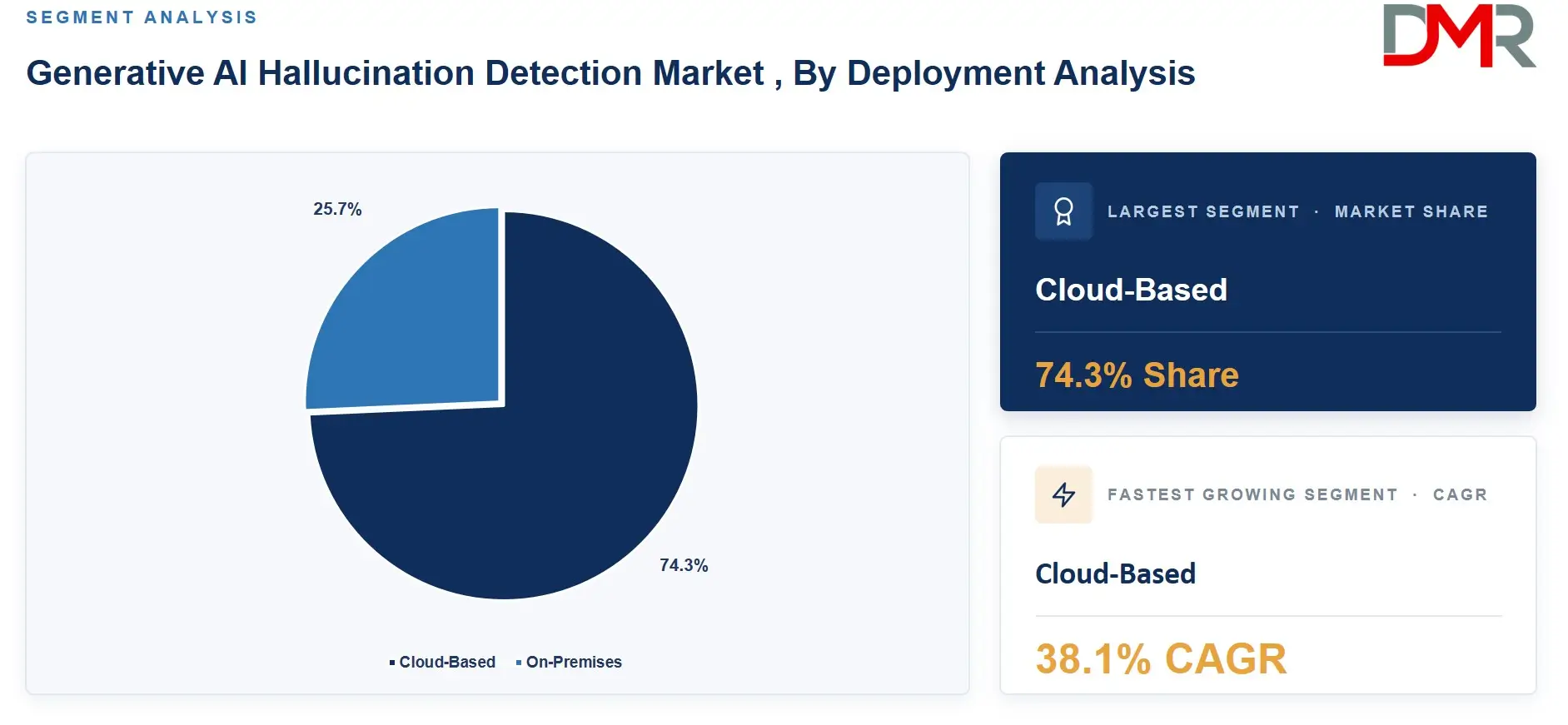
With a 74.3% share in 2025, Cloud-Based outpaced all other Deployment categories.
Cloud delivery removes the integration burden that has historically slowed enterprise AI tooling adoption. A 74.3% cloud share confirms that buyers chose speed of deployment over data residency control in the initial market formation phase. Cloud-based detection also scales with inference volume without capital expenditure, which aligns with how enterprises buy AI infrastructure generally.
ℹ
To learn more about this report –
Download Your Free Sample Report Here
On-Premises deployments concentrate in financial services, defense, and healthcare buyers who cannot route proprietary data through external APIs under their data governance policies. Cloud-Based is simultaneously the dominant and fastest-growing deployment model, a combination that signals the restraint from on-premises preferences has not yet materialized into meaningful share capture for local deployments.
Model/Application Environment Analysis
Retrieval-Augmented Generation (RAG) captured 41.6% of the Model/Application Environment segment in 2025, ahead of all rivals.
RAG became the default enterprise LLM pattern precisely because it grounds generation in retrieved documents, making hallucination detectable by comparing output against a defined source. A 41.6% share for RAG environments reflects that buyers deployed detection infrastructure where the grounding mechanism already existed. Large Language Model and Enterprise Generative AI Application environments represent the next tier of detection demand, driven by customer-facing deployments where output errors carry brand and legal consequences.
AI Agents & Agentic Systems holds the smallest current share but is the fastest-growing environment category. The AgentHallu 2026 study evaluated 13 leading models across 693 multi-step agent trajectories spanning 7 agent frameworks, 5 domains, 5 hallucination categories, and 14 subcategories, as published in arxiv 2601.06818. Agentic hallucination is qualitatively harder to catch than single-turn errors because errors compound across reasoning steps. Vendors who solve multi-step agent verification will define the next competitive frontier. Multimodal Generative AI rounds out the environment mix, with image-caption and chart-interpretation validation representing an emerging but commercially underpenetrated opportunity.
Application Analysis
RAG Response Validation led the Application segment as the largest category in 2025.
RAG Response Validation dominates because the RAG architecture creates an explicit retrieval artifact against which generation can be compared, making automated validation technically feasible at scale. A 34.8% application share confirms that buyers deployed detection tools earliest where verification was structurally easiest. Generative AI in Financial Services buyers concentrated early adoption in RAG Response Validation and Document Summarization, two applications where factual errors carry direct regulatory and liability exposure.
Conversational AI & Chatbots and Enterprise Search are the next-largest application categories, both scaling with the volume of customer-facing AI deployments. AI Agent Validation is the fastest-growing application as enterprises move from assistant AI to autonomous agent workflows. Content Generation, Code Generation & Copilots, and Decision Support Systems occupy the long tail of current spend but represent significant future demand as AI-generated artifacts become auditable outputs in regulated procurement and legal workflows.
Organization Size Analysis
Large Enterprises led the Organization Size segment with a 69.1% share in 2025.
Large enterprises had the budget, the board-level AI risk mandates, and the existing legal exposure to justify hallucination detection spend ahead of smaller peers. A 69.1% share reflects a procurement pattern common in early enterprise software cycles: large buyers adopt first, mid-market and SME buyers follow once pricing structures shift downward. The concentration in large enterprises also reflects that only organizations with active compliance functions could translate EU AI Act requirements into funded detection infrastructure projects.
Small & Medium Enterprises face a cost-per-detection barrier that cloud APIs are beginning to erode. Detection-as-a-Service models will be the primary mechanism by which the SME segment grows its share over the forecast period, without requiring internal ML engineering capacity.
End-Use Industry Analysis
IT & Telecom accounted for 28.9% of End-Use Industry demand in 2025, the highest of any category.
IT & Telecom buyers both build and consume AI products at scale, creating a dual demand profile. A 28.9% share reflects that technology organizations were the first to operationalize hallucination detection as part of their AI development pipelines. BFSI ranks second, driven by financial services compliance requirements that make factual output errors a regulatory event rather than a product defect. Healthcare & Life Sciences commands significant share given patient safety stakes in clinical AI applications.
Legal & Professional Services, Retail & E-commerce, and Government & Public Sector represent the next tier of vertical adoption. Governments deploying AI for citizen services face public accountability pressures that push hallucination detection onto procurement checklists. Media & Entertainment, Education, and Manufacturing are earlier-stage adopters where the case for detection infrastructure is still being built at the line-of-business level.
Key Market Segments
By Component
- Software Platforms
- Services
By Detection Technique
- Groundedness & Factual Consistency Detection
- Semantic Consistency Detection
- Retrieval/Source Verification
- LLM-as-a-Judge Evaluation
- Knowledge Graph-Based Validation
- Ensemble & Cross-Model Verification
By Deployment
By Model/Application Environment
- Retrieval-Augmented Generation (RAG)
- Large Language Models
- Enterprise Generative AI Applications
- AI Agents & Agentic Systems
- Multimodal Generative AI
By Application
- RAG Response Validation
- Conversational AI & Chatbots
- Enterprise Search
- AI Agent Validation
- Content Generation
- Document Summarization
- Code Generation & Copilots
- Decision Support Systems
By Organization Size
- Large Enterprises
- Small & Medium Enterprises
By End-Use Industry
- IT & Telecom
- BFSI
- Healthcare & Life Sciences
- Retail & E-commerce
- Legal & Professional Services
- Government & Public Sector
- Media & Entertainment
- Education
- Manufacturing
- Other Industries
Regional Analysis
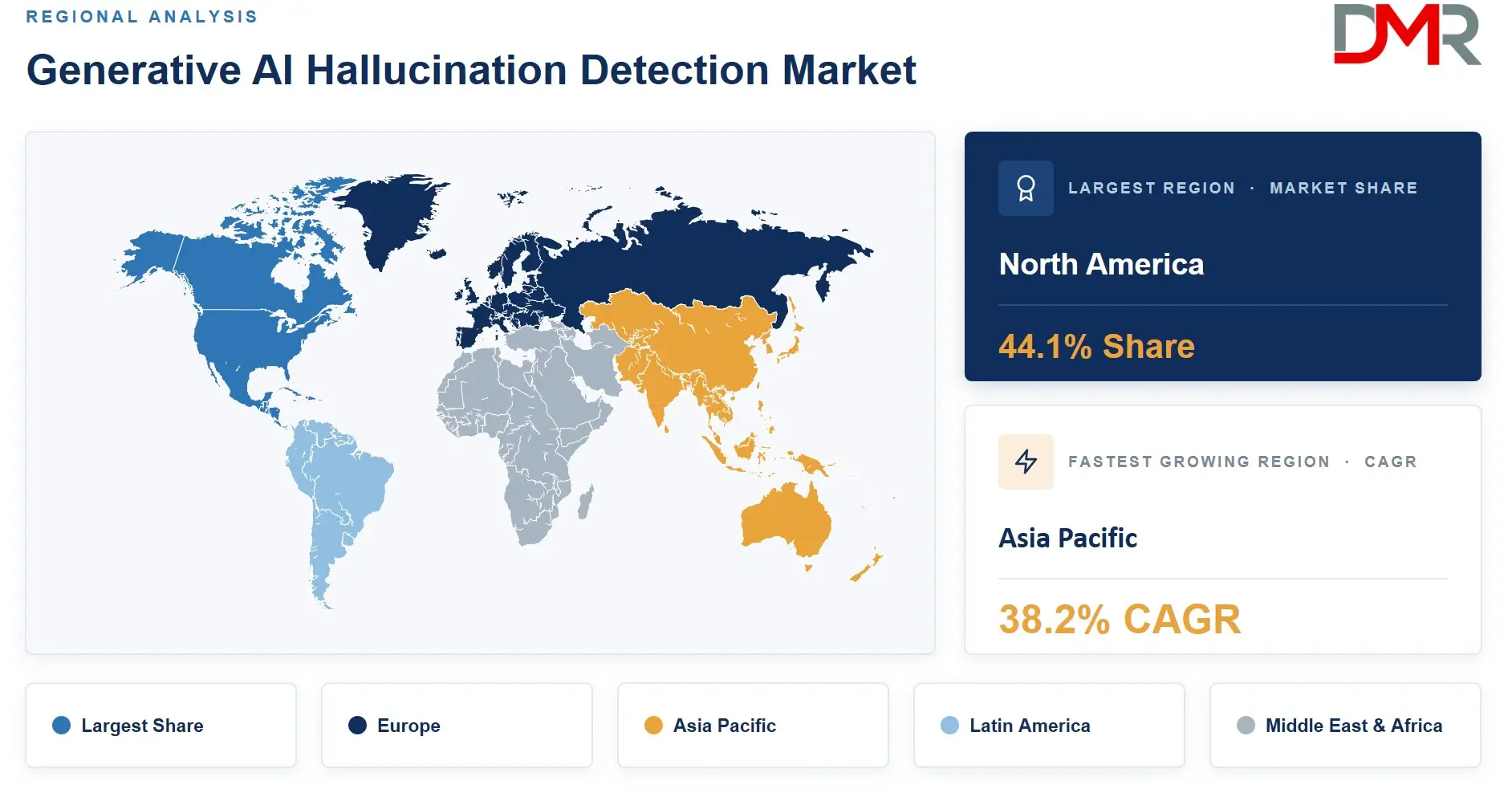
North America led the Generative AI Hallucination Detection Market with a 44.1% share, valued at USD 2.97 Billion, in 2025.
North America
North America's 44.1% share reflects the geographic concentration of both foundation model providers and the enterprise AI buyers deploying them at production scale. US-based cloud hyperscalers and LLM vendors built hallucination detection into their observability roadmaps earlier than any other region. Threat Detection Cybersecurity and AI output validation budgets frequently share the same enterprise risk function, which accelerated co-procurement of detection tools alongside security infrastructure. The regulatory environment, though less prescriptive than the EU, created board-level awareness of AI liability that translated into funded detection programs.
Research from HalluLens, published in acl 2025, confirms that GPT-4o achieved 84.89% Recall@32 and a 75.8% F1@32 score on LongWiki evaluations, with a false-refusal rate of 0.13%. North American enterprise buyers making procurement decisions based on published benchmark data will increasingly demand that detection vendors produce auditable benchmark results against standardized test suites, creating a compliance-adjacent procurement criterion.
Asia Pacific
Asia Pacific is the fastest-growing regional market. China, Japan, South Korea, and India each accelerated enterprise AI deployment through domestic policy support and local LLM development programs. The HalluLens 2025 study evaluated 13 instruction-tuned models, generating 5,000 question-answer pairs from a pool of 44,754 Wikipedia pages and maintaining run-to-run standard deviation below 1.01%, as published in acl 2025. Multilingual hallucination detection capability is a prerequisite for Asia Pacific adoption, given the linguistic diversity of enterprise AI deployments across the region.
ℹ
To learn more about this report –
Download Your Free Sample Report Here
Europe
Europe's demand profile is shaped by the EU AI Act, which classifies several enterprise AI use cases as high-risk systems requiring human oversight mechanisms. Hallucination detection functions as a compliance control layer for European enterprises deploying AI in healthcare, legal, and financial workflows. Germany and France lead in enterprise AI adoption within the region, with public sector procurement programs adding a second demand source beyond private enterprise.
Latin America
Latin America is an early-stage adopter. Brazil and Mexico anchor enterprise AI spend across the region, with financial services and retail sectors leading deployment. Cloud-based detection APIs will be the entry point for most Latin American buyers, as internal ML engineering capacity is limited outside major metropolitan technology hubs.
Middle East & Africa
GCC states are building AI-first government services programs that create public sector demand for output verification infrastructure. Saudi Arabia and UAE national AI strategies include responsible AI mandates that reference output validation. South Africa leads in private sector AI adoption within the African subregion, with financial services the primary vertical.
Key Regions and Countries
North America
Europe
- Germany
- France
- The UK
- Spain
- Italy
- Rest of Europe
Asia Pacific
- China
- Japan
- South Korea
- India
- Australia
- Rest of APAC
Latin America
- Brazil
- Mexico
- Rest of Latin America
Middle East & Africa
- GCC
- South Africa
- Rest of MEA
Macroeconomic Impact
Enterprise AI investment cycles are sensitive to credit conditions and IT budget cycles. Higher interest rates between 2023 and 2025 compressed discretionary software budgets, but hallucination detection avoided the worst of that pressure by attaching to compliance mandates rather than discretionary AI innovation spending. Buyers facing regulatory deadlines funded detection infrastructure even when broader AI spending decelerated.
The combined cost of Finch-Zk detection and mitigation across 10 samples reached 37.9 seconds and $0.3877 per response, which tracked closely against the 36.6 seconds required for ordinary response generation with extended thinking, as reported by arxiv 2508.14314. CFOs evaluating detection infrastructure now see a cost that approximates the inference cost itself, creating a practical ceiling for per-query pricing models and incentivizing batch processing architectures that reduce per-unit detection costs.
Market Dynamics
Driver: Regulated Industry Liability and Compliance Mandates Accelerate Detection Spend
Legal, medical, and financial enterprises face direct liability when AI outputs contain factual errors. Boards in regulated sectors now treat hallucination detection as a governance control, not a product feature. The EU AI Act's high-risk system requirements functionally mandate output verification infrastructure for enterprises deploying AI in healthcare diagnostics, credit decisioning, and legal document generation. Hallucination detection moved from the engineering backlog onto compliance roadmaps.
Detector performance benchmarks expose the stakes clearly. HalluMix research shows Ragas Faithfulness achieved the highest recall at 95.0% but with precision of only 71.9%, while Azure Groundedness produced 78.1% precision and 79.5% recall, as reported by arxiv 2505.00506. A high false-negative rate in a clinical or legal detection system is not a product gap. It is a liability event. Buyers in regulated sectors use precision-recall trade-offs as procurement filters, favoring detectors that minimize missed hallucinations over those that minimize false positives. The HalluLens study further found that Mistral-7B-Instruct accepted nonexistent entities at an 86.36% false-acceptance rate, compared with only 6.88% for Llama-3.1-405B-Instruct, as published in acl 2025, confirming that model selection itself is a risk management decision that detection infrastructure must account for.
Restraint: Latency Overhead and Absent Ground Truth Standards Limit Deployment Scale
Production LLM deployments operating at high throughput cannot absorb detection latency that doubles inference time. The Finch-Zk 10-sample configuration required 19.0 seconds per response and cost $0.3488, representing 1.7 times the baseline latency and 36.3 times the cost of an unverified response, as reported by arxiv 2508.14314. Customer-facing applications with sub-second response requirements cannot integrate such overhead without architectural re-design. Real-time inference pipelines are structurally incompatible with high-confidence detection at these cost and latency points.
The absence of a universal hallucination ground truth standard compounds the deployment problem. For 9 of 13 detectors analyzed in FaithBench, more than 70% of errors involved incorrectly classifying hallucinations as consistent, as published in acl 2025. MiniCheck-DeBERTa-large reduced this error category to 42%, but no single benchmark is accepted industry-wide. Enterprise procurement teams evaluating multiple vendors cannot make apples-to-apples comparisons, which extends sales cycles and keeps buyers on the sidelines.
Opportunity: Domain-Specific and Agentic Detection Open New Revenue Tiers
Generic detection systems fail at unacceptable rates on domain-specific corpora. The FaithBench evaluation shows RAGAS with GPT-4o produced 62.31% balanced accuracy at sample level and a 57.06% macro-F1 score, as published in acl 2025, performance that falls short of regulated industry tolerance. Vendors building domain-specific detection models fine-tuned on clinical, legal, and financial corpora will command premium pricing precisely because generic alternatives cannot meet accuracy requirements. In March 2025, Patronus AI launched an industry-first multimodal LLM-as-a-judge for image evaluation, expanding hallucination defense into vision models and validating the domain-extension thesis commercially.
Agentic hallucination detection is the larger structural opportunity. The AgentHallu 2026 study found that the best-evaluated model achieved only 41.1% accuracy in locating the hallucination-responsible step in multi-step agent trajectories, while accuracy for tool-use hallucinations was 11.6%, as published in arxiv 2601.06818. No current detection system adequately handles compound reasoning chains in autonomous agent workflows. Vendors who ship agentic verification will address a multi-billion-dollar gap that generic LLM detection products cannot fill. Generative Engine Optimization workflows that depend on accurate agent outputs are particularly exposed, creating a co-investment case for detection infrastructure alongside AI search deployments.
Porter's Five Forces
The hallucination detection market carries high competitive intensity with asymmetric barriers. New entrant threat is moderate: the research base is public, open-source detector models are freely available, and the API integration layer is not technically proprietary. Barriers come from benchmark credibility, enterprise procurement cycles, and the cost of domain-specific fine-tuning rather than from patents or infrastructure moats. Supplier power is low because model weights and compute are broadly available from hyperscalers with no exclusivity constraints. Buyer power is rising sharply as procurement teams gain sophistication. Buyers now evaluate detection systems on standardized benchmarks: Quotient Detections achieved 82.1% accuracy and an 84.0% F1 score on HalluMix across approximately 6,500 examples, as reported by arxiv 2505.00506, while FaithBench covered 750 challenging summaries from 75 passages generated by 10 LLMs across 8 model families and annotated by 11 human evaluators, as published in acl 2025. Published benchmark tables give buyers negotiating leverage and force vendors to disclose performance gaps. Natural Language Processing platforms with native quality evaluation features represent the primary substitute threat, as foundation model providers embed uncertainty quantification and citation grounding natively, partially commoditizing standalone detection products. Competitive rivalry is high among the 20+ vendors in the space, concentrated between specialized startups and hyperscaler-embedded solutions competing on accuracy, latency, and integration depth.
AI and Gen AI Impact
AI reshapes this market from both the supply and demand sides simultaneously. Foundation model providers embedding native uncertainty quantification into their APIs reduce the addressable market for standalone detectors at the commodity end, while simultaneously expanding the enterprise AI footprint that creates demand for specialized detection at the premium end. The net effect is segmentation: generic detection commoditizes, domain-specific and agentic detection commands price premiums. MiniCheck-DeBERTa-large demonstrated that sentence-level detection could reach 58.49% macro-F1 on the hardest FaithBench samples, the highest among evaluated sentence-level detectors, as published in acl 2025. Sentence-level granularity matters because it enables targeted correction rather than full-response rejection.
A 2026 SpeechLLM study found that attention-map detectors improved precision-recall AUC by as much as 0.23 over uncertainty-based and prior attention-based baselines, with approximately 100 attention heads sufficient for strong detection performance, as published in acl 2026. Attention-map methods enable hallucination detection without separate verification calls, reducing both latency and cost. Early movers deploying attention-based architectures will offer a product with a structurally lower cost floor than judge-based systems. Laggards relying purely on LLM-as-a-Judge pipelines risk being undercut on both accuracy and inference economics as attention-based approaches mature.
Market Trends
LLM Self-Evaluation and RAG Grounding Reshape Detection Architectures
Chain-of-thought verification techniques are being productized into commercial hallucination mitigation layers, moving detection from post-hoc audit to in-generation verification. The Finch-Zk framework achieved a sentence-level F1 of 49.2% and balanced accuracy of 69.8%, representing a 39.0% F1 improvement and a 15.0% balanced-accuracy improvement over a vanilla GPT-4 judge baseline, as published in arxiv 2508.14314. RAG architectures became the dominant enterprise LLM pattern, shifting detection focus from model-level evaluation to retrieval-grounding verification. Early movers embedding detection into the generation loop rather than layering it on top will operate at lower cost and with faster time-to-correction than competitors running separate evaluation calls. Small Language Model architectures are entering the detection stack as low-latency verifier components, challenging the assumption that high-accuracy detection requires full-size model inference.
Market Competition Overview
The market is fragmented, with 20+ active vendors split between specialized AI evaluation startups, cloud-native observability platforms, and hyperscaler-embedded detection features. No single vendor holds dominant share. Specialized startups compete on benchmark accuracy and domain-specific fine-tuning while cloud-native platforms compete on integration breadth and enterprise contracts. The Finch-Zk framework achieved 65.1% F1 and 74.0% balanced accuracy at response level, compared with 48.3% F1 and 63.8% balanced accuracy for the vanilla GPT-4 judge baseline, as published in arxiv 2508.14314. That 16.8 percentage-point F1 gap demonstrates that specialized detection methods materially outperform general-purpose baselines, which sustains the commercial case for dedicated vendors over generic alternatives.
Human evaluation data reinforces the competitive value of higher-quality corrected outputs. Independent annotators preferred Finch-Zk corrected responses in 84% of cases (42 of 50 questions), with corrected answers averaging 229 tokens versus 153 tokens for originals, as published in arxiv 2508.14314. Longer, more accurate responses command higher perceived value from end users, which gives vendors demonstrating output quality improvement a commercial narrative beyond raw detection accuracy scores. Foundation model providers embedding detection natively pose the primary long-term consolidation risk for standalone vendors.
Pricing Analysis
Pricing models split across two primary structures: per-query API pricing for cloud-based detection services and platform licensing for enterprise deployments with high inference volumes. The HHEM-based evaluation framework reduced hallucination-judgment time from approximately 8 hours to 10 minutes while achieving 67.2% true-positive rate, 86.6% true-negative rate, and 76.9% accuracy on QA tasks, as reported by arxiv 2512.22416. Speed-to-judgment improvements directly reduce per-query detection costs. Adding non-fabrication checking to HHEM increased QA detection accuracy to 82.2% and the true-positive rate to 78.9%, with judgment time of approximately 1 hour, as reported by arxiv 2512.22416. Buyers face a precision-speed trade-off that maps directly onto pricing tier design.
Cost compression is the active competitive lever. A lower-cost Finch-Zk configuration using 3 samples and batch judging required 24.5 seconds and $0.0780 per detection, cutting cost by approximately 77.6% versus the standard 10-sample configuration at $0.3488, as published in arxiv 2508.14314. Batch processing architectures enable vendors to offer enterprise volume tiers that undercut per-query pricing. Market leaders will build tiered pricing structures anchored to accuracy levels, with real-time detection commanding a premium over batch validation workflows.
Company Profiles
Galileo built its competitive position on real-time RAG pipeline observability, making hallucination scoring an embedded feature of enterprise AI development workflows rather than a separate evaluation tool. In May 2025, Cisco Systems acquired Galileo and integrated it into the Splunk Observability portfolio to protect enterprise RAG pipelines from hallucinations and data leaks. The acquisition gave Galileo distribution through Cisco's enterprise security and networking customer base, a channel that purpose-built AI evaluation startups cannot replicate organically. The strategic risk is product integration latency: absorbing a specialist platform into a large enterprise software suite risks diluting the detection-first roadmap that made Galileo attractive.
Patronus AI differentiated by investing in domain-specific evaluation models and multimodal detection capabilities ahead of competitors. Bespoke MiniCheck-7B recorded 80.8% accuracy and an 83.2% F1 score on HalluMix, while Patronus Lynx-8B matched that 80.8% accuracy and produced an 82.8% F1 score, as published by arxiv 2505.00506. Dual model performance across general and domain benchmarks gives Patronus AI a credible story for both horizontal platform buyers and vertical industry buyers simultaneously. June 2026 funding of $50 million Series B validates the investment thesis but raises execution expectations around agentic and multimodal detection product delivery.
Key Players
- Galileo
- Patronus AI
- Arize AI
- Vectara
- Fiddler AI
- NVIDIA Corporation
- Cleanlab
- Amazon Web Services (AWS)
- Microsoft Corporation
- Deepchecks
- Weights & Biases
- IBM Corporation
- Google LLC
- OpenAI
- DataRobot, Inc.
- TrustScale, Inc.
- LangSmith (LangChain, Inc.)
- Giskard AI
- Future AGI, Inc.
- Reality Defender, Inc.
Supply Chain and Value Chain Analysis
The value chain runs from foundation model training (upstream) through enterprise AI application development (midstream) to production deployment and monitoring (downstream). Maximum value creation concentrates in the midstream integration layer, where detection platforms embed into LLM orchestration frameworks and development pipelines. Raw material inputs are model weights, benchmark datasets, and compute infrastructure, all supplied by hyperscalers or open-source communities with no proprietary lock-in. The primary bottleneck is labeled evaluation data for domain-specific fine-tuning. Clinical, legal, and financial corpora with human-annotated hallucination labels are scarce, expensive to produce, and controlled by vertical industry incumbents. Vendors who secure proprietary labeled datasets in regulated domains create a durable competitive moat that pure-play algorithm vendors cannot cross without equivalent data investment.
Regulatory Landscape
The EU AI Act is the most consequential current regulatory driver for this market. High-risk AI system classifications under the Act require human oversight mechanisms and output verification as compliance conditions. Hallucination detection satisfies this requirement operationally, converting a regulatory obligation into a specific software procurement. US federal agencies issued AI governance executive orders between 2023 and 2025 that referenced output reliability, but without mandatory compliance timelines. The US regulatory posture creates voluntary demand rather than mandated procurement, producing a weaker pull on enterprise budgets than the EU framework.
Asia Pacific regulatory approaches diverge sharply by country. China's generative AI regulations require algorithmic transparency and content accuracy controls. Japan's AI governance framework favors self-regulation with government guidance. India's DPDP Act creates data handling requirements that affect how detection systems can process enterprise content. Regulatory divergence across Asia Pacific creates compliance complexity for global vendors and local market opportunity for region-native detection providers.
Investment and White Space Analysis
Investment is flowing toward agentic hallucination detection and multimodal verification, two segments where current commercial offerings are weakest relative to demand. The PROBE 2026 benchmark, covering 12,000 hallucination-detection test cases across 3 task types and 4 evaluation stages including claim decomposition, evidence finding, evidence evaluation, and hallucination localization, as published in acl 2026, maps the detection problem at a granularity that current commercial products do not yet address fully. Each evaluation stage represents a discrete product opportunity. Vendors targeting claim decomposition and hallucination localization as standalone capabilities will serve audit and compliance workflows that demand step-level accountability rather than binary pass/fail verdicts.
White space concentrates in three areas: domain-specific detection for healthcare and legal corpora, multimodal hallucination detection for image and video AI, and detection-as-a-service APIs targeting SME buyers who lack internal ML capacity. Asia Pacific multilingual detection is a geographic white space, given that most commercial detectors were built and benchmarked on English-language corpora. Vendors entering any of these white spaces face a low incumbent density, manageable capital requirements relative to foundation model development, and clear buyer demand from regulated industries facing compliance deadlines.
Recent Developments
- January 2026: Handshake AI acquired Cleanlab, a leader in data curation and LLM output reliability, to bake automated hallucination remediation and Trustworthy Language Model trust scoring into enterprise data pipelines.
- June 2026: Patronus AI secured a $50 million Series B funding round led by Greenfield Partners to expand its research organization and scale Digital World Models that stress-test AI agents against complex real-world workflows.
- November 2025: Vectara launched the next generation of its Hallucination Leaderboard, upgrading the benchmark with a dataset of over 7,700 real enterprise articles spanning finance, law, and medicine to evaluate factual consistency of modern LLMs.
- September 2025: Vectara released its HHEM-2.3 hallucination detection model via API, introducing multilingual support across 11 languages and a significantly expanded effective context window compared to its open-weights predecessors.
- December 2025: Cleanlab introduced specialized real-time error detection mechanisms designed to catch hallucinations and extraction failures in LLM Structured Outputs.
Report Scope
| Report Characteristics |
| Market Value (2026) |
USD 6.73 Billion |
| Forecast Revenue (2035) |
USD 23.98 Billion |
| CAGR (2026 to 2035) |
37.4% |
| Base Year for Estimation |
2025 |
| Historic Period |
2020 to 2024 |
| Forecast Period |
2026 to 2035 |
| Report Coverage |
Revenue Forecast, Market Dynamics, Competitive Landscape, Recent Developments |
| Segments Covered |
By Component (Software Platforms, Services), By Detection Technique (Groundedness & Factual Consistency Detection, Semantic Consistency Detection, Retrieval/Source Verification, LLM-as-a-Judge Evaluation, Knowledge Graph-Based Validation, Ensemble & Cross-Model Verification), By Deployment (Cloud-Based, On-Premises), By Model/Application Environment (RAG, LLMs, Enterprise Generative AI Applications, AI Agents & Agentic Systems, Multimodal Generative AI), By Application (RAG Response Validation, Conversational AI & Chatbots, Enterprise Search, AI Agent Validation, Content Generation, Document Summarization, Code Generation & Copilots, Decision Support Systems), By Organization Size (Large Enterprises, Small & Medium Enterprises), By End-Use Industry (IT & Telecom, BFSI, Healthcare & Life Sciences, Retail & E-commerce, Legal & Professional Services, Government & Public Sector, Media & Entertainment, Education, Manufacturing, Other Industries) |
| Regional Analysis |
North America (US and Canada), Europe (Germany, France, The UK, Spain, Italy, and Rest of Europe), Asia Pacific (China, Japan, South Korea, India, Australia, and Rest of APAC), Latin America (Brazil, Mexico, and Rest of Latin America), Middle East & Africa (GCC, South Africa, and Rest of MEA) |
| Competitive Landscape |
Galileo, Patronus AI, Arize AI, Vectara, Fiddler AI, NVIDIA Corporation, Cleanlab, Amazon Web Services (AWS), Microsoft Corporation, Deepchecks, Weights & Biases, IBM Corporation, Google LLC, OpenAI, DataRobot Inc., TrustScale Inc., LangSmith (LangChain Inc.), Giskard AI, Future AGI Inc., Reality Defender Inc. |
| Customization Scope |
Customization for segments and region or country level will be provided. Additional customization can be done based on requirements. |
| Purchase Options |
Three license options: Single User License, Multi-User License (Up to 5 Users), Corporate Use License (Unlimited Users and Printable PDF) |
Frequently Asked Questions
What is the biggest investment opportunity in the Generative AI Hallucination Detection market?
▾ Domain-specific detection models fine-tuned on clinical, legal, and financial corpora represent the highest-value investment opportunity. Generic detection systems produce unacceptably high false-negative rates on regulated industry corpora, and no current commercial offering adequately addresses multi-step agentic hallucination, where the best evaluated model achieved only 41.1% accuracy in locating the hallucination-responsible step.
Who are the top companies in the Generative AI Hallucination Detection market?
▾ The leading players are Galileo (now part of Cisco's Splunk portfolio), Patronus AI, Arize AI, Vectara, Fiddler AI, NVIDIA Corporation, Cleanlab, Amazon Web Services, Microsoft Corporation, and Google LLC. Specialized startups and hyperscaler-embedded detection tools are the two competing commercial models defining the current landscape.
Which segment is growing fastest in the Generative AI Hallucination Detection market and why?
▾ AI Agents & Agentic Systems is the fastest-growing Model/Application Environment segment, and Cloud-Based is the fastest-growing Deployment segment. Agentic AI deployments create compound hallucination risk across multi-step reasoning chains that single-turn detection systems cannot address, pulling forward enterprise investment into agentic verification infrastructure ahead of broad autonomous agent adoption.
Which region is growing fastest in the Generative AI Hallucination Detection market and why?
▾ Asia Pacific is the fastest-growing region, driven by government-backed AI deployment programs in China, Japan, South Korea, and India. Multilingual hallucination detection is a prerequisite for regional adoption, and vendors offering detection across non-English enterprise corpora will capture disproportionate share as Asia Pacific AI deployments scale through 2035.
What is the biggest challenge holding in the Generative AI Hallucination Detection market back?
▾ Latency and cost overhead from detection infrastructure remain the primary adoption barrier in high-throughput production deployments. A high-accuracy Finch-Zk configuration costs $0.3488 per evaluated response, representing 36.3 times the cost of an unverified inference, a ratio that makes real-time detection economically impractical for most customer-facing applications at current price points.