Market Snapshot
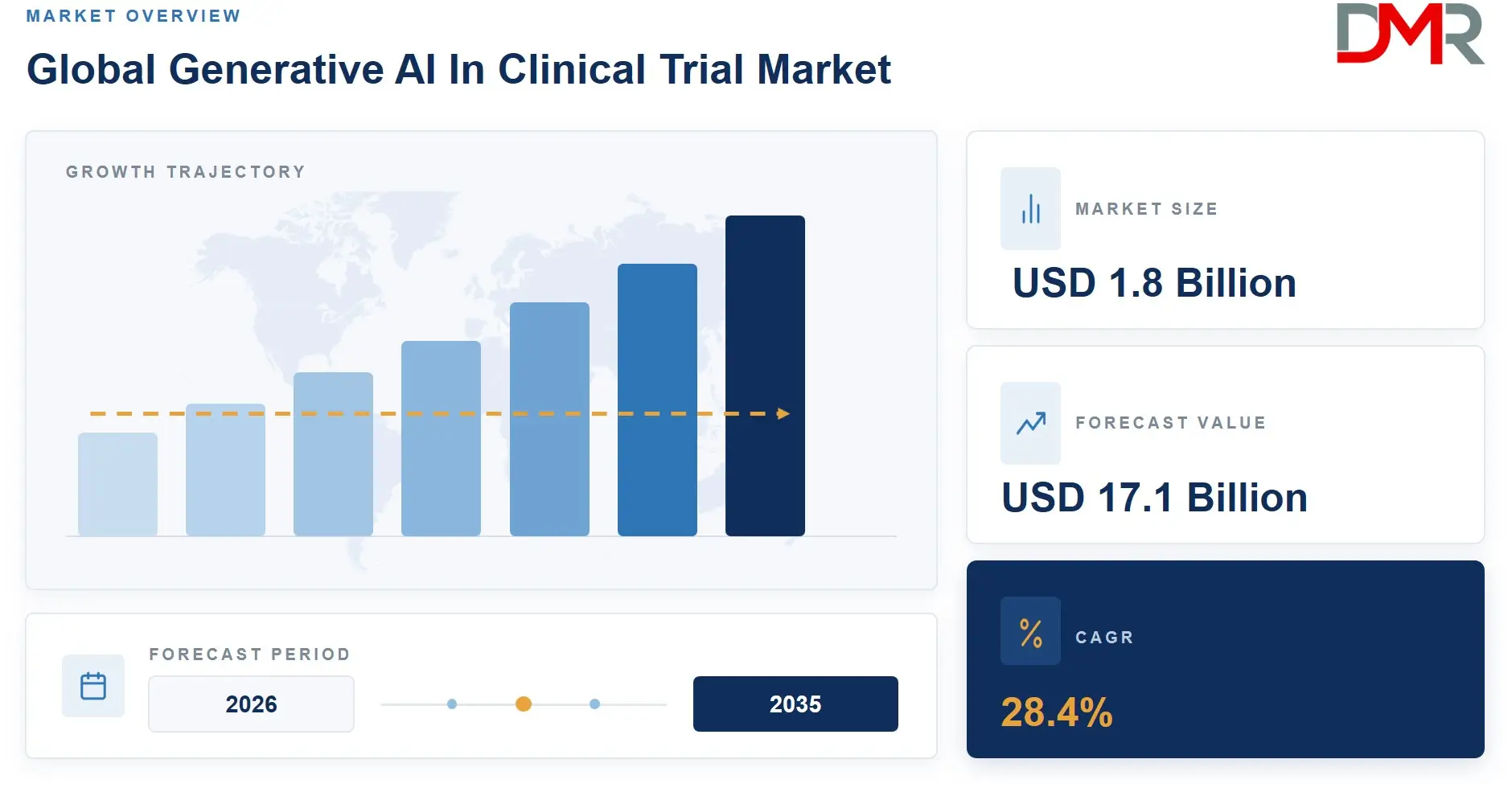
- Market Size (2026): USD 1.8 Bn
- Forecast Value (2035): USD 17.1 Bn
- CAGR (2026-2035): 28.4%
- Largest Region (2026): North America, approximately 46%
- Fastest-Growing Region: Asia-Pacific
- Leading Offering (2026): Software Platforms, around 64%
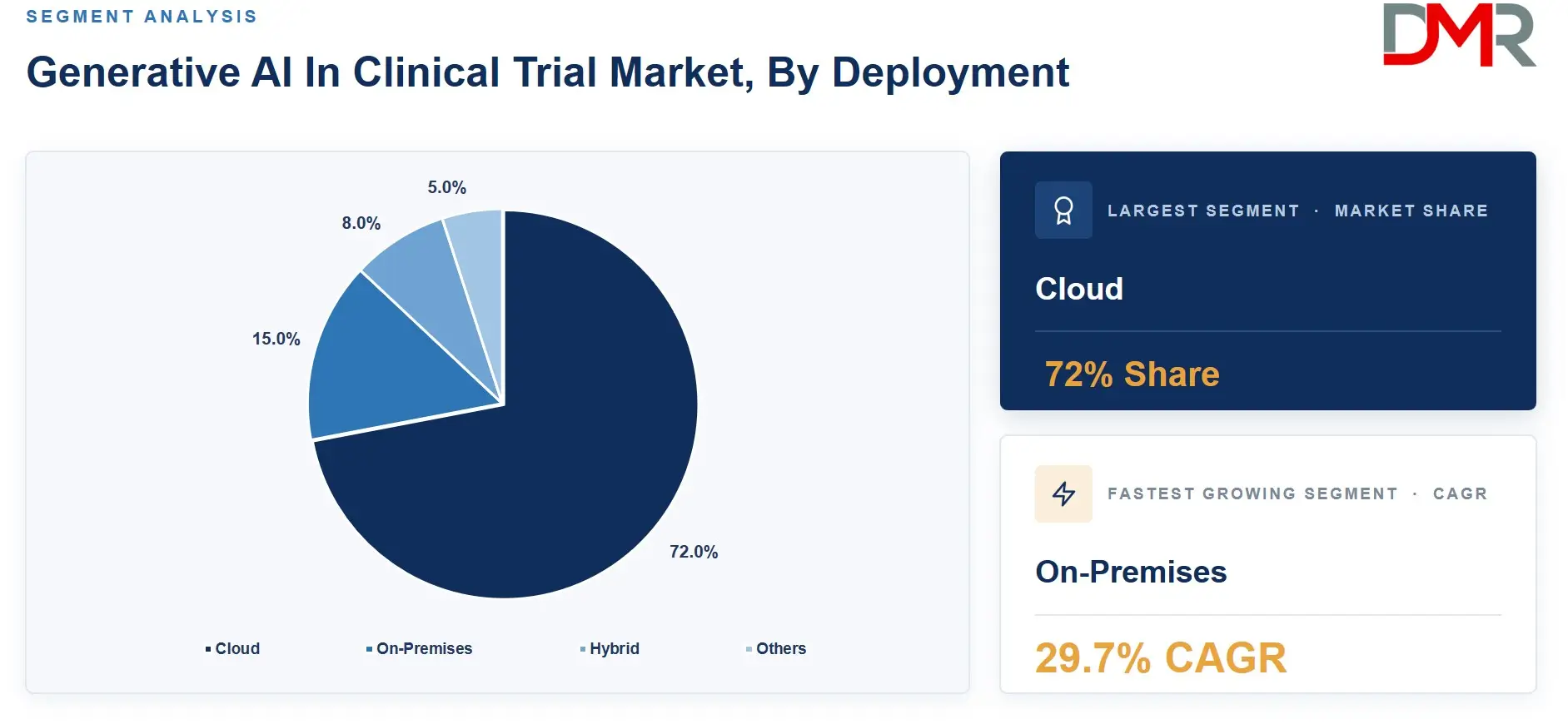
- Leading Deployment (2026): Cloud, close to 72%
- Key Players: Microsoft, IQVIA, Medidata and others
What is Generative AI In Clinical Trial Market and its Market Size?
Global Generative AI In Clinical Trial Market size is estimated to reach USD 1.8 Bn in 2026 and is further anticipated to reach USD 17.1 Bn by 2035, at a CAGR of 28.4%.
ℹ
To learn more about this report –
Download Your Free Sample Report Here
Generative AI in clinical trials covers software and associated services that create, summarize, simulate or optimize trial content and data workflows. The scope includes protocol drafting, eligibility criteria refinement, site and patient matching, synthetic or augmented datasets, medical writing, query resolution, safety narratives and decision support used across trial planning and execution.
Demand comes primarily from pharmaceutical and biotechnology sponsors, contract research organizations, medical device developers and research institutions seeking to reduce cycle time while preserving traceability. Buyers increasingly favor systems that connect with electronic data capture, clinical trial management systems, real-world data environments and regulated document repositories rather than isolated generative tools.
Structural change is being driven by foundation models adapted to biomedical language, retrieval-augmented generation, privacy-preserving data architectures and stronger human review controls. Commercial value depends less on generic text generation and more on validated workflows that can show provenance, reproducibility, audit trails and controlled use of protected health information.
Use Cases
- Protocol Development: Sponsor clinical operations teams use generative models to compare prior protocols, draft endpoints and eligibility language, and identify avoidable complexity before finalization, helping teams shorten authoring cycles and reduce amendments caused by inconsistent operational assumptions.
- Site Feasibility: CRO and sponsor feasibility teams combine structured site performance data with generated summaries to prioritize investigators, explain selection rationale and prepare outreach materials, improving consistency across geographically distributed trial planning teams.
- Clinical Data Review: Data management teams use controlled generation to summarize discrepancies, propose query language and organize review queues, allowing specialists to focus on clinically meaningful exceptions while retaining human approval for database changes.
- Medical Writing: Regulatory and medical writing groups generate first drafts of clinical summaries, narratives and evidence tables from governed source material, reducing repetitive assembly work while maintaining source links for verification and quality review.
Key Takeaways
- Market Growth: The industry is forecast to expand at 28.4% CAGR from 2026 to 2035.
- Application Analysis: Protocol Design & Optimization is expected to represent roughly 27% of 2026 revenue.
- Regional Analysis: North America is projected to hold approximately 46% of global revenue in 2026.
- Cloud Adoption: Cloud deployment is set to account for close to 72% of 2026 demand.
- Buyer Concentration: Pharmaceutical & biotechnology companies are expected to account for around 58% of 2026 revenue.
How AI/Gen AI is Transforming the Generative AI In Clinical Trial Market?
Generative AI is moving clinical trial software from passive record keeping toward assisted reasoning and content production. Biomedical large language models can interpret protocol text, investigator documents and clinical data dictionaries, while retrieval-augmented generation constrains outputs to approved evidence. The practical shift is toward shorter handoffs between clinical operations, data management, biostatistics and regulatory writing.
Adoption remains workflow-specific because regulated trials require human accountability. Vendors are therefore combining models with role-based access, source attribution, validation layers and audit trails rather than allowing unrestricted generation.
- LLM Document Processing: Drafting and comparing protocols, amendments, informed consent materials and clinical summaries.
- Synthetic Data: Generating privacy-aware datasets for simulation, model development and selected external-control workflows.
- Patient Matching: Translating complex eligibility criteria into computable concepts and ranking potential participants.
- Trial Simulation: Exploring recruitment, endpoint and operational scenarios before expensive protocol commitments.
Key Drivers in the Global Generative AI In Clinical Trial Market
Commercial adoption reflects both the economics of trial execution and the evidentiary standards applied to AI-assisted workflows.
- Pressure to Compress Development Timelines: Sponsors are investing in automation because trial delays compound across site activation, recruitment, data cleaning and submission preparation. With pharmaceutical and biotechnology companies expected to represent around 58% of 2026 demand, vendors that integrate generation directly into sponsor workflows can address high-value bottlenecks without requiring users to replace core clinical systems.
- Expansion of Digitized Clinical Data: Cloud deployment is projected to account for close to 72% of 2026 revenue, reflecting the growing availability of interoperable trial data and scalable model infrastructure. As EDC, CTMS, eCOA and real-world data environments become more connected, generative applications gain a larger governed information base for summarization, matching and document production.
Restraints in the Global Generative AI In Clinical Trial Market
Commercial adoption reflects both the economics of trial execution and the evidentiary standards applied to AI-assisted workflows.
- Validation and Regulatory Accountability: Clinical trial decisions must remain explainable and reviewable, which limits autonomous deployment. Protocol Design & Optimization may hold roughly 27% of 2026 revenue, yet even drafting use cases require source verification, version control and documented human approval because model hallucination or omitted context can propagate into costly protocol changes.
- Data Privacy and Integration Complexity: North America may account for approximately 46% of 2026 revenue, but fragmented data rights, protected health information controls and institution-specific governance still slow cross-system implementation. Sponsors must connect models to validated repositories without exposing sensitive participant data, increasing implementation effort and favoring vendors with mature security and governance capabilities.
Growth Opportunities in the Global Generative AI In Clinical Trial Market
Commercial adoption reflects both the economics of trial execution and the evidentiary standards applied to AI-assisted workflows.
- AI-Assisted Patient Recruitment: Patient Recruitment & Enrollment is modeled as the fastest-growing application at a 33.1% CAGR through 2035. The opportunity lies in translating nuanced eligibility criteria, screening longitudinal records and generating site-ready candidate explanations, particularly where recruitment failure is a major source of trial delay.
- CRO-Led Managed AI Services: CROs are expected to expand at a 30.8% CAGR through 2035 as sponsors seek operational outcomes rather than standalone licenses. Providers can embed governed generative workflows into feasibility, monitoring, data review and medical writing services, creating recurring revenue while spreading model validation and specialist oversight across multiple sponsor programs.
Trends in the Global Generative AI In Clinical Trial Market
Commercial adoption reflects both the economics of trial execution and the evidentiary standards applied to AI-assisted workflows.
- Shift Toward Domain-Grounded Models: Software Platforms are expected to hold around 64% of 2026 revenue, but platform differentiation is shifting from general-purpose model access to biomedical grounding, retrieval, provenance and workflow-specific guardrails. Buyers increasingly test whether outputs can be traced to controlled source documents and reproduced during quality review.
- Growing Use of Synthetic and Simulated Evidence: Phase I is projected to grow at a 32.4% CAGR through 2035 as sponsors use simulation and generated data to explore dose, cohort and operational scenarios earlier in development. Adoption is strongest where synthetic outputs support planning or model development while clearly remaining distinct from directly observed clinical evidence.
Research Scope and Analysis
Segment performance is assessed across offering, deployment, application, trial phase and end user. Each axis identifies where 2026 revenue is concentrated and where adoption is expected to accelerate through 2035, linking market structure to clinical workflow economics and technology adoption.
ℹ
To learn more about this report –
Download Your Free Sample Report Here
By Offering
Software Platforms is projected to hold the largest share by offering in 2026, accounting for approximately 64% of revenue, supported by its central role in current purchasing and deployment patterns. Buyers favor established workflows that can integrate with validated clinical systems and preserve governance. Growth, however, is concentrated in Services, which is forecast to expand at a CAGR of 31.2% from 2026 to 2035 as sponsors seek faster cycle times, more flexible capacity and specialized AI capabilities. Adoption will depend on evidence quality, integration depth and the ability to maintain human oversight across regulated trial processes.
By Deployment
Cloud is projected to hold the largest share by deployment in 2026, accounting for approximately 72% of revenue, supported by its central role in current purchasing and deployment patterns. Buyers favor established workflows that can integrate with validated clinical systems and preserve governance. Growth, however, is concentrated in On-Premises, which is forecast to expand at a CAGR of 29.7% from 2026 to 2035 as sponsors seek faster cycle times, more flexible capacity and specialized AI capabilities. Adoption will depend on evidence quality, integration depth and the ability to maintain human oversight across regulated trial processes.
By Application
Protocol Design & Optimization is projected to hold the largest share by application in 2026, accounting for approximately 27% of revenue, supported by its central role in current purchasing and deployment patterns. Buyers favor established workflows that can integrate with validated clinical systems and preserve governance. Growth, however, is concentrated in Patient Recruitment & Enrollment, which is forecast to expand at a CAGR of 33.1% from 2026 to 2035 as sponsors seek faster cycle times, more flexible capacity and specialized AI capabilities. Adoption will depend on evidence quality, integration depth and the ability to maintain human oversight across regulated trial processes.
By Trial Phase
Phase III is projected to hold the largest share by trial phase in 2026, accounting for approximately 36% of revenue, supported by its central role in current purchasing and deployment patterns. Buyers favor established workflows that can integrate with validated clinical systems and preserve governance. Growth, however, is concentrated in Phase I, which is forecast to expand at a CAGR of 32.4% from 2026 to 2035 as sponsors seek faster cycle times, more flexible capacity and specialized AI capabilities. Adoption will depend on evidence quality, integration depth and the ability to maintain human oversight across regulated trial processes.
By End User
Pharmaceutical & Biotechnology Companies is projected to hold the largest share by end user in 2026, accounting for approximately 58% of revenue, supported by its central role in current purchasing and deployment patterns. Buyers favor established workflows that can integrate with validated clinical systems and preserve governance. Growth, however, is concentrated in CROs, which is forecast to expand at a CAGR of 30.8% from 2026 to 2035 as sponsors seek faster cycle times, more flexible capacity and specialized AI capabilities. Adoption will depend on evidence quality, integration depth and the ability to maintain human oversight across regulated trial processes.
The Global Generative AI In Clinical Trial Market Report is Segmented Based on the Following
By Offering
- Software Platforms
- Services
- Others
By Deployment
- Cloud
- On-Premises
- Hybrid
- Others
By Application
- Protocol Design & Optimization
- Patient Recruitment & Enrollment
- Synthetic Data Generation
- Clinical Data Management
- Regulatory Documentation
- Safety & Pharmacovigilance
- Others
By Trial Phase
- Phase I
- Phase II
- Phase III
- Phase IV
- Others
By End User
- Pharmaceutical & Biotechnology Companies
- Contract Research Organizations
- Academic & Research Institutes
- Medical Device Companies
- Others
Regional Analysis
Region with the Largest Revenue Share
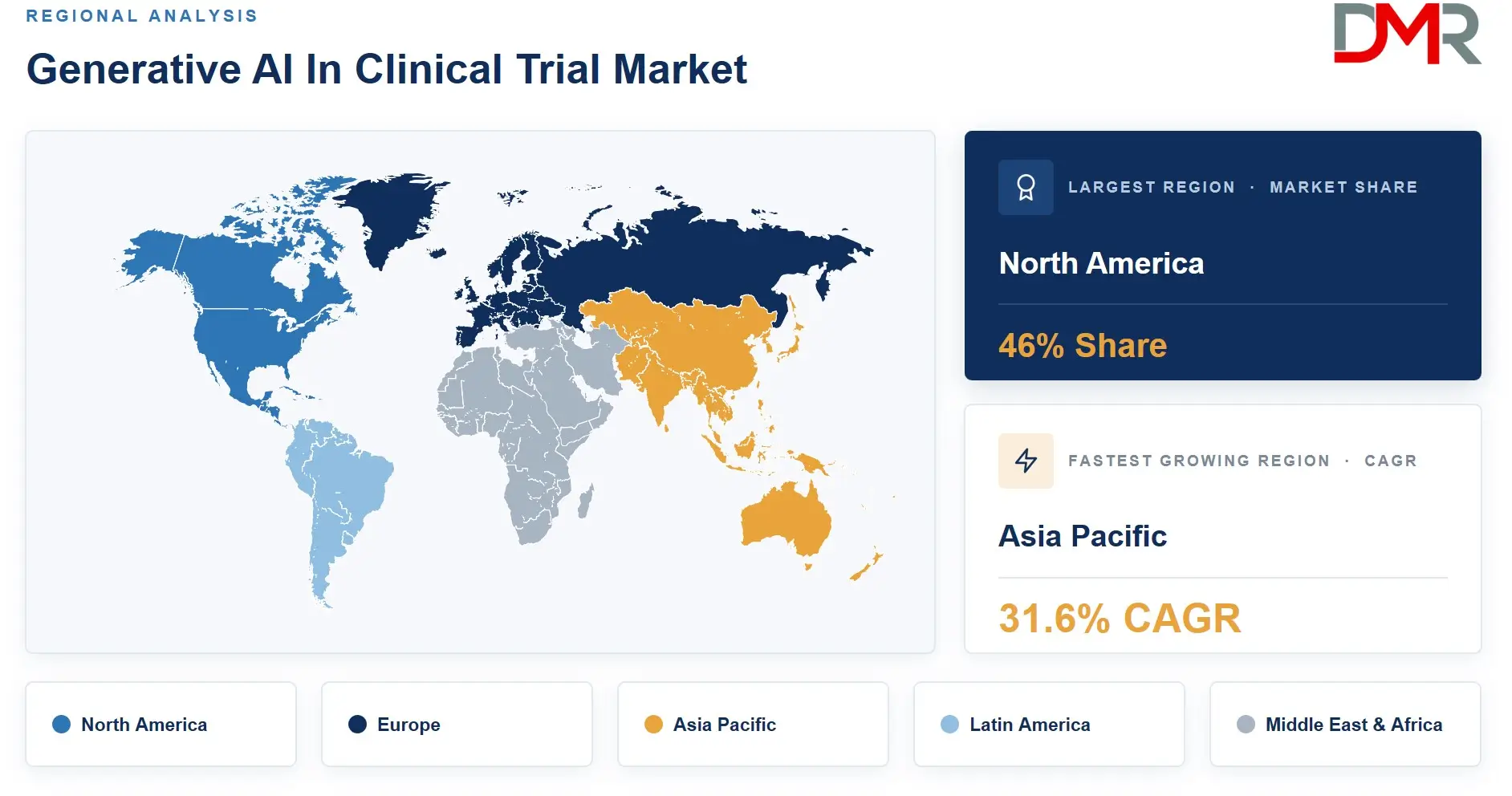
North America is expected to remain the largest regional market in 2026, representing approximately 46% of global revenue. The region combines dense sponsor and CRO concentration, extensive use of digital clinical platforms, strong venture funding for AI-enabled life science software and large pools of structured health data. Commercial adoption is also supported by enterprise cloud maturity and the presence of major technology vendors. Buyers nevertheless require strong privacy controls, model validation and auditability, which directs spending toward integrated platforms and specialized clinical AI providers rather than unmanaged general-purpose tools.
ℹ
To learn more about this report –
Download Your Free Sample Report Here
Region with the Highest CAGR
Asia-Pacific is forecast to record the fastest regional growth at a CAGR of 31.6% from 2026 to 2035. Trial activity is expanding across China, India, Japan, South Korea and Australia, while sponsors are using digital tools to coordinate multilingual documentation, site selection and patient recruitment across larger networks. Growing domestic biotechnology sectors and cloud adoption create additional demand. The commercial opening is strongest for platforms that support local language workflows, data residency requirements and interoperability with regional hospital systems without weakening global sponsor governance.
By Region
North America
Europe
- Germany
- France
- The UK
- Italy
- Spain
- Rest of Europe
Asia-Pacific
- China
- Japan
- India
- Australia
- South Korea
- Rest of APAC
Latin America
- Mexico
- Brazil
- Colombia
- Argentina
- Rest of LATAM
Middle East & Africa
- Saudi Arabia
- The UAE
- South Africa
- Rest of MEA
Regulatory Landscape
Regulatory expectations are moving toward risk-based governance of AI across drug development rather than blanket acceptance of generated outputs. Sponsors must document intended use, data lineage, validation, human oversight and change control when AI influences regulated trial work. Guidance from bodies such as the FDA, EMA and ICH increases demand for traceable systems that can preserve source evidence and audit histories. The commercial opening therefore sits in validated workflow layers, model monitoring and compliant document generation. The brake is that evolving expectations can lengthen procurement and validation cycles, favoring vendors that can demonstrate controlled deployment over those selling generic model access.
Technology Analysis
Technology competition centers on biomedical foundation models, retrieval-augmented generation, knowledge graphs, multimodal models, synthetic data methods and secure orchestration across clinical systems. The shift is from standalone copilots toward agentic workflows that can retrieve approved evidence, execute bounded tasks and route outputs to human reviewers. White space remains in protocol intelligence, multilingual trial operations, structured-to-narrative generation and privacy-preserving simulation. Technical risk comes from hallucination, model drift, weak provenance and inconsistent performance across therapeutic areas. These constraints push demand toward domain-grounded architectures with evaluation frameworks, access controls and integration into EDC, CTMS and regulatory content management environments.
Competitive Landscape
Competition spans hyperscale cloud and AI vendors, clinical technology incumbents, CROs and specialized generative AI companies. Large platforms compete on infrastructure, security, model ecosystems and enterprise integration, while clinical specialists differentiate through validated datasets, protocol intelligence, patient matching and regulated workflow expertise. Partnerships are common because sponsors prefer AI capabilities embedded inside existing clinical operations rather than additional disconnected applications. Competitive advantage increasingly depends on proprietary clinical data access, evidence provenance, therapeutic-area performance, interoperability and the ability to support validation across changing models.
Some of the Prominent Players in the Global Generative AI In Clinical Trial Market Are
- Microsoft
- Google
- Amazon Web Services
- IBM
- NVIDIA
- Oracle
- Salesforce
- IQVIA
- Medidata
- Parexel
- ICON plc
- Fortrea
- Syneos Health
- Tempus AI
- ConcertAI
- Saama
- Unlearn.AI
- Phesi
- Deep 6 AI
- TrialKey
- QuantHealth
- Aitia
- Owkin
- PathAI
- Insilico Medicine
- BioAge Labs
- Aktana
- TriNetX
- Clario
- eClinical Solutions
- Yseop
- Causaly
- Mendel AI
- Innoplexus
- Qure.ai
- Nference
- MediBuddy
- Ping An Healthcare and Technology
- Alibaba Cloud
- Tencent Cloud
- Other Key Players
Recent Developments
- In 2026, clinical technology vendors continued expanding generative AI capabilities for protocol, data review and medical writing workflows, with emphasis shifting toward governed enterprise deployment and integration with established trial platforms.
- In 2025, major cloud and life science technology providers broadened healthcare-focused foundation model and agent offerings, creating additional infrastructure options for sponsors building controlled clinical research applications.
- In 2025, specialized clinical AI companies advanced synthetic data and trial simulation products designed to support protocol planning and external evidence strategies while preserving separation between generated and observed data.
- In 2024, sponsors and CROs increased pilots of generative AI for document-intensive clinical operations, accelerating demand for retrieval, provenance, access controls and human review mechanisms suited to regulated environments.
Report Details
| Report Characteristics |
| Market Size (2026) |
USD 1.8 Bn |
| Forecast Value (2035) |
USD 17.1 Bn |
| CAGR (2026-2035) |
28.4% |
| The US Market Size (2026) |
USD 0.7 Bn |
| Historical Data |
2021 - 2025 |
| Forecast Data |
2026 - 2035 |
| Base Year |
2025 |
| Segments Covered |
By Offering, By Deployment, By Application, By Trial Phase and By End User |
| Regional Coverage |
North America - The US and Canada; Europe - Germany, France, The UK, Italy, Spain, Rest of Europe; Asia-Pacific - China, Japan, India, Australia, South Korea, Rest of APAC; Latin America - Mexico, Brazil, Colombia, Argentina, Rest of LATAM; Middle East & Africa - Saudi Arabia, The UAE, South Africa, Rest of MEA |
Frequently Asked Questions
How big is the Global Generative AI In Clinical Trial Market?
▾ Global Generative AI In Clinical Trial Market size is estimated at USD 1.8 Bn in 2026. Spending includes software platforms and services used to generate, summarize, simulate or optimize regulated clinical trial workflows across sponsors, CROs and research organizations.
What is the growth rate of the Global Generative AI In Clinical Trial Market?
▾ The market is forecast to expand at a CAGR of 28.4% from 2026 to 2035 as sponsors move generative AI from isolated pilots into governed protocol, recruitment, data management and medical writing workflows.
Which region holds the largest share in the Global Generative AI In Clinical Trial Market?
▾ North America is expected to hold the largest share in 2026 at approximately 46%, supported by high biopharmaceutical R&D spending, mature clinical technology adoption, large sponsor and CRO networks, and strong availability of enterprise AI infrastructure.
Who are the key players in the Global Generative AI In Clinical Trial Market?
▾ Key participants include Microsoft, IQVIA, Medidata, NVIDIA, Oracle, Saama and Unlearn.AI. Competition also includes CROs, hyperscale cloud providers and specialized clinical AI companies focused on protocol intelligence, patient matching, synthetic data and regulated content generation.
Which application is leading the market?
▾ Protocol Design & Optimization is expected to lead application revenue in 2026 with a share of roughly 27%. Sponsors value the ability to compare prior studies, reduce protocol complexity and accelerate document development while retaining clinical and regulatory review.
Why is cloud deployment important?
▾ Cloud deployment is projected to account for close to 72% of 2026 revenue because generative models require scalable compute, rapid model updates and integration with distributed clinical data environments. Security, data residency and validation remain central purchasing requirements.
What is shaping the future of the Generative AI In Clinical Trial Market?
▾ The Generative AI In Clinical Trial Market is being shaped by biomedical foundation models, retrieval-augmented generation, synthetic data, stronger AI governance and integration with EDC, CTMS and regulatory content systems. Long-term adoption will depend on demonstrable accuracy, provenance, privacy protection and human accountability.