Germany Bakery Ingredients Market Snapshot
- Germany Bakery Ingredients Market Size in 2026: USD 7.5 Billion
- Germany Bakery Ingredients Market Size in 2035: USD 9.8 Billion
- Germany CAGR from 2026 to 2035: 3.0%
- Flour and Starches is the leading ingredient type segment in 2026: 32.6%
- Bread is the leading application segment in 2026: 41.8%
- Dry is the leading form segment in 2026: 68.4%
- Direct/B2B (Industrial Supply) is the leading distribution channel segment in 2026: 54.2%
- Industrial and Large-Scale Bakeries is the leading end user segment in 2026: 47.6%
What is the Germany Bakery Ingredients Market and its Market Size?
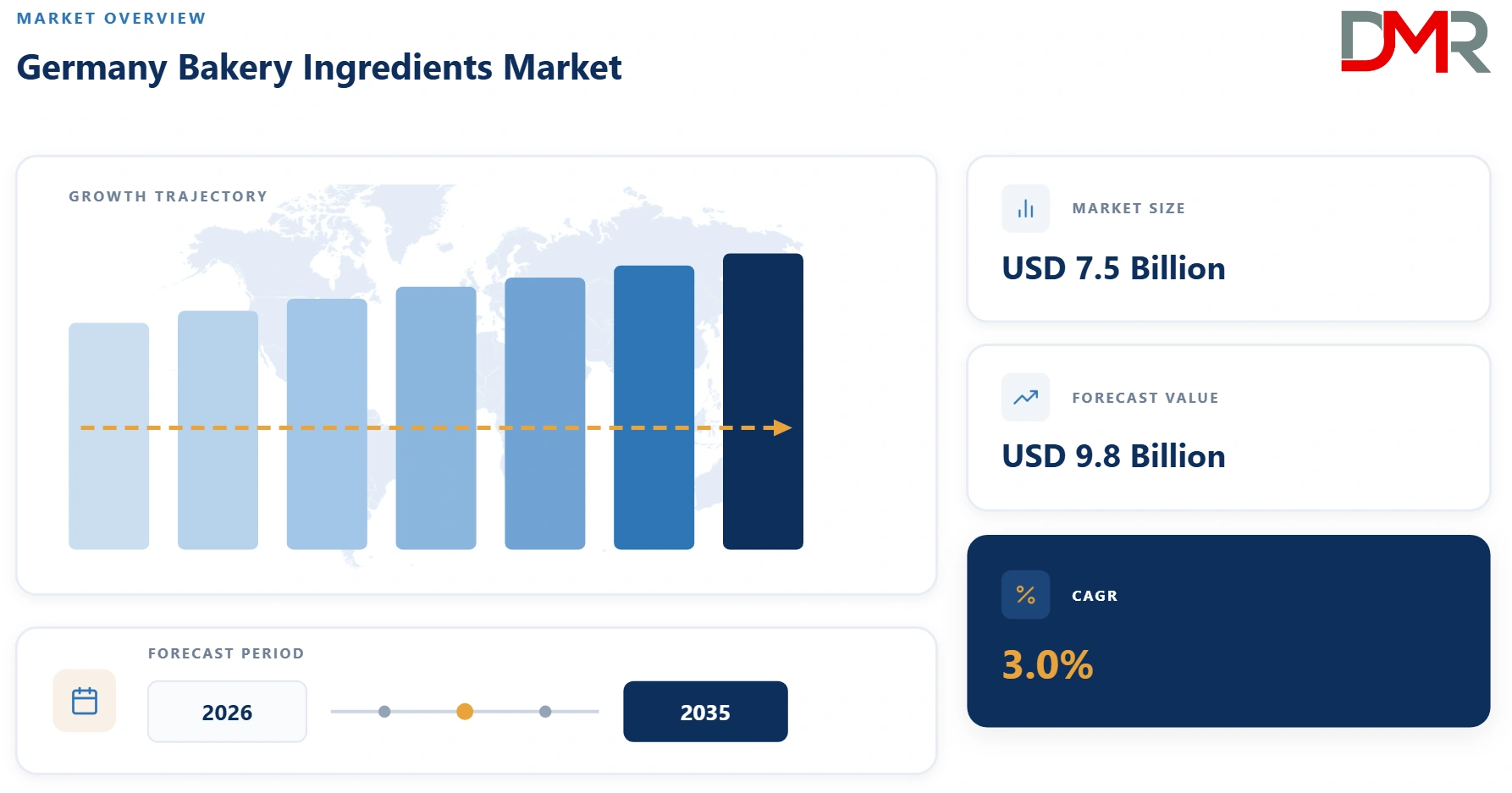
The Germany Bakery Ingredients Market is projected to be valued at USD 7.5 billion in 2026 and is projected to reach USD 9.8 billion by 2035, expanding at a CAGR of 3.0% during the forecast period.
ℹ
To learn more about this report –
Download Your Free Sample Report Here
Growth is being propelled by Germany's deeply entrenched bakery culture, one of the largest baked goods consumption bases in Europe, alongside sustained demand from industrial and artisanal bakeries for functional and convenience-oriented ingredient systems. The adoption of enzyme-based dough conditioners replacing chemical additives, rising clean-label and organic ingredient sourcing driven by EU Farm to Fork regulatory momentum, and expanding demand for reduced-sugar and high-fiber formulations are reshaping ingredient procurement. Investment is accelerating as ingredient suppliers pivot from commodity flour and sugar supply toward higher-margin specialty systems, including emulsifiers, enzyme blends, and fortified premixes, to help German bakeries manage input cost volatility while meeting evolving consumer health and sustainability expectations.
Use Cases
- Shelf-Life Extension and Process Efficiency in Industrial Bakeries: Large-scale bread and packaged bakery manufacturers deploy enzyme systems, emulsifiers, and dough conditioners to extend product freshness, reduce staling, and improve dough handling on high-throughput production lines.
- Clean-Label Reformulation for Artisanal and Retail Bakeries: Independent bakeries and pastry shops replace synthetic additives with enzyme-based and fermentation-derived natural alternatives to meet consumer demand for transparent, minimally processed ingredient lists.
- Health Fortification and Sugar Reduction in Packaged Baked Goods: Manufacturers incorporate specialty fibers, resistant starches, and natural sweeteners such as stevia and allulose to support reduced-sugar, high-fiber, and protein-fortified product launches.
- Gluten-Free and Allergen-Free Formulation Support: Ingredient suppliers provide alternative flour blends and functional binding systems that replicate the taste and texture of traditional German baked goods for the well-established free-from consumer segment.
Key Takeaways
- Market Size: The Germany Bakery Ingredients Market is anticipated to be valued at USD 7.5 billion in 2026 and is forecast to reach USD 9.8 billion by 2035, expanding at a CAGR of 3.0%.
- Growth Outlook: Market expansion is sustained by Germany's outsized bakery consumption culture, the shift toward functional and convenience ingredient systems, growing clean-label and organic sourcing requirements, and the increasing use of digital procurement tools for ingredient sourcing and contract management.
- Primary Growth Drivers: A large and structurally resilient bakery products base, rising adoption of enzyme-based clean-label solutions, EU regulatory momentum around allergen labeling and sustainable sourcing, and consolidation among ingredient suppliers seeking scale and technical capability are accelerating investment across the German bakery ingredients supply chain.
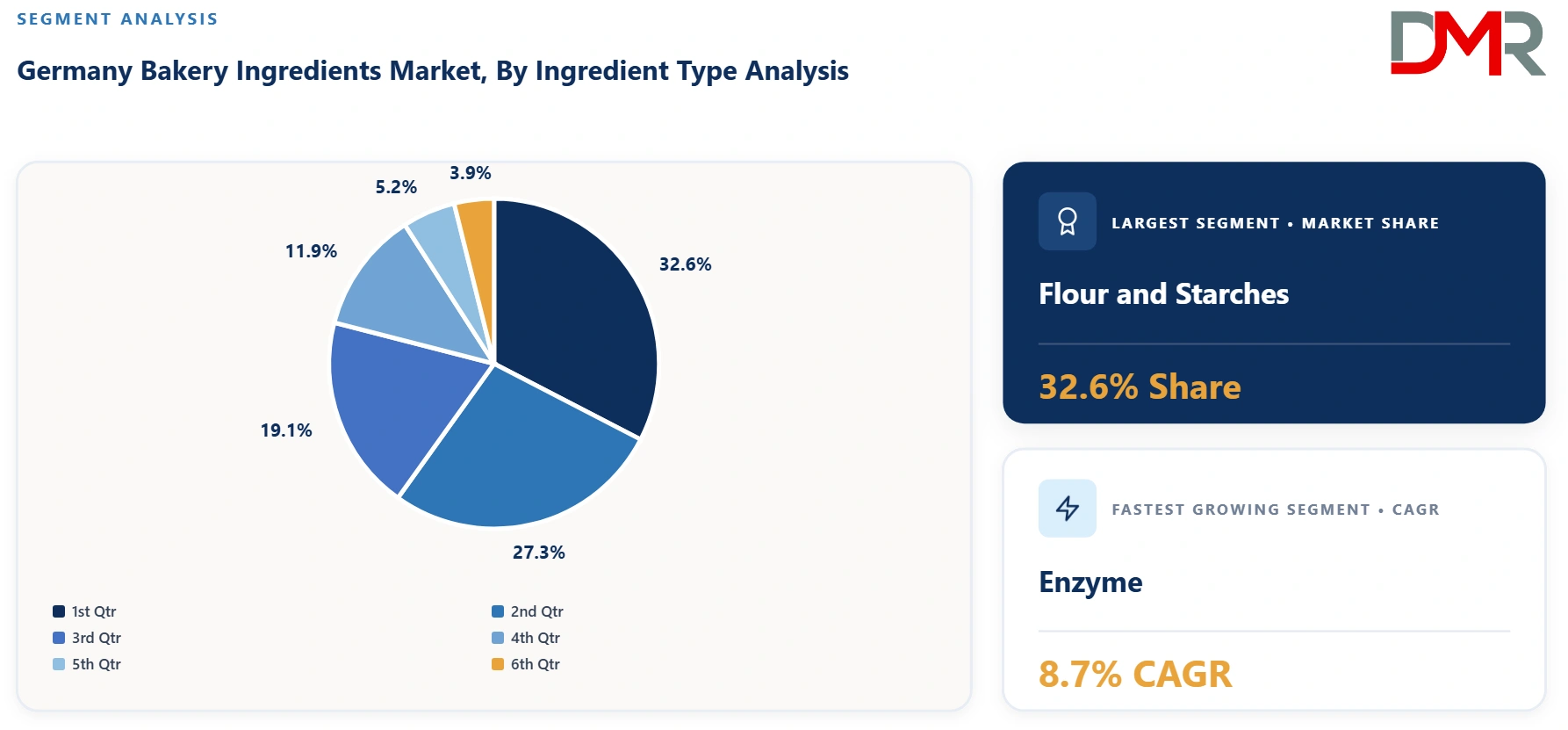
- By Ingredient Type Analysis: Flour and Starches is projected to lead the segment with a dominant 32.6% share in 2026, reflecting their foundational role across nearly all baked goods categories, while Enzymes hold an 8.7% share and are registering the fastest growth as German bakers replace chemical dough conditioners with amylase, xylanase, and lipase-based systems.
- By Application Analysis: Bread is anticipated to hold a 41.8% share in 2026, reflecting bread's central position in German dietary culture and packaged retail assortments, while Biscuits and Cookies represent a smaller but steadily growing application category.
- By Form Analysis: Dry is expected to command a 68.4% share in 2026, underpinned by the dominance of powdered premixes, flour blends, and dry enzyme systems, with Liquid forms gaining share in emulsifier and syrup-based sweetener applications.
- By Distribution Channel Analysis: Direct/B2B supply to industrial and large-scale bakeries is expected to dominate with a 54.2% share in 2026, while Online procurement channels are the fastest-growing distribution route as digital B2B ingredient marketplaces expand.
- By End User Analysis: Industrial and Large-Scale Bakeries are expected to lead with a 47.6% share in 2026 given their high-volume ingredient consumption and long-term supply contracts, while Food Service and QSR operators represent the fastest-growing end-user category amid expanding on-the-go and snacking bakery formats.
How AI/Gen AI is Transforming the Germany Bakery Ingredients Market?
Artificial intelligence and digital procurement technologies are reshaping the German bakery ingredients supply chain by enabling more precise demand forecasting, formulation optimization, and supply chain risk management. Machine learning models trained on commodity price histories and harvest data help ingredient buyers anticipate wheat, sugar, and specialty fat price volatility, enabling proactive contract coverage and alternative sourcing decisions. AI-assisted formulation platforms are helping bakery ingredient developers optimize enzyme blends and emulsifier systems to hit target texture, shelf-life, and clean-label specifications faster than traditional trial-and-error methods. Predictive quality control tools using computer vision are also being deployed on ingredient production lines to detect inconsistencies in flour milling, premix blending, and packaging before products reach industrial bakery customers.
Key Drivers in the Germany Bakery Ingredients Market
Deeply Entrenched Bakery Culture Sustaining Structural Ingredient Demand
Germany's bakeries and pastry shops remain a defining feature of national food culture, with the vast majority of German consumers viewing bakery visits as part of their cultural identity. This structural, culturally embedded demand for bread, rolls, and pastries sustains a large and relatively resilient base of ingredient consumption even as individual bakery outlet counts consolidate. The persistence of both traditional artisanal baking and large-scale packaged bread and roll production creates dual demand channels for both commodity ingredients and higher-margin specialty systems, supporting sustained ingredient market value even amid moderating volume growth in finished bakery products.
Shift Toward Functional, Clean-Label, and Enzyme-Based Ingredient Systems
German bakers are increasingly replacing chemical dough conditioners with enzyme systems such as amylases, xylanases, and lipases, alongside fermentation-derived natural flavors, driven by consumer demand for transparency and minimally processed labels. Stringent European regulations around health claims and labeling are further shaping which functional ingredients manufacturers can use and how they can be marketed, pushing suppliers toward more sophisticated, compliant formulation technologies. This evidence-driven shift is generating sustained demand for enzyme-based and functional ingredient categories, elevating their share of total ingredient spend even as overall bakery product volumes grow more slowly.
Restraints in the Germany Bakery Ingredients Market
Commodity Price Volatility and Import Dependency
Germany remains structurally dependent on imports for key raw materials such as high-protein wheat, specialty fats, cocoa-based inclusions, and certain starches, with imports covering a substantial share of total ingredient demand by volume. Price volatility for commodity flours, sugars, and fats continues to pressure ingredient buyer margins, with recent spot price fluctuations for European wheat flour prompting buyers to increase contract coverage and explore alternative starch sources. Certification burdens across organic, non-GMO, kosher, halal, and allergen-free schemes further add to sourcing costs and limit the pool of qualified suppliers, particularly constraining smaller artisanal bakeries from adopting premium ingredient systems.
Growth Opportunities in the Germany Bakery Ingredients Market
Expansion of Premium and Certified Sustainable Ingredient Sub-Segments
Regulatory shifts around allergen labeling, GMO traceability, and the EU's Farm to Fork Strategy are accelerating demand for certified organic, non-GMO, and sustainably sourced bakery ingredients, creating premium sub-segments with above-market growth rates. Ingredient suppliers that can offer traceable, documented sourcing—such as traceable active sourdough cultures and verified supply chains for specialty fats and inclusions—are well positioned to capture premium pricing as German retailers and bakery chains compete on sustainability credentials.
Snacking and On-the-Go Bakery Format Growth
The German on-the-go bakery segment—wraps, snack bars, and individually wrapped pastries—is expanding steadily, boosting demand for premix and inclusion ingredients tailored to convenience formats. This creates opportunities for ingredient suppliers to develop specialized fortification and shelf-stability solutions for snacking formats, an adjacency to traditional bread and pastry ingredient supply that is growing faster than the base market.
Trends in the Germany Bakery Ingredients Market
Consolidation Among Global Bakery Ingredient Suppliers
A defining trend reshaping the competitive landscape is accelerating consolidation among major bakery ingredient manufacturers serving the German and broader European market. In March 2026, Puratos entered into a definitive agreement to acquire Dawn Foods, bringing together two century-old companies supplying ingredients and technical solutions to professional bakers worldwide, with the deal expected to close by the end of 2026 subject to regulatory approval. Such consolidation is expected to expand the scale, R&D capability, and geographic reach of ingredient suppliers active in the German market, intensifying competition for German industrial and artisanal bakery accounts.
Health Fortification and Sugar Reduction Reshaping Product Launches
A majority of new bakery product launches in Germany now feature a reduced-sugar, high-fiber, or protein-fortified claim, driving sustained demand for specialty fibers, resistant starches, and natural sweeteners such as stevia and allulose. This trend is pushing ingredient suppliers to expand their functional ingredient portfolios and is creating a durable growth pathway for health-oriented ingredient sub-segments that outpaces the broader market's moderate overall growth rate.
Research Scope and Analysis
The Germany Bakery Ingredients Market is segmented by ingredient type, application, form, distribution channel, and end user. Ingredient types span flour and starches, sweeteners, fats and oils, emulsifiers, leavening agents and yeast, enzymes, dairy ingredients, and preservatives. End users include industrial and large-scale bakeries, artisanal and retail bakeries, food service and QSR operators, and households.
ℹ
To learn more about this report –
Download Your Free Sample Report Here
By Ingredient Type Analysis
Flour and Starches is poised to dominate the Germany Bakery Ingredients Market, accounting for an estimated 32.6% share in 2026. As the foundational input across nearly all bread, roll, cake, and pastry categories, flour and starch demand is sustained by Germany's large packaged bread and private-label bakery lines, which require dependable, consistent grades for large-scale supply contracts. Enzymes hold an estimated 8.7% share in 2026 and represent the fastest-growing ingredient category, propelled by German bakers' accelerating shift toward amylase, xylanase, and lipase-based clean-label dough conditioning systems.
By Application Analysis
Bread is expected to lead the application segment, holding an estimated 41.8% share in 2026. Bread's central role in German dietary culture, spanning both artisanal loaves and packaged retail bread, sustains the largest share of ingredient consumption across flour, leavening agents, and dough conditioners. Biscuits and Cookies represent a smaller but steadily expanding application category, benefiting from snacking format growth and health-fortified product innovation.
By Form Analysis
Dry form ingredients is projected to lead the segment, holding an estimated 68.4% share in 2026. Powdered premixes, flour blends, and dry enzyme and emulsifier systems dominate given their storage stability, ease of transport, and compatibility with automated industrial bakery dosing systems. Liquid form ingredients are gaining share steadily, particularly in emulsifier and liquid sweetener applications used in cake and pastry production.
By Distribution Channel Analysis
Direct/B2B supply to industrial bakery customers are poised to dominate the distribution channel segment, accounting for an estimated 54.2% share in 2026. Long-term supply contracts with large-scale and private-label bakery manufacturers sustain this channel's leadership, given the volume and consistency requirements of industrial baking operations. Online B2B procurement channels are the fastest-growing distribution route as digital ingredient marketplaces and direct supplier platforms expand, particularly among small and mid-sized artisanal bakeries.
By End User Analysis
Industrial and Large-Scale Bakeries are expected to dominate the end user segment, accounting for an estimated 47.6% share in 2026. Their high-volume ingredient consumption, long-term supplier relationships, and need for consistent, cost-controlled formulations across packaged bread and private-label lines sustain their leading position. Food Service and QSR operators represent the fastest-growing end-user category, driven by expanding on-the-go bakery and snacking formats across German retail and quick-service channels.
The Germany Bakery Ingredients Market Report is segmented on the basis of the following:
By Ingredient Type
- Flour and Starches
- Sweeteners
- Fats and Oils
- Emulsifiers
- Leavening Agents and Yeast
- Enzymes
- Dairy Ingredients
- Preservatives and Others
By Application
- Bread
- Cakes and Pastries
- Biscuits and Cookies
- Morning Goods
- Others
By Form
By Distribution Channel
- Direct/B2B (Industrial Supply)
- Retail
- Online
By End User
- Industrial and Large-Scale Bakeries
- Artisanal and Retail Bakeries
- Food Service and QSR
- Household
Regulatory Landscape
The regulatory landscape for bakery ingredients in Germany is shaped by European Union frameworks governing food safety, labeling, and sustainability. Allergen labeling requirements, GMO traceability rules, and the EU's Farm to Fork Strategy are collectively accelerating demand for certified organic, non-GMO, and sustainably sourced ingredients. Certification burdens across multiple overlapping schemes, including organic, non-GMO, kosher, halal, and allergen-free standards, add meaningfully to ingredient sourcing costs and compliance complexity, particularly for smaller and mid-sized German bakery ingredient suppliers.
White Space Analysis
Functional and convenience ingredients, including enzyme systems, emulsifiers, and bakery premixes, account for a substantial share of total German bakery ingredient market value, reflecting bakeries' sustained push for process efficiency, shelf-life extension, and clean-label reformulation. Germany remains structurally dependent on imports for key raw materials such as high-protein wheat, specialty fats, cocoa-based inclusions, and certain starches, with imports covering a meaningful share of total ingredient demand by volume. Enzyme demand in German baking has grown at a steady mid-single-digit annual pace in recent years as bakers replace chemical dough conditioners with amylase, xylanase, and lipase-based systems. A majority of new bakery product launches in Germany now feature a reduced-sugar, high-fiber, or protein-fortified claim, sustaining above-market growth for specialty fibers, resistant starches, and natural sweeteners.
Competitive Landscape
The Germany Bakery Ingredients Market is characterized by strong competition among multinational ingredient suppliers, specialized bakery solution providers, regional manufacturers, and established flour and sugar companies. Puratos and Zeelandia hold prominent positions through broad portfolios of enzymes, emulsifiers, improvers, fillings, and premixes designed for industrial and artisanal bakers. IREKS and Backaldrin strengthen competition through deep regional expertise, customized formulations, and technical support aligned with German and Central European baking traditions. Companies such as Dawn Foods, Lesaffre, GoodMills Innovation, and Martin Braun further expand product diversity across yeast, mixes, functional ingredients, and specialty solutions. Market participants increasingly focus on clean-label formulations, natural ingredients, texture improvement, shelf-life extension, cost efficiency, and plant-based innovation to meet evolving consumer and bakery manufacturer requirements efficiently.
Some of the prominent players in the Germany Bakery Ingredients Market are:
- IREKS GmbH
- Puratos GmbH
- Zeelandia GmbH & Co. KG
- Backaldrin International The Kornspitz Company GmbH
- Dawn Foods Germany GmbH
- Lesaffre Deutschland GmbH
- CSM Ingredients
- AB Mauri
- Bakels Deutschland GmbH
- Abel + Schäfer Komplet Bäckereigrundstoffe GmbH & Co. KG
- EUROGERM Deutschland GmbH
- UNIFERM GmbH & Co. KG
- B&C Backmittel GmbH
- Martin Braun Backmittel und Essenzen KG
- DeutscheBack GmbH & Co. KG
- GoodMills Innovation GmbH
- SternEnzym GmbH & Co. KG
- Stern-Wywiol Gruppe
- AB Enzymes GmbH
- Novonesis
- Corbion N.V.
- Kerry Group plc
- dsm-firmenich
- International Flavors & Fragrances Inc.
- Cargill, Incorporated
- ADM
- Ingredion Incorporated
- Tate & Lyle PLC
- Südzucker AG
- BENEO GmbH
- AAK AB
- BASF SE
- Döhler Group
- Givaudan SA
- Lallemand Inc.
- Palsgaard A/S
- Jungbunzlauer Suisse AG
- Dr. August Oetker Nahrungsmittel KG
- GoodMills Deutschland GmbH
- SchapfenMühle GmbH & Co. KG
- Other Key Players
Recent Developments
- April 2026: GoodMills Innovation launched SNOW SPELT Wholegrain Microgranulate, a wholegrain spelt concentrate designed to produce lighter-colored, finer-textured, and milder-tasting breads, rolls, and bakery products while retaining wholegrain nutritional benefits.
- April 2026: Martin Braun and AGRANO presented new bakery ingredient solutions at Sachsenback 2026, strengthening their focus on innovative formulations and products for Germany’s artisanal and professional bakery sector.
- March 2026: Puratos announced a definitive agreement to acquire Dawn Foods, combining complementary bakery ingredient capabilities across mixes, fillings, icings, sweet baked goods, and other professional bakery solutions. The transaction is expected to close by the end of 2026, subject to approvals.
- May 2025: IREKS showcased new bakery ingredient concepts including TEN SPROUTS, IREKS SOFT OAT, and CRAFT MASTER DURUM at iba 2025, emphasizing clean-label, sourdough, oat-based, sprouted-grain, and premium bakery applications.
Report Details
| Report Characteristics |
| Market Size (2026) |
USD 7.5 Bn |
| Forecast Value (2035) |
USD 9.8 Bn |
| CAGR (2026–2035) |
3.0% |
| Historical Data |
2021 – 2025 |
| Forecast Data |
2026 – 2035 |
| Base Year |
2025 |
| Segments Covered |
By Ingredient Type, By Application, By Form, By Distribution Channel, By End User |
| Country Coverage |
Germany |
Frequently Asked Questions
How big is the Germany Bakery Ingredients Market?
▾ The Germany Bakery Ingredients Market is valued at USD 7.5 billion in 2026 and is projected to reach USD 9.8 billion by 2035, reflecting steady demand from Germany's large industrial and artisanal bakery base for flour, starches, functional ingredients, and specialty systems.
What is the CAGR of the Germany Bakery Ingredients Market from 2026 to 2035?
▾ The market is projected to expand at a CAGR of 3.0% between 2026 and 2035, supported by steady demand for functional and clean-label ingredient systems, sustainability-driven sourcing shifts, and growth in convenience and snacking bakery formats.
What factors are driving the growth of the Germany Bakery Ingredients Market?
▾ Growth is driven by Germany's deeply entrenched bakery culture, rising adoption of enzyme-based clean-label dough conditioning systems, EU regulatory momentum around allergen labeling and sustainable sourcing, and consolidation among global bakery ingredient suppliers expanding technical capability and reach.
What are the major trends in the Germany Bakery Ingredients Market?
▾ Major trends include accelerating consolidation among global bakery ingredient manufacturers, the shift toward enzyme-based and fermentation-derived clean-label solutions, health fortification and sugar reduction reshaping new product launches, and growth of on-the-go and snacking bakery formats.
Which ingredient type leads the Germany Bakery Ingredients Market in 2026?
▾ Flour and Starches lead with a 32.6% share in 2026, given their foundational role across virtually all bread, cake, and pastry categories, while Enzymes represent the fastest-growing ingredient category.
Which application segment leads the Germany Bakery Ingredients Market in 2026?
▾ Bread leads with a 41.8% share in 2026, reflecting its central role in German dietary culture and packaged retail bakery assortments.
Who are the key players in the Germany Bakery Ingredients Market?
▾ Key market participants include Puratos, Dawn Foods, Royal Zeelandia Group, IREKS, Backaldrin, CSM Ingredients, Corbion, Kerry Group, ADM, and Cargill, among other global and regional bakery ingredient suppliers.
How is the Germany Bakery Ingredients Market segmented?
▾ The market is segmented by ingredient type, application, form, distribution channel, and end user, with regional analysis covering key domestic bakery ingredient demand centers including North Rhine-Westphalia, Bavaria, Baden-Württemberg, Lower Saxony, Berlin, and Hamburg.