Germany Contact Intraocular Lenses Market Snapshot
- Germany Contact Intraocular Lenses Market Size in 2026: USD 1.8 Billion
- Germany Contact Intraocular Lenses Market Size in 2035: USD 3.3 Billion
- Germany CAGR from 2026 to 2035: 6.97%
- Monofocal IOLs is the leading product type segment in 2026: 46.2%
- Hydrophobic Acrylic is the leading material segment in 2026: 39.8%
- Cataract Surgery is the leading application segment in 2026: 52.6%
- Hospitals and Eye Clinics is the leading distribution channel segment in 2026: 61.3%
- Hospitals is the leading end user segment in 2026: 44.7%
What is the Germany Contact Intraocular Lenses Market and its Market Size?
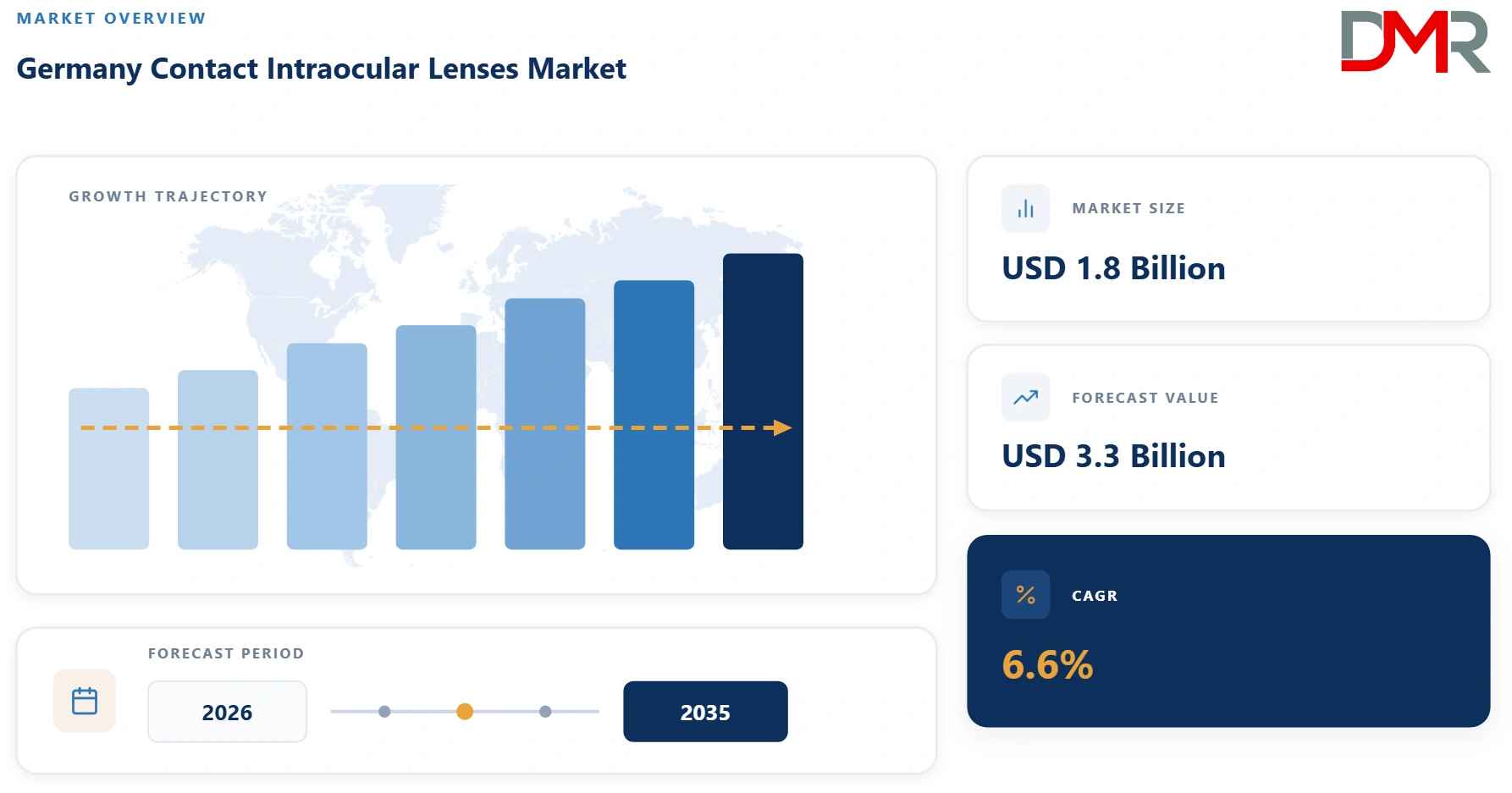
The Germany Contact Intraocular Lenses Market is projected to be valued at USD 1.8 Billion in 2026 and is projected to reach USD 3.3 Billion by 2035, expanding at a CAGR of 6.97% during the forecast period.
ℹ
To learn more about this report –
Download Your Free Sample Report Here
Growth is being propelled by Germany's substantial and rapidly aging population driving sustained growth in cataract surgery volumes, rising myopia prevalence among younger German populations increasing demand for refractive correction lens solutions, and growing patient willingness to pay out-of-pocket for premium multifocal, toric, and extended depth of focus intraocular lenses offering spectacle independence beyond standard statutory health insurance coverage. The maturing of advanced hydrophobic and hydrophilic acrylic lens materials offering improved biocompatibility and reduced posterior capsule opacification risk, growing accommodating IOL innovation aimed at more naturally replicating the eye's focusing mechanism, and continued expansion of ambulatory surgical center capacity supporting more efficient, high-volume cataract surgery delivery are reshaping the market from a largely standardized, insurance-reimbursement-driven category into an increasingly premiumized, technology- and material-differentiated ophthalmic lens industry. Investment is accelerating as German ophthalmology providers and lens manufacturers expand premium material and design offerings while serving both aging-population-driven cataract volume growth and younger population refractive correction demand.
Use Cases
- Premium Multifocal and EDOF Lens Implantation for Cataract Surgery: German cataract surgery patients, particularly those willing to pay out-of-pocket premiums beyond statutory health insurance coverage, increasingly choose multifocal and extended depth of focus intraocular lenses manufactured from advanced hydrophobic acrylic materials offering improved near, intermediate, and distance vision.
- Toric Lens Implantation for Astigmatism Correction During Cataract Surgery: Ophthalmic surgeons implant toric intraocular lenses, often manufactured from hydrophobic or hydrophilic acrylic materials, for cataract patients with pre-existing astigmatism, correcting both the cataract and underlying astigmatism simultaneously.
- Accommodating IOL Adoption for More Natural Focusing Outcomes: A growing segment of German cataract and refractive lens exchange patients choose accommodating intraocular lenses designed to shift position within the eye to more naturally replicate the natural lens's focusing mechanism, appealing to patients seeking an alternative to traditional multifocal optical designs.
- Ambulatory Surgical Center-Based Cataract Surgery Delivery: German ambulatory surgical centers increasingly deliver high-volume, efficient cataract surgery and intraocular lens implantation services, offering patients a lower-cost, faster-throughput alternative to traditional hospital-based surgical delivery for routine cataract cases.
Key Takeaways
- Market Size: The Germany Contact Intraocular Lenses Market is anticipated to be valued at USD 1.8 Billion in 2026 and is forecast to reach USD 3.3 Billion by 2035, expanding at a CAGR of 6.97%.
- Growth Outlook: Market expansion is sustained by Germany's aging population driving cataract surgery and intraocular lens demand growth, rising myopia prevalence increasing refractive correction lens demand, and growing patient willingness to pay for premium lens materials and optical designs.
- Primary Growth Drivers: Germany's rapidly aging population driving cataract surgery volume growth, rising myopia prevalence among younger populations, growing out-of-pocket spending on premium intraocular lens technology, and continued expansion of ambulatory surgical center capacity are accelerating market growth.
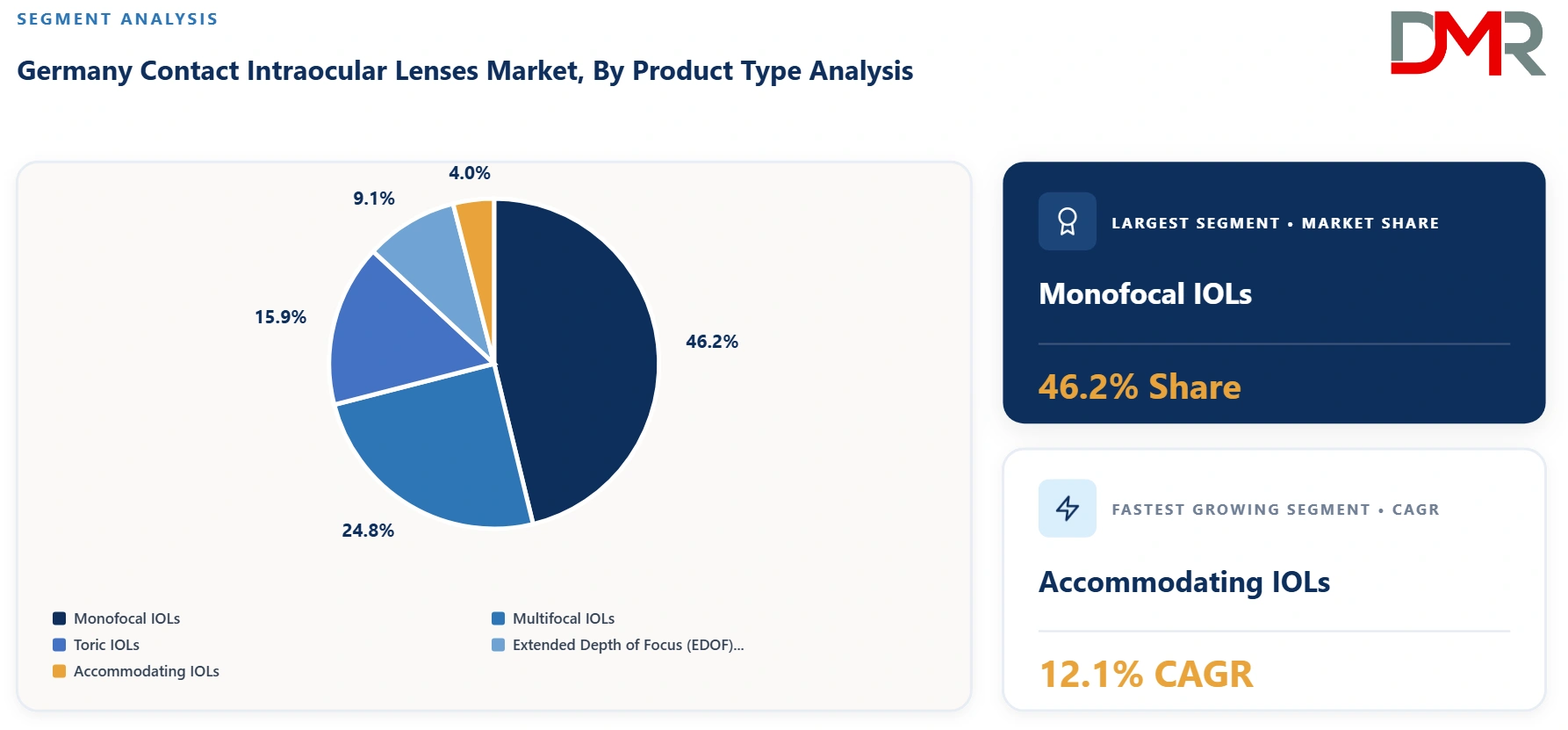
- By Product Type Analysis: Monofocal IOLs is projected to lead the product type segment with a 46.2% share in 2026, reflecting their status as the standard, fully insurance-reimbursed lens option. Accommodating IOLs is the fastest-growing product type segment at 12.1% CAGR, driven by growing patient interest in more naturally focusing lens alternatives to traditional multifocal designs.
- By Material Analysis: Hydrophobic Acrylic is expected to dominate with a 39.8% share in 2026, supported by its favorable biocompatibility and reduced posterior capsule opacification profile. Silicone Hydrogel is the fastest-growing material segment at 9.4% CAGR, driven by expanding use in advanced contact lens applications supporting refractive correction.
- By Application Analysis: Cataract Surgery is poised to lead with a 52.6% share in 2026, reflecting Germany's substantial and aging cataract surgery patient population. Presbyopia Correction is the fastest-growing application segment at 9.8% CAGR, driven by demographic aging and growing multifocal and accommodating lens adoption.
- By Distribution Channel Analysis: Hospitals and Eye Clinics is projected to dominate with a 61.3% share in 2026, reflecting the clinical nature of intraocular lens implantation procedures. E-Commerce/Online Channels is the fastest-growing distribution channel segment at 11.6% CAGR, driven by growing consumer comfort purchasing contact lens products through digital channels.
- By End User Analysis: Hospitals are projected to dominate with a 44.7% share in 2026, reflecting their central role in cataract surgery and broader ophthalmic care delivery. Ambulatory Surgical Centers is the fastest-growing end user segment at 10.9% CAGR, driven by continued shift toward efficient, high-volume outpatient cataract surgery delivery models.
Key Drivers in the Germany Contact Intraocular Lenses Market
Germany's Rapidly Aging Population Driving Cataract Surgery Volume Growth
Germany's substantial and continuing demographic aging trend, with one of the highest median ages in Europe, is driving sustained growth in age-related cataract prevalence and corresponding cataract surgery volumes. As cataracts represent an age-related condition affecting a large proportion of elderly populations, Germany's demographic profile creates a structurally durable and growing demand base for intraocular lens products across all material and optical design categories, with this demographic-driven growth expected to continue as Germany's elderly population share continues expanding throughout the forecast period.
Growing Patient Willingness to Pay for Premium Lens Materials and Optical Designs
German statutory health insurance typically covers the cost of standard monofocal intraocular lenses for cataract surgery, but patients increasingly choose to pay out-of-pocket premiums for advanced multifocal, toric, EDOF, or accommodating lens options manufactured from premium hydrophobic or hydrophilic acrylic materials offering improved visual outcomes and reduced dependence on glasses following surgery. This growing patient willingness to invest personally in premium visual outcomes is driving substantial premiumization within the intraocular lens market beyond what insurance-reimbursed standard lens volumes alone would suggest.
Restraints in the Germany Contact Intraocular Lenses Market
Insurance Reimbursement Limitations Constraining Premium Product Accessibility
Germany's statutory health insurance system's limited reimbursement coverage for premium intraocular lens optical designs and materials, requiring patients to pay substantial out-of-pocket premiums for multifocal, EDOF, toric, or accommodating lens options, represents a meaningful restraint on the Contact Intraocular Lenses Market. This reimbursement structure can limit premium lens accessibility for patients with more constrained personal financial resources, constraining overall premium lens category growth relative to a fully reimbursed alternative reimbursement structure.
Growth Opportunities in the Germany Contact Intraocular Lenses Market
Advanced Material Innovation Reducing Posterior Capsule Opacification and Improving Biocompatibility
Growing clinical and patient interest in intraocular lens materials that minimize long-term complications such as posterior capsule opacification presents a substantial opportunity for manufacturers developing advanced hydrophobic and hydrophilic acrylic material formulations with improved biocompatibility profiles. Companies capable of demonstrating superior long-term clinical outcomes associated with next-generation lens materials can capture premium positioning and stronger surgeon and patient preference within the German market.
Digital and Direct-to-Consumer Distribution Channel Development for Refractive Correction Products
Growing German consumer comfort with digital commerce presents an opportunity for companies to develop enhanced e-commerce and direct-to-consumer distribution capabilities for refractive correction lens products, potentially including digital vision testing and prescription verification services that reduce friction in the online purchasing process while maintaining appropriate clinical oversight standards.
Trends in the Germany Contact Intraocular Lenses Market
Continued Premiumization Toward Multifocal, EDOF, and Accommodating Lens Designs
German ophthalmology practices and cataract surgery patients continue to shift toward premium multifocal, extended depth of focus, and accommodating intraocular lens options, reflecting both improving lens technology performance and growing patient expectations for comprehensive visual outcome improvement, including reduced spectacle dependence, as part of cataract surgery.
Growing Adoption of Advanced Acrylic Materials Across Premium Lens Categories
German lens manufacturers and ophthalmology practices are increasingly favoring advanced hydrophobic and hydrophilic acrylic materials across premium intraocular lens categories, reflecting their favorable optical clarity, biocompatibility, and long-term safety profile relative to older material categories such as PMMA and certain silicone formulations, which continue to see more limited use in specific clinical contexts.
Research Scope and Analysis
The Germany Contact Intraocular Lenses Market is segmented by product type, material, application, distribution channel, and end user, covering monofocal, multifocal, toric, EDOF, and accommodating IOLs, hydrogel, silicone hydrogel, rigid gas permeable, acrylic, PMMA, and silicone materials, and cataract surgery, refractive correction, and cosmetic application categories.
ℹ
To learn more about this report –
Download Your Free Sample Report Here
By Product Type Analysis
Monofocal IOLs is projected to dominate the Germany Contact Intraocular Lenses Market with 46.2% share in 2026, reflecting their status as the standard, fully statutory health insurance-reimbursed intraocular lens option for cataract surgery patients. Accommodating IOLs is expected to register the highest CAGR of 12.1% during 2026-2035, driven by growing patient and surgeon interest in lens designs that more naturally replicate the eye's own focusing mechanism as an alternative to traditional multifocal optical approaches.
By Material Analysis
Hydrophobic Acrylic is anticipated to dominate the Germany Contact Intraocular Lenses Market by material, accounting for 39.8% share in 2026, supported by its favorable biocompatibility, optical clarity, and reduced posterior capsule opacification profile relative to alternative lens materials. Silicone Hydrogel is projected to register the highest CAGR of 9.4% between 2026 and 2035, driven by expanding use in advanced contact lens applications supporting oxygen permeability and comfort for refractive correction wearers.
By Application Analysis
Cataract Surgery is projected to lead the Germany Contact Intraocular Lenses Market with an estimated 52.6% share in 2026, underpinned by Germany's substantial and demographically-driven growing cataract surgery patient population. Presbyopia Correction is expected to register the fastest CAGR of 9.8% through 2035, driven by Germany's aging population and growing adoption of multifocal and accommodating lens solutions addressing age-related near vision decline.
By Distribution Channel Analysis
Hospitals and Eye Clinics are projected to dominate the Germany Contact Intraocular Lenses Market with 61.3% share in 2026, reflecting the clinical, procedure-based nature of intraocular lens implantation requiring specialized surgical facilities. E-Commerce/Online Channels is expected to register the fastest CAGR of 11.6% through 2035, driven by growing German consumer comfort purchasing contact lens and related eye care products through digital channels.
By End User Analysis
Hospitals are projected to dominate the Germany Contact Intraocular Lenses Market with 44.7% share in 2026, reflecting their central and essential role in cataract surgery and broader specialized ophthalmic care delivery. Ambulatory Surgical Centers are expected to register the fastest CAGR of 10.9% through 2035, driven by continued shift toward efficient, high-volume outpatient cataract surgery delivery models across the German healthcare system.
The Germany Contact Intraocular Lenses Market Report is segmented based on the following:
By Product Type
- Monofocal IOLs
- Multifocal IOLs
- Toric IOLs
- Extended Depth of Focus (EDOF) IOLs
- Accommodating IOLs
By Material
- Hydrogel
- Silicone Hydrogel
- Rigid Gas Permeable Materials
- Hydrophobic Acrylic
- Hydrophilic Acrylic
- Polymethyl Methacrylate (PMMA)
- Silicone
By Application
- Myopia and Refractive Correction
- Astigmatism Correction
- Presbyopia Correction
- Cataract Surgery
- Cosmetic and Aesthetic Use
By Distribution Channel
- Hospitals and Eye Clinics
- Optical Retail Stores
- E-Commerce/Online Channels
- Others
By End User
- Hospitals
- Ophthalmology and Eye Care Clinics
- Ambulatory Surgical Centers
- Retail Optical Chains
- Others
Technology Analysis
Technology development is increasingly shaping competitiveness in the Germany Contact Intraocular Lenses Market as companies invest in advanced hydrophobic and hydrophilic acrylic material formulations improving biocompatibility and long-term optical clarity, accommodating lens mechanisms designed to more naturally replicate eye focusing, and digital biometry and surgical planning technology supporting precise lens power selection. Growing use of light-adjustable lens technology is enabling post-surgical vision correction refinement, addressing a persistent limitation of fixed-power intraocular lens implantation. Opportunities are expanding for companies developing next-generation accommodating lens designs, advanced material formulations reducing posterior capsule opacification risk, and digital vision testing technology supporting safe online distribution of refractive correction products. However, achieving consistent visual outcome quality across diverse patient anatomies remains an ongoing clinical and technical consideration for premium lens technology adoption.
Investment and White Space Analysis
Investment opportunities in the Germany Contact Intraocular Lenses Market are expanding alongside the country's demographically-driven cataract surgery volume growth, rising myopia prevalence, and continued patient willingness to invest in premium lens materials and optical designs. Significant white space exists in accommodating lens technology innovation, advanced acrylic material development reducing long-term complication risk, and digital distribution channel development for refractive correction products. Companies with strong clinical evidence supporting premium material and design performance, established relationships with German ophthalmology practices and ambulatory surgical centers, and digital distribution capability are positioned to capture premium, longer-duration growth opportunities. However, insurance reimbursement limitations constraining premium product accessibility can constrain the pace of premiumization-driven market expansion.
Competitive Landscape
The Germany Contact Intraocular Lenses Market is moderately consolidated and competitive, comprising large diversified global ophthalmic device and contact lens companies with substantial German operations, specialized intraocular lens manufacturers focused on advanced materials and optical designs, and German and European retail optical chains. Competition centers on premium lens material and optical design performance, clinical evidence generation, established relationships with German hospitals and ambulatory surgical centers, and digital distribution capability. Large diversified global companies benefit from substantial research and development resources and broad product portfolios spanning multiple material and optical design categories, while specialized manufacturers compete through deep technical expertise in specific premium material or accommodating lens technology. Companies increasingly differentiate through material innovation and clinical evidence generation rather than standard product breadth alone.
Some of the prominent players in the Germany Contact Intraocular Lenses Market are:
- Alcon Inc.
- Johnson & Johnson Vision
- Bausch + Lomb Corporation
- Carl Zeiss Meditec AG
- HOYA Corporation
- Rayner Group
- HumanOptics Holding AG
- STAAR Surgical Company
- BVI Medical
- Lenstec, Inc.
- Ophtec B.V.
- SIFI S.p.A.
- Medicontur Medical Engineering Ltd.
- Hanita Lenses
- SAV-IOL SA
- EyeKon Medical, Inc.
- Aurolab
- Biotech Healthcare Group
- MORCHER GmbH
- Teleon Surgical B.V.
- Cutting Edge SAS
- Cristalens Industrie
- VSY Biotechnology GmbH
- AJL Ophthalmic S.A.
- Kowa Company, Ltd.
- NIDEK CO., LTD.
- Santen Pharmaceutical Co., Ltd.
- Care Group
- Omni Lens Pvt. Ltd.
- Excellent Hi-Care Pvt. Ltd.
- Appasamy Associates
- Eagle Optics Pvt. Ltd.
- Ophthalmic Innovations International
- Sidapharm P.C.
- EyeOL UK Limited
- Soleko S.p.A.
- Rumex International Co.
- Aaren Scientific Inc.
- Tekia, Inc.
- Visioncare Ophthalmic Technologies
- Other Key Players
Recent Developments
- June 2026: Carl Zeiss Meditec announced successful early clinical implantations of the AT LUCIA toric 721P IOL across six European countries, explicitly including Germany. It was CE marked and expected to become commercially available in selected European countries later in 2026.
- June 2025: Johnson & Johnson announced the rollout of the TECNIS Odyssey IOL across Europe, the Middle East, and Canada on June 17, 2025. However, the announcement does not explicitly identify Germany, so it is better described as a European market development relevant to Germany.
- March 2025: Alcon announced CE Mark approval for Clareon Vivity and Clareon Vivity Toric IOLs and stated that European commercialization would begin in early Q2 2025. The official announcement specifically discusses the German cataract market and quotes a German ophthalmology specialist.
Report Details
| Report Characteristics |
| Market Size (2026) |
USD 1.8 Bn |
| Forecast Value (2035) |
USD 3.3 Bn |
| CAGR (2026–2035) |
6.97% |
| Historical Data |
2021 – 2025 |
| Forecast Data |
2026 – 2035 |
| Base Year |
2025 |
| Segments Covered |
By Product Type, By Material, By Application, By Distribution Channel, and By End User |
| Country Coverage |
Germany |
Frequently Asked Questions
How big is the Germany Contact Intraocular Lenses Market?
▾ The Germany Contact Intraocular Lenses Market is poised to be valued at USD 1.8 Billion in 2026 and is projected to reach USD 3.3 Billion by 2035, reflecting Germany's aging population driving cataract surgery growth and rising myopia prevalence increasing refractive correction lens demand.
What is the CAGR of the Germany Contact Intraocular Lenses Market from 2026 to 2035?
▾ The market is projected to expand at a compound annual growth rate (CAGR) of 6.6% between 2026 and 2035, supported by demographic-driven cataract surgery volume growth, premium lens material and design adoption, and continued ambulatory surgical center expansion.
What factors are driving the growth of the Germany Contact Intraocular Lenses Market?
▾ Growth is driven by Germany's rapidly aging population driving cataract surgery volume growth, rising myopia prevalence among younger populations, growing out-of-pocket spending on premium intraocular lens technology, and continued expansion of ambulatory surgical center capacity.
What are the major trends in the Germany Contact Intraocular Lenses Market?
▾ Major trends include continued premiumization toward multifocal, EDOF, and accommodating lens designs, growing adoption of advanced acrylic materials across premium lens categories, and rising investment in light-adjustable lens technology.
Who are the key players in the Germany Contact Intraocular Lenses Market?
▾ Key market participants include Carl Zeiss Meditec, Alcon, Johnson & Johnson Vision, Bausch + Lomb, and CooperVision, among other global and specialized German ophthalmic lens companies.
How is the Germany Contact Intraocular Lenses Market segmented?
▾ The market is segmented by product type, material, application, distribution channel, and end user, with demand analysis concentrated across Bavaria, North Rhine-Westphalia, and Baden-Württemberg.