Germany Food Safety Testing Market Snapshot
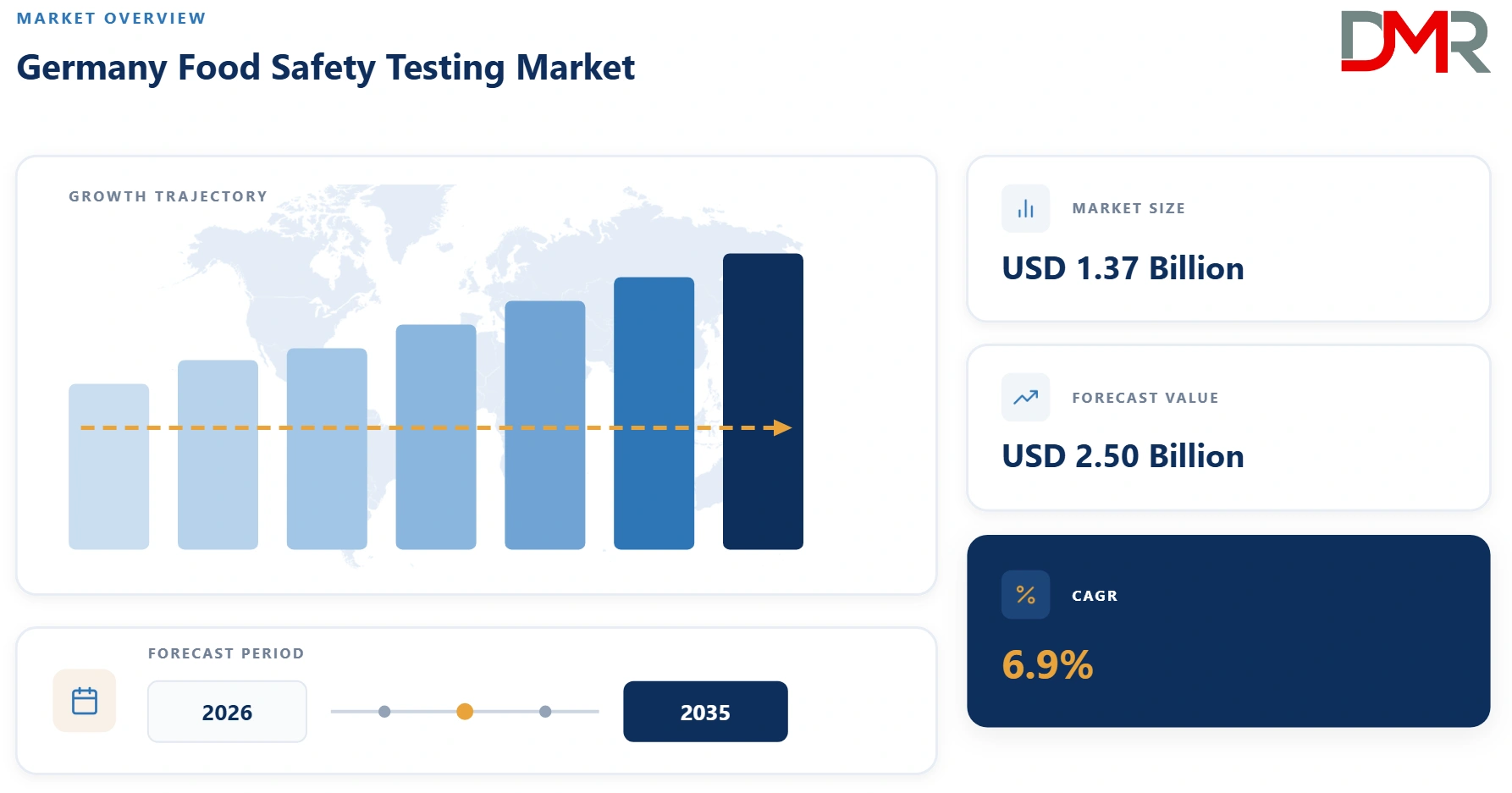
- Germany Food Safety Testing Market Size in 2026: USD 1.37 Billion
- Germany Food Safety Testing Market Size in 2035: USD 2.50 Billion
- Germany CAGR from 2026 to 2035: 6.9%
- Pathogen is the leading Type segment in 2026: 40.2%
- Meat and Meat Products is the leading Food Tested segment in 2026: 32.3%
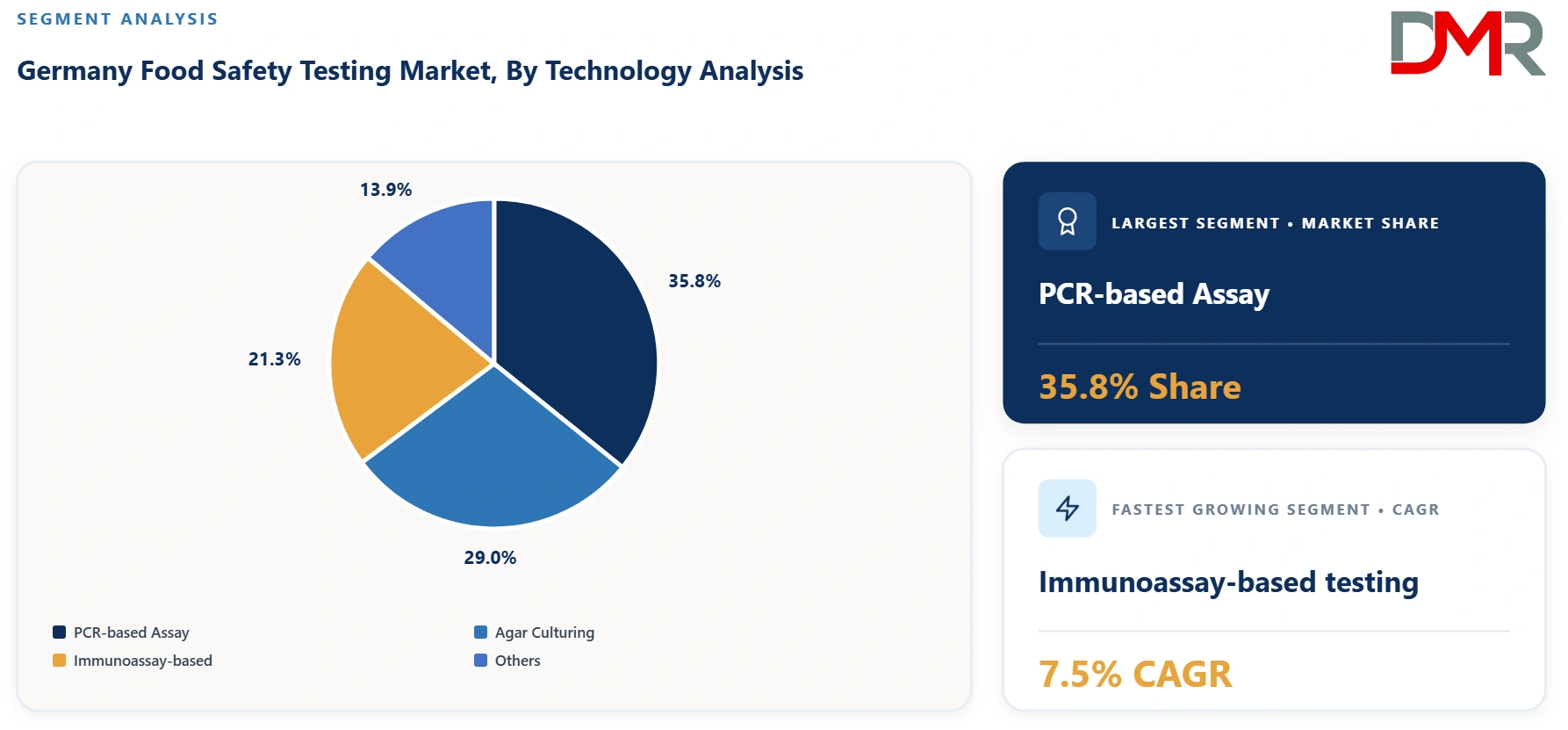
- PCR-based Assay is the leading Technology segment in 2026: 35.8%
What is the Germany Food Safety Testing Market and its Market Size?
The Germany Food Safety Testing Market is projected to reach USD 1.37 billion in 2026 and grow at a compound annual growth rate of 6.9% through 2035 to reach USD 2.50 billion.
ℹ
To learn more about this report –
Download Your Free Sample Report Here
Food safety testing comprises analytical processes used to detect pathogens, toxins, allergens, pesticide residues, genetically modified organisms, chemical contaminants, adulterants, and other hazards in food products. Germany maintains one of Europe’s most structured food-control systems, supported by federal and state authorities, accredited laboratories, food manufacturers, retailers, and independent testing companies. Market demand is strengthened by stringent European Union regulations, cross-border food trade, consumer concern about contamination, product recalls, food fraud, and traceability. Laboratories increasingly employ PCR assays, immunoassays, chromatography, mass spectrometry, biosensors, automation, and digital laboratory-management platforms to deliver accurate and rapid results.
Use Cases
- Pathogen Detection: Food producers, processors, retailers, and regulatory laboratories use pathogen testing to detect Salmonella, Listeria monocytogenes, Campylobacter, pathogenic E. coli, viruses, and other microorganisms. Testing raw materials, production environments, finished products, and processing surfaces enables early contamination detection, supports hygiene verification, prevents foodborne outbreaks, protects consumers, and reduces the financial and reputational consequences associated with recalls and regulatory violations.
- Chemical and Residue Analysis: Laboratories examine food products for pesticide residues, mycotoxins, heavy metals, veterinary drug residues, processing contaminants, allergens, and environmental pollutants. These services help German food companies demonstrate compliance with European maximum residue levels and contaminant limits. Advanced chromatography and mass-spectrometry systems provide sensitive multiresidue analysis, enabling manufacturers and importers to evaluate complex products and manage chemical risks throughout supply chains.
- Authenticity and GMO Verification: DNA-based testing verifies species, geographical origin, ingredient composition, genetically modified content, and product-label accuracy. Meat processors, organic brands, importers, retailers, and certification organizations use these services to identify substitution, adulteration, undeclared ingredients, and fraudulent claims. Reliable authenticity testing supports regulatory compliance, protects premium product categories, strengthens consumer confidence, and enables companies to validate supplier documentation across increasingly international food networks.
Key Takeaways
- Market Size: The Germany Food Safety Testing Market is anticipated to be valued at USD 1.37 billion in 2026 and is forecast to reach USD 2.50 billion by 2035, expanding at a CAGR of 6.9%.
- Growth Rate and Outlook: Market expansion is supported by stringent food-safety regulations, increasing food imports, rising consumer awareness, more frequent testing requirements, complex international supply chains, private-label quality programs, technological advancements, and growing demand for faster detection of biological and chemical contaminants.
- Primary Growth Drivers: Increasing concerns about foodborne illnesses, allergen exposure, pesticide residues, mycotoxins, food fraud, antimicrobial resistance, and undeclared ingredients are accelerating investment in laboratory testing. Regulatory enforcement and retailer-mandated quality requirements are also expanding routine testing volumes.
- By Type Analysis: Pathogen testing is projected to lead the type segment with a 40.2% share in 2026. Its dominance is supported by mandatory microbiological criteria, recurring Salmonella and Listeria risks, environmental-monitoring programs, and stringent hygiene requirements across meat, dairy, ready-to-eat, and processed-food facilities.
- By Food Tested Analysis: Meat and Meat Products are anticipated to dominate with a 32.3% share in 2026. High susceptibility to microbial contamination, extensive processing and cold-chain handling, species-authenticity concerns, veterinary residue monitoring, and strict regulatory controls support frequent testing.
- By Technology Analysis: PCR-based Assay is expected to lead with a 35.8% share in 2026 due to its high sensitivity, specificity, speed, multiplexing capability, and suitability for detecting pathogens, allergens, genetically modified organisms, and species-specific DNA in complex food samples.
How AI and Generative AI are Transforming the Germany Food Safety Testing Market?
Artificial intelligence is improving Germany’s food safety testing workflows through automated sample prioritization, contamination-pattern recognition, predictive risk assessment, and intelligent interpretation of laboratory results. Machine-learning systems can combine testing histories, supplier records, environmental-monitoring data, weather conditions, and recall information to identify higher-risk products and facilities. Generative AI supports report preparation, regulatory-document analysis, corrective-action summaries, and laboratory knowledge retrieval. AI-enabled imaging also accelerates colony counting and foreign-object identification. Adoption nevertheless requires validated models, secure data governance, human oversight, transparent decisions, and integration with laboratory information management systems to maintain regulatory confidence.
Key Drivers in the Germany Food Safety Testing Market
Stringent European and German Food-Safety Regulations
Germany’s food industry operates under comprehensive EU hygiene, microbiological, pesticide-residue, contaminant, labeling, GMO, and official-control requirements. Regulation EC 2073 2005 establishes microbiological criteria, while EU databases define maximum residue levels for pesticide substances. Germany’s Federal Office of Consumer Protection and Food Safety coordinates important monitoring and risk-management activities with state authorities. Compliance requires manufacturers, importers, retailers, and laboratories to test products regularly and document reliable results. The regulatory framework covers the entire food chain and encourages accredited testing, method validation, traceability, and corrective action, creating sustained demand for microbiological, molecular, chemical, allergen, authenticity, and residue-testing services.
Growing Food Fraud and Supply-Chain Complexity
Germany’s dependence on domestic production, intra-European trade, and imports from non-EU countries creates complicated ingredient and product networks requiring stronger verification. The European Alert and Cooperation Network recorded 1,335 AAC notifications and 1,959 RASFF notifications associated with suspected fraud during 2024, representing respective annual increases of 24% and 21%. Product tampering, inaccurate documentation, undeclared ingredients, and misleading origin claims increase demand for DNA testing, isotope analysis, spectroscopy, chromatography, and chemical fingerprinting. German retailers and food manufacturers are therefore expanding supplier audits, authenticity programs, incoming-material testing, and traceability controls to reduce recall exposure and protect brand credibility.
Restraints in the Germany Food Safety Testing Market
High Instrumentation and Laboratory Operating Costs
Advanced testing laboratories require substantial expenditure on PCR systems, chromatography, mass spectrometry, automated sample preparation, biosafety infrastructure, reference materials, software, calibration, maintenance, and trained personnel. ISO 17025 accreditation and participation in proficiency-testing programs add continuing compliance expenses. Small processors and independent laboratories may struggle to justify investment when sample volumes are inconsistent, or customers demand lower prices and faster turnaround. Complex matrices can also require extensive extraction, enrichment, cleanup, and confirmatory testing. These cost pressures encourage outsourcing but may constrain testing frequency among smaller businesses, particularly where legal requirements permit risk-based rather than universal batch testing.
Shortage of Specialized Laboratory Professionals
Food testing requires microbiologists, molecular biologists, analytical chemists, toxicologists, bioinformaticians, quality managers, and technicians capable of operating increasingly sophisticated instruments. Germany’s broader shortage of technically trained personnel creates recruitment and retention challenges for commercial and public laboratories. Training new employees in validated methods, laboratory quality systems, result interpretation, and regulatory documentation requires considerable time. Personnel shortages can extend turnaround times, limit laboratory capacity, increase wage costs, and delay the deployment of new testing technologies. Greater automation can reduce repetitive work, but expert oversight remains necessary for method development, unusual matrices, confirmatory analysis, quality assurance, and legally defensible reporting.
Growth Opportunities in the Germany Food Safety Testing Market
Expansion of Rapid and On-site Testing Solutions
German manufacturers increasingly require actionable results before releasing short-shelf-life products or restarting production lines following sanitation. This creates opportunities for portable PCR, lateral-flow assays, biosensors, ATP monitoring, microfluidics, and enrichment-free molecular detection. Rapid methods can reduce product-hold times, storage expenses, waste, and recall exposure while enabling more frequent environmental monitoring. Suppliers that combine validated testing kits with instruments, software, training, and technical support can address dairy, meat, bakery, fresh-produce, and ready-to-eat facilities. Wider acceptance will depend on comparable performance with reference methods, third-party certification, robust sampling protocols, and effective confirmation of presumptive-positive results.
Testing for Emerging Contaminants and Alternative Foods
Alternative proteins, plant-based products, fermentation-derived ingredients, novel foods, functional foods, and imported specialty ingredients introduce new analytical challenges. Laboratories can expand into allergen cross-contact, nutritional verification, processing contaminants, PFAS, mineral oils, microplastics, heavy metals, novel microbial hazards, and authenticity testing. Updated limits for substances such as nickel and continuing reviews of food-contact materials also create specialized compliance demand. Germany’s innovative food-manufacturing base offers opportunities for laboratories to develop matrix-specific methods, regulatory consulting, shelf-life studies, challenge testing, and integrated safety assessments. Providers that identify emerging risks early can establish differentiated, higher-value service portfolios.
Trends in the Germany Food Safety Testing Market
Transition Toward Molecular and Multiplex Testing
PCR-based assays are increasingly replacing or complementing traditional culture techniques where manufacturers need faster and more specific results. Multiplex assays can screen several pathogens, allergens, GMO events, or animal species within one workflow, reducing time and sample requirements. Digital PCR and next-generation sequencing provide additional sensitivity and characterization for difficult samples, outbreak investigations, authenticity verification, and microbial-source tracking. In March 2025, Bio-Rad introduced an XP-Design PCR assay for rapid Salmonella detection and serotyping in food and environmental samples. However, culture confirmation remains important for regulatory investigation, strain recovery, and antimicrobial-resistance testing. (Bio-Rad)
Laboratory Automation and Digital Data Integration
Testing providers are automating sample preparation, plate handling, colony counting, nucleic-acid extraction, result interpretation, and reporting to increase throughput and reduce human error. Laboratory information management systems connect sample custody, instrument outputs, specifications, quality-control data, and customer portals. Eurofins previously outlined plans to automate a sizable proportion of contaminant-testing sample preparation within its European food and environmental laboratory network. Germany’s laboratories are also adopting electronic records, cloud-enabled dashboards, barcode tracking, and predictive maintenance. These investments improve reproducibility and turnaround times but increase requirements for cybersecurity, software validation, interoperability, audit trails, and laboratory employee training.
Research Scope and Analysis
This report examines German food safety testing across type of food tested and technology, covering pathogen, genetically modified organism, chemical and toxin, and other testing of meat and meat products; dairy and dairy products; cereals, grains and pulses; processed food and other foods; agar culturing; PCR-based assays; immunoassay methods and technologies, with forecasts from 2026 through 2035.
ℹ
To learn more about this report –
Download Your Free Sample Report Here
By Type Analysis
Pathogen testing is projected to dominate the type segment with a 40.2% market share in 2026, driven by mandatory microbial controls and regular environmental monitoring. Chemical and Toxin testing is expected to record the highest CAGR of approximately 7.8%. Expansion is supported by tighter limits for pesticides, mycotoxins, heavy metals, PFAS, veterinary residues, processing contaminants, and undeclared allergens.
By Food Tested Analysis
Meat and Meat Products are expected to lead the food tested segment with a 32.3% share in 2026, owing to recurring pathogen risks and stringent processing controls. Processed Food is projected to register the highest CAGR of 7.7%. Growth reflects complex ingredient formulations, allergen risks, extended supply chains, convenience-food consumption, private-label standards, and rising authenticity-testing requirements.
By Technology Analysis
PCR-based Assay is anticipated to lead the technology segment with a 35.8% share in 2026, supported by rapid detection, high sensitivity, specificity, and multiplex capabilities. Immunoassay-based testing is expected to achieve the highest CAGR of around 7.5%. Its expansion is driven by cost-effective screening, simple workflows, portable formats, rapid allergen detection, and broader adoption within production facilities.
The Germany Food Safety Testing Market Report is Segmented Based on the Following
By Type
- Pathogen
- Genetically Modified Organism
- Chemical and Toxin
- Others
By Food Tested
- Meat and Meat Products
- Dairy and Dairy Products
- Cereals, Grains and Pulses
- Processed Food
- Others
By Technology
- Agar Culturing
- PCR-based Assay
- Immunoassay-based
- Others
Regulatory Landscape
Germany’s food safety testing environment is governed by harmonized EU legislation and national enforcement conducted primarily through federal-state coordination. Major requirements address official controls, food hygiene, microbiological criteria, contaminants, pesticide residues, allergens, GMOs, veterinary residues, food-contact materials, traceability, and labeling. Germany’s BVL coordinates national monitoring activities, while BfR provides scientific risk assessment and recommendations. RASFF facilitates rapid information exchange concerning unsafe food and feed across Europe. Regulatory tightening creates recurring laboratory demand but also increases method-validation and documentation burdens. Opportunities exist for accredited providers offering integrated compliance testing, regulatory intelligence, risk assessment, and rapid response following noncompliance, border rejection, or product-recall events.
Technology Analysis
Germany’s testing laboratories use complementary technologies according to hazard, matrix, turnaround requirement, and regulatory purpose. Agar culture remains essential for viable organism recovery and confirmatory microbiology, while PCR offers faster and highly specific pathogen, GMO, allergen, and species detection. Immunoassays support economical screening at laboratories and production sites. Chromatography and mass spectrometry enable sensitive analysis of pesticides, toxins, allergens, residues, contaminants, and adulterants. Digital PCR, next-generation sequencing, biosensors, robotics, and AI-assisted analysis represent higher-growth opportunities. Technology adoption may improve throughput and detection capability, although laboratories must address equipment costs, reference-method comparability, accreditation, cybersecurity, skilled staffing, software validation, and cross-platform data integration.
Competitive Landscape
The Germany Food Safety Testing Market includes multinational testing, inspection, and certification groups, domestic laboratories, scientific instrument manufacturers, diagnostic-assay suppliers, and specialized food analytics companies. Competition centers on accreditation, laboratory coverage, test-menu breadth, turnaround time, analytical sensitivity, regulatory knowledge, digital reporting, and customer support. Eurofins, SGS, TÜV organizations, Intertek, Mérieux NutriSciences, Tentamus, and Institut Kirchhoff hold strong service capabilities, while Bio-Rad, Neogen, QIAGEN, Thermo Fisher Scientific, and Merck supply testing platforms and consumables. Consolidation, laboratory automation, rapid-test development, and integrated compliance services are expected to strengthen competition.
Some of the Prominent Players in the Germany Food Safety Testing Market Are
- Eurofins Scientific SE
- SGS Société Générale de Surveillance SA
- Intertek Group plc
- TÜV SÜD AG
- TÜV Rheinland AG
- TÜV NORD GROUP
- Mérieux NutriSciences Corporation
- Tentamus Group GmbH
- Institut Kirchhoff Berlin GmbH
- WESSLING GmbH
- AGROLAB GROUP
- GBA Group
- ifp Institut für Produktqualität GmbH
- bilacon GmbH
- QIAGEN N.V.
- Bio-Rad Laboratories Inc.
- Neogen Corporation
- Thermo Fisher Scientific Inc.
- Merck KGaA
- R-Biopharm AG
- Hygiena LLC
- Romer Labs Division Holding GmbH
- Charm Sciences Inc.
- PerkinElmer Inc.
- Agilent Technologies Inc.
- Shimadzu Corporation
- Bruker Corporation
- Waters Corporation
- SCIEX
- ALS Limited
- Bureau Veritas SA
- NSF International
- AsureQuality Limited
- IDEXX Laboratories Inc.
- 3M Company
- ELISA Technologies Inc.
- BIOTECON Diagnostics GmbH
- Analytik Jena GmbH+Co. KG
- LGC Limited
- Microbac Laboratories Inc.
- Other Key Players
Recent Developments
- April 2026: Neogen’s Listeria Right Now rapid environmental-monitoring test received AOAC Performance Tested Methods certification. The enrichment-free assay can detect viable and nonviable Listeria species on stainless-steel surfaces and provide actionable results in approximately two hours.
- March 2025: Bio-Rad Laboratories launched the XP-Design Assay Salmonella Serotyping Solution for rapid detection and precise characterization of Salmonella species in food and environmental samples, strengthening its molecular food-safety testing portfolio. (Bio-Rad)
- July 2025: Mérieux NutriSciences completed its global acquisition of Bureau Veritas’ food-testing business, significantly expanding its laboratory presence and strengthening its position in food testing, inspection, and certification services.
- January 2025: Neogen launched its Molecular Detection Assay 2 Quantitative Salmonella solution, providing food producers and laboratories with quantitative molecular analysis alongside established qualitative pathogen-testing workflows.
Report Details
| Report Characteristics |
| Market Size (2026) |
USD 1.37 Bn |
| Forecast Value (2035) |
USD 2.50 Bn |
| CAGR (2026–2035) |
6.9% |
| Historical Data |
2021 – 2025 |
| Forecast Data |
2026 – 2035 |
| Base Year |
2025 |
| Segments Covered |
By Type, By Food Tested, By Technology |
Frequently Asked Questions
How big is the Germany Food Safety Testing Market?
▾ The Germany Food Safety Testing Market is projected to be valued at USD 1.37 billion in 2026 and reach USD 2.50 billion by 2035.
What is the CAGR of the Germany Food Safety Testing Market from 2026 to 2035?
▾ The market is forecast to expand at a compound annual growth rate of 6.9% from 2026 to 2035.
What factors are driving the growth of the Germany Food Safety Testing Market?
▾ Market growth is driven by stringent EU regulations, foodborne disease concerns, expanding cross-border trade, complex supply chains, food fraud, product recalls, consumer awareness, and growing adoption of rapid testing technologies.
What are the major trends in the Germany Food Safety Testing Market?
▾ Major trends include PCR and multiplex testing, laboratory automation, AI-supported risk assessment, digital laboratory systems, rapid on-site assays, authenticity verification, and testing for emerging chemical contaminants.
Who are the key players in the Germany Food Safety Testing Market?
▾ Key players include Eurofins Scientific, SGS, Intertek, TÜV SÜD, TÜV Rheinland, Mérieux NutriSciences, Tentamus Group, QIAGEN, Bio-Rad Laboratories, Neogen, Thermo Fisher Scientific, and R-Biopharm.
How is the Germany Food Safety Testing Market segmented?
▾ The market is segmented by Type into Pathogen, Genetically Modified Organism, Chemical and Toxin, and Others, by Food Tested, and by Technology into Agar Culturing, PCR-based Assay, Immunoassay-based, and Others.