Germany Sustainable Food Packaging Market Snapshot
- Germany Sustainable Food Packaging Market Size in 2026: USD 12.7 billion
- Germany Sustainable Food Packaging Market Size in 2035: USD 22.8 billion
- Germany CAGR from 2026 to 2035: 6.7%
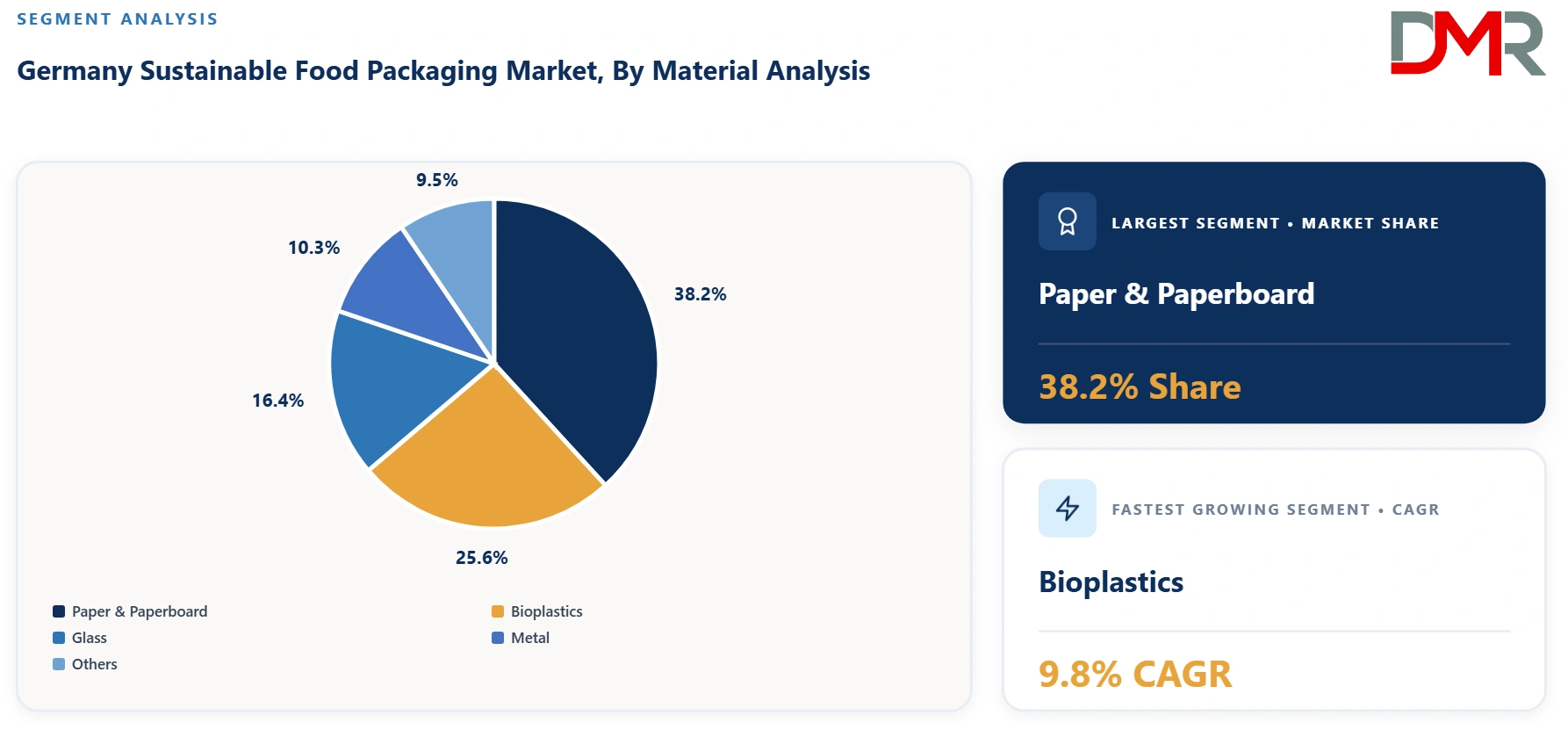
- Paper & Paperboard is the leading Material segment in 2026: 38.2%
- Rigid is the leading Packaging Type segment in 2026: 57.6%
- Bioplastics is the fastest-growing Material segment: 9.8% CAGR
- Ready-to-Eat Meals is the fastest-growing Application segment: 8.9% CAGR
- Offline remains the leading Distribution Channel in 2026: 71.4%
What is the Germany Sustainable Food Packaging and its Market Size?
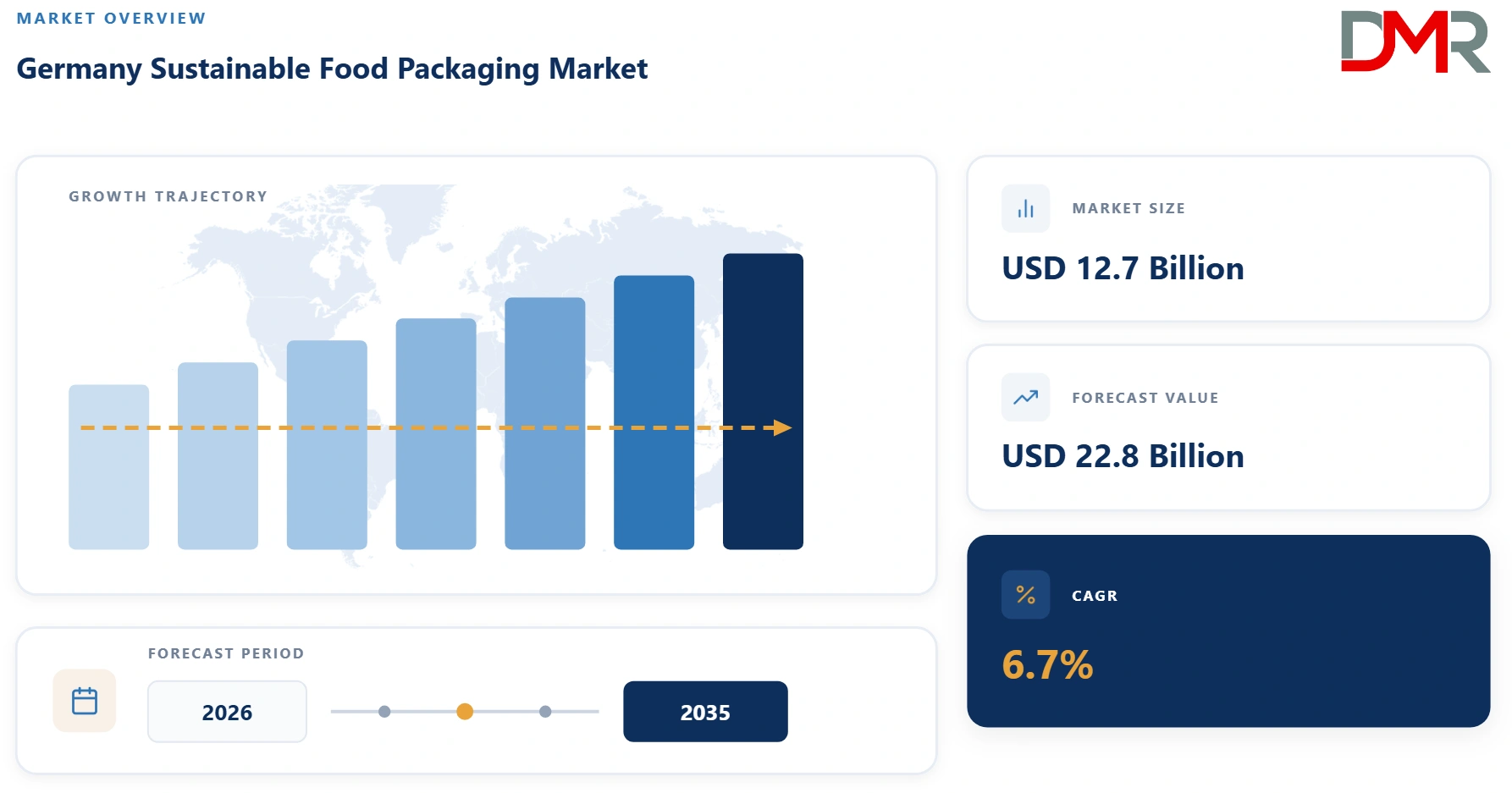
The Germany Sustainable Food Packaging Market is projected to be valued at USD 12.7 billion in 2026, and is further anticipated to reach USD 22.8 billion by 2035, expanding at a CAGR of 6.7%.
ℹ
To learn more about this report –
Download Your Free Sample Report Here
Germany's sustainable food packaging landscape is being reshaped by one of Europe's most stringent regulatory environments, anchored by the Packaging Act (VerpackG) and reinforced by EU-wide directives such as the Single-Use Plastics Directive and the Packaging and Packaging Waste Regulation (PPWR). These frameworks are compelling food manufacturers, retailers, and packaging converters to accelerate the shift away from conventional plastics toward recyclable, compostable, and bio-based alternatives. Germany's well-established recycling infrastructure, high consumer environmental awareness, and dense concentration of packaging technology innovators position it as the leading sustainable food packaging market within Europe, with demand reinforced by growing e-commerce food delivery, ready-to-eat meal consumption, and retailer-driven sustainability commitments across the grocery sector.
Use Cases
- Fresh Produce and Perishables Packaging: Compostable films, paper-based trays, and biodegradable wraps are increasingly used to extend shelf life for fruits, vegetables, dairy, and bakery products while meeting recyclability mandates.
- Ready-to-Eat and Convenience Food Packaging: Rigid, recyclable mono-material trays and clamshells support Germany's growing ready-to-eat and food delivery segment while complying with material-separation requirements under VerpackG.
- Beverage Packaging: Fiber-based bottles, recycled PET, and lightweight glass alternatives are gaining share as beverage producers respond to deposit-return system (Pfand) requirements and recycled-content targets.
- E-Commerce Food Delivery Packaging: Curbside-recyclable corrugated and paper-based mailers are replacing plastic-heavy packaging formats as online grocery and meal-kit delivery expands across urban Germany.
Key Takeaways
- Market Value: The Germany sustainable food packaging market is projected to grow from USD 12.7 billion in 2026 to USD 22.8 billion by 2035.
- Growth Rate: The market is expected to register a CAGR of 6.7% during the forecast period from 2026 to 2035.
- Regulatory Trends: VerpackG, EU Single-Use Plastics Directive, and the incoming PPWR are the primary structural forces shaping material selection and packaging design across the country.
- Market Drivers: Rising consumer willingness to pay a premium for eco-friendly packaging, retailer sustainability commitments, and expanding recycling infrastructure are key growth catalysts.
- Material Segment Analysis: Paper & Paperboard is expected to remain the leading material segment, while Bioplastics is projected to be the fastest-growing, registering roughly a 9.8% CAGR through 2035.
- Regional Position: Germany is expected to remain the largest sustainable food packaging market within Europe through the forecast period, ahead of France and the UK.
How is Innovation Transforming the Sustainable Food Packaging Market in Germany?
Material science innovation is central to Germany's sustainable food packaging evolution, with manufacturers investing in mono-material structures that simplify recycling, compostable bio-based films derived from plant fibers and starches, and barrier coatings that extend shelf life without compromising recyclability. Smart packaging technologies, including QR-code-enabled traceability and RFID-based lifecycle tracking, are being layered onto sustainable formats to help brands demonstrate compliance and give consumers visibility into a package's recyclability or compostability status. Advances in chemical and mechanical recycling infrastructure are simultaneously improving the economic viability of recovering food-grade materials, narrowing the cost gap between sustainable and conventional packaging formats.
Key Drivers in the Germany Sustainable Food Packaging Market
Stringent National and EU Packaging Regulation
Germany’s Packaging Act (VerpackG), alongside the EU Packaging and Packaging Waste Regulation and restrictions on single-use plastics, is accelerating the transition toward recyclable and resource-efficient food packaging. Producer responsibility requirements, recycling targets, material reduction measures, and increasing recyclability standards are encouraging food manufacturers and packaging companies to redesign product formats. Companies are investing in mono-material structures, recycled-content packaging, lightweight formats, and improved design-for-recycling capabilities. Regulatory deadlines create sustained demand for compliant packaging solutions across dairy, bakery, beverages, meat, and convenience foods. These requirements are expected to remain a major structural driver of sustainable packaging innovation and investment in Germany.
Rising Consumer Demand for Eco-Friendly Products
Growing environmental awareness among German consumers is strengthening demand for food products packaged in recyclable, reusable, compostable, and reduced-plastic formats. Consumers increasingly consider packaging sustainability when evaluating brands, encouraging food manufacturers and retailers to communicate recyclability, material sourcing, and waste-reduction credentials. Supermarkets, food brands, and private-label manufacturers are responding by adopting paper-based solutions, recyclable mono-material films, reusable containers, and packaging with reduced material consumption. This trend creates opportunities for packaging suppliers capable of combining sustainability with convenience, product protection, and visual appeal. Increasing consumer expectations are therefore transforming sustainable packaging from a compliance requirement into an important competitive differentiation strategy.
Restraints in the Germany Sustainable Food Packaging Market
Higher Material and Conversion Costs
The higher cost of sustainable materials remains a significant challenge for Germany’s food packaging market. Bio-based polymers, compostable films, specialty paper barriers, and high-quality recycled materials can carry higher costs than conventional virgin plastic alternatives. Packaging converters may also require new machinery, tooling, coatings, and production-line modifications to process emerging sustainable substrates efficiently. These investments can increase capital expenditure and manufacturing costs, particularly for smaller packaging companies and food producers. Cost pressures become especially significant in price-sensitive categories where manufacturers have limited ability to transfer increases to consumers. Achieving greater production scale and material availability will therefore remain important for improving commercial competitiveness.
Performance and Barrier Limitations
Performance limitations can restrict the adoption of sustainable food packaging across applications requiring strong moisture, oxygen, grease, temperature, and aroma barriers. Paper-based materials and certain compostable films may not independently provide the shelf-life performance achieved by conventional multilayer plastics. Manufacturers often require coatings, laminations, or additional barrier technologies, which can increase costs and potentially complicate recyclability. These challenges are particularly relevant for dairy products, meat, seafood, ready meals, and other perishable foods requiring extended shelf life. Continued innovation in functional coatings, bio-based barriers, and recyclable high-performance films will be necessary to balance sustainability requirements with food safety and product protection.
Growth Opportunities in the Germany Sustainable Food Packaging Market
Expansion of Bioplastics and Compostable Formats
Advancements in bio-based polymers and compostable packaging technologies are creating significant opportunities in Germany’s sustainable food packaging market. Improved heat resistance, mechanical strength, sealing performance, and barrier properties are expanding potential applications beyond dry foods into fresh, chilled, and convenience products. Packaging manufacturers are exploring renewable feedstocks and next-generation biodegradable materials to reduce dependence on fossil-based plastics. Growing sustainability commitments among food manufacturers and retailers can further support commercialization of these solutions. Bioplastics are therefore positioned for strong growth through 2035, particularly where suitable collection and treatment infrastructure exists and where alternative materials can meet food-contact safety and performance requirements.
Recycling Infrastructure Investment
Germany’s established recycling ecosystem provides significant opportunities for packaging companies developing formats compatible with advanced collection, sorting, and material-recovery systems. Continued investment in mechanical recycling, sorting technologies, recycled-material processing, and emerging chemical recycling methods could increase the availability of secondary raw materials for food packaging. Packaging manufacturers can benefit by developing mono-material structures and design-for-recycling solutions that improve recovery rates and material quality. Greater collaboration among recyclers, converters, food manufacturers, retailers, and waste-management companies can support closed-loop packaging systems. These developments create opportunities to increase recycled content, reduce dependence on virgin materials, and support circular-economy objectives across Germany’s food packaging value chain.
Trends in the Germany Sustainable Food Packaging Market
Shift Toward Mono-Material Packaging Design
German packaging manufacturers are increasingly replacing complex multilayer structures with mono-material packaging designed to improve sorting and recycling efficiency. Polyethylene- and polypropylene-based flexible structures are gaining attention as manufacturers seek to retain essential barrier, sealing, and mechanical properties while improving recyclability. Food companies are also redesigning trays, pouches, films, and containers to reduce unnecessary components and simplify material composition. This transition supports regulatory compliance and helps companies achieve circular packaging commitments. Continued advances in coatings, barrier technologies, and material engineering are expected to expand mono-material applications into more demanding food categories while reducing dependence on difficult-to-recycle combinations of plastics, aluminum, and other materials.
Growth of Reusable and Refillable Packaging Models
Reusable and refillable packaging models are emerging as an important sustainability trend as German retailers and food brands seek alternatives to conventional single-use packaging. Deposit-return concepts, reusable beverage containers, refill stations, and standardized reusable food-service packaging can reduce packaging waste through repeated circulation. Germany’s established consumer familiarity with deposit-return systems provides a supportive environment for broader reuse initiatives. However, successful adoption requires efficient collection, washing, reverse logistics, and inventory-management systems. Digital tracking technologies may further improve container circulation and return rates. Growing regulatory emphasis on packaging waste prevention is expected to encourage additional experimentation and investment in scalable reuse and refill models.
Research Scope and Analysis
The Germany sustainable food packaging market is segmented by material, packaging type, application, and distribution channel. Materials include paper and paperboard, bioplastics, glass, and metal, while applications cover bakery, dairy, produce, meat, seafood, beverages, and ready-to-eat meals, distributed through online and offline channels.
ℹ
To learn more about this report –
Download Your Free Sample Report Here
By Material Analysis
Paper & Paperboard is expected to remain the leading material segment in Germany’s sustainable food packaging market, supported by established recycling infrastructure, broad consumer acceptance, and extensive applications across bakery, confectionery, dry foods, and takeaway packaging. Manufacturers are improving coatings and barrier technologies to extend paper-based packaging into more demanding applications. Bioplastics are projected to be the fastest-growing material segment, with an estimated CAGR of approximately 9.8% through 2035. Advances in renewable feedstocks, compostable polymers, barrier performance, and processing technologies are supporting adoption across fresh and chilled food categories, creating new opportunities beyond applications traditionally dominated by conventional plastics.
By Packaging Type Analysis
Rigid packaging is expected to dominate Germany’s sustainable food packaging market in 2026 with approximately 57.6% of the market, supported by widespread utilization of trays, containers, bottles, cups, and clamshells. These formats are extensively used for dairy products, beverages, ready-to-eat meals, and fresh produce where structural protection is essential. Flexible packaging is anticipated to expand faster as manufacturers increasingly adopt lightweight and recyclable mono-material films. Lower material consumption, transportation efficiency, and improving recycling compatibility strengthen its sustainability proposition. Innovations in high-barrier recyclable films and functional coatings are expected to further expand flexible packaging applications while maintaining product protection and required shelf-life performance.
By Application Analysis
Bakery & Confectionery and Fruits & Vegetables are expected to represent substantial application segments within Germany’s sustainable food packaging market, supported by high packaging volumes and extensive use of paper-based, fiber-based, and recyclable formats. Packaging suppliers are developing lightweight trays, cartons, wraps, and films to reduce material consumption while protecting product quality. Ready-to-Eat Meals are projected to represent the fastest-growing application, registering an estimated CAGR of 8.9% through 2035. Rising demand for convenience foods, takeaway meals, and food delivery is increasing requirements for recyclable, compostable, and reusable containers capable of delivering adequate heat resistance, barrier performance, and transportation durability.
By Distribution Channel Analysis
Offline distribution channels are expected to remain dominant in Germany’s sustainable food packaging market, accounting for approximately 71.4% of packaged food sales in 2026. Supermarkets, discounters, convenience outlets, and traditional retailers generate substantial packaging demand and increasingly influence sustainability requirements through private-label strategies and supplier standards. Online distribution is projected to expand faster as grocery e-commerce, meal-kit platforms, and food delivery services gain adoption. This growth creates demand for packaging that combines recyclability with durability, lightweight construction, leakage prevention, and transportation protection. Packaging suppliers are consequently developing e-commerce-optimized formats that minimize unnecessary materials while maintaining food quality throughout fulfillment and last-mile delivery.
The Germany Sustainable Food Packaging Market Report is segmented based on the following:
By Material
- Paper & Paperboard
- Corrugated Board
- Folding Cartons
- Kraft Paper
- Molded Fiber
- Paper-Based Flexible Packaging
- Bioplastics
- Polylactic Acid (PLA)
- Polyhydroxyalkanoates (PHA)
- Starch-Based Bioplastics
- Bio-Based Polyethylene (Bio-PE)
- Other Bioplastics
- Glass
- Bottles
- Jars & Containers
- Metal
- Others
By Packaging Type
- Rigid
- Bottles & Jars
- Trays & Containers
- Cans
- Cartons & Boxes
- Cups & Tubs
- Flexible
- Pouches
- Bags & Sacks
- Films & Wraps
- Sachets
By Application
- Bakery & Confectionery
- Dairy Products
- Fruits & Vegetables
- Meat, Poultry & Seafood
- Beverages
- Ready-to-Eat Meals
- Others
By Distribution Channel
- Online
- E-Commerce Platforms
- Direct-to-Consumer
- Offline
- Supermarkets & Hypermarkets
- Convenience Stores
- Specialty Stores
- Traditional Retail Stores
Regulatory Landscape Analysis
The sustainable food packaging market is strongly influenced by tightening regulations targeting packaging waste, recyclability, recycled content, and single-use plastics. Governments are expanding extended producer responsibility frameworks and introducing stricter design-for-recycling and waste-reduction requirements, encouraging manufacturers to adopt recyclable, reusable, compostable, and lightweight packaging. These regulations create opportunities for suppliers of paper-based materials, bioplastics, mono-material films, and recycled-content solutions. However, evolving compliance standards, certification requirements, and differences between national regulations can increase development and operational costs. Companies that proactively redesign packaging portfolios can strengthen market positioning, while slower adopters face compliance risks, additional producer fees, restricted material choices, and potential loss of customers.
Technology Analysis
Technology innovation is accelerating sustainable food packaging development through advanced materials, high-barrier coatings, mono-material structures, bioplastics, molded fiber, and improved recycling technologies. Manufacturers are developing recyclable flexible films that maintain moisture, oxygen, grease, and aroma barriers while reducing dependence on complex multilayer packaging. Smart manufacturing, digital printing, lightweighting, and AI-assisted packaging design are also improving material efficiency and production performance. Significant opportunities exist in bio-based polymers, water-based coatings, reusable packaging systems, and food-grade recycled materials. However, performance limitations, scalability challenges, recycling compatibility, and higher technology costs remain risks. Continued innovation will expand sustainable packaging applications while improving shelf life, recyclability, resource efficiency, and commercial competitiveness.
Competitive Landscape
The Germany sustainable food packaging market is highly competitive, with global packaging groups, German manufacturers, and specialized converters competing through recyclable, fiber-based, lightweight, reusable, and recycled-content solutions. Major participants are investing in mono-material films, high-barrier papers, molded fiber, bioplastics, and advanced recycling-compatible packaging to address evolving PPWR and German packaging requirements. Competition increasingly centers on material efficiency, recyclability, food safety, barrier performance, and production scalability. Strategic partnerships with food manufacturers, acquisitions, capacity expansion, and material innovation remain important growth strategies. Companies with established recycling expertise and broad food-packaging portfolios are positioned strongly. Rising regulatory pressure and sustainability commitments are also creating opportunities for smaller technology-focused suppliers offering specialized coatings, compostable materials, and circular packaging solutions.
Some of the prominent players in the Germany Sustainable Food Packaging Market are:
- Mondi Group
- Amcor
- Huhtamaki
- Constantia Flexibles
- SÜDPACK
- Coveris
- Wipak
- ALPLA Group
- Greiner Packaging
- Klöckner Pentaplast
- Bischof+Klein
- Schur Flexibles
- Gerresheimer
- Sealed Air
- Sonoco
- Tetra Pak
- Berry Global
- Silgan Holdings
- Plastipak Packaging
- Smurfit Westrock
- Stora Enso
- Sappi
- Koehler Paper
- ProAmpac
- Walki Group
- Metsä Board
- Billerud
- DS Smith
- Graphic Packaging International
- Sonoco Consumer Products Europe
- PACCOR
- Coveris Flexibles Deutschland
- KROHNE Packaging Solutions
- Papacks
- Pöppelmann
- Storopack
- Schoeller Allibert
- SIG
- Elopak
- Korozo Group
- Other Key Players
Recent Developments
- July 2026: Coveris strengthened transparency around recycled plastics through RecyClass certifications and also highlighted its expanded capabilities in Germany following the acquisition of GEFO, supporting circular flexible-packaging development.
- July 2026: Mondi outlined new sustainable packaging strategies for food and FMCG manufacturers, emphasizing regulatory readiness, circular packaging design, material innovation, and solutions supporting changing European packaging requirements.
- April 2026: Amcor, Metsä Group, and G. Mondini advanced their collaboration on an integrated fiber-based tray system for protein and chilled ready-meal applications, combining fiber packaging with lightweight barrier materials.
Report Details
| Report Characteristics |
| Market Size (2026) |
USD 12.7 Bn |
| Forecast Value (2035) |
USD 22.8 Bn |
| CAGR (2026–2035) |
6.7% |
| Historical Data |
2021 – 2025 |
| Forecast Data |
2026 – 2035 |
| Base Year |
2025 |
| Segments Covered |
By Material, By Packaging Type, By Application, and By Distribution Channel |
| Country Coverage |
Germany |
Frequently Asked Questions
How big is the Germany Sustainable Food Packaging Market?
▾ The Germany sustainable food packaging market is projected to be valued at USD 12.7 billion in 2026 and is expected to reach USD 22.8 billion by 2035.
What is the CAGR of the Germany Sustainable Food Packaging Market from 2026 to 2035?
▾ The market is anticipated to grow at a CAGR of 6.7% during the forecast period from 2026 to 2035.
What factors are driving the growth of the Germany Sustainable Food Packaging Market?
▾ Growth is driven by stringent packaging regulation (VerpackG, EU PPWR), rising consumer demand for eco-friendly packaging, retailer sustainability commitments, and continued investment in recycling infrastructure.
Which material segment leads the Germany Sustainable Food Packaging Market?
▾ Paper & Paperboard is expected to lead the material segment in 2026, while Bioplastics is projected to be the fastest-growing material segment through 2035.
How is the Germany Sustainable Food Packaging Market segmented?
▾ The market is segmented by Material (Paper & Paperboard, Bioplastics, Glass, Metal, Others), Packaging Type (Rigid, Flexible), Application (Bakery & Confectionery, Dairy Products, Fruits & Vegetables, Meat, Poultry & Seafood, Beverages, Ready-to-Eat Meals, Others), and Distribution Channel (Online, Offline).