What is the Green Data Center Market Size?
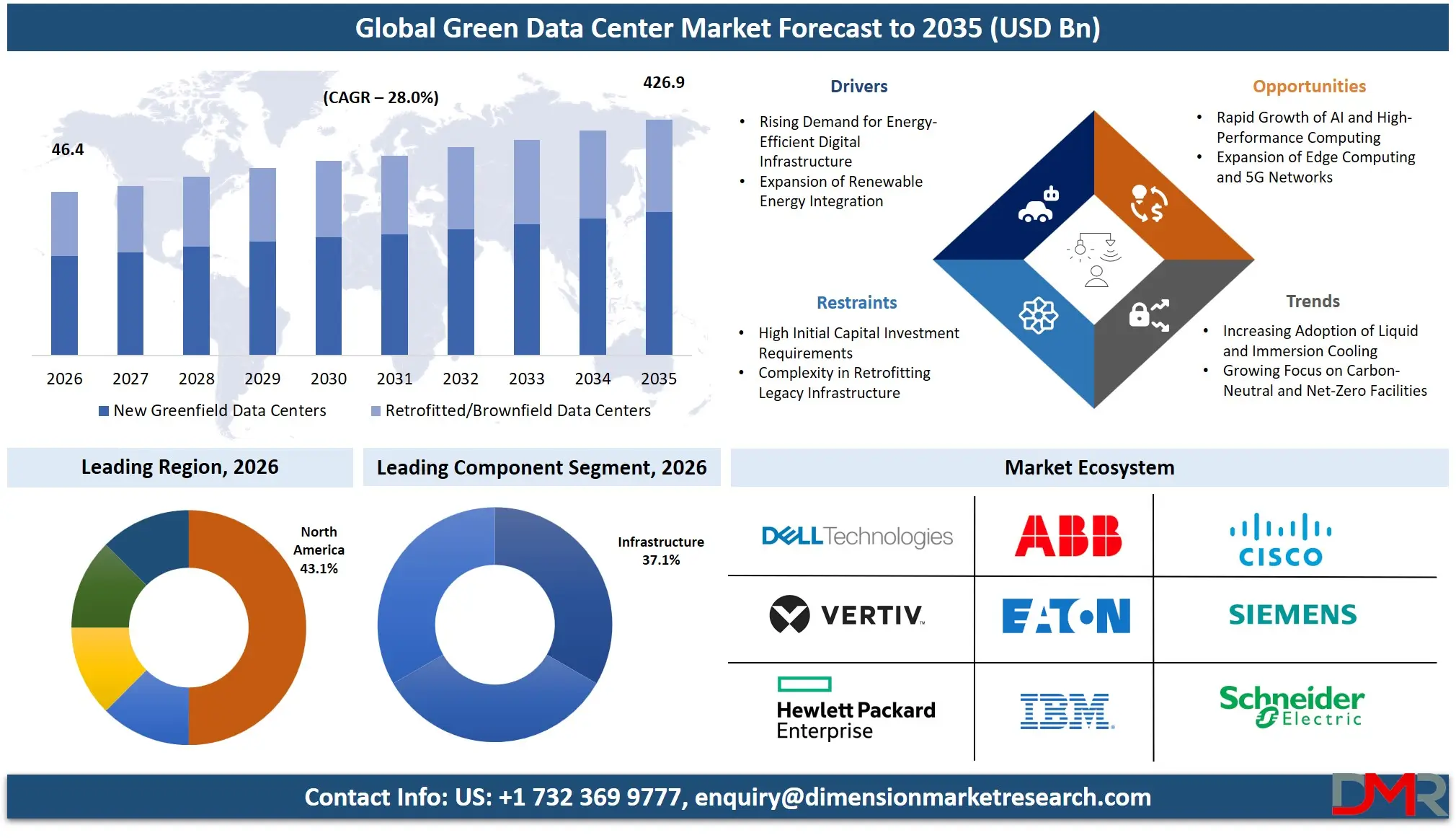
The Global Green Data Center Market is expected to reach a value of USD 46.4 billion in 2026, and it is further anticipated to reach USD 426.9 billion by 2035, growing at a CAGR of 28.0% during the forecast period.
ℹ
To learn more about this report –
Download Your Free Sample Report Here
Green Data Center Solutions have witnessed unprecedented exponential growth over recent years owing to the pressure of strict compliance on companies and the rising expectations of reducing carbon footprints within digital ecosystems. The green data center industry comprises innovative infrastructure, cutting-edge cooling systems, eco-friendly monitoring software, and consultancy & maintenance services that enable companies to design, install, and operate entirely carbon-free computing ecosystems.
Rising pressure for managing higher power density requirements due to Artificial Intelligence applications, complying with environmental regulation, and meeting corporations' ESG objectives have necessitated the development of specialized technologies and professional services. Most common adopters of green data centers are hyperscale and cloud computing facilities, while renewable energy integration and liquid cooling have always dominated the green data center market owing to their unmatched efficacy and scalability. Tech companies, BFSI, and telecoms are the primary participants in the green data centers market due to performance-driven and resilient requirements.
ℹ
To learn more about this report –
Download Your Free Sample Report Here
The US Green Data Center Market
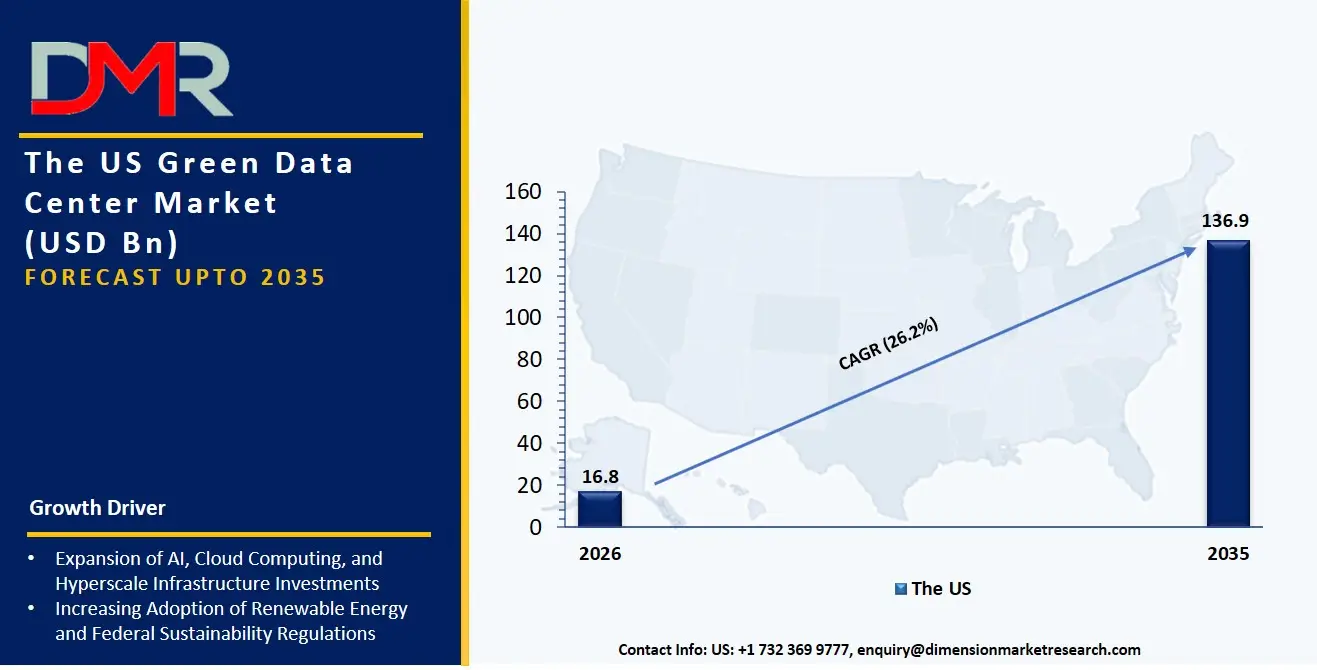
The US Green Data Center Market is projected to reach USD 16.8 billion in 2026 at a compound annual growth rate of 26.6% over its forecast period, which is further anticipated to reach a value of USD 16.8 billion by 2035. This can be attributed to the fact that America still remains the biggest and most advanced market in the world when it comes to green data centers, owing to the ambitious green initiatives set by Fortune 500 companies, alongside an influx of power-intensive hyperscale data centers in key cities such as Northern Virginia. This market has been characterized by an intense need for cooling equipment to enable companies to handle the tremendous heat generated by GPU servers. Further, the adoption of tough energy efficiency policies on the part of the locals has created a similar need in the area of compliance software and energy auditing services.
ℹ
To learn more about this report –
Download Your Free Sample Report Here
The Europe Green Data Center Market
The Europe Green Data Center Market is estimated to be valued at USD 11.2 billion in 2026 and is further anticipated to reach USD 44.8 billion by 2035 at a CAGR of 16.6%. The regulations comprising the EU Energy Efficiency Directive and the Climate Neutral Data Center Pact have a considerable effect on the European market environment and necessitate the use of renewable energy power purchase agreements (PPAs) along with sophisticated waste heat recovery solutions. Furthermore, rapid expansion in the area of retrofitted brownfield data centers is currently being seen because manufacturers and automakers in Germany and France are striving to update their existing centers by providing environmentally friendly air and liquid cooling capabilities that adhere to stringent operational efficiency criteria. Finally, initiatives like GAIA-X are placing pressure on service providers to develop integration and deployment services for eco-friendly systems.
The Japan Green Data Center Market
The Japan Green Data Center Market is projected to be valued at USD 4.1 billion in 2026. It is further expected to witness robust growth, holding USD 14.8 billion in 2035 at a CAGR of 15.3%. What sets Japan apart is the push from companies to reduce their carbon footprint to meet country-wide efforts toward carbon neutrality as well as to counter the increased energy costs for operating facilities in a resource-poor country that is an island nation. Strategy consulting, energy auditing, and sustainable operation & maintenance (O&M) service comprise a significant portion of spending as mega corporations retrofit critical data centers with free-air and hybrid-cooling technologies. The need to integrate into the local market to reconcile existing legacy facilities power-distribution system infrastructure with new smart-grid renewable energy sources is a niche within DCIM software and intelligent building management systems.
Key Takeaways
- Market Size & Forecast: The Global Green Data Center market is forecasted to be valued at USD 46.4 billion in 2026 and will grow to USD 426.9 billion by 2035 due to the rising impacts of increased power density in enterprise AI systems and the demand for zero-net operations.
- Growth Rate & Outlook: A compound annual growth rate of 28.0% is anticipated for the global market due to the increasing necessity of replacing old and inefficient cooling with direct-to-chip and immersion technologies, coupled with the rising difficulty in managing PUE and carbon footprint.
- Primary Growth Drivers: Some of the major factors contributing to market growth include migration towards liquid-cooled instead of air-cooled high-power density data centers, strategy consulting and energy auditing to reduce energy wastage and minimize operational costs, as well as the use of on-site renewable power generation sources necessitating eco-friendly expertise.
- Key Market Trends: Important trends in the market include the emergence of vertical solutions in green hosting, like the healthcare cloud, finance cloud use of AI in DCIM software for automatically fixing issues of cooling and power inefficiency, and the movement towards compliance software for board-driven sustainability data of data centers.
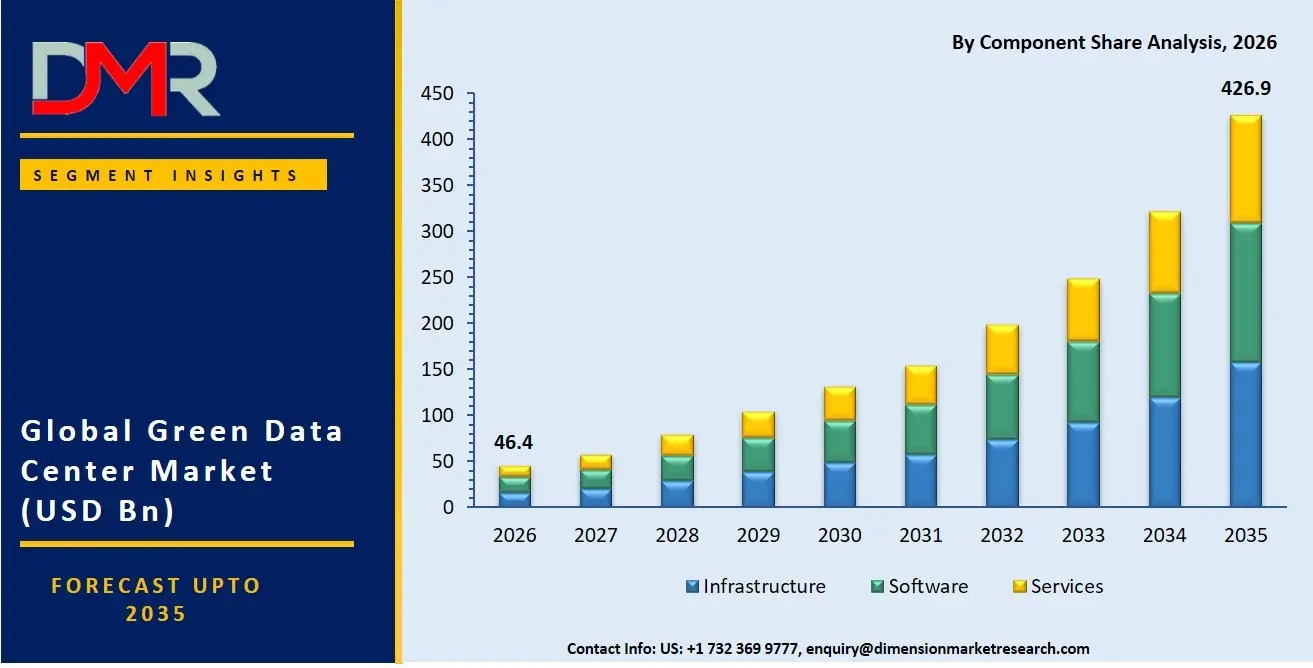
- By Component Analysis: The green data center market is currently poised to be dominated by infrastructure owing to increasing investment towards renewable energy integration, advanced cooling solutions, smarter power distribution, and energy-saving technologies related to AI, cloud computing, and hyperscale deployment among others, worldwide.
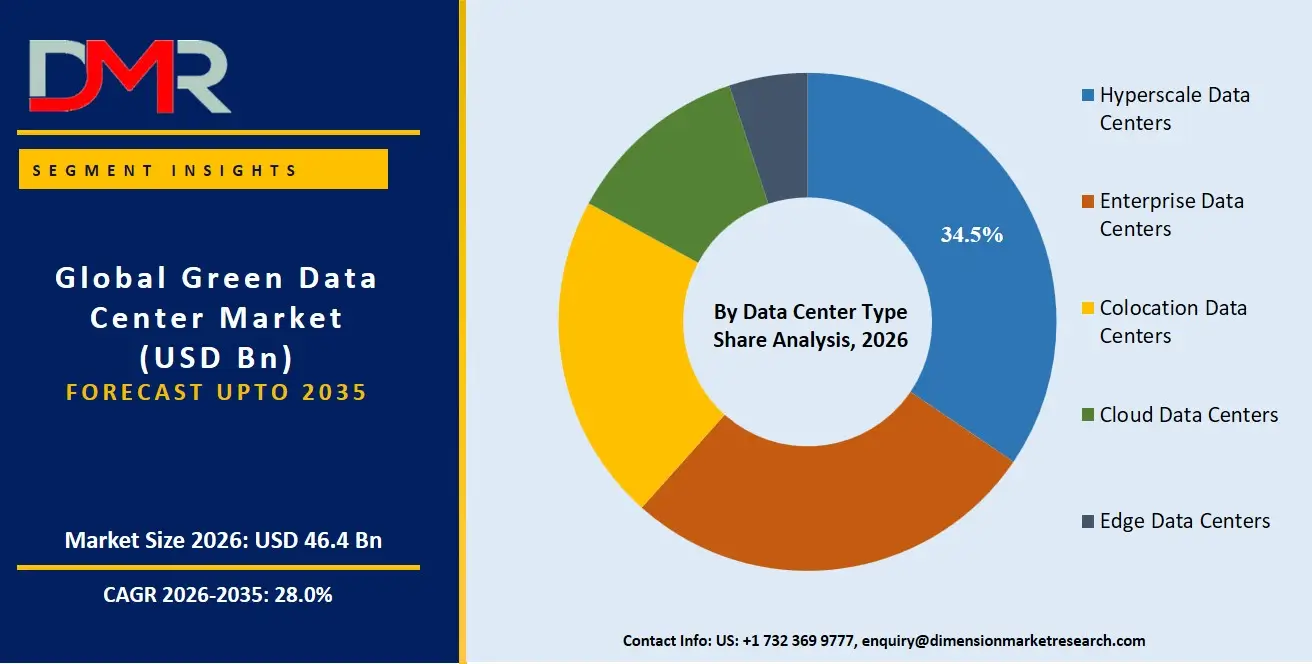
- By Data Center Type Analysis: Hyperscale data centers is anticipated to dominate the market for similar reasons, including the need for scalability and energy efficiency along with renewable energy sources, cooling technologies, low PUE, and reduced operating costs.
- Regional Leadership: North America will continue to be dominant in this market, with a share of 43.1% in 2026, because of its advanced infrastructure and technology companies that benefit fully from its features.
What is the Green Data Center?
Green Data Center solutions represent those specific tools and services provided by third-party companies or consultants that help organizations manage the process of designing and operating their sustainable facilities from beginning to end. Green data centers solutions differ from data center constructions (a physical shell of the building or computing equipment), because those have nothing to do with the processes of how energy efficiency is reached. It concerns Infrastructure (providing a basic infrastructure for energy-efficient power distribution and green liquid cooling), Software (for managing the usage of resources), and Services (developing strategic guidelines on how to integrate environmentally-friendly practices and sustain them). As hyperscale operators consume a significant part of total global energy resources in the sphere of IT, green data center solutions must be implemented in order to achieve cost control, comply with regulations, and reach carbon neutrality, turning sustainability investments into business benefits rather than complicated technologies.
Use Cases
- Retirement of Mainframes and Power Saving in Banking: The banking sector employs environmental integration and deployment services for the retirement of COBOL applications in energy-intensive mainframes and migration of the applications to energy-efficient power-distributed cloud-based infrastructure.
- High Density AI Readiness for Hospitals: The hospital industry employs energy audit and strategy consulting in addition to brownfield retrofit data center solutions to achieve high-density readiness of petabyte-scale AI applications for genomics and diagnostics.
- Data Sovereignty and Sustainability for Governments: Governments employ compliance services and strategy consulting services for the design and deployment of architectures compliant with strict government data sovereignty and sustainability regulations. Data storage of government data will be hosted in sustainable data centers powered by renewable energy sources.
- Energy Resilient Edge Manufacturing Centers: Manufacturers employ sustainable operations and maintenance services to control edge data centers in factories connected to cloud ERP with PLC and efficient and resilient power back-up facilities for real-time visibility into supply chains.
How AI is Transforming the Green Data Center Market?
The application of AI will transform the green data center market through optimizing facility operations in addition to improving long-term design precision. On the front of infrastructure technology, AI-based analytical tools can be implemented on the DCIM and building management software to achieve the automatic adaptation of cooling and power systems to current loads of the data center IT equipment, which will substantially reduce energy wastage and manual interventions. Additionally, AI-based technologies within compliance and monitoring systems provide companies with the opportunity for controlling their carbon expenditure levels through monitoring abnormal usage and forecasting future consumption, suggesting solutions such as relocating workload onto microgrids using renewable energy generation.
The use of AI-based systems will change the landscape of governance and facility strategy development projects. Regarding consulting services, AI-based compliance monitoring agents help to continuously monitor and detect any problems within multiple data center sites in terms of cooling, configuration issues, and any policy violations in order to ensure alignment with standards such as LEED and the EU Code of Conduct. Furthermore, AI-based generative assistants can assist with strategy consultations and energy auditing processes by simulating the effects of altering the airflow of the data center facilities.
Market Dynamics
Key Drivers in the Global Green Data Center Market
Rising Demand for Energy-Efficient Digital Infrastructure
With the rapid rise in the number of applications related to cloud computing, artificial intelligence, IoT, and big data analysis, global data processing needs are rising fast, which is resulting in growing demands for green data centers that use less energy. This is because conventional data centers need large amounts of electrical power and create huge carbon emissions, leading companies to invest in green infrastructure. There is also a lot of encouragement from governments and other regulatory authorities to set up environmentally friendly data centers that reduce carbon emissions.
Expansion of Renewable Energy Integration
The increased utilization of renewable energy resources like solar, wind, hydroelectric, and geothermal power plays an important role in driving the growth of the green data center industry. Many large technology firms and colocation providers have started making contracts for renewable energy usage in order to be carbon neutral and become less reliant on traditional fossil fuels. Utilizing renewable energy resources can help in ensuring the stability of energy prices in the long run, along with enhancing the performance of the firm regarding its sustainability practices. Governments in different parts of the world including North America, Europe, and Asia Pacific are providing various incentives towards renewable energy-based infrastructure.
Restraints in the Global Green Data Center Market
High Initial Capital Investment Requirements
The construction of eco-friendly data centers needs considerable initial expenditure on renewable energy sources, effective cooling systems, efficient power systems, and energy-saving building materials. Liquid cooling, battery storage, and smart grid installation incur higher costs than those incurred by normal data center construction. SMEs may lack sufficient funds to deploy sustainable infrastructure technology due to their financial constraints. In addition, the long return period involved in such projects deters investors from investing in developing countries. Financial challenges hinder market adoption, especially in areas lacking renewable energy infrastructure, access to financing, and sustainable energy initiatives.
Complexity in Retrofitting Legacy Infrastructure
Most data centers that are currently in operation have been built using dated power and cooling solutions that make it complicated to upgrade these sites to sustainable data centers. The process of upgrading such data centers is both costly and cumbersome because it will affect the ongoing activities at the facility. Such old data centers may also not be structurally capable of supporting current modern high density computing capabilities and cooling solutions. Interoperability problems with legacy systems further pose a problem as they lead to inefficient and costly operations.
Growth Opportunities in the Global Green Data Center Market
Rapid Growth of AI and High-Performance Computing
The growth in use cases for artificial intelligence, machine learning, and high-performance computing is presenting compelling chances for the green data center sector. Artificial intelligence needs high-performance hardware, which means that a higher amount of energy will be needed, leading to higher heat generation. This calls for green data centers, which are fitted with such things like liquid cooling technologies, intelligent energy management, and sustainable energy supply. With the growing use of generative AI, automation, and analysis software by businesses, it is anticipated that environmental computing infrastructures will see increased investments.
Expansion of Edge Computing and 5G Networks
The rollout of 5G technology and establishment of edge computing network across the world provides new possibilities for development of small-sized energy-efficient green data centers. The edge-based architecture allows for processing information near the customers, which ensures lower latency and enables applications in sectors like automated driving, smart cities, industrial automation, and real-time data analysis. Such technologies need an eco-friendly energy supply and cooling solutions in order to minimize expenses on operations. Growing use of modular and micro data centers operated with renewable energy sources drives market growth. Telecom operators and cloud services providers are making big investments in establishing green edge infrastructures worldwide.
Trends in the Global Green Data Center Market
Increasing Adoption of Liquid and Immersion Cooling
The use of liquid and immersion cooling technologies is gaining momentum in the green data center market because of the exceptional thermal efficiency of such cooling methods as opposed to air-cooling technologies. The amount of heat produced by AI servers and high-density computing makes the use of air-cooling ineffective and inefficient. On top of that, liquid cooling consumes less power and is more precise than air cooling. Moreover, it helps increase rack density while minimizing greenhouse gas emissions. In addition, immersion cooling uses less water and creates less noise during operations, making it a highly sustainable option.
Growing Focus on Carbon-Neutral and Net-Zero Facilities
The focus of data center companies all around the world has shifted toward net zero and carbon-neutral strategies in order to align themselves with their corporate sustainability objectives and environmental policies. Investments in renewable power procurement, carbon offset schemes, battery energy storage systems, and energy-efficient data centers have become common practices to minimize the release of greenhouse gases into the atmosphere. The certification and reporting of sustainable buildings have also gained importance due to their competitiveness. Hyperscalers are spearheading efforts toward running their cloud services on renewable energy through the use of AI-based energy consumption optimization.
Research Scope and Analysis
The Global Green Data Center Market is segmented by component, including infrastructure, software, and services; by data center type, deployment type, cooling technology, and power source; and by end-use industries such as technology, telecommunications, BFSI, healthcare, manufacturing, government, retail, media, energy, and utilities.
ℹ
To learn more about this report –
Download Your Free Sample Report Here
By Component Analysis
The component segment of the green data center market is projected to dominate by infrastructure owing to the necessity for energy-efficient energy distribution and renewable energy as well as cooling mechanisms. Infrastructure investment within the low carbon economy is highly sought after by operators with an aim of cutting costs and meeting sustainability goals. Infrastructure for cooling and electricity comprises a considerable proportion of energy consumed within a data center, and thus the modernization of infrastructure is essential, especially for hyperscale data centers and colocation centers. The growing demands of AI computing, cloud computing, and high-density server rooms increase infrastructure requirements.
By Data Center Type Analysis
This market is expected to be dominated by hyperscale data centers, owing to the fact that global cloud computing firms and artificial intelligence companies need huge computing capabilities that are energy efficient. Companies like those providing cloud computing services are building hyperscale data centers fueled by renewables, featuring state-of-the-art cooling systems and intelligent power consumption systems. Such data centers perform better in terms of power usage efficiency than traditional data centers used by enterprises. Expansion of artificial intelligence technology, big data analytics, streaming services, and cloud computing services has driven the development of hyperscale data centers across the globe.
By Deployment Type Analysis
Greenfield data centers is anticipated to hold an overwhelming market share in the deployments segment as operators are shifting towards the development of data centers that are sustainable by design. Greenfield data centers offer the opportunity to incorporate sustainable features such as renewable energy solutions, modular buildings, innovative cooling techniques, and AI-enabled energy management from the start of the construction process. Such data centers also offer easier implementation of environmental laws and targets compared to upgrading older assets. Growth in the number of investments made in hyperscale clouds in North America, Europe, and Asia-Pacific regions is fueling the adoption of greenfield data centers.
By Cooling Technology Analysis
In the technology segment liquid cooling is projected to dominate owing to the increased usage of high-density computing platforms, mainly AI, machine learning, and hyperscale. Air cooling is unable to cope with the amount of heat emitted by the modern chips and GPUs. The technology is more efficient when it comes to energy consumption and power costs. In addition, the technology enhances server performance. It helps achieve sustainability objectives since it uses less energy, thus reducing waste. The adoption of liquid cooling by hyperscalers who use AI infrastructure makes it the preferred cooling method for green data centers.
By Power Source Analysis
Data centers are expected to be driven by renewable sources of energy are currently dominating this space, with companies showing more interest in achieving carbon neutrality and cost optimization for energy in the long run. Leading players in the cloud and colocation space are working to secure large-scale renewable energy deals to minimize their reliance on non-renewable energy. Countries and regulatory bodies globally are also promoting renewable energy through various policy decisions aimed at ensuring sustainable energy use and emissions reductions. Using renewable energy is important not only because it is environmentally friendly but also because it increases energy security and operational resilience.
By End-Use Industry Analysis
The industry of technology and software is anticipated to dominate the end-use industry due to cloud service providers, AI firms, SaaS solutions, and digital companies which produce huge amounts of demands for data computation and data storage. Such companies are great investors in sustainable computing facilities, helping them cut costs and comply with environmental policies. The fast development of AI, cybersecurity, streaming solutions, and cloud solutions for enterprises keeps on growing, and there is no doubt that their demand for green data centers will increase further. It also can be stated that the largest users of alternative energy sources and advanced cooling systems, as well as carbon neutrality, are technology and software companies.
The Global Green Data Center Market Report is segmented on the basis of the following:
By Component
- Infrastructure
- Energy Infrastructure
- Renewable Power Generators
- Power Backup & Energy Storage
- Energy-Efficient Power Distribution
- Cooling Infrastructure
- Green Air Cooling
- Green Liquid Cooling
- Software
- Data Center Infrastructure Management (DCIM)
- Building Management Software
- Compliance Software
- Other Software
- Services
- Strategy Consulting & Energy Audits
- Eco-Friendly Integration & Deployment
- Sustainable Operation & Maintenance Services
- Other Services
By Data Center Type
- Hyperscale Data Centers
- Enterprise Data Centers
- Colocation Data Centers
- Cloud Data Centers
- Edge Data Centers
By Deployment Type
- New Greenfield Data Centers
- Retrofitted/Brownfield Data Centers
By Cooling Technology
- Liquid Cooling
- Air-Based Cooling
- Immersion Cooling
- Free Cooling Systems
- Hybrid Cooling Systems
By Power Source
- Renewable Energy Powered Data Centers
- Grid-Powered Green Data Centers
- Hybrid Energy Systems
By End-Use Industry
- Manufacturing
- Energy & Utilities
- Retail & E-Commerce
- Technology & Software
- Telecommunications
- Media & Entertainment
- Banking, Financial Services & Insurance (BFSI)
- Healthcare & Life Sciences
- Government & Defense
- Other End-Use Industry
Regional Analysis
Leading Region by Market Share
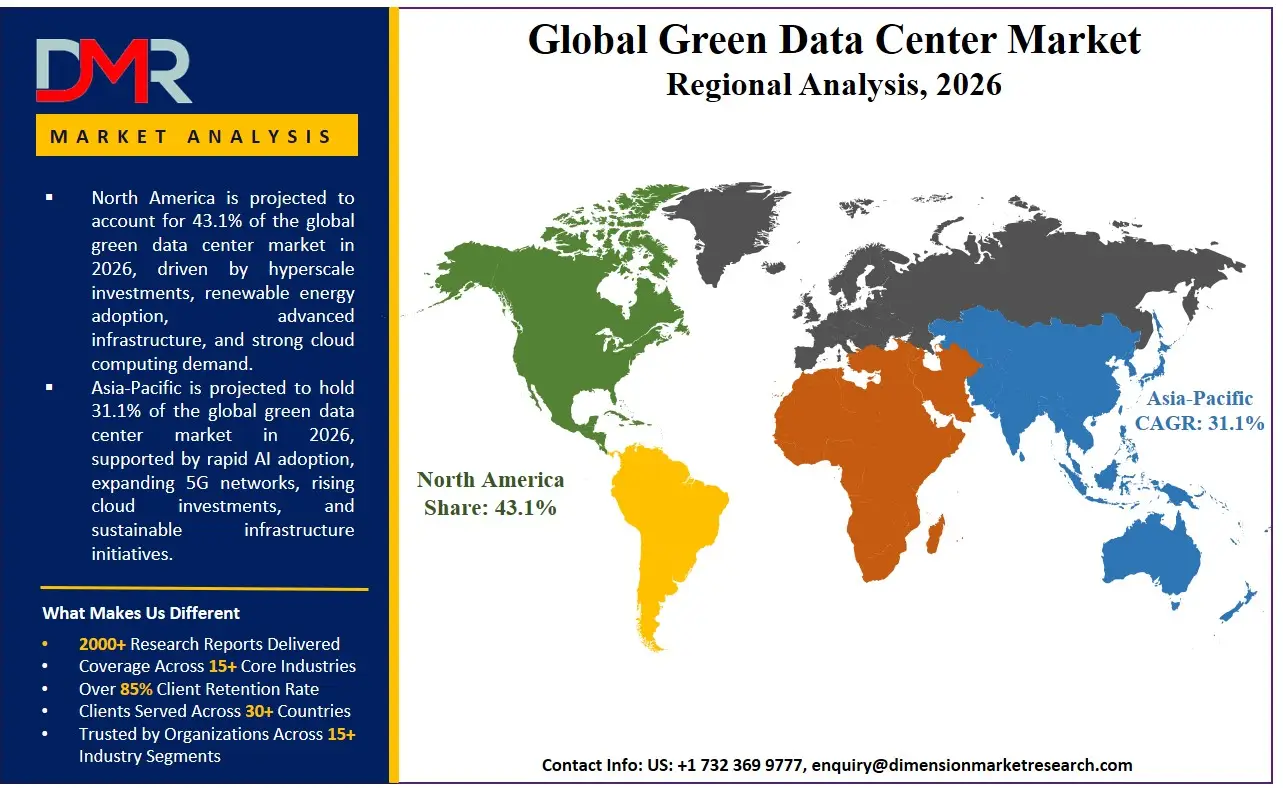
North America is poised to dominate the global green data center market as it is projected to hold 43.1% of the market share by the end of 2026. The dominance is due to the unique presence of hyperscale cloud providers and net-zero commitments of Fortune 500 companies. The region has a well-established ecosystem of global system integrators, specialized boutique sustainability consultants, and extensive talent base in liquid cooling systems and microgrids. Investments by enterprises in AI and analytics technology, together with the replacement of outdated enterprise server rooms, are some of the drivers that will fuel the need for retrofitting, modernization, and sustainment services in addition to green operations. Furthermore, the pro-regulatory environment in places like California consistently funds future carbon-free power generation infrastructure projects that require professional greenfield design services.
ℹ
To learn more about this report –
Download Your Free Sample Report Here
Fastest-Growing Regional Market
Asia-Pacific is forecasted to be the fastest-growing market for green data centers due to the digital revolution and carbon neutrality plans initiated by the government of India, China, Japan, and Southeast Asia. Due to rapid economic development, the emergence of a digitally savvy middle class, and dynamic development of the digital economy, incumbent enterprises and government bodies have to abandon inefficient systems or update them with new systems built on the ground up. Strategy consulting and energy auditing is a sought-after service in order for the aforementioned large-scale entities to be able to move toward an entirely carbon-free operation of data centers around the clock. Moreover, there is a great scarcity of talent for green facilities in the region, which requires outsourcing of eco-integration and sustainable management practices in the field.
By Region
North America
Europe
- Germany
- The U.K.
- France
- Italy
- Russia
- Spain
- Benelux
- Nordic
- Rest of Europe
Asia-Pacific
- China
- Japan
- South Korea
- India
- ANZ
- ASEAN
- Rest of Asia-Pacific
Latin America
- Brazil
- Mexico
- Argentina
- Colombia
- Rest of Latin America
Middle East & Africa
- Saudi Arabia
- UAE
- South Africa
- Israel
- Egypt
- Rest of MEA
Competitive Landscape
The competitive landscape of the green data centers globally has evolved into an extremely volatile one with the presence of a diverse range of international cooling technology providers, GSIs, professional services arms of major hyperscalers' tech organizations, and liquid cooling technology startups. The success factor will lie in creating very deep strategic partnerships with the key chip manufacturers and compute platform providers due to their ability to provide co-design capabilities and early access to thermal data about future AI processors. The process of market consolidation is advancing at an unprecedented pace with legacy data center providers acquiring specialized firms that provide immersive cooling and microgrid technology. IP has emerged as a much bigger source of competitive advantage than mere commoditized hardware or standard project management methodologies.
Some of the prominent players in the Global Green Data Center Market are:
- Schneider Electric
- Vertiv
- Dell Technologies
- Hewlett Packard Enterprise
- Cisco Systems
- IBM
- Siemens
- ABB
- Eaton
- Johnson Controls
- Huawei Technologies
- Fujitsu
- Lenovo
- Hitachi
- Mitsubishi Electric
- Delta Electronics
- NTT DATA
- Equinix
- Digital Realty
- Google
- Other Key Players
Recent Developments
- January 2026: Microsoft declared a significant expansion of its green data center design center, a professional services initiative to assist Healthcare & Life Sciences and Manufacturing clients in designing proprietary liquid-cooled AI clusters with on-site renewable power generators and expertise in eco-friendly integration and deployment.
- November 2025: Accenture strengthened its collaboration with Vertiv and introduced a compliance and sustainable operations and energy audits practice aimed at supporting BFSI clients in retrofitting high-frequency trading data centers with immersion cooling while maintaining compliance with international ESG financial regulations.
- October 2025: Deloitte acquired FNT Software to strengthen its strategy consulting and workflow automation capabilities for sovereign and green facilities, supporting Government & Defense and public sector customers in data residency and energy reporting requirements.
Report Details
| Report Characteristics |
| Market Size (2026) |
USD 46.4 Bn |
| Forecast Value (2035) |
USD 426.9 Bn |
| CAGR (2026–2035) |
28.0% |
| The US Market Size (2026) |
USD 16.8 Bn |
| Historical Data |
2021 – 2025 |
| Forecast Data |
2027 – 2035 |
| Base Year |
2025 |
| Estimate Year |
2026 |
| Segments Covered |
By Component, By Data Center Type, By Deployment Type, By Cooling Technology, By Power Source, and By End-Use Industry |
| Regional Coverage |
North America – The US and Canada; Europe – Germany, The UK, France, Russia, Spain, Italy, Benelux, Nordic, & Rest of Europe; Asia-Pacific – China, Japan, South Korea, India, ANZ, ASEAN, Rest of APAC; Latin America – Brazil, Mexico, Argentina, Colombia, Rest of Latin America; Middle East & Africa – Saudi Arabia, UAE, South Africa, Turkey, Egypt, Israel, & Rest of MEA |
Frequently Asked Questions
How big is the Global Green Data Center Market?
▾ The Global Green Data Center market is poised to be valued at USD 46.4 billion in 2026 and is projected to reach USD 426.9 billion by 2035, driven by the universal need for specialized technology in high-density cooling, renewable energy integration, and facility modernization.
What is the CAGR of the Global Green Data Center Market from 2026 to 2035?
▾ The market is expected to grow at a CAGR of 28.0% from 2026 to 2035, reflecting the accelerating power density of enterprise AI environments and the persistent shortage of internal green engineering talent.
What factors are driving the growth of the Global Green Data Center Market?
▾ Key drivers include the global energy skills gap, the imperative to modernize legacy air-cooled facilities, the management complexity of hybrid cooling deployments, and the surge in demand for compliance software and energy audits amid evolving carbon taxation and disclosure laws.
Which region held the largest share of the Green Data Center Market in 2026?
▾ North America is poised to lead this market as it holds 43.1% of the market share in 2026, driven by a mature hyperscaler ecosystem and aggressive enterprise investment in liquid cooling and AI-driven sustainable facility capabilities.
Which region is expected to grow the fastest in the Green Data Center Market?
▾ The Asia-Pacific region is expected to grow the fastest, fueled by rapid digital transformation and sustainability mandates in India, China, and Japan, where strategy consulting is critical for transitioning large conglomerates to carbon-neutral operations.
What are the major trends in the Global Green Data Center Market?
▾ Major trends include the integration of AI into DCIM and cooling workflows, the rise of dedicated strategy consulting and energy audits, the demand for industry-specific green hosting solutions, and the focus on sustainable operation and maintenance within complex high-density environments.
Who are the key players in the Global Green Data Center Market?
▾ Key players in the Global Green Data Center Market include Schneider Electric, Vertiv, Dell Technologies, Cisco Systems, IBM, and Equinix., alongside specialized pure-play green data center consultancies and design firms.
How is the Global Green Data Center Market segmented?
▾ The market is segmented by Component, Data Center Type, Deployment Type, Cooling Technology, Power Source, and End-Use Industry.