What is the Green Hydrogen Electrolyzer Market Size?
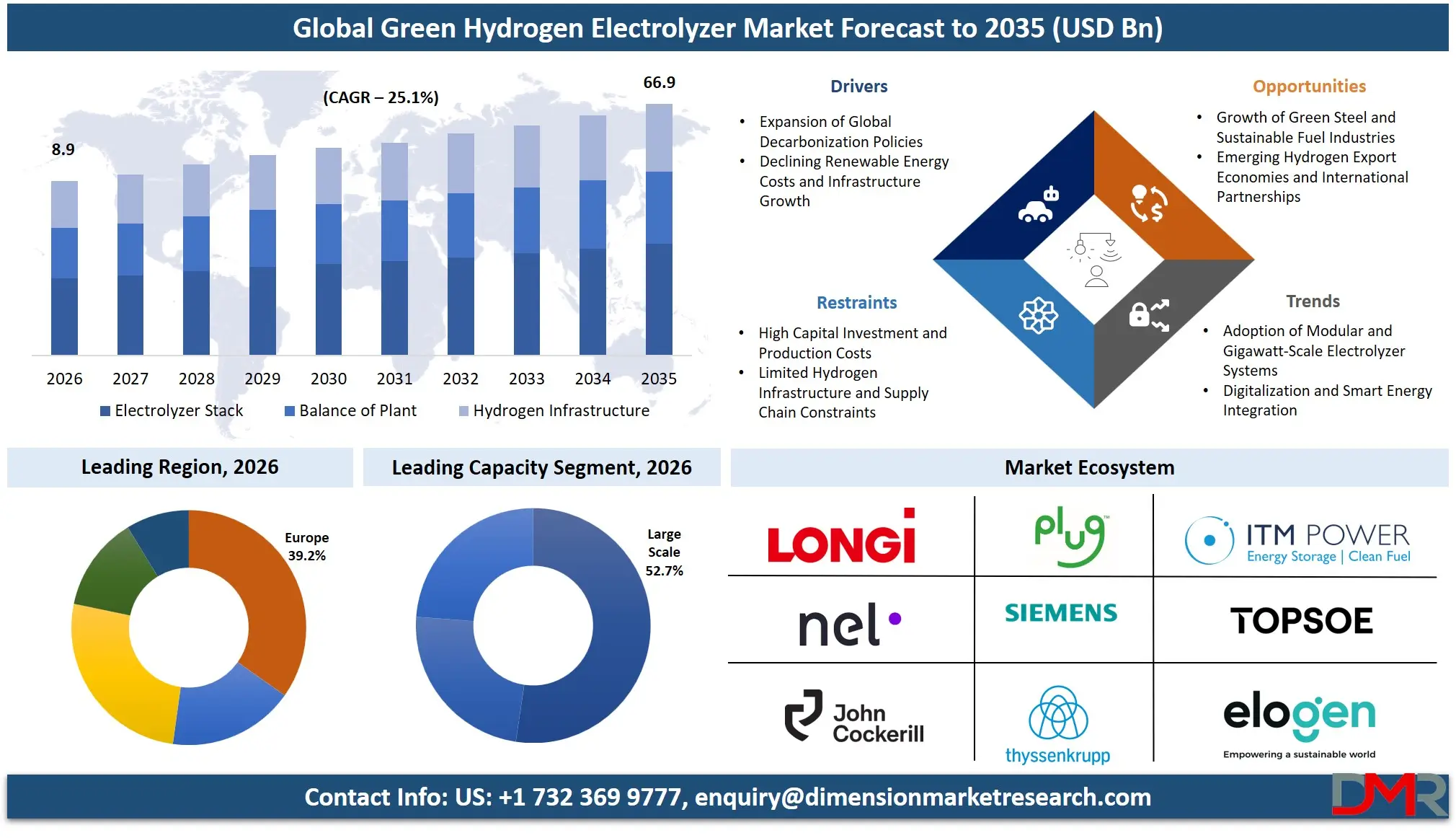
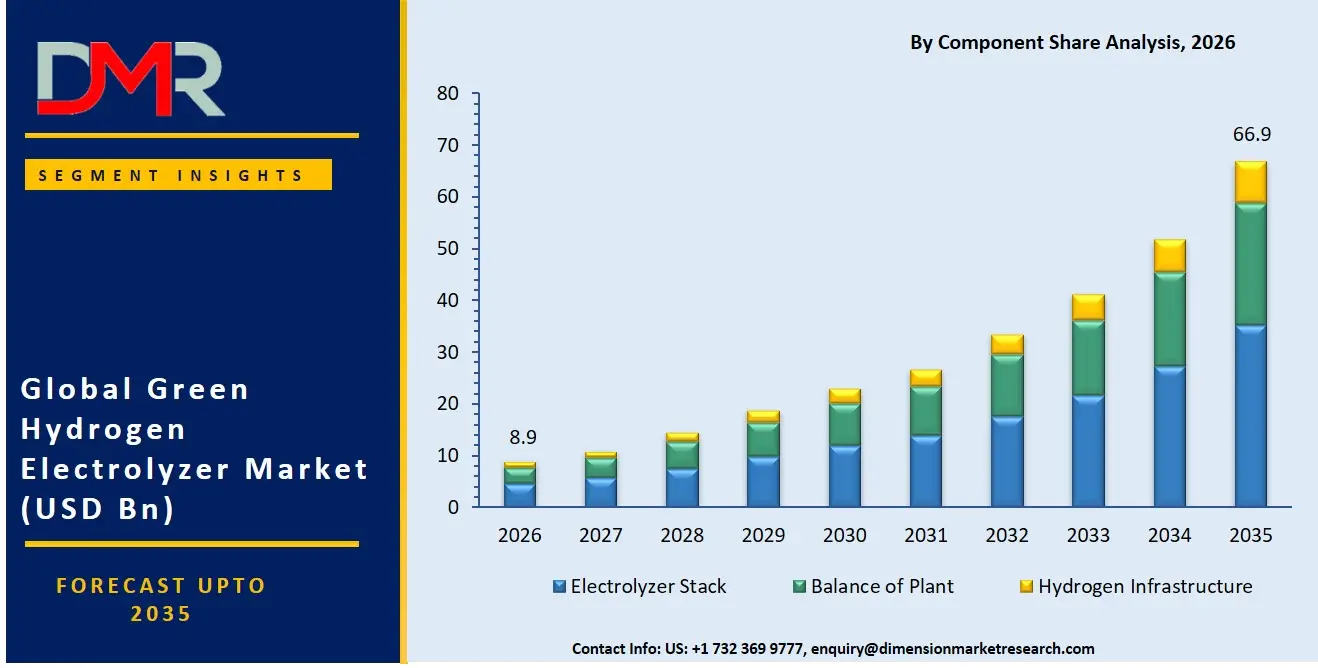
The Green Hydrogen Electrolyzer Market size is expected to be USD 8.9 billion in 2026 and increase at a compound annual growth rate of 25.1% to USD 66.9 billion in 2035 due to emergence of innovative carbon neutral plans, energy plans and hydrogen programs by many countries.
ℹ
To learn more about this report –
Download Your Free Sample Report Here
A few innovations are currently happening in the Green Hydrogen Electrolyzer Market due to the increasing relevance of energy transition, carbon neutrality, and green hydrogen production. The green hydrogen electrolyzers are viewed as breakthrough technologies that help produce hydrogen by means of water electrolysis process through the use of renewable energy sources from solar, wind, and hydro plants.
Some of the major innovations in green hydrogen electrolyzers are the alkaline electrolyzers, PEM electrolyzers, solid oxide electrolyzers, anion exchange membrane electrolyzers, and numerous others. Such technologies cater to various applications, including industrial raw materials, transportation, energy storage, and also synthetic fuels. Growth in the hydrogen infrastructure investments, favorable government policies, declining costs of renewables, and de-carbonization of industries will drive the market growth. Some of the notable trends include gigawatt-scale hydrogen projects, modular electrolyzers, monitoring solutions, and artificial intelligence optimization.
ℹ
To learn more about this report –
Download Your Free Sample Report Here
The US Green Hydrogen Electrolyzer Market
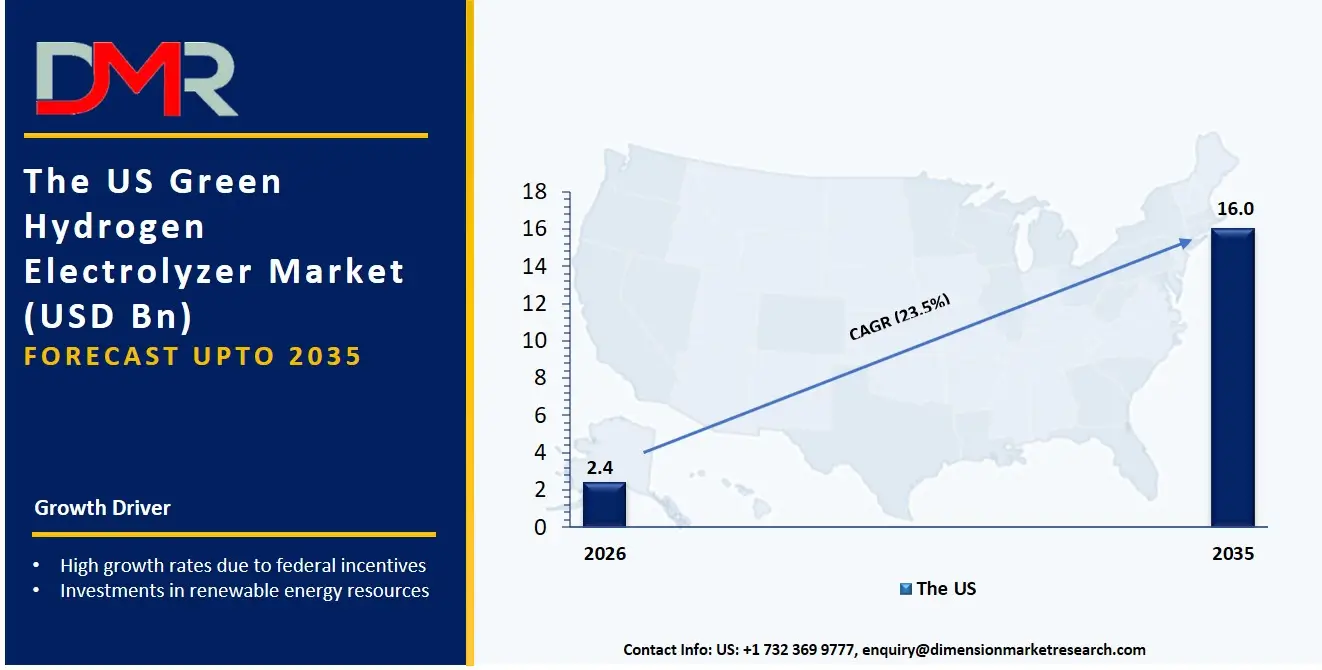
The US Green Hydrogen Electrolyzer Market size is estimated to be USD 2.4 billion in 2026 and is expected to increase at a CAGR of 23.5% over the forecast period.
The US green hydrogen electrolyzer market shows high growth rates due to federal incentives, hydrogen tax credits, and investments in renewable energy resources. Electrolyzers have higher demand due to industrial sector decarbonization, such as the oil refining industry, steel industries, and transportation. The Inflation Reduction Act project and hydrogen hubs by the Department of Energy are promoting local production. The collaboration of energy companies and technology vendors is speeding up the implementation of PEM and alkaline electrolyzers in different states.
ℹ
To learn more about this report –
Download Your Free Sample Report Here
Europe Green Hydrogen Electrolyzer Market
The Europe Green Hydrogen Electrolyzer Market size is estimated to be USD 3.5 billion in 2026 and is expected to increase at a CAGR of 23.0% over the forecast period.
Europe is still among the most progressive areas in the Green Hydrogen Electrolyzer Market due to ambitious climate goals and robust policy mechanisms within the European Green Deal and REPowerEU programs. Nations such as Germany, France, the Netherlands, and Spain have been making significant investments in hydrogen valleys, electrolysis through offshore wind power, and industrial decarbonization. Europe has the advantage of having a large network of cross-border hydrogen infrastructural development, substantial renewable power deployment, and financing from the European Commission.
Japan Green Hydrogen Electrolyzer Market
The market size of Japan Green Hydrogen Electrolyzer will be USD 356 million in 2026 and at a CAGR of 27.1% in the forecast period.
A growing need for green hydrogen electrolyzers in Japan exists since Japan has made sure that hydrogen would form a part of its future energy strategy. Projects related to hydrogen imports, fuel cells, and industries lead to the creation of green hydrogen electrolyzers. Japanese companies are working on the development of small and effective PEM electrolyzers and solid oxide electrolyzers which can be used in industrial and urban settings. Working with foreign hydrogen producers and setting up the hydrogen mobility system can create breakthroughs in spite of production costs and lack of space for renewables.
Key Takeaways
- Market Size & Forecast: The Green Hydrogen Electrolyzer Market size is projected to reach USD 8.9 billion in 2026 and is anticipated to have a value of USD 66.9 billion in 2035.
- Growth Rate & Outlook: The Green Hydrogen Electrolyzer Market size is set to grow at a compound annual growth rate of 25.1% during the forecast period of 2026 to 2035.
- Primary Growth Drivers: Some of the major growth drivers in the market include Decarbonization Efforts Around the World Will Increase the Need for Electrolyzers, and more.
- Key Market Trends: Some of the major trends in the market are Use of Modular and Gigawatt-Class Electrolyzers, and more.
- By Component: The electrolyzer stack segment is anticipated to get the majority share of the Green Hydrogen Electrolyzer market in 2026.
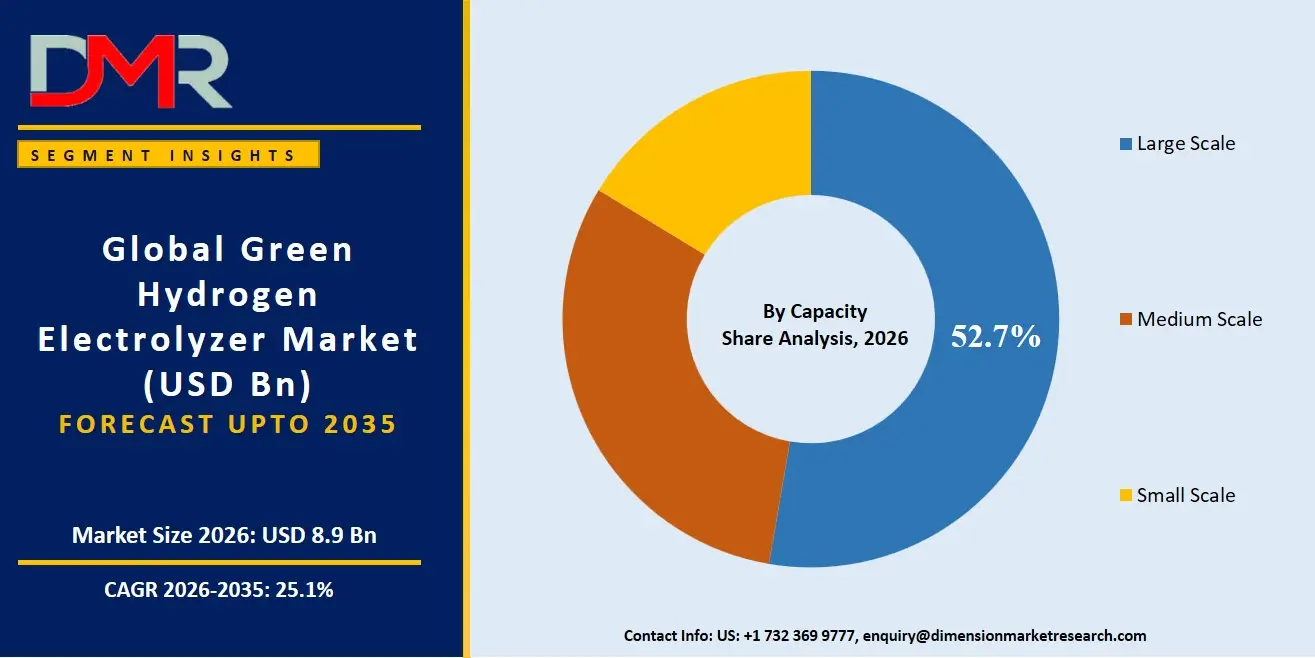
- By Capacity: The large scale plants segment is expected to get the largest revenue share in 2026 in the Green Hydrogen Electrolyzer market.
- By End Use Industry: The energy & utility segment is expected to get the largest revenue share in 2026 in the Green Hydrogen Electrolyzer market.
- Regional Leadership: Europe is set to lead the Green Hydrogen Electrolyzer market with an estimated 39.2% share in 2026.
What is the Green Hydrogen Electrolyzer?
Green Hydrogen Electrolyzer refers to the technology which has been used to produce hydrogen gas using electrical energy obtained from renewable sources of energy such as solar energy, wind energy, and hydro energy. Therefore, the technology has contributed significantly towards separating water molecules without generating carbon dioxide during the process of electrolysis. Various electrolyzers are alkaline electrolyzer, PEM electrolyzer, solid oxide electrolyzer, and anion exchange membrane electrolyzer. The various applications of these electrolyzers include industrial feedstock, transportation, energy storage, and green hydrogen fuel. The importance of using this technology lies in its huge significance within the world's clean energy transition for several reasons such as decarbonization targets, hydrogen technologies investments, and net zero strategies.
Use Cases
- Production of Industrial Hydrogen: The use of hydrogen electrolysis in ammonia, methanol, and refinery sectors is very common as an alternative to hydrogen that is produced through fossil fuels. It is becoming increasingly common among companies that use electrolysis driven by renewable energy sources to avoid greenhouse gases and comply with regulations set by the environment.
- Mobility and Transport: The application of electrolysis is becoming more relevant when it comes to fueling stations for fuel cell vehicles and public transport including trains, buses, trucks, and ships. The growing demand for sustainable mobility would mean that companies invest in hydrogen production systems that are renewable energy-powered.
- Energy Storage within Power Grids: Electrolysis helps in power-to-gas applications through which renewable energy sources are used for hydrogen production as a way of storing energy in power grids.
- Steel Making: Steel making companies are now using hydrogen electrolysis in their business operations to enable direct reduced iron production. This helps reduce the dependence on coal-driven blast furnaces in large and industrialized nations.
How AI Is Transforming the Green Hydrogen Electrolyzer Market
AI is enhancing electrolyzers' efficiencies by implementing predictive maintenance, energy management, and optimizing operation. Artificial intelligence will be capable of determining the amount of renewable energy available, the water's quality, temperature, and the effectiveness of the stack to ensure maximum production and minimize energy loss and expenses on maintenance. AI is also aiding in predicting catalyst utilization and detecting potential problems that could lead to equipment malfunction.
AI is equally benefiting the hydrogen infrastructure projects by enhancing supply chain management, forecasting demand, and optimizing the grid. AI will enhance project planning and minimize operational downtime for large-scale electrolyzers. Digital twins driven by AI will increasingly be employed in simulating electrolyzers' operations and improving their efficiency, thus promoting research and development in next-generation hydrogen technologies.
Market Dynamic
Driving Factors in the Green Hydrogen Electrolyzer Market
Decarbonization Efforts Around the World Will Increase the Need for Electrolyzers
There is an emergence of innovative carbon neutral plans, energy plans and hydrogen programs by many countries that are going to play a big role in encouraging the adoption of electrolyzers. Through various financial motivators such as incentives, subsidies, carbon price models and fuel regulations, companies have managed to adopt clean hydrogen over conventional hydrogen using electricity as an alternative. The industrial sectors such as steel, refinery and petrochemical industries are more likely to adopt green hydrogen.
Restraints in the Green Hydrogen Electrolyzer Market
Large Capital Requirements and Cost of Production
Despite technological advancements that have resulted in significant reductions in capital cost requirements, the market for the Green Hydrogen Electrolyzer is still encountering issues with the high cost of initial investments and green hydrogen production procedures. Electrolyzer stacks, catalysts, deionizers, and other systems involved in producing green hydrogen entail large investments, thereby discouraging their implementation by small to medium-sized industries. Although the cost of green hydrogen production has been decreasing, it is still relatively higher compared to conventional hydrogen from natural gas.
Opportunities in the Green Hydrogen Electrolyzer Market
Growth in Green Steel & Sustainable Fuel Manufacturing
As companies shift towards producing low-carbon industrial products, significant opportunities will arise for electrolyzer usage in industries such as green steel manufacturing, sustainable fuel manufacture, and e-fuel generation. Companies are increasingly using hydrogen technology as a means of meeting their regulatory and emission requirements. The large amounts of hydrogen that will be required for the operations in direct reduced iron plants and e-fuel production factories will provide tremendous opportunities for electrolyzer firms.
Trends in the Green Hydrogen Electrolyzer Market
Use of Modular and Gigawatt-Class Electrolyzers
Modular electrolysers are becoming more popular among manufacturers as they help in the easy installation of electrolyzer units in industrial and renewable energy applications. Gigawatt-class electrolysers have started to emerge as well, catering to higher hydrogen production goals in Europe, North America, and Asia Pacific. With the adoption of modular electrolysers by industries, maintenance is easier and more efficient energy management can be achieved.
Research Scope and Analysis
The research scope covers important factors such as technology, components, capacity, power source, application, and end use that affect green hydrogen electrolyzer market growth. The research scope also assesses demand trends, technological advancements, regulations, investments, and adoption rates in leading economies. Other aspects considered include competition, integration of renewable energy, decarbonization efforts, and growth opportunities in the global green hydrogen electrolyzer market.
ℹ
To learn more about this report –
Download Your Free Sample Report Here
By Electrolyzer Technology Analysis
PEM (Proton Exchange Membrane) Electrolyzers are projected to capture the largest share of nearly 41.8% by 2026 because of their high efficiency, small size, fast response, and compatibility with intermittent power from renewable energy sources. PEM Electrolyzers are increasingly being utilized in the fields of transport, electrical grid balance, and decentralized hydrogen production due to their ability to function efficiently with different renewable electrical inputs. The fastest growth segment is that of solid oxide electrolyzers because of their high operational temperature and high efficiency energy conversions. Innovation in electrolyzer technology is fueled by developments in electrolysis technology and more efficient use of catalyst material. Industries prefer alkaline electrolyzers because of their low capital costs; on the other hand, AEM Electrolyzers are the newest technologies in electrolyzers because of their lower dependency on noble metal catalysts.
By Component Analysis
Electrolyzer Stacks are predicted to capture around 46.3% of the market share by 2026 as they form the primary unit of hydrogen generation and are instrumental in the cost structure and performance of the entire system. There is growing demand for efficient membranes, catalysts, and bipolar plates to achieve greater longevity, energy savings, and increased scale of production. Balance of Plant products are also experiencing significant gains in their demand owing to increased need for cooling solutions, power electronics, gas separators, and water purification technologies in larger-scale applications. Hydrogen infrastructure elements including storage and compression equipment are also expected to record a fast-paced expansion alongside hydrogen transport investments across the globe.
By Capacity Analysis
The Large Scale Electrolyzers segment is estimated to capture the highest share of 52.7% by 2026 owing to rising funding activities in decarbonizing projects, green ammonia manufacture, and utility-scale hydrogen hubs. Installations of more than 20 MW capacities and gigawatt-scale operations are gaining increasing popularity owing to the focus of government and private organizations in hydrogen mass production. The large electrolyzers have advantages like economies of scale, better efficiencies, and higher integration with renewable energy operations. Medium Scale Electrolyzers are fast emerging in the context of industrial use and hydrogen mobility applications in various regions. Small Scale Electrolyzer systems remain relevant in decentralized hydrogen production operations and remote energy systems.
By Power Source Analysis
The Solar-powered Electrolyzers are anticipated to gain around 38.9% of market share in 2026 owing to increased adoption of solar photovoltaic in the world and reduced costs of solar electricity. The utility-scale integration of solar power is helping in the production of cheap green hydrogen. The Wind-powered Electrolyzers too hold a significant market share, especially in Europe which enjoys high offshore wind power potential. The fastest growing segment of renewable powered electrolyzers would be hybrid renewable powered electrolyzers as they ensure energy efficiency, renewable resource optimization, and sustainable hydrogen production. Grid-connected electrolyzers will remain relevant for industrial hydrogen production where electricity availability is critical.
By Application Analysis
Applications in Industrial Feedstock are estimated to account for 34.6% market share by 2026 due to the rising preference of green hydrogen over fossil fuel-based hydrogen in the production of ammonia, methanol, and refineries. There is increasing need for industries to cut down on emissions and adhere to sustainability laws, resulting in massive amounts being channeled towards renewable hydrogen production units. The transportation and mobility sector is expected to experience the highest rate of growth owing to development of hydrogen refueling stations and fuel cell vehicles. The power and energy storage sector is set to see growth as well due to increased uptake of renewables across the globe. Furthermore, synthetic fuels production and manufacture of green steel have been identified as critical segments in the coming years.
By End Use Industry Analysis
Energy & Utilities segment is expected to hold the largest share of around 31.4% in the Green Hydrogen Electrolyzer Market by 2026 as the utilities have been making huge investments in integrating renewable energy resources, grid balancing systems, and building large-scale hydrogen production units. The utility sector is using electrolyzers to produce hydrogen from excess energy generated from renewable energy sources to store hydrogen for future use. In the coming years, the fastest-growing segments will be those related to the steel sector and transportation due to efforts towards decarbonization along with increased usage of alternative fuels.
The Green Hydrogen Electrolyzer Market Report is segmented on the basis of the following:
By Electrolyzer Technology
- Alkaline Electrolyzer (AEL/AWE)
- Atmospheric alkaline systems
- Pressurized alkaline systems
- Proton Exchange Membrane (PEM) Electrolyzer
- Low-pressure PEM systems
- High-pressure PEM systems
- Modular PEM systems
- Solid Oxide Electrolyzer (SOEC)
- Tubular SOEC
- Planar SOEC
- Reversible SOEC systems
- Anion Exchange Membrane (AEM) Electrolyzer
- Hybrid AEM systems
- Low-cost catalyst AEM systems
By Component
- Electrolyzer Stack
- Membrane
- Catalyst
- Bipolar plates
- Balance of Plant (BoP)
- Power electronics
- Cooling systems
- Water purification systems
- Gas separation systems
- Hydrogen Infrastructure
- Compression systems
- Storage systems
By Capacity
- Small Scale
- Medium Scale
- Large Scale
- Above 20 MW
- GW-scale electrolyzer plants
By Power Source
- Solar-powered Electrolyzers
- Utility-scale solar integration
- Off-grid solar hydrogen systems
- Wind-powered Electrolyzers
- Onshore wind integration
- Offshore wind integration
- Hybrid Renewable-powered Electrolyzers
- Solar + Wind hybrid systems
- Renewable + Battery integrated systems
- Grid-connected Electrolyzers
By Application
- Industrial Feedstock
- Ammonia production
- Methanol production
- Refinery hydrogen
- Transportation & Mobility
- Hydrogen refueling stations
- Commercial fuel-cell vehicles
- Rail applications
- Maritime applications
- Aviation & e-fuels
- Power & Energy Storage
- Power-to-gas
- Grid balancing
- Seasonal energy storage
- Steel Production
- Direct Reduced Iron (DRI)
- Green steel manufacturing
- Synthetic Fuel Production
- E-methanol
- Sustainable aviation fuel (SAF)
- E-diesel
By End-Use Industry
- Energy & Utilities
- Chemicals & Petrochemicals
- Oil Refineries
- Fertilizers
- Steel
- Transportation
- Aviation
Regional Analysis
Leading Region in the Green Hydrogen Electrolyzer Market
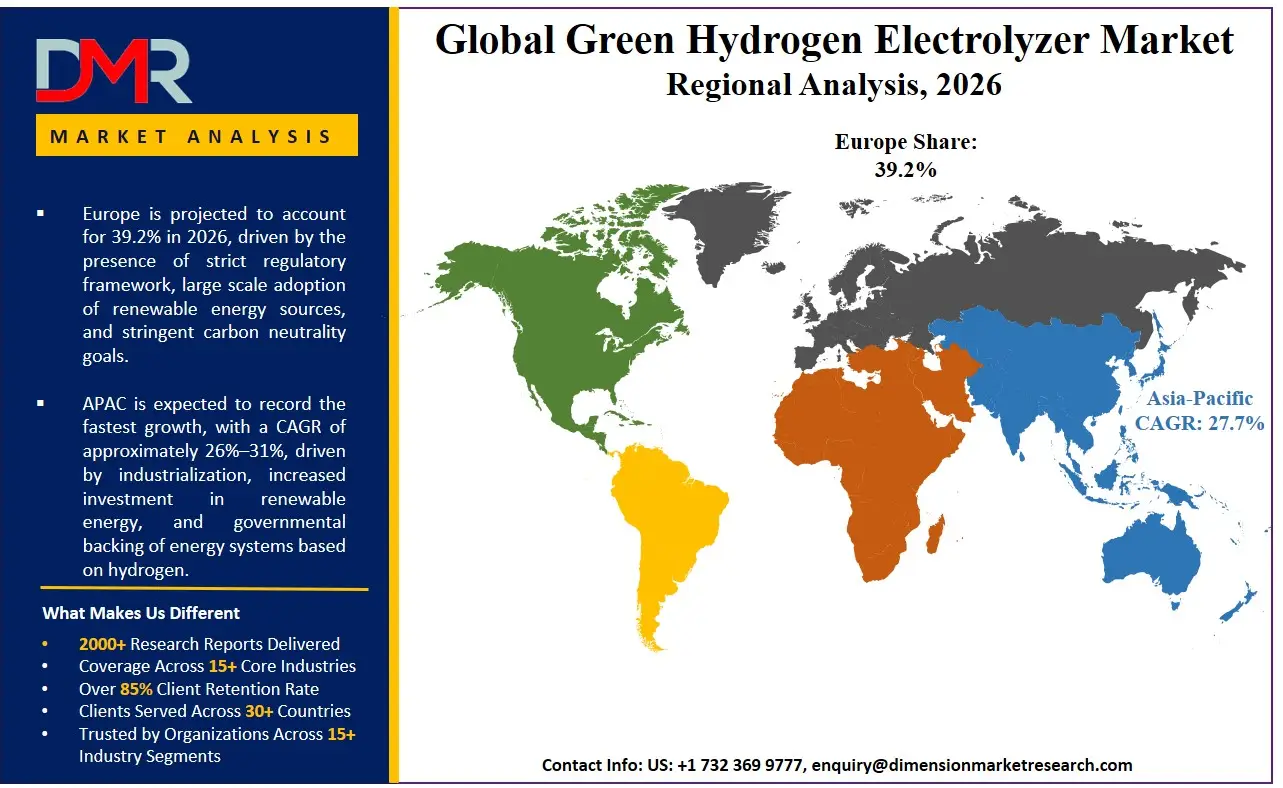
Europe will maintain its dominance in the Green Hydrogen Electrolyzer Market with a projected market share of 39.2% in 2026, owing to the presence of strict regulatory framework, large scale adoption of renewable energy sources, and stringent carbon neutrality goals. The Green Deal initiative, REPowerEU plan, and other strategic investments related to green hydrogen in Europe are driving rapid market adoption in the transportation and industrial sectors. Countries such as Germany, France, Spain, and Netherlands are making huge investments in hydrogen valleys, offshore wind-driven electrolyzers, and industrial decarbonization solutions.
ℹ
To learn more about this report –
Download Your Free Sample Report Here
Fastest Growing Region in the Green Hydrogen Electrolyzer Market
Asia-Pacific is expected to witness the highest growth in the Green Hydrogen Electrolyzer Market owing to industrialization, increased investment in renewable energy, and governmental backing of energy systems based on hydrogen. Countries such as China, Japan, South Korea, India, and Australia are focusing heavily on their hydrogen economies, including hydrogen projects and exportations. The region is aided by high demand for energy, advanced manufacturing abilities, and addition of capacity for solar and wind energy sources. It is anticipated that hydrogen roadmaps, international partnerships, and decarbonization efforts will significantly contribute to the development of the electrolyzer market in the region.
By Region
North America
Europe
- Germany
- The U.K.
- France
- Italy
- Russia
- Spain
- Benelux
- Nordic
- Rest of Europe
Asia-Pacific
- China
- Japan
- South Korea
- India
- ANZ
- ASEAN
- Rest of Asia-Pacific
Latin America
- Brazil
- Mexico
- Argentina
- Colombia
- Rest of Latin America
Middle East & Africa
- Saudi Arabia
- UAE
- South Africa
- Israel
- Egypt
- Rest of MEA
Competitive Landscape
The Green Hydrogen Electrolyzer Market is marked by stiff competition due to advances in technology, increase in scale of production, and business alliances within the renewable energy and industrial segments. The players are paying special attention to research and development for improving electrolyzer efficiency, reducing the use of catalysts, and cutting down on manufacturing costs. In addition to this, the players are entering into long-term contracts for supplies, setting up operations in new regions, and collaborating on the development of hydrogen-based infrastructure as means of enhancing their position within the market.
Some of the prominent players in the global Green Hydrogen Electrolyzer are:
- Nel ASA
- Plug Power Inc.
- Siemens Energy
- thyssenkrupp nucera
- ITM Power
- Cummins Inc.
- Bloom Energy
- John Cockerill
- Sunfire GmbH
- Topsoe
- McPhy Energy
- Ohmium International
- Enapter AG
- HydrogenPro
- Elogen
- LONGi Hydrogen
- Peric Hydrogen Technologies
- Shandong Saikesaisi Hydrogen Energy
- Sungrow Hydrogen
- Cockerill Jingli Hydrogen
- Other Key Players
Recent Developments
- In May 2026, Nel ASA launched the new generation pressurized alkaline electrolyser system for commercial purposes, which was developed for eight years and was successfully tested at their plant in Herøya, Norway. This new platform will help in improving efficiency, scalability, simplicity, and reducing costs associated with hydrogen production. According to Nel ASA, the cost of the turnkey system will be less than USD 1,450 per kW, which is less than the industry average, whereas producing 30-bar pressurized hydrogen of purity level 99.99%.
- In October 2025, The Stargate Hydrogen company introduced two innovations in green hydrogen solutions. They included the 5 MW Starbase electrolyser stack and the 10 MW Aurora electrolyser system module. Both systems are meant for use in various industries, including refineries, chemical plants, and steel plants. Aurora is known for its reduced spatial requirements, measuring only 14.4 m²/MW, while Starbase can achieve an energy efficiency of less than 49 kWh/kg.
- In October 2025, Plug Power Inc. has disclosed the shipment of its inaugural 10-MW GenEco™ electrolyzer array destined for Galp, serving the purpose of providing renewable hydrogen fuel for the Sines Refinery in Portugal. In all, 10 arrays will be delivered with an aggregate capacity of 100 MW, which is anticipated to manufacture 15,000 tons of renewable hydrogen annually. The project will eliminate about 20 percent of grey hydrogen consumption at the Sines Refinery and reduce carbon dioxide emissions by 110,000 tons annually.
Report Details
| Report Characteristics |
| Market Size (2026) |
USD 8.9 Bn |
| Forecast Value (2035) |
USD 66.9 Bn |
| CAGR (2026–2035) |
25.1% |
| Historical Period |
2021 – 2025 |
| Forecast Period |
2027 – 2035 |
| Base Year |
2025 |
| Estimate Year |
2026 |
| Segments Covered |
By Electrolyzer Technology, By Component, By Capacity, By Power Source, By Application, By End-Use Industry |
| Regional Coverage |
North America – The US and Canada; Europe – Germany, The UK, France, Russia, Spain, Italy, Benelux, Nordic, & Rest of Europe; Asia-Pacific – China, Japan, South Korea, India, ANZ, ASEAN, Rest of APAC; Latin America – Brazil, Mexico, Argentina, Colombia, Rest of Latin America; Middle East & Africa – Saudi Arabia, UAE, South Africa, Turkey, Egypt, Israel, & Rest of MEA |
Frequently Asked Questions
How big is the Green Hydrogen Electrolyzer Market?
▾ The Green Hydrogen Electrolyzer Market size is expected to reach USD 8.9 billion by 2026 and is projected to reach USD 66.9 billion by the end of 2035.
What is the CAGR of the Green Hydrogen Electrolyzer Market from 2026 to 2035?
▾ The market is growing at a CAGR of 25.1 percent over the forecasted period.
What factors are driving the growth of the Green Hydrogen Electrolyzer Market?
▾ Decarbonization Efforts Around the World Will Increase the Need for Electrolyzers, and more are the factors driving the growth of the Green Hydrogen Electrolyzer Market.
What are the major trends in the Green Hydrogen Electrolyzer Market?
▾ Use of Modular and Gigawatt-Class Electrolyzers, and more are some of the major trends in the market.
Who are the key players in the Green Hydrogen Electrolyzer Market?
▾ Some of the key players in the Green Hydrogen Electrolyzer Market include Nel, Siemens, Plug Power, and more.
How is the Green Hydrogen Electrolyzer Market segmented?
▾ The Green Hydrogen Electrolyzer Market is segmented by electrolyzer technology, component, capacity, power source, application, end-use industry.
Which region held the largest share of the Green Hydrogen Electrolyzer Market in 2026?
▾ Europe is set to lead the Green Hydrogen Electrolyzer market with an estimated 39.2% share in 2026.
Which region is expected to grow the fastest in the Green Hydrogen Electrolyzer Market?
▾ Asia Pacific is the fastest-growing region in the Green Hydrogen Electrolyzer market during the forecast period.