What is the Green Hydrogen Market Size?
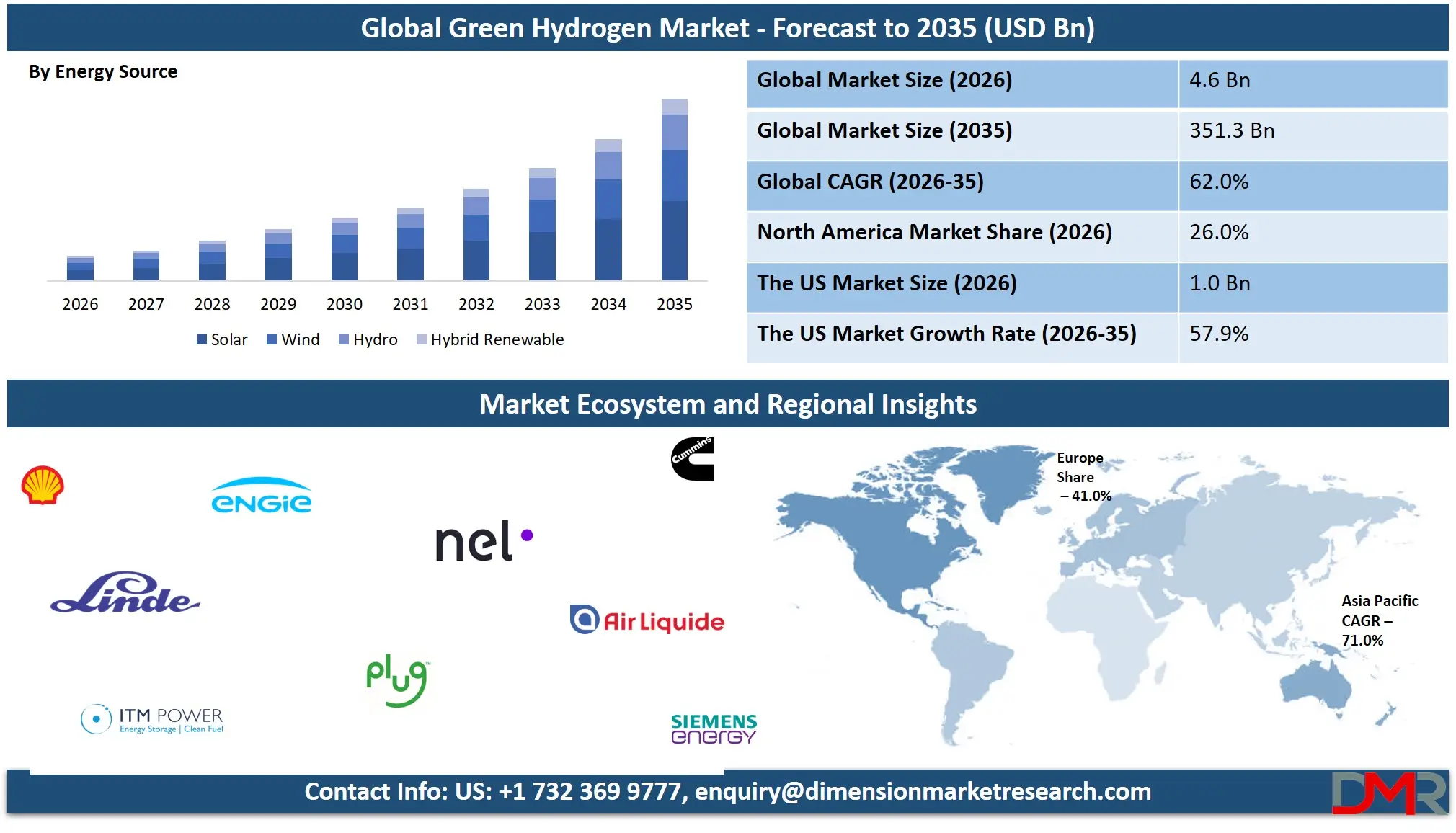
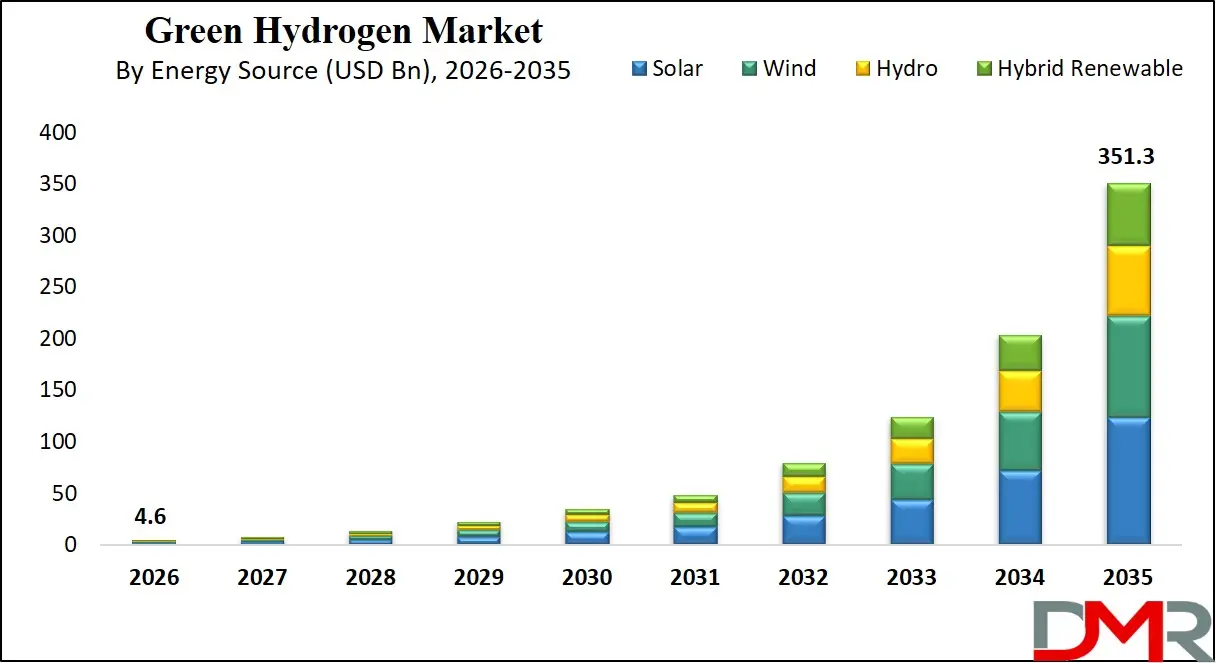
The Green Hydrogen Market size is projected to reach USD 4.6 billion in 2026 and grow at a compound annual growth rate of 62.0% to reach a value of USD 351.3 billion in 2035, driven by commitments toward net-zero emissions.
ℹ
To learn more about this report –
Download Your Free Sample Report Here
The Green Hydrogen Market is experiencing rapid growth as an essential part of the global efforts towards decarbonization. It is driven by the shift towards renewables and net-zero emissions. The term green hydrogen describes hydrogen obtained using electrolysis through renewable energy sources, such as wind, solar, or hydroelectric plants.
Its significance is reflected in the potential for decarbonization in hard-to-abate industries, such as transport, industrial production, and energy storage. Some of the latest trends in the market include falling prices for renewable energy, investment in electrolysis plant construction, and hydrogen infrastructure.
ℹ
To learn more about this report –
Download Your Free Sample Report Here
The US Green Hydrogen Market
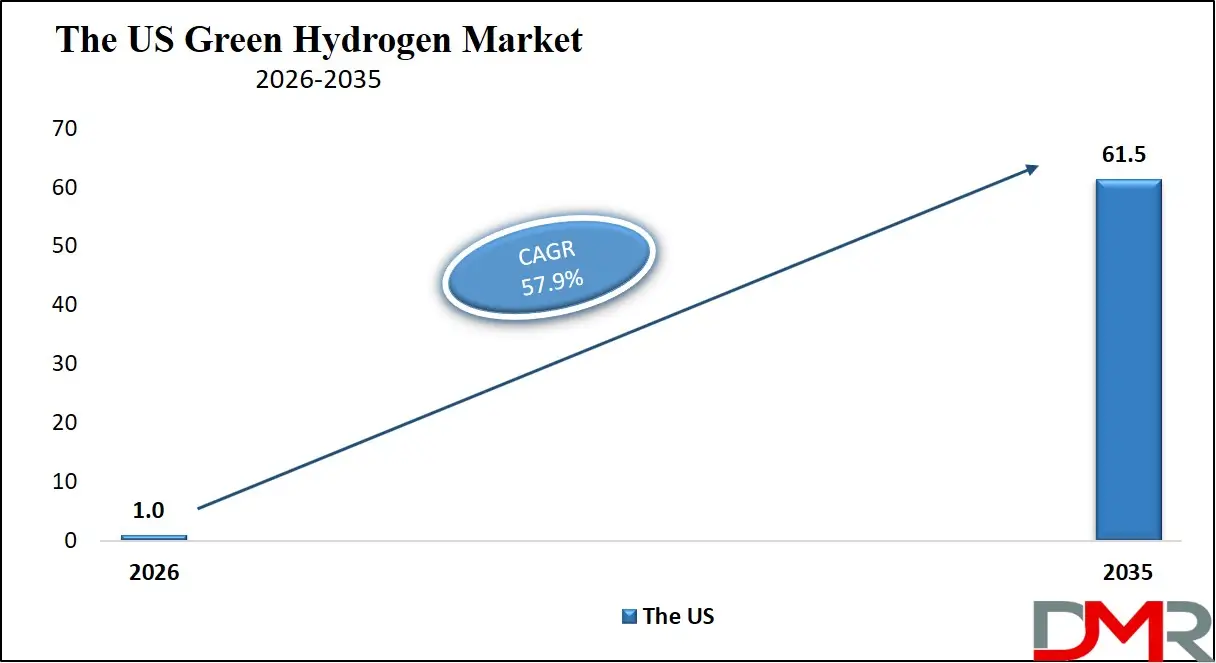
The US Green Hydrogen Market size is projected to reach USD 1.0 billion in 2026 and grow at a CAGR of 57.9% during the forecast period.
ℹ
To learn more about this report –
Download Your Free Sample Report Here
The market for green hydrogen in the US is growing because of substantial government backing, involving tax breaks and financial investments based on clean energy policies. Various government measures are fostering the establishment of huge hydrogen centers and infrastructures. Leading companies in this industry are focusing on developing electrolyzer technology. Availability of advanced research facilities and rising cooperation between the government and the private sector are improving competitive advantage.
Europe Green Hydrogen Market
The Europe Green Hydrogen Market size is estimated to be USD 1.9 billion in 2026 and its CAGR of 57.1% over the forecast period.
Europe continues to be the leader in terms of green hydrogen adoption due to proactive environmental policies such as the European Green Deal. Europe seeks to limit its dependency on fossil fuel sources and improve energy security. Robust regulation, subsidies, and intercontinental hydrogen transportation projects are helping in the growth of the market. Countries have invested significantly in increasing the production of electrolyzers and integrating renewable energy sources.
Japan Green Hydrogen Market
Japan Green Hydrogen Market size will be USD 184 million in 2026 and CAGR is 64.1% in the forecast period.
The Japan green hydrogen market is developing with support from government projects that intend to reach carbon neutrality. Hydrogen energy carriers are seen as a potential solution by the Japanese to decrease their reliance on foreign fossil fuels. Hydrogen investments have been increasing, particularly those related to fuel stations. Transportation and electricity generation will be the two main users of hydrogen technology. There are still problems like high production costs and low availability of renewable energy sources domestically.
Key Takeaways
- Market Size & Forecast: The Green Hydrogen Market size is projected to reach USD 4.6 billion in 2026 and is anticipated to have a value of USD 351.3 billion in 2035.
- Growth Rate & Outlook: The Green Hydrogen Market size is set to grow at a compound annual growth rate of 62.0% during the forecast period of 2026 to 2035.
- Primary Growth Drivers: Some of the major growth drivers in the market include rising decarbonization target, declining renewable energy costs, and more.
- Key Market Trends: Some of the major trends in the market are integration with renewable energy system, advancement in electrolyzer technologies, and more.
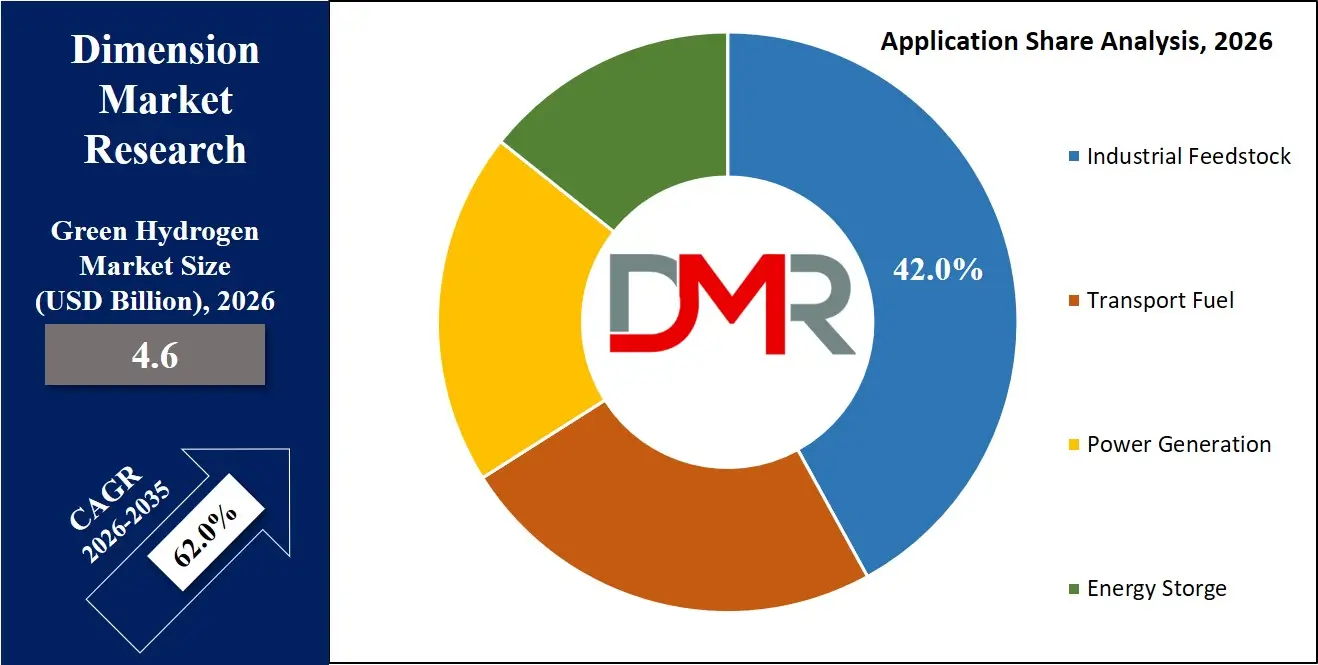
- By Application: The industrial feedstock segment is anticipated to get the majority share of the Green Hydrogen market in 2026.
- By Energy Source: The solar segment is expected to get the largest revenue share in 2026 in the Green Hydrogen market.
- By System Size: The large scale segment is expected to get the largest revenue share in 2026 in the Green Hydrogen market.
- Regional Leadership: Europe is set to lead the Green Hydrogen market with an estimated 41.0% share in 2026.
What is the Green Hydrogen?
Green hydrogen refers to hydrogen gas obtained by electrolyzing water using electricity that comes from renewable sources such as solar, wind, and hydroelectric energy. In this case, the process separates water molecules into hydrogen and oxygen without releasing carbon dioxide, which makes it a form of clean energy storage. Green hydrogen is an environmentally sustainable energy source since it offers a clean solution for hydrogen production compared to fossil fuel hydrogen production processes.
Use Cases
- Industrial Decarbonization: Green hydrogen is widely used as a clean feedstock in industries such as ammonia, methanol, and steel production, replacing carbon-intensive hydrogen sources and reducing emissions significantly.
- Clean Transportation: It powers fuel cell electric vehicles (FCEVs), including trucks, buses, and trains, offering long-range and fast refueling advantages over battery-based systems.
- Energy Storage: Green hydrogen acts as a long-duration energy storage solution, enabling excess renewable energy to be stored and used when needed, stabilizing power grids.
- Power Generation: It is utilized in gas turbines and fuel cells to generate electricity, providing a clean alternative for backup and peak power generation.
How AI Is Transforming the Green Hydrogen Market
AI technologies are making green hydrogen production more efficient by ensuring that the electrolyzers perform efficiently, scheduling maintenance in time, and managing energy effectively. AI helps manage renewable energy sources to provide consistent supply of green hydrogen while using the least amount of energy possible.
Apart from improving project decisions and investments, AI will contribute towards improved logistics and infrastructure development for green hydrogen production.
Market Dynamic
Driving Factors in the Green Hydrogen Market
Rising Decarbonization Targets
One of the main factors driving the demand for green hydrogen is global commitments towards net zero emissions. There have been many strict environmental regulations imposed by governments that force industries to shift to greener options. The use of green hydrogen will be highly beneficial in reducing carbon footprints from industries such as steel, chemicals, and transportation.
Declining Renewable Energy Costs
The rapid fall in prices of renewable energy sources, such as solar and wind energy, is greatly enhancing the production of green hydrogen. The reduction in electricity prices means that there will be a lower cost for electrolysis processes, resulting in green hydrogen being cheaper than traditional hydrogen.
Restraints in the Green Hydrogen Market
High Production Costs
In spite of the development of technologies, green hydrogen proves to be more costly than both grey and blue hydrogen, since its production involves a significant amount of investment that has to be covered by expenditures on electrolyzers and energy.
Infrastructure Limitations
Another problem is that there is no existing hydrogen infrastructure for storage, transport, and distribution. This makes implementation difficult because it will take years and large sums of money to build the necessary infrastructure to transport hydrogen.
Opportunities in the Green Hydrogen Market
Expansion in Emerging Economies
Many developing nations have been actively engaging in renewable energy projects, which presents an opportunity to develop green hydrogen. Areas like Asia Pacific and the Middle East have plentiful solar and wind energy and can emerge as future exporters of green hydrogen.
Government Incentives and Funding
Positive policies, subsidies, and funding mechanisms are creating new areas of growth. Countries around the world have started developing hydrogen policies along with providing incentives for production and adoption.
Trends in the Green Hydrogen Market
Integration with Renewable Energy Systems
The production of green hydrogen has started to be incorporated into renewable energy initiatives, thereby allowing the efficient use of excess energy. Hybrid technologies that harness solar, wind, and hydrogen power are becoming more popular.
Advancements in Electrolyzer Technologies
Developments in electrolyzer technology, such as increased efficiency and longevity, are revolutionizing the industry. New materials and designs are decreasing expenses and improving functionality, thus allowing for the commercialization of green hydrogen production.
Research Scope and Analysis
By Technology Analysis
Proton Exchange Membrane (PEM) Electrolyzer is likely to take market lead with a market share forecasted at 38% in 2026 owing to the high efficiency rate of the product, compactness, and adaptability to renewable energy input sources. The fast reaction rate of Proton Exchange Membrane (PEM) Electrolyzers allows them to effectively combine with wind and solar energy. Apart from that, PEM Electrolyzers have smaller space requirements along with high current densities which make them ideal for urban and industrial installations. On the other hand, Solid Oxide Electrolyzers are expected to grow rapidly in the global market due to the high efficiency rates of Solid Oxide Electrolyzers under high temperatures and the potential for their effective integration with industrial waste heat recovery systems.
By Energy Source Analysis
The share of solar energy will take up nearly 35%, owing to the availability of solar energy and its cost efficiency. Solar-powered electrolysis initiatives have seen growth in areas where solar radiation is abundant. In addition, innovations in photovoltaics and battery technology have increased the reliability of solar hydrogen production technology. Wind energy is also gaining prominence, particularly at offshore wind farms, where favorable conditions for producing hydrogen continuously and on a larger scale are present. The hybrid category is currently the fastest-growing one because it allows the combination of solar energy, wind energy, and water to guarantee that hydrogen production is ongoing at all times.
By Application Analysis
The largest application area is anticipated to be industrial feedstock, accounting for about 42% of the market share in 2026, owing to significant growth in the consumption of ammonia, methanol, and refinery industries with an objective of reducing their carbon emissions. In addition, green hydrogen will be used to replace conventional hydrogen due to stringent environmental norms.
ℹ
To learn more about this report –
Download Your Free Sample Report Here
The process of steel manufacturing by adopting direct reduced iron (DRI) technique is gradually becoming more prevalent compared to coal-based techniques. Moreover, the application of green hydrogen in chemical synthesis has been increasing rapidly. The transport fuel industry is projected to be the fastest growing sector, owing to the increasing usage of hydrogen-powered cars such as trucks, buses, and trains.
By End Use Industry Analysis
The energy and utilities industry is expected to dominate the market, with a forecasted market share of 33% in 2026, based on the rising application of hydrogen as a source of energy for generating electricity, stabilizing the power grid, and harnessing renewable energy sources. The energy and utilities industries are currently employing green hydrogen as an energy storage medium that can help balance the supply and demand for energy and also facilitate the storage of surplus energy generated from renewable sources. Moreover, hydrogen is increasingly being employed as an alternative fuel in gas turbines and fuel cells for the generation of electricity.
By System Size Analysis
Large-scale systems will likely capture a dominant market share of around 46% by 2026 due to huge investments made in hydrogen production facilities on an industrial scale. Such systems have economies of scale due to which their production cost is lower while efficiency is high. The integration of large-scale systems with large energy sources, such as solar plants and offshore wind power facilities, provides the necessary electricity needed to perform electrolysis operations. Large-scale systems play an important role in fulfilling industrial needs, as well as helping with export-oriented hydrogen production systems. The medium-scale segment is the fastest-growing segment because of its versatility and relative lower investment requirement.
By Deployment Mode Analysis
In terms of deployment, on-site deployments are expected to account for a significant 57% of the market in 2026 due to the growing demand from industrial sectors that want to produce hydrogen locally to avoid expensive transportation costs and carbon footprint issues. On-site production helps manage hydrogen supply more effectively, increases productivity, and benefits industries that need constant hydrogen supplies. In contrast, off-site deployments are developing quickly as hydrogen production plants become increasingly centralized, thanks to investments in hydrogen pipelines and storage tanks. Such a strategy facilitates hydrogen production at scale and distribution to several users simultaneously.
The Green Hydrogen Market Report is segmented on the basis of the following:
By Technology
- Alkaline Electrolysis (AEL)
- Proton Exchange Membrane (PEM) Electrolysis
- Solid Oxide Electrolysis (SOEC)
- Anion Exchange Membrane (AEM) Electrolysis
By Energy Source
- Solar
- Wind
- Hydro
- Hybrid Renewable
By Application
- Industrial Feedstock
- Ammonia Production
- Methanol Production
- Refining
- Steel (DRI)
- Transport Fuel
- Road (FCEVs, Trucks, Buses)
- Rail
- Maritime
- Aviation (e-fuels)
- Power Generation
- Energy Storage
By End-Use Industry
- Energy & Utilities
- Transportation
- Chemicals
- Oil & Gas
- Metals & Mining
By System Size
- Small Scale
- Medium Scale
- Large Scale
By Deployment Mode
Regional Analysis
Leading Region in the Green Hydrogen Market
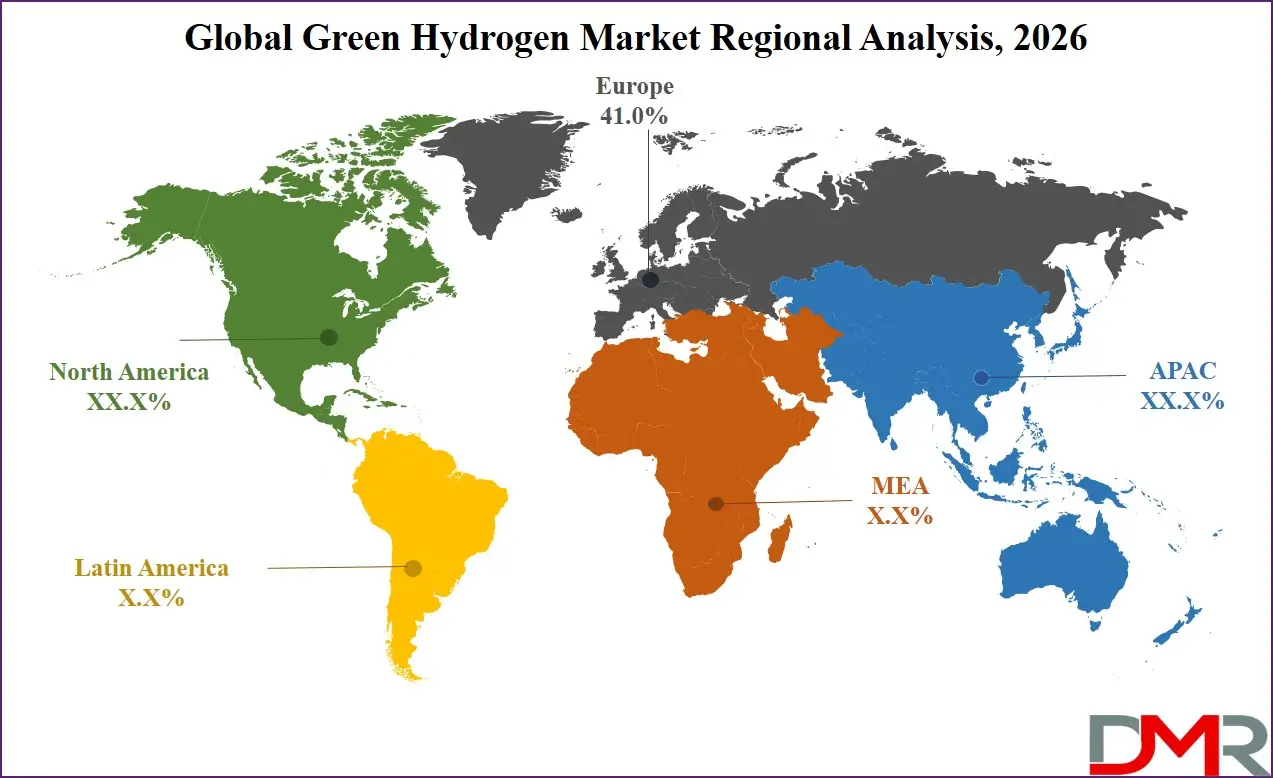
Europe is projected to become the leading player in the green hydrogen market with a market share of around 41% by 2026 due to its effective policy measures, commitment towards achieving net-zero carbon emissions, and huge investments in renewable energy infrastructure. Europe will be able to benefit from the presence of various hydrogen policies among several countries and their collaboration on hydrogen-based projects. Huge financial support provided to hydrogen projects through grants and subsidies will enable faster execution of large projects. Industrial decarbonization in industries such as steel and chemical industries will play a key role in driving the demand.
ℹ
To learn more about this report –
Download Your Free Sample Report Here
Fastest Growing Region in the Green Hydrogen Market
It is expected that Asia-Pacific will have the highest growth rate owing to its fast industrialization and high energy demand and strong governmental initiatives for shifting towards renewables. Countries in the region are making large investments in renewable power generation and hydrogen infrastructure construction in order to cut their dependency on fossil fuels. With the availability of ample sources of solar and wind energy, there is a good possibility for the affordable production of green hydrogen in the region. Moreover, the region is seeing more strategic collaborations and exports of hydrogen, especially to international markets.
By Region
North America
Europe
- Germany
- The U.K.
- France
- Italy
- Russia
- Spain
- Benelux
- Nordic
- Rest of Europe
Asia-Pacific
- China
- Japan
- South Korea
- India
- ANZ
- ASEAN
- Rest of Asia-Pacific
Latin America
- Brazil
- Mexico
- Argentina
- Colombia
- Rest of Latin America
Middle East & Africa
- Saudi Arabia
- UAE
- South Africa
- Israel
- Egypt
- Rest of MEA
Competitive Landscape
The green hydrogen industry is associated with high barriers to entry because of its capital requirements and technological complexity. Strategic alliances, joint ventures, and supply contracts have been adopted by firms to improve their competitive positioning within the market. Innovation through constant investments in R&D has led to advancements in electrolyzer technologies. Competitive advantage has been established through renewable resource availability, technological capabilities, and hydrogen value chain integration.
Some of the prominent players in the global Green Hydrogen are:
- Air Liquide
- Linde plc
- Nel ASA
- Plug Power
- Siemens Energy
- ITM Power
- Cummins Inc.
- ENGIE
- Shell plc
- Ballard Power Systems
- TotalEnergies
- Fortescue Future Industries
- Adani Enterprises
- Reliance Industries
- NTPC Limited
- Larsen & Toubro
- Thyssenkrupp
- John Cockerill
- Hydrogenics
- CWP Global
- Other Key Players
Recent Developments
- In April 2026, The African Development Bank, via its Sustainable Energy Fund for Africa, has launched a call for proposals offering up to $20 million to support early-stage green hydrogen projects. The programme focuses on pre-investment activities like feasibility studies, engineering design, and transaction support. Aimed at bridging development gaps, it will assist a few shortlisted projects in reaching investment readiness, helping them progress toward final investment decisions and financial closure.
- In January 2026, India’s Biotechnology Industry Research Assistance Council launched a funding programme under the National Green Hydrogen Mission to support green hydrogen projects. With a total outlay of INR 100 crore (USD 10.7 million), it targets pilot-scale initiatives using biomass, wastewater, and innovative energy integration methods. Biomass-based production is a key focus, leveraging agricultural and organic waste. Projects can receive up to INR 25 crore (USD 2.7 million) each, with applications open for a limited period.
- In June 2025, Suntory Holdings unveiled its "Suntory Green Hydrogen Vision," outlining its long-term strategy for hydrogen utilization. This comes ahead of the launch of the Yamanashi Model Power-to-Gas system, a 16 MW facility developed with regional partners. The project will produce green hydrogen for Suntory’s water plant and distillery, supporting Japan's broader efforts to build hydrogen supply networks and advance decarbonization through public-private collaboration.
Report Details
| Report Characteristics |
| Market Size (2026) |
USD 4.6 Bn |
| Forecast Value (2035) |
USD 351.3 Bn |
| CAGR (2026–2035) |
62.0% |
| Historical Period |
2021 – 2025 |
| Forecast Period |
2027 – 2035 |
| Base Year |
2025 |
| Estimate Year |
2026 |
| Segments Covered |
By Technology (Alkaline Electrolysis (AEL), Proton Exchange Membrane (PEM) Electrolysis, Solid Oxide Electrolysis (SOEC), Anion Exchange Membrane (AEM) Electrolysis),
By Energy Source (Solar, Wind, Hydro, Hybrid Renewable),
By Application (Industrial Feedstock, Transport Fuel, Power Generation, Energy Storage),
By End-Use Industry (Energy & Utilities, Transportation, Chemicals, Oil & Gas, Metals & Mining),
By System Size (Small Scale, Medium Scale, Large Scale),
By Deployment Mode (On-site, Off-site) |
| Regional Coverage |
North America – The US and Canada;
Europe – Germany, The UK, France, Russia, Spain, Italy, Benelux, Nordic, & Rest of Europe;
Asia-Pacific – China, Japan, South Korea, India, ANZ, ASEAN, Rest of APAC;
Latin America – Brazil, Mexico, Argentina, Colombia, Rest of Latin America;
Middle East & Africa – Saudi Arabia, UAE, South Africa, Turkey, Egypt, Israel, & Rest of MEA |
Frequently Asked Questions
How big is the Green Hydrogen Market?
▾ The Green Hydrogen Market size is expected to reach USD 4.6 billion by 2026 and is projected to reach USD 351.3 billion by the end of 2035.
What is the CAGR of the Green Hydrogen Market from 2026 to 2035?
▾ The market is growing at a CAGR of 62.0 percent over the forecasted period.
What factors are driving the growth of the Green Hydrogen Market?
▾ Rising decarbonization target, declining renewable energy costs, and more are the factors driving the growth of the Green Hydrogen Market.
What are the major trends in the Green Hydrogen Market?
▾ Integration with renewable energy system, advancement in electrolyzer technologies, and more are some of the major trends in the market.
Who are the key players in the Green Hydrogen Market?
▾ Some of the key players in the Green Hydrogen Market include Air Liquide, Linde, Siemens, and more.
How is the Green Hydrogen Market segmented?
▾ The Green Hydrogen Market is segmented by technology, energy source, application, end-use industry, system size, and deployment mode.
Which region held the largest share of the Green Hydrogen Market in 2026?
▾ Europe is set to lead the Green Hydrogen market with an estimated 41.0% share in 2026.
Which region is expected to grow the fastest in the Green Hydrogen Market?
▾ Asia-Pacific is the fastest-growing region in the Green Hydrogen market during the forecast period.