What is the Grid Scale Energy Storage Market Size?
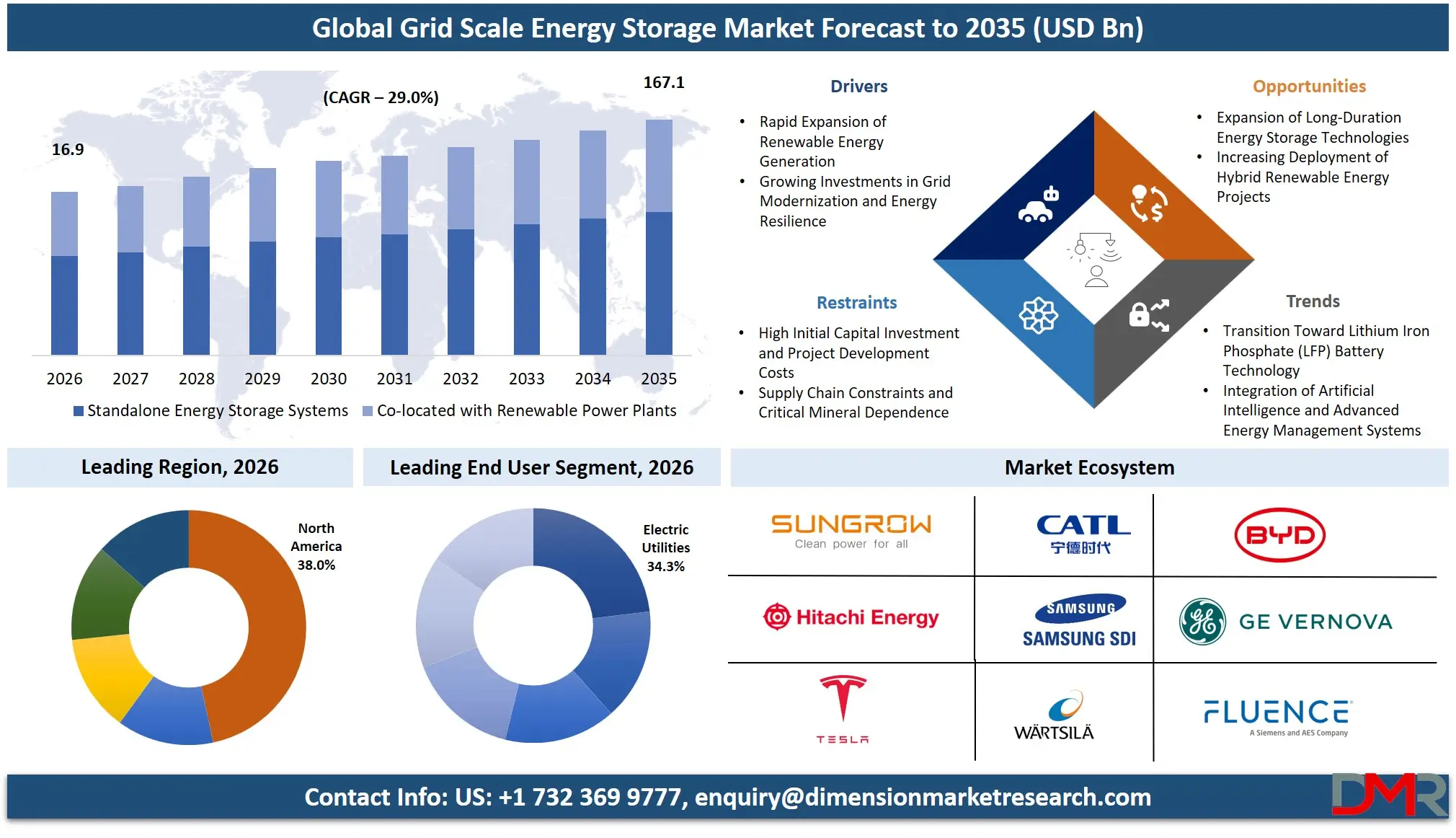
The Global Grid-Scale Energy Storage Market is expected to reach a value of USD 16.9 billion in 2026 and is further anticipated to surge to USD 167.1 billion by 2035, growing at a CAGR of 29.0% during the forecast period.
ℹ
To learn more about this report –
Download Your Free Sample Report Here
The grid-scale energy storage market is experiencing exponential growth as the global energy ecosystem undergoes a fundamental transition from centralized fossil-fuel generation to decentralized, intermittent renewable power sources. The market encompasses the deployment of stationary storage assets, including Battery Energy Storage Systems (BESS), Pumped Hydroelectric Storage (PHS), and emerging long-duration energy storage (LDES) technologies, which provide critical flexibility to stabilize transmission networks. The imperative to integrate massive capacities of solar and wind generation, coupled with the retirement of dispatchable coal and gas plants, is driving the necessity for advanced storage solutions. Electric utilities, Independent Power Producers (IPPs), and Transmission System Operators (TSOs) are the primary adopters, with Lithium Iron Phosphate (LFP) chemistry and co-located renewable-plus-storage installations remaining the most popular configurations due to their safety profile, declining costs, and modular scalability.
The US Grid Scale Energy Storage Market
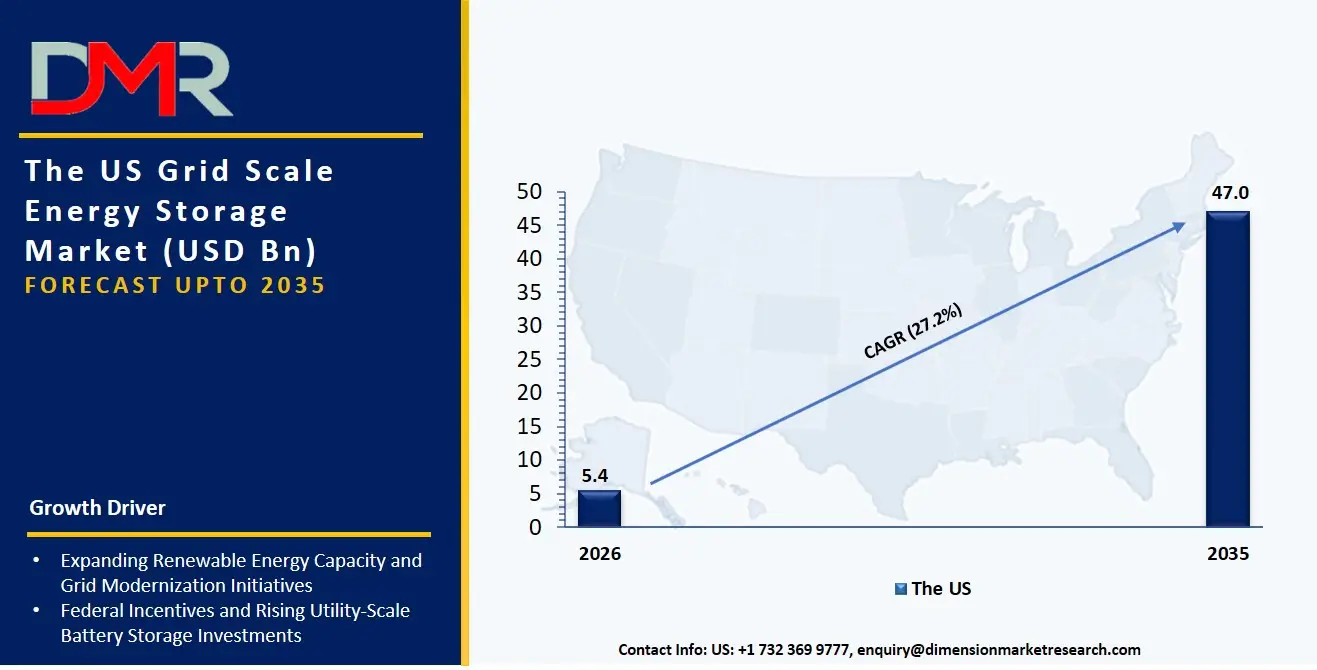
The US Grid-Scale Energy Storage Market is projected to reach USD 5.4 billion in 2026 at a compound annual growth rate of 27.2% over its forecast period, culminating in a value of USD 47.0 billion by 2035.
ℹ
To learn more about this report –
Download Your Free Sample Report Here
The US continues to be the largest and most dynamic market for grid-scale storage, fueled by aggressive state-level clean energy portfolio standards and the Inflation Reduction Act's investment tax credits for standalone storage. The market has been typified by high demand for 4-hour and 8-hour duration BESS assets, which are increasingly deployed by IPPs to participate in wholesale energy markets. Besides, the growing frequency of climate-related grid instability events is producing a similar need for microgrid support and black start services to ensure energy resilience for critical public infrastructure and commercial operations.
The Europe Grid Scale Energy Storage Market
The Europe Grid-Scale Energy Storage Market is estimated to be valued at USD 4.6 billion in 2026 and is further anticipated to reach USD 42.2 billion by 2035 at a CAGR of 27.9%. The regulatory frameworks, including the EU Electricity Market Design reform and stringent decarbonization targets, have a significant impact on the European market and drive the need for frequency regulation and energy arbitrage services. Accelerated growth of co-located renewable power plants is also being experienced in the region as transmission system operators in Germany, the UK, and Italy seek to reduce curtailment of offshore wind and utility-scale solar. In addition, hydrogen energy storage (Power-to-Hydrogen-to-Power) pilot projects are challenging service providers to create dedicated seasonal storage solutions to provide resource adequacy and long-duration energy shifting across European transmission networks.
The Japan Grid Scale Energy Storage Market
The Japan Grid-Scale Energy Storage Market is projected to be valued at USD 1.2 billion in 2026. It is further expected to witness robust growth, holding USD 4.4 billion in 2035 at a CAGR of 15.3%. The Japanese market is unique, with a corporate and governmental drive to enhance grid stabilization and energy security in response to the post-Fukushima nuclear phase-out and a growing penetration of behind-the-meter solar. Sodium-ion and Vanadium Redox Flow Battery (VRFB) installations make up a large part of the spending as large conglomerates deploy megawatt-scale systems to defer expensive transmission & distribution upgrades. There is also a strong need to integrate storage deeply in the local market to bridge the gaps between on-grid and off-grid hybrid grid systems on remote islands, creating a niche for long-duration, seismically resilient storage assets.
Key Takeaways
- Market Size & Forecast: The Global Grid-Scale Energy Storage market is projected to reach USD 16.9 billion in 2026, expanding dramatically to USD 167.1 billion by 2035, fueled by the dual drivers of massive renewable energy integration and the mandatory modernization of aging grid infrastructure.
- Growth Rate & Outlook: Global market growth is expected at a CAGR of 29.0%, driven by a critical shortage of dispatchable power sources and the escalating complexity of managing frequency regulation and voltage support on inertia-deficient grids.
- Primary Growth Drivers: Key forces include the widespread transition from levelized cost of energy (LCOE) parity to value-based procurement of solar-plus-storage, the need for energy arbitrage to capture peak-to-off-peak price spreads, and the implementation of ancillary service market reforms requiring specialized BESS control software.
- Key Market Trends: Major trends include the rise of hybrid grid system, the use of AI-powered predictive algorithms within peak shaving & load shifting services to auto-optimize asset dispatch against wholesale market signals, and the shift toward standalone energy storage systems as utilities prioritize resource adequacy.
- By Connection Type Analysis: On-grid connection types are expected to dominate enterprise discussions due to market monetization opportunities. Hybrid grid systems are increasingly required to build seamless power electronics layers that connect off-grid renewable assets with the main grid's stability mechanisms.
- By End User Analysis: Electric Utilities and IPPs are the most lucrative end users due to the need for large-capacity ancillary services. Commercial & Industrial (C&I) is the fastest-growing sector as high energy consumers require robust backup power & emergency reserve systems to mitigate demand charges and operational disruption.
- Regional Leadership: North America is poised to dominate this market with 38.0% of the market share in 2026 due to its well-developed energy trading infrastructure that utilizes battery assets to their fullest capability and makes it a leader in this market.
What is the Grid-Scale Energy Storage?
Grid-Scale Energy Storage refers to the specialized physical and digital assets deployed by electric utilities, developers, and grid operators to absorb, store, and re-inject large quantities of electricity into the transmission or distribution network. These services, unlike energy consumption (the electrical load itself), relate to the how of grid management. This involves utilizing Battery Energy Storage Systems to provide sub-second frequency regulation, Pumped Hydroelectric Storage for bulk energy shifting over 8-12 hours, and Compressed Air or Thermal Energy Storage to replace traditional peaker plants. With nations targeting 80-100% renewable electricity grids, energy storage is required to achieve supply-demand balancing, grid inertia emulation, and transmission congestion relief, making intermittent generation translate into a tangible baseload and dispatchable power resource, as opposed to a source of volatility.
Use Cases
- Utility-Scale Solar Shifting in California: Electric utilities hire EPC contractors to deploy co-located, above 1,000 MWh LFP battery plants that store midday solar oversupply, effectively shifting the generation into the evening peak demand hours and mitigating the infamous "duck curve."
- Wind Grid Compliance in the North Sea: Offshore wind IPPs use frequency regulation services from co-located BESS assets to comply with strict TSO grid codes, ensuring that variable wind output provides synthetic inertia and primary frequency response to stabilize the transmission network.
- Island Microgrid Resilience in the Pacific: Island governments and DSOs deploy off-grid hybrid grid systems combining solar PV with Zinc-Based and VRFB long-duration storage to displace diesel generators, ensuring that power supply remains uninterrupted without fossil fuel shipments.
- Industrial Peak Shaving in Manufacturing: Energy-intensive C&I users deploy behind-the-meter, 100–500 MWh standalone energy storage systems to perform peak shaving, automatically discharging during periods of high demand charges to drastically reduce electricity procurement costs.
How AI is Transforming the Grid Scale Energy Storage Market?
AI is changing grid-scale energy storage by accelerating the monetization of battery assets, as well as enhancing operational lifespan. In Energy Arbitrage, AI-based trading algorithms have the potential to automatically forecast locational marginal prices (LMPs) and autonomously bid storage capacity into day-ahead and real-time markets, greatly minimizing opportunity cost and maximizing revenue stacking from a single asset. Meanwhile, AI-powered battery management systems in Battery Energy Storage Systems allow operators to better control thermal runaway risks by predicting cell-level degradation patterns and suggesting measures like dynamic state-of-charge (SoC) buffering to extend the lifecycle of Lithium Titanate (LTO) and NMC packs.
Battery technology innovation and project development are also revolving around AI. In the area of co-located renewable power plants, intelligent grid-forming inverters are used to continuously check external grid conditions and identify voltage anomalies and harmonic distortions to keep hybrid assets in line with IEEE 1547 interconnection standards. Moreover, generative AI design tools are complementing transmission & distribution deferral projects by simulating congestion patterns and modeling future load growth to give stakeholders a visualization of a non-wires alternative before committing capital-intensive substation upgrades.
Market Dynamics
Key Drivers in the Global Grid Scale Energy Storage Market
Rapid Expansion of Renewable Energy Generation
The accelerating deployment of solar and wind power is a major driver of the global grid scale energy storage market. Renewable energy sources produce electricity intermittently, creating fluctuations in power generation that require flexible storage solutions for reliable grid operation. Grid-scale energy storage systems capture surplus electricity during periods of high renewable output and discharge it during peak demand or low generation periods. Governments are introducing renewable energy targets, carbon reduction policies, and clean energy incentives that encourage large-scale storage deployment. Utilities increasingly depend on energy storage to improve renewable utilization, reduce curtailment, stabilize electricity supply, and strengthen overall grid resilience.
Growing Investments in Grid Modernization and Energy Resilience
Governments and utilities worldwide are investing heavily in modernizing aging electricity infrastructure, creating strong demand for grid-scale energy storage. Increasing electricity consumption, electrification of transportation, and rising climate-related disruptions require more flexible and resilient power networks. Energy storage systems provide frequency regulation, voltage support, peak demand management, backup power, and transmission deferral, helping utilities improve operational efficiency while avoiding costly infrastructure expansion. Public funding programs, regulatory reforms, and utility investment plans continue accelerating large-scale deployment. As smart grids expand globally, grid-scale energy storage is becoming a critical component for ensuring reliable, efficient, and secure electricity delivery.
Restraints in the Global Grid Scale Energy Storage Market
High Initial Capital Investment and Project Development Costs
Despite declining battery prices, grid-scale energy storage projects require substantial upfront investment for batteries, power conversion equipment, land acquisition, engineering, installation, grid interconnection, and safety systems. Large utility-scale projects often involve complex financing structures that can delay project execution, particularly in developing economies with limited investment capacity. Additional expenses related to permitting, environmental compliance, and long-term maintenance further increase total project costs. Although operational savings improve project economics over time, the significant initial financial commitment remains a key restraint for utilities, independent power producers, and governments planning widespread deployment of energy storage infrastructure.
Supply Chain Constraints and Critical Mineral Dependence
The market remains vulnerable to supply chain disruptions and dependence on critical raw materials such as lithium, nickel, cobalt, graphite, and rare earth elements. Rising global demand for batteries has intensified competition for these minerals, leading to price volatility and procurement challenges. Geopolitical tensions, mining limitations, export restrictions, and transportation disruptions can significantly affect battery manufacturing and project timelines. Manufacturers are investing in alternative chemistries and recycling technologies to reduce material dependence, but current supply constraints continue influencing project costs and availability. These uncertainties create challenges for large-scale deployment and long-term planning across global energy storage markets.
Growth Opportunities in the Global Grid Scale Energy Storage Market
Expansion of Long-Duration Energy Storage Technologies
Growing renewable energy penetration is increasing demand for long-duration energy storage solutions capable of delivering electricity for several hours or even days. Technologies including flow batteries, hydrogen storage, compressed air energy storage, gravity-based systems, and advanced thermal storage offer significant opportunities for balancing renewable generation over extended periods. Governments and utilities are funding demonstration projects to diversify storage technologies beyond lithium-ion batteries. As technology costs decline and commercialization advances, long-duration energy storage will play an increasingly important role in supporting grid reliability, seasonal energy balancing, and carbon-neutral electricity systems across global energy markets.
Increasing Deployment of Hybrid Renewable Energy Projects
Hybrid renewable projects combining solar, wind, and battery storage are emerging as a major growth opportunity for the industry. Co-locating energy storage with renewable generation improves asset utilization, reduces transmission congestion, minimizes renewable curtailment, and increases project revenues through energy arbitrage and ancillary services. Utilities and independent power producers increasingly prefer integrated renewable-plus-storage developments because they provide dispatchable clean electricity while improving grid flexibility. Government incentive programs, favorable regulatory frameworks, and declining battery costs continue supporting hybrid project development. The rapid expansion of renewable capacity worldwide will significantly increase demand for integrated grid-scale energy storage solutions.
Trends in the Global Grid Scale Energy Storage Market
Transition Toward Lithium Iron Phosphate (LFP) Battery Technology
Lithium Iron Phosphate batteries are increasingly replacing other lithium-ion chemistries in utility-scale storage projects due to their superior safety, longer operational life, thermal stability, and competitive pricing. Major battery manufacturers continue expanding LFP production capacity as utilities seek reliable storage solutions with lower maintenance requirements. Improvements in manufacturing efficiency and economies of scale have further reduced LFP battery costs, making them highly attractive for large-scale deployments. Their ability to withstand frequent charging and discharging cycles supports applications including renewable integration, peak shaving, and frequency regulation. This transition is reshaping procurement strategies throughout the global storage industry.
Integration of Artificial Intelligence and Advanced Energy Management Systems
Artificial intelligence, machine learning, and advanced energy management software are becoming essential components of modern grid-scale energy storage systems. These technologies optimize battery charging and discharging schedules, forecast electricity demand, predict renewable generation, and maximize asset utilization in real time. Utilities increasingly deploy intelligent energy management platforms to improve operational efficiency, reduce maintenance costs, and extend battery lifespan through predictive analytics. Integration with smart grids enables automated decision-making, enhances grid reliability, and supports participation in electricity markets. As digitalization accelerates, AI-powered energy management will become a defining trend across future energy storage deployments.
Research Scope and Analysis
The Global Grid Scale Energy Storage Market Report is segmented by Technology, Battery Chemistry, Capacity, Connection Type, Installation Type, Application, and End User. These segments comprehensively evaluate technology adoption, storage capacity, battery advancements, deployment models, grid integration, operational applications, and key end-user industries, providing detailed insights into global market dynamics, competitive positioning, and future growth opportunities.
ℹ
To learn more about this report –
Download Your Free Sample Report Here
By Technology Analysis
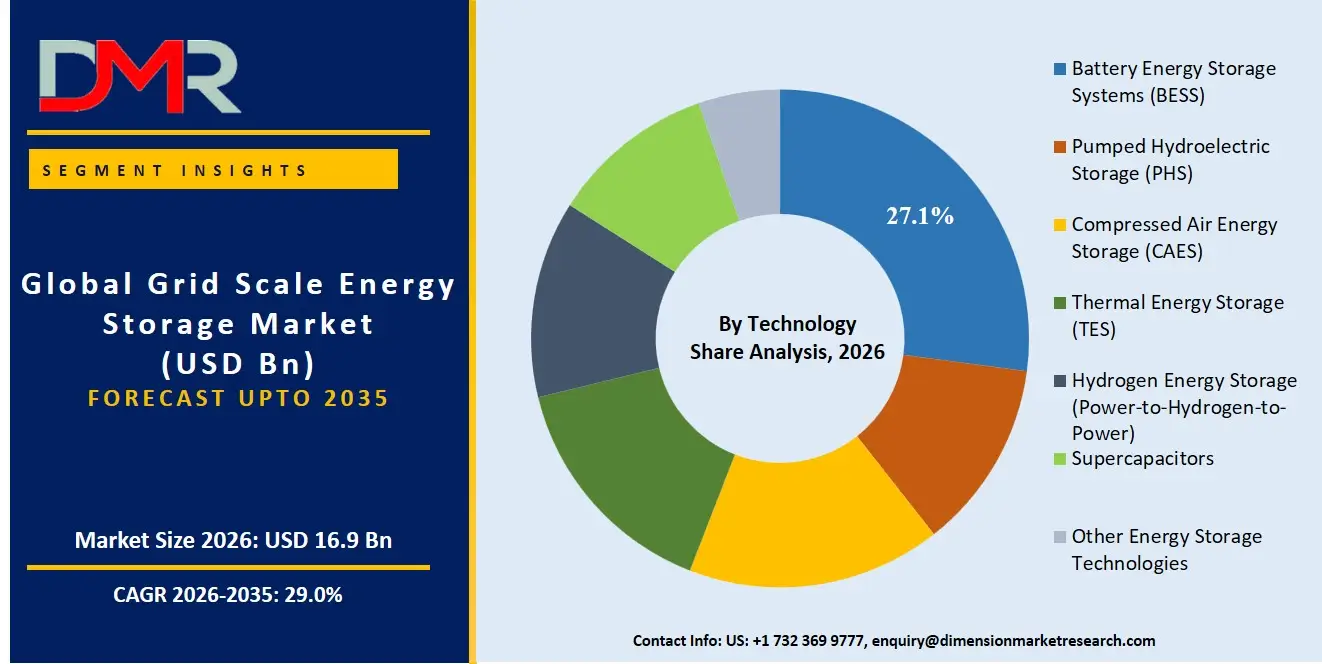
Battery Energy Storage Systems (BESS) is poised to dominate the technology segment due to their rapid deployment, modular design, declining battery costs, and high operational flexibility. Lithium-ion-based BESS projects have become the preferred choice for utilities because they provide fast frequency response, peak shaving, renewable energy integration, and grid balancing with minimal installation time compared to conventional storage technologies. Governments worldwide are supporting battery deployments through clean energy policies and grid modernization programs. The scalability of BESS, ranging from a few megawatt-hours to multi-gigawatt-hour facilities, further strengthens its market leadership. Continuous improvements in battery efficiency, safety, energy density, and lifecycle performance ensure BESS remains the most widely adopted grid-scale energy storage technology.
By Battery Chemistry Analysis
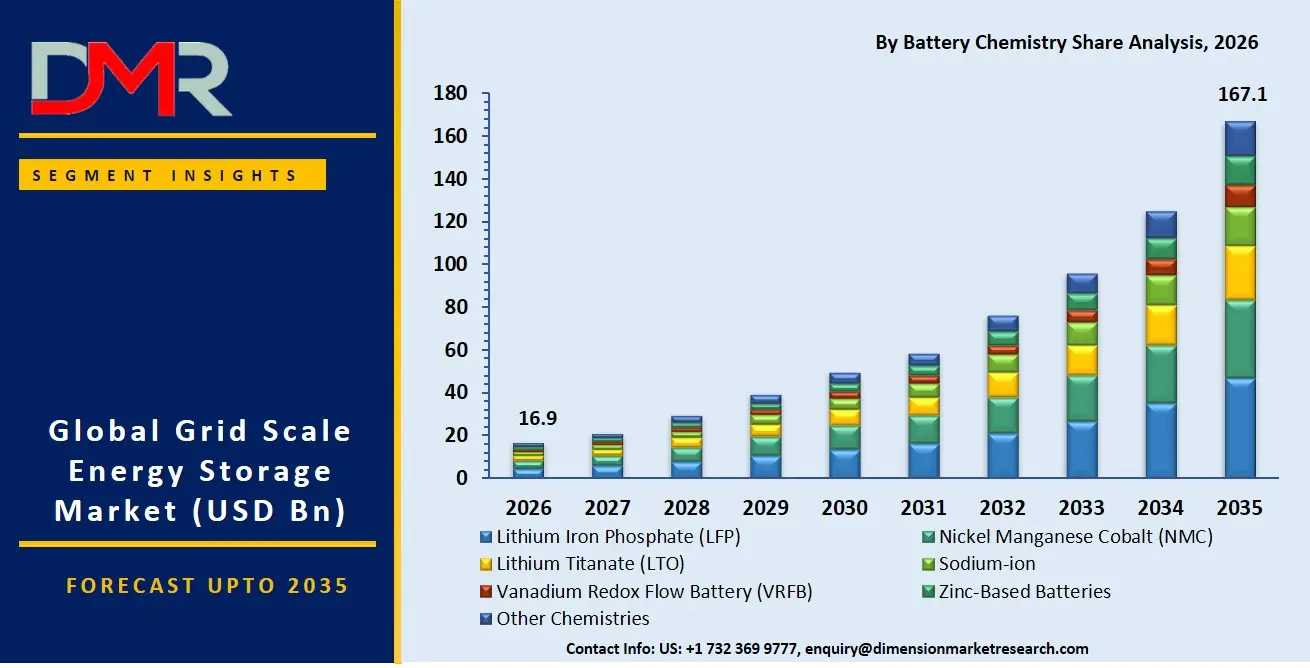
Lithium Iron Phosphate (LFP) batteries is anticipated to dominate the battery chemistry segment because they offer superior thermal stability, enhanced safety, long cycle life, and competitive costs compared with other chemistries. Utility-scale developers increasingly favor LFP technology for large energy storage installations where reliability, durability, and lower maintenance are critical.
ℹ
To learn more about this report –
Download Your Free Sample Report Here
The chemistry performs well under frequent charging and discharging cycles, making it ideal for renewable energy integration and frequency regulation. Expanding manufacturing capacity, particularly across Asia-Pacific, has further reduced production costs and improved supply availability. Strong adoption by major battery manufacturers and grid operators continues to reinforce LFP as the preferred chemistry for new installations.
By Capacity Analysis
The 100–500 MWh capacity segment is expected to dominate the market because it effectively meets the operational requirements of utilities, renewable power plants, and transmission operators. Projects within this range provide sufficient storage for renewable integration, grid balancing, peak demand management, and ancillary services while maintaining favorable project economics. Many recently commissioned battery storage facilities globally fall within this capacity category due to manageable investment costs and flexible scalability. Governments and utilities increasingly procure projects in this range to support expanding solar and wind installations. The balance between affordability, operational flexibility, and reliable energy delivery makes this capacity segment the leading choice worldwide.
By Connection Type Analysis
On-grid systems is poised to dominate the connection type segment because most utility-scale energy storage projects are directly integrated with national electricity transmission and distribution networks. Grid-connected storage enables operators to improve grid reliability, support renewable energy integration, provide ancillary services, stabilize voltage, and manage frequency fluctuations efficiently. Utilities benefit from centralized monitoring, optimized dispatch, and participation in electricity markets through on-grid installations. Strong investments in transmission infrastructure, renewable power expansion, and smart grid development continue driving widespread adoption. Government incentives and regulatory frameworks encouraging large-scale grid modernization further strengthen the dominance of on-grid energy storage across developed and emerging economies.
By Installation Type Analysis
Co-located energy storage installations is projected to dominate because they maximize the value of renewable generation by storing surplus electricity produced from solar and wind facilities. These integrated systems reduce renewable energy curtailment, improve project economics, enhance grid stability, and allow electricity delivery during periods of high demand. Utilities and independent power producers increasingly prefer combining storage with renewable assets to meet grid reliability requirements and optimize revenue through energy arbitrage and ancillary services. Favorable government policies promoting renewable-plus-storage projects, declining battery costs, and increasing investments in hybrid power plants continue strengthening this installation model's leadership across global energy markets.
By Application Analysis
Renewable energy integration is anticipated to dominate the application segment because energy storage has become essential for managing the variability and intermittency of solar and wind power generation. Grid-scale storage systems absorb excess electricity during periods of high renewable production and release it when demand increases or renewable generation declines. This capability improves grid stability, enhances renewable utilization, minimizes curtailment, and supports national decarbonization objectives. Governments worldwide continue expanding renewable generation capacity while introducing policies encouraging integrated storage solutions. The growing transition toward low-carbon electricity systems ensures renewable energy integration remains the largest and fastest-expanding application for grid-scale energy storage deployments.
By End User Analysis
Electric utilities is projected to dominate the end-user segment because they are responsible for maintaining grid stability, ensuring reliable electricity supply, and integrating growing renewable energy capacity into national power systems. Utilities invest heavily in grid-scale storage to manage peak demand, provide ancillary services, defer transmission infrastructure upgrades, and improve power quality. Large financial resources, long-term infrastructure planning, and government-backed investment programs enable utilities to deploy large-scale energy storage projects faster than other end users. Increasing electricity demand, decarbonization initiatives, and modernization of aging power grids continue driving utility investments, reinforcing their dominant position in the global grid-scale energy storage market.
The Global Grid Scale Energy Storage Market Report is segmented on the basis of the following:
By Technology
- Battery Energy Storage Systems (BESS)
- Pumped Hydroelectric Storage (PHS)
- Compressed Air Energy Storage (CAES)
- Thermal Energy Storage (TES)
- Hydrogen Energy Storage (Power-to-Hydrogen-to-Power)
- Supercapacitors
- Other Energy Storage Technologies
By Battery Chemistry
- Lithium Iron Phosphate (LFP)
- Nickel Manganese Cobalt (NMC)
- Lithium Titanate (LTO)
- Sodium-ion
- Vanadium Redox Flow Battery (VRFB)
- Zinc-Based Batteries
- Other Chemistries
By Capacity
- Below 100 MWh
- 100–500 MWh
- 500–1,000 MWh
- Above 1,000 MWh
By Connection Type
- On-Grid
- Off-Grid
- Hybrid Grid Systems
By Installation Type
- Standalone Energy Storage Systems
- Co-located with Renewable Power Plants
By Application
- Renewable Energy Integration
- Frequency Regulation
- Peak Shaving & Load Shifting
- Energy Arbitrage
- Grid Stabilization
- Voltage Support
- Black Start Services
- Transmission & Distribution Deferral
- Backup Power & Emergency Reserve
- Microgrid Support
By End User
- Electric Utilities
- Independent Power Producers (IPPs)
- Transmission System Operators (TSOs)
- Distribution System Operators (DSOs)
- Commercial & Industrial (C&I)
- Government & Public Infrastructure
Regional Analysis
Leading Region by Market Share
ℹ
To learn more about this report –
Download Your Free Sample Report Here
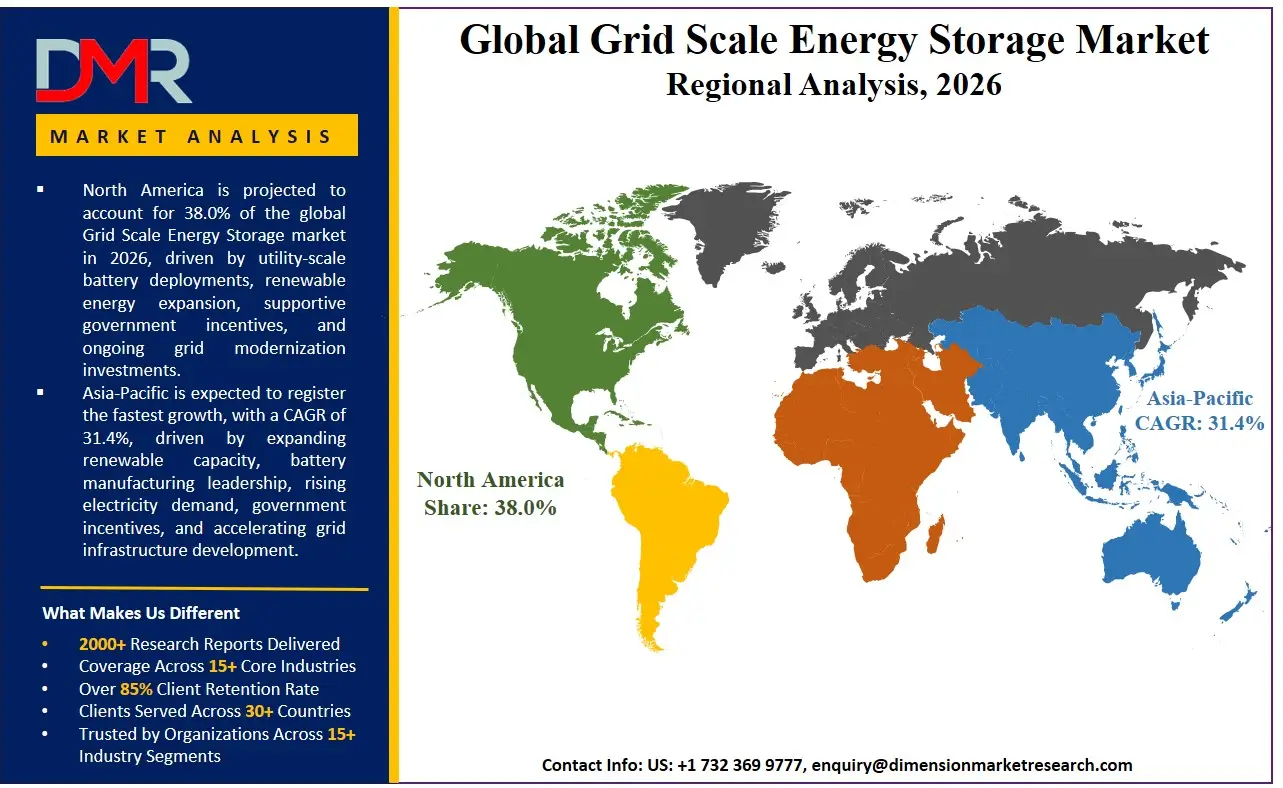
North America is poised to dominate the global grid-scale energy storage market as it is projected to hold 38.0% of the market share by the end of 2026. The United States, which dominates North America, has the highest share in the market because of the unmatched concentration of merchant power trading floors and the aggressive clean energy procurement mandates of Fortune 500 corporate off-takers. The area has an established ecosystem of global EPC contractors, boutique power market analytics firms, and a rich pool of battery systems engineers and wholesale energy traders. Enterprise investment in copper-to-fiber grid modernization, advanced power electronics, and the overall retirement of inflexible coal fleets contributes to the continued demand for frequency regulation and load-shifting assets. Moreover, a liquid financial climate persistently finances upcoming standalone storage developers that need expert optimization services to achieve expeditious revenue stacking and NERC compliance.
Fastest-Growing Regional Market
Asia-Pacific is expected to be the most rapidly expanding grid-scale energy storage market, driven by government-led sweeping energy security mandates and electrification initiatives in China, India, and Australia. The fast-paced economic growth, the rise of a manufacturing-led middle-income population, and the dynamic expansion of the commercial & industrial (C&I) sector are compelling state-owned utilities and private IPPs to discard inefficient, polluting diesel backup generation. Grid stabilization and renewable energy integration are in high demand to help these large state grids head in the direction of a high-voltage, synchronous grid-forming operating model. There is also a severe lack of qualified power system protection engineers in the region, and it is necessary to outsource integration services for microgrid support and off-grid hybrid systems to cover the skills gap and enable faster investments in village electrification and island energy independence projects.
By Region
North America
Europe
- Germany
- The U.K.
- France
- Italy
- Russia
- Spain
- Benelux
- Nordic
- Rest of Europe
Asia-Pacific
- China
- Japan
- South Korea
- India
- ANZ
- ASEAN
- Rest of Asia-Pacific
Latin America
- Brazil
- Mexico
- Argentina
- Colombia
- Rest of Latin America
Middle East & Africa
- Saudi Arabia
- UAE
- South Africa
- Israel
- Egypt
- Rest of MEA
Competitive Landscape
The competitive environment of global grid-scale energy storage has become highly dynamic with a heterogeneous array of multinational power technology OEMs, pure-play battery system integrators, and the energy storage divisions of the large automotive conglomerates. The key to success will be the profound strategic partnerships with major cell manufacturers like CATL or BYD, because they will open the necessary supply chain security and early access to the new sodium-ion and solid-state platform capabilities. The movement towards vertical integration is rapidly progressing with traditional thermal EPC firms acquiring power electronics and EMS (Energy Management System) software specialized boutiques to stay afloat. Proprietary intellectual property, including AI-driven auto-bidding platforms and liquid cooling system accelerators, is becoming a more important basis of competitive differentiation than just raw cell cost procurement or generic balance-of-plant approaches.
Some of the prominent players in the Global Grid Scale Energy Storage Market are:
- Tesla, Inc.
- BYD Company Ltd.
- Contemporary Amperex Technology Co., Limited (CATL)
- LG Energy Solution
- Samsung SDI
- Fluence Energy
- Wärtsilä
- Hitachi Energy
- GE Vernova
- Siemens Energy
- Huawei Digital Power
- Sungrow Power Supply Co., Ltd.
- ABB Ltd.
- Schneider Electric
- Enphase Energy
- Powin
- Saft
- Eos Energy Enterprises
- Canadian Solar Inc.
- Mitsubishi Electric Corporation
- Other Key Players
Recent Developments
- January 2026: Tesla Megapack division declared a major expansion of its grid-forming inverter initiative, a professional services engagement to assist Electric Utilities and IPPs in Hawaii and the Caribbean to create proprietary microgrid support frameworks through its Autobidder platform and advanced LFP Application and control logic.
- November 2025: Fluence Energy strengthened its collaboration with Siemens and introduced a specific practice called Mosaic AI-powered bidding and HVDC integration, aimed at supporting TSO clients in integrating offshore wind storage hubs to AC transmission networks and keeping in compliance with European system operator regulations.
- October 2025: Canadian Solar's e-STORAGE arm purchased a European BESS commissioning firm to further its co-located renewable power plant and transmission & distribution deferral solutions for 2-hour to 8-hour grid-scale assets, to support the complicated requirements of Government and public sector customers in energy sovereignty.
Report Details
| Report Characteristics |
| Market Size (2026) |
USD 16.9 Bn |
| Forecast Value (2035) |
USD 167.1 Bn |
| CAGR (2026–2035) |
29.0% |
| The US Market Size (2026) |
USD 5.4 Bn |
| Historical Data |
2021 – 2025 |
| Forecast Data |
2027 – 2035 |
| Base Year |
2025 |
| Estimate Year |
2026 |
| Segments Covered |
By Technology, By Battery Chemistry, By Capacity, By Connection Type, By Installation Type, By Application, and By End User |
| Regional Coverage |
North America – The US and Canada; Europe – Germany, The UK, France, Russia, Spain, Italy, Benelux, Nordic, & Rest of Europe; Asia-Pacific – China, Japan, South Korea, India, ANZ, ASEAN, Rest of APAC; Latin America – Brazil, Mexico, Argentina, Colombia, Rest of Latin America; Middle East & Africa – Saudi Arabia, UAE, South Africa, Turkey, Egypt, Israel, & Rest of MEA |
Frequently Asked Questions
How big is the Global Grid-Scale Energy Storage Market?
▾ The Global Grid-Scale Energy Storage market is poised to be valued at USD 16.9 billion in 2026 and is projected to reach USD 167.1 billion by 2035, driven by the universal need for specialized asset flexibility in grid stabilization, frequency regulation, and renewable energy time-shifting.
What is the CAGR of the Global Grid-Scale Energy Storage Market from 2026 to 2035?
▾ The market is expected to grow at a CAGR of 29.0% from 2026 to 2035, reflecting the accelerating retirement of synchronous thermal generators and the persistent integration of intermittent solar and wind energy capacity.
What factors are driving the growth of the Global Grid-Scale Energy Storage Market?
▾ Key drivers include the global renewable integration imperative, the need to replace obsolete peaker plants, the management complexity of hybrid grid systems, and the surge in demand for co-located solar-plus-storage installations amid evolving capacity market designs.
Which region held the largest share of the Grid-Scale Energy Storage Market in 2026?
▾ North America is projected to hold 38.0% of the market share in 2026, driven by a mature wholesale electricity market and aggressive utility investment in 4-hour LFP energy storage and AI-driven energy arbitrage capabilities.
Which region is expected to grow the fastest in the Grid-Scale Energy Storage Market?
▾ The Asia-Pacific region is expected to grow the fastest, fueled by rapid electrification in China and India, where Standalone Energy Storage Systems and Microgrid Support are critical for transitioning off-grid diesel-dependent networks to renewable-based hybrid operations.
What are the major trends in the Global Grid-Scale Energy Storage Market?
▾ Major trends include the integration of grid-forming inverters into BESS deployments, the rise of Long-Duration Energy Storage (LDES) like Iron-Air and VRFB, the demand for non-flammable battery chemistries, and the focus on AI-driven auto-bidding within energy arbitrage applications.
Who are the key players in the Global Grid-Scale Energy Storage Market?
▾ Key players include global integrators like Fluence, Tesla, Wärtsilä, and Sungrow, as well as the energy storage divisions of OEMs like CATL and BYD, alongside specialized power conversion system (PCS) and EMS software pure-play firms.
How is the Global Grid-Scale Energy Storage Market segmented?
▾ The market is segmented by Technology, Battery Chemistry, Capacity, Connection Type, Installation Type, Application, and End User.