Market Snapshot
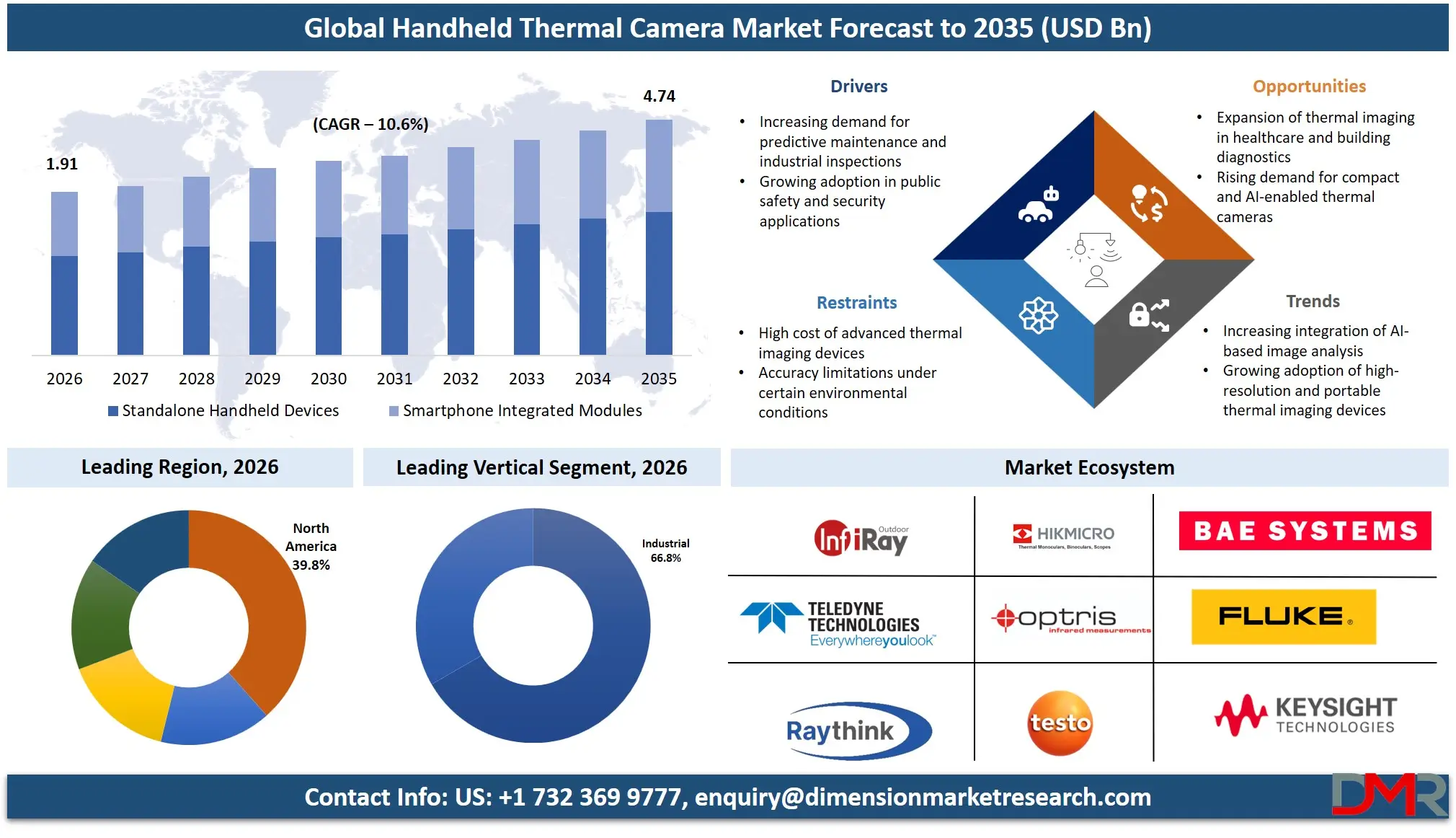
- The handheld thermal camera market size is USD 1.73 billion in 2025, reached USD 1.91 billion in 2026, and is projected to hit USD 4.74 billion by 2035 at a CAGR of 10.6%.
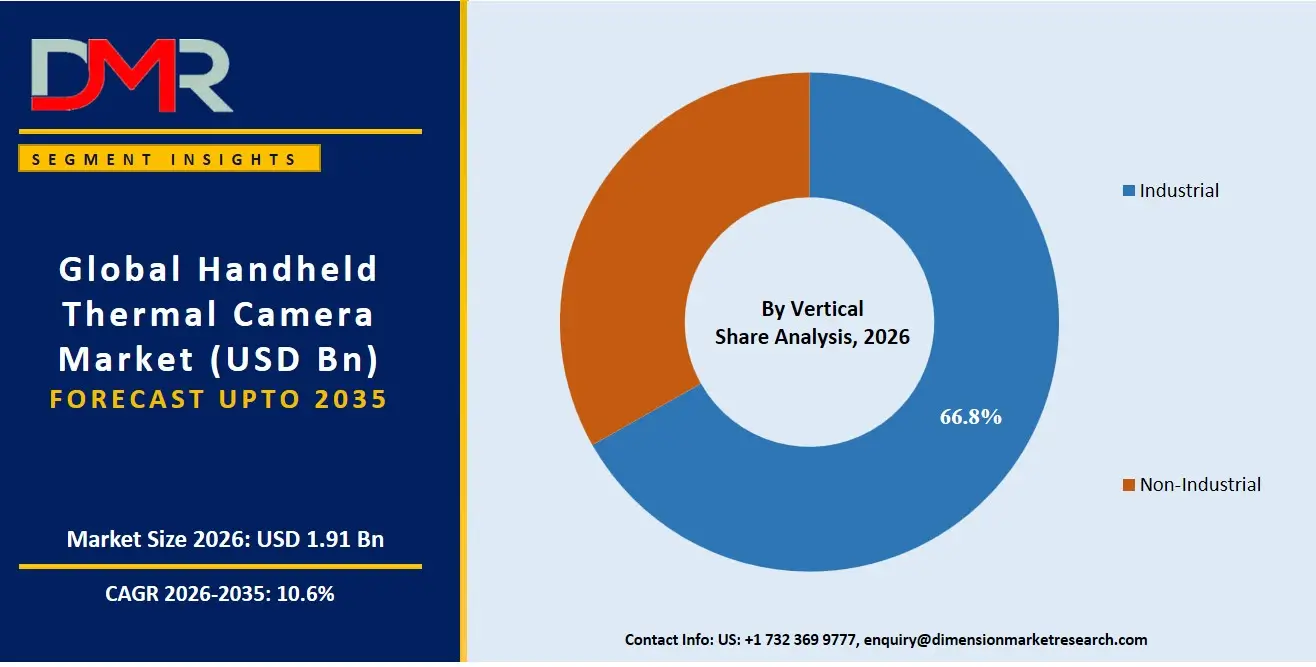
- The Industrial vertical led all segments with a 66.8% revenue share in 2026.
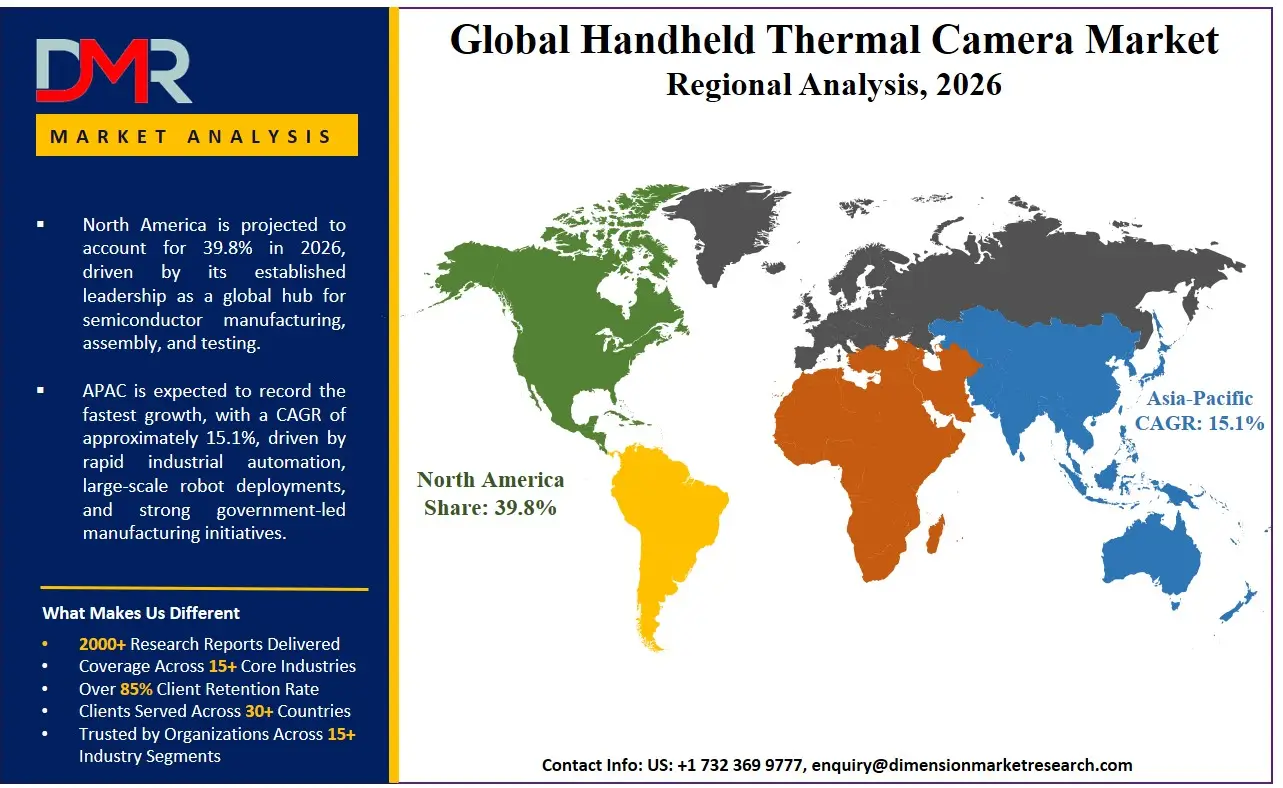
- North America held the dominant regional position with a 39.8% revenue share in 2026.
- Building Inspectors and Energy Auditors represented the largest profession type segment at 37.8% share.
- E-commerce was the leading distribution channel, capturing 47.2% of revenue.
- Entry Level devices (below USD 799) commanded the largest price tier share at 42.8%.
- Electrical Inspection was the top application segment with a 38.7% revenue share.
Market Overview
The global handheld thermal camera market covers portable infrared imaging devices used for non-contact temperature measurement and thermal anomaly detection across professional and commercial applications. Standalone handheld units and smartphone-integrated thermal modules are both included, spanning price tiers from entry-level consumer products below USD 799 to high-end professional systems. Fixed-mount industrial cameras, airborne systems, and military-grade cooled detector products fall outside this segment's scope. Portability and total cost of ownership, not imaging performance alone, determine adoption decisions within Handheld Thermal Camera Market.
ℹ
To learn more about this report –
Download Your Free Sample Report Here
Uncooled microbolometer sensor technology dominates detector architecture across this segment. As reported by FLIR, uncooled microbolometer handheld cameras operate at up to 50 frames per second, setting the practical ceiling for real-time field inspection imagery. Advances in microbolometer fabrication have compressed the cost of 320×240 resolution sensors far enough to bring them within reach of small contractors and independent inspectors, a buyer group that previously relied on rental or outsourced thermal surveys. The addressable market now spans electrical inspection, predictive maintenance, building diagnostics, healthcare screening, security surveillance, and emerging agricultural monitoring use cases.
Market Size and Forecast
The Global Handheld Thermal Camera Market size is estimated at USD 1.91 Billion in 2026 from USD 1.73 Billion in 2025, and is projected to reach USD 4.74 Billion by 2035, exhibiting a CAGR of 10.6% during the forecast period.
Two structural forces compound across the forecast window. Industrial asset owners are shifting maintenance budgets from reactive repair cycles toward scheduled thermal inspections of electrical panels, motors, and mechanical joints. Teledyne FLIR's January 2024 launch of the enhanced K-Series cameras for firefighting and rescue reinforced this trajectory by delivering improved image clarity targeted at high-stakes field deployment, expanding the professional user base beyond industrial maintenance into public safety procurement. Each category that normalizes thermal inspection as a compliance workflow adds a replacement and upgrade cycle that sustains volume independent of first-time purchase demand.
Uncooled sensor costs have declined far enough that the entry-level tier now draws first-time buyers, including independent HVAC contractors and building inspectors, who previously outsourced thermal surveys. The upside scenario depends on accelerated AI integration. Devices that automate anomaly flagging remove operator expertise as a barrier, and if AI-enabled handhelds reach mid-range price points within the forecast window, adoption among small and medium enterprises could exceed the base CAGR assumption. No data supports a formal downside revision, but high-performance cooled detector pricing remains a ceiling that limits penetration at the professional high end.
Vertical Analysis
Industrial led the Vertical segment with a 66.8% share in 2026.
ℹ
To learn more about this report –
Download Your Free Sample Report Here
Industrial facilities operate electrical panels, rotating machinery, and high-voltage infrastructure that require periodic non-contact thermal inspection to meet insurance requirements and internal safety standards. The concentration of procurement within this vertical reflects a straightforward cost-avoidance logic: the price of a handheld thermal camera is negligible against the cost of an unplanned equipment failure. Plant and facilities managers can justify thermal inspection tools against a measurable budget line, which shortens procurement cycles compared to other verticals.
The Non-Industrial vertical held a 33.2% share in 2026 but covers structurally different buyer profiles that cannot be served with a single product line. Firefighting and rescue applications demand ruggedized premium devices, while consumer-facing building energy auditing pulls toward lower price points. Healthcare screening, security surveillance, and building diagnostics each carry separate budget owners and procurement cycles. Vendors entering Non-Industrial must choose a sub-segment entry point rather than addressing the group as a uniform opportunity.
Profession Type Analysis
Building Inspectors and Energy Auditors accounted for 37.8% of Profession Type demand in 2026, the highest of any category.
Building Inspectors and Energy Auditors conduct repeat inspections across multiple sites weekly, creating consistent replacement and upgrade demand alongside the initial device purchase. Residential and commercial building stock across North America and Europe requires ongoing energy compliance assessments and structural diagnostics, anchoring this profession segment as the largest volume driver in the market. Vendors that bundle reporting software with their devices hold a direct advantage in converting these professionals into recurring customers.
Electricians and HVAC Technicians represent the two remaining profession segments, each with distinct thermal imaging requirements. Electricians prioritize high sensitivity and resolution for panel and switchgear inspection, where identifying a single failing connection can prevent a costly shutdown. HVAC Technicians need quick, low-overhead temperature checks on refrigerant lines and duct systems rather than formal survey-grade imaging, making them the most natural early adopters for smartphone-integrated modules. The divergence between these two groups creates a product segmentation opportunity that few vendors have fully exploited.
Price Tier Analysis
With a 42.8% share in 2026, Entry Level devices outpaced all other Price Tier categories.
First-time buyers, independent contractors, and consumer-oriented users drive entry-level dominance. Buyers in this tier understand thermal imaging conceptually but cannot justify the capital outlay of professional systems without first proving workflow value on lower-cost hardware. The practical risk for the market is that entry-level specifications may not meet the 320×240 resolution and 50 mK sensitivity thresholds that government procurement bodies and larger industrial clients now require, creating a gap between what SMEs can afford and what demanding applications need.
Mid-Range and High-End Professional tiers together account for the remaining 57.2% of revenue at higher average selling prices and lower unit volumes. Mid-Range is the most contested competitive space, as entry-level brands upgrade specifications to capture trade professionals while high-end players simplify interfaces to retain customers who would otherwise trade down. High-End Professional serves defense procurement and scientific applications where cooled detector performance is non-negotiable and price sensitivity is secondary.
Distribution Channel Analysis
E-commerce captured 47.2% of the Distribution Channel segment in 2026, ahead of all rivals.
E-commerce dominance signals that product specification sheets and user reviews now carry more weight in the purchase decision than distributor relationships or in-person demonstrations. Small businesses and independent professionals research and buy tools online without requiring pre-sale technical support, a behavioral pattern that compresses distributor margin and rewards vendors with strong digital product content. Manufacturer Direct and web store channels give vendors margin control and direct customer data access, making them strategically important even at lower volumes.
Wholesalers serve mid-market industrial buyers who bundle thermal cameras into larger safety equipment orders. The Specialist Trade Channel retains relevance for high-end professional buyers who require demonstration, calibration services, and post-sale technical support before committing to multi-unit deployments. A vendor covering only e-commerce without a specialist trade presence risks ceding the highest-margin enterprise accounts to competitors with dedicated field sales.
Application Analysis
Electrical Inspection led all Application categories with a 38.7% share in 2026.
Thermal cameras are the most effective non-invasive tool for detecting resistance faults, loose connections, and overloaded circuits before they cause equipment failure or fire. Regulatory requirements in many industrial markets mandate periodic electrical thermal surveys, making this application a compliance-driven purchase rather than a discretionary one. Vendors whose devices meet or exceed the sensitivity and resolution thresholds specified in those compliance frameworks capture repeat purchase cycles tied to annual inspection schedules.
Energy Audits, Predictive Maintenance, and Mechanical Equipment Monitoring represent the next tier of application volume, each tied to industrial budget cycles. Building Diagnostics overlaps with Energy Audits in buyer profile but focuses on moisture intrusion and insulation failure rather than energy efficiency scoring. Security and Surveillance, Healthcare and Medical, and Firefighting and Rescue command higher per-unit prices and stricter performance specifications despite lower volume. Agricultural and precision livestock monitoring represent the frontier growth area in Asia-Pacific, with no dominant vendor currently serving these use cases with purpose-built products.
Product Type Analysis
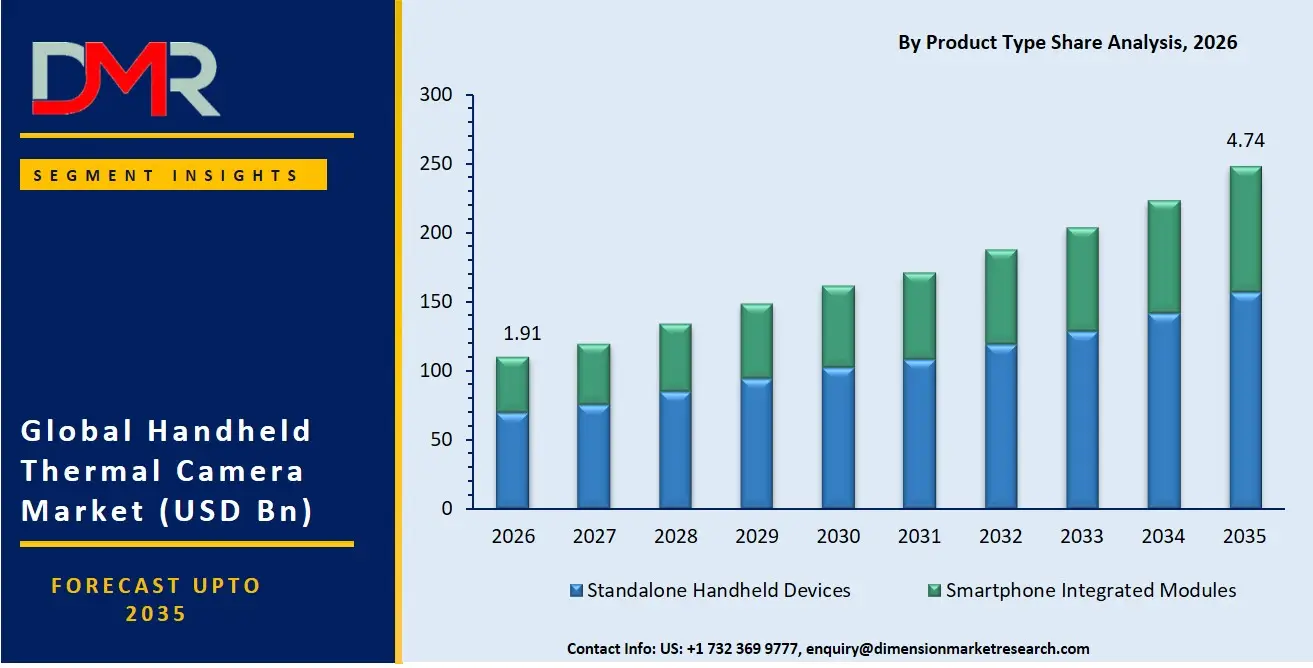
Standalone Handheld Devices held the established position across Product Type categories in 2026.
ℹ
To learn more about this report –
Download Your Free Sample Report Here
Standalone devices serve professional buyers who require dedicated instruments with calibrated sensors, rugged enclosures, and purpose-built software for thermal analysis and reporting. Building inspectors, industrial maintenance engineers, and public safety personnel depend on field-hardened equipment that operates independently of a smartphone. As reported by Seek Thermal, the Seek Compact smartphone module uses a 206×156 sensor detecting from −40°C to approximately 330°C, while the Seek CompactPRO steps up to a 320×240 thermal sensor, narrowing the resolution gap with entry-level standalone devices.
Smartphone Integrated Modules are the faster-moving segment for new buyer acquisition. Removing the need for a separate device lowers entry cost and appeals directly to HVAC technicians and electronics repair professionals who already carry mobile devices on the job. As module image quality approaches the specification floor required for professional inspections, price competition in the sub-USD 799 tier will intensify, compressing margins for both standalone entry-level device makers and module vendors simultaneously.
Key Market Segments
By Vertical
- Industrial
- Non-Industrial
By Profession Type
- Building Inspectors & Energy Auditors
- Electricians
- HVAC Technicians
By Price Tier
- Entry Level (Below USD 799)
- Mid-Range
- High-End Professional
By Distribution Channel
- E-commerce
- Manufacturer Direct / Web Store
- Wholesalers
- Specialist Trade Channel
By Application
- Electrical Inspection
- Energy Audits
- Predictive Maintenance
- Mechanical Equipment Monitoring
- Building Diagnostics
- Security and Surveillance
- Healthcare and Medical
- Firefighting and Rescue
By Product Type
- Standalone Handheld Devices
- Smartphone Integrated Modules
Regional Analysis
North America held the dominant regional position with a 39.8% revenue share in 2026, representing approximately USD 0.69 Billion of the USD 1.73 Billion total market.
ℹ
To learn more about this report –
Download Your Free Sample Report Here
A mature industrial base, stringent electrical safety codes, and widespread adoption of predictive maintenance programs across manufacturing, utilities, and commercial construction support North America's leadership. The United States carries a large installed base of professional building inspectors and energy auditors whose recurring inspection workflows generate consistent replacement and upgrade demand. Compliance-driven procurement tied to standards such as NFPA 70B embeds thermal camera use into operational budgets rather than discretionary capital spending, reducing churn risk for established vendors.
Europe follows as the second-largest regional market, where building energy efficiency regulations and aging industrial infrastructure create steady replacement demand across Germany, France, and the UK. Asia-Pacific is the highest-growth region in the forecast period. Expanding manufacturing capacity in China and India generates industrial inspection demand, while emerging agricultural thermal monitoring applications in Southeast Asia add a channel that North America and Europe do not share at comparable scale. Figures from the data confirm that Asia-Pacific agricultural and livestock monitoring represent a geographically concentrated opportunity that current market leaders have not yet systematically addressed. Latin America and Middle East and Africa remain smaller markets by revenue share but present first-mover opportunities for vendors willing to invest in distribution and operator training ahead of competitive saturation.
Key Regions and Countries
North America
Europe
- Germany
- France
- The UK
- Spain
- Italy
- Rest of Europe
Asia Pacific
- China
- Japan
- South Korea
- India
- Australia
- Rest of APAC
Latin America
- Brazil
- Mexico
- Rest of Latin America
Middle East & Africa
- GCC
- South Africa
- Rest of MEA
Market Dynamics
Predictive Maintenance Mandates Create a Recurring Purchase Cycle
Industrial manufacturers are replacing calendar-based maintenance schedules with condition-based programs that require portable thermal tools at the asset level. Each unplanned equipment failure carries costs that far exceed the price of a handheld thermal camera, making the business case self-evident for plant managers evaluating tool budgets. Teledyne FLIR reinforced this demand signal in January 2024 with the enhanced K-Series launch, targeting firefighting and rescue field deployments where thermal imaging shifts from optional to operationally essential.
Defense and border security agencies are separately adding ruggedized portable thermal units to field procurement programs, creating a government demand channel that operates independently of industrial business cycles. Workplace safety requirements in manufacturing and public facilities have extended thermal screening from post-pandemic healthcare contexts into routine facility management. Together, these two channels provide a resilience buffer against any single-sector slowdown.
High Unit Costs and Training Requirements Limit SME Penetration
High-performance cooled detector models carry unit prices that push small and medium enterprises toward entry-level uncooled devices. The practical problem is that entry-level specifications may not meet the minimum resolution and sensitivity standards that government procurement bodies and larger industrial clients now require. As confirmed by FLIR, a minimum 3×3 pixel area on the target is required for accurate temperature measurement, which sets a hard distance limit for a given camera resolution and creates diagnostic unreliability when operators push entry-level devices beyond their technical range.
Specialized operator training compounds the cost barrier. Accurate thermal diagnosis requires understanding emissivity, reflected temperature compensation, and minimum pixel-on-target requirements. Without trained operators, camera data produces unreliable conclusions, raising implementation risk for organizations without dedicated maintenance engineering staff. Vendors bundling training programs or embedding automated interpretation into their devices hold a structural advantage over those selling hardware alone.
AI Integration and Smartphone Modules Open Untapped Buyer Segments
HVAC Technicians represent a large, under-converted buyer pool for smartphone-integrated thermal modules. A module attaching to an existing smartphone eliminates the need to justify a standalone capital purchase, lowering the adoption threshold for trades workers inspecting dozens of properties weekly. Raythink Technology's November 2025 launch of the EX10 and EX10 Pro series with AI-powered super-resolution technology advances automated field diagnostics, signaling that AI-enabled devices are entering the market at accessible price points rather than remaining confined to premium tiers.
Smart factory IoT deployments that route handheld thermal data into cloud-based predictive analytics platforms create subscription revenue streams beyond the initial hardware sale. Agricultural applications in Asia-Pacific covering crop health monitoring and livestock temperature management represent a geographically concentrated opportunity that no dominant vendor has yet addressed with purpose-built products and local support infrastructure. Vendors moving first into either of these positions will build recurring revenue that hardware sales alone cannot replicate.
Market Trends
Wearable Form Factors and AR Overlays Accelerate Inspection Reach
Sensor miniaturization and battery efficiency improvements are enabling thermal cameras to move into wearable and drone-mounted configurations, extending inspection reach into confined or elevated spaces without additional personnel. RealWear's February 2024 launch of the Navigator Z1 assisted-reality wearable, equipped with a FLIR thermal camera module, demonstrated the commercial viability of hands-free thermal inspection in hazardous industrial environments. Simultaneously, consumer entry through outdoor recreation and home energy auditing is creating a pipeline of first-time users who may graduate to professional-grade devices as their inspection needs expand.
Market Competition Overview
The handheld thermal camera market is moderately consolidated at the top. A small number of established sensor and imaging technology owners control the high-resolution professional tier, while a larger group of Asian manufacturers compete on price in entry-level and mid-range segments. Vendors with proprietary uncooled microbolometer platforms hold a cost and supply chain advantage in volume segments. Those with cooled detector expertise defend the high-end professional and defense channels on performance. As reported by FLIR, the EX series delivers up to 320×240 thermal resolution with 76,800 measurement pixels per frame, a specification level that anchors the professional mid-market standard against which challenger brands price their devices.
Share is contested most actively in the mid-range tier, where premium brands introduce accessible product lines and value-oriented manufacturers upgrade sensor specifications, compressing margins from both directions. The competitive move with the highest strategic significance is AI-enabled anomaly detection. Vendors that lock customers into cloud-based analytics platforms create switching costs that outlast any individual product cycle, shifting competition from a transactional hardware sale into a recurring data services relationship.
Company Profiles
Teledyne FLIR holds the strongest brand recognition in professional and government thermal imaging markets, built on decades of sensor development across both cooled and uncooled detector platforms. A deliberate dual-track strategy runs one track defending the high-performance professional segment through hardware advancement and another pursuing smartphone integration to capture volume at the accessible end of the market. The February 2024 showcase of the Blackview BL9000 Pro at Mobile World Congress, featuring the FLIR Lepton 3.5 thermal module and MyFLIR Pro application, confirmed the company's intent to own the smartphone-integrated module category before smaller competitors can establish brand equity in it. Breadth across price tiers is a competitive strength but also creates internal channel conflict between premium and consumer-facing product lines.
HIKMICRO is executing a specification escalation strategy targeting the professional mid-market from below. The October 2024 launch of a 1280-resolution thermal imaging product lineup positioned the brand at a resolution level previously associated only with premium vendors. By delivering high-resolution imaging at competitive price points, HIKMICRO is compressing the performance gap that historically justified premium pricing, putting direct pressure on established players whose differentiation relied on resolution leadership rather than software or ecosystem advantages.
Key Players
- Teledyne FLIR
- Fluke Corporation
- Keysight Technologies, Inc.
- HIKMICRO
- Testo SE & Co. KGaA
- Optris GmbH
- Guide Sensmart
- Infiray
- Seek Thermal
- SATIR Europe Ltd.
- Raythink Tech
- UNI-TREND Technology Co., Ltd.
- Dali Technology Co., Ltd.
- Thermoteknix Systems Ltd.
- BAE Systems Plc
Supply Chain and Value Chain Analysis
The supply chain originates with infrared detector fabrication, where a small number of specialized semiconductor manufacturers produce uncooled microbolometer wafers. Camera assemblers that do not own detector manufacturing must source from the same suppliers as competitors, limiting the ability to differentiate on cost or secure preferential supply during component scarcity. Detector availability directly constrains the pace at which new entrants can scale production.
Value accumulates most heavily at two points. The first is detector and optics integration, where proprietary sensor calibration and lens design determine image quality and temperature accuracy. The second is software and analytics, where thermal data interpretation tools, reporting platforms, and AI anomaly detection create differentiation that hardware alone cannot sustain. Vendors controlling both detector-level hardware and application-layer software capture the widest margin across the chain and build the strongest barriers against commoditization.
Regulatory Landscape
The NFPA 70B standard in the United States recommends thermal imaging as part of predictive electrical maintenance programs, effectively embedding thermal camera use into compliance workflows for industrial facilities. Defense and security applications carry strict export control frameworks, with thermal imaging hardware subject to dual-use technology regulations under export control regimes in the United States, European Union, and other major manufacturing jurisdictions. Vendors supplying ruggedized thermal cameras to border security and military buyers must address these controls at the product design stage.
Public sector procurement in India sets a clear performance floor. As documented in the 2025 to 2026 Government e-Marketplace specification, government-purchased handheld thermal imagers must deliver minimum 50 mK thermal sensitivity at 30°C and a minimum 3.5-inch touchscreen with 640×480 display resolution. Specifications like these filter out low-performance devices from institutional buying channels and reward vendors meeting defined technical benchmarks. The extension of thermal screening protocols from healthcare facilities into public infrastructure has opened new public procurement channels operating under facility safety regulations rather than specialized thermal imaging standards.
Investment and White Space Analysis
Current investment concentrates on two areas: AI-enabled software layered onto existing handheld hardware platforms for smart factory IoT deployments, and smartphone-integrated module development, where compact sensor packaging attracts capital from consumer electronics adjacent investors. The clearest white space sits at the intersection of agricultural monitoring and Asia-Pacific distribution, where no dominant vendor serves crop health assessment and precision livestock management with purpose-built products and local support infrastructure.
A second underserved position exists in bundled subscription services combining handheld thermal data capture with cloud-based building energy audit platforms. Building Inspectors and Energy Auditors represent the largest profession segment but currently use thermal cameras as standalone tools without connected analytics. Vendors moving into this subscription model first will build recurring revenue that is structurally more defensible than hardware sales alone, creating switching costs that purely hardware-focused competitors cannot easily replicate.
Recent Developments
- October 2024, HIKMICRO unveiled a new 1280-resolution thermal imaging product lineup, extending high-resolution thermal imaging into the professional mid-market segment and compressing the performance gap that previously justified premium pricing.
- November 2025, FOTRIC launched the TK6 handheld thermal camera featuring a 384×288 detector, manual focus, and a 3.5-inch HD display, aligning with government procurement minimum specifications.
Report Details
| Report Characteristics |
| Market Value (2025) |
USD 1.73 Billion |
| Market Value (2026) |
USD 1.91 Billion |
| Forecast Revenue (2035) |
USD 4.74 Billion |
| CAGR (2026–2035) |
10.6% |
| Base Year for Estimation |
2025 |
| Historic Period |
2020 – 2024 |
| Forecast Period |
2026 – 2035 |
| Report Coverage |
Revenue Forecast, Market Dynamics, Competitive Landscape, Recent Developments |
| Segments Covered |
By Vertical (Industrial, Non-Industrial), By Profession Type (Building Inspectors & Energy Auditors, Electricians, HVAC Technicians), By Price Tier (Entry Level, Mid-Range, High-End Professional), By Distribution Channel (E-commerce, Manufacturer Direct / Web Store, Wholesalers, Specialist Trade Channel), By Application (Electrical Inspection, Energy Audits, Predictive Maintenance, Mechanical Equipment Monitoring, Building Diagnostics, Security and Surveillance, Healthcare and Medical, Firefighting and Rescue), By Product Type (Standalone Handheld Devices, Smartphone Integrated Modules) |
| Regional Analysis |
North America – US and Canada; Europe – Germany, France, The UK, Spain, Italy, and Rest of Europe; Asia Pacific – China, Japan, South Korea, India, Australia, and Rest of APAC; Latin America – Brazil, Mexico, and Rest of Latin America; Middle East & Africa – GCC, South Africa, and Rest of MEA |
| Competitive Landscape |
Teledyne FLIR, Fluke Corporation, Keysight Technologies Inc., HIKMICRO, Testo SE & Co. KGaA, Optris GmbH, Guide Sensmart, Infiray, Seek Thermal, SATIR Europe Ltd., Raythink Tech, UNI-TREND Technology Co. Ltd., Dali Technology Co. Ltd., Thermoteknix Systems Ltd., BAE Systems Plc |
| Customization Scope |
Customization for segments and region or country level will be provided. Additional customization can be done based on requirements. |
| Purchase Options |
Three license options: Single User License, Multi-User License (Up to 5 Users), Corporate Use License (Unlimited Users and Printable PDF). |
Frequently Asked Questions
What is the biggest investment opportunity in Handheld Thermal Camera Market?
▾ Bundled subscription services combining handheld thermal data with cloud-based building energy audit platforms represent the most underpenetrated high-value opportunity. Building Inspectors and Energy Auditors hold a 37.8% profession segment share but currently use thermal cameras as isolated hardware tools without connected analytics. Vendors moving first into recurring data service models in this segment will build switching costs that hardware competitors cannot easily replicate.
Who are the top companies in Handheld Thermal Camera Market?
▾ Teledyne FLIR and HIKMICRO are the two most strategically active players based on recent product launches and market positioning. Teledyne FLIR holds the strongest professional and government brand credibility, while HIKMICRO's 1280-resolution product lineup compresses the performance gap that historically justified premium pricing. Fluke Corporation, Testo SE, Seek Thermal, and Infiray are among the other significant participants across different price tiers.
Which segment is growing fastest in Handheld Thermal Camera Market and why?
▾ Smartphone Integrated Modules are the fastest-moving product segment because they remove the capital justification barrier slowing standalone device adoption among HVAC technicians and electronics repair professionals. Buyers in this segment already carry mobile devices on the job and need quick thermal checks rather than survey-grade imaging. As module resolution approaches the specification floor for professional inspections, price pressure across the entire entry-level tier will intensify.
Which region is growing fastest in Handheld Thermal Camera Market and why?
▾ Asia-Pacific is the highest-growth region in the forecast period, driven by expanding manufacturing capacity in China and India generating industrial inspection demand, alongside emerging agricultural thermal monitoring applications that no other major region shares at comparable scale. North America retains the largest revenue share at 39.8%, but Asia-Pacific's dual demand drivers provide a longer growth runway through 2035. Vendors building for 2030 and beyond need a credible Asia-Pacific entry strategy now.
What is the biggest challenge holding Handheld Thermal Camera Market back?
▾ High unit costs for cooled detector models and specialized operator training requirements create a two-layer adoption barrier that disproportionately affects small and medium enterprises. Entry-level devices priced below USD 799 captured a 42.8% share in 2025, confirming buyers are trading down to affordable hardware. Without embedded AI interpretation, lower-cost devices still require trained operators to produce reliable diagnostics, limiting practical value extraction for SME buyers.