What is the Healthcare Contract Manufacturing Market Size?
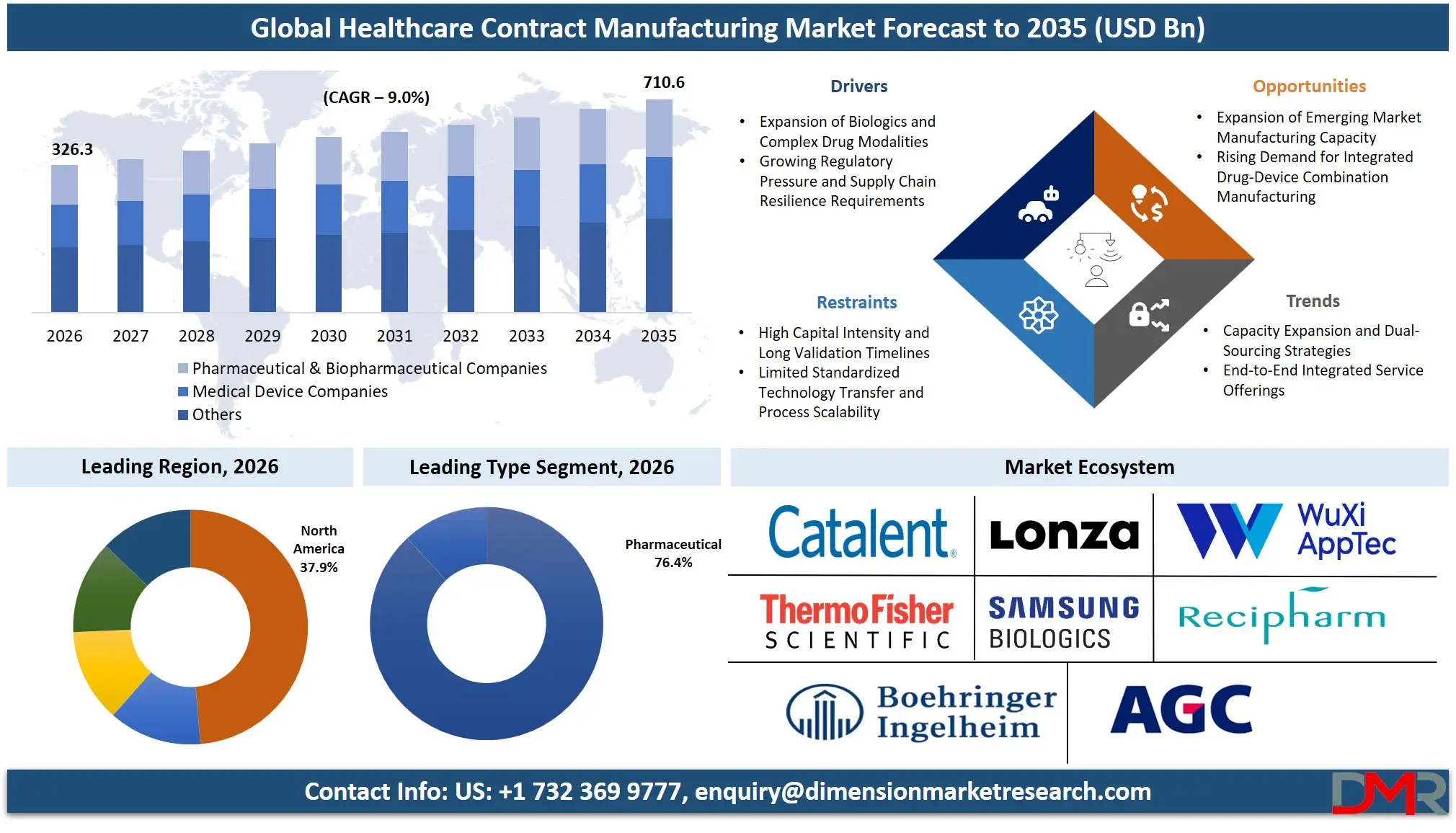
The Global Healthcare Contract Manufacturing Market size is estimated at USD 326.3 billion in 2026 and is projected to reach USD 710.6 billion by 2035, exhibiting a CAGR of 9.0% during the forecast period, driven by the increasing complexity of biologics, the rise of personalized medicine, and the integration of AI and automation in manufacturing processes.
ℹ
To learn more about this report –
Download Your Free Sample Report Here
The global healthcare contract manufacturing market has grown exponentially due to the adoption of advanced manufacturing technologies for sterile fill-finish, high-potency API production, and modular cleanroom solutions, regulatory requirements that reduce drug shortages and accelerate time-to-market for novel therapies, and increased funding for flexible manufacturing capacity by private and public entities.
Other factors include the emergence of real-time batch release, predictive maintenance models, single-use bioprocessing systems, and end-to-end serialization supporting supply chain integrity. Continuous manufacturing, digital twins, and autonomous quality control systems have driven adoption, and national strategies for pharmaceutical self-sufficiency have facilitated localized production.
The US Healthcare Contract Manufacturing Market
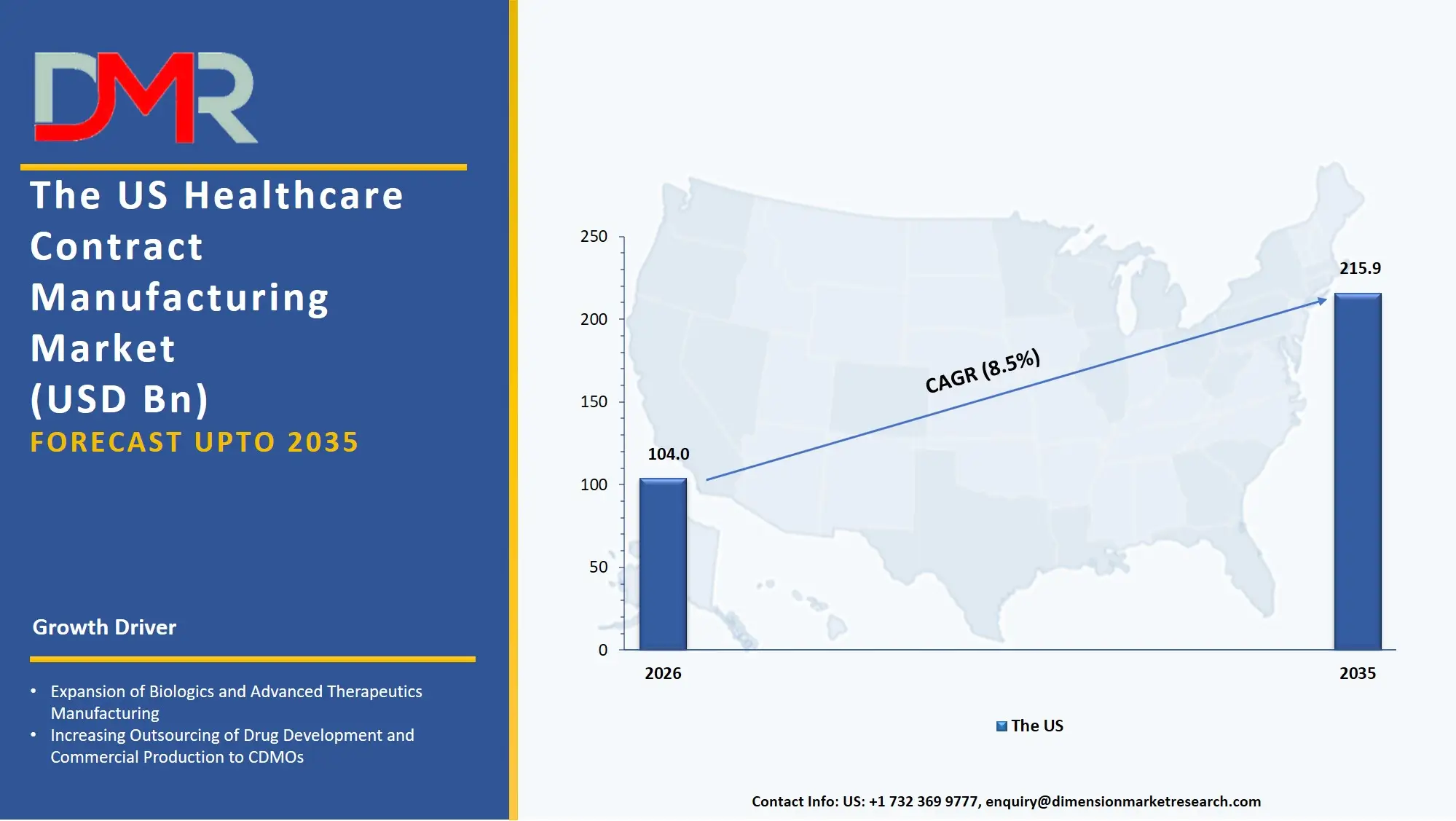
The US Healthcare Contract Manufacturing Market is estimated to grow to USD 104.0 billion in 2026 with a compound annual growth rate of 8.5% during the forecast period.
The market within the United States is characterized by the presence of government initiatives such as the National Strategy for Critical Supply Chains, the FDA's Emerging Technology Program, and the tax incentive for pharmaceuticals and devices manufacturing that will facilitate the need for rapid vial fillers, combination products robots, and AI-powered inspection tools. Advanced manufacturing systems continue to be rapidly adopted in the region, and the US needs highly developed interoperability frameworks, integration of real-time data using manufacturing execution systems (MES), and verifiable AI assurance for batch records. Also, service providers are being pressured by initiatives like the Bioshield Act and national pharmaceutical resilience strategies to create dedicated integration and deployment services to guarantee data integrity, security, and compliance across pharma R&D and medical device manufacturing networks.
ℹ
To learn more about this report –
Download Your Free Sample Report Here
Europe Healthcare Contract Manufacturing Market
The Europe Healthcare Contract Manufacturing Market is estimated to be valued at USD 83.5 billion in 2026, witnessing growth at a CAGR of 8.4%, during the forecast period.
European healthcare contract manufacturing is a highly developed market, characterized by considerable regulatory impact such as EU Pharmaceutical Strategy, Critical Medicines Act, and national resilience plans (e.g. French Health Innovation Plan & German Pharma Strategy 2030). Another area that countries are working towards is flexible manufacturing modularization to align with fluctuating demand and interoperability of cross-border supply chain data. The market is driven by advanced technologies, such as real-time stability prediction engines and high-reliability sterility assurance models with embedded predictive analytics for novel drug-device combinations. Adoption is facilitated by the use of public-private partnerships and harmonization of GMP standards. Technologies like real-time workload balancing and secure data sharing are commonly practiced in multi-site manufacturing networks, and Europe is a frontrunner in the digital transformation of safe and efficient contract manufacturing.
Japan Healthcare Contract Manufacturing Market
The Japan Healthcare Contract Manufacturing Market is projected to be valued at USD 10.8 billion in 2026, progressing at a CAGR of 9.3%, during the period spanning from 2026 to 2035.
Japan boasts a mature healthcare contract manufacturing market supported by high-precision automated assembly systems, diagnostic integration technology, and a wide network of robotics-enabled packaging innovations. Automation, precision, and process integrity are priorities in the country, achieved by predictive maintenance models and intelligent process management systems for pharmaceutical and device manufacturing. Growth is stimulated by government actions under the Society 5.0 initiative and constant investment in digital manufacturing infrastructure. The high level of R&D activities, industrial production of biologics and combination products, and automation processes demand efficient AI for instantaneous decision-making based on data analysis. Challenges such as expensive validation for novel manufacturing frameworks and legacy processes are present; however, there is great potential in exporting advanced contract manufacturing technology to Asian and Pacific markets.
Key Takeaways
- Market Size & Forecast: The Global Healthcare Contract Manufacturing Market is estimated to be valued at USD 326.3 billion in 2026 and is expected to grow to USD 710.6 billion by 2035.
- Growth Rate & Outlook: The market is expected to witness growth at a compound annual growth rate of 9.0% in the forecast period.
- Primary Growth Drivers: Some of the major factors driving growth are advances in continuous bioprocessing and high-potency API manufacturing, regulatory requirements for faster time-to-market and reduced supply chain risks, and deployment of intelligent quality control platforms.
- Key Market Trends: The use of predictive batch release monitoring, real-time manufacturing optimization, and the transition to cloud-based manufacturing data management systems are some of the primary market trends.
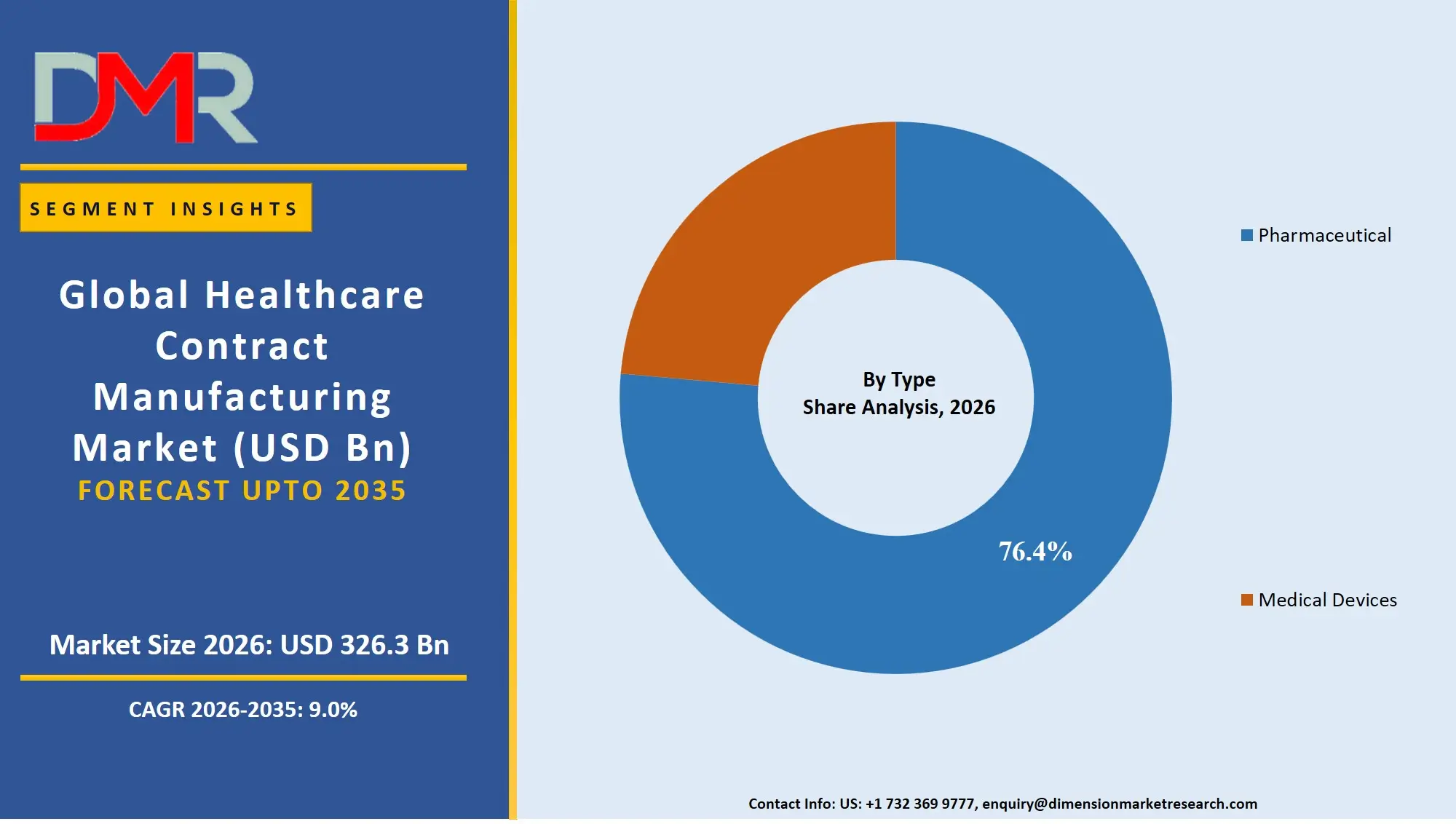
- By Type: The Pharmaceutical segment is anticipated to capture the largest share of the healthcare contract manufacturing market in 2026.
- By Device Class: Class II devices are expected to capture the largest revenue share in 2026.
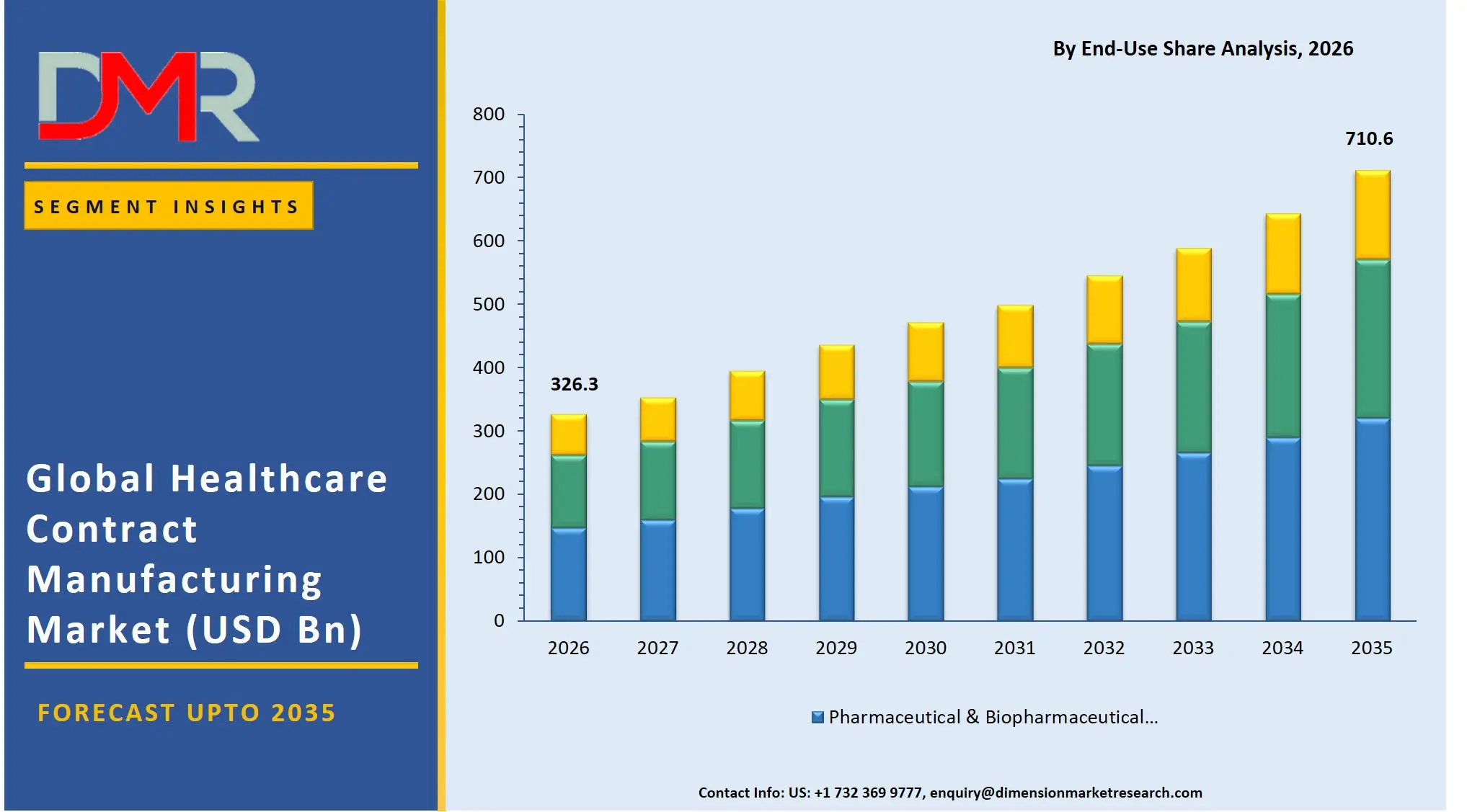
- By End-Use: Pharmaceutical & Biopharmaceutical Companies are expected to capture the largest revenue share in 2026.
- Regional Leadership: North America is predicted to dominate the market with an estimated 37.9% share in 2026, driven by high pharma R&D spend and the reshoring of manufacturing capacity.
What is Healthcare Contract Manufacturing?
Healthcare contract manufacturing refers to the outsourcing of pharmaceutical and medical device production by innovator companies to specialized third-party organizations. These services include API and bulk drug manufacturing, advanced drug delivery formulation, finished dose manufacturing (solid, liquid, and semi-solid), packaging, and full medical device manufacturing across therapeutic areas such as cardiology, orthopedics, in vitro diagnostics (IVD), and drug delivery. Additional services include component manufacturing, assembly, and sterilization. Healthcare contract manufacturing is distinguished from other forms of outsourcing by its scalability, specialized infrastructure such as sterile fill-finish and cleanroom environments, and strong regulatory and compliance expertise required to ensure product quality, safety, and efficacy.
Use Cases
- High-Potency API Manufacturing for Oncology: Contract manufacturers are developing high-containment strategies to safely produce potent APIs for cancer therapies, reducing cross-contamination risks and saving capital expenditure compared to in-house facilities.
- Advanced Drug Delivery Formulation Development: Long-term stability and release profile data, including dissolution and impurity accumulation, are modeled to provide process optimization recommendations for safe and continuous manufacturing of oral solids and injectables.
- Medical Device Assembly & Packaging: Industrial manufacturing deployments employ machine vision and robotic assembly to perform real-time defect detection, process anomaly identification, and automated sorting with quantifiable accuracy.
- Population Health & Government Programs: More efficient contract manufacturing assists in pandemic preparedness, developing critical care devices, and smart supply chain monitoring, enabling national pharmaceutical resilience and aiding in the implementation of policies, including drug pricing reforms and GMP harmonization.
How AI Is Transforming the Global Healthcare Contract Manufacturing Market
Artificial intelligence is revolutionizing contract manufacturing, enabling predictive modeling of batch success likelihood, automatic detection of anomalies in fill-finish data patterns, and optimization of manufacturing parameters in a product-specific context. Real-time telemetry from bioreactors, vial lines, and assembly equipment can be processed using AI algorithms to identify any degradation or performance drift and optimize production outcomes at scale. This saves time, improves verifiability, and reduces costs compared to manual quality checks.
Moreover, AI enhances manufacturing assurance through adaptive scheduling, anticipating workflow threats to design accuracy, and intelligent prioritization of equipment health monitoring. It is also involved in reducing the cost of baseline testing and ongoing performance tracking, allowing contract manufacturing IT operators to reduce the physical footprint of on-prem validation campaigns and improve the reliability of production workloads and their financial returns.
Market Dynamics
Key Drivers of the Healthcare Contract Manufacturing Market
Expansion of Biologics and Complex Drug Modalities
The rapid development of biologics, cell and gene therapies and antibody-drug conjugates is creating pressure on dedicated contract manufacturing capacity. Pharmaceutical firms do not have in-house sterile fill-finish, high-potency API suites, and viral vectors manufacturing, and thus are more outsourced to CDMOs with specialized facilities. These technologies facilitate scalable synthesis of intricate molecules, preclinical batch manufacturing, and regulatory know-how across jurisdictions. Consequently, there are high utilization rates and extended long-term supply contracts among CDMOs. Increasing biologic pipeline development, particularly oncology and rare disease development, is driving a need to have flexible, multi-product manufacturing platforms and more sponsors are opting to outsource production, rather than pay capital expenditure.
Growing Regulatory Pressure and Supply Chain Resilience Requirements
Increasing regulatory pressure on the quality of medicines, the security of the supply chain, and manufacturing redundancy will continue. Initiatives like the FDA's Drug Shortage Mitigation program, the EU's Critical Medicines Act, and the national strategy for pharmaceutical resilience have contributed to the increased need for contract manufacturers who can offer redundancy, validated alternate sites, and technology transfer. These regulations promote outsourcing to contract manufacturers who have demonstrated compliance and a presence in multiple regions. The emphasis on transparency within the supply chain and diversification beyond single sourcing is also increasing the importance of contract manufacturing.
Restraints in the Healthcare Contract Manufacturing Market
High Capital Intensity and Long Validation Timelines
Investment in terms of capital is very high for such contract manufacturing sites due to the special equipment needed. The time taken for qualification and validation usually ranges between 12 to 24 months. It takes a lot of time and money before the facility starts making money. In addition, there are other complications arising from the requirements for site inspection by the FDA, EMA, and other health authorities. All these contribute to making it difficult for new entrants to join the market.
Limited Standardized Technology Transfer and Process Scalability
The sector still struggles with the technical transfer of manufacturing operations to the contract development and manufacturing organization (CDMO) and scale-up from clinical batches to commercial production. Non-standardization of data transmission protocols for process control parameters, materials specification, and batch records causes additional time, deviations, and technical transfer costs. There is also an available ISA-95 platform for manufacturing execution systems, yet the biopharmaceutical and cell therapies manufacturing processes are very specific to each product. This makes it hard to achieve interoperability, reduces agility in manufacturing, and makes the organization dependent on skilled staff.
Growth Opportunities in the Healthcare Contract Manufacturing Market
Expansion of Emerging Market Manufacturing Capacity
Emerging pharmaceutical markets like Brazil, Indonesia, Nigeria, the UAE, and Vietnam are investing in infrastructural drug production and harmonization of regulations. The potential is high in these areas as demand is rising to produce fill-finish, packaging, and API locally, and this is backed by government subsidies and the import substitution policy. They have small legacy manufacturing capacity and facilitate opportunities for greenfield CDMO investments or strategic regional and export supply joint ventures.
Rising Demand for Integrated Drug-Device Combination Manufacturing
With the growing complexity of combination products, such as autoinjectors, pen injectors, and wearables, there is a need for CDMOs that offer an integrated platform that covers drug formulation, device assembly, and packaging. They are essential in ensuring that drugs like GLP-1 agonists, monoclonal antibodies, and emergency medications are administered effectively. Considering how important patient compliance is today, integrated platforms in combination products will be an integral part of the future CDMO services.
Healthcare Contract Manufacturing Market Trends
Capacity Expansion and Dual-Sourcing Strategies
The proliferation of CMOs into sectors like sterile fill and finish, high-potent APIs, and biologicals is rapidly taking place in light of supply chain modifications post-COVID-19. The dual sourcing strategy and geographic redundancy that the pharmaceutical industry now requires, instead of dealing with a single CDMO, is transforming contract manufacturing from cost-driven outsourcing to risk management.
End-to-End Integrated Service Offerings
CDMOs have progressed from offering services as unit operations (such as manufacturing either just the API or just packaging) to providing end-to-end services starting from the development of cell lines, formulation, supply for clinical trials, commercial manufacturing, and ultimately packaging. Such integration not only mitigates the risk of technology transfer but also ensures faster market introduction of the product. This trend has been very strong in biologicals and drug devices.
Research Scope and Analysis
The global healthcare contract manufacturing market encompasses outsourced production services provided by CMOs/CDMOs for pharmaceuticals, biologics, and medical devices. The study covers segmentation by type, device class, sterility type, and end-use, driven by increasing pharmaceutical outsourcing, rising demand for biologics and sterile manufacturing, and the need for scalable, regulatory-compliant production capabilities.
ℹ
To learn more about this report –
Download Your Free Sample Report Here
By Type Analysis
The Pharmaceutical segment is predicted to dominate the healthcare contract manufacturing industry through 2026, representing around 76.0% of the global market share due to continued demand for the manufacturing of API/bulk drugs, advanced drug delivery systems, and finished dose formulations (solids, liquids, semisolids). On the other hand, Medical Devices are growing at a healthy rate owing to increased demand for outsourced manufacturing services, including accessories, assembly, components, and finished devices for therapeutic applications such as cardiology, orthopedics, IVD, ophthalmic, drug delivery, and diabetes management. Such applications require precise engineering and sterilization processes and can benefit from workflow optimization, real-time quality enhancements, and modular designs to increase manufacturing flexibility.
By Device Class Analysis
The Class II segment is expected to dominate with around 54.2% market share in 2026, driven by the critical need for moderate-risk devices such as infusion pumps, surgical drapes, and diagnostic equipment. Contract manufacturers prioritize Class II device production due to higher volumes and balanced regulatory burden. The Class III segment, while smaller, is witnessing strong growth, driven by innovation in implantables, pacemakers, and drug-eluting stents, particularly in North America and Europe. Increasing regulatory scrutiny and patient safety requirements for high-risk devices continue to drive specialized outsourcing demand for Class III manufacturing.
By Sterility Type Analysis
The Sterile segment represents the largest manufacturing type in 2026, accounting for 64.8% share, driven by injectable drugs, ophthalmic products, and implantable medical devices requiring aseptic processing. Non-sterile manufacturing is the fastest-growing area, as demand for oral solids, topical creams, and non-invasive devices increases with aging populations and chronic disease management. Stringent regulatory requirements for sterility assurance and growing preference for ready-to-use sterile formats further reinforce the dominance of sterile contract manufacturing.
By End-Use Analysis
Pharmaceutical & Biopharmaceutical Companies represent the largest end-user in 2026, accounting for 58.6% share, driven by complex R&D and commercial manufacturing environments requiring flexible capacity for biologics, vaccines, and oral solids. Medical Device Companies form the second-largest segment, utilizing contract manufacturing for components, assemblies, and finished devices. The fastest-growing area is Others (including startups and virtual pharma), adopting contract manufacturing for cost-efficient scale-up and regulatory support. Rising R&D productivity among emerging biotech firms and lean operating models are expected to sustain strong outsourcing demand from this end-user segment.
ℹ
To learn more about this report –
Download Your Free Sample Report Here
The Global Healthcare Contract Manufacturing Market Report is segmented based on the following:
By Type
- Pharmaceutical
- API / Bulk Drugs
- Advanced Drug Delivery Formulations
- Packaging
- Finished Dose Formulations
- Medical Devices
- Manufacturing Services
- Accessories Manufacturing
- Assembly Manufacturing
- Component Manufacturing
- Device Manufacturing
- Therapeutic Areas (Device Manufacturing)
- Cardiology
- Diagnostic Imaging
- Orthopedic
- IVD (In Vitro Diagnostics)
- Ophthalmic
- General & Plastic Surgery
- Drug Delivery
- Dental
- Endoscopy
- Diabetes Care
- Others
By Device Class
- Class I
- Class II
- Class III
By Sterility Type
By End-Use
- Pharmaceutical & Biopharmaceutical Companies
- Medical Device Companies
- Others
Regional Analysis
Leading Region in the Healthcare Contract Manufacturing Market
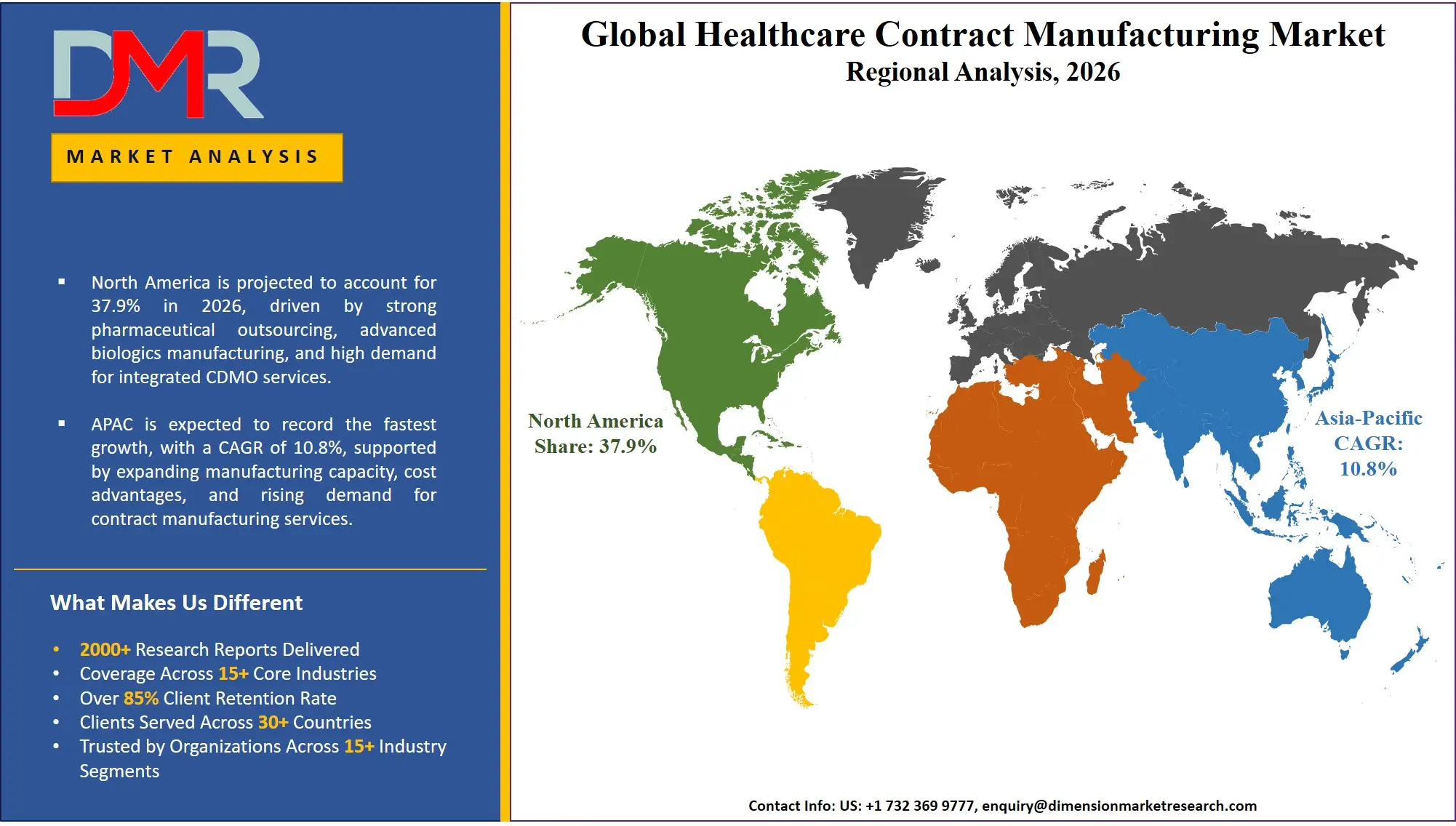
It is projected that North America will take the lead in the global healthcare contract manufacturing market, covering a market share of about 37.9% in the year 2026. The region's dominance is driven by strong pharma & biotech R&D spending (US-based CMO expansion and reshoring incentives), high drug prices relative to other regions, a mature supply chain for advanced interoperability and high-speed data exchange, and the presence of key contract manufacturers and research labs. The widespread adoption of advanced robotics and AI-based quality inspection for sterile injectables, cardiology devices, and combination products further strengthens North America's leading position. Additionally, continuous investments in digital manufacturing and interoperability capabilities further reinforce regional technological leadership.
ℹ
To learn more about this report –
Download Your Free Sample Report Here
Fastest-Growing Region in the Healthcare Contract Manufacturing Market
Asia-Pacific is the fastest-growing region, supported by strong manufacturing deployment targets (China, India, Japan), increasing drug self-sufficiency initiatives, rising investments in domestic sterile and device manufacturing capabilities, and growing adoption of automated assembly systems. The region benefits from well-established generic drug manufacturing capacity, increasing commercial participation, and alignment with national bioeconomy roadmaps. Countries across the region are actively deploying contract manufacturing infrastructure to enhance productivity-per-dollar and strengthen supply chain resilience. Growing emphasis on quality compliance and structured process development further accelerates market expansion. Moreover, increasing government support and commercial commitments are expected to sustain high growth momentum.
By Region
North America
Europe
- Germany
- The U.K.
- France
- Italy
- Russia
- Spain
- Benelux
- Nordic
- Rest of Europe
Asia-Pacific
- China
- Japan
- South Korea
- India
- ANZ
- ASEAN
- Rest of Asia-Pacific
Latin America
- Brazil
- Mexico
- Argentina
- Colombia
- Rest of Latin America
Middle East & Africa
- Saudi Arabia
- UAE
- South Africa
- Israel
- Egypt
- Rest of MEA
Competitive Landscape
The healthcare contract manufacturing market is highly competitive, with innovation and strategic alliances shaping the competitive environment. In order to achieve a competitive advantage, companies are focused on the development of advanced manufacturing platforms (e.g., continuous manufacturing, robotics for high-speed assembly, and machine learning for quality optimization), AI-powered process monitoring, and digital twin-enabled production platforms. There are high barriers to entry due to capital-intensive validation infrastructure, specialized regulatory expertise, and the need for mature software ecosystems and compliance systems.
Strategic approaches to increase market presence include partnerships with pharma and device companies, mergers between automation solution providers and system integrators, and long-term supply contracts with R&D labs and academic institutions. Moreover, research and development in interoperability frameworks and scalable manufacturing architectures are important factors in maintaining competitiveness and addressing the evolving needs of the healthcare contract manufacturing community.
Some of the prominent players in the Global Healthcare Contract Manufacturing Market are:
- Catalent, Inc.
- Thermo Fisher Scientific Inc.
- Lonza Group AG
- WuXi AppTec Co., Ltd.
- Samsung Biologics Co., Ltd.
- Recipharm AB
- Boehringer Ingelheim International GmbH
- FUJIFILM Holdings Corporation
- AGC Inc.
- Vetter Pharma-Fertigung GmbH & Co. KG
- Baxter International Inc.
- Piramal Pharma Limited
- Jubilant Pharmova Limited
- Cambrex Corporation
- Almac Group Limited
- Siegfried Holding AG
- Fareva SA
- Eurofins Scientific SE
- Charles River Laboratories International, Inc.
- Flex Ltd.
- Other Key Players
Recent Developments
- April 2026: AGC Inc. (through its CDMO arm AGC Biologics) received the 2026 Fierce Outsourcing Award for Leadership in Regulatory and Quality Compliance, recognizing its global quality systems, regulatory track record, and manufacturing excellence across biologics production.
- January 2026: Thermo Fisher Scientific Inc. announced that its pharmaceutical services business secured multiple new contracts driven by increasing reshoring of drug manufacturing to the U.S., alongside expansion through the acquisition of a Sanofi manufacturing site in New Jersey, strengthening its CDMO capacity and domestic production capabilities.
- January 2026: Lonza Group AG projected continued expansion of its core CDMO segment with expected 11–12% revenue growth in 2026, driven by sustained demand across mammalian, small molecule, and bioconjugate manufacturing platforms.
- December 2025: Samsung Biologics Co., Ltd. announced the acquisition of a U.S.-based drug manufacturing facility from GSK for USD 280 million, with the deal expected to close by Q1 2026, strengthening its global CDMO footprint and expanding biologics production capacity in the US.
Report Details
| Report Characteristics |
| Market Size (2026) |
USD 326.3 Bn |
| Forecast Value (2035) |
USD 710.6 Bn |
| CAGR (2026–2035) |
9.0% |
| The US Market Size (2026) |
USD 104.0 Bn |
| Historical Period |
2021 – 2025 |
| Forecast Period |
2027 – 2035 |
| Base Year |
2025 |
| Estimated Year |
2026 |
| Segments Covered |
By Type, By Device Class, By Sterility Type, By End-Use |
| Regional Coverage |
North America – The US and Canada; Europe – Germany, The UK, France, Russia, Spain, Italy, Benelux, Nordic, & Rest of Europe; Asia-Pacific – China, Japan, South Korea, India, ANZ, ASEAN, Rest of APAC; Latin America – Brazil, Mexico, Argentina, Colombia, Rest of Latin America; Middle East & Africa – Saudi Arabia, UAE, South Africa, Turkey, Egypt, Israel, & Rest of MEA |
Frequently Asked Questions
How big is the Global Healthcare Contract Manufacturing Market?
▾ The Global Healthcare Contract Manufacturing Market size is estimated to have a value of USD 326.3 billion in 2026 and is expected to reach USD 710.6 billion by the end of 2035.
Which region held the largest share of the Global Healthcare Contract Manufacturing Market in 2026?
▾ North America is expected to account for the largest market share in 2026, with a share of about 37.9%.
Who are the key players in the Global Healthcare Contract Manufacturing Market?
▾ Some of the major key players in the Global Healthcare Contract Manufacturing Market are Lonza Group AG, Catalent, Inc., Samsung Biologics, Thermo Fisher Scientific Inc. (Patheon), Boehringer Ingelheim, and many others.
What is the CAGR of the Global Healthcare Contract Manufacturing Market from 2026 to 2035?
▾ The market is growing at a CAGR of 9.0% over the forecasted period.
What factors are driving the growth of the Global Healthcare Contract Manufacturing Market?
▾ The market is driven by advances in continuous manufacturing and high-potency API production, regulatory pressure to accelerate time-to-market and reduce supply chain risks, and increasing government investment in national pharmaceutical resilience infrastructure.
What are the major trends in the Global Healthcare Contract Manufacturing Market?
▾ The key market trends include the adoption of predictive batch outcome monitoring and real-time manufacturing control, along with a growing shift toward cloud-based manufacturing platforms and data-enabled workflow management systems.
Which region is expected to grow the fastest in the Global Healthcare Contract Manufacturing Market?
▾ Asia Pacific is the fastest-growing region in the market during the forecast period.
How is the Global Healthcare Contract Manufacturing Market segmented?
▾ The market is segmented by type, device class, sterility type, and end-use.