What is the Healthcare Technology Management Market Size?
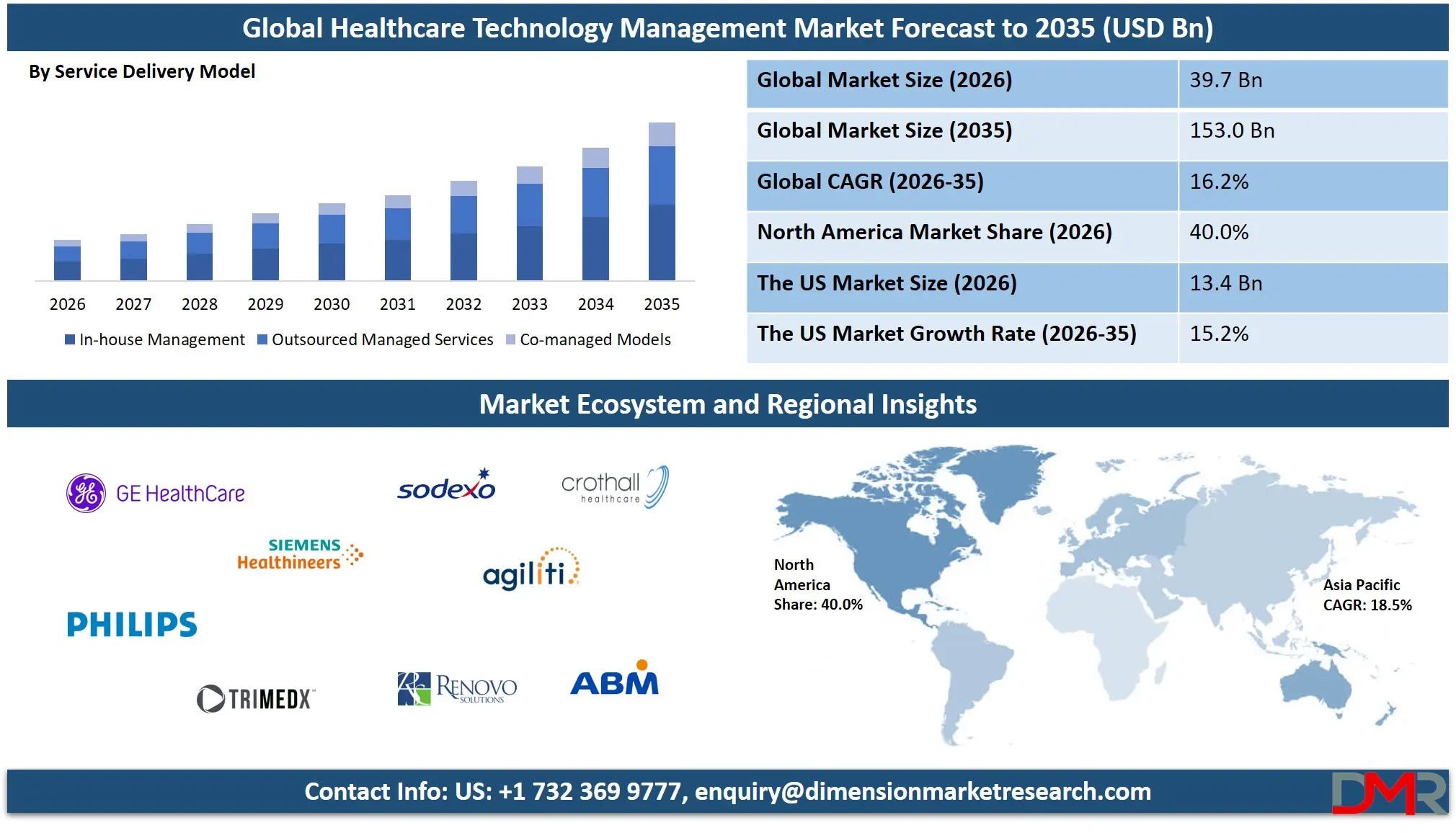
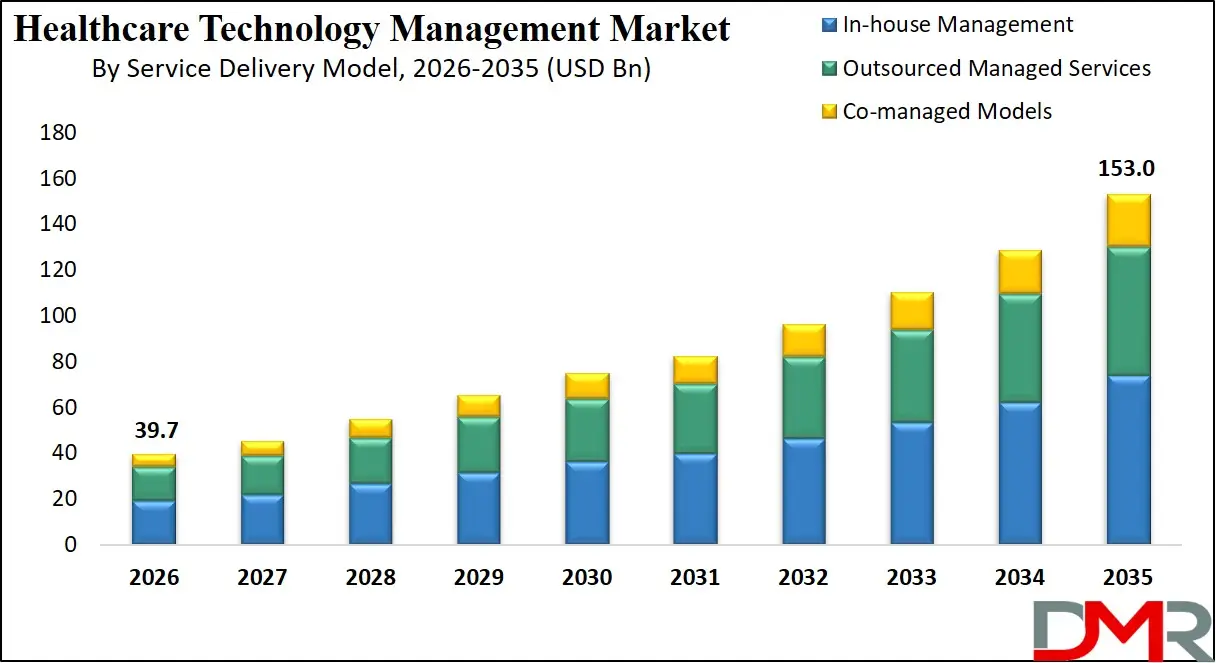
The Global Healthcare Technology Management Market size is projected to reach USD 39.7 billion in 2026 and grow at a compound annual growth rate of 16.2%, reaching USD 153.0 billion by 2035, driven by demand for clinical asset management, medical equipment lifecycle solutions, and healthcare IT optimization.
ℹ
To learn more about this report –
Download Your Free Sample Report Here
The Healthcare Technology Management (HTM) market refers to the provision of products and services for managing the entire lifecycle and performance of the equipment while ensuring regulatory compliance. This market is expanding at a consistent pace due to the growth in digital health technology, which, according to the WHO, plays an important role in improving healthcare systems through digitization.
Moreover, almost 90 percent of doctors have reported using electronic health record software according to the Office of the National Coordinator for Health Information Technology, creating more demand for effective equipment management.
ℹ
To learn more about this report –
Download Your Free Sample Report Here
US Healthcare Technology Management Market
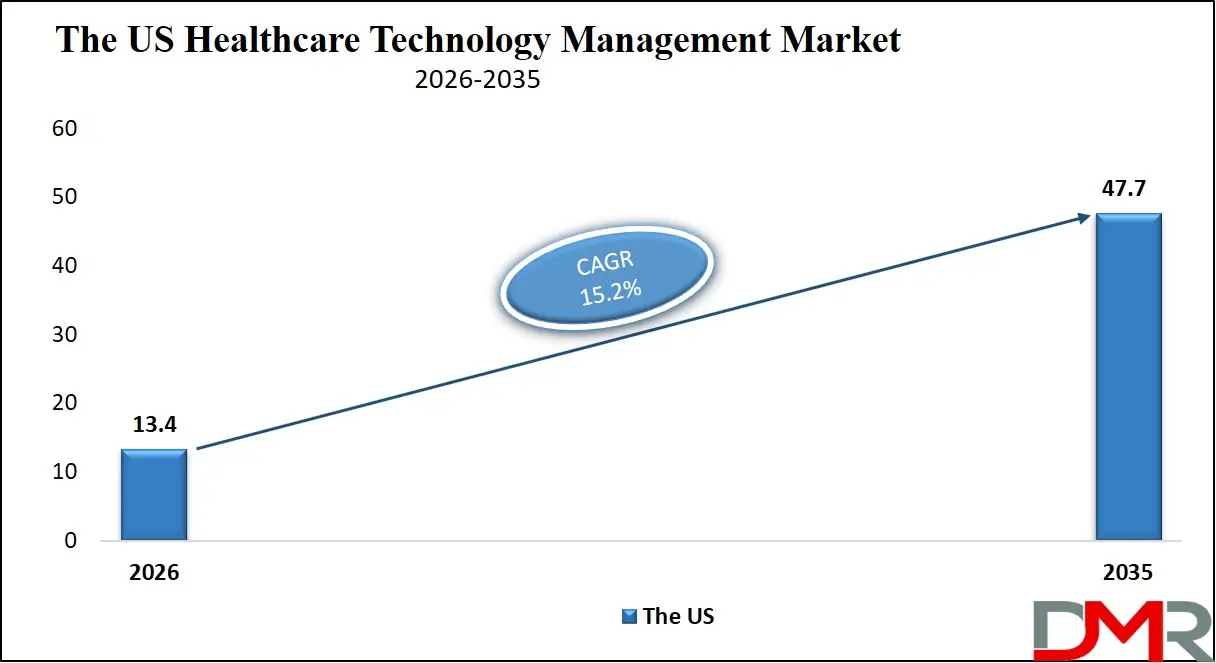
The US Healthcare Technology Management Market is projected to reach USD 13.4 billion in 2026 and grow at a compound annual growth rate of 15.2%, reaching USD 47.7 billion by 2035.
ℹ
To learn more about this report –
Download Your Free Sample Report Here
The market for healthcare technology management in the US is one of the most developed markets for such solutions in the world, owing to their significant use in the context of medical equipment management and monitoring within hospitals. The growth of this market is being fueled by the use of digital solutions and regulatory control exercised by the U.S. Food and Drug Administration regarding the quality and effectiveness of devices. The expansion of this market is due to the use of new AI solutions, connected medical devices, and smart hospitals.
Europe Healthcare Technology Management Market
The Europe Healthcare Technology Management Market size is expected to grow to around USD 10.7 billion in 2026, growing at a CAGR of 15.5%. This is attributed to the growing adoption of digitalization within hospitals, along with advancements in the field of medical equipment management technologies. The presence of robust regulations for ensuring safety, compliance, and efficiency in the functioning of the healthcare sector is aiding in fueling the growth of this market.
Japan Healthcare Technology Management Market
The Japan Healthcare Technology Management Market is expected to achieve a valuation of USD 2.7 billion in 2026, growing at a CAGR of 17.0%, due to digital transformation in the healthcare sector, along with higher adoption rates of medical equipment management systems. There is growing involvement of governments in the development of smart and automated hospitals. Usage of technologies like predictive maintenance through AI and connectivity in medical devices is making operations more efficient while ensuring patient safety. Moreover, an aging demographic in Japan is adding to growth.
Key Takeaways
- Market Size: The Global Healthcare Technology Management market is projected to reach USD 39.7 billion in 2026 and is expected to expand significantly to USD 153.0 billion by 2035.
- Growth Rate and Outlook: The market is forecasted to grow at a CAGR of 16.2%, driven by rapid healthcare digital transformation and increasing adoption of connected medical infrastructure.
- Primary Growth Drivers: Key drivers include rising deployment of digital hospital systems, increasing use of connected medical devices, growing focus on equipment lifecycle optimization, and demand for cost-efficient healthcare operations.
- By Component Analysis: Services dominate the market with 54.0% share, led by maintenance, lifecycle management, and compliance services, reflecting strong outsourcing preference in hospitals.
- By Deployment Model Analysis: On-premise solutions lead with 56.0% share, driven by high demand for data security, regulatory compliance, and integration with existing hospital IT systems.
- By End-Use Facility Analysis: Hospitals dominate with 47.0% share, due to high equipment intensity, continuous patient flow, and strong need for real-time asset management and maintenance.
- Regional Leadership: North America leads the market with 40.0% share, supported by advanced healthcare IT infrastructure and early adoption of AI-driven healthcare technology management systems.
What is Healthcare Technology Management?
Healthcare Technology Management (HTM) can be defined as a strategy for managing healthcare equipment and technology from procurement, maintenance, optimization, until retirement. The management approach helps improve efficiency in hospitals by minimizing downtime of equipment and ensuring efficient functioning. Healthcare technology management is guided by health care safety measures recommended by the World Health Organization and device safety measures imposed by the United States Food and Drug Administration.
Use Cases
- Medical Equipment Lifecycle Management: HTM systems manage medical devices from procurement to disposal, ensuring optimal usage across their lifespan. They help hospitals track performance, maintenance schedules, and replacement cycles. This reduces equipment failure and improves operational efficiency.
- Predictive Maintenance and Fault Detection: Advanced HTM platforms use data analytics to predict equipment failures before they occur. This enables timely maintenance interventions and reduces unexpected downtime. It improves patient safety and extends equipment lifespan.
- Regulatory Compliance and Audit Management: HTM solutions ensure that medical devices meet safety and quality standards set by regulatory bodies. They automate documentation, inspection tracking, and audit readiness. This helps hospitals avoid penalties and maintain accreditation.
- Asset Tracking and Utilization Optimization: HTM systems provide real-time visibility of medical equipment across hospital departments. They monitor usage rates and location of devices to prevent loss or underutilization. This improves resource allocation and reduces operational costs.
How AI is Transforming the Healthcare Technology Management Market
AI is transforming the Healthcare Technology Management market by enabling predictive maintenance to detect equipment failures early and reduce downtime. It improves asset utilization through real-time analytics for better device allocation. AI also automates compliance and audit processes with higher accuracy. Additionally, it supports smarter equipment lifecycle and cost management across healthcare systems.
Market Dynamics
Key Drivers in the Global Healthcare Technology Management Market
Increasing Adoption of Medical Devices that Are IoT-Enabled and Connected
The rising use of IoT-enabled and connected medical devices by hospitals will significantly drive the adoption of HTM. This is because such devices are capable of producing performance metrics that make it possible to monitor them and plan preventive maintenance. There has been an increased adoption of such systems by many hospitals because of their benefits in improving operations and minimizing equipment downtime.
Rising Need to Optimize Costs Associated With Hospital Operations
It is imperative for any organization in the healthcare industry to continuously optimize the cost of running their operations. The implementation of HTM will play a critical role in this aspect. It enables optimization in the use of assets and eliminates instances of purchasing or repairing equipment unnecessarily. Predictive maintenance is another advantage because it helps avoid emergencies caused by malfunctions.
Restraints in the Global Healthcare Technology Management Market
High Initial Investment in Implementation and Integration
The installation of HTM involves substantial initial investments in software, hardware, and integration. Small healthcare organizations often have budget limitations, which make it difficult for them to invest. The integration of HTM with existing hospital management systems might prove to be challenging. Cost is the primary obstacle in the wide deployment of HTM, particularly in less-developed areas. Therefore, the application of HTM technology remains confined to bigger and richer hospitals.
Human Resource Gaps
The effective use of HTM tools necessitates specialized personnel, including biomedical and information technology professionals. Healthcare organizations lack sufficient skilled manpower that could operate modern technological devices. It would hinder the efficient use of the HTM platform. Human resource management poses another serious constraint to the use of HTM.
Growth Opportunities in the Global Healthcare Technology Management Market
AI Expansion in Equipment Management
Predictive analytics, which leverages artificial intelligence, holds great potential within HTM systems. With AI, predictive maintenance can be conducted, minimizing equipment breakdowns and maximizing efficiency. Decision-making in asset management and optimization will also benefit from advanced AI capabilities. Data-driven decisions have become essential in healthcare organizations to ensure operational efficiency. There is thus a high global demand for intelligent HTM systems.
Smart Hospitals and Digital Transformation of Healthcare Systems
The advent of smart hospitals has contributed greatly to the increasing need for HTM systems. Hospitals have embraced connectivity technologies for efficient data collection, automation of processes, and real-time monitoring. The management of sophisticated medical equipment in smart hospitals requires HTM technology. The global shift towards digital transformation in healthcare has led to significant investments by governments and healthcare systems.
Trends in the Global Healthcare Technology Management Market
Movement towards Cloud-Based HTM Systems
Medical organizations are leaning towards using cloud-based HTM systems to ensure scale and accessibility. These systems allow for the centralized monitoring of healthcare equipment within various locations. Additionally, these systems minimize reliance on on-site resources for IT support and maintenance services. Cloud systems also allow for timely upgrades and better integration with other information technology systems.
Inclusion of Cybersecurity in Medical Device Administration
As healthcare organizations move towards more connectivity, cybersecurity has emerged as one of the critical elements in HTM. Organizations are adopting measures aimed at safeguarding the data collected by medical devices from cyberattacks. The inclusion of cybersecurity has been encouraged by regulatory agencies to increase digital security measures in hospitals.
Research Scope and Analysis
By Component Analysis
Services are anticipated to gain prominence in the components category of the Healthcare Technology Management market at a share of 54.0% in 2026, owing to increasing dependency on outsourcing for maintenance, lifecycle management, and compliance requirements in order to maintain efficiency in hospital processes and minimize downtime of medical equipment. Software-based products facilitate better asset management, maintenance, and compliance monitoring, but their usage will remain limited compared to that of services owing to the need for physical equipment management.
By Service Delivery Model Analysis
The in-house management is forecasted to lead the market in the segment of service delivery model, which will have 48.0% of the market share in 2026, as larger hospitals prefer keeping their own clinical engineers who take care of all the aspects of operating the equipment. Outsourced managed services, on the other hand, are becoming popular as healthcare organizations try to minimize their expenses and get some technical expertise from third-party vendors. These services help in managing the maintenance of equipment, ensuring its optimal performance, and monitoring its compliance status. The use of outsourced managed services is relatively less compared to in-house management because of issues related to data security and dependence on third parties.
By Equipment Category Analysis
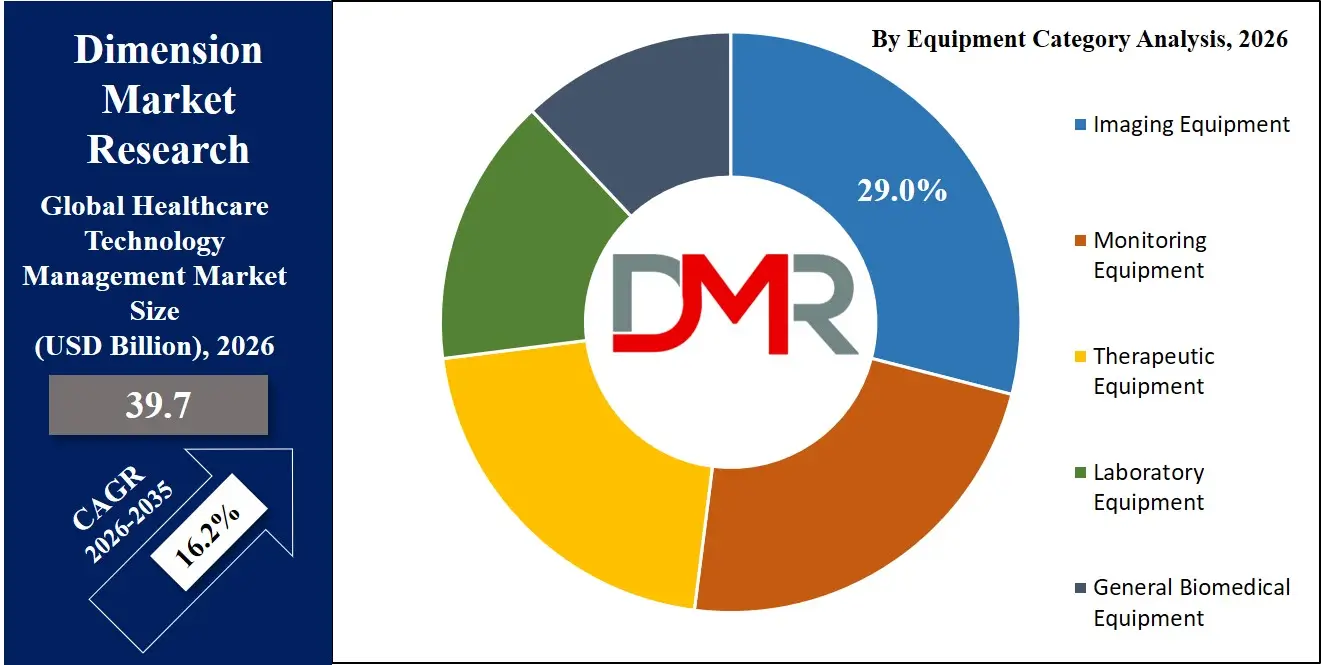
It is anticipated that imaging equipment will continue to dominate the equipment category segment of the Healthcare Technology Management market in terms of market share, contributing up to 29.0% in 2026 because of their expensive nature, complexity of maintenance, and importance in diagnosis processes at the hospitals.
ℹ
To learn more about this report –
Download Your Free Sample Report Here
Some of the devices that have to be monitored, calibrated, and maintained regularly include MRI scanners, CT scanners, and X-rays, creating a huge need for healthcare technology management products and services. On the other hand, there has been increased demand for monitoring devices that are backed by software technologies that provide live monitoring of patients' vital signs and the performance of the devices in use.
By Core Application Area Analysis
It is projected that the maintenance execution management category will lead the segment in Healthcare Technology Management market core applications by accounting for 30.0% of the total market share in 2026. This will be attributed to the need to efficiently schedule, execute, and monitor the maintenance of medical devices within hospitals to minimize downtime and maintain uninterrupted clinical services. The processes include maintenance practices such as preventive and corrective maintenance practices aimed at enhancing the performance of the devices. Asset visibility and tracking systems will gain importance owing to their ability to monitor the location and status of the medical devices in real-time and minimize losses and increase usage efficiency.
By Deployment Model Analysis
The On-premises segment is anticipated to hold the largest market share of the Deployment Model category of the Healthcare Technology Management market, accounting for 56.0% of the market share in 2026. This is because hospitals usually tend to rely on localized systems for better control over data, enhanced data security, and ease of integration with current healthcare technology systems. These systems have been adopted extensively in big healthcare centers. Cloud deployment will experience continuous growth owing to the features such as scalability, ease of access, and low cost of implementation. Cloud systems allow hospitals to remotely monitor medical equipment in multiple locations and provide real-time analysis.
By Technology Enablement Analysis
Connected asset ecosystems are projected to be the leading technology enablement category within the Healthcare Technology Management market, accounting for 34.0% of the overall market share in 2026, due to increased adoption of Internet-of-Things-based and interconnected hospital devices that offer real-time performance management and remote monitoring. Data integration frameworks play a crucial role in facilitating communication between all hospital systems such as electronic health records, asset management, and maintenance systems. Nevertheless, despite their importance, connected asset ecosystems are the dominant technology enablement within the HTM market because of their direct influence on the management of medical devices and equipment in real time.
By End-Use Facility Analysis
The hospitals will occupy a major share of the end-user facilities portion of the Healthcare Technology Management market, accounting for 47.0% of the overall market share in 2026, owing to the presence of complex medical devices in high concentration in them, as well as continuous patient inflow and the requirement for managing the lifecycle of the assets and maintenance of medical devices efficiently. Hospitals have to deploy HTM software for smooth functioning. On the other hand, the long-term and post-acute care facilities segment is gradually witnessing the adoption of HTM services for ensuring the uptime of equipment used for providing consistent patient care during prolonged periods.
The Global Healthcare Technology Management Market Report is segmented on the basis of the following:
By Component
- Services
- Equipment Lifecycle Management Services
- Regulatory Compliance & Audit Services
- Technology Planning & Capital Advisory
- Decommissioning & Disposal Services
- Software Solutions
- Asset & Equipment Registry Platforms
- Maintenance Workflow Management Systems
- Compliance Documentation Systems
- Connected Hardware Systems
- Asset Identification Technologies (RFID, Barcode)
- Device Connectivity Modules (IoMT Gateways)
- Environmental & Utilization Sensors
By Service Delivery Model
- In-house Management
- Outsourced Managed Services
- Co-managed Models
By Equipment Category
- Imaging Equipment
- High-value Imaging Systems (MRI, CT)
- Mid-range Imaging Systems (Ultrasound, X-ray)
- Monitoring Equipment
- Bedside Monitoring Systems
- Remote Monitoring Devices
- Therapeutic Equipment
- Life-support Systems
- Drug Delivery Systems
- Laboratory Equipment
- Automated Lab Systems
- Manual/Standalone Devices
- General Biomedical Equipment
By Core Application Area
- Maintenance Execution Management
- Asset Visibility & Tracking
- Capital Planning & Budget Optimization
- Regulatory & Quality Assurance
- Operational Efficiency Monitoring
By Deployment Model
- On-Premise
- Cloud-Based
- Hybrid
By Technology Enablement
- Connected Asset Ecosystems
- Data Integration Frameworks
- Advanced Analytics Engines
- Cybersecurity Frameworks
- Simulation & Virtual Modeling
By End-Use Facility
- Hospitals
- Long-term & Post-Acute Care Facilities
- Ambulatory Care Centers
- Diagnostics & Research Facilities
Regional Analysis
Leading Region by Market Share
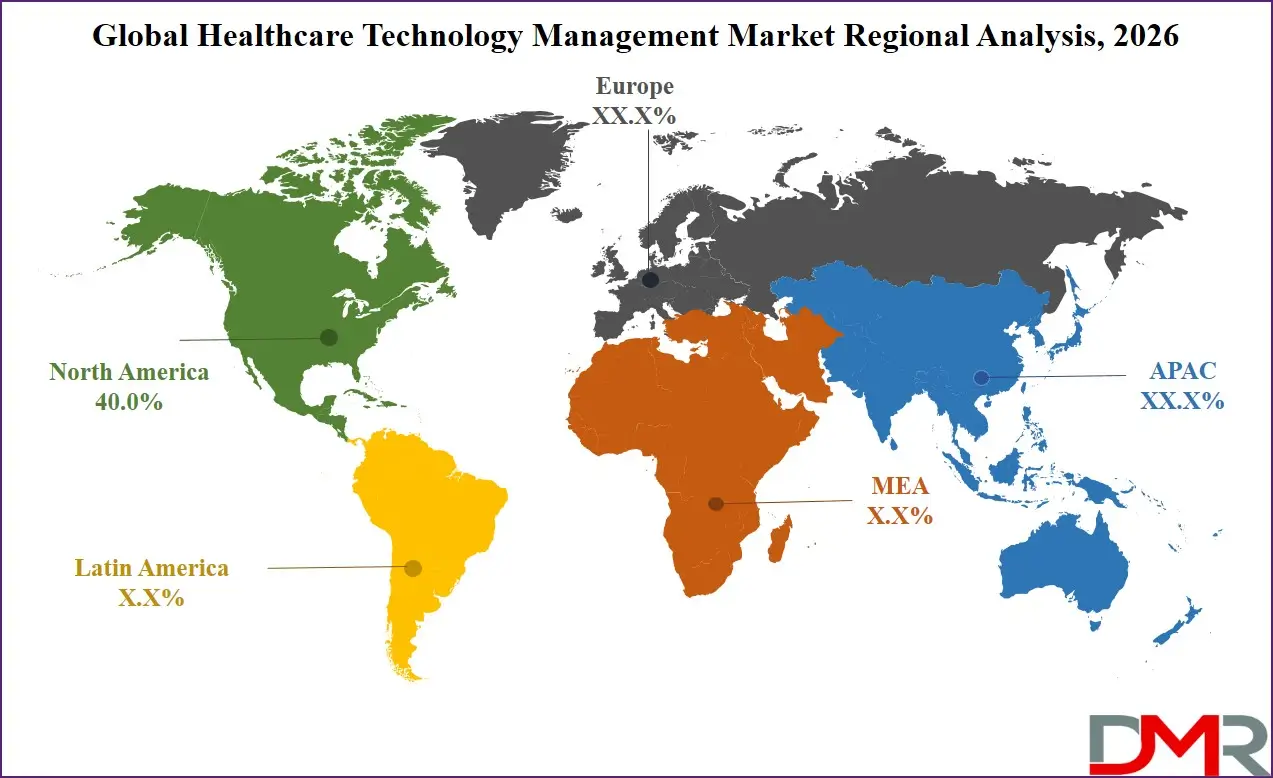
North America holds the top position in the global Healthcare Technology Management market, owning a share of 40.0% in 2026. This region is characterized by highly advanced healthcare infrastructure and high penetration of digital hospital systems.
ℹ
To learn more about this report –
Download Your Free Sample Report Here
Besides, the availability of connected medical devices and investments in modernizing IT solutions in healthcare have contributed to the popularity of HTM solutions in this region. Besides, strict guidelines regarding the safety of medical devices have also fueled the uptake of HTM solutions.
Fastest-Growing Regional Market
The Asia-Pacific region represents the fastest-growing regional market for Healthcare Technology Management, due to the fast-paced growth of the healthcare infrastructure in this region and the rising usage of digital hospital systems. Moreover, there have been significant investments in creating smart hospitals and developing medical devices, which is adding to the demand for HTM solutions in this region. Furthermore, the region has also witnessed substantial advancements in connected medical equipment and IT solutions in the field of healthcare.
By Region
North America
Europe
- Germany
- The U.K.
- France
- Italy
- Russia
- Spain
- Benelux
- Nordic
- Rest of Europe
Asia-Pacific
- China
- Japan
- South Korea
- India
- ANZ
- ASEAN
- Rest of Asia-Pacific
Latin America
- Brazil
- Mexico
- Argentina
- Colombia
- Rest of Latin America
Middle East & Africa
- Saudi Arabia
- UAE
- South Africa
- Israel
- Egypt
- Rest of MEA
Competitive Landscape
Healthcare Technology Management is characterized by stiff competition within the industry, where players are keen on incorporating AI maintenance technologies, cloud-based technology, and integrated asset management technologies. There are efforts to improve interoperability and predictive analysis. More healthcare providers are entering into collaborations with firms. The rate of innovations in the sector is increasing.
Some of the prominent players in the Global Healthcare Technology Management Market are:
- GE HealthCare Technologies Inc.
- Siemens Healthineers AG
- Koninklijke Philips N.V.
- TRIMEDX LLC
- Sodexo S.A.
- Crothall Healthcare
- Agiliti Health Inc.
- RENOVO Solutions LLC
- ABM Industries Incorporated
- JANNX Medical Systems Inc.
- InterMed Group Inc.
- Accruent LLC
- ISS Solutions
- Oracle Health
- Epic Systems Corporation
- Medtronic plc
- McKesson Corporation
- IBM Watson Health
- Agfa HealthCare
- Fujifilm Holdings Corporation
- Other Key Players
Recent Developments
- November 2025: RedSail Technologies acquired RxMile to expand pharmacy and healthcare technology capabilities, strengthening its presence in healthcare operations and service management ecosystems.
- June 2025: Philips Healthcare launched an enhanced HTM software module integrating medical device inventory management, service contracts, and compliance tracking to centralize hospital equipment operations and improve utilization efficiency.
- March 2025: Siemens Healthineers announced a strategic cloud-based HTM asset management platform in partnership with Nuvolo, designed to improve hospital equipment tracking, predictive maintenance, and lifecycle optimization across large healthcare networks.
Report Details
| Report Characteristics |
| Market Size (2026) |
USD 39.7 Bn |
| Forecast Value (2035) |
USD 153.0 Bn |
| CAGR (2026–2035) |
16.2% |
| Historical Data |
2021 – 2025 |
| Forecast Data |
2027 – 2035 |
| Base Year |
2025 |
| Estimate Year |
2026 |
| Segments Covered |
By Component (Services, Software Solutions, Connected Hardware Systems),
By Service Delivery Model (In-house Management, Outsourced Managed Services, Co-managed Models),
By Equipment Category (Imaging Equipment, Monitoring Equipment, Therapeutic Equipment, Laboratory Equipment, General Biomedical Equipment),
By Core Application Area (Maintenance Execution Management, Asset Visibility & Tracking, Capital Planning & Budget Optimization, Regulatory & Quality Assurance, Operational Efficiency Monitoring),
By Deployment Model (On-Premise, Cloud-Based, Hybrid),
By Technology Enablement (Connected Asset Ecosystems, Data Integration Frameworks, Advanced Analytics Engines, Cybersecurity Frameworks, Simulation & Virtual Modeling),
By End-Use Facility (Hospitals, Long-term & Post-Acute Care Facilities, Ambulatory Care Centers, Diagnostics & Research Facilities) |
| Regional Coverage |
North America – The US and Canada;
Europe – Germany, The UK, France, Russia, Spain, Italy, Benelux, Nordic, & Rest of Europe;
Asia-Pacific – China, Japan, South Korea, India, ANZ, ASEAN, Rest of APAC;
Latin America – Brazil, Mexico, Argentina, Colombia, Rest of Latin America;
Middle East & Africa – Saudi Arabia, UAE, South Africa, Turkey, Egypt, Israel, & Rest of MEA |
Frequently Asked Questions
How big is the Healthcare Technology Management Market?
▾ The Healthcare Technology Management Market is expected to reach at USD 39.7 billion in 2026 and is projected to reach USD 153.0 billion by 2035, reflecting strong expansion across global healthcare systems.
What is the CAGR of the Healthcare Technology Management Market from 2026 to 2035?
▾ The market is expected to grow at a CAGR of 16.2% during the forecast period 2026 to 2035, driven by digital transformation in healthcare infrastructure.
What factors are driving the growth of the Healthcare Technology Management Market?
▾ Growth is driven by rising adoption of digital healthcare systems, increasing use of connected medical devices, growing demand for efficient equipment lifecycle management, and the need to reduce hospital operational costs and equipment downtime.
What are the major trends in the Healthcare Technology Management Market?
▾ Key trends include AI-enabled predictive maintenance, expansion of cloud-based HTM platforms, increasing deployment of smart hospital systems, and growing focus on interoperability and real-time asset tracking.
Which region held the largest share of the Healthcare Technology Management Market in 2026?
▾ North America held the largest market share in 2026, accounting for 40.0%, due to advanced healthcare infrastructure and high digital adoption in hospitals.
Which region is expected to grow the fastest in the Healthcare Technology Management Market?
▾ Asia-Pacific is expected to be the fastest-growing region, supported by rapid healthcare modernization, rising government investments, and expanding hospital infrastructure.
Who are the key players in the Healthcare Technology Management Market?
▾ Key players include GE HealthCare Technologies Inc., Siemens Healthineers AG, Koninklijke Philips N.V., TRIMEDX LLC, Sodexo S.A., Crothall Healthcare, Agiliti Health Inc., RENOVO Solutions LLC, ABM Industries Incorporated, JANNX Medical Systems Inc., InterMed Group Inc., Accruent LLC, ISS Solutions, Oracle Health, Epic Systems Corporation, Medtronic plc, McKesson Corporation, IBM Watson Health, Agfa HealthCare, Fujifilm Holdings Corporation, and others.
How is the Healthcare Technology Management Market segmented?
▾ The market is segmented by Component, Service Delivery Model, Equipment Category, Core Application Area, Deployment Model, Technology Enablement, and End-Use Facility.