What is the Healthcare Workforce Management Market Size?
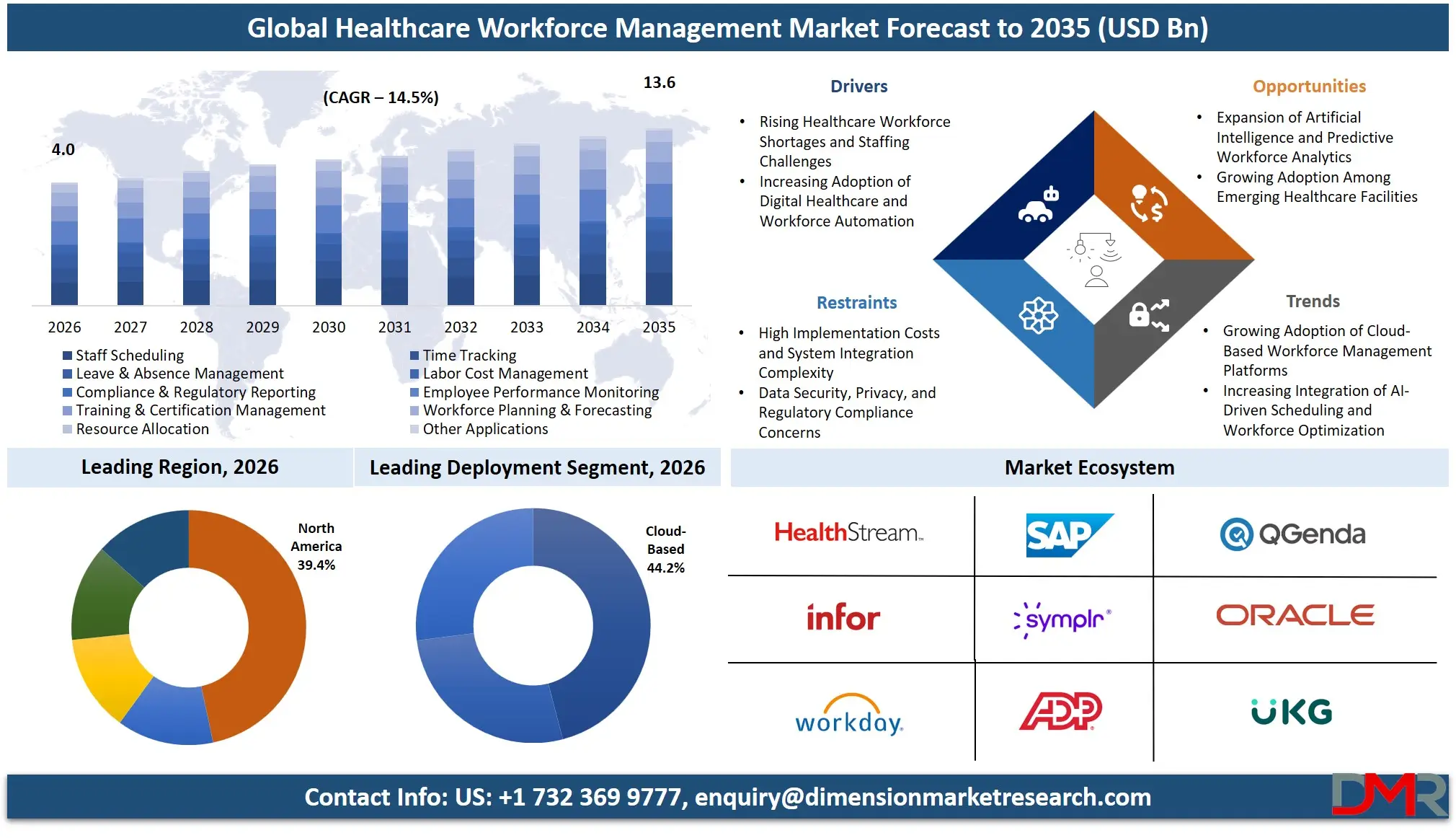
The Global Healthcare Workforce Management Market is expected to reach a value of USD 4.0 billion in 2026, and it is further anticipated to reach USD 13.6 billion by 2035, growing at a CAGR of 14.5% during the forecast period.
ℹ
To learn more about this report –
Download Your Free Sample Report Here
The healthcare workforce management market has been growing at a high rate with healthcare providers increasing the pace of operational digitization and transitioning out of manual, paper-based staffing processes to automated, data-driven platforms. The market consists of software, services, and integrated solutions that assist healthcare organizations in optimizing staff scheduling, time and attendance tracking, talent management, payroll, and compliance. The increasing demand to manage complex shift patterns, control escalating labor costs, address clinical burnout, and adhere to stringent labor laws and accreditation standards is driving the necessity of specialized workforce management technologies. Hospitals are the most frequent adopters, with cloud-based and analytics-driven solutions remaining the most popular because of their scalability and ability to provide real-time operational visibility. The acute care, long-term care, and home healthcare sectors are key players as they need secure, compliant, and highly available systems to manage a mix of full-time, part-time, per-diem, and contract clinicians.
The US Healthcare Workforce Management Market
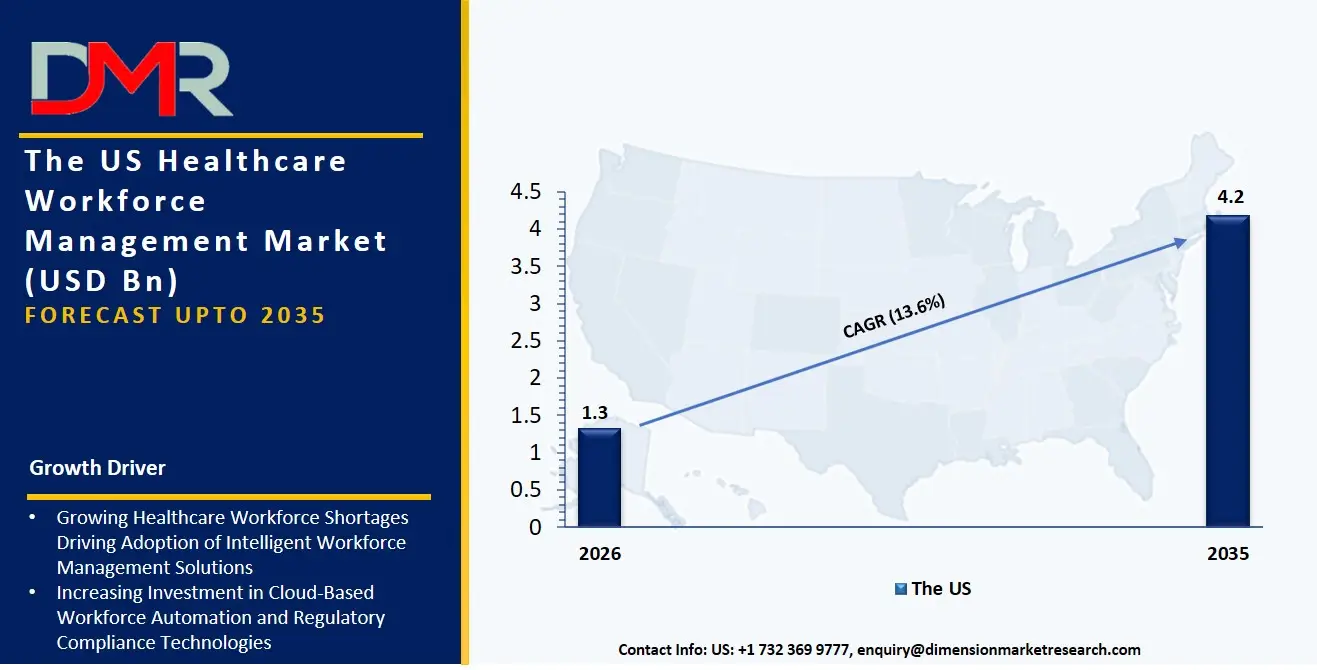
The US Healthcare Workforce Management Market is projected to reach USD 1.3 billion in 2026 at a compound annual growth rate of 13.6% over its forecast period, culminating in a value of USD 4.2 billion by 2035.
ℹ
To learn more about this report –
Download Your Free Sample Report Here
The US continues to be the largest and most developed market in healthcare workforce management due to the active consolidation of health systems and the growing complexity of multi-facility, multi-state labor regulations. The market has been typified by high demand for Scheduling & Shift Management solutions whereby organizations are aimed at balancing nurse-to-patient ratios and managing complex union rules. Besides, the integration of Workforce Analytics tools is producing a similar need in Compliance Management solutions to govern staff credentialing, mandatory training, and labor law adherence across diverse jurisdictions.
The Europe Healthcare Workforce Management Market
The Europe Healthcare Workforce Management Market is estimated to be valued at USD 1.2 billion in 2026 and is further anticipated to reach USD 3.8 billion by 2035 at a CAGR of 13.9%. The regulatory frameworks including the European Working Time Directive and country-specific staffing mandates have a significant impact on the European market and drive the need to employ Compliance & Regulatory Reporting and workforce planning tools. Accelerated growth of Cloud-Based deployment services is also being experienced in the region as public and private hospital groups in Germany and France are trying to strike a balance between clinical staff wellbeing and operational efficiency with centralized, data-driven rostering. In addition, efforts to create interoperable digital health records are challenging service providers to create dedicated Implementation & Integration Services to ensure seamless data flow between workforce management platforms and electronic health records (EHR) across European healthcare ecosystems.
The Japan Healthcare Workforce Management Market
The Japan Healthcare Workforce Management Market is projected to be valued at USD 343.7 million, at a CAGR of 13.1%. The Japanese market is unique, with a national drive to address a rapidly aging population and a critical shortage of healthcare professionals, which has been exacerbated by outdated workforce administration infrastructure. Consulting Services and Workforce Scheduling solutions make up a large part of the spending as large hospital conglomerates migrate from legacy time clocks and spreadsheets to cloud-based systems. There is also a strong need to deeply integrate workforce data with existing Electronic Medical Record (EMR) and payroll systems, which forms a niche in API-led integration and Workflow Automation to bridge gaps between clinical service demands and available human resources.
Key Takeaways
- Market Size & Forecast: The Global Healthcare Workforce Management market is projected to reach USD 4.0 billion in 2026, expanding dramatically to USD 13.6 billion by 2035, fueled by the dual drivers of chronic healthcare staff shortages and the mandatory transition from manual to automated operational systems.
- Growth Rate & Outlook: Global market growth is expected at a CAGR of 14.5%, driven by a critical shortage of nursing and specialized clinical staff and the escalating complexity of managing compliance across multiple accrediting bodies and labor jurisdictions.
- Primary Growth Drivers: Key forces include the widespread recognition of labor as the largest operational cost for healthcare providers, the need for Workforce Analytics to mitigate burnout and optimize staffing ratios, and the integration of scheduling with payroll systems requiring specialized Implementation & Integration Services.
- Key Market Trends: Major trends include the rise of AI-powered predictive scheduling, the use of mobile-first engagement tools to empower staff with shift bidding and self-scheduling, and the shift toward centralized Compliance Management as healthcare boards prioritize risk mitigation and audit readiness.
- By Deployment Analysis: Cloud-Based models are expected to dominate enterprise discussions due to their scalability and lower upfront costs. Professional services are increasingly required to build seamless API integration layers that connect cloud workforce platforms with on-premise HRIS and EHR systems.
- By End User Analysis: Hospitals and Long-Term Care Facilities are the most lucrative segments due to stringent staffing mandates and complex skill-mix requirements. Home Healthcare Agencies represent the fastest-growing sector as mobile workforce tracking and geo-verified time and attendance become critical for decentralized care models.
- Regional Leadership: North America is poised to dominate this market with 39.4% of the market share in 2026 due to its advanced technological infrastructure, large consolidated health systems, and a mature understanding of the ROI derived from workforce optimization tools.
What is the Healthcare Workforce Management?
Healthcare Workforce Management encompasses the specialized software, solutions, and advisory services that are deployed by healthcare providers to strategically manage their entire clinical and non-clinical labor lifecycle. These platforms, unlike generic HR systems, are purpose-built to address the unique demands of healthcare, which operates on a 24/7 basis. This involves Software for Time & Attendance Management to capture complex shift differentials, Scheduling & Shift Management to align the right credentialed staff with patient demand, and Workforce Analytics to generate actionable intelligence on productivity and labor costs. With healthcare systems navigating razor-thin margins and critical talent shortages, these professional solutions and underlying services are needed to achieve labor cost governance, ensure regulatory compliance, and drive staff engagement, making human capital investments translate into tangible improvements in patient care, rather than administrative complexity.
Use Cases
- Centralized Nurse Scheduling in Hospitals: Acute care hospital networks hire Scheduling & Shift Management solutions to replace unit-based paper rosters with a centralized, acuity-based staffing system that ensures safe nurse-to-patient ratios, manages complex shift swaps, and reduces reliance on costly agency nurses.
- Credentialing and Compliance in Home Healthcare: Home Healthcare Agencies use Credentialing & Compliance Management solutions and Support & Maintenance Services to proactively track expiring licenses and certifications for a mobile workforce, ensuring only compliant clinicians are assigned to patient visits, thereby mitigating legal and billing risk.
- Labor Cost Prediction in Long-Term Care: Skilled nursing facilities use Workforce Analytics & Reporting solutions to predict census-driven labor demand and model the financial impact of overtime versus agency use, optimizing labor cost management in a fixed-reimbursement environment.
- Multi-Entity Payroll Integration for Diagnostic Labs: National diagnostic chains use Payroll & Compensation Management solutions and Implementation & Integration Services to unify complex pay rules, shift differentials, and on-call pay across hundreds of locations into a single, accurate payroll process.
How AI is Transforming the Healthcare Workforce Management Market?
AI is changing the healthcare workforce management by accelerating the transition from reactive staffing to predictive and prescriptive resource allocation. In Workforce Scheduling, AI-based algorithms analyze historical patient volume, seasonal illness patterns, and local events to forecast future workload, automatically generating optimal shift rosters that preemptively balance labor demand with supply, greatly minimizing last-minute agency staffing surges. Meanwhile, AI-powered features in Workforce Analytics allow healthcare leaders to identify hidden patterns of staff burnout, predict attrition risk, and model the potential impact of scheduling changes on patient safety and operational costs before implementing them.
Governance and compliance projects are also revolving around AI. In the area of Compliance Management, intelligent agents continuously monitor multi-state and federal regulatory databases, automatically cross-referencing internal credential files to flag discrepancies and ensuring organizations remain in line with The Joint Commission and CMS mandates. Moreover, generative AI assistants are complementing employee performance monitoring by analyzing subjective feedback alongside quantitative data to provide nurse managers with a 360-degree view of team dynamics and individual development needs.
Market Dynamics
Key Drivers in the Global Healthcare Workforce Management Market
Rising Healthcare Workforce Shortages and Staffing Challenges
Healthcare organizations worldwide are experiencing increasing shortages of physicians, nurses, allied health professionals, and support staff, creating significant demand for workforce management solutions. Advanced workforce management platforms enable hospitals to optimize staff scheduling, reduce overtime, improve workforce utilization, and ensure adequate staffing levels for quality patient care. These systems leverage predictive analytics and automation to forecast workforce requirements based on patient demand and operational needs. Growing pressure to improve employee satisfaction, reduce burnout, and maintain regulatory compliance is accelerating software adoption. The expanding healthcare workforce shortage continues to position workforce management solutions as an essential operational investment across healthcare organizations.
Increasing Adoption of Digital Healthcare and Workforce Automation
The rapid digital transformation of healthcare is driving widespread adoption of workforce management platforms that automate scheduling, payroll, attendance, compliance, and employee performance monitoring. Healthcare providers increasingly deploy cloud-based and AI-powered solutions to streamline administrative processes while reducing manual errors and operational costs. Integration with electronic health records, payroll systems, and human resource platforms improves workforce visibility and organizational efficiency. Government initiatives supporting healthcare digitalization, combined with rising investments in hospital modernization, continue accelerating adoption. As healthcare organizations prioritize operational excellence and data-driven workforce planning, digital workforce management technologies are becoming fundamental components of modern healthcare infrastructure.
Restraints in the Global Healthcare Workforce Management Market
High Implementation Costs and System Integration Complexity
Deploying healthcare workforce management solutions often requires substantial investment in software licensing, cloud infrastructure, implementation services, employee training, and ongoing maintenance. Healthcare organizations must integrate workforce management platforms with existing payroll, human resources, hospital information systems, and electronic health records, creating technical complexity and extended deployment timelines. Smaller healthcare providers frequently face financial limitations that delay technology adoption. Additionally, system customization, workflow redesign, and continuous software upgrades increase total ownership costs. These implementation challenges remain significant barriers for healthcare organizations seeking to modernize workforce management while maintaining uninterrupted clinical operations and regulatory compliance.
Data Security, Privacy, and Regulatory Compliance Concerns
Healthcare workforce management platforms process sensitive employee information including payroll records, personal identification, scheduling data, credentials, and performance evaluations. Protecting this information from cyberattacks and unauthorized access is a major concern for healthcare organizations. Compliance with evolving labor laws, healthcare regulations, and data protection requirements increases implementation complexity and operational risk. Organizations must continuously strengthen cybersecurity frameworks while ensuring secure integration with multiple enterprise systems. Concerns regarding cloud security, data privacy, and regulatory compliance continue influencing purchasing decisions, particularly among organizations managing large healthcare workforces across multiple facilities and jurisdictions.
Growth Opportunities in the Global Healthcare Workforce Management Market
Expansion of Artificial Intelligence and Predictive Workforce Analytics
Artificial intelligence and predictive analytics present substantial growth opportunities for healthcare workforce management vendors. AI-powered platforms analyze historical staffing patterns, patient admissions, seasonal demand, and employee availability to generate optimized workforce schedules and improve resource allocation. Predictive analytics help healthcare organizations anticipate staffing shortages, reduce overtime costs, and enhance workforce productivity while maintaining quality patient care. As healthcare systems increasingly adopt intelligent automation and data-driven decision-making, demand for AI-enabled workforce management solutions continues expanding. Continuous advancements in machine learning technologies will further strengthen workforce forecasting capabilities and operational efficiency across healthcare organizations.
Growing Adoption Among Emerging Healthcare Facilities
Rapid healthcare infrastructure development across emerging economies creates significant opportunities for workforce management solution providers. Governments are investing heavily in hospitals, specialty clinics, ambulatory centers, and long-term care facilities to improve healthcare accessibility and service quality. Newly established healthcare organizations increasingly implement digital workforce management platforms from the beginning of operations to improve staffing efficiency, regulatory compliance, and labor cost optimization. Rising healthcare expenditure, expanding private healthcare investments, and increasing awareness of workforce optimization technologies continue supporting market growth. Emerging markets represent substantial long-term expansion opportunities for global healthcare workforce management vendors.
Trends in the Global Healthcare Workforce Management Market
Growing Adoption of Cloud-Based Workforce Management Platforms
Cloud-based workforce management platforms are becoming the preferred deployment model across healthcare organizations due to their scalability, flexibility, and lower infrastructure requirements. These platforms enable real-time workforce scheduling, mobile employee access, automated software updates, centralized analytics, and seamless integration with enterprise healthcare systems. Multi-site hospital networks particularly benefit from centralized workforce visibility and standardized workforce management practices. Continuous improvements in cloud security, interoperability, and regulatory compliance further accelerate adoption. As healthcare organizations continue digital transformation initiatives, cloud-based workforce management solutions are emerging as the dominant technology trend across the global market.
Increasing Integration of AI-Driven Scheduling and Workforce Optimization
Artificial intelligence is transforming healthcare workforce management by automating staff scheduling, workload balancing, shift optimization, and labor forecasting. AI-powered platforms evaluate employee skills, certifications, patient demand, labor regulations, and historical staffing data to generate optimized schedules with minimal manual intervention. These intelligent systems reduce scheduling conflicts, improve workforce utilization, minimize overtime, and enhance employee satisfaction. Healthcare providers increasingly adopt AI-driven workforce optimization to address staffing shortages while maintaining high-quality patient care. Continuous advancements in machine learning and predictive analytics are expected to further reshape workforce management practices throughout the global healthcare industry.
Research Scope and Analysis
The Global Healthcare Workforce Management Market Report is segmented by Component, Solution, Deployment, Organization Size, Application, and End User. These segments comprehensively evaluate workforce management technologies, deployment models, organizational adoption, operational applications, and healthcare settings, providing detailed insights into staffing optimization, workforce efficiency, regulatory compliance, competitive landscape, and future market growth opportunities.
ℹ
To learn more about this report –
Download Your Free Sample Report Here
By Component Analysis
The Software segment is poised to dominate the Healthcare Workforce Management market because healthcare organizations increasingly rely on digital platforms to automate workforce scheduling, attendance tracking, payroll, compliance, workforce analytics, and employee performance management. Hospitals and healthcare systems require integrated software solutions to manage staffing shortages, reduce administrative workloads, ensure regulatory compliance, and optimize labor costs. Cloud-enabled workforce management platforms further improve operational efficiency through real-time scheduling, predictive analytics, and mobile accessibility. Continuous advancements in artificial intelligence, automation, and interoperability with electronic health records and human resource systems have strengthened software adoption, making it the largest revenue-generating component across global healthcare workforce management solutions.
By Solution Analysis
Workforce Scheduling is expected to dominate the solution segment because efficient staff scheduling is essential for maintaining uninterrupted patient care, regulatory compliance, and cost-effective hospital operations. Healthcare providers must coordinate physicians, nurses, technicians, and support staff across multiple departments while accommodating varying patient volumes and shift requirements. Advanced scheduling platforms use artificial intelligence and predictive analytics to optimize shift assignments, minimize overtime, improve employee satisfaction, and reduce workforce shortages. Increasing pressure to enhance productivity while addressing clinician burnout continues driving adoption. As healthcare organizations prioritize operational efficiency and quality patient outcomes, workforce scheduling remains the most widely implemented workforce management solution globally.
By Deployment Analysis
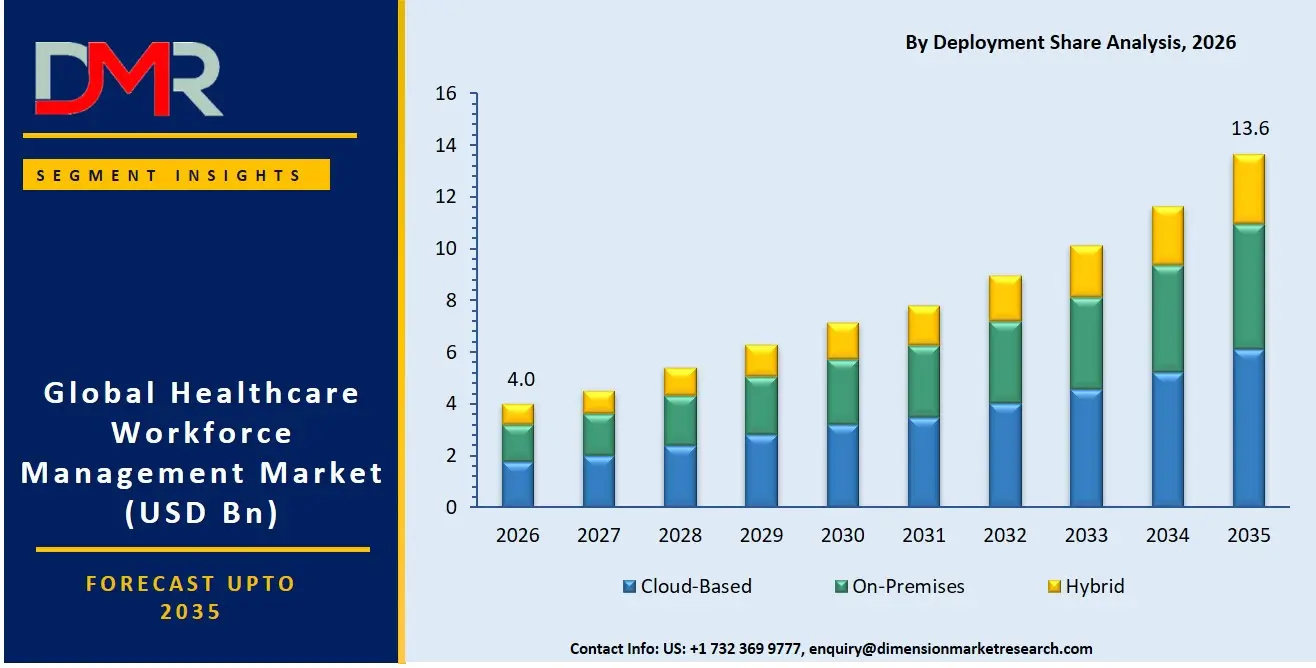
The Cloud-Based deployment segment was anticipated to dominate because healthcare organizations increasingly prefer scalable, secure, and remotely accessible workforce management platforms.
ℹ
To learn more about this report –
Download Your Free Sample Report Here
Cloud deployment enables real-time scheduling, employee self-service, centralized workforce analytics, seamless software updates, and integration with payroll, HR, and hospital information systems. It reduces infrastructure costs while improving operational flexibility across multi-site healthcare networks. Growing adoption of digital transformation strategies, hybrid work environments, and mobile workforce applications has further accelerated cloud implementation. Continuous improvements in cybersecurity, regulatory compliance, and interoperability with healthcare IT ecosystems have strengthened confidence in cloud-based workforce management, making it the preferred deployment model worldwide.
By Organization Size Analysis
Large Enterprises is projected to dominate the organization size segment because major hospital networks, integrated healthcare systems, academic medical centers, and multi-facility healthcare providers manage thousands of employees requiring sophisticated workforce management solutions. These organizations possess the financial resources to invest in enterprise-grade software that automates scheduling, payroll, compliance, credentialing, workforce analytics, and labor optimization across multiple locations. Increasing regulatory requirements, workforce shortages, and the need for operational efficiency continue driving investments in advanced workforce management platforms. Large healthcare organizations also prioritize digital transformation initiatives, reinforcing their leadership in adopting comprehensive workforce management technologies across global healthcare markets.
By Application Analysis
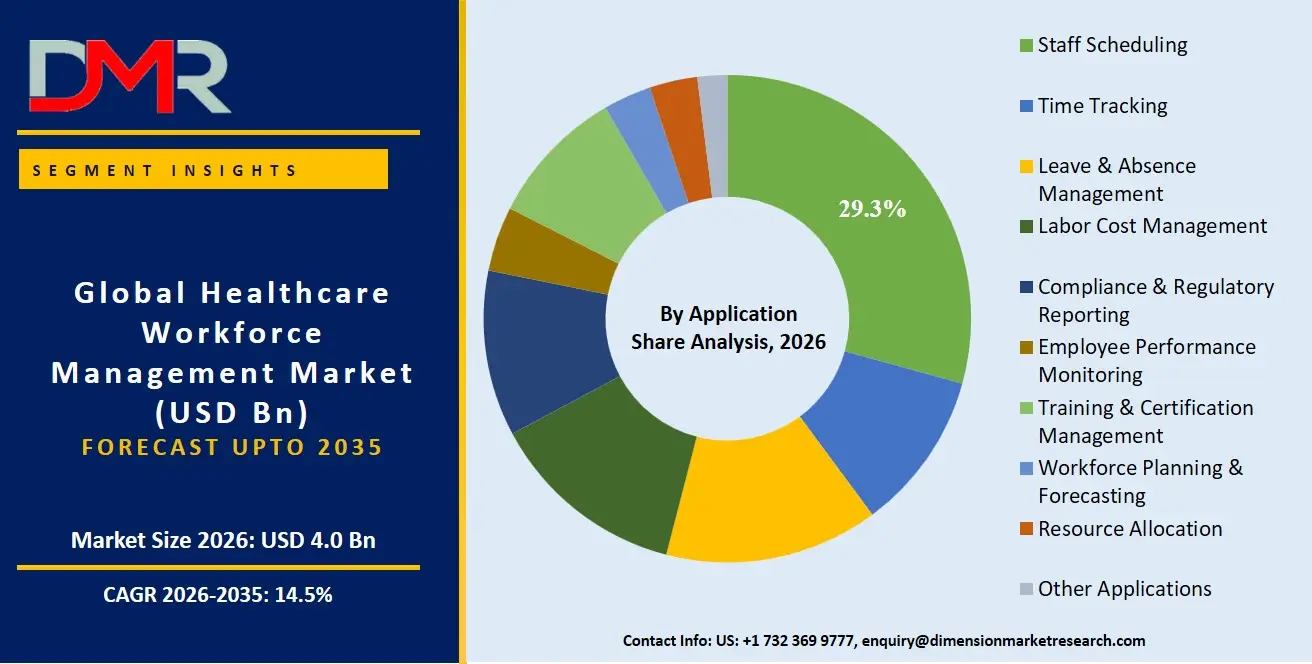
Staff Scheduling is poised to dominate the application segment because effective scheduling directly influences patient care quality, workforce productivity, operational efficiency, and labor cost control. Healthcare organizations must ensure appropriate staffing levels around the clock while complying with labor regulations, credentialing requirements, and employee availability. Modern scheduling platforms automate complex shift planning using predictive analytics and real-time workforce data to reduce staffing gaps and overtime expenses. Rising patient volumes, clinician shortages, and increasing demand for flexible workforce management continue accelerating adoption. Staff scheduling remains the most critical operational application supporting healthcare organizations' daily workforce planning and resource utilization activities.
By End User Analysis
Hospitals is expected to dominate the end-user segment because they employ the largest healthcare workforce and require comprehensive workforce management systems to coordinate physicians, nurses, technicians, administrative personnel, and support staff across multiple departments. Large hospitals operate continuously, making efficient scheduling, attendance management, compliance monitoring, payroll processing, and workforce analytics essential for maintaining quality patient care. Rising patient admissions, staffing shortages, and increasing regulatory requirements continue driving investments in digital workforce management solutions. The ongoing adoption of artificial intelligence, cloud computing, and predictive workforce planning technologies further strengthens hospitals' position as the largest end-user segment in the global Healthcare Workforce Management market.
The Global Healthcare Workforce Management Market Report is segmented on the basis of the following:
By Component
- Software
- Time & Attendance Management
- Scheduling & Shift Management
- Workforce Analytics
- Talent Management
- Payroll & Compensation Management
- Leave Management
- Compliance Management
- Services
- Consulting Services
- Implementation & Integration Services
- Support & Maintenance Services
- Training Services
By Solution
- Workforce Scheduling
- Time & Attendance Management
- Talent Acquisition & Recruitment
- Workforce Analytics & Reporting
- Payroll & Compensation Management
- Employee Performance Management
- Credentialing & Compliance Management
- Learning & Development Management
- Employee Engagement Solutions
By Deployment
- Cloud-Based
- On-Premises
- Hybrid
By Organization Size
- Large Enterprises
- Small & Medium Enterprises (SMEs)
By Application
- Staff Scheduling
- Time Tracking
- Leave & Absence Management
- Labor Cost Management
- Compliance & Regulatory Reporting
- Employee Performance Monitoring
- Training & Certification Management
- Workforce Planning & Forecasting
- Resource Allocation
- Other Applications
By End User
- Hospitals
- Ambulatory Care Centers
- Long-Term Care Facilities
- Nursing Homes
- Specialty Clinics
- Home Healthcare Agencies
- Diagnostic Laboratories
- Healthcare BPOs
- Other Healthcare Organizations
Regional Analysis
Leading Region by Market Share
ℹ
To learn more about this report –
Download Your Free Sample Report Here
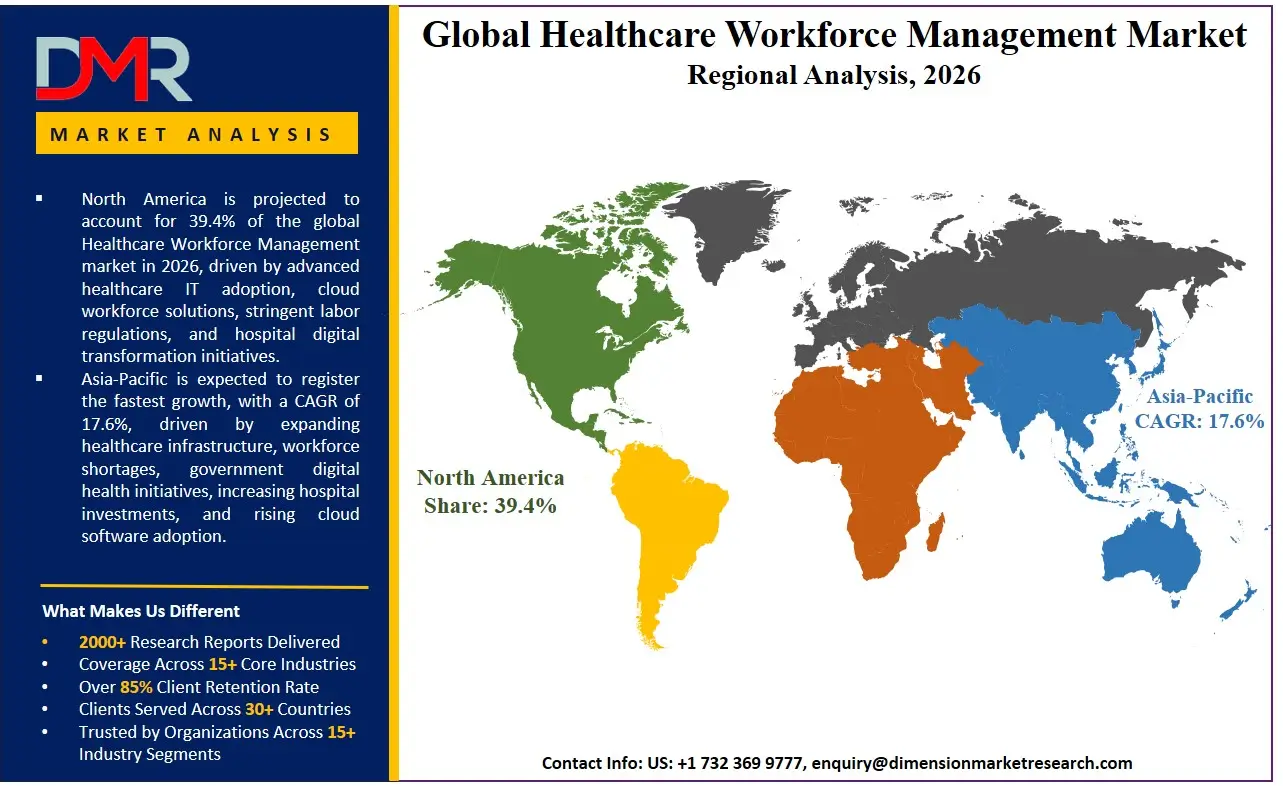
North America is poised to dominate the global healthcare workforce management market as it is projected to hold 39.4% of the market share by the end of 2026. The United States, which dominates North America, has the highest share in the healthcare workforce management market because of the unmatched concentration of large, consolidated health systems and the aggressive cost-containment agendas required by value-based care models. The area has an established ecosystem of global system integrators, specialized healthcare consultancy firms, and a rich pool of health IT architects and clinical informaticists. Enterprise investment in mitigating nurse burnout, controlling soaring labor costs, and preparing for stricter staffing ratio legislation contributes to the continued demand for staffing analytics and acuity-based scheduling solutions along with continuous compliance monitoring. Moreover, a robust venture capital climate persistently finances emerging digital health enterprises that need expert professional services to achieve integration with major EHR ecosystems.
Fastest-Growing Regional Market
Asia-Pacific is expected to be the most rapidly expanding healthcare workforce management market, driven by government-led sweeping healthcare digitalization initiatives in India, China, Japan, and Southeast Asia. The fast-paced economic growth, the rapid expansion of private hospital networks, and the rising demand for medical tourism are compelling established conglomerates and public health authorities to discard inefficient paper-based rostering and manual attendance tracking. Consulting Services and Workforce Scheduling solutions are in high demand to help these large organizations head in the direction of data-driven, automated operating models. There is also a severe lack of skilled health IT administrators in the region, and it is necessary to outsource Support & Maintenance Services and managed services to cover the skills gap and enable faster investments in operational technology projects that improve both patient throughput and staff retention.
By Region
North America
Europe
- Germany
- The U.K.
- France
- Italy
- Russia
- Spain
- Benelux
- Nordic
- Rest of Europe
Asia-Pacific
- China
- Japan
- South Korea
- India
- ANZ
- ASEAN
- Rest of Asia-Pacific
Latin America
- Brazil
- Mexico
- Argentina
- Colombia
- Rest of Latin America
Middle East & Africa
- Saudi Arabia
- UAE
- South Africa
- Israel
- Egypt
- Rest of MEA
Competitive Landscape
The competitive environment of the global healthcare workforce management market has become highly dynamic with a heterogeneous array of major enterprise technology players, specialized pure-play workforce vendors, and professional service divisions of global consulting firms. The key to success will be the profound strategic alliances with major EHR vendors like Epic and Oracle Cerner because they will open necessary co-development and data-integration opportunities, embedding workforce data directly into clinical workflows. The movement towards market consolidation is rapidly progressing, with traditional HRIS giants acquiring specialized scheduling and credentialing boutiques to offer a holistic healthcare-specific suite. Proprietary intellectual property, including AI-driven predictive staffing algorithms and pre-configured, role-based rules engines for nurse scheduling, is becoming a more important basis of competitive differentiation than just generic time-and-attendance tracking or isolated project management approaches.
Some of the prominent players in the Global Healthcare Workforce Management Market are:
- UKG
- Oracle
- Workday, Inc.
- Infor
- SAP SE
- ADP, Inc.
- Symplr
- HealthStream
- QGenda
- AMN Healthcare
- RLDatix
- Cornerstone OnDemand
- Dayforce
- Shiftboard
- NICE Ltd.
- Kronos Incorporated
- Verint
- SmartLinx
- Vector Solutions
- Allocate Software
- Other Key Players
Recent Developments
- November 2025: UKG introduced the Workforce Intelligence Hub, an AI-powered operational intelligence platform that unifies workforce data to provide predictive staffing insights, overtime analysis, shift coverage monitoring, and workforce performance dashboards. The solution became available to select customers in early 2026.
- July 2025: symplr acquired Smart Square scheduling software from AMN Healthcare, strengthening its AI-driven workforce management portfolio with advanced nurse and staff scheduling, predictive staffing, and real-time workforce optimization capabilities.
- February 2026: symplr announced new AI-powered enhancements to its Operations Platform at ViVE 2026, including predictive workforce scheduling, intelligent staffing optimization, automated payroll policy management, and advanced open-shift management to improve healthcare workforce efficiency.
Report Details
| Report Characteristics |
| Market Size (2026) |
USD 4.0 Bn |
| Forecast Value (2035) |
USD 13.6 Bn |
| CAGR (2026–2035) |
14.5% |
| The US Market Size (2026) |
USD 1.3 Bn |
| Historical Data |
2021 – 2025 |
| Forecast Data |
2027 – 2035 |
| Base Year |
2025 |
| Estimate Year |
2026 |
| Segments Covered |
By Component, By Deployment, By Organization Size, By Application, and By End User |
| Regional Coverage |
North America – The US and Canada; Europe – Germany, The UK, France, Russia, Spain, Italy, Benelux, Nordic, & Rest of Europe; Asia-Pacific – China, Japan, South Korea, India, ANZ, ASEAN, Rest of APAC; Latin America – Brazil, Mexico, Argentina, Colombia, Rest of Latin America; Middle East & Africa – Saudi Arabia, UAE, South Africa, Turkey, Egypt, Israel, & Rest of MEA |
Frequently Asked Questions
How big is the Global Healthcare Workforce Management Market?
▾ The Global Healthcare Workforce Management market is poised to be valued at USD 4.0 billion in 2026 and is projected to reach USD 13.6 billion by 2035, driven by the universal need for specialized technology and services in labor cost control, clinical scheduling, and healthcare compliance management.
What is the CAGR of the Global Healthcare Workforce Management Market from 2026 to 2035?
▾ The market is expected to grow at a CAGR of 14.5% from 2026 to 2035, reflecting the accelerating complexity of healthcare labor models and the persistent shortage of internal IT and informatics talent within provider organizations.
What factors are driving the growth of the Global Healthcare Workforce Management Market?
▾ Key drivers include the global clinical talent crisis, the imperative to modernize legacy scheduling and payroll systems, the management complexity of multi-entity labor pools, and the surge in demand for Compliance & Regulatory Reporting amid evolving staffing ratio and fair workweek legislation.
Which region held the largest share of the Healthcare Workforce Management Market in 2026?
▾ North America is projected to hold a 39.4% market share in 2026, driven by a mature ecosystem of consolidated health systems and aggressive enterprise investment in Workforce Analytics & Reporting and AI-driven staffing capabilities.
Which region is expected to grow the fastest in the Healthcare Workforce Management Market?
▾ The Asia-Pacific region is expected to grow the fastest, fueled by rapid healthcare digitalization in India, China, and Japan, where Workforce Scheduling solutions are critical for transitioning large hospital groups to modern, automated operating models.
What are the major trends in the Global Healthcare Workforce Management Market?
▾ Major trends include the integration of Generative AI for schedule communication, the rise of acuity-based and predictive staffing models, the demand for mobile-first employee engagement solutions, and the focus on unifying Labor Cost Management with patient outcome analytics.
Who are the key players in the Global Healthcare Workforce Management Market?
▾ Key players include enterprise platform providers like UKG, Oracle, and Workday, specialized pure-play vendors like QGenda, symplr, and RLDatix, alongside healthcare-focused consulting arms of global system integrators.
How is the Global Healthcare Workforce Management Market segmented?
▾ The market is segmented by Component, Deployment, Organization Size, Application, and End User.