What is the High Performance Computing Market Size?
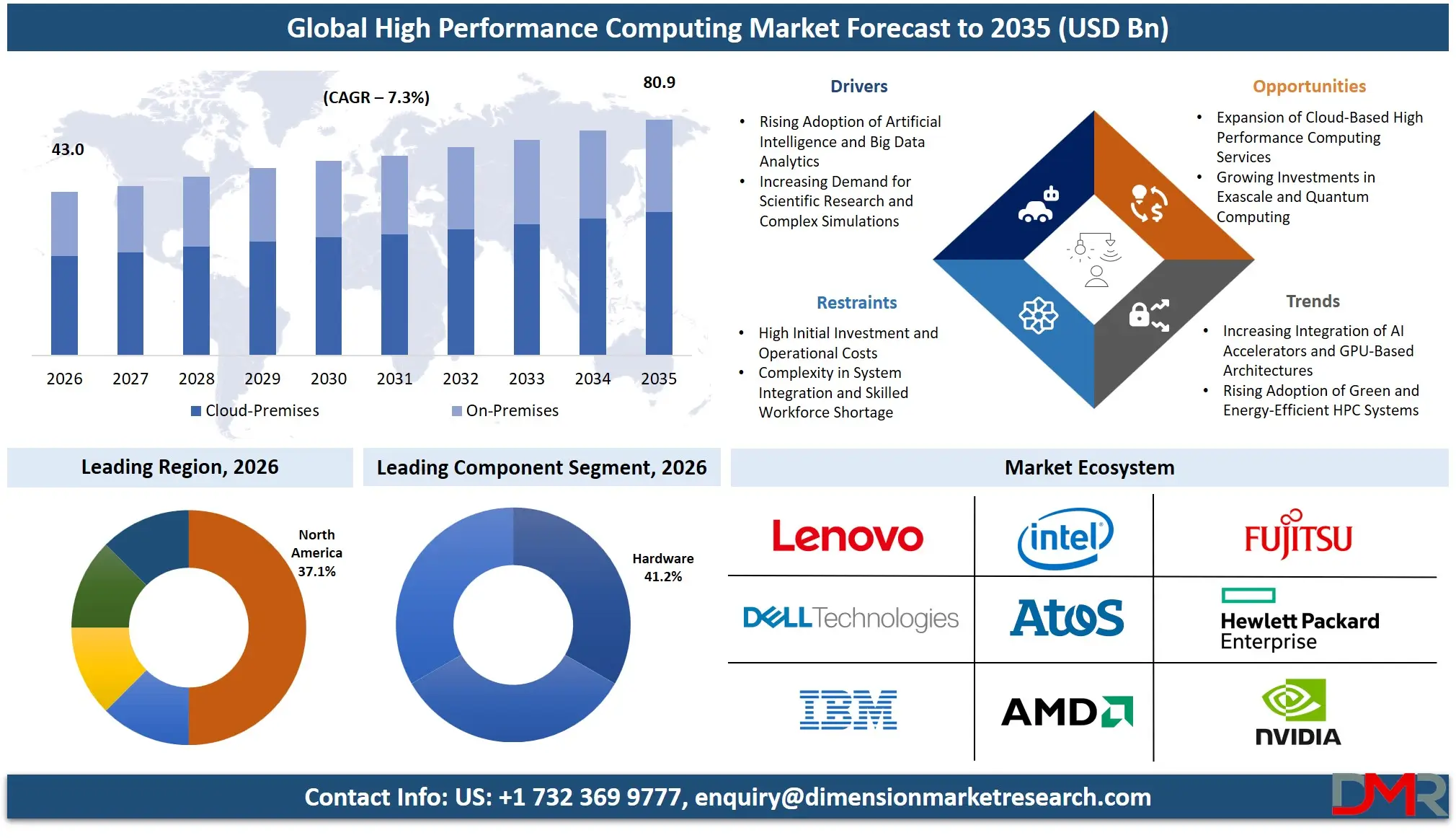
The Global High Performance Computing (HPC) Market is expected to reach a value of USD 43.0 billion in 2026, and it is further anticipated to reach USD 80.9 billion by 2035, growing at a CAGR of 7.3% during the forecast period.
ℹ
To learn more about this report –
Download Your Free Sample Report Here
The market for high-performance computing has been witnessing robust growth rates, with enterprises and research institutions accelerating their efforts towards complex modeling and moving from traditional serial processing methods to massively parallel and distributed computing approaches. High-performance computing includes hardware, software, and services that help enterprises adopt their on-premises, cloud-based, and hybrid HPC infrastructures.
There is a rising requirement for implementing artificial intelligence workloads, exascale computing solutions, and complex scientific simulations, which is forcing enterprises to adopt specialized hardware such as accelerators and parallel computing software. Large enterprises have been leading adopters of HPC solutions, with cloud-based HPC solutions being the most adopted solution due to its scalability and flexibility. Government & Defense, Healthcare & Life Sciences, and BFSI are the key sectors that adopt HPC solutions, as they require a secure, high-throughput, and highly reliable computing ecosystem.
ℹ
To learn more about this report –
Download Your Free Sample Report Here
The US High Performance Computing Market
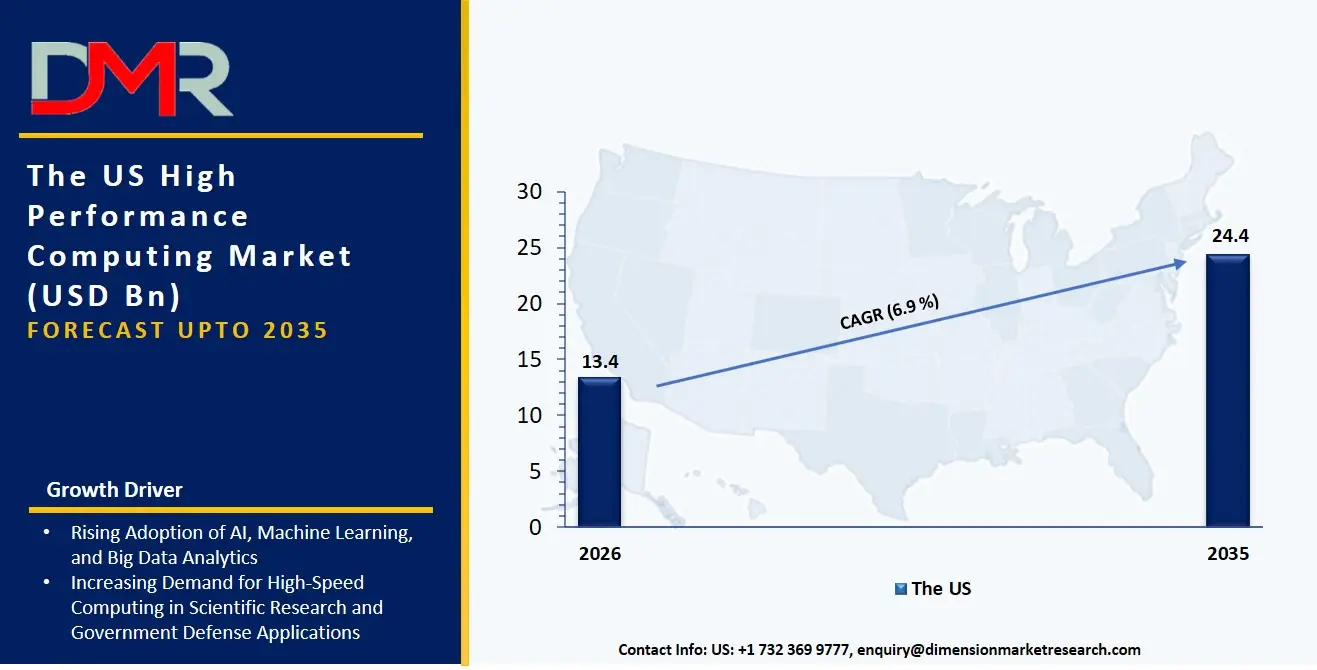
The US High Performance Computing Market is projected to reach USD 13.4 billion in 2026 at a compound annual growth rate of 6.9% over its forecast period. The US remains the largest and most advanced market for HPC as a result of the ongoing modernization activities by national laboratories, Fortune 500 companies, and the increasing availability of hyperscale data centers providing HPC as a service. Traditionally, there has been a high demand for Accelerators & Coprocessors in the market since businesses have been trying to speed up AI and machine learning training models. In addition, the adoption of Generative AI software solutions is creating a similar demand for Consulting Services.
ℹ
To learn more about this report –
Download Your Free Sample Report Here
The Europe High Performance Computing Market
The Europe High Performance Computing Market is estimated to be valued at USD 13.0 billion in 2026 and is further anticipated to reach USD 23.8 billion by 2035 at a CAGR of 6.9%. The regulatory environment consisting of GDPR and the soon-to-be-implemented EU AI Act plays an important role in the European market, which makes the adoption of sovereign cloud-based HPC technologies and specific Security Software a necessity. The rapid development of exascale computing projects is observed in Europe, where the manufacturing and automotive industries in Germany and France strive to find a balance between OT security and cloud-based modeling and simulation. Furthermore, initiatives like EuroHPC Joint Undertaking require the providers to develop special services for integration and deployment, allowing interoperability within European HPC environments.
The Japan High Performance Computing Market
The Japan High Performance Computing Market is projected to be valued at USD 2.1 billion in 2026 at a CAGR of 6.9%. The Japanese market is very unique with an initiative by companies to utilize HPC for their scientific studies and innovations in the industries like developing next-generation drugs and material science. The software component represents a significant share in the total expenditure as research consortiums and conglomerates conduct highly complex simulations which need analytics and visualization software as well as resource and workload management solutions. Moreover, there is also a requirement for deep integration with legacy manufacturing control systems and AI clouds to fill the void, which represents a niche for custom parallel computing solutions.
Key Takeaways
- Market Size & Forecast: The Global High Performance Computing market is projected to reach USD 43.0 billion in 2026, expanding to USD 80.9 billion by 2035, fueled by the dual drivers of the increasing penetration of AI into the enterprise space and the need for the modernization of the infrastructure of scientific research.
- Growth Rate & Outlook: Global market growth rates are forecast at CAGR of 7.3% due to a severe shortage of in-house architects specializing in HPC technology, along with growing complexity in managing hybrid architectures consisting of CPUs, GPUs, and other accelerators.
- Primary Growth Drivers: The main factors of growth include the growing trend of migrating from CapEx to OpEx models of computing in the cloud, the demand for I&D services to minimize risks of misconfiguration and high costs, and integration of AI pipelines that require special Accelerators & Coprocessors.
- Key Market Trends: Major trends include the emergence of industry-specific HPC systems, the incorporation of AI technology into Resource & Workload Management for auto-remediation of performance problems, and the development of exascale computing to ensure technological sovereignty of nations.
- By Deployment Analysis: Cloud-based deployment will be dominant in enterprise discussions because of issues of scalability and data gravity, making services necessary to create integration layers which will link on-premises cluster computing to public cloud computing engines.
- By Vertical Analysis: BFSI and Healthcare are two very profitable segments as their need for performance and compliance necessitates the use of HPC in areas like risk modeling and genomics. Government & Defense is the fastest growing segment as HPC will be needed for their security initiatives.
- Regional Leadership: North America is poised to take the lead in this market by acquiring 37.1% market share in 2026 because of the advanced technological environment which exploits this technology to its full potential.
What is the High Performance Computing?
High Performance Computing (HPC) means the consolidation of computing resources that will provide significantly more power than a regular desktop PC or workstation to address large-scale computing issues for science, engineering, or business applications. Unlike standard computing, HPC is associated with the methodology of addressing complex computational tasks. It includes Hardware such as servers and accelerators to conduct massively parallel computations. Software, including cluster computing software and other parallel computing software, to distribute the workload, and services such as consulting services to help organizations implement and optimize such complex infrastructure. As almost 90 percent of top-tier research organizations operate HPC clusters, professional services are necessary for cost management, security, and performance optimization, which turns the investment into actual scientific discoveries or business agility, not mere technological complexity.
Use Cases
- Genomics & Life Sciences Drug Discovery: Researchers in genomics and life sciences take advantage of Managed Services and GPU Accelerators/Coprocessors to perform molecular dynamics simulations and artificial intelligence-based drug discovery, resulting in shortened times from years to months to discover new drugs.
- BFSI Real-Time Fraud Detection: Banks employ low-latency Networking Devices and parallel computing software to process millions of transactions per second in order to conduct risk modeling and detect fraud in real time, thus going beyond batch processing and detecting anomalies instantly.
- Government Sovereign Weather Forecasting: National government meteorological services make use of on-premise supercomputers and analytics and visualization software to perform complex weather forecasting algorithms, ensuring that all important national security information remains within sovereign borders while using powerful HPC technology.
- Manufacturing Hybrid Design Simulation: Leading global manufacturers take advantage of cloud computing HPC resources combined with on-premise systems to run computational fluid dynamics simulations for prototyping purposes, allowing for predictive maintenance of design prototypes.
How AI is Transforming the High Performance Computing Market?
The AI revolution is affecting the HPC industry by speeding up the process of scientific computing along with improving operational efficiency. In the hardware category, dedicated accelerators and coprocessors, including tensor cores, are increasingly becoming an integral part of HPC systems, drastically reducing the time-to-solution for AI training and inference tasks. Furthermore, AI-based functionality in Resource & Workload Management software enables companies and scientific organizations to have more control over their computing budgets by forecasting their future usage requirements and intelligently scheduling and allocating resources.
AI technology is transforming governance and scientific studies. Regarding consulting services, compliance monitoring agents are deployed to continually monitor multi-tenant cloud HPC systems, detecting any potential security threats or improper configurations to ensure that organizations meet all SOC 2 and ISO 27001 requirements. Additionally, generative AI assistants assist scientific studies by replicating physical phenomena and designing future experiments to provide scientists with a visual representation of expected results.
Market Dynamics
Key Drivers in the Global High Performance Computing Market
Rising Adoption of Artificial Intelligence and Big Data Analytics
The rising implementation of artificial intelligence, machine learning, and big data analysis has been one of the key factors driving the growth of the high-performance computing industry. Various sectors including healthcare, banking, manufacturing, and retail need computing solutions that can quickly analyze huge amounts of both structured and unstructured data. HPC solutions allow faster training of AI models, predictive analysis, and decision making. With an increasing requirement for generative AI, autonomy, and intelligent automation, there has been an increase in spending on supercomputers equipped with GPUs and other parallel processing solutions.
Increasing Demand for Scientific Research and Complex Simulations
The increased demand for scientific research and simulation is contributing to the high growth rate in the high-performance computing market. High-performance computing systems are used by research organizations, governments, and industries in various applications like weather prediction, molecular modeling, nuclear science, aerospace engineering, and seismic studies. In such applications, there is a requirement for very fast computing and processing power, which can be provided only by HPC systems. Genomic research, climate change models, and space exploration missions are also boosting the demand for such systems. Governments all around the world are spending a lot of money on national supercomputing programs.
Restraints in the Global High Performance Computing Market
High Initial Investment and Operational Costs
The expensive nature of implementing and sustaining the high-performance computing infrastructure is one of the key constraints limiting growth in the market. The implementation of an HPC solution involves the installation of state-of-the-art processors, storage infrastructure, cooling mechanisms, networking equipment, and specialized software. Besides the initial expenses, businesses incur further costs due to energy usage, maintenance, and infrastructural upgrades. Smaller companies often experience challenges in financing the deployment of extensive HPC systems. Moreover, the fast-changing nature of technology necessitates frequent upgrades to hardware, which leads to higher costs for organizations utilizing HPC solutions.
Complexity in System Integration and Skilled Workforce Shortage
The difficulty associated with integrating high performance computing systems into existing information technology infrastructure is a factor that restricts further growth in the market. High performance computing systems necessitate technical know-how in terms of managing clusters, parallel programming, data protection, and workload management. Most companies find it difficult to source highly skilled personnel capable of handling high performance computing and artificial intelligence computing tasks. Inadequate integration of the system may result in inefficiencies and increased costs for maintenance. Companies transitioning to hybrid and cloud high performance computing systems have challenges with data management, interoperability, and cybersecurity.
Growth Opportunities in the Global High Performance Computing Market
Expansion of Cloud-Based High Performance Computing Services
The fast-growing trend towards cloud HPC services is expected to create many growth opportunities in the market. With cloud HPC services, companies get access to computing power without having to invest in heavy hardware infrastructure. More and more small and mid-sized companies, research organizations, and start-ups are using cloud HPC services to run simulations, machine learning tasks, and other large computations. Many of the cloud service providers keep launching new GPU-based services and HPC-as-a-service products. Furthermore, hybrid cloud services provide users with an option to merge their local infrastructure with cloud scalability benefits.
Growing Investments in Exascale and Quantum Computing
Growing interest in exascale and quantum computing technologies has resulted in great opportunities for the HPC market. Organizations like governments, educational establishments, and tech firms are increasingly concentrating on the development of advanced computing technologies that can solve highly difficult problems at extremely high speeds. The use of exascale computing allows for advancements in science, weather modeling, and medicine, whereas quantum computing can change the game in cryptography, optimization, and material science. The increasing need for high-speed computing in applications like artificial intelligence and national security is boosting the adoption of such technologies.
Trends in the Global High Performance Computing Market
Increasing Integration of AI Accelerators and GPU-Based Architectures
One of the significant trends in the HPC industry is the incorporation of AI accelerators and GPU architectures into their operations. Firms are adopting GPUs, TPUs, and specialized accelerators to increase processing speeds while training AI, performing deep learning, and conducting simulations. GPU architecture provides better parallel processing than CPU architecture and offers faster data analysis and lower computational times. Companies are designing power-efficient accelerators designed to perform HPC and AI tasks. An increased need for generative AI solutions, autonomous systems, and real-time analytics is bolstering the adoption of accelerator-based HPC systems.
Rising Adoption of Green and Energy-Efficient HPC Systems
Sustainability and energy efficiency are driving some major trends in the high-performance computing industry. The electricity consumed by HPC data centers is enormous, motivating firms to use energy-efficient processors, better cooling techniques, and more efficient power management. Firms and governments have started emphasizing green computing solutions to decrease carbon footprint and operating expenses. Liquid cooling, renewable energy, and low-power semiconductors are being widely used in recent HPC installations. Furthermore, supercomputing centers are building sustainable infrastructure to comply with environmental policies and maintain their superior processing capabilities.
Research Scope and Analysis
The Global High Performance Computing Market is segmented by component into hardware, software, and services, by computation type including parallel, distributed, grid, and exascale computing, by deployment and organization size, by server price band, by applications across AI, analytics, and simulation, and by verticals including government, BFSI, healthcare, manufacturing, and energy.
ℹ
To learn more about this report –
Download Your Free Sample Report Here
By Component Analysis
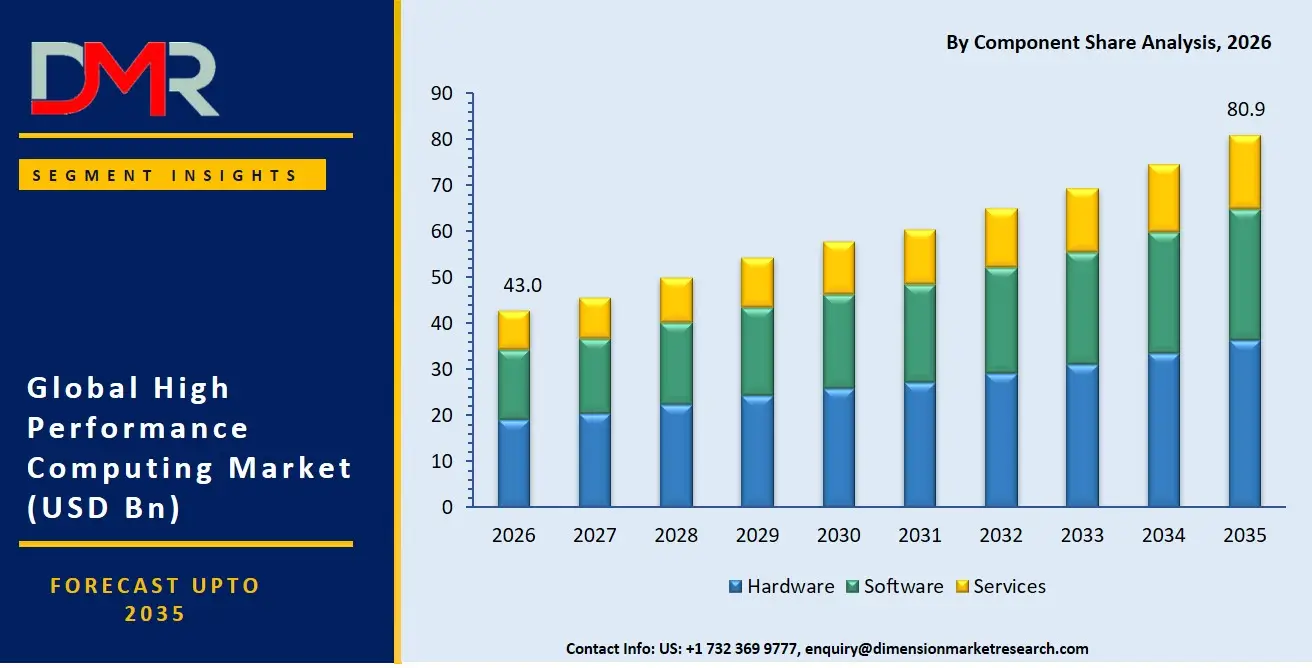
Hardware is projected to dominate the global high-performance computing market as HPC ecosystems need powerful hardware to support their requirements like high computing capabilities, extremely fast network connections, and large amounts of storage capacity. Servers, and accelerator hardware like GPUs and coprocessors, make up a substantial portion of the investment in the sector due to the focus on faster processing, training of AI models, and simulation of scientific models. Government labs, research organizations, and hyperscale clouds are making heavy investments in advanced HPC hardware solutions. Increasing adoption of exascale computing, machine learning applications, and engineering simulations is contributing further to hardware demand.
By Computation Type Analysis
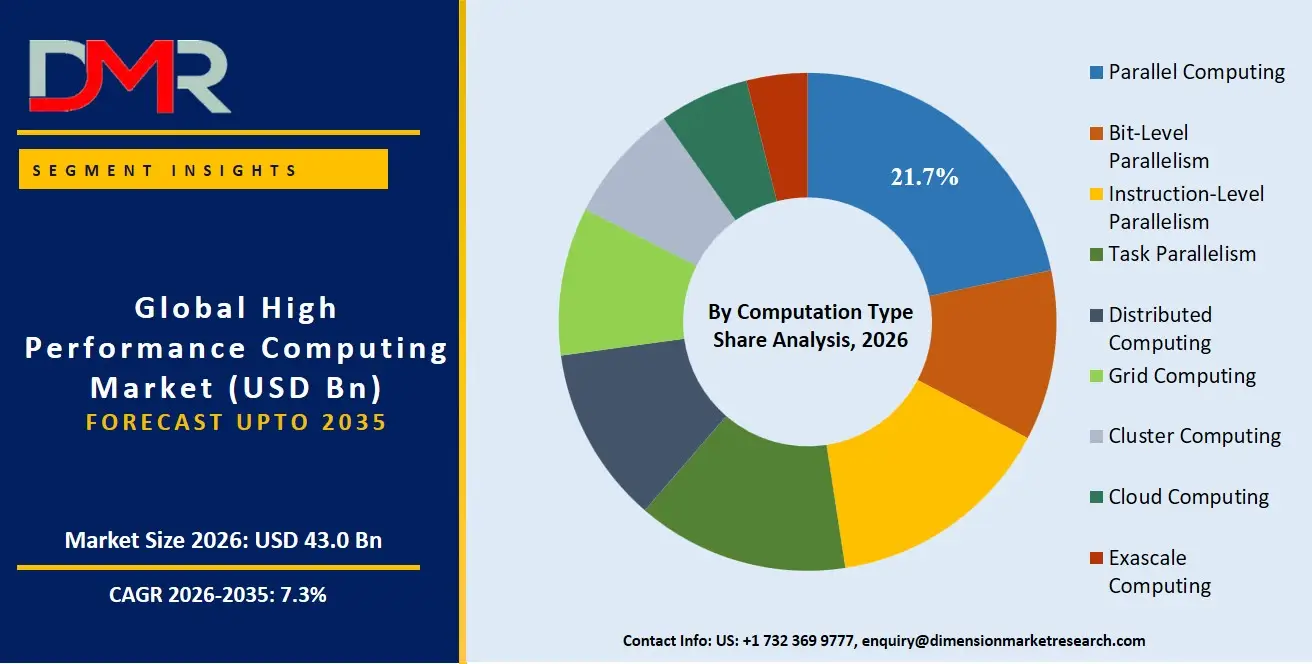
Parallel computing is expected to lead the computation type category owing to its capability of performing multiple computations at once, thus cutting down computational time drastically. Sectors like aerospace, health care, weather forecasting, and finance depend greatly on parallel computing in order to increase efficiency and accuracy in their operations. Parallel computing is key in enabling AI learning processes, big data analysis, and other scientific computing applications that require fast computing speed. More enterprises have been embracing multicore processing and GPU architecture to enable parallel computing. Moreover, the increasing need for large-scale simulations and analytics in different sectors is driving up the adoption of parallel computing systems.
By Deployment Analysis
On-premises deployment is poised to be predominant in the high performance computing industry due to the fact that there is need for utmost security, infrastructure control, and optimal performance levels among other reasons. Governmental entities, defense establishments, financial institutions, and research centers are more interested in on-premises HPC solutions to ensure security and adhere to regulatory requirements. On-premises solutions provide tailored architectures suited to complex workloads including scientific simulations, genomics, and engineering calculations. The large corporations find it beneficial to use on-premises HPC solutions since they can guarantee performance and access to computing power.
By Organization Size Analysis
Large enterprises is expected to occupy a leading place in the market of high-performance computing owing to their financial strength and large scale of computing needs. The sectors like aerospace, automotive, pharmaceuticals, banking, and energy industries need HPC systems to process data for AI training, forecasting, and simulations. Big corporations have the know-how and money required to buy supercomputers, high-speed storage solutions, and fast networking equipment. Furthermore, big corporations always focus on digital transformation and innovations that rely greatly on HPC. Moreover, an increase in the use of cloud-based HPC systems and enterprise analytics systems will reinforce the leading role of big companies in the global market.
By Server Price Band Analysis
The USD 250,000–500,000 and above server price band dominates the market since advanced HPC computers are vital for running very complicated computations. Research establishments, defense departments, meteorological bodies, and large-scale data centers have significant investment interests in advanced HPC computing systems that can provide outstanding processing speed and scalability. Some of the applications for which these HPC computers are used include exascale computing, artificial intelligence model training, seismic modeling, and molecular modeling. Expensive HPC computers are equipped with powerful GPUs, processors, and interconnects that increase their efficiency. Additionally, rising investment in science and supercomputers increases demand for premium servers.
By Application Analysis
AI and machine learning are projected to be the dominant applications in the market as HPC platforms play an important role in training AI models as well as analyzing huge amounts of data at high speeds. Companies in industries such as healthcare, automotive, finance, and manufacturing depend more on AI and its capabilities to enhance their performance and innovation process. High performance computing platforms fitted with GPUs and accelerators are capable of executing deep learning algorithms and analyzing data in real time. Increased use of generative AI, autonomous technology, and intelligent cybersecurity systems also contributes to the growth of this application area.
By Vertical Analysis
Government and defense are expected to dominate the vertical segment because of large investments in areas of national security, scientific studies, and military technology. Defense departments utilize high performance computing in the areas of cryptography, intelligence operations, missile simulations, cyber security, and war scenarios modeling. Governments around the world also make investments in supercomputing facilities for weather predictions, nuclear studies, and space exploration programs. The demand for secure and dependable computing resources leads to increased purchases of high performance computing facilities by governmental agencies. Moreover, increasing geopolitical conflicts and technological sovereignty push governments to invest in high performance computing solutions.
The Global High Performance Computing Market Report is segmented on the basis of the following:
By Component
- Hardware
- Servers
- Storage Systems
- Networking Devices
- Accelerators & Coprocessors
- Software
- Cluster Management Software
- Resource & Workload Management
- Analytics & Visualization Software
- Parallel Computing Software
- Security Software
- Services
- Consulting Services
- Integration & Deployment
- Support & Maintenance
- Managed Services
By Computation Type
- Parallel Computing
- Bit-Level Parallelism
- Instruction-Level Parallelism
- Task Parallelism
- Distributed Computing
- Grid Computing
- Cluster Computing
- Cloud Computing
- Exascale Computing
By Deployment
- Cloud-Premises
- On-Premises
By Organization Size
- Small & Medium-Sized Enterprises (SMEs)
- Large Enterprises
By Server Price Band
- USD 250,000–500,000 and Above
- USD 250,000–100,000 and Below
By Application
- Artificial Intelligence & Machine Learning
- Modeling & Simulation
- Data Analytics
- Scientific Research
- Risk Modeling
- Weather Forecasting
- Seismic Processing
- Genomics & Life Sciences
- Rendering & Visualization
- Cybersecurity
By Vertical
- Government & Defense
- Banking, Financial Services & Insurance (BFSI)
- Education & Research
- Manufacturing
- Media & Entertainment
- Healthcare & Life Sciences
- Energy & Utilities
- Earth Sciences
- Others
Regional Analysis
Leading Region by Market Share
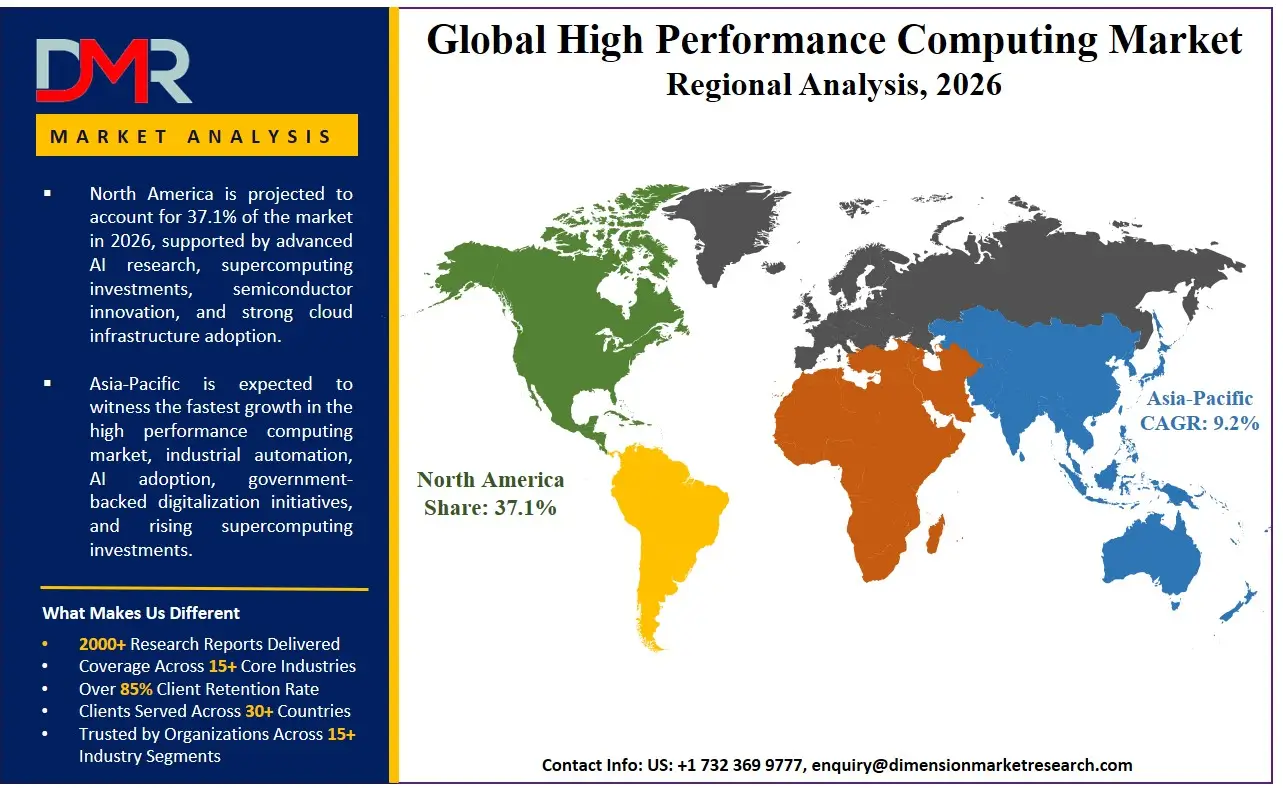
North America is poised to dominate the global high performance computing market as it is projected to hold 37.1% of the market share by the end of 2026. The United States, which dominates North America leads the HPC market owing to its unmatched density of hyperscale cloud service providers, national laboratories, and research and development activities by Fortune 500 companies. North America is well endowed with a mature ecosystem comprising global system integrators, specialized HPC consultancies, and highly skilled parallel computing architects and engineers. Artificial intelligence, modeling and simulation, and legacy software retirements fuel the need for Accelerators & Coprocessors and Integration & Deployment services. Additionally, a positive venture capital environment continuously funds emerging AI startups that require HPC expertise for fast computations and data security compliance.
ℹ
To learn more about this report –
Download Your Free Sample Report Here
Fastest-Growing Regional Market
The Asia-Pacific region will be one of the fastest-growing markets for HPC, powered by government-led initiatives for sweeping digital transformation and technology sovereignty in India, China, Japan, and Southeast Asia. With rapid economic growth, development in the digital economy, and an emphasis on research supremacy, established conglomerates and government entities have no choice but to embrace exascale computing capabilities. In that regard, consulting services will be highly sought after to assist these organizations in planning for exascale computing and adopting GPU computing architecture. At the same time, there is a dire shortage of HPC experts in the region, necessitating the outsourcing of professional services in integration & deployment and managed services.
By Region
North America
Europe
- Germany
- The U.K.
- France
- Italy
- Russia
- Spain
- Benelux
- Nordic
- Rest of Europe
Asia-Pacific
- China
- Japan
- South Korea
- India
- ANZ
- ASEAN
- Rest of Asia-Pacific
Latin America
- Brazil
- Mexico
- Argentina
- Colombia
- Rest of Latin America
Middle East & Africa
- Saudi Arabia
- UAE
- South Africa
- Israel
- Egypt
- Rest of MEA
Competitive Landscape
The dynamics of the competition in the international HPC market have increased tremendously, with an increasing presence of multiple multinational server manufacturers, as well as dedicated service departments within the major hyperscalers, along with smaller HPC software suppliers. The most effective strategy here would involve building extensive strategic partnerships with hardware suppliers such as NVIDIA, Intel, and AMD, who would then provide opportunities for co-engineering and access to advanced accelerator technology. The trend of market consolidation is moving at a tremendous pace, with traditional IT infrastructures acquiring specialized Parallel Computing Software and Cluster Management Software boutiques in order to remain competitive. Competitive advantage based on proprietary IP has become increasingly more significant than simply offering superior hardware or standard project management practices.
Some of the prominent players in the Global High Performance Computing Market are:
- IBM
- Hewlett Packard Enterprise (HPE)
- Dell Technologies
- Lenovo
- NVIDIA
- Intel Corporation
- Advanced Micro Devices (AMD)
- Atos
- Fujitsu
- Oracle Corporation
- Microsoft
- Amazon Web Services (AWS)
- Google Cloud
- Cray Inc.
- Sugon
- NEC Corporation
- Super Micro Computer (Supermicro)
- Cisco Systems
- Inspur Group
- Penguin Solutions
- Other Key Players
Recent Developments
- January 2026: AWS announced that it would launch a significant expansion of its professional services program geared towards High Performance Computing (HPC), to help its BFSI and Manufacturing customers create customized AI models using parallel computing on its cloud platform, with proficiency in implementing GPU-based Accelerators & Coprocessors.
- November 2025: IBM enhanced its partnership with one of the most prominent cloud players and launched a particular service offering named Risk Modeling & Simulation and Integration & Deployment designed to help BFSI customers migrate their sophisticated risk analytics workload into the cloud while complying with global financial regulations.
- October 2025: HPE acquired a European HPC software company to bolster its Consulting Services and Cluster Management Software offerings to cater to the complex data residency demands of its Government & Defense customers.
Report Details
| Report Characteristics |
| Market Size (2026) |
USD 43.0 Bn |
| Forecast Value (2035) |
USD 80.9 Bn |
| CAGR (2026–2035) |
7.3% |
| The US Market Size (2026) |
USD 13.4 Bn |
| Historical Data |
2021 – 2025 |
| Forecast Data |
2027 – 2035 |
| Base Year |
2025 |
| Estimate Year |
2026 |
| Segments Covered |
By Component, By Computation Type, By Deployment, By Organization Size, By Server Price Band, By Application, and By Vertical |
| Regional Coverage |
North America – The US and Canada; Europe – Germany, The UK, France, Russia, Spain, Italy, Benelux, Nordic, & Rest of Europe; Asia-Pacific – China, Japan, South Korea, India, ANZ, ASEAN, Rest of APAC; Latin America – Brazil, Mexico, Argentina, Colombia, Rest of Latin America; Middle East & Africa – Saudi Arabia, UAE, South Africa, Turkey, Egypt, Israel, & Rest of MEA |
Frequently Asked Questions
How big is the Global High Performance Computing Market?
▾ The Global High Performance Computing market is poised to be valued at USD 43.0 billion in 2026 and is projected to reach USD 80.9 billion by 2035, driven by the universal need for specialized computing power in AI, modeling & simulation, and scientific research.
What is the CAGR of the Global High Performance Computing Market from 2026 to 2035?
▾ The market is expected to grow at a CAGR of 7.3% from 2026 to 2035, reflecting the accelerating complexity of computational problems and the persistent evolution of hardware accelerators and parallel computing software.
What factors are driving the growth of the Global High Performance Computing Market?
▾ Key drivers include the global HPC skills gap, the imperative to modernize legacy scientific codebases for modern accelerators, the management complexity of heterogeneous architectures, and the surge in demand for AI-driven compute capabilities across all verticals.
Which region held the largest share of the High Performance Computing Market in 2026?
▾ North America, specifically the United States, is poised to hold 37.1% of the market share in 2026, driven by a mature ecosystem of hyperscalers, national labs, and aggressive enterprise investment in AI and modeling & simulation-driven HPC capabilities.
Which region is expected to grow the fastest in the High Performance Computing Market?
▾ The Asia-Pacific region is expected to grow the fastest, fueled by rapid digital transformation and technology sovereignty initiatives in China, Japan, and India, where building national exascale computing capabilities is a strategic priority.
What are the major trends in the Global High Performance Computing Market?
▾ Major trends include the integration of Generative AI into scientific workflows, the rise of sustainable and energy-efficient computing design, the shift to cloud-based HPC for peak demand, and the focus on application-specific solutions in genomics, weather forecasting, and seismic processing.
Who are the key players in the Global High Performance Computing Market?
▾ Key players include server and component manufacturers like HPE, Dell, NVIDIA, and Intel, as well as the HPC divisions of hyperscalers like AWS, Microsoft, and Google Cloud, alongside specialized pure-play HPC software and storage providers like Altair and DDN.
How is the Global High Performance Computing Market segmented?
▾ The market is segmented by Component, Computation Type, Deployment, Organization Size, Server Price Band, Application, and Vertical.