Market Snapshot
- The Global Home-Use Robotic Lower-Body Exoskeleton Market was valued at USD 0.48 Billion in 2025 and is projected to reach USD 2.58 Billion by 2035, at a CAGR of 18.3%.
- Battery-Powered Exoskeleton led the By Product Type segment with a 54.0% share in 2025.
- Lower-Limb Paralysis Support led the By Application segment with a 46.0% share in 2025.
- North America dominated the regional landscape with a 40.7% share in 2025, valued at approximately USD 0.20 Billion.
Market Overview
The home-use robotic lower-body exoskeleton market covers powered wearable devices designed for independent or minimally supervised ambulation outside clinical settings. Products in scope include FDA-cleared personal exoskeletons for spinal cord injury and stroke recovery, battery-operated gait-assist frames, and smart wearable interfaces for lower-limb support. The market excludes industrial exoskeletons for occupational fatigue reduction, upper-body rehabilitation systems, and clinic-only robotic gait trainers requiring fixed infrastructure.
Home-use exoskeletons sit at the intersection of advanced robotics, neurorehabilitation, and personal medical devices. Buyers are primarily individuals with spinal cord injuries, post-stroke mobility deficits, or progressive neuromuscular conditions seeking functional independence between clinical visits. As reported by PMC and cited in 2025 payer policy documents, ReWalk home users engaged with their devices a median of 9 days out of a 16-day available period, at roughly 3 sessions per week. That pattern confirms sustained, recurring use rather than occasional trial, which distinguishes this segment from durable medical equipment categories with low post-purchase engagement.
AI-assisted gait control and embedded sensor arrays now shift exoskeleton design from passive mechanical support toward adaptive systems that learn individual gait patterns. Vendors embedding machine learning into motion planning reduce the clinical training burden that historically blocked home deployment. The connection to broader digital health infrastructure, including remote monitoring platforms and tele-supervised therapy tools, is pulling home exoskeletons into managed care pathways rather than limiting them to one-time assistive device purchases.
Market Size and Forecast
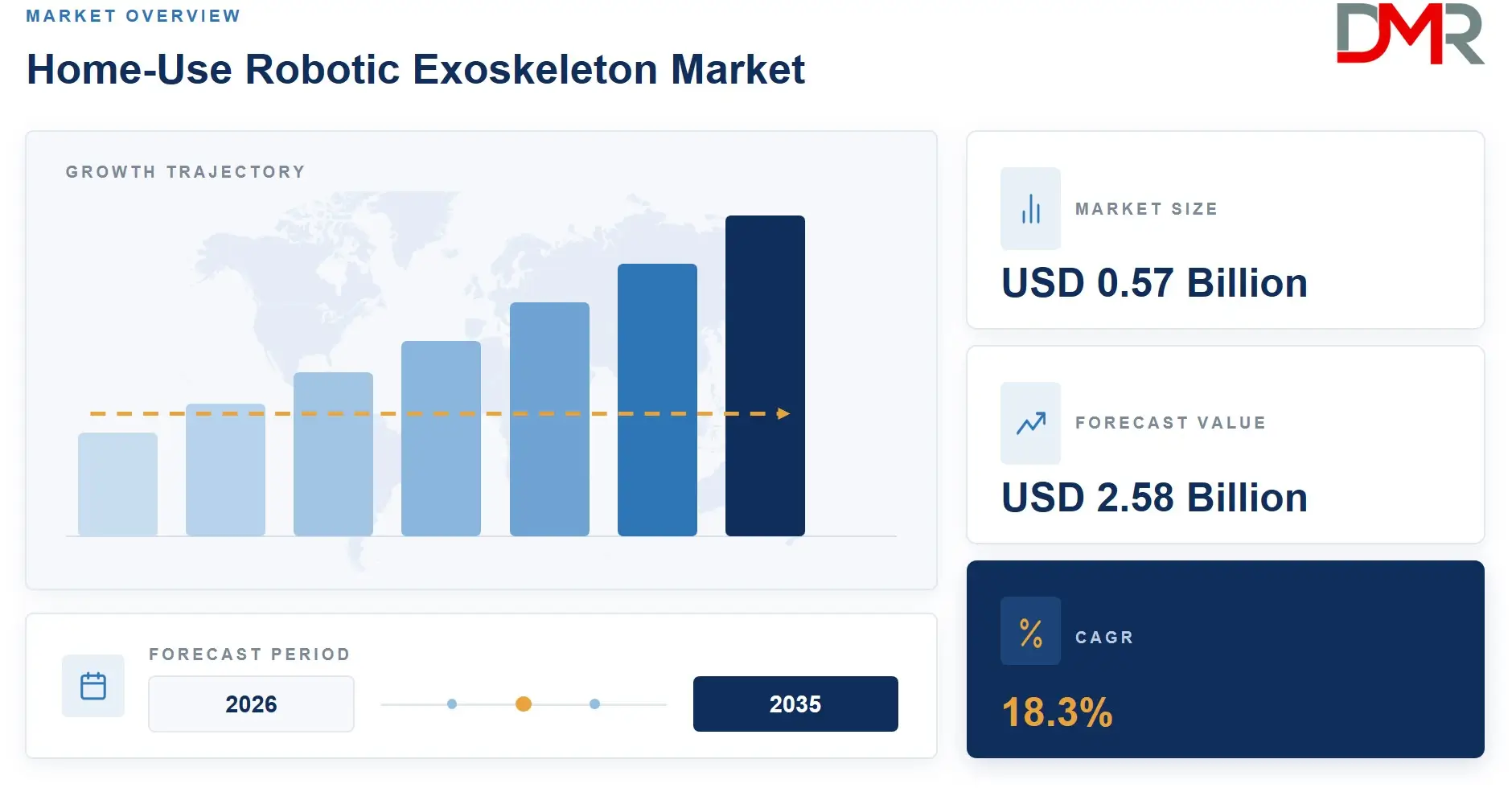
The Global Home-Use Robotic Lower-Body Exoskeleton Market size is estimated at USD 0.57 Billion in 2026 from USD 0.48 Billion in 2025, and is projected to reach USD 2.58 Billion by 2035, exhibiting a CAGR of 18.3% during the forecast period.
Growth from 2020 to 2024 tracked closely with FDA regulatory milestones and the expansion of Medicare brace-category recognition for personal exoskeletons. Each new clearance reduced insurer uncertainty and opened sequential purchasing decisions. The 18.3% CAGR through the forecast period assumes continued reimbursement expansion, declining per-unit manufacturing costs as volumes scale, and sustained clinical evidence output validating home-use safety profiles. In November 2025, Wandercraft's Atalante X received expanded FDA clearance covering multiple sclerosis rehabilitation and broader spinal cord injury cohorts, signaling regulators' willingness to extend cleared indications beyond the narrow SCI base that anchored early market entry.
ℹ
To learn more about this report –
Download Your Free Sample Report Here
Forecast assumptions carry asymmetric risk on the downside. Reimbursement policy reversals or payer-specific coverage exclusions could suppress household adoption faster than any technology barrier. Upside depends on whether outcome-based contracting between device makers and health systems gains traction before 2028, which would fundamentally reframe these devices as cost-saving interventions rather than high-ticket durable medical equipment purchases.
Product Type Analysis
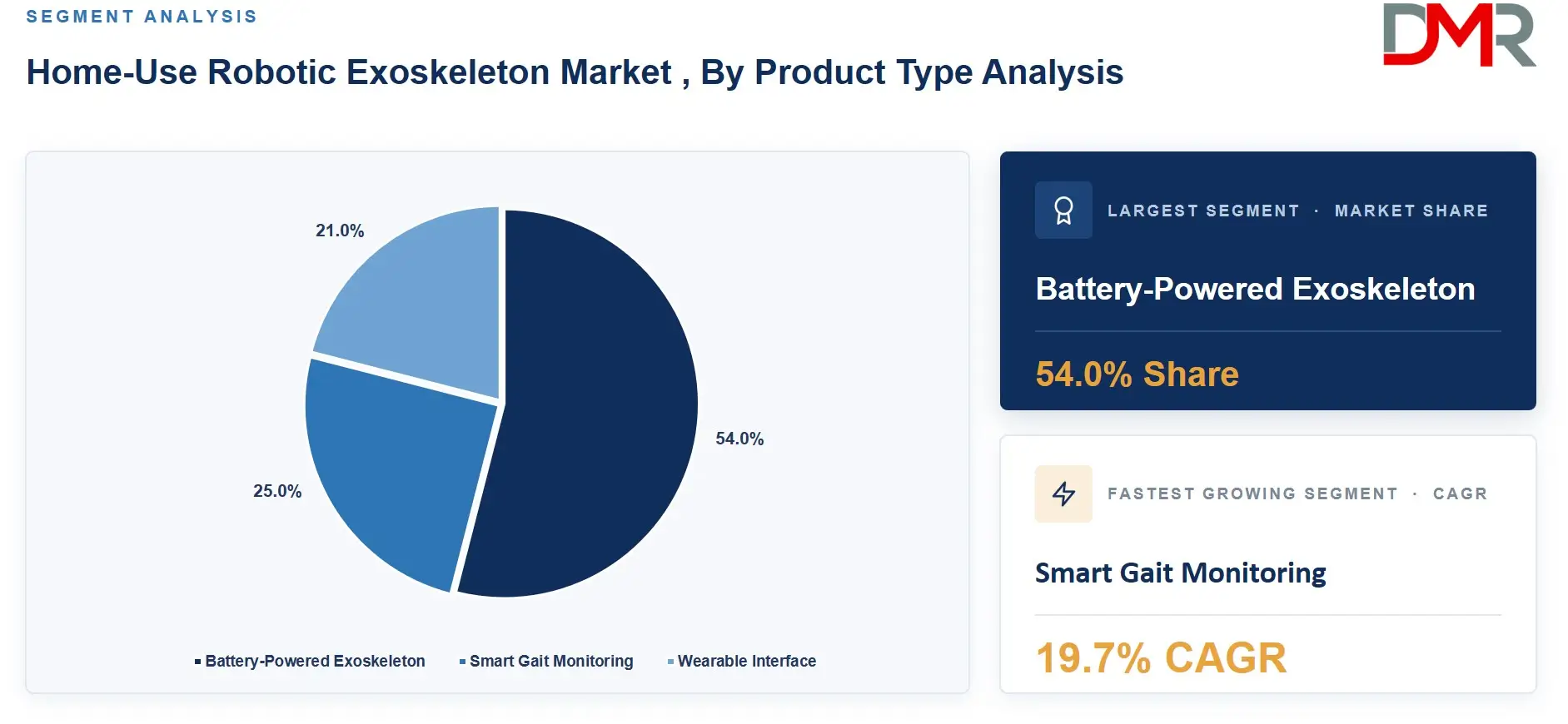
Battery-Powered Exoskeleton led the Product Type segment with a 54.0% share in 2026.
Battery-powered systems captured majority share because they address the core requirement of home use: untethered, independent ambulation across variable indoor environments. Buyers with spinal cord injuries or post-stroke deficits need devices that operate without a wall outlet or clinical power source. Vendors achieving longer charge cycles and lighter battery packs directly expand the addressable time window per daily session, which payer criteria increasingly link to coverage eligibility.
ℹ
To learn more about this report –
Download Your Free Sample Report Here
Smart Gait Monitoring held a 25.0% share and represents the fastest-shifting category within the segment. Embedding real-time gait analytics into the device itself eliminates the need for a separate monitoring system, which lowers the total cost of a supervised home program. Wearable Interface products accounted for the remaining 21.0%, appealing to users seeking lighter-weight partial-assist options. Vendors serving the wearable interface category face the sharpest pricing pressure as consumer electronics form factors migrate toward medical applications, compressing margins for dedicated medical device makers.
Application Analysis
With a 46.0% share in 2026, Lower-Limb Paralysis Support outpaced all other Application categories.
Lower-Limb Paralysis Support dominates because spinal cord injury patients represent the clearest clinical and regulatory case for powered home ambulation. FDA special controls and Medicare brace-category precedents were built around this population, making reimbursement navigation more predictable for buyers and prescribers. As per ABLE's 2024 clinical investigation, at least 50% of home-use exoskeleton users completed 4 out of 6 basic home skills with supervision or less, and the median Home-Skills-Test time reached 7 minutes 45 seconds, confirming that functional independence benchmarks are achievable within realistic home environments for this population.
Wheelchair User Mobility held a 30.0% share, reflecting demand from users seeking periodic standing and ambulation rather than full replacement of wheelchair mobility. Home Rehabilitation accounted for 24.0% and is the category most sensitive to health system discharge patterns. As hospital stays shorten and payers push recovery into home settings, post-acute rehabilitation demand will pull this segment's share upward. Vendors positioned across both wheelchair user and home rehabilitation applications reduce their exposure to any single reimbursement decision.
Key Market Segments
By Product Type
- Battery-Powered Exoskeleton
- Smart Gait Monitoring
- Wearable Interface
By Application
- Lower-Limb Paralysis Support
- Wheelchair User Mobility
- Home Rehabilitation
Regional Analysis
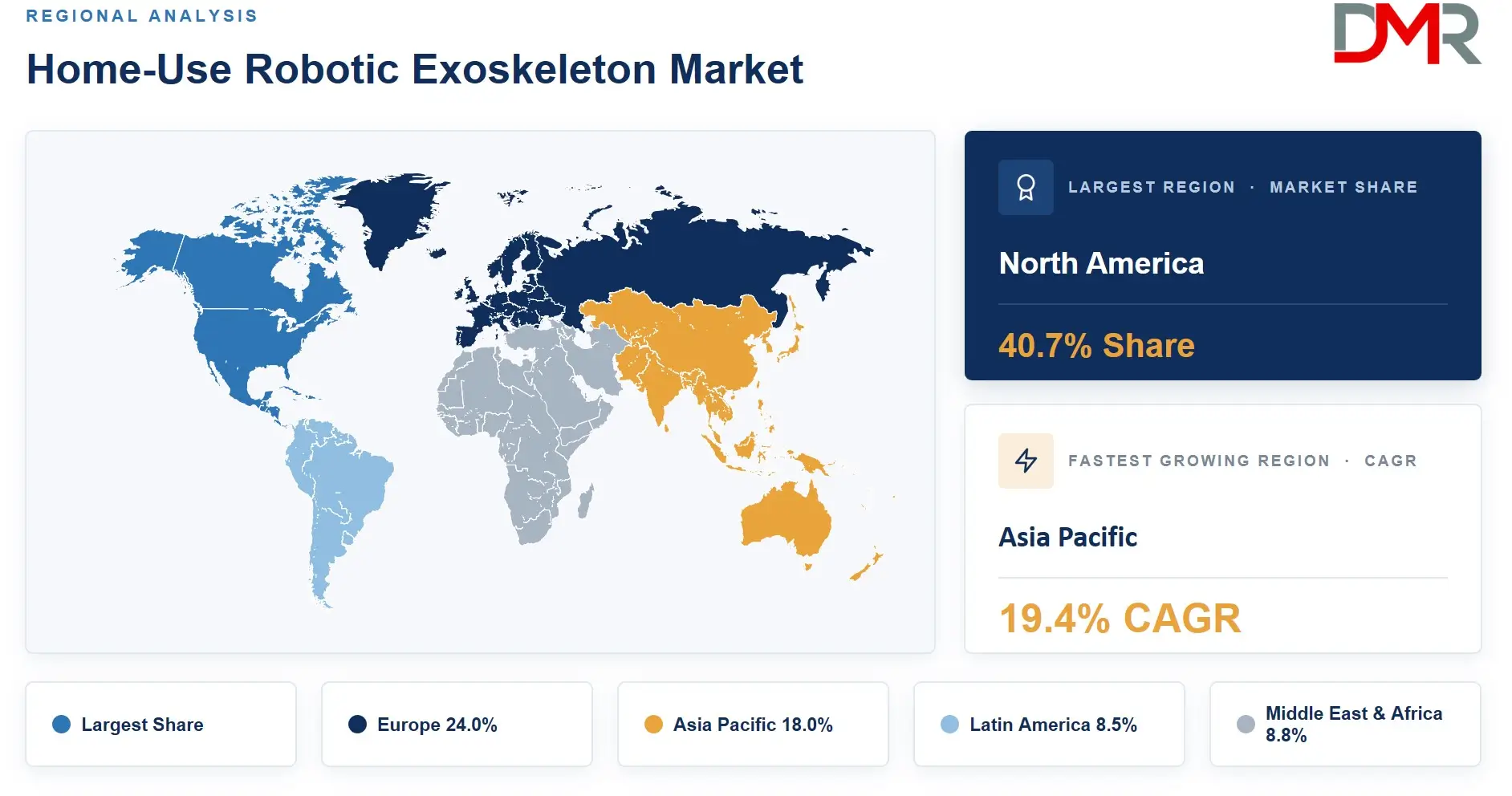
North America accounted for 40.7% of the Home-Use Robotic Lower-Body Exoskeleton Market in 2026, valued at approximately USD 0.20 Billion.
North America leads because the U.S. regulatory and reimbursement environment has moved faster than any other region in recognizing powered personal exoskeletons as covered medical devices. FDA Class II designation under special controls gave manufacturers a defined validation pathway. Medicare's brace-category classification created the first payer precedent, giving private insurers a framework to follow. Taken together, these structural advantages compressed the commercial adoption timeline that other regions are still working to replicate.
Europe held a 24.0% share and is accelerating as CE Mark approvals accumulate and national health systems begin incorporating exoskeleton pathways into post-stroke and neurological rehabilitation protocols. Asia Pacific's 18.0% share understates its trajectory: Japan's aging population and South Korea's advanced robotics manufacturing base position both markets for above-average growth through 2030. Latin America at 8.5% and Middle East & Africa at 8.8% remain nascent, but direct-to-consumer distribution models are reducing the clinic-access barrier that previously excluded both regions from meaningful adoption.
ℹ
To learn more about this report –
Download Your Free Sample Report Here
Key Regions and Countries
North America
Europe
- Germany
- France
- The UK
- Spain
- Italy
- Rest of Europe
Asia Pacific
- China
- Japan
- South Korea
- India
- Australia
- Rest of APAC
Latin America
- Brazil
- Mexico
- Rest of Latin America
Middle East & Africa
- GCC
- South Africa
- Rest of MEA
Market Dynamics
Regulatory Clarity and Payer Recognition Accelerate Home Deployment
FDA Class II designation for powered exoskeletons gave manufacturers a defined special-controls framework, removing the regulatory ambiguity that previously forced home-use devices through the more expensive and time-consuming PMA pathway. Vendors now enter clinical validation knowing the evidentiary bar in advance, which compresses development timelines and reduces capital exposure before market entry. In September 2025, Lifeward secured CE Mark approval for the ReWalk 7 Personal Exoskeleton, extending that regulatory confidence across European commercial channels.
Medicare's recognition of personal exoskeletons as brace-category devices created a reimbursement precedent that private insurers in the U.S. are beginning to follow. Figures from ABLE's 2025 clinical study show that the ABLEhipknee's walking-standing ratio per session was at least 77.2% higher than benchmarks from earlier ABLEknee studies, providing the kind of functional outcome data that payer medical directors require before extending prior authorization. Each new clinical proof point tightens the link between device performance and coverage eligibility.
Cost Barriers Confine the Market to Affluent and Well-Insured Buyers
Powered lower-limb exoskeletons carry purchase prices that place them beyond reach for the majority of potential users without comprehensive insurance coverage. A 2024–2025 foresight report by Bax & Company found that active lower-limb exoskeletons were priced between €5,000 and €10,000 per unit, and estimated that a roughly 60% average price reduction would be required by 2030 to reach the adoption threshold needed for broad market penetration. Without that correction, the market remains structurally constrained to a narrow band of well-insured or high-income households.
Reimbursement coverage remains highly indication-specific. A buyer with incomplete SCI may qualify under existing codes; a buyer with a less-documented mobility impairment may not. Vendors cannot price to volume while coverage decisions remain fragmented across payers, states, and countries. Stringent post-market surveillance obligations compound the issue by adding recurring compliance costs that inflate effective device pricing beyond the sticker value.
Outcome-Based Contracting Opens Pathways Into Managed Care
Bundling home exoskeletons into neurorehabilitation pathways tied to measurable outcomes, including fall reduction rates and hospital readmission avoidance, reframes the device from a capital purchase into a cost-saving clinical tool. Health systems operating under value-based care contracts have financial incentives to adopt this model. In 2025, prior authorization pathways for the ReWalk 7 Personal Exoskeleton expanded reimbursement for home-based use in the U.S., demonstrating that outcome-aligned coverage structures are executable within current payer frameworks rather than theoretical future states.
Passive exoskeletons in occupational settings are currently priced between €900 and €4,600 per unit, as reported by Bax & Company. That cost range, still 60% above the estimated 2030 buy-in barrier, confirms that volume-driven price compression has not yet reached the level required for mass adoption in either occupational or home markets. Vendors who secure outcome-based contracts insulate themselves from price-ceiling pressure by shifting the commercial conversation from unit cost to cost-per-outcome.
Market Trends
Home Ambulation Models Replace Clinic-Confined Deployment
FDA-cleared personal exoskeleton systems now support both supervised clinical sessions and unsupervised home ambulation, ending the assumption that robotic gait assistance requires a clinician in the room. ABLE's 2024 clinical data showed that donning and doffing averaged 10 minutes 23 seconds, with 80% of participants needing only minimal assistance or less, confirming that setup complexity no longer represents a practical barrier to daily independent use. Early movers embedding AI-driven gait analytics and remote monitoring into their platforms will capture the tele-supervised therapy segment before competitors standardize around those features.
Market Competition Overview
The home-use robotic lower-body exoskeleton market remains moderately fragmented, with a small number of FDA-cleared device makers holding disproportionate commercial influence. Clearance-backed products command pricing power that pre-clearance competitors cannot match, creating a structural moat around the handful of companies with approved home-use indications. Vendors with Class II approvals in both the U.S. and Europe hold dual-market access that smaller, single-jurisdiction players cannot replicate without significant regulatory investment.
Consolidation pressure is visible at the mid-market tier, where companies carrying high development and compliance costs but limited reimbursement coverage struggle to sustain independent operations. Share gain is flowing toward vendors that combine clinical validation breadth with active payer engagement. Companies that wait for broad reimbursement before scaling commercial operations risk ceding channel relationships to first movers who built prescriber and insurer networks during the coverage-expansion phase.
Company Profiles
ABLE Human Motion competes on clinical evidence density rather than brand recognition. ABLE's 2025 pilot study showed that users of the ABLEhipknee achieved at least 3 times more steps and covered 7 times more walking distance per training session compared with the earlier ABLEknee model, a performance delta that directly supports payer arguments for superior functional outcomes. Concentrating clinical output on measurable gait throughput metrics positions ABLE favorably in markets where coverage decisions hinge on published outcome data rather than device features alone.
Ekso Bionics carries both institutional rehabilitation and personal mobility device experience, giving it a broader addressable base than single-indication competitors. However, restructuring activity in early 2025 signals that balancing R&D investment across multiple product lines while managing regulatory overhead has strained operational efficiency. Vendors navigating consolidation pressure must resolve the tension between maintaining existing clinical product lines and funding next-generation home-use platform development before the reimbursement window fully opens.
Key Players
- ABLE
- Ekso Bionics
- ReWalk Robotics
- Bionik Laboratories
- CYBERDYNE
- Parker Hannifin
- Ottobock
Supply Chain and Value Chain Analysis
Component sourcing for home-use robotic lower-body exoskeletons draws from three specialized upstream tiers: precision actuators and servo motors, lightweight structural materials including carbon fiber and high-strength polymers, and embedded sensor and computing modules. Maximum value creation concentrates at the software and AI integration layer, where proprietary gait algorithms differentiate products that share similar hardware architectures. The most acute supply risk sits at the actuator tier, where a small number of precision motor suppliers serve both medical device and industrial robotics markets, creating substitution constraints during demand surges.
Downstream, the value chain runs through prescribing clinicians, durable medical equipment distributors, and direct-to-consumer channels in markets with limited clinic access. Distribution through DME suppliers adds cost and reduces vendor control over end-user onboarding quality. Vendors investing in direct distribution and remote setup support capture a larger share of the value chain while improving clinical outcomes data collection, a strategic advantage that compounds over time as reimbursement decisions increasingly depend on real-world evidence.
Regulatory Landscape
In the United States, powered lower-limb exoskeletons for personal home use are classified as Class II medical devices under FDA special controls. Manufacturers must satisfy performance testing, labeling, and post-market surveillance requirements before receiving 510(k) clearance for home indications. The special-controls framework reduces regulatory uncertainty relative to the PMA pathway, but post-market obligations, including mandatory adverse event reporting and user training documentation, sustain compliance costs across the product lifecycle.
European manufacturers operate under the EU Medical Device Regulation, which demands clinical evidence sufficient to demonstrate safety and performance for the intended home-use population. CE Mark approval unlocks access to all EU member states but requires notified-body review timelines that can extend commercial launch by 12 to 24 months beyond U.S. timelines. Japan's PMDA and South Korea's MFDS apply comparable frameworks, with Japan offering expedited review for devices targeting its priority aging-population health agenda, creating a regulatory fast lane that forward-looking vendors are beginning to use strategically.
Investment and White Space Analysis
Investment is concentrating at two points: regulatory-ready product platforms with existing FDA or CE Mark clearance, and software layers that convert device-generated gait data into payer-recognized outcome metrics. Both attract capital because they reduce the binary risk that early-stage hardware development carries. Underfunded segments include modular lower-body platforms configurable across rehabilitation, eldercare, and light daily-assist use cases, where a single R&D base can serve multiple buyer segments and reduce per-unit amortization costs.
Asia Pacific, specifically Japan and South Korea, represents the clearest geographic white space. Both markets combine aging demographics, advanced manufacturing ecosystems, and national policy support for assistive robotics, yet per-capita exoskeleton penetration remains low relative to North America. Direct-to-consumer distribution strategies in Latin America and Middle East & Africa offer entry points where institutional channels are thin and home-device adoption can bypass clinic gatekeeping entirely. First-mover channel investment in those regions now costs a fraction of what it will cost once incumbent vendors establish distribution networks.
Recent Developments
- March 2025 — Lifeward received FDA 510(k) clearance for the ReWalk 7 Personal Exoskeleton, enabling expanded home and community ambulation for individuals with spinal cord injury across U.S. markets.
- November 2025 — Wandercraft's Atalante X received expanded FDA clearance covering multiple sclerosis rehabilitation and a broader range of spinal cord injury patient groups, widening the addressable population for home-capable exoskeleton systems.
- March 2025 — Ekso Bionics continued restructuring operations, reflecting consolidation pressure across the medical exoskeleton segment as mid-tier vendors balance regulatory compliance costs against constrained reimbursement coverage
Report Details
| Report Characteristics |
| Market Value (2025) |
USD 0.48 Billion |
| Market Value (2026) |
USD 0.57 Billion |
| Forecast Revenue (2035) |
USD 2.58 Billion |
| CAGR (2026–2035) |
18.3% |
| Base Year for Estimation |
2025 |
| Historic Period |
2020 – 2024 |
| Forecast Period |
2026 – 2035 |
| Report Coverage |
Revenue Forecast, Market Dynamics, Competitive Landscape, Recent Developments |
| Segments Covered |
By Product Type (Battery-Powered Exoskeleton, Smart Gait Monitoring, Wearable Interface), By Application (Lower-Limb Paralysis Support, Wheelchair User Mobility, Home Rehabilitation) |
| Regional Analysis |
North America – US and Canada; Europe – Germany, France, The UK, Spain, Italy, and Rest of Europe; Asia Pacific – China, Japan, South Korea, India, Australia, and Rest of APAC; Latin America – Brazil, Mexico, and Rest of Latin America; Middle East & Africa – GCC, South Africa, and Rest of MEA |
| Competitive Landscape |
ABLE, Ekso Bionics, ReWalk Robotics, Bionik Laboratories, CYBERDYNE, Parker Hannifin, Ottobock, Others |
| Customization Scope |
Customization for segments and region or country level will be provided. Additional customization can be done based on requirements. |
| Purchase Options |
Three license options: Single User License, Multi-User License (Up to 5 Users), Corporate Use License (Unlimited Users and Printable PDF) |
Frequently Asked Questions
What is the biggest investment opportunity in Home-Use Robotic Exoskeleton Market ?
▾ Outcome-based contracting with insurers and health systems represents the most immediate investment opportunity. Vendors bundling home exoskeleton use into neurorehabilitation pathways tied to fall reduction and readmission metrics can unlock reimbursement structures that bypass per-unit price ceilings. Modular platforms configurable across rehabilitation, eldercare, and daily-assist applications offer the broadest return on R&D investment.
Who are the top companies in Home-Use Robotic Exoskeleton Market ?
▾ Leading companies include ABLE, Ekso Bionics, ReWalk Robotics, Bionik Laboratories, CYBERDYNE, Parker Hannifin, and Ottobock. Vendors with dual FDA and CE Mark clearance for home-use indications hold the strongest commercial positioning. ABLE and Lifeward (ReWalk) have the deepest published clinical evidence bases supporting home and community deployment.
Which segment is growing fastest in Home-Use Robotic Exoskeleton Market in Home-Use Robotic Exoskeleton Market and why?
▾ Smart Gait Monitoring is the fastest-shifting product category within the market. Embedding real-time analytics directly into devices reduces the total cost of a supervised home program and creates continuous outcome data streams that payers increasingly require for coverage authorization. That combination of cost reduction and evidence generation accelerates adoption faster than either hardware improvement or reimbursement expansion alone.
Which region is growing fastest in Home-Use Robotic Exoskeleton Market and why?
▾ Asia Pacific is the fastest-growing region, with Japan and South Korea leading. Japan's national aging-population health agenda provides expedited regulatory pathways and public procurement support for assistive robotics. South Korea's advanced manufacturing base lowers component costs for domestic producers, creating a structural cost advantage that is beginning to attract international OEM partnerships.
What is the biggest challenge holding Home-Use Robotic Exoskeleton back?
▾ High device cost combined with fragmented, indication-specific reimbursement is the primary barrier to broad market adoption. Active lower-limb exoskeletons currently priced between €5,000 and €10,000 per unit remain approximately 60% above the buy-in price threshold estimated for mass adoption by 2030. Until manufacturing scale drives costs to that level or payer coverage expands to close the affordability gap, household penetration will remain confined to well-insured and affluent buyers.