Humanoid Robot Market Size
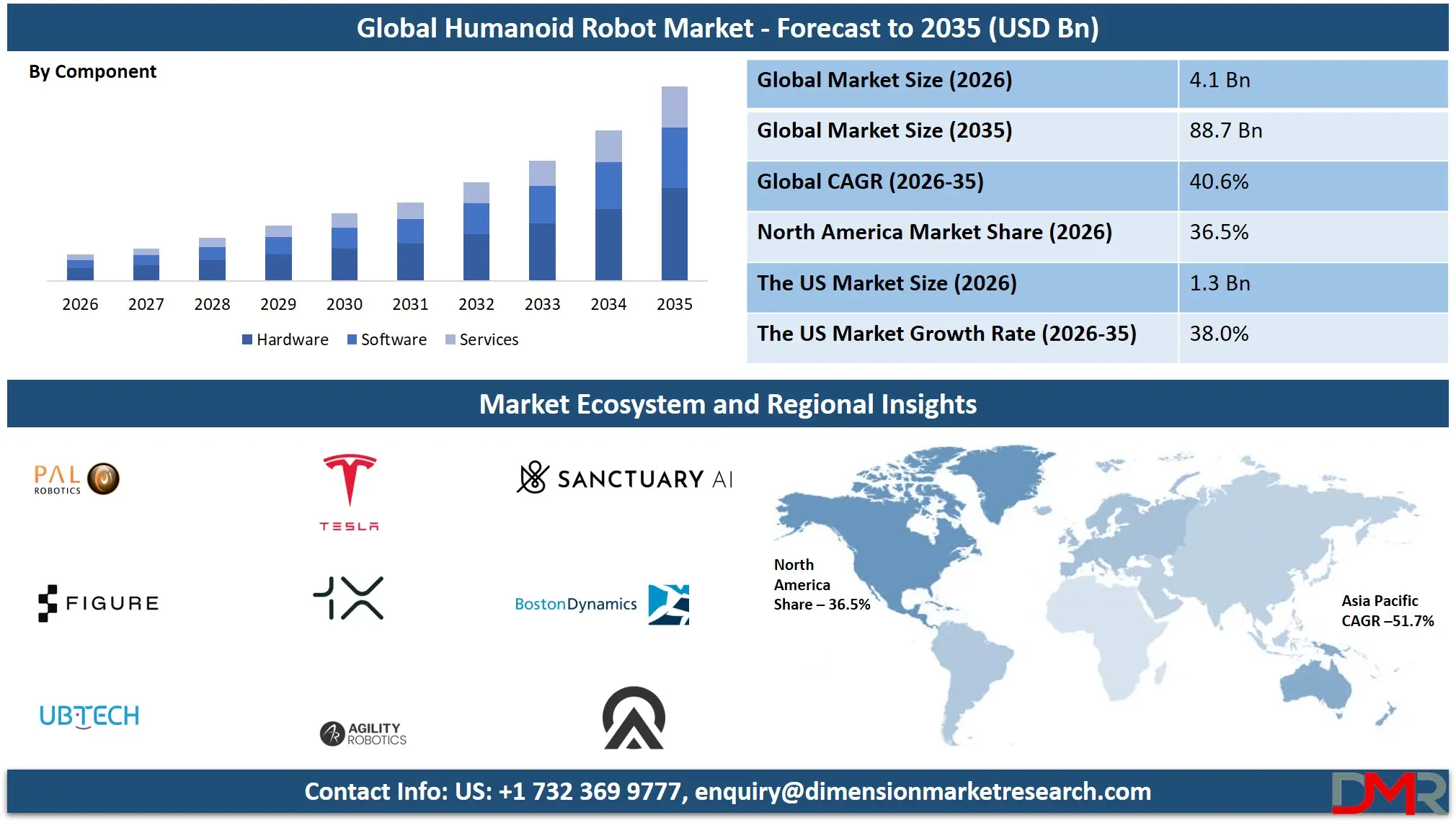
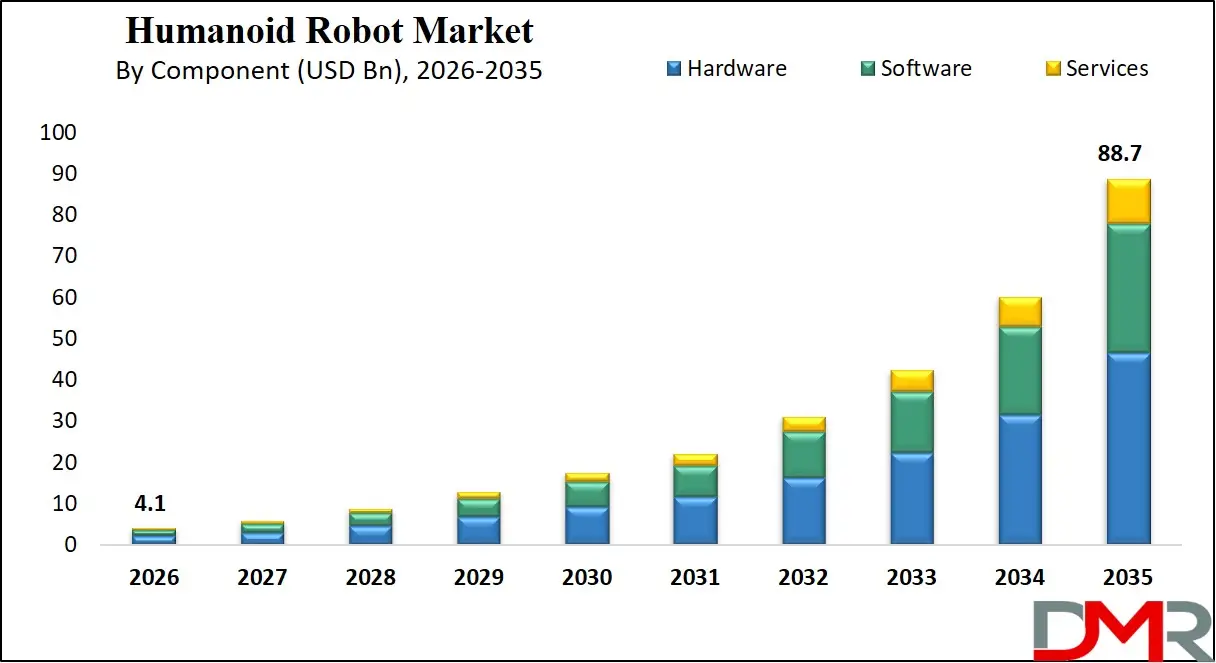
The Humanoid Robot Market size is projected to reach USD 4.1 billion in 2026 and grow at a compound annual growth rate of 40.6% to reach a value of USD 88.7 billion in 2035, driven by continuous progress in AI, machine learning, and sensor technologies is significantly enhancing humanoid robot capabilities.
ℹ
To learn more about this report –
Download Your Free Sample Report Here
Humanoid robot market can be described as the creation, manufacture and application of robots that are designed to mimic the human body and actions and incorporate state of the art hardware, artificial intelligence, and sensor technology. They are applicable across a range of industries such as manufacturing, health, logistics and customer care where robots are becoming commonplace.
The market is booming due to the rapid evolution of AI, machine learning, and robotics engineering, allowing them to provide greater mobility, perception, and communication. The adoption rate is increasing because of the rising labor shortages, the rising need of automation and increasing investment in robotics innovation. Also, such trends as robot-as-a-service models and collaborative robotics are transforming the market environment on an international level.
ℹ
To learn more about this report –
Download Your Free Sample Report Here
The US Humanoid Robot Market
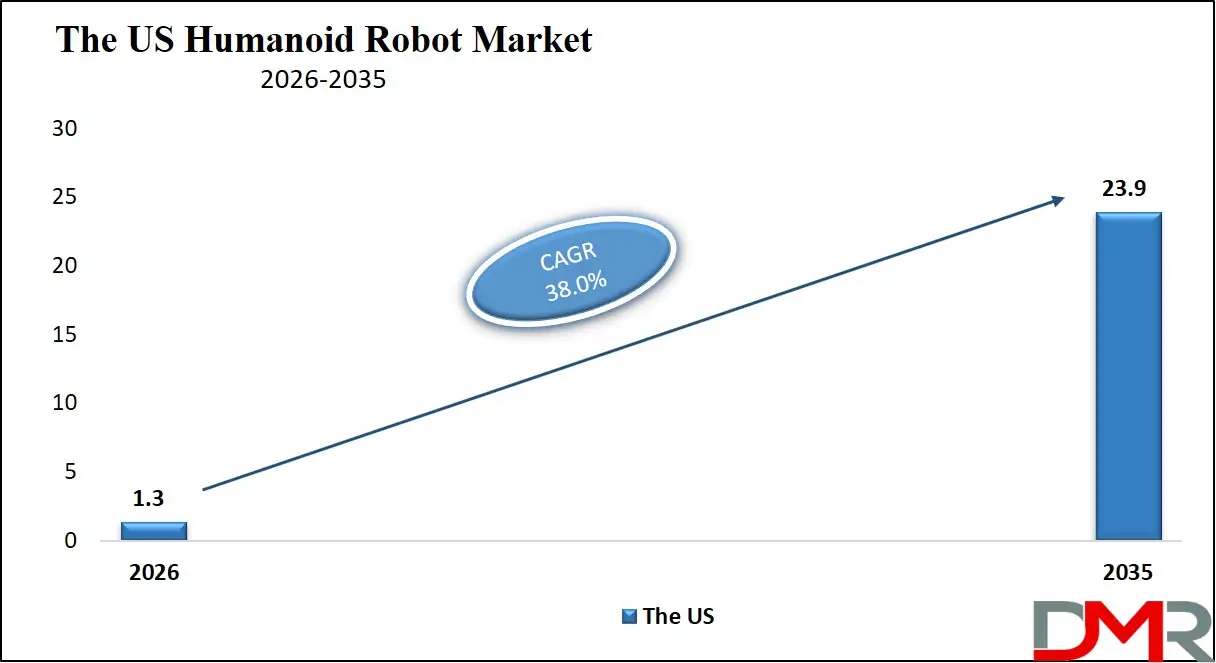
The US Humanoid Robot Market size is projected to reach USD 1.3 billion in 2026 and grow at a CAGR of 38.0% during the forecast period.
ℹ
To learn more about this report –
Download Your Free Sample Report Here
High technological innovations, investment in robotics and AI startups, and presence of a well-developed research institution characterize the humanoid robot market in the US. The military has government subsidies on automation and robotics, which also boost growth. High adoption in manufacturing, logistics, and health care sectors are beneficial to the region. Additionally, the increasing shortage of labor and automation needs are fueling the use of humanoid robots by businesses. Strategic alliances and venture capital funding are enhancing the competitiveness and regulatory frameworks are encouraging safe and scalable implementation in industries.
Europe Humanoid Robot Market
The Europe Humanoid Robot Market size is estimated to be USD 1.0 billion in 2026 and its CAGR of 37.1% over the forecast period.
Europe humanoid robot markets are marked by stringent policies, sustainability, and strong policy frameworks such as European Green Deal. The region is dedicated to ethical AI and human-centric robotics, promoting new advances in healthcare, geriatrics, service industry. The most successful nations in the use of industrial robots are Germany and France, but Nordic nations are in social robotics. Innovation is being hastened by public-private partnerships and EU-funded research programs. However, the requirement of adherence to regulations may put the implementation behind schedule compared to other regions with the introduction of automation still being in its gains.
Japan Humanoid Robot Market
Japan Humanoid Robot Market size will be USD 143.5 million in 2026 and CAGR is 37.4% in the forecast period.
Japanese are pioneers in humanoid robotics as the ageing population and a high level of culture favouring the use of robots in Japan. The nation dwells extensively on applications in the elderly support, healthcare support and the service sectors. Robotics integration and innovation is actively encouraged by government efforts and industrial policies. The accelerated technological changes are maintained with high-tech production and long-term investments in research and development. Nevertheless, issues like the cost of development and complexity of integration still exist. However, Japan is also on the frontline as far as the humanoid robot application is concerned where there is an increasing level of application in the home and export market.
Humanoid Robot Market: Key Takeaways & Influencing Factors
- Market Size & Forecast: The Humanoid Robot Market size is projected to reach USD 4.1 billion in 2026 and is anticipated to have a value of USD 88.7 billion in 2035.
- Growth Rate & Outlook: The Humanoid Robot Market size is set to grow at a compound annual growth rate of 40.6% during the forecast period of 2026 to 2035.
- Primary Growth Drivers: Some of the major growth drivers in the market include rising demand for automation and labor substitution, advancements in artificial intelligence and robotics technologies, and more.
- Key Market Trends: Some of the major trends in the market are integration of AI for enhanced human-robot interaction, shift toward collaborative and service-oriented robots, and more.
- By Offering: The hardware segment is anticipated to get the majority share of the Humanoid Robot market in 2026.
- By Motion Type: The biped segment is expected to get the largest revenue share in 2026 in the Humanoid Robot market.
- By Application: The industrial segment is expected to get the largest revenue share in 2026 in the Humanoid Robot market.
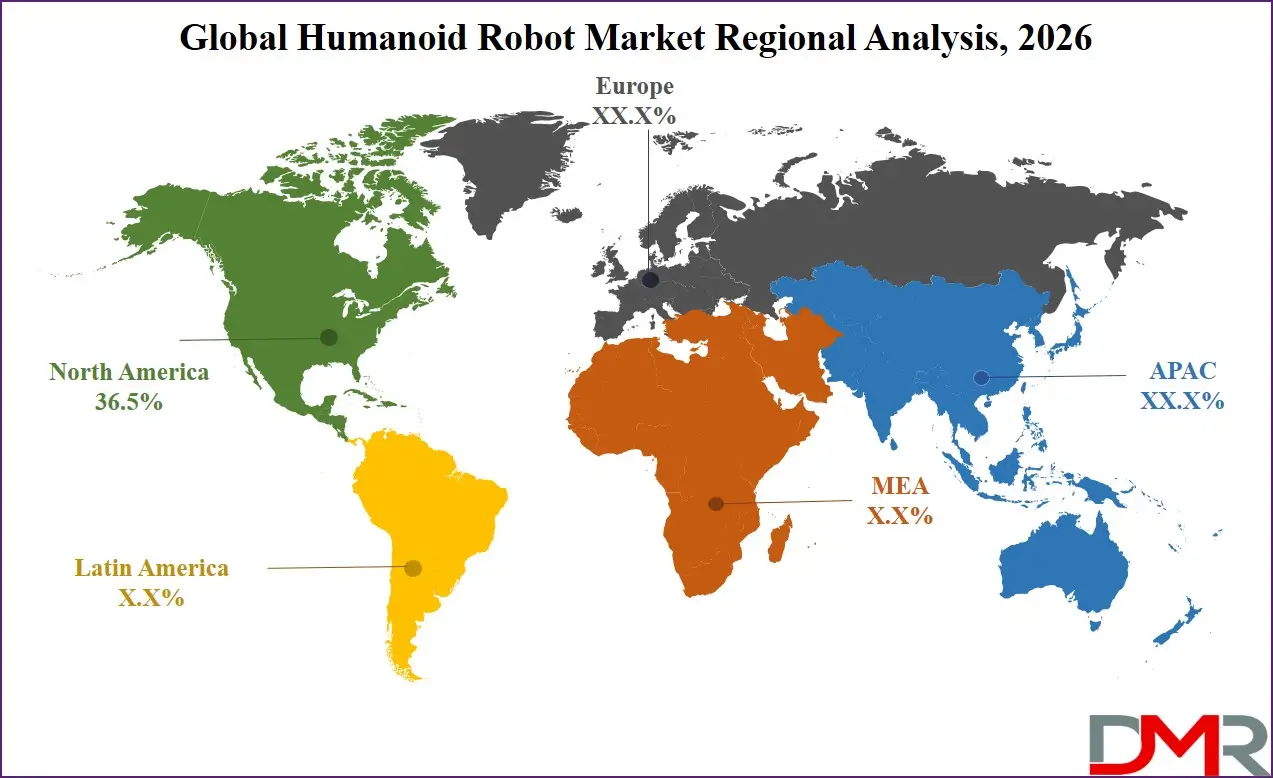
- Regional Leadership: North America is set to lead the Humanoid Robot market with an estimated 36.5% share in 2026.
What is the Humanoid Robot?
A humanoid robot is a robot that assumes the form of the human body and is capable of acting like a human being and typically has a head, torso, arms and legs and can also perform the same tasks that humans can. The technologies that come with these robots are artificial intelligence, computer vision, sensors, actuators, and motion control systems, to effectively communicate with the environments and people. The humanoid robots are significant in such industries where human dexterity, flexibility, and communication are required. The new directions are more natural language processing, emotion recognition, and autonomous decision-making that can be applied extensively to service industries, healthcare, and in team-based work in the industry.
Use Cases
- Industrial Automation: Humanoid robots assist in manufacturing tasks such as assembly, inspection, and material handling, improving efficiency and reducing human labor dependency in complex and repetitive operations.
- Healthcare & Elderly Care: These robots provide patient monitoring, rehabilitation support, and companionship, addressing workforce shortages and enhancing quality of care for aging populations.
- Logistics & Warehousing: Humanoid robots perform picking, packing, and sorting tasks, improving accuracy and speed in supply chain operations while reducing operational costs.
- Customer Service & Hospitality: Robots are used in retail stores, hotels, and reception areas to interact with customers, provide information, and enhance user experience through personalized assistance.
How AI Is Transforming the Humanoid Robot Market
Robotic Artificial Intelligence has a transformative impact on the humanoid robot market since it creates advanced perception, learning, and decision-making processes. The AI-driven robots can process large amounts of data, spot patterns and react to evolving circumstances and can immensely improve the efficiency and precision of operations.
Moreover, AI makes human-robot interaction less complicated as it enhances the natural language processing and emotional intelligence so that robots could communicate with people and provide them with individual services. This will translate into better customer experiences, increased potential of application and adoption in more industries.
Market Dynamic
Driving Factors in the Humanoid Robot Market
Rising Demand for Automation and Labor Substitution
One of the main driving forces of humanoid robots is the increasing lack of skilled labor in many industries, such as manufacturing, logistics, and healthcare. Organizations are resorting to automation in order to be productive and efficient. The capability to imitate human behavior affords humanoid robots with the flexibility in dynamic environments. Their use minimizes the use of human labor and guarantees continual production. In addition, rising wages and operational cost is forcing the companies to think of investing in robots and the humanoid robots are a bright prospective investment in the long run in scalable businesses.
Advancements in Artificial Intelligence and Robotics Technologies
The ongoing advancement in AI, machine learning, and sensor technologies is majorly increasing the abilities of humanoid robots. Realized enhanced computer vision, natural language processing and motion planning allow robots to interact with human beings and environments in a natural way. These technologies are capable of facilitating greater levels of independence and accuracy. Cloud computing and edge AI are also useful in significantly enhancing real-time decision-making. With technological developments being more affordable and accessible, humanoid robots are gaining popularity in various industries, leading to the overall growth of the market.
Restraints in the Humanoid Robot Market
High Development and Deployment Costs
Humanoid robots are mainly designed, utilize complex materials, and detailed software, which is rather expensive to manufacture and use. Small and medium enterprises may not be able to afford these costs. Also, maintenance and upgrades contribute to the overall ownership cost. It takes special infrastructure and expertise to integrate, and thus it limits its adoption, particularly in cost-sensitive markets, retarding the overall diffusion of the market.
Technical Complexity and Reliability Challenges
Despite this breakthrough, reliability, adaptability and safety challenges in the unstructured environment remain a challenge to humanoid robots. Dexterity and decision-making similar to humans are difficult to attain. Some of the issues that can impair performance are battery life, system breakdowns, and unclear background knowledge. These technical barriers create hesitation amongst the end-users, especially in the sensitive sectors of healthcare and defense, and affect the adoption rate.
Opportunities in the Humanoid Robot Market
Expansion in Healthcare and Elderly Care Applications
With the increasing ageing population in all parts of the world, humanoid robots in healthcare and caregiving stand to have a great opportunity. These robots will be in a position to assist in the day to day tasks, monitor the health condition and provide companionship. Robotic solutions are being increasingly invested by governments and healthcare providers to manage workforce shortages. The trend is said to offer tremendous growth opportunities, particularly in some regions of the developed world whereby the population is ageing.
Emergence of Robot-as-a-Service (RaaS) Models
Subscriptions models of Robot-as-a-Service are reducing barriers to entry by businesses. Humanoid robots can be deployed by companies without significant initial investments and payment is done on a usage basis. The model enhances scalability and accessibility especially among SMEs. It also enables continuous upgrades and support in maintenance and this makes humanoid robots more attractive, and compelling infiltration in the market in other industries.
Trends in the Humanoid Robot Market
Integration of AI for Enhanced Human-Robot Interaction
An important trend in the humanoid robot market is the integration of advanced AI technologies into improving the interaction possibilities. Robots are gaining intuitive qualities and can comprehend speech, emotions and gestures. This increases their applicability in customer care, health and education. The human-centric design is leading to innovations and broadening the sphere of usage.
Shift Toward Collaborative and Service-Oriented Robots
The adoption of collaborative robots, which can safely operate with humans, is on the increase. The humanoid robots are also being applied in service based applications, i.e. retail and hospitality. This change is necessitated by the fact that there is a necessity to have adaptable automation systems capable of being adjusted to fit the changing environment. Other developments such as safety features and real-time responsiveness also support the trend.
Research Scope and Analysis
By Component Analysis
The humanoid robot market is dominated by hardware, which is because sensors, actuators and mechanical structures are necessary to facilitate physical interaction and mobility. In 2026, hardware is projected to capture about 52.3% market share since robotics engineering is constantly advancing, and the demand of high-performance components is increasing. This segment is further gaining strength with the increasing investments in precision components and energy-efficient systems. But the quickest growing is software which is driven by AI, machine learning and computer vision technologies that make robots smarter and more autonomous. Services, specifically integration and Robot-as-a-Service, are also growing fast as organizations are pursuing flexible deployment models, the ability to customize services, and continuous technical support, all making significant contributions to overall market growth.
By Motion Type Analysis
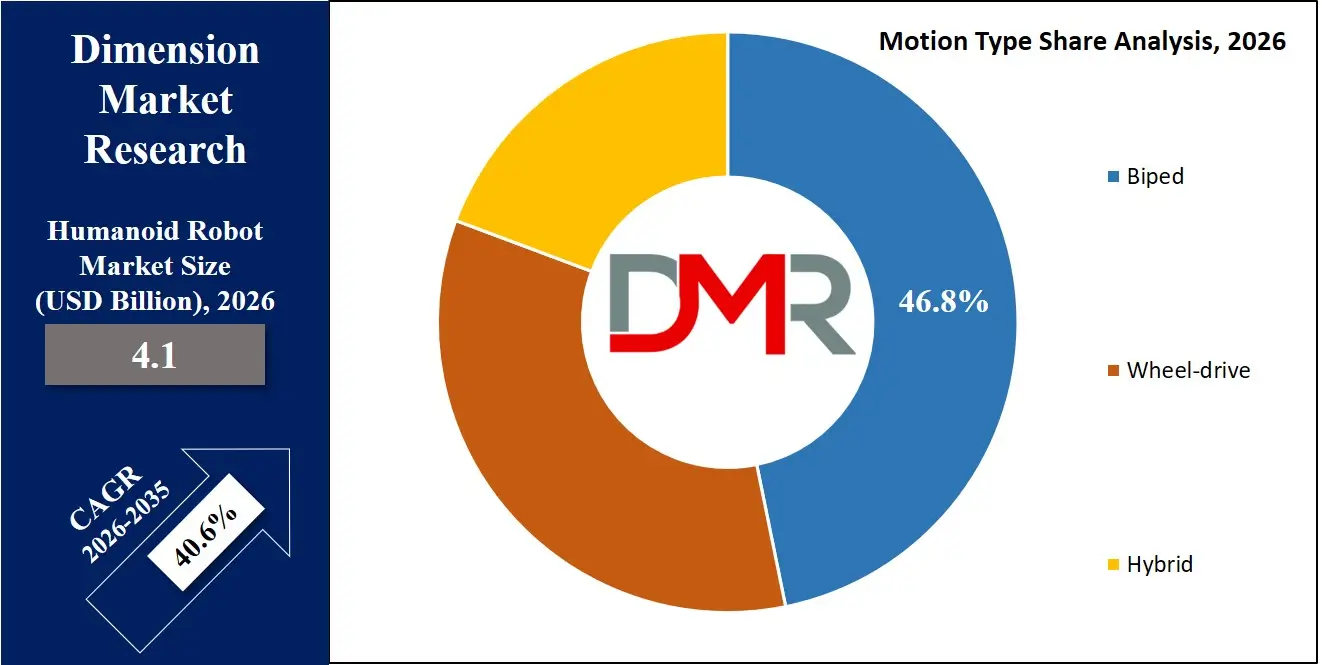
The segment is led by biped humanoid robots because they can closely imitate human movement and work in a human-centric setting. It is estimated that in 2026, the biped robots will make up 46.8% of the market share and this would be aided by the growth of balance, locomotion and real time control technologies. They can be used in various applications due to their capacity to move about stairs and rough surfaces.
ℹ
To learn more about this report –
Download Your Free Sample Report Here
Hybrid robots, which have legs and are mounted on wheels, represent the most rapidly expanding category as they provide both speed and flexibility with their efficiency and ability to operate in a variety of terrains. Wheel-driven robots remain also relevant in the logistics and industrial sectors where strict control is made over stability, cost-effectiveness, and speed, rather than the elaborate human-like mobility.
By Application Analysis
Industrial applications market share of the humanoid robot is projected to be very high with an estimated market share of 34.6% in 2026 due to the high demand of automation in the manufacturing and assembly process as well as material handling. These robots are used to increase productivity, minimize errors, and maximize operational efficiency. Nevertheless, the largest growth is observed in healthcare and personal assistance applications because of the growing aging populations and the growing need in caregiving and rehabilitation solutions. There are also good prospects of growth in logistics and warehousing due to the growth of e-commerce and the necessity of effective supply chain activities. Moreover, new markets in retail, education, hospitality are also contributing to the market diversification.
By Level of Autonomy Analysis
The market is currently dominated by semi-autonomous robots with a market share of about 44.1% in 2026 since these provide a good compromise between human intervention capability and automated capabilities. These systems are common among the industries that demand accuracy and control. The most rapidly developing part is fully autonomous robots thanks to the development of AI, deep learning, and real-time decision-making, which allow the least human intervention. Teleoperated robots are also applicable in dangerous places like disaster response and defense because human control guarantees safety. The effectiveness of the teleoperated systems is also being improved by the continuous advancement of connectivity and technologies of remote operations.
The Humanoid Robot Market Report is segmented on the basis of the following:
By Component
- Hardware
- Sensors (Vision, Force, Position)
- Actuators (Electric, Hydraulic)
- Power Systems (Batteries)
- Control Systems
- Mechanical Structure
- Software
- AI & Machine Learning
- Computer Vision
- Natural Language Processing
- Motion Planning & Control
- Services
- Integration & Deployment
- Maintenance & Support
- Robot-as-a-Service (RaaS)
By Motion Type
- Biped
- Wheel-Drive
- Hybrid (Leg + Wheel)
By Application
- Industrial
- Manufacturing Assistance
- Assembly Operations
- Material Handling
- Logistics & Warehousing
- Picking & Packing
- Sorting
- Inventory Management
- Personal Assistance & Caregiving
- Elderly Care
- Home Assistance
- Rehabilitation Support
- Healthcare Support
- Patient Monitoring
- Hospital Logistics
- Therapy Assistance
- Customer Service
- Retail Assistance
- Hospitality & Reception
- Front Desk Operations
- Education & Entertainment
- Teaching Assistants
- Research Platforms
- Social & Companion Robots
- Defense, Security & Rescue
- Surveillance
- Disaster Response
- Military Support
By Level of Autonomy
- Fully Autonomous
- Semi-Autonomous
- Teleoperated
Regional Analysis
Leading Region in the Humanoid Robot Market
It is projected that North America will take the lead in the market of humanoid robots covering a market share of about 36.5% in the year 2026. The area enjoys a good technological infrastructure, major investment in AI and robotics, and major innovation centers. The growth of the market is also enhanced by government assistance especially in defense and automation projects. Its leadership is achieved through high adoption in all types of industries, including manufacturing, healthcare, and logistics, as well as ongoing research and development efforts.
ℹ
To learn more about this report –
Download Your Free Sample Report Here
Fastest Growing Region in the Humanoid Robot Market
Asia-Pacific is the region with the fastest growth in the humanoid market due to the rate of industrialization and urbanization, as well as the rising investments in robotics technologies. Such countries as Japan, China, and South Korea are on the forefront of innovation and adoption. The increasing labor costs, governmental programs in favour of automation and smart manufacturing are fueling growth. The region is also characterized by good manufacturing capacities and widening areas of application especially on healthcare and service sectors.
By Region
North America
Europe
- Germany
- The U.K.
- France
- Italy
- Russia
- Spain
- Benelux
- Nordic
- Rest of Europe
Asia-Pacific
- China
- Japan
- South Korea
- India
- ANZ
- ASEAN
- Rest of Asia-Pacific
Latin America
- Brazil
- Mexico
- Argentina
- Colombia
- Rest of Latin America
Middle East & Africa
- Saudi Arabia
- UAE
- South Africa
- Israel
- Egypt
- Rest of MEA
Competitive Landscape
The market of humanoid robots is very competitive with the blistering technological progress and the considerable level of investments into the sphere of research. Companies are concentrating on innovation, strategic alliance, and product differentiation, to retain market share. Technical complexity and capital intensity are high barriers to new entrants. Market participants are more inclined to collaborative strategies, using AI and cloud technologies, and considering service-based solutions to become more competitive and global.
Some of the prominent players in the global Humanoid Robot are:
- Tesla
- Figure AI
- Boston Dynamics
- Agility Robotics
- Apptronik
- UBTECH Robotics
- Sanctuary AI
- 1X Technologies
- Unitree Robotics
- PAL Robotics
- Hanson Robotics
- Fourier Intelligence
- Engineered Arts
- Robotis
- Kawada Robotics
- SoftBank Robotics
- Honda
- Toyota
- Hyundai Motor Group
- Samsung Electronics
- Other Key Players
Recent Developments
- In November 2025, Agile Robots unveiled Agile ONE, its first humanoid robot designed for industrial environments. Built for safe collaboration with humans, it features advanced AI, intuitive interaction, and a highly dexterous robotic hand trained on real industrial data. Manufactured in Germany, it supports tasks like material handling, pick-and-place, and machine tending. Part of a broader AI-driven portfolio, Agile ONE integrates with the AgileCore platform for seamless operation across robotic systems.
- In November 2025, Orano partnered with Capgemini to introduce the first intelligent humanoid robot in the nuclear industry. Named Hoxo, the robot is deployed at Orano's training facility in France and features AI, advanced sensors, and autonomous capabilities. It can mimic human actions and assist in complex environments. Over a four-month trial, teams will evaluate its performance, aiming to improve efficiency and provide scalable robotic support in operations.
- In September 2025, UK-based robotics and AI firm Humanoid has introduced HMND 01 Alpha, the country's first industrial humanoid robot. Developed in seven months, it marks a record-fast build and has already completed two commercial proof-of-concept projects. Designed to address labor shortages, the robot targets warehouses, logistics, and retail operations. It performs repetitive tasks like sorting, loading, and packaging, enhancing productivity, reducing errors, and improving working conditions without requiring major infrastructure changes.
Report Details
| Report Characteristics |
| Market Size (2026) |
USD 4.1 Bn |
| Forecast Value (2035) |
USD 88.7 Bn |
| CAGR (2026–2035) |
40.6% |
| Historical Period |
2021 – 2025 |
| Forecast Period |
2027 – 2035 |
| Base Year |
2025 |
| Estimate Year |
2026 |
| Segments Covered |
By Component (Hardware, Software, and Services), By Motion Type (Biped, Wheel-Drive, and Hybrid (Leg + Wheel)), By Application (Industrial, Logistics & Warehousing, Personal Assistance & Caregiving, Healthcare Support, Customer Service, Education & Entertainment, and Defense, Security & Rescue), By Level of Autonomy (Fully Autonomous, Semi-Autonomous, and Teleoperated) |
| Regional Coverage |
North America – The US and Canada; Europe – Germany, The UK, France, Russia, Spain, Italy, Benelux, Nordic, & Rest of Europe; Asia-Pacific – China, Japan, South Korea, India, ANZ, ASEAN, Rest of APAC; Latin America – Brazil, Mexico, Argentina, Colombia, Rest of Latin America; Middle East & Africa – Saudi Arabia, UAE, South Africa, Turkey, Egypt, Israel, & Rest of MEA |
Frequently Asked Questions
How big is the Humanoid Robot Market?
▾ The Humanoid Robot Market size is expected to reach USD 4.1 billion by 2026 and is projected to reach USD 88.7 billion by the end of 2035.
What is the CAGR of the Humanoid Robot Market from 2026 to 2035?
▾ The market is growing at a CAGR of 40.6 percent over the forecasted period.
What factors are driving the growth of the Humanoid Robot Market?
▾ Rising demand for automation and labor substitution, advancements in artificial intelligence and robotics technologies, and more are the factors driving the growth of the Humanoid Robot Market.
What are the major trends in the Humanoid Robot Market?
▾ Integration of AI for enhanced human-robot interaction, shift toward collaborative and service-oriented robots, and more are some of the major trends in the market.
Who are the key players in the Humanoid Robot Market?
▾ Some of the key players in the Humanoid Robot Market include Tesla, Figure AI, Honda, and more
How is the Humanoid Robot Market segmented?
▾ The Humanoid Robot Market is segmented by component, motion type, application, and level of autonomy
Which region held the largest share of the Humanoid Robot Market in 2026?
▾ North America is set to lead the Humanoid Robot market with an estimated 36.5% share in 2026.
Which region is expected to grow the fastest in the Humanoid Robot Market?
▾ Asia-Pacific is the fastest-growing region in the Humanoid Robot market during the forecast period.