What is the In-Building Wireless Market Size?
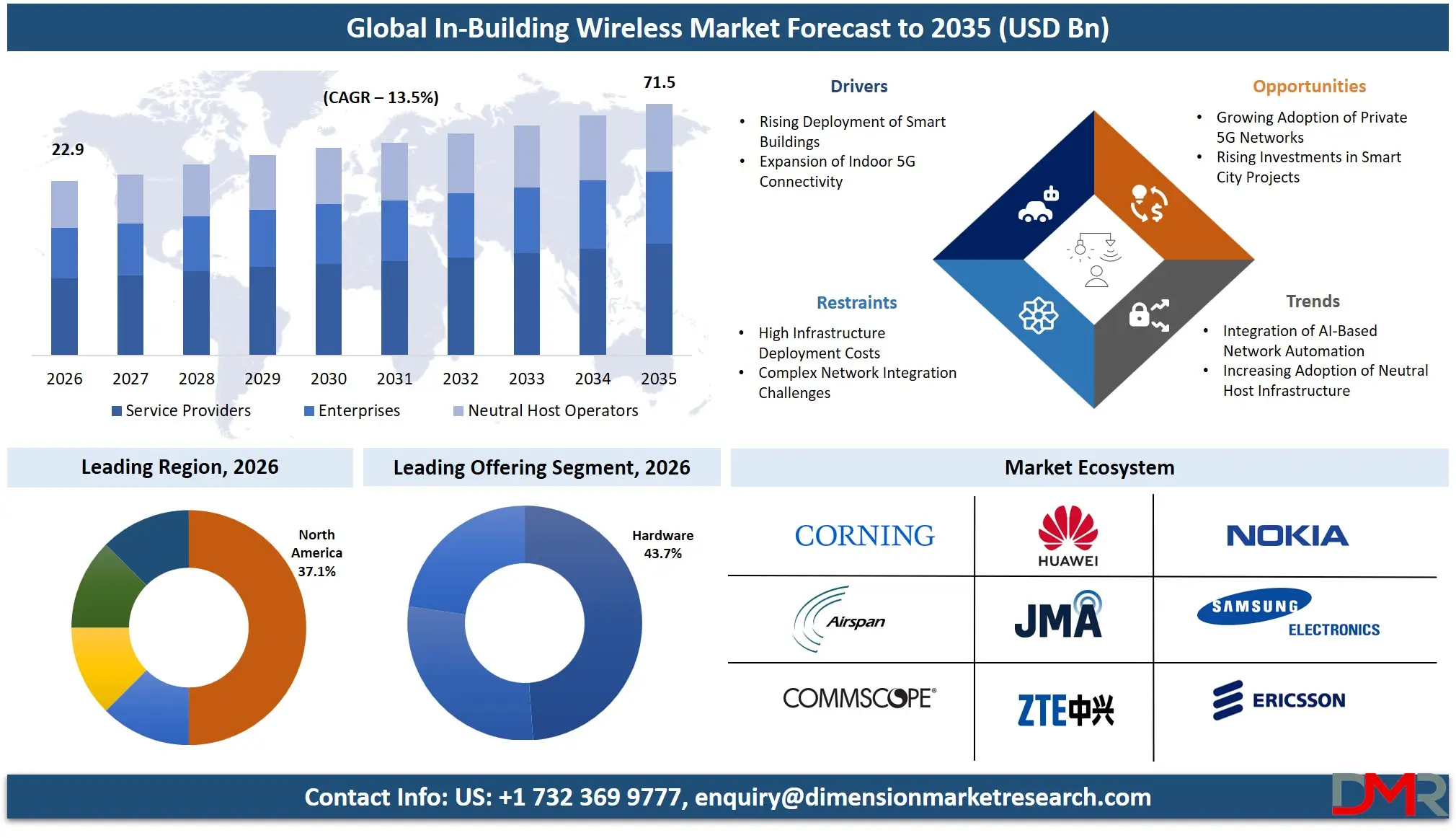
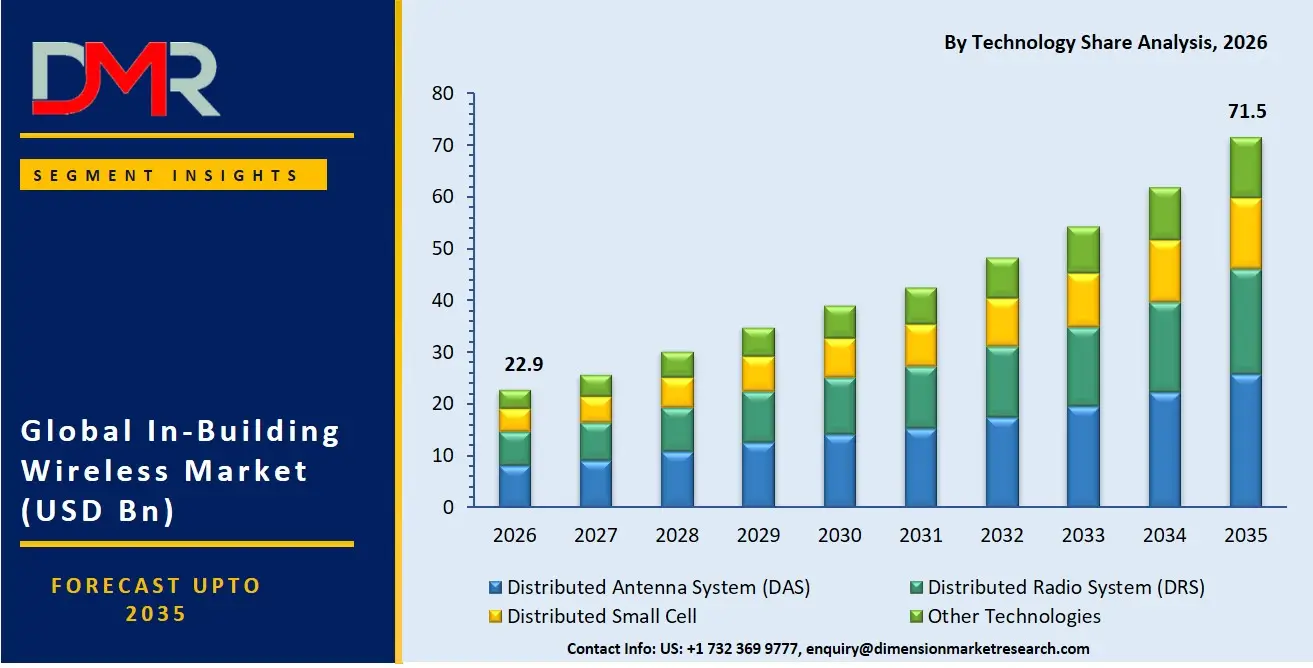
The Global In-Building Wireless Market is expected to reach a value of USD 22.9 billion in 2026, and it is further anticipated to reach USD 71.5 billion by 2035, growing at a CAGR of 13.5% during the forecast period.
ℹ
To learn more about this report –
Download Your Free Sample Report Here
This in-building wireless market has been experiencing fast growth with corporations and building owners looking to get rid of dead zones in order to facilitate the increasing consumption of data through wireless devices. It encompasses both hardware, software, and specialized services for providing uninterrupted cellular and wireless connections within buildings where there are no penetration levels of external macro network infrastructure.
The rising need for implementation of 5G networks, use cases of private wireless communications, and the implementation of IoT-based automated processes explains the need for specialized in-building solutions. Enterprises have been known to be among the biggest buyers with DAS and 5G small cells being the most popular types of in-building products because of their flexibility and multi-carrier capabilities. Some of the major sectors that play an important role include commercial campuses, healthcare facilities, manufacturing operations, and transportation services.
ℹ
To learn more about this report –
Download Your Free Sample Report Here
The US In-Building Wireless Market
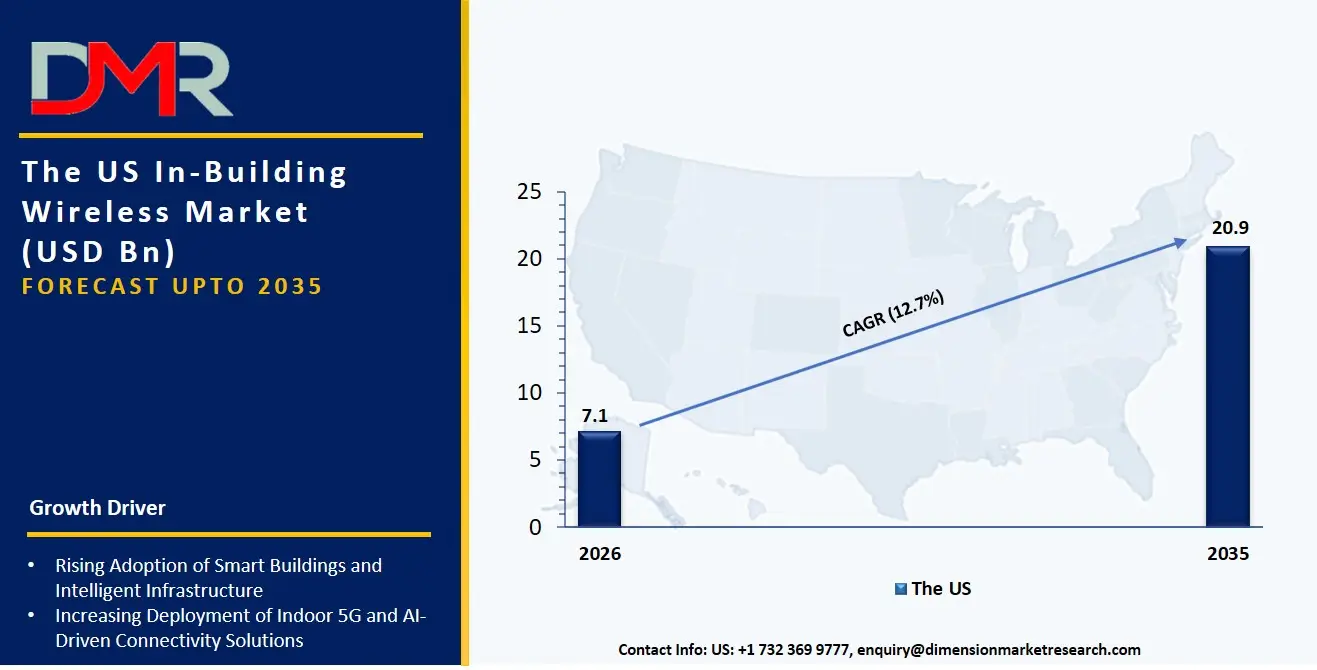
The US In-Building Wireless Market is projected to reach USD 7.1 billion in 2026 at a compound annual growth rate of 12.7% over its forecast period. The US will continue to remain the largest and most advanced market for in-building wireless thanks to the ongoing modernization programs within commercial real estate portfolios, as well as the rising adoption of 5G millimeter wave technologies. This particular market can be characterized by increased demands for Active DAS where businesses are increasingly working on transforming the passive infrastructure into fiber-fed active DAS that delivers multi-gigabit speeds. Furthermore, there is an increasing demand for the AI-Based Optimization Software in managing the propagation and energy consumption, as well as quality of service (QoS) in industrial campuses adopting private 5G networks.
ℹ
To learn more about this report –
Download Your Free Sample Report Here
The Europe In-Building Wireless Market
The Europe In-Building Wireless Market is estimated to be valued at USD 6.6 billion in 2026 and is further anticipated to reach USD 20.2 billion by 2035 at a CAGR of 13.2%. The regulatory structures of building safety standards and the initiative for gigabit connectivity objectives have a great effect on the European market environment and contribute to the demand for neutral hosts and shared signals among multiple operators. The rapid adoption of Hybrid DAS network services is also happening in the region because of the balancing act between the architectural protection issues and advanced wireless networks within transportation facilities and historic structures in Germany and France. Furthermore, the initiative for establishing secure and reliable supply chains has prompted the creation of separate private network services that offer data sovereignty and Ultra Reliable Low Latency Communication (URLLC).
The Japan In-Building Wireless Market
The Japan In-Building Wireless Market is projected to be valued at USD 2.4 billion in 2026. It is further expected to witness robust growth, holding USD 7.1 billion in 2035 at a CAGR of 12.8%. This particular market has many unique features due to its demand for Society 5.0 transformation driven by corporations that have to address the challenges of a shrinking labor pool and the necessity of implementing automation on an urban scale infrastructure. In this market, the majority of the spending comes from the areas of Consulting Services and Deployment & Integration services because major corporations shift mission-critical machine-to-machine communication traffic from unlicensed frequencies to private 5G networks. Another critical aspect here is deep local integration as a solution to fill the gap between legacy OT networks for high-speed rail and 5G Small Cells, leading to the AI-Based Optimization Software and Managed Services niche market.
Key Takeaways
- Market Size & Forecast: The Global In-Building Wireless market size is forecast to grow to USD 22.9 billion in 2026 and USD 71.5 billion in 2035, propelled by the two core factors, such as enterprise 5G deployment and mandated digitization of physical space.
- Growth Rate & Outlook: Global market growth is expected at a CAGR of 13.5%, driven by a critical shortage of in-house radio frequency (RF) engineers and the escalating complexity of managing active DAS and Coordinated Shared Spectrum environments.
- Primary Growth Drivers: Key market drivers will be the shift away from outdoor-only macro solutions to indoor solutions, the necessity for Neutral Host operators to pool their infrastructure costs, and CBRS/ private 5G deployment, which require specialized deployment & integration services.
- Key Market Trends: Some key trends include the adoption of industry-focused indoor networks (for example, Hospital 5G, Airport 5G), the use of artificial intelligence tools in Network Management Software that can automatically fix interference problems, and the move to Managed Services as enterprises focus on operating expenditure models.
- By Network Type Analysis: Public Networks are projected to dominate this segment as they will be main topic of conversation among enterprises, driven by data sovereignty concerns and need for determinism. Professional services will play a major role in creating seamless RF planning layers connecting private 5G radio units on premise with public network roaming abilities.
- By End User Analysis: Commercial Campuses and Healthcare are the two most profitable vertical markets because of the demand for high-level coverage and security. Industrial & Manufacturing represents the highest growth vertical as Industry 4.0 requires reliable Radio Units and highly resilient radio architectures.
- Regional Leadership: North America is expcted to dominate this market with a market share of 37.1% in 2026 because of its technologically advanced environment that has made full use of this technology and has become a dominant player in this segment.
What is the In-Building Wireless?
In-Building Wireless Solutions refer to the technology, services, and solutions provided by the original equipment manufacturer (OEM), system integrator, and neutral host companies to help businesses provide wireless access indoors. Unlike outdoor macro cellular consumption (public network), In-Building Wireless Solutions pertain to the delivery of coverage indoors, which entails Hardware components such as Antennas and Small Cells for signal propagation, Software solutions such as AI-Based Optimization for autonomous tuning of the network, and Services such as Consulting to create a roadmap for spectrum and capacity planning. Since 80% of mobile data is consumed indoors, professional integration services are required to provide handover, interference management, and multi-carrier support, thus making sure that investment in In-Building Wireless Solutions materializes into an end-user experience.
Use Cases
- Smart Hospitals Wireless Backhaul: Hospitals' networks employ Managed Services along with the installation of 5G Small Cells in order to guarantee uninterrupted connectivity for wireless patient telemetry, real-time asset location services, and ultra-high-bandwidth wireless networks for augmented reality surgical procedures.
- Industrial Private Networks Preparedness: Global manufacturers rely on deployment & integration services alongside AI-based optimization software to install industrial private 5G radio networks that will interconnect the automated guided vehicles and PLCs on the manufacturing floors using zero-packet-loss wireless networks, thus enabling predictive maintenance and safety shut-down zones.
- Neutral Host Venues Modernization: Stadium owners utilize consulting services to develop a Hybrid DAS infrastructure that meets public-safety communication codes to enable several Tier-1 mobile networks operators to share the very same physical antennas and cabling systems, greatly minimizing redundant installations.
- Smart Logistics Ports Deployment: Transportation authorities deploy outdoor distributed small cells and cabling & connectivity systems to facilitate a smooth integration between outdoor yard management systems and indoor logistics facility networking in order to allow tracking the cargo from port to warehouse.
How AI is Transforming the In-Building Wireless Market?
The way, artificial intelligence revolutionizes in-building wireless professional services not only through speeding up network planning but also through optimizing operation. Specifically, in the Hardware and Network Planning stage, advanced AI-based predictive modeling can help automatically plan for antenna placement and capacity settings, thus significantly reducing human effort on site survey, walk-test, and risk assessment. At the same time, the capabilities of AI in Software enable enterprises to reduce expenses on spectrum usage through detecting unusual interference patterns, predicting traffic spikes, and recommending dynamic spectrum allocation practices that improve SON techniques.
However, AI technology is widely used both in network assurance services and business models for network projects. In particular, in the Managed Services stage, intelligent agents monitor multiple operator DAS systems to detect any cases of PIM interference, poor configuration settings, and violations of the venue's safety policies. Furthermore, the use of generative AI assistants complements the Consulting Services stage, allowing for simulating material attenuation losses and predicting capacity growth, thereby providing visual estimates of the coverage grid before investing in actual infrastructure assets.
Market Dynamics
Key Drivers in the Global In-Building Wireless Market
Rising Deployment of Smart Buildings
Growing deployment of smart buildings in commercial, industrial, health care, and education industries will drive the growth of the In-Building Wireless market across the world. Smart buildings require uninterrupted connectivity from wireless systems for enabling Internet of Things (IoT), automation, artificial intelligence (AI) analytics, surveillance, and energy management solutions. Companies are making increased investments in advanced wireless systems for boosting the effectiveness of operations, experience of the occupants, and improved monitoring. Further, the growing trend of digital workplace and smart cities will lead to the rapid adoption of advanced wireless solutions within buildings.
Expansion of Indoor 5G Connectivity
The rapid spread of 5G technologies across the globe is becoming an important driver for the development of AI-based indoor wireless infrastructure solutions. Modern companies, stadiums, airports, hospitals, and other transport hubs need fast connections to process large amounts of data and support low latency. AI wireless solutions help to distribute signals better, optimize connections automatically, and provide better user experience inside densely populated spaces. Telecoms are interested in deploying indoor 5G technologies to provide better services to their customers and increase customer satisfaction. In addition, the increasing use of cloud and edge computing requires advanced wireless technologies.
Restraints in the Global In-Building Wireless Market
High Infrastructure Deployment Costs
The installation of artificial intelligence-enabled wireless technology, along with In-Building Wireless, necessitates heavy financial outlay, which constitutes a key impediment to market growth. Installation of distributed antenna systems, small cells, network controllers powered by AI, and monitoring systems entails considerable expenditure for installation, integration, and maintenance. Specialized wireless networks may need to be deployed for large commercial establishments, resulting in further cost concerns. Small- and medium-size businesses may lack funds, thus posing challenges to the adoption of cutting-edge indoor wireless technology. Moreover, frequent upgrades due to new 5G standards and integration of AI software result in higher operational costs.
Complex Network Integration Challenges
However, incorporating wireless systems powered by AI into the current infrastructures of buildings can be technologically challenging and consume much time. Most buildings have communication infrastructures that may not be compatible with contemporary AI-driven wireless systems. Companies find it difficult to integrate diverse network technologies such as Wi-Fi, DAS, private LTE, and 5G networks into one infrastructure. There is also an issue related to cybersecurity and interoperability of the network system, which complicates the process of integration. Further, there is a lack of trained personnel who can manage AI-driven wireless ecosystems.
Growth Opportunities in the Global In-Building Wireless Market
Growing Adoption of Private 5G Networks
The increasing implementation of private 5G wireless networks in businesses, factories, hospitals, and campuses will bring many growth prospects for the In-Building Wireless market. Private wireless networks ensure higher levels of security, lower latency, and faster connection speeds for critical applications. The use of AI-based wireless systems assists in managing the traffic flow on the network, optimizing the usage of the spectrum and enabling real-time automation. Businesses that rely on Industry 4.0 technologies have started allocating resources towards creating an intelligent wireless network. The need for secure and dedicated connectivity services will be a major driving force behind future market growth.
Rising Investments in Smart City Projects
The government and many other private sectors around the world have been putting money into various smart city ventures, which provide great chances for AI-based building wireless technologies. For smart cities, there is a need for wireless connectivity indoors and outdoors to be used with their intelligent transport, digital governance, surveillance systems, and interconnected buildings. The use of AI to control and manage building wireless technology leads to efficient communications. The increasing urban population and energy-efficient smart city infrastructures are driving forces behind the demand for such building wireless technologies.
Trends in the Global In-Building Wireless Market
Integration of AI-Based Network Automation
Some of the important trends in the market include the incorporation of AI-based automation in the management of indoor wireless networks. There has been an increase in the use of AI-based analytical tools that can monitor network traffic, diagnose performance problems, and optimize connectivity in real time. Automation in wireless networks makes it easier to maintain good network performance while reducing system complexity. Predictive maintenance made possible by the use of AI-based tools improves the reliability of the wireless infrastructure by predicting failures.
Increasing Adoption of Neutral Host Infrastructure
Increasing demand for neutral host In-Building Wireless infrastructure is one of the important trends within the worldwide In-Building Wireless market. Neutral host concept makes it possible for several telecommunication companies to use the same indoor wireless infrastructure; hence, making deployment more affordable and efficient for both users and providers of In-Building Wirelesss. Places that have large numbers of users, such as airports, malls, sports grounds, and hospitals, are increasingly using such networks due to their cost-efficiency and scalability. AI technologies also improve performance through traffic management.
Research Scope and Analysis
The Global In-Building Wireless Market Report is segmented by offering into hardware, software, and services, by technology into DAS, DRS, distributed small cells and other technologies, by business model into service providers, enterprises and neutral host operators, by building size, network type, and end-user industries including healthcare, education, hospitality, transportation, manufacturing, government and other end users such as retail, residential complexes, data centers, energy utilities, and research institutions.
ℹ
To learn more about this report –
Download Your Free Sample Report Here
By Offering Analysis
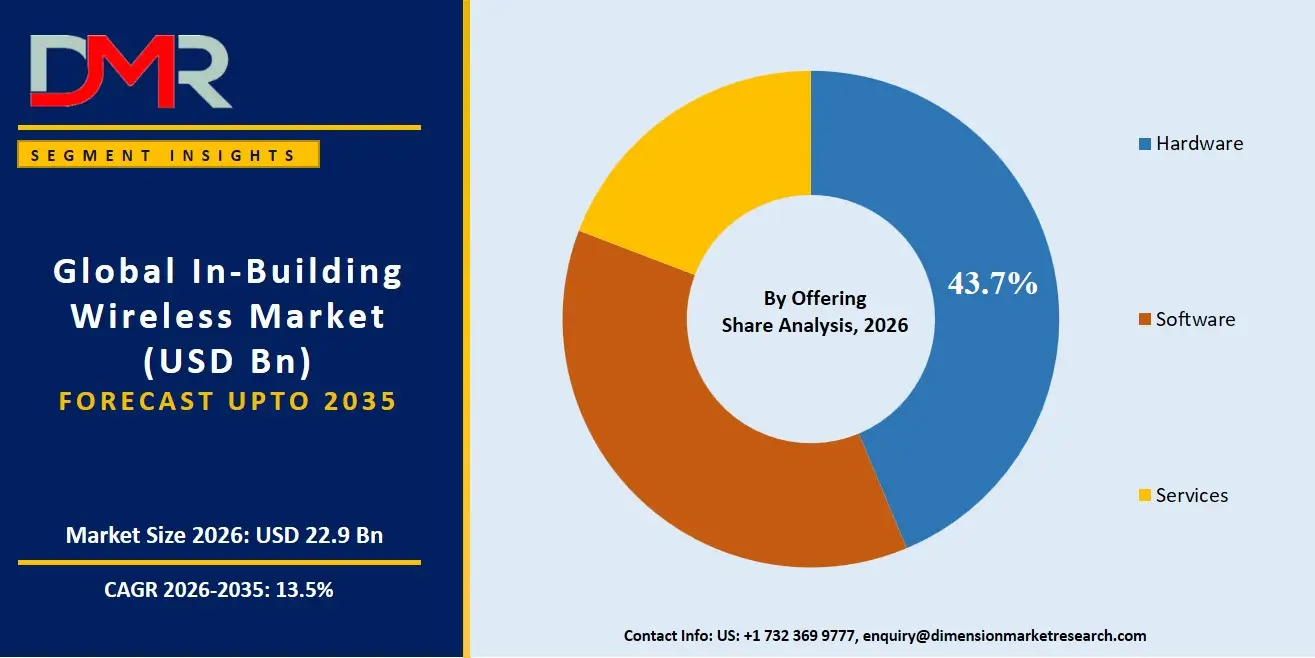
The Hardware category is projected to hold a significant share of the Global In-Building Wireless market owing to the extensive installation of physical connectivity components required for reliable indoor wireless connectivity. Antennas, small cells, repeaters, radio units, and network controllers are some important components of AI-powered connectivity systems within buildings. The rising investments made in 5G infrastructure, smart buildings, and indoor densification solutions have further increased the demand for robust hardware solutions. Enterprises, airports, stadiums, hospitals, and commercial facilities need robust installations of hardware components to enable consistent connectivity and network optimization. The application of artificial intelligence in the management of signals and radio technology has bolstered the dominance of the Hardware market globally.
By Technology Analysis
The DAS segment is expected to hold the largest market share due to its high potential of delivering wireless services reliably indoors. DAS solutions are extensively used in airport terminals, healthcare centers, stadiums, transport facilities, and commercial buildings as they are able to deliver seamless wireless service in areas with high user density. The growing popularity of active and hybrid DAS solutions stems from their potential to accommodate networks for 4G, 5G, and public safety communications simultaneously. Increased installations of smart infrastructure and investments in the indoor deployment of 5G networks are some other factors contributing to the market dominance of DAS.
By Business Model Analysis
The service providers are expected to hold a significant market share in the In-building wireless market as a result of investments made by the telecoms industry into building indoor wireless coverage and 5G connectivity. There have been numerous instances of telecoms adopting artificial intelligence to enhance their networks, optimize spectrum usage, and facilitate increased mobile data traffic using In-Building Wireless technology. Service providers are also key in managing indoor connectivity solutions among various organizations, public sites, and transport infrastructure. The increasing need for smooth communication services amid smartphone and Internet of Things adoption is prompting telecom-related investments.
By Building Size Analysis
Large buildings are projected to account for the highest share of the market because large building installations need efficient wireless networks to guarantee seamless connectivity within such large indoor spaces. Airports, stadiums, hospitals, educational institutions, shopping malls, and corporate offices have high volumes of mobile data usage, and thus there is a need for efficient coverage. Wireless networking solutions empowered by artificial intelligence technology play an important role in enhancing connectivity within such places. In addition, there is the increasing adoption of smart buildings due to technological innovation, which promotes the implementation of advanced wireless technologies in large buildings.
By Network Type Analysis
Public network is projected to be the largest segment in the in-building wireless market, owing to the increasing reliance of consumers on fast internet connectivity and increased adoption of public 4G/5G networks indoors in commercial/public places. Public indoor networks allow telecom service providers to provide smooth voice and data connectivity to a vast user base in congested locations like airports, shopping malls, hotels, and stadiums. The growing consumption of mobile data, the development of smart cities, and the need for uninterrupted connectivity have boosted the segment's growth. Moreover, both governments and telecom operators are making huge investments in public indoor wireless infrastructure.
By End User Analysis
The commercial campuses are expected to account for the highest share in the market owing to the fast-paced adoption of AI-driven wireless infrastructure among corporate offices, business parks, and other commercial establishments. Commercial sites need reliable indoor connectivity for implementing cloud-based applications, video conferencing, IoT devices, intelligent security systems, and digital workplaces. The growth of hybrid working arrangements and digital transformation initiatives is fueling the demand for efficient wireless infrastructures that can cater to the requirements of high-density connectivity. The incorporation of artificial intelligence in wireless infrastructures improves network performance and helps in efficient communication. Moreover, the growing trend of smart offices and installation of private 5G & Wi-Fi networks boosts the position of the segment in the market.
The Global In-Building Wireless Market Report is segmented on the basis of the following:
By Offering
- Hardware
- Antennas
- Small Cells
- Repeaters
- Radio Units
- Network Controllers
- Cabling & Connectivity Equipment
- Software
- Network Management Software
- AI-Based Optimization Software
- Security & Monitoring Software
- Analytics Platforms
- Services
- Consulting Services
- Deployment & Integration Services
- Managed Services
- Maintenance & Support Services
By Technology
- Distributed Antenna System (DAS)
- Active DAS
- Passive DAS
- Hybrid DAS
- Distributed Radio System (DRS)
- Centralized DRS
- Cloud-Based DRS
- Distributed Small Cell
- 4G/LTE Small Cells
- 5G Small Cells
- Indoor Small Cells
- Other Technologies
By Business Model
- Service Providers
- Enterprises
- Neutral Host Operators
By Building Size
- Large Buildings
- Medium Buildings
- Small Buildings
By Network Type
- Public Network
- Private Network
By End User
- Commercial Campuses
- Government
- Transportation & Logistics
- Hospitality
- Industrial & Manufacturing
- Education
- Healthcare
- Entertainment & Sports Venues
- Other End Users
Regional Analysis
Leading Region by Market Share
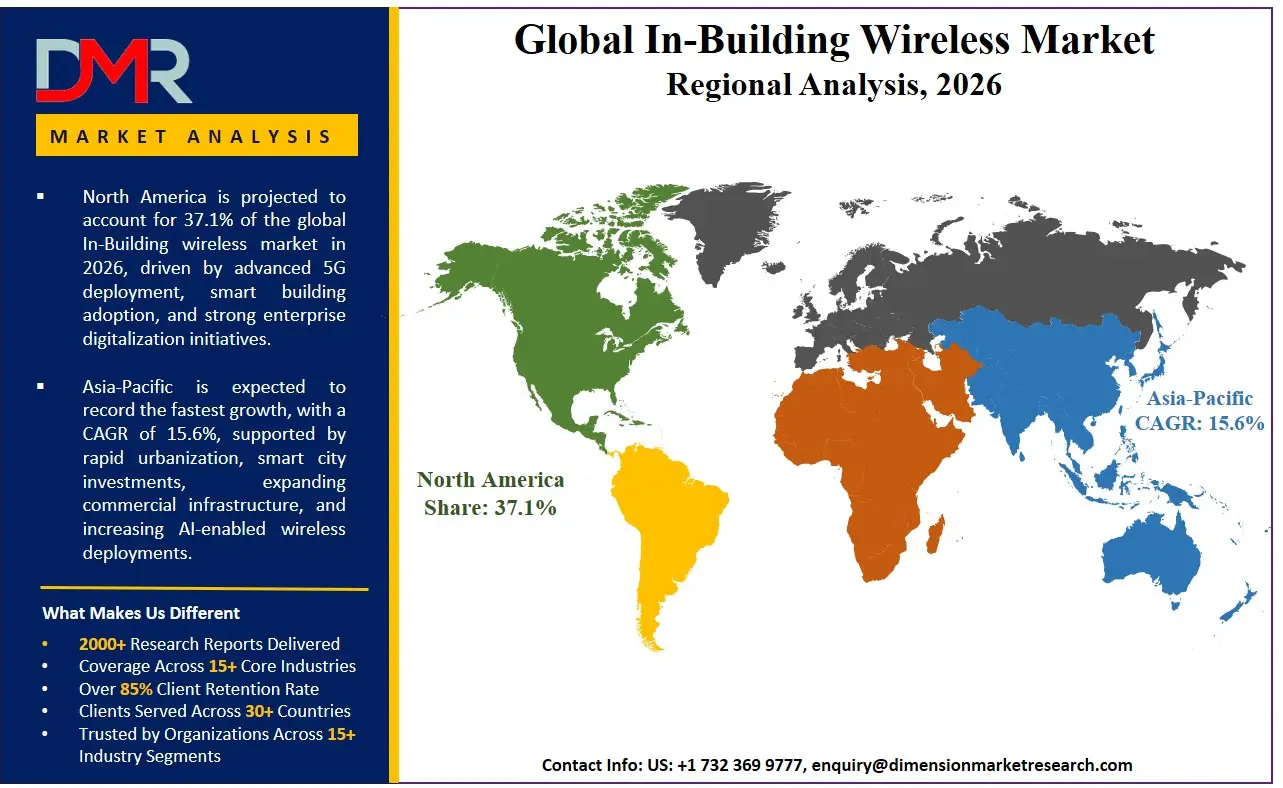
North America is poised to dominate the global in-building wireless market as it is projected to hold 37.1% of the market share by the end of 2026. The United States, which controls North America, is leading the market due to the exceptional concentration of large-scale indoor facilities and robust digital modernization efforts undertaken by the Fortune 500 commercial property owners. This region features a vibrant ecosystem comprised of global system integrators, niche RF consulting firms, and a plethora of DAS and small cell specialists. Corporate spending on private CBRS networks, cutting-edge LiDAR site surveys, and decommissioning of existing passive coaxial infrastructure supports the increasing need for Active DAS and Distributed Small Cell installations, as well as perpetual AI-Based Optimization. In addition, the presence of stringent municipal code regulations continues to compel the construction of new skyscrapers to hire professional services and meet public safety grid requirements and FirstNet.
ℹ
To learn more about this report –
Download Your Free Sample Report Here
Fastest-Growing Regional Market
The fastest-growing in-building wireless market is predicted to be the Asia-Pacific region, due to the implementation of comprehensive smart city programs and other connectivity-driven schemes implemented by the governments in China, India, Japan, and Southeast Asia. Urbanization and vertical development of megacities, combined with the fast growth of the digital economy that is predominantly mobile-focused, force traditional construction corporations and transport authorities to replace aging analog repeater systems. High demand for Consulting Services and Deployment & Integration services will allow large buildings to move toward new-generation fiber-based and 5G-ready DAS architectures. Moreover, there is a lack of skilled Radio Frequency technicians in the region, so it becomes absolutely vital to turn to outsourced Managed Services in order to install and secure wireless networks in buildings to support 5G infrastructures.
By Region
North America
Europe
- Germany
- The U.K.
- France
- Italy
- Russia
- Spain
- Benelux
- Nordic
- Rest of Europe
Asia-Pacific
- China
- Japan
- South Korea
- India
- ANZ
- ASEAN
- Rest of Asia-Pacific
Latin America
- Brazil
- Mexico
- Argentina
- Colombia
- Rest of Latin America
Middle East & Africa
- Saudi Arabia
- UAE
- South Africa
- Israel
- Egypt
- Rest of MEA
Competitive Landscape
The nature of competition in global in-building wireless space has become very dynamic in light of the heterogeneous nature of multi-national infrastructure OEMs, the professional services division of the large neutral hosts, and the boutique firms specializing in RF engineering. The ability to forge a powerful strategic partnership with companies such as CommScope, Corning, and Ericsson would be essential as it would provide critical co-selling partnerships and early entry into new radio platform technology. The process of market consolidation is already moving at breakneck speed, as the traditional electrical and cabling contractors have started acquiring the specialist RF engineering design boutiques to survive. Proprietary intellectual property through the use of AI-driven site survey tools and network design accelerators has emerged as an important driver for differentiation over just labor arbitrage.
Some of the prominent players in the Global In-Building Wireless Market are:
- CommScope
- Corning Incorporated
- Huawei Technologies
- Ericsson
- Nokia
- Samsung Electronics
- ZTE Corporation
- Airspan Networks
- JMA Wireless
- Boingo Wireless
- American Tower Corporation
- Crown Castle
- SOLiD
- Comba Telecom Systems
- Mavenir
- Cisco Systems
- Intel Corporation
- ADRF
- Dali Wireless
- BTI Wireless
- Other Key Players
Recent Developments
- February 2026: Ericsson announced that it would make a significant expansion of its Private 5G innovation center, a professional services offering designed to help customers in the transportation & logistics and industrial & manufacturing sectors design their own 5G networks indoors by leveraging radio units and AI-based optimization software capabilities.
- November 2025: CommScope bolstered its partnership with one of the largest neutral host companies, while launching a particular practice called managed services and maintenance & support that was aimed at helping clients from the entertainment & sports venues sector deploy Hybrid DAS and comply with RF signal strength laws.
- October 2025: American tower acquired an integration company specializing in DAS technology to expand its consulting services and deployment & integration offerings to serve the needs of complex Government and Healthcare clients related to data sovereignty and interference problems.
Report Details
| Report Characteristics |
| Market Size (2026) |
USD 22.9 Bn |
| Forecast Value (2035) |
USD 71.5 Bn |
| CAGR (2026–2035) |
13.5% |
| The US Market Size (2026) |
USD 7.1 Bn |
| Historical Data |
2021 – 2025 |
| Forecast Data |
2027 – 2035 |
| Base Year |
2025 |
| Estimate Year |
2026 |
| Segments Covered |
By Offering (Hardware, Software, and Services), By Technology, By Business Model, By Building Size, By Network Type, By End User |
| Regional Coverage |
North America – The US and Canada; Europe – Germany, The UK, France, Russia, Spain, Italy, Benelux, Nordic, & Rest of Europe; Asia-Pacific – China, Japan, South Korea, India, ANZ, ASEAN, Rest of APAC; Latin America – Brazil, Mexico, Argentina, Colombia, Rest of Latin America; Middle East & Africa – Saudi Arabia, UAE, South Africa, Turkey, Egypt, Israel, & Rest of MEA |
Frequently Asked Questions
How big is the Global In-Building Wireless Market?
▾ The Global In-Building Wireless market is poised to be valued at USD 22.9 billion in 2026 and is projected to reach USD 71.5 billion by 2035, driven by the universal need for specialized skills in 5G DAS deployment, private network integration, and AI-driven RF optimization.
What is the CAGR of the Global In-Building Wireless Market from 2026 to 2035?
▾ The market is expected to grow at a CAGR of 13.5% from 2026 to 2035, reflecting the accelerating complexity of multi-operator 5G environments and the persistent shortage of internal radio frequency engineering talent.
What factors are driving the growth of the Global In-Building Wireless Market?
▾ Key drivers include the global RF engineering skills gap, the imperative to modernize legacy passive coaxial systems, the management complexity of shared spectrum and private 5G deployments, and the surge in demand for Neutral Host Operators amid evolving building code density requirements.
Which region held the largest share of the In-Building Wireless Market in 2026?
▾ North America, specifically the United States, is projected to hold 37.1% of the market share in 2026, driven by a mature commercial real estate ecosystem and aggressive enterprise investment in Private Networks, Active DAS, and AI-driven indoor capabilities.
Which region is expected to grow the fastest in the In-Building Wireless Market?
▾ The Asia-Pacific region is expected to grow the fastest, fueled by rapid smart city development in China, India, and Japan, where Managed Services and Deployment & Integration are critical for transitioning large infrastructure conglomerates to 5G-native indoor operations.
What are the major trends in the Global In-Building Wireless Market?
▾ Major trends include the integration of Generative AI into RF design workflows, the rise of Private Network-as-a-Service (NaaS) models, the demand for industry-specific radio solutions, and the focus on GreenOps and energy-efficient Network Controllers within complex venue environments.
Who are the key players in the Global In-Building Wireless Market?
▾ Key players include infrastructure OEMs like CommScope, Ericsson, and Nokia, as well as neutral host operators like Boingo Wireless and American Tower, alongside specialized pure-play private 5G start-ups like Celona.
How is the Global In-Building Wireless Market segmented?
▾ The market is segmented by Offering, Technology, Business Model, Building Size, Network Type, and End User.