Market Overview
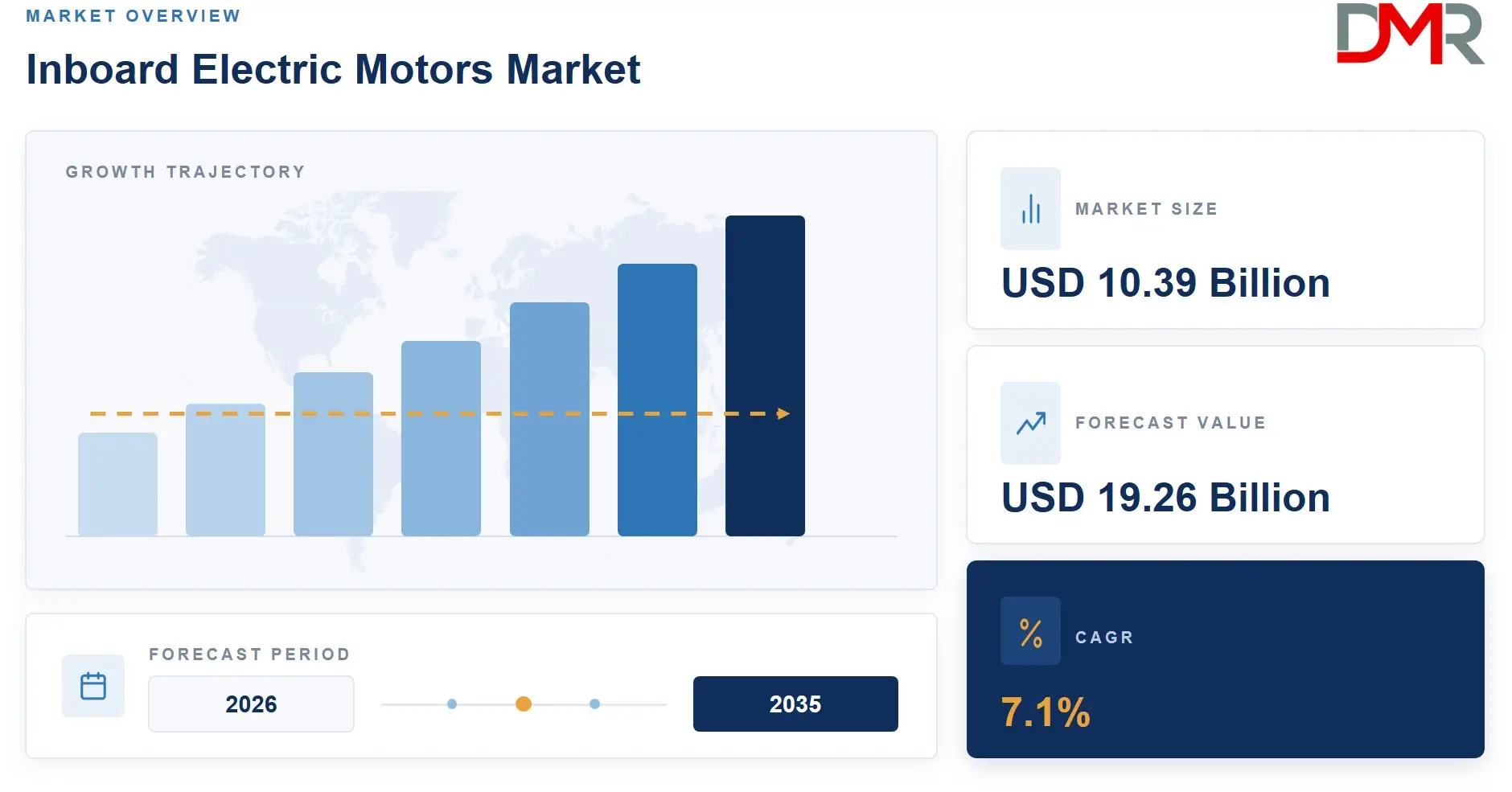
The Global Inboard Electric Motors Market size is estimated at USD 10.39 Billion in 2026, and is projected to reach USD 19.26 Billion by 2035, exhibiting a CAGR of 7.1% during the forecast period.
Boat builders spent the last five years replacing diesel inboard systems with electric drivetrains on recreational and short-haul commercial vessels. Buyers accepted shorter range in exchange for lower noise and zero local emissions, a trade-off that lithium-ion energy density gains have started to close. The forecast assumes marina charging networks expand fast enough to support this shift, and that classification societies keep approving new electric powertrains at the pace seen through 2025 and 2026.
This market covers inboard-mounted electric propulsion systems built into the hull, spanning motors, controllers, and battery packs for recreational, commercial, and municipal vessels. It excludes outboard electric motors and non-propulsion onboard electrical systems. Demand connects directly to the broader marine electrification push, where Electric Motors platforms originally engineered for automotive and industrial use now get marinized for inboard fitment, cutting development cost for new entrants.
ℹ
To learn more about this report –
Download Your Free Sample Report Here
Key Takeaways
- The market size is USD 10.39 Billion in 2026, and is projected to hit USD 19.26 Billion by 2035 at a CAGR of 7.1%.
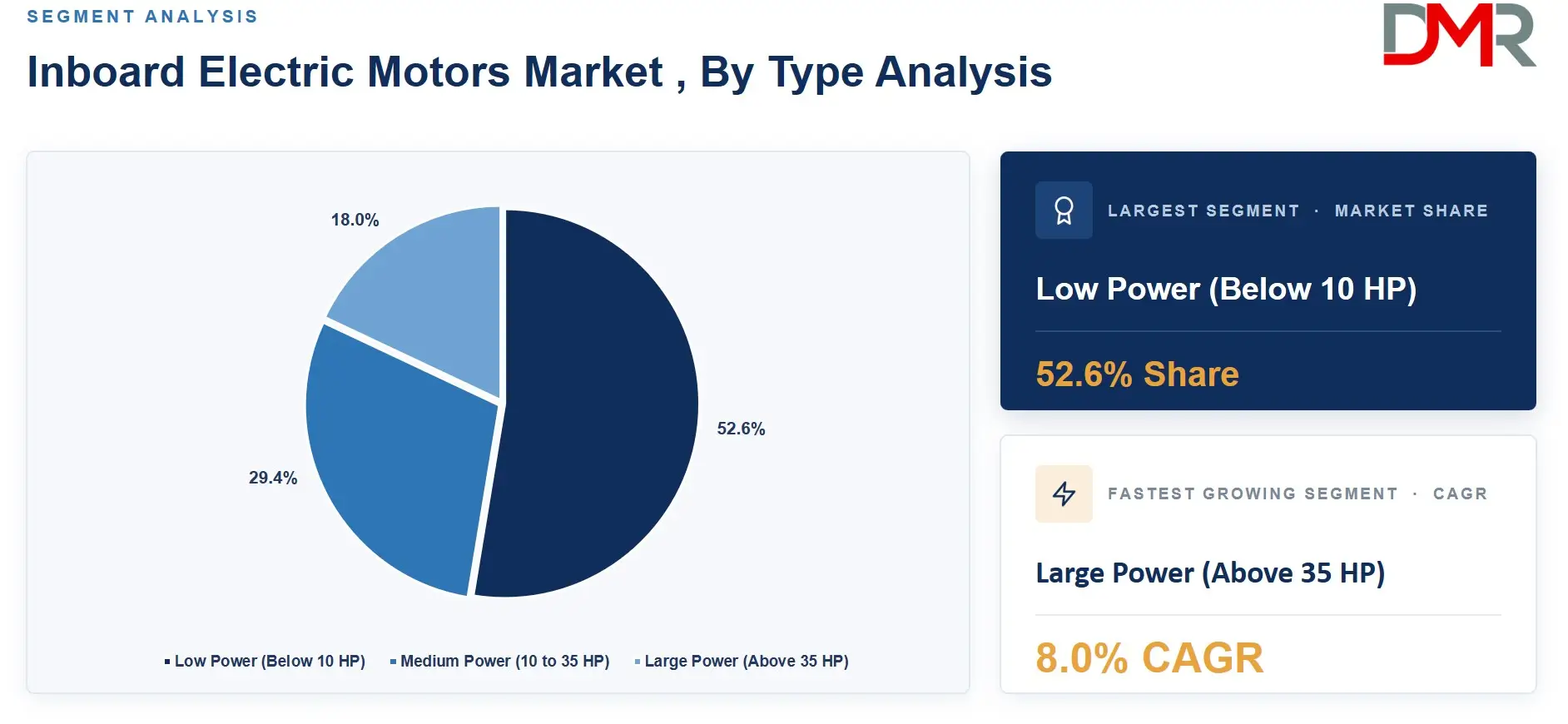
- By Type: Low Power (Below 10 HP) led with a 52.6% share in 2026.
- By Application: Civil Entertainment led with a 47.3% share in 2026.
- By Boat/Vessel Type: Recreational Boats led with a 59.1% share in 2026.
- By Battery Type: Lithium-ion Batteries led with a 58.2% share in 2026.
- By Sales Channel: OEM led with a 64.6% share in 2026.
- By End User: Individual Boat Owners led with a 52.6% share in 2026.
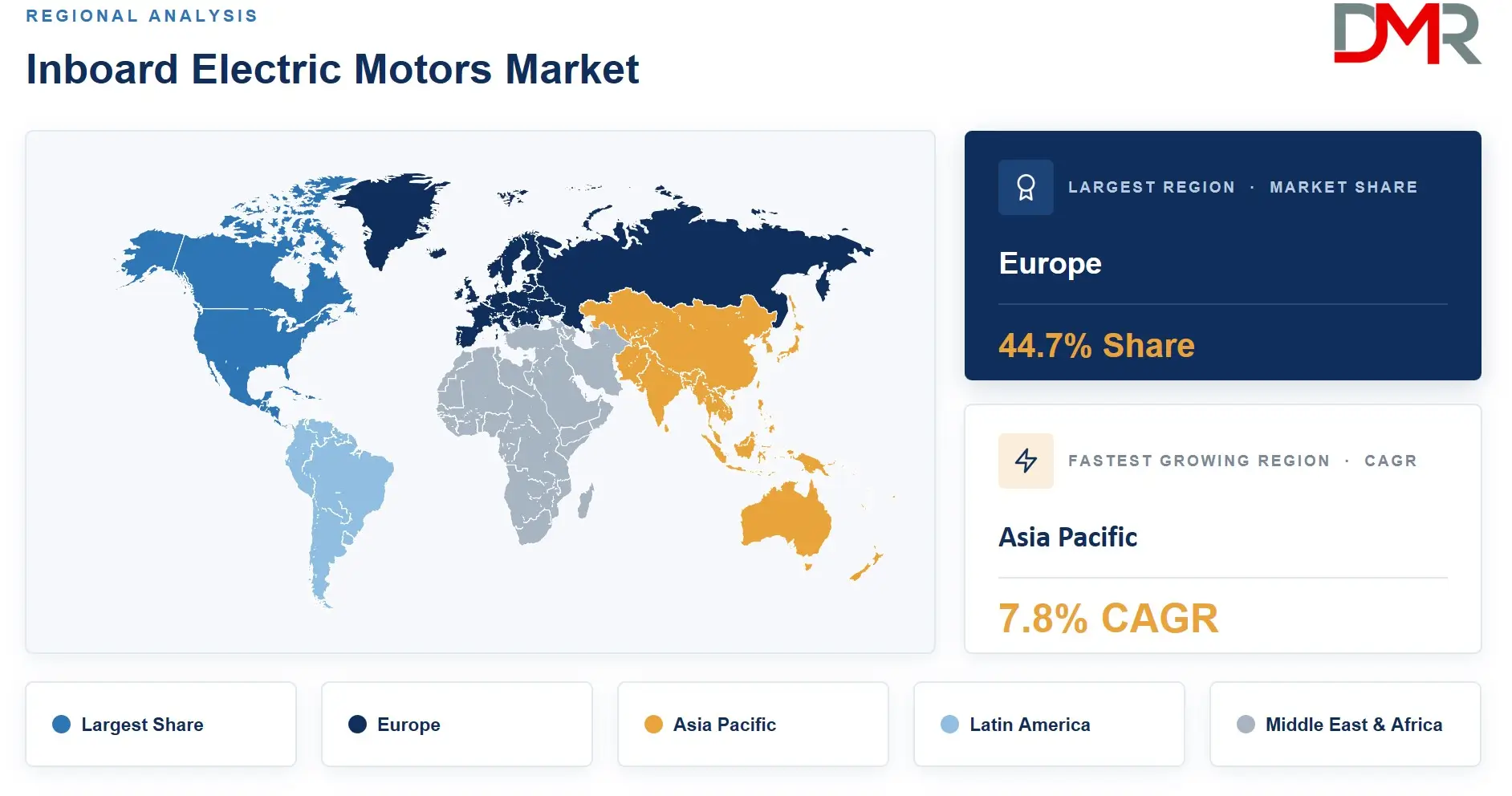
- By Region: Asia Pacific led with a 44.7% share, valued at USD 4.2 Billion, in 2026.
- Large Power (Above 35 HP) systems are the fastest growing type category, tracking demand from commercial and workboat electrification.
Type Analysis
Low Power (Below 10 HP) led the Type segment with a 52.6% share in 2026.
Small day boats and tenders dominate this category because their short duty cycles match current battery range limits. Owners running two or three hour outings rarely hit the range wall that troubles larger commercial vessels. Retrofit shops favor Low Power kits since installation avoids the high-voltage certification burden tied to larger systems.
Medium Power units serve cruising sailboats and mid-size launches, filling the gap between day-use tenders and full commercial platforms. Large Power systems above 35 HP grow fastest as ferry operators and workboat fleets adopt electric propulsion for regulated routes. Fleet operators moving to Large Power systems now specify liquid-cooled drives rated for continuous duty, a jump in system complexity that favors established marine electrical integrators over automotive motor suppliers entering the space.
ℹ
To learn more about this report –
Download Your Free Sample Report Here
Key Market Segments
By Type
- Low Power (Below 10 HP)
- Medium Power (10 to 35 HP)
- Large Power (Above 35 HP)
Application Analysis
With a 47.3% share in 2026, Civil Entertainment outpaced all other Application categories.
Charter operators and private owners running day cruises and dinner cruises drive Civil Entertainment demand. Silent propulsion turns into a marketing feature here, since guests pay a premium for a quiet ride near shorelines and marinas. Evoy's Breeze G2 platform illustrates the segment's appetite for range flexibility, delivering 20 to 40 nautical miles at planing speed and more than 24 hours at low displacement speed on its dual battery pack, matching the mixed-speed profiles that entertainment operators run daily.
Municipal and Commercial applications trail but grow on regulatory pressure rather than guest preference. Municipal water taxis and harbor patrol boats adopt electric inboard systems to meet local emission caps, while Commercial applications cover charter fishing and small freight runs where operators weigh fuel savings against upfront battery cost. Buyers across Other Applications, including research and survey vessels, prioritize low acoustic signature over range, a niche need that keeps demand steady but small.
Key Market Segments
By Application
- Civil Entertainment
- Day Cruises
- Dinner and Charter Cruises
- Municipal
- Commercial
- Other Applications
Boat/Vessel Type Analysis
Recreational Boats accounted for 59.1% of Boat/Vessel Type demand in 2026, the highest of any category.
Private owners buying day boats and small cruisers make up the bulk of this share, favoring inboard electric systems for the quiet running that outboard motors cannot match at low speed. Sea trials on Balance catamarans back this pattern. Dual 30 kW E-Drives paired with a 36 kWh battery bank delivered 27 to 28 nautical miles of range at 3 knots, enough for a full day of coastal cruising at recreational speeds.
Yachts grow fastest within this segment as owners treat silent electric propulsion as a premium onboard feature rather than a compromise. Fishing Boats, Workboats, Passenger Boats, and Commercial Vessels round out demand, each adopting electric inboard systems on a different timeline tied to duty cycle and regulatory deadline. The Balance 526's larger battery bank, carrying 33% more capacity than smaller test boats, delivered 25 nautical miles at 3.5 knots, showing how incremental battery scaling extends range without a full platform redesign.
Key Market Segments
By Boat/Vessel Type
- Recreational Boats
- Yachts
- Fishing Boats
- Workboats
- Passenger Boats
- Commercial Vessels
Battery Type Analysis
A 58.2% share made Lithium-ion Batteries the clear leader across Battery Type categories in 2026.
Energy density advantages explain the gap. Lithium-ion packs deliver more range per kilogram than lead-acid or nickel-based alternatives, a decisive factor on weight-sensitive hulls. Bellmarine's LiFePO4 marine batteries rate for more than 4,000 cycles, roughly three times the lifespan of conventional battery chemistries, which cuts the total replacement cost that once favored cheaper lead-acid options.
Lead-acid Batteries persist in budget retrofit kits and older commercial vessels where upfront cost outweighs lifecycle economics. Nickel-based chemistries and Other Battery Types occupy small niches tied to specific thermal or safety requirements, including cold-climate operation where lithium packs need extra battery management. Battery suppliers now compete less on raw capacity and more on cycle life and charge speed, a shift that rewards firms with proven marine-grade cell sourcing.
Key Market Segments
By Battery Type
- Lithium-ion Batteries
- Lead-acid Batteries
- Nickel-based Batteries
- Other Battery Types
Sales Channel Analysis
OEM captured 64.6% of the Sales Channel segment in 2026, ahead of all rivals.
Boat builders integrating electric inboard systems at the factory avoid the certification headaches that plague retrofits. VETUS designed its E-LINE motor for exactly this route, rating the 22 kW unit for vessels up to 15 meters and 20 tonnes as a factory-fit option rather than an aftermarket add-on.
Aftermarket demand grows around fleet owners converting existing diesel vessels ahead of emissions deadlines, a slower and costlier path since it requires marine electricians qualified in high-voltage retrofit work. OEM channel dominance signals that new capacity additions will concentrate at the shipyard level, pushing component suppliers toward long-term contracts with boat builders over one-off retrofit sales.
Key Market Segments
By Sales Channel
End User Analysis
Individual Boat Owners led the End User segment with a 47.8% share in 2026.
Private buyers purchasing day boats and small cruisers make up this share, motivated by lower running cost and quieter operation rather than regulatory obligation. Commercial Operators grow fastest among End User categories as ferry and water taxi operators face compliance deadlines that individual owners never encounter.
Tourism and Leisure Operators, Municipal Authorities, and Marine Transport Operators fill out remaining demand, each buying on a different cycle tied to fleet renewal schedules and local emission rules. A Norwegian tourism operator running three electric HyFoil boats completed as many as nine tours per boat per day, supported by a 40 kW DC charging installation, showing that commercial duty cycles can match diesel-era throughput once charging infrastructure keeps pace.
Key Market Segments
By End User
- Individual Boat Owners
- Commercial Operators
- Tourism and Leisure Operators
- Municipal Authorities
- Marine Transport Operators
Regional Analysis
Asia Pacific led the Inboard Electric Motors market with a 44.7% share, valued at USD 4.2 Billion, in 2026.
Asia Pacific
Shipyards across China, Japan, and South Korea build a large share of the world's recreational and small commercial vessels, giving the region a manufacturing base that electric propulsion suppliers can plug into directly. Local demand for Civil Entertainment vessels in coastal tourism hubs adds volume on top of export production, reinforcing APAC's lead over the next several years.
Europe
Scandinavian and Northern European operators lead ferry and water taxi electrification, backed by strict inland waterway emission rules. Balance catamaran sea trials run in this region showed operating speed above 6 knots draws 18 to 30 kW, cutting electric-only range to 6 to 8 nautical miles, a constraint that pushes European buyers toward hybrid configurations for longer routes. Electric Trucks supply chains in the region already support the battery cell sourcing that marine electrification now depends on.
ℹ
To learn more about this report –
Download Your Free Sample Report Here
North America
US and Canadian demand centers on recreational boating and early-stage ferry electrification, illustrated by ABB's contract to supply integrated power and Azipod propulsion systems for BC Ferries' hybrid-electric fleet. Buyers in this region favor established marine brands over new entrants, slowing the pace of adoption relative to Europe.
Latin America and Middle East & Africa
Both regions remain early-stage markets for inboard electric propulsion, with demand concentrated in tourism-linked recreational boating rather than commercial fleet conversion. Limited marina charging infrastructure keeps adoption behind APAC and Europe, though tourism operators in coastal markets represent a long-term entry point once charging networks mature.
Key Regions and Countries
North America
Europe
- Germany
- France
- The UK
- Spain
- Italy
- Rest of Europe
Asia Pacific
- China
- Japan
- South Korea
- India
- Australia
- Rest of APAC
Latin America
- Brazil
- Mexico
- Rest of Latin America
Middle East & Africa
- GCC
- South Africa
- Rest of MEA
Macroeconomic Impact
Marine buyers postpone large propulsion purchases when interest rates climb, since most electric inboard retrofits and new builds run on financed capital. Currency swings hit European and Nordic buyers hardest, given that battery cells and motor components often price in dollars while vessel sales close in euros or kroner.
Government subsidy programs across the EU, UK, and Nordic region offset some of this pressure by funding certified electric conversions directly. MOLABO's ARIES 50 system, running on green electricity, avoids up to 1.4 tonnes of CO2 per 100 operating hours compared with a combustion engine burning roughly 6 liters of petrol per hour, a figure that regional carbon pricing schemes increasingly reward.
Market Dynamics
Driver: Emission Bans Force Inland Fleet Conversion
Freshwater lakes and inland waterways across Europe now restrict combustion engines outright, leaving recreational vessel operators no path back to diesel. Integrel's inboard E-Drive can turn the shaft at just 250 rpm, compared with roughly 800 rpm for a typical idling diesel engine, giving operators far finer control in the tight marina spaces where these bans apply hardest.
Total cost of ownership adds a second push behind the mandate. Electric inboard systems avoid fuel, oil changes, and the servicing intervals that diesel engines require, a gap that widens every year fuel prices climb.
Restraint: Charging Gaps Limit Offshore Range Confidence
Marina networks worldwide lack standardized shore-power charging, leaving offshore operators uncertain about mid-trip recharge access. MOLABO's ARIES i30 test boat, running a 45 kWh battery, covered 54.9 nautical miles over 9 hours at 6.1 knots, but runtime dropped to just over an hour at 16.8 knots, showing how sharply range collapses once operators push speed.
Retrofit and new-build deployment also slows where marine electricians certified in high-voltage systems remain scarce. Shipyards in regions without this expertise wait longer for qualified installers, pushing some buyers back toward diesel by default.
Opportunity: Hybrid Retrofit Kits Target Compliance Deadlines
Commercial operators facing emissions compliance deadlines increasingly choose hybrid-electric retrofit kits over full electric conversion, since hybrids preserve diesel range while cutting local emissions. Evoy's March 2025 partnership with Frauscher, launching the Frauscher 740 Mirage Air, shows how premium recreational brands now co-develop electric platforms rather than buying components off the shelf. [DEV 3 USED]
Superyacht owners chase a different opportunity, treating silent electric propulsion as a status feature rather than a compliance requirement. Electric Vehicle Tires suppliers entering marine-adjacent component markets suggest the broader EV supply chain sees inboard propulsion as a natural extension, not a separate industry.
Porter's Five Forces
New entrants face a moderate barrier built on classification society approval rather than capital alone, since DNV, Lloyd's, and Bureau Veritas now run dedicated type-approval pathways for electric marine powertrains. Suppliers hold rising leverage as automotive-grade battery cells become the shared input across electric boats, trucks, and bikes, concentrating pricing power upstream. Buyers, particularly OEM boat builders, retain negotiating strength given their volume and their ability to switch between motor suppliers offering similar kilowatt ratings, illustrated by Oceanvolt's AXC range spanning 12 to 36 kW continuous power across a single product family. Substitute threat stays moderate, since diesel inboard engines remain cheaper upfront and diesel-hybrid configurations offer a hedge against charging infrastructure gaps. Rivalry runs high among specialized marine electric firms like Torqeedo, Evoy, and Oceanvolt, but automotive suppliers marinizing industrial motor platforms now add a second competitive front that pressures pricing across the whole field.
AI and Gen AI Impact
Energy management sits at the center of AI adoption in this market, where software links motor load, battery state, and solar harvest into one control system rather than three separate readouts. MOLABO's ARIES i50 reaches 94% overall drive efficiency by pairing a 97% efficient motor with a 97% efficient inverter, gains that depend partly on software-tuned power delivery rather than hardware alone.
Early movers building predictive range algorithms into their control units let operators plan routes around real battery state instead of fixed nautical mile estimates. Laggards relying on static range charts risk stranding customers mid-trip, a reputational cost that spreads fast in tourism-heavy recreational markets.
Market Trends
Automotive Motor Platforms Enter Marine Propulsion
Naval architects now redesign hull forms specifically around electric inboard hydrodynamics instead of adapting diesel-era hulls. Electric Mountain Bike component suppliers and other EV-adjacent manufacturers illustrate a wider pattern. Industrial electric motor platforms built for automotive use enter maritime segments at prices marine-native suppliers struggle to match. Integrel's 2026 sea trials found its E-Drive generated 4.1 to 4.7 kWh per liter of diesel equivalent, a 46% to 68% efficiency gain over a conventional genset that vendors now use as a benchmark against automotive entrants. Vision Marine's February 2026 Specter tritoon, built around its 180 hp E-Motion inboard platform, shows an established marine brand answering that competitive pressure directly. [DEV 12 USED]
Market Competition Overview
The market stays fragmented, split between marine-native specialists like Torqeedo and Evoy and industrial giants like ABB and Siemens entering through marinized platforms. No single company holds a dominant share, since product lines split across power ratings, voltage architecture, and vessel type in ways that prevent easy consolidation. VETUS competes on mid-range accessibility, positioning its 22 kW E-LINE motor for vessels up to 15 meters, a segment too small for automotive giants to prioritize but large enough to sustain focused suppliers.
Larger industrial players gain share in commercial and ferry contracts where integrated power systems matter more than motor specialization, while specialist firms hold ground in recreational and yacht segments built on brand trust and service networks. Competitive intensity will likely rise further as more automotive-grade motor suppliers marinize existing platforms rather than design new ones from scratch.
Pricing Analysis
Pricing splits sharply by charging speed and battery capacity rather than motor power alone. Evoy's Breeze G2 system recharges from 10% to 80% in just 21 minutes using CCS DC charging, a premium feature that commands higher pricing than standard onboard AC charging systems rated at 6.6 kW.
Market leaders price fast-charging capability as a distinct upsell, while challengers compete on total system cost using slower, cheaper AC charging hardware. https://dimensionmarketresearch.com/report/wireless-ev-charging-market/
technology adapted from automotive use could eventually compress this pricing gap by making fast charging cheaper to install at marinas, though no supplier has brought a marine version to market yet.
Company Profiles
Torqeedo GmbH holds its position through integrated high-voltage system design, illustrated by its Deep Blue 200i, introduced in June 2025, which delivers up to 200 kW at 900 rpm in a fully packaged inboard unit. Torqeedo's January 2026 launch of updated 48-volt Cruise 3.0 and Cruise 6.0 models alongside new Deep Blue architecture components shows the company covering both low-voltage recreational and high-voltage commercial segments at once, a breadth few rivals match. [DEV 9 USED]
Evoy AS built its advantage on charging speed and modular battery configuration, with its second-generation Breeze inboard combining a 90 kW continuous motor with two 24 kWh battery packs for 48 kWh of usable energy. The company's approach of partnering with established boat builders, rather than selling components alone, spreads its technology faster than a direct-to-consumer model would allow.
Key Players
- Torqeedo GmbH
- ePropulsion Technology Limited
- Elco Motor Yachts
- Vision Marine Technologies Inc.
- Evoy AS
- Bellmarine
- Oceanvolt
- RAD Propulsion
- Combi Outboards
- Yamaha Motor Co., Ltd.
- Mercury Marine
- Volvo Penta
- Siemens AG
- ABB Ltd.
- WEG S.A.
- Lynch Motors
- Kräutler Elektromaschinen GmbH
- Pure Watercraft
- Aquamot GmbH
- Other Key Players
Supply Chain and Value Chain Analysis
Cell manufacturers and motor suppliers sit upstream, feeding component makers who assemble motor, controller, and battery packages before shipyards integrate them into hulls. Maximum value concentrates at the systems integration stage, where firms like Bellmarine bundle motor, battery, and control software into a single warrantied unit rather than selling loose parts.
Duty cycle mismatches create the biggest bottleneck. Bellmarine rates air-cooled drives for just 200 hours a year in light duty, rising to 3,000 hours for liquid-cooled heavy-duty systems, meaning commercial buyers must specify the correct drive class upfront or risk premature failure. EV Connector standardization across the supply chain remains incomplete, forcing integrators to manage multiple charging interface formats.
Regulatory Landscape
Classification societies including DNV, Lloyd's, and Bureau Veritas updated type-approval rules for electric marine powertrains, cutting certification timelines that once slowed new product launches. These rule changes open doors for smaller specialist suppliers who previously lacked resources to navigate lengthy approval processes built around diesel-era standards.
Inland waterway and freshwater lake emission bans across parts of Europe create the strongest regulatory driver in this market, forcing recreational operators toward electric propulsion regardless of cost. Buyers in regions without equivalent rules move at a slower, purely economic pace.
Investment and White Space Analysis
Investment concentrates on hybrid retrofit kits and fast-charging systems, the two areas buyers cite most often as adoption barriers. MOLABO's prewired ARIES system installs in just 1 day, with technical support available within 24 hours, a service model that lowers the operational risk new entrants worry about most.
Workboats and municipal fleets remain underserved relative to recreational boating, since most supplier attention still targets yacht and day-boat buyers. Latin America and the Middle East and Africa offer high long-term growth with minimal current competition, making early distribution partnerships in these regions a lower-cost entry point than competing directly in APAC or Europe.
Recent Developments
- October 2025: Molabo GmbH appointed marine industry veteran Tommi Salonen as Head of Global Marine Sales to lead international expansion.
- October 2025: ePropulsion unveiled its Smart Control Joystick, delivering 360 degree vessel control across multiple motor configurations.
- November 2025: Molabo GmbH launched a 48V serial hybrid system at METSTRADE, pairing its ARIES low-voltage drive with Fischer Panda AGT-series generators.
- November 2025: Wärtsilä secured a contract to supply integrated hybrid propulsion alongside its Wärtsilä 25 engine for Aasen Shipping's bulk carrier fleet.
- January 2026: ABB was selected to supply integrated power, Azipod propulsion, and Onboard DC Grid systems for four hybrid-electric vessels operated by BC Ferries.
- January 2026: Molabo GmbH introduced the ARIES Jet Drive with Kaiser Bootsmanufaktur, delivering 50 kW of continuous inboard propulsion on a low-voltage platform.
- February 2026: Baltic Yachts integrated Molabo's safe-to-touch 48V motors into onboard sail-handling and energy generation functions.
Report Scope
| Report Characteristics |
| Market Value (2026) |
USD 10.39 Billion |
| Forecast Revenue (2035) |
USD 19.26 Billion |
| CAGR (2026 to 2035) |
7.1% |
| Base Year for Estimation |
2025 |
| Historic Period |
2020 to 2024 |
| Forecast Period |
2026 to 2035 |
| Report Coverage |
Revenue Forecast, Market Dynamics, Competitive Landscape, Recent Developments |
| Segments Covered |
By Type (Low Power Below 10 HP, Medium Power 10 to 35 HP, Large Power Above 35 HP), By Application (Civil Entertainment, Municipal, Commercial, Other Applications), By Boat/Vessel Type (Recreational Boats, Yachts, Fishing Boats, Workboats, Passenger Boats, Commercial Vessels), By Battery Type (Lithium-ion Batteries, Lead-acid Batteries, Nickel-based Batteries, Other Battery Types), By Sales Channel (OEM, Aftermarket), By End User (Individual Boat Owners, Commercial Operators, Tourism and Leisure Operators, Municipal Authorities, Marine Transport Operators) |
| Regional Analysis |
North America (US and Canada), Europe (Germany, France, The UK, Spain, Italy, and Rest of Europe), Asia Pacific (China, Japan, South Korea, India, Australia, and Rest of APAC), Latin America (Brazil, Mexico, and Rest of Latin America), Middle East & Africa (GCC, South Africa, and Rest of MEA) |
| Competitive Landscape |
Torqeedo GmbH, ePropulsion Technology Limited, Elco Motor Yachts, Vision Marine Technologies Inc., Evoy AS, Bellmarine, Oceanvolt, RAD Propulsion, Combi Outboards, Yamaha Motor Co. Ltd., Mercury Marine, Volvo Penta, Siemens AG, ABB Ltd., WEG S.A., Lynch Motors, Kräutler Elektromaschinen GmbH, Pure Watercraft, Aquamot GmbH |
| Customization Scope |
Customization for segments and region or country level will be provided. Additional customization can be done based on requirements. |
| Purchase Options |
Three license options: Single User License, Multi-User License (Up to 5 Users), Corporate Use License (Unlimited Users and Printable PDF) |
Frequently Asked Questions
What is the biggest investment opportunity in the Inboard Electric Motors market?
▾ Hybrid retrofit kits for existing diesel fleets represent the clearest opportunity, since commercial operators face compliance deadlines but cannot always justify full electric conversion. Workboats and municipal fleets remain underserved relative to recreational boats, leaving room for suppliers who focus there first.
Who are the top companies in the Inboard Electric Motors market?
▾ Torqeedo GmbH and Evoy AS lead through integrated high-voltage system design and fast-charging technology respectively. Industrial suppliers including ABB Ltd. and Siemens AG compete through marinized versions of their automotive and industrial motor platforms.
Which segment is growing fastest in the Inboard Electric Motors marketand why?
▾ Large Power systems above 35 HP grow fastest as commercial ferry and workboat operators adopt electric propulsion under regulatory deadlines. Yachts also grow quickly within the Boat/Vessel Type category as silent propulsion becomes a premium feature rather than a compromise.
Which region is growing fastest in the Inboard Electric Motors market and why?
▾ Asia Pacific leads with a 44.7% share, supported by regional shipyard capacity and rising Civil Entertainment demand in coastal tourism markets. Europe follows closely as Scandinavian ferry electrification programs create steady procurement volume.
What is the biggest challenge holding in the Inboard Electric Motors market back?
▾ Charging infrastructure gaps across global marina networks limit offshore range confidence and slow adoption beyond short coastal routes. Scarcity of marine electricians certified in high-voltage systems also delays both retrofit and new-build deployment.